RESEARCH ARTICLE
Subtle short-term physiological costs of an experimental
augmentation of fleas in wild Columbian ground squirrels
Jeffrey D. Roth1,*, F. Stephen Dobson1, François Criscuolo2, Pierre Uhlrich2, Alexandre Zahariev2, Audrey Bergouignan2and Vincent A. Viblanc2ABSTRACT
Parasites affect many aspects of host physiology and behavior, and thus are generally thought to negatively impact host fitness. However, changes in form of short-term parasite effects on host physiological markers have generally been overlooked in favor of fitness measures. Here, we studied flea (Oropsylla idahoensisandOropsylla opisocroistis tuberculata) parasitism on a natural population of Columbian ground squirrels (Urocitellus columbianus) in Sheep River Provincial Park, AB, Canada. Fleas were experimentally added to adult female U. columbianus at physiologically demanding times, including birth, lactation and weaning of their young. The body mass of adult females, as well as their oxidative stress and immunity were recorded multiple times over the active season under flea-augmented and control conditions. We also measured the prevalence of an internal parasite (Trypanosoma otospermophili). Doubly labeled water (DLW) was intra-peritoneally injected at peak lactation to examine energy expenditure. Effects of parasites on oxidative stress were only observed after offspring were weaned. There was no direct effect of experimentally heightened flea prevalence on energy use. A short-term 24 h mass loss (−17 g) was detected briefly after parasite addition, likely due to U. columbianuspreferentially allocating time for grooming. Our parasite augmentation did not strongly affect hosts and suggested that short-term physiological effects were unlikely to culminate in long-short-term fitness consequences. Columbian ground squirrels appear to rapidly manage parasite costs, probably through grooming.
KEY WORDS: Parasitism, Immune cost,Urocitellus columbianus, Host–parasite, Energy expenditure, Oxidative stress
INTRODUCTION
The resources that parasites extract from their hosts are often thought to produce negative effects on host fitness (Møller et al., 1994; Delahay et al., 1995; Careau et al., 2010). Parasitism can induce direct costs through sapping resources from their hosts (Nelson et al., 1975) and indirect costs through changes in behavioral activity (Giorgi et al., 2001; Scantlebury et al., 2007), acting as pathogen vectors (Smith et al., 2006), or modifying physiological tradeoffs (Bertrand et al., 2006b; Sorci et al., 2017). These host– parasite links are illustrated by eastern grey kangaroos selectively foraging away from better quality, but fecally contaminated grass
patches (Garnick et al., 2010) or male grey squirrels suffering from higher flea parasitization when upregulating testosterone levels (Scantlebury et al., 2010). As a result, parasites, when numerous, have the potential to generate a high resource toll on their hosts (Khokhlova et al., 2002; Krasnov et al., 2008). For example, when feral rock doves had lice levels experimentally increased, they steadily lost feather and body mass, resulting in compromised integument insulation (increased thermal conductance) and increased metabolic rate (Booth et al., 1993).
It is often difficult to distinguish direct resource loss to the parasite from the costs of anti-parasite defense or environmental effects (Bonneaud et al., 2003), such as effects of temperature extremes (Cohen et al., 2017) on energetics. Additionally, it is hard to discern whether parasites are the cause of poor host health and body condition or the result of it (Boonstra et al., 1980). Thus, it is useful to examine parasite effects through controlled experimental manipulation (Keymer and Read, 1991) to directly address these questions. Such research has been conducted in laboratory studies, but these have often failed to account for natural host–parasite dynamics such as the‘80:20 rule’, an aggregated negative binomial distribution where a few hosts (20%) harbor the majority of parasites (80%) in a population (Galvani, 2003; Poulin, 2004; Craig et al., 2007). This underlines the parasite preference for hosts in terms of age, sex, condition and season (Dick and Patterson, 2007; Bize et al., 2008; Liberman et al., 2011), which are often overlooked and indicate the value of further field studies.
These factors, coupled with experimental studies that frequently focus on long-term fitness costs, may explain findings of muted parasite effects in wild studies (Khokhlova et al., 2002) compared with laboratory tests. An alternative research design might quantify more subtle short-term physiological modifications while preserving natural features of wild conditions. An emphasis of short-term effects on physiological changes serves two purposes. Firstly, short-term physiological shifts should be more detectable and directly quantifiable than multi-faceted fitness outcomes. Secondly, collection of these chronically sustained short-term effects may allow improved interpretation of potential long-term costs.
In this study, we experimentally tested the effects of ectoparasitic fleas (Oropsylla idahoensis and Oropsylla opisocroistis
tuberculata) on a wild population of adult female Columbian
ground squirrels (Urocitellus columbianus). We subjected a group of Columbian ground squirrels to an experimental increase in their natural flea loads and compared their physiological responses with those of a group of ground squirrels in which flea loads were left unchanged. Columbian ground squirrels are hibernating sciurid rodents with a 3–4 month annual active season, during which reproduction takes place (Dobson et al., 1992). Parental care is restricted to the highly territorial mothers during the 24 days of gestation, 27 days of lactation and a short period after weaning (Murie and Harris, 1982). This species is naturally parasitized by both ecto- (ticks, mites, botflies) and endo-parasites (helminths,
Received 18 March 2019; Accepted 16 May 2019
1Department of Biological Sciences, Auburn University, Auburn, AL 36849, USA. 2Universitéde Strasbourg, CNRS, IPHC, UMR 7178, 67037 Strasbourg CEDEX 2, France.
*Author for correspondence ( [email protected])
J.D.R., 9469-4511; F.S.D., 0000-0001-5562-6316; A.B., 0000-0002-1266-5144; V.A.V., 0000-0002-4953-659X
Journal
of
Experimental
coccidia, trypanosomes). The most visible of these are fleas (Raveh et al., 2011, 2015) that seem to follow the aggregated 80:20 distribution. As fleas are often localized to individual hosts and burrows, natural parasite dispersal is low, thus allowing enhanced isolation of parasite effects on hosts. As such, breeding female
U. columbianusare an ideal model system to reveal parasite costs
because of the lack of confounding factors such as parasite transfer or dispersal (Krasnov et al., 2003b; Hawlena et al., 2005).
Prior studies on parasite effects inU. columbianushave resulted in variable outcomes (little to no effect: Raveh et al., 2011, 2015; negative effect: Neuhaus, 2003). These studies applied experimental reductions of fleas, in a species that naturally has relatively low levels of infestation, to assess fitness consequences on individuals. Such detection of parasite effects may have been limited by the natural parasite distribution when using the approach of parasite removal in lightly infested populations. Parasite costs might only be relevant when present in resource-deficient hosts. Co-evolution of host–parasite interactions might be favored by natural selection when they minimize negative effects of the parasite on the host (Hinnebusch et al., 2017). In these cases, lowering the level of parasites is unlikely to have strong effects on fitness. Adding parasites to wild hosts provides an improvement over previous tests of ectoparasite effects reported in the literature (Booth et al., 1993; Warburton et al., 2016), because treated hosts should be more likely to show parasite consequences as a result of exacerbated costs.
Our approach to understanding host–parasite dynamics thus has two novel features: augmentation of fleas, which is more likely to reveal costs, and physiological measures that can expose such costs. Short-term parasite effects on physiological metrics were assessed during energetically constrained time points, such as lactation (Rogowitz, 1998; Naya et al., 2008), to augment the perceptibility of costs through a higher energy budget (Metcalfe and Monaghan, 2013). In particular, we expected thatU. columbianuswould employ behavioral and immune defenses against flea-induced stress. As fleas can serve as a vector for pathogens (Durden and Hinkle, 2019), such as the blood parasiteTrypanosoma otospermophili(Freedman, 1947; Lizundia et al., 2011), trypanosome levels might also increase in the flea-treated group. We expected higher trypanosome prevalence to lead to stimulation of nitric oxide (NO), which has been shown to rise in response to trypanosome infections (Vespa et al., 1994). By doing so, parasite infestation would be positively correlated with energy use (Kam et al., 2011) and a subsequently enhanced oxidative stress due to a non-specific innate immune response (Plumel et al., 2016; Bertrand et al., 2006a). A difference in the dynamics of mass, oxidative stress, immunity and energetic demand of heavily infested individuals would provide evidence supporting a short-term physiological consequence of parasite infestation inU. columbianus.
MATERIALS AND METHODS Ethics statement
Animal care was carried out in accordance with Auburn University IACUC protocol no. 2018-3227 (with additional approval by the University of Calgary). Authorization for conducting research and collecting samples in Sheep River Provincial Park was obtained from Alberta Environment and Parks (research permit no. 58954) and Alberta Tourism, Parks, and Recreation (research and collection permit no. 18-448).
Population monitoring
Columbian ground squirrels, U. columbianus (Ord 1815), were studied at Sheep River Provincial Park, AB, Canada (Meadow B; 50°38′11.3″N, 114°39′56.7″W; 1550 m elevation) from April to
August 2018. The entireU. columbianuspopulation at Meadow B has been continuously monitored since 1992 (Wiggett and Boag, 1986; Viblanc et al., 2010; Rubach et al., 2016), from the onset of emergence from hibernation in late April, to the end of offspring weaning in early July. FemaleU. columbianushave a short active season and a single reproductive period each year (Dobson et al., 1992). Each squirrel in this population is permanently identified with unique numbered fingerling eartags (#1-Monel metal, National Band and Tag Company, Newport, KY, USA), and is given a unique hair dye marking (Clairol, Stamford, CT, USA) at the start of the season so it can be identified from a distance during field observations. We followed all reproductive females (n=31) to determine their mating day from behavioral observations and inspection of their genitalia (Murie and Harris, 1982).Urocitellus
columbianus were trapped using Tomahawk live traps
(13×13×40 cm; Tomahawk, Hazelhurst, WI, USA) baited with a small amount of peanut butter. Some of the females (n=5) either disappeared during the breeding season or were not re-captured and were thus excluded from analyses.
Experimental manipulation of flea load
We experimentally increased ectoparasite load on 16 females (treatment group) and compared them with 15 control females (control group; see below). At the start of the experiment, we ascertained U. columbianus body condition and then randomly assigned females of similar condition and age to control and treatment groups. Body condition was estimated by regressing individual body mass on zygomatic arch breadth (an index of structural size; Dobson, 1992). Fleas were collected from squirrels at a neighboring meadow less than 400 m away from the study site (50°38′19.7″N, 114°39′47.1″W) by brushing individuals with a fine-tooth flea comb (Four Paws, Hauppauge, NY, USA) into an aerated plastic container and transferring the fleas on the same day to experimental subjects. Because of the need for the same-day transfer to new hosts, fleas were not identified to species or sex, and were assumed to belong to one of the two common species found in prior studies (Hubbard, 1947; Hilton and Mahrt, 1971). Prior to flea addition, each squirrel was carefully combed on all sides of the body, including the head, to assess initial natural flea numbers. After counting, all initially present fleas were returned to their host. An average of 20 fleas were added to each experimental subject at each time point, in addition to their inherent number of parasites (see Results). Fleas were added at three separate time points during the season: gestation (t1), at lactation onset (t2) and at peak lactation (t3)
prior to weaning. These time points were chosen because they represent important transitions in the breeding cycle and likely would incur elevated physiological demands. Additionally, they coincided with other manipulations of the long-term study, hence reducing animal handling and stress. We re-captured all non-hibernating females at a 4th time point (t4; roughly a week before the
onset of hibernation), but did not re-infest any animals, as a negative control. Fleas were deposited on the ventral side of the restrained animal and rubbed into the fur. We ensured all fleas had entered the animal’s pelage before releasing it. The control group had their pelage rubbed in a similar manner to simulate flea addition, but with no change in number of natural fleas.
Trypanosomes
We assayed presence of T. otospermophili through collection of 100μl whole blood in capillary tubes. After collection, we centrifuged the capillary tubes at 5000g for 10 min to apply quantitative buffy coat methodology. Centrifugation of whole blood
Journal
of
Experimental
serves to concentrate trypanosomes in the buffy coat of the solute and enhance parasite detection (Sato et al., 2007); 5μl of the buffy coat was spread on a glass slide in a thin smear and Wright–Giesma stained (Shandon Kwik-Diff stain, Thermo Fisher Scientific, Waltham, MA, USA), followed by count estimates of trypanosomes.
Behavior
After flea addition, we released squirrels at the place of initial capture. We then visually observed control and treated squirrel behavior for 15 min to gauge how differentially parasitized squirrels allocated their time-budget to body maintenance. We recorded the number of seconds spent self-grooming.
Oxidative status and innate immunity
Individual oxidative stress levels and innate immunity were estimated during time pointst1,t2,t3andt4. Blood (0.5 ml) was collected from
the saphenous vein using a 27 G needle fitted to a 1 ml heparinized syringe. We kept blood on ice packs in a cooler box while in the field. After centrifugation (5000gfor 10 min), within 1–2 h of collection, plasma was separated and kept frozen at−20°C until the end of the field season, before transportation on dry ice and subsequent frozen storage at−80°C until laboratory analysis.
We assessed female oxidative status in plasma by global measures of oxidative damage (d-ROMs test; 8μl of plasma) and antioxidant defenses (OXY-absorbent test; 5μl of 1:100 diluted plasma) (Diacron International, Grosseto, Italy) (for details, see Costantini et al., 2011; Costantini et al., 2016; Viblanc et al., 2018). In addition, we measured NO in plasma (diazotization assay; 10 µl plasma; for details, see Bourgeon et al., 2007) as a reflection of macrophage activation by intracellular pathogens (Playfair and Bancroft, 2004). Reactive oxygen metabolite (ROM) and antioxidant capacity (OXY) sample measurements were run in duplicate and NO was run once per sample. Intra-plate variation was 5.15% for ROMs and 12.1% for OXY. Inter-plate variation based on a standard sample repeated over plates was 2.74% for ROMs, 8.61% for OXY and 1.51% for NO.
Estimation of total daily energy expenditure (DEE)
Field protocol
DEE for treated and control females was determined only during peak lactation (day 25;t3), when reproductive demands on females were
expected to be the highest. DEE was estimated using the doubly labeled water (DLW) technique, as extensively described elsewhere (Kenagy et al., 1990; Rimbach et al., 2018), including in U.
columbianus(Skibiel et al., 2013). Briefly, females were weighed (to
the nearest 5 g using a spring scale; 1 kg, Pesola Ag, Baar, Switzerland) and a first blood draw (100μl) was collected from the saphenous vein using a 30 G needle in two 100 µl non-heparinized capillary tubes to establish background levels of 18O and 2H. Capillaries were immediately sealed with a micro-jet flame and
stored at room temperature until analysis (within 3 months). Squirrels were then injected intra-peritoneally with a premixed 5 g kg−1dose
of DLW (10% H218O and 99.9% 2H2O, Cambridge Isotopic
Laboratories, Cambridge, MA, USA). After injection, females (n=26) were held in traps in a quiet, shaded location and covered with a dark cotton pillowcase for 75 min to allow for isotope equilibration (Król and Speakman, 1999; Simmen et al., 2010; Skibiel et al., 2013). Following the equilibration period, another blood sample was drawn (n=26), fleas were added to the experimental animals, and the subjects were released. As part of the DLW test, subsequent blood samples and weight measurements were taken at 24 h and 72 h post-enrichment (n=26) to estimate isotope elimination
rates (Speakman and Racey, 1987). During the DLW experiment, we recorded the average ambient temperature (TA) experienced by
individuals to control for potential thermoregulatory effects on metabolic rate. We used thermo-loggering iButtons (DS1921G, Maxim Integrated, San Jose, CA, USA), which recordedTAwith
15 min intervals over the course of the experiment. iButtons were centrally located in the colony, attached to the bases of elevated observation benches, with the iButtons 1 m above ground level.
Isotope analyses
Sealed capillary tubes were vacuum distilled for 10 min and the resulting water distillate analyzed by a continuous flow isotope ratio mass spectrometer (IRMS; IRMS-DELTA V PLUS, Thermo, Bremen, Germany) as described previously (Chery et al., 2015; Mahlert et al., 2018). Distillates were pyrolyzed at 1400°C into H2
and CO2 gases in a glassy carbon tube under pure He flow at
90 ml min−1. H2and CO
2were separated at 110°C on a molecular
sieve GC column before sequential analysis in IRMS. Results were normalized using the VSMOW2/SLAP2 international scale. In addition, memory-effect and drift-corrections were applied as needed. All analyses were performed in quadruplet and samples were re-analyzed if the standard deviation exceeded 2% for2H or
0.2% for 18O in more than three out of the four analyses. We
calculated the total body water (TBW) from the18O dilution space
divided by 1.007 to correct forin vivoisotopic exchange (Racette et al., 1994). The mean±s.d. isotope dilution space ratio was 1.029± 0.016. We calculated the CO2production rate from the single pool
model as recommended for the body size of U. columbianus (Speakman et al., 1993; Speakman and Hambly, 2016). We converted CO2production to DEE using a modification of Weir’s
equation and an assumed food quotient of 0.85 based on the prior literature involvingU. columbianusand DLW (Skibiel et al., 2013). For 6 animals, we observed either capillary leakage or incomplete DLW equilibration occurring within the standardized equilibration period, thus prompting their removal from subsequent analyses.
Statistical analysis
All statistics were done in R 3.5.1 (R Core Team 2018; https://www. R-project.org). We proceeded in a 3-step analysis. First, we assessed the efficiency of our treatment by comparing the initial and final parasite loads of our control and treated individuals at each time point of infestation. For this, we used either linear mixed models or generalized linear mixed effects models (LMMs and GLMMs; lme4 package in R; Bates et al., 2015) with initial or final (initial+additional fleas) parasite counts entered as the dependent variable, time point (t1tot4), treatment group (control or treatment)
and their interaction entered as independent variables, and female ID as a random factor to account for longitudinal data collection. For initial flea levels, we used a Poisson distribution as is appropriate when working with count data and given the distribution of initial flea loads. For final flea loads, the addition of ca. 20 fleas per squirrel in the treated group normalized the distribution of residuals in our model. Second, we investigated changes in body mass, oxidative status (ROM and OXY) and innate immunity (NO and trypanosomes) over the season using a similar procedure. Mass, ROM, OXY, NO or trypanosome levels were entered as dependent variables in separate LMMs and we tested for the fixed effects of time point, treatment and their interaction. In those models, we added female ID and age as random factors to account for repeated observations and potential age effects on physiological variables. The number of observations (n) and corresponding number of
Journal
of
Experimental
individuals (N) are indicated for each model. Because of repeated observations on individuals,n>N. Finally, we analyzed the effects of our treatment on female energy expenditure during peak lactation, the period of highest reproductive demand. We compared treatment and control groups in terms of body mass, DEE, oxidative status and immunity using linear models (LMs). We included female age, litter mass at weaning (reproductive investment) and TA (average temperature between release of the
individual after DLW injection and collection of last blood sample) as covariates in the model to test for their effects on DEE. For all analyses, we visually inspected the distribution of model residuals using Q–Q plots to ensure a reasonable fit to normality. Mean differences between groups (time points or treatment) were assessed usingpost hoc Tukey’s HSD test (‘glht’package in R; Hothorn et al., 2008). For each model, we calculated effect sizes (Cohen’sd) and their 95% confidence intervals (‘effsize’package in R; https:// CRAN.R-project.org/package=effsize). We used benchmarks d=0.2, 0.5, 0.8 to indicate small, medium and large effect sizes, respectively (Nakagawa and Cuthill, 2007). Theα-level was set at 0.05 for all statistical analyses and results are presented as means± 1 s.e.m. unless stated otherwise.
RESULTS
Changes in parasite load and individual condition over the experiment
Fleas
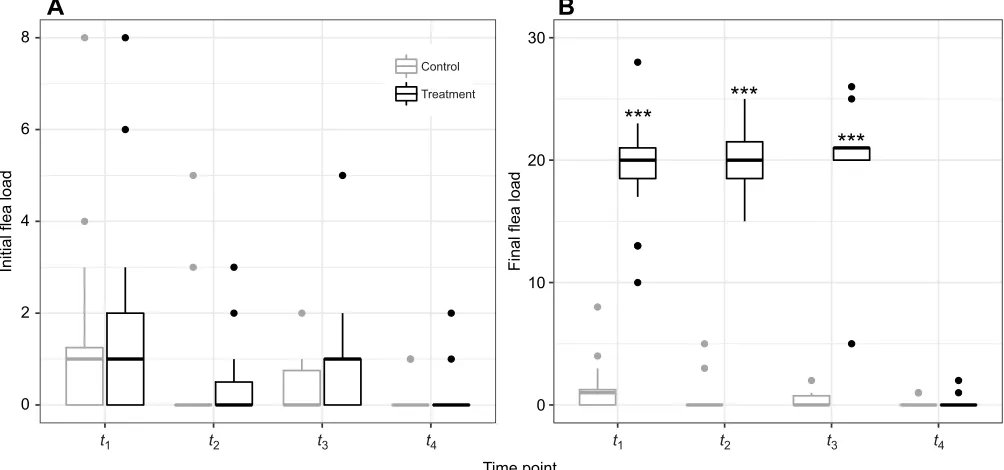
Over the course of the experiment, treated individuals were infested at three different time points with a mean of 19.59±0.71 fleas per animal on top of the originally present 0.93±0.24 fleas. In contrast, control animals had on average 0.61±0.16 fleas per animal at each time point (Fig. 1B). Thus, after treatment, treated individuals averaged 33.63 times the flea load of the control individuals (LMM; t=22.94, P<2e−16, n=90 observations, N=31 individuals). The
number of fleas in the treated individuals had returned to a level near the initial level by the next experimental infestation (Fig. 1A).
Mass
We did not observe differential mass changes between groups (Table 1) fromt1tot4. During the DLW experiment, at t3, initial
mass was not significantly different between control and treatment groups prior to flea application (Table 1): treatedU. columbianus experienced a short-term (24 h) mass loss compared with control animals but this disparity was negligible at 72 h post-flea application. As a result of incomplete DLW equilibration, some individuals (n=5) were removed from mass analyses.
Behavior
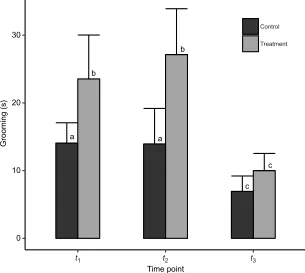
After controlling for age, treatedU. columbianusresponded to flea infestation by increasing their self-grooming behavior by 73.31% compared with controls (Fig. 2;t1–t320.45±3.41 s, control 11.8±
2.18 s; LMM;t=2.22,P=0.03,n=89,N=31). Grooming decreased for both groups at peak lactation (t3).
Trypanosomes
Trypanosome prevalence steadily decreased over the season in both treatment and control groups (Fig. 3A). Att4, we observed a
statistically insignificant increase in average count of trypanosomes ( per 5μl of buffy coat) in the control group (329.82±272.43; LM; t=1.789,P=0.09, n=23, N=23) compared with the treatment group (25.46±19.14). Upon removal of an extreme outlier, there was no appreciable difference between treatment and control groups (Fig. 3A; control 62.8±59.72; LM; t=−0.66,P=0.52,n=22,N=22).
Total DEE at peak lactation (t3)
During peak lactation, treated individuals did not show significantly higher DEE than controls (Fig. 4; LM; t=0.31, P=0.76, n=20, N=20), even when we accounted for differences in fat-free mass. DEE significantly increased with age (Fig. 4; LM;t=2.48,P=0.02, n=20,N=20). Older breeders did not have larger litter masses at weaning (LM; t=0.84, P=0.41,n=28,N=28), nor did litter mass
0 2 4 6 8
t1 t2 t3 t4
Time point
Initial flea load
Control Treatment
A
0 10 20 30
t1 t2 t3 t4
Final flea load
B
***
***
[image:4.612.56.558.464.699.2]***
Fig. 1. Flea infestation in Columbian ground squirrels between April and August 2018.(A) Initial and (B) final flea numbers. Time points:t1, gestation (16
control, 15 treatment);t2, early lactation (14 control, 14 treatment);t3, peak lactation (14 control, 15 treatment);t4, prior to hibernation immergence (11 control, 13
treatment). Data are medians±s.e.m.; asterisks indicate significant differences between groups (***P≤0.001).
Journal
of
Experimental
differ substantially between treated and control individuals (Table 1; LM;t=0.3,P=0.77,n=28,N=28). We did not observe a relationship between DEE and ROM (Fig. 5; LM;t=0.64,P=0.54,n=20,N=20). A similar analysis on antioxidant defenses (OXY) revealed a relationship of decreased OXY levels (LM;t=−2.26,P=0.04,n=20, N=20) with increased DEE in treatment group females. Upon removal of a single outlier, this relationship disappeared (LM; t=−0.61,P=0.55,n=19,N=19).
Changes in innate immunity and oxidative status
Innate immunity (NO levels)
The level of inflammation, assayed through NO concentration, was similar in the control and treatment groups and over time (Fig. 3B; LMM with Tukey’spost hoctest;t=0.25,P=0.63,n=69,N=29). NO concentration was not associated with ROM (LMM; t=0.07,
P=0.95, n=69, N=29), OXY (LMM; t=1.17, P=0.25) or trypanosome (LMM;t=0.893,P=0.38) levels.
Oxidative stress
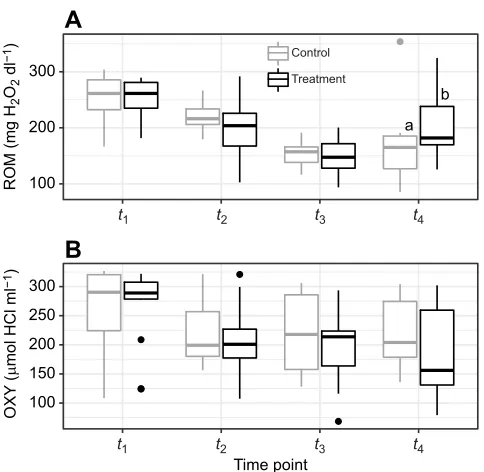
There was a significant effect of time period on ROM and OXY levels (Fig. 6; ROM z=−5.08, P<0.001, n=107, N=31; OXY z=−3.26,P<0.001,n=108,N=31). ROM levels decreased fromt1to
t3, but slightly rebounded att4in the treated group (LMM; Tukey’s
post hoc test; t=−2.5, P<0.02, n=54, N=15) compared with the
control group. OXY levels steadily decreased in both groups as the season progressed. As for other metrics, ROM (LM; t=−0.42, P=0.68, n=69, n=24, N=24) and OXY (LM; t=−0.36, P=0.72) values were not significantly different between the treatment and control groups at peak lactation (t3).
DISCUSSION
Our experimental transformation of an aggregated parasite distribution to a bimodal distribution by adding fleas to some ground squirrels was an attempt to discern short-term parasite effects. However, like otherU. columbianusstudies that removed parasites, our results indicated that these fleas did not significantly impact their hosts over the short term in regards to any of our physiological measures.
Flea augmentation and grooming
By experimentally adding fleas toU. columbianus, we expected a multitude of downstream physiological responses. This was partially fulfilled, at least in terms of the flea treatment temporarily enforcing a large short-term increase of parasites. This level of parasites was at the extreme high end of what is normally seen in adult femaleU. columbianusat this specific field site, but not outside the natural range of variation. Urocitellus
columbianus, especially males and juveniles, have the capacity to
[image:5.612.48.301.69.202.2]harbor and maintain numbers of fleas equivalent to or in excess of the treatment level under natural conditions (Raveh et al., 2015;
Table 1. Seasonal data
Variable Control Treatment Cohen’sd
Age (years) 4.07±0.40 4.13±0.43 0.03 (−0.35, 0.4)
Litter size 1.714±0.37 1.64±0.33 −0.04 (−0.41, 0.34)
Litter mass 179.21±36.99 195.87±40.96 −0.13 (−0.5, 0.24) Temperature (°C) 13.94±0.29 13.67±0.28 0.27 (−0.54, 1.08)
t3
Mass change 24 h (g) 4.5±6.6 −17.00±6.67 1.02 (0.02, 2.02) Mass change 72 h (g) 3.5±8.5 −2.22±8.38 0.22 (−0.75, 1.19) Mass
t1(g) 552.81±11.36 563.33±8.36 −0.27 (−1.00, 0.47) t2(g) 538.21±15.61 540.00±16.28 −0.03 (−0.81, 0.75) t3(g) 529.64±14.21 546.13±19.23 −0.28 (−1.05, 0.48) t4(g) 545.45±19.93 550.38±19.61 −0.07 (−0.92, 0.78)
t1, gestation (16 control, 15 treatment);t2, early lactation (14 control, 14
treatment);t3, peak lactation (14 control, 15 treatment);t4, prior to hibernation
immergence (11 control, 13 treatment). Data are means±95% confidence interval. Cohen’sdis given (with 95% confidence intervals), with 0.2 being a small effect size, 0.5 a medium effect size and 0.8 a large effect size. Confidence intervals including 0 indicate statistical non-significance.
0 10 20 30
t1 t2 t3
Time point
Grooming (s)
Control
Treatment
a a
b
c b
c
Fig. 2. Time spent grooming in Columbian ground squirrels between April and August 2018.t1, gestation (16
control, 15 treatment);t2, early lactation (14 control, 14
treatment);t3, peak lactation (14 control, 15 treatment). Data
are means±s.e.m. Different letters above boxes indicate significant differences between time points (Tukey HSD).
Journal
of
Experimental
[image:5.612.49.354.463.736.2]J.D.R., F.S.D. and V.A.V., unpublished observations). Post-flea addition, treatedU. columbianusallocated almost double the time of their non-parasitized counterparts to grooming. More importantly, they allocated energy that would normally be devoted to acquiring resources to maintenance of low flea levels at energetically and nutritionally demanding times. Within 24 h (J.D.R. unpublished observations of recaptured animals), almost all of the added fleas were removed, as evidenced by the equilibration of initial flea levels at each time point. This grooming time frame coincides with the 24 h mass shifts seen only in the treated group at the lactation peak time point (t3). However, in the context of an acute high infestation,
this statistically significant mass loss is hardly biologically costly given the return to normal mass within 72 h. As this population
behaviorally enforces low parasite levels, a situation of prolonged high parasitization is improbable and thus is not of high consequence for most host individuals.
Surprisingly, even during peak lactation, a critical period of the year where female energy demands are typically highest in mammals (Oftedal, 1984; Speakman and McQueenie, 1996), we did not observe an effect of our treatment on female energy expenditure. This result indicates that these parasites do not impose a high energetic cost on their host or that the cost of managing
0 200 400 600 800
t1 t2 t3 t4
Time point
T
rypanosome count
Control
Treatment
A
0 2 4 6
t1 t2 t3 t4
logNO
[image:6.612.76.539.59.278.2]B
Fig. 3. Innate immunity of Columbian ground squirrels between April and August 2018.(A) Trypanosome count ( per 5μl of buffy coat) and (B) log nitric oxide concentration (NO,μmol l−1).t
1, gestation (16 control, 15 treatment);t2, early lactation (14 control, 14 treatment);t3, peak lactation (14 control, 15 treatment); t4, prior to hibernation immergence (11 control, 13 treatment). Data are medians±s.e.m.
400 800 1200
2 3 4 5 6 7
Age (years)
DEE (kJ day
−1
)
Control Treatment
Fig. 4. Regression of age on daily energy expenditure (DEE).Mean data are shown with the 95% confidence interval (grey shading).
100 200 300
500 1000 1500
OXY
(
µ
mol HCl ml
−1
)
80 120 160 200
500 1000 1500
DEE (kJ day−1)
ROM (mg H
2
O2
dl
−1
)
B
[image:6.612.318.562.456.696.2]A
ControlTreatmentFig. 5. Impact of DEE on oxidative status in Columbian ground squirrels.
(A) Antioxidant capacity (OXY) and (B) reactive oxygen metabolite (ROM) concentration in plasma. Mean data are shown with the 95% confidence
interval (grey shading).
Journal
of
Experimental
[image:6.612.55.292.497.711.2]parasites (i.e. grooming) is compensated through other pathways. Indeed, the time invested in flea removal likely accounts for the loss in body mass through changes in potential energy intake. With both species of fleas being ground squirrel specialists (Hubbard, 1947; Hilton and Mahrt, 1971) and a lack of alternative hosts in the area, it makes sense that the fleas have muted effects onU. columbianus. If parasites have co-evolved to specific hosts, they are more likely to deliver less irritable bites and introduce saliva that does not elicit an immune or behavioral response from the host (Dick and Patterson, 2007). Unfortunately, our observations do not account for a sex-biased effect whereupon fleas of a particular sex differentially induce stress (Hawlena et al., 2005; Krasnov et al., 2008). As fleas were collected and assigned randomly to treated individuals, we can assume that any sex bias in the parasites averaged out when the treated and control groups were compared. However, whether potential sex ratio bias in flea populations may differently affect individuals remains to be tested in the future. Given that female fleas consume larger blood meals (Krasnov et al., 2003a), one might expect female-biased populations to have a larger impact on hosts than male-biased populations.
A multitude of studies in other systems have demonstrated that the complexity of parasite and host energetics obscures the quantification of parasite effects (Hicks et al., 2018; Careau et al., 2010). For example, cape ground squirrel (Xerus inauris) DEE was similarly unaffected when parasite levels were manipulated (Scantlebury et al., 2007). Rather than parasites, increasing age stimulated slightly higher DEE. Many attributes associated with body composition such as larger litters or heavier young (Adams, 2005) would logically result in increased maternal investment and thus higher DEE. For example, older femaleU. columbianusappear to undergo reproductive senescence and may require extra energy to succeed at breeding (Broussard et al., 2003; 2005). In addition, younger breeding females may exhibit reproductive inefficacies
when breeding for the first time (Broussard et al., 2008; Rubach et al., 2016), perhaps resulting in younger animals having lower reproduction-associated DEE than older animals (e.g. through reduced milk production). As such, instead of parasites, age-related body composition and activity levels largely influence DEE (Klausen et al., 1997).
Oxidative stress and immunity
Given their relationship, it is natural that a lack of parasite effects on energy use culminated in a similar lack of treatment consequences on immunity and oxidative stress. However, given that NO is a key immune factor involved in the oxidative killing machinery of macrophages (Playfair and Bancroft, 2004) and has been implicated in fighting trypanosome infections (Magez et al., 2006; Gobert et al., 2000), it is somewhat surprising that plasma NO levels did not mirror trypanosome levels in our study. Trypanosome levels declined in both groups over the season, but NO concentrations fluctuated equally in the two groups. One likely explanation of the lack of treatment effect is that this species of flea is simply an inefficient trypanosome vector (Eisen et al., 2009). This putative inefficiency, in addition to the rapid grooming response, affords only a short transmission window and a subsequent lack of NO response to trypanosomes. This absence indicates that, at least
inU. columbianus, trypanosomes are of little consequence or are at
least not managed by NO in macrophages.
In contrast, oxidative stress patterns were more responsive to change over time in that they mirrored prior studies (Viblanc et al., 2018), likely because of the establishment of an oxidative shield early on during lactation (Blount et al., 2016; Vitikainen et al., 2016) that allowed costs to be offset. The oxidative shielding model proposes that mothers increase antioxidant defenses early in reproduction to prevent the transfer of damaged molecules to their offspring, which may occur as maternal oxidative stress increases through gestation and lactation (i.e. the oxidative cost of breeding). In our study, effects of parasites appeared to manifest in the post-shielding period (t4), with treated individuals experiencing larger
increases in ROM levels. This may reflect a poorer capacity of parasitized females to buffer reproduction-associated oxidative increases or a potential delayed effect of parasites. Generally, similar flea infestation studies have largely found no results of parasites on oxidative stress (Devevey et al., 2008; Maronde et al., 2018; Wegmann et al., 2015). That said, our finding of an interaction between parasitism and oxidative stress where others have found no relationship is not surprising given the multifaceted and non-linear relationship between the two (Costantini and Møller, 2009).
Conclusion
We attempted to quantify the previously variable costs of parasitism
inU. columbianusby discriminating between short- and long-term
effects (Asghar et al., 2015). However, it became clear that the tendency of U. columbianus to prioritize immediate grooming of parasites was likely the reason for the initial low level of fleas (Raveh et al., 2011, 2015) and the lack of seasonal effects of our experimental parasite manipulation. This strong grooming response coupled with oxidative shielding likely resulted in the dampening of any physiologically detectable parasite effects, even during the energetically demanding reproductive period. Some subtle short-term effects do manifest but are unlikely to culminate in detrimental long-term fitness consequences unless parasitemia is chronically sustained. As such, fleas, even when experimentally augmented in number to increase their impact, do not strongly affect these hosts.
100 200 300
t1 t2 t3 t4
ROM (mg H
2
O2
dl
−1
)
A
100 150 200 250 300
t1 t2 t3 t4
Time point
OXY
(
µ
mol HCl ml
−1
)
B
Control Treatment
[image:7.612.55.297.55.291.2]b a
Fig. 6. Oxidative status in Columbian ground squirrels between April and August 2018.(A) ROM concentration and (B) OXY concentration.t1, gestation
(16 control, 15 treatment);t2, early lactation (14 control, 14 treatment);t3, peak
lactation (14 control, 15 treatment);t4, prior to hibernation immergence (11
control, 13 treatment). Data are medians±s.e.m. Different letters above boxes indicate significant differences between time points (Tukey HSD).
Journal
of
Experimental
This result suggests that while hosts in poor condition may exhibit high flea loads, flea infestation by itself is unlikely to debilitate hosts. Seasonal variance in parasite levels over many species coupled with larger processes (i.e. oxidative shieldingt1–t3) temporarily masking
costs may result in studies overlooking parasite effects as a result of a short detection time frame. Given the current direction of climate change, it is eminently possible for parasite prevalence to increase (Cohen et al., 2017), and with it, the manifestation of these subtle costs. As such, short-term physiological measurements may be a better approach than long-term fitness estimates to detect parasite costs in wild populations.
Acknowledgements
The University of Calgary Biogeoscience Institute provided housing at the R. B. Miller field station during data collection at Sheep River Provincial Park (AB, Canada). We are especially grateful to E. Johnson (Director), A. Cunnings (Station Manager) and K. Ruckstuhl (Faculty Responsible) for providing us with field camp and laboratory facilities. The IPHC-CNRS contributed to resources needed for data analysis. We would like to recognize all persons who aided in data collection, especially C. Saraux, E. Harscouet and T. Hammer. We are grateful to S. Blanc for his expertise and guidance on DLW analysis. J. O. Murie initiated the long-term study on Columbian ground squirrels, and we are thankful for his continued advice and support. We would also like to thank three anonymous reviewers for their helpful feedback.
Competing interests
The authors declare no competing or financial interests.
Author contributions
Conceptualization: J.D.R., F.S.D., V.A.V.; Methodology: J.D.R., A.B., V.A.V; Software: J.D.R.; Validation: J.D.R.; Formal analysis: J.D.R., A.Z., V.A.V; Investigation: J.D.R., F.S.D., F.C., P.U., V.A.V; Resources: J.D.R., F.S.D., F.C., A.Z., A.B., V.A.V; Data curation: J.D.R.; Writing - original draft: J.D.R.; Writing - review & editing: J.D.R., F.S.D., F.C., A.B., V.A.V; Visualization: J.D.R.; Supervision: J.D.R., V.A.V, F.S.D.; Project administration: J.D.R.; Funding acquisition: J.D.R., F.S.D., V.A.V.
Funding
The research was funded by a Theodore Roosevelt Memorial Grant (American Museum of Natural History), a Grant-in-aid of Research (American Society of Mammalogists), and an Auburn University Graduate Teaching Assistantship to J.D.R.; a CNRS Projet International de Coopération Scientifique grant (PICS-07143) and a research grant from the Fondation Fyssen to V.A.V.; and by a USA National Science Foundation grant (DEB-0089473) to F.S.D. Additionally, this material is based upon research supported by the Chateaubriand Fellowship of the Office for Science and Technology of the Embassy of France in the USA.
References
Adams, L. G.(2005). Effects of maternal characteristics and climatic variation on birth masses of Alaskan caribou.J. Mammal86, 506-513. doi:10.1644/1545-1542(2005)86[506:EOMCAC]2.0.CO;2
Asghar, M., Hasselquist, D., Hansson, B., Zehtindjiev, P., Westerdahl, H., Bensch, S., Färnert, A., Bensch, S., Hasselquist, D., Asghar, M. et al.(2015). Chronic infection. Hidden costs of infection: chronic malaria accelerates telomere degradation and senescence in wild birds.Science347, 436-438. doi:10.1126/ science.1261121
Bates, D., Mächler, M., Bolker, B. M. Walker, S. C.(2015). Fitting linear mixed-effects models using lme4.J. Stat. Softw.67, 1-48. doi:10.18637/jss.v067.i01
Bertrand, S., Criscuolo, F., Faivre, B. and Sorci, G.(2006a). Immune activation increases susceptibility to oxidative tissue damage in zebra finches.Funct. Ecol.
20, 1022-1027. doi:10.1111/j.1365-2435.2006.01191.x
Bertrand, S., Alonso-Alvarez, C., Devevey, G., Faivre, B., Prost, J. and Sorci, G.
(2006b). Carotenoids modulate the trade-off between egg production and resistance to oxidative stress in zebra finches.Oecologia147, 576-584. doi:10. 1007/s00442-005-0317-8
Bize, P., Jeanneret, C., Klopfenstein, A. and Roulin, A.(2008). What makes a host profitable? Parasites balance host nutritive resources against immunity.Am. Nat.
171, 107-118. doi:10.1086/523943
Blount, J. D., Vitikainen, E. I. K., Stott, I. and Cant, M. A.(2016). Oxidative shielding and the cost of reproduction.Biol. Rev.91, 483-497. doi:10.1111/brv.12179
Bonneaud, C., Mazuc, J., Gonzalez, G., Haussy, C., Chastel, O., Faivre, B. and Sorci, G.(2003). Assessing the cost of mounting an immune response.Am. Nat.
161, 367-379. doi:10.1086/346134
Boonstra, R., Krebs, C. J. and Beacham, T. D.(1980). Impact of botfly parasitism onMicrotus townsendiipopulations.Can. J. Zool.58, 1683-1692. doi:10.1139/ z80-230
Booth, D. T., Clayton, D. H. and Block, B. A.(1993). Experimental demonstration of the energetic cost of parasitism in free-ranging hosts.Proc. Biol. Sci.253, 125-129. doi:10.1098/rspb.1993.0091
Bourgeon, S., Raclot, T., Le Maho, Y., Ricquier, D. and Criscuolo, F.(2007). Innate immunity, assessed by plasma NO measurements, is not suppressed during the incubation fast in eiders.Dev. Comp. Immunol.31, 720-728. doi:10. 1016/j.dci.2006.11.009
Broussard, D. R., Risch, T. S., Dobson, F. S. and Murie, J. O.(2003). Senescence and age-related reproduction of female Columbian ground squirrels.J. Anim. Ecol.72, 212-219. doi:10.1046/j.1365-2656.2003.00691.x
Broussard, D. R., Dobson, F. S. and Murie, J. O.(2005). The effects of capital on an income breeder: evidence from female Columbian ground squirrels.
Can. J. Zool.83, 546-552. doi:10.1139/z05-044
Broussard, D. R., Dobson, F. S. and Murie, J. O.(2008). Previous experience and reproductive investment of female Columbian ground squirrels.J. Mammal.89, 145-152. doi:10.1644/06-MAMM-A-357.1
Careau, V., Thomas, D. W. and Humphries, M. M.(2010). Energetic cost of bot fly parasitism in free-ranging eastern chipmunks.Oecologia162, 303-312. doi:10. 1007/s00442-009-1466-y
Chery, I., Zahariev, A., Simon, C. and Blanc, S.(2015). Analytical aspects of measuring2H/1H and18O/16O ratios in urine from doubly labelled water studies by high-temperature conversion elemental analyser-isotope-ratio mass spectrometry.Rapid Commun. Mass Spectrom.29, 562-572. doi:10.1002/rcm. 7135
Cohen, J. M., Venesky, M. D., Sauer, E. L., Civitello, D. J., McMahon, T. A., Roznik, E. A. and Rohr, J. R.(2017). The thermal mismatch hypothesis explains host susceptibility to an emerging infectious disease.Ecol. Lett.20, 184-193. doi:10.1111/ele.12720
Costantini, D. and Møller, A. P.(2009). Does immune response cause oxidative stress in birds? A meta-analysis.Comp. Biochem. Physiol. A Mol. Integr. Physiol.
153, 339-344. doi:10.1016/j.cbpa.2009.03.010
Costantini, D., Monaghan, P. and Metcalfe, N. B.(2011). Biochemical integration of blood redox state in captive zebra finches (Taeniopygia guttata).J. Exp. Biol.
214, 1148-1152. doi:10.1242/jeb.053496
Costantini, D., Casasole, G., AbdElgawad, H., Asard, H. and Eens, M.(2016). Experimental evidence that oxidative stress influences reproductive decisions.
Funct. Ecol.30, 1169-1174. doi:10.1111/1365-2435.12608
Craig, B. H., Pilkington, J. G., Kruuk, L. E. B. and Pemberton, J. M.(2007). Epidemiology of parasitic protozoan infections in Soay sheep (Ovis aries L.) on St Kilda.Parasitology134, 9-21. doi:10.1017/S0031182006001144
Delahay, R. J., Speakman, J. R. and Moss, R. (1995). The energetic consequences of parasitism: effects of a developing infection of
Trichostrongylus tenuis(Nematoda) on red grouse (Lagopus lagopus scoticus) energy balance, body weight and condition.Parasitology110, 473-482. doi:10. 1017/S0031182000064817
Devevey, G., Niculita-Hirzel, H., Biollaz, F., Yvon, C., Chapuisat, M. and Christe, P.(2008). Developmental, metabolic and immunological costs of flea infestation in the common vole.Funct. Ecol.22, 1091-1098. doi:10.1111/j.1365-2435.2008. 01493.x
Dick, C. W. and Patterson, B. D.(2007). Against all odds: explaining high host specificity in dispersal-prone parasites.Int. J. Parasitol.37, 871-876. doi:10.1016/ j.ijpara.2007.02.004
Dobson, F. S.(1992). Body mass, Structural size, and life-history patterns of the Columbian ground squirrel.Am. Nat.140, 109-125. doi:10.1086/285405
Dobson, F. S., Badry, M. J. and Geddes, C.(1992). Seasonal activity and body mass of Columbian ground squirrels.Can. J. Zool.70, 1364-1368. doi:10.1139/ z92-192
Durden, L. A. and Hinkle, N. C.(2019). Fleas(Siphonaptera).InMedical and Veterinary Entomolology, 3rd edn. (ed. G. Mullen and L. Durden), pp. 145-169. Massachusetts: Academic Press.
Eisen, R. J., Eisen, L. and Gage, K. L.(2009). Studies of vector competency and efficiency of North American fleas foryersinia pestis: state of the field and future research needs.J. Med. Entomol.46, 737-744. doi:10.1603/033.046.0403
Freedman, M. I.(1947). The trypanosomes of rodents. Masters thesis, Boston University, Boston, MA.
Galvani, A. P. (2003). Immunity, antigenic heterogeneity, and aggregation of helminth parasites. J. Parasitol. 89, 232-241. doi:10.1645/0022-3395(2003)089[0232:IAHAAO]2.0.CO;2
Garnick, S. W., Elgar, M. A., Beveridge, I. and Coulson, G.(2010). Foraging efficiency and parasite risk in eastern grey kangaroos (Macropus giganteus).
Behav. Ecol.21, 129-137. doi:10.1093/beheco/arp162
Giorgi, M. S., Arlettaz, R., Christe, P. and Vogel, P.(2001). The energetic grooming costs imposed by a parasitic mite (Spinturnix myoti) upon its bat host (Myotis myotis).Proc. R. Soc. B Biol. Sci.268, 2071-2075. doi:10.1098/rspb. 2001.1686
Gobert, A. P., Daulouede, S., Lepoivre, M., Boucher, J. L., Bouteille, B., Buguet, A., Cespuglio, R., Veyret, B. and Vincendeau, P.(2000). L-arginine availability
Journal
of
Experimental
modulates local nitric oxide production and parasite killing in experimental trypanosomiasis.Infect. Immun.68, 4653-4657. doi:10.1128/IAI.68.8.4653-4657. 2000
Hawlena, H., Abramsky, Z. and Krasnov, B. R.(2005). Age-biased parasitism and density-dependent distribution of fleas (Siphonaptera) on a desert rodent.
Oecologia146, 200-208. doi:10.1007/s00442-005-0187-0
Hicks, O., Burthe, S. J., Daunt, F., Newell, M., Butler, A., Ito, M., Sato, K. and Green, J. A. (2018). The energetic cost of parasitism in a wild population.
Proc. R. Soc. B Biol. Sci.285. doi:10.1098/rspb.2018.0489
Hilton, D. F. J. and Mahrt, J. L.(1971). Ectoparasites from three species of Spermophilus (Rodentia: Sciuridae) in Alberta. Can. J. Zool.49, 1497-1499. doi:10.1139/z71-219
Hinnebusch, B. J., Jarrett, C. O. and Bland, D. M.(2017).“Fleaing”the plague: adaptations ofYersinia pestisto its insect vector that lead to transmission.Annu. Rev. Microbiol.71, 215-232. doi:10.1146/annurev-micro-090816-093521
Hothorn, T., Bretz, F. and Westfall, P.(2008). Simultaneous inference in general parametric models.Biom. J.50, 346-363. doi:10.1002/bimj.200810425
Hubbard, C. A.(1947).Fleas of western North America. New York, New York, USA: Hafner.
Kam, M., Khokhlova, I. S., Krasnov, B. R. and Degen, A. A.(2011). Flea infestation does not cause a long-term increase in energy metabolism inGerbillus nanus.J. Exp. Biol.214, 3968-3971. doi:10.1242/jeb.061556
Kenagy, G. J., Masman, D., Sharbaugh, S. M. and Nagy, K. A.(1990). Energy expenditure during lactation in relation to litter size in free-living golden-mantled ground squirrels.J. Anim. Ecol.59, 73-88. doi:10.2307/5159
Keymer, A. E. and Read, A. F.(1991). Behavioral ecology: the impact of parasitism. In Parasite-Host Associations: Coexistence or Conflict? (ed. C. A. Toft, A. Aeschlimann and L. Bolis), pp. 37-61. Oxford, UK: Oxford University Press.
Khokhlova, I. S., Krasnov, B. R., Kam, M., Burdelova, N. I. and Degen, A. A.
(2002). Energy cost of ectoparasitism: The fleaXenopsylla ramesison the desert gerbil Gerbillus dasyurus. J. Zool. 258, 349-354. doi:10.1017/ S0952836902001498
Klausen, B., Toubro, S. and Astrup, A.(1997). Age and sex effects on energy expenditure.Am. J. Clin. Nutr.65, 895-907. doi:10.1093/ajcn/65.4.895
Krasnov, B. R., Burdelov, S. A., Khokhlova, I. S. and Burdelova, N. V.(2003a). Sexual size dimorphism, morphological traits and jump performance in seven species of desert fleas (Siphonaptera). J. Zool. 261, 181-189. doi:10.1017/ S0952836903004096
Krasnov, B. R., Sarfati, M., Arakelyan, M. S., Khokhlova, I. S., Burdelova, N. V. and Degen, A. A.(2003b). Host specificity and foraging efficiency in blood-sucking parasite: Feeding patterns of the flea Parapulex chephrenis on two species of desert rodents.Parasitol. Res.90, 393-399. doi:10.1007/s00436-003-0873-y
Krasnov, B. R., Shenbrot, G. I., Khokhlova, I. S., Hawlena, H. and Degen, A. A.
(2008). Sex ratio in flea infrapopulations: number of fleas, host gender and host age do not have an effect. Parasitology 135, 1133-1141. doi:10.1017/ S0031182008004551
Król, E. and Speakman, J. R.(1999). Isotope dilution spaces of mice injected simultaneously with deuterium, tritium and oxygen-18. J. Exp. Biol. 202, 2839-2849.
Liberman, V., Khokhlova, I. S., Degen, A. A. and Krasnov, B. R.(2011). The effect of host age on feeding performance of fleas.Parasitology138, 1154-1163. doi:10. 1017/S0031182011000758
Lizundia, R., Newman, C., Buesching, C. D., Ngugi, D., Blake, D., Sin, Y. W., Macdonald, D. W., Wilson, A. and McKeever, D.(2011). Evidence for a role of the host-specific flea (Paraceras melis) in the transmission ofTrypanosoma (Megatrypanum) pestanaito the European badger.PLoS ONE6, e16977. doi:10. 1371/journal.pone.0016977
Magez, S., Radwanska, M., Drennan, M., Fick, L., Baral, T. N., Brombacher, F. and Baetselier, and P. D., (2006). Interferon-γand nitric oxide in combination with antibodies are key protective host immune factors duringTrypanosoma congolenseTc13 infections.J. Infect. Dis.193, 1575-1583. doi:10.1086/503808
Mahlert, B., Gerritsmann, H., Stalder, G., Ruf, T., Zahariev, A., Blanc, S. and Giroud, S.(2018). Implications of being born late in the active season for growth, fattening, torpor use, winter survival and fecundity.eLife7, 1-25. doi:10.7554/ eLife.31225
Maronde, L., Losdat, S. and Richner, H.(2018). Do parasites and antioxidant availability affect begging behaviour, growth rate and resistance to oxidative stress?J. Evol. Biol.31, 904-913. doi:10.1111/jeb.13274
Metcalfe, N. B. and Monaghan, P.(2013). Does reproduction cause oxidative stress? An open question.Trends Ecol. Evol.28, 347-350. doi:10.1016/j.tree. 2013.01.015
Møller, A. P., de Lope, F., Moreno, J., González, G. and Pérez, J. J.(1994). Ectoparasites and host energetics: house martin bugs and house martin nestlings.Oecologia98, 263-268. doi:10.1007/BF00324213
Murie, J. O. and Harris, M. A.(1982). Annual variation of spring emergence and breeding in Columbian ground squirrels (Spermophilus columbianus).J. Mammal.
63, 431-439. doi:10.2307/1380440
Nakagawa, S. and Cuthill, I. C. (2007). Effect size, confidence interval and statistical significance: A practical guide for biologists.Biol. Rev.82, 591-605. doi:10.1111/j.1469-185X.2007.00027.x
Naya, D. E., Ebensperger, L. A., Sabat, P. and Bozinovic, F.(2008). Digestive and metabolic flexibility allows female degus to cope with lactation costs.Physiol. Biochem. Zool.81, 186-194. doi:10.1086/527453
Nelson, W. A., Keirans, J. E., Bell, J. F. and Clifford, C. M.(1975). Host-ectoparasite relationships.J. Med. Entomol.12, 143-166. doi:10.1093/jmedent/ 12.2.143
Neuhaus, P.(2003). Parasite removal and its impact on litter size and body condition in Columbian ground squirrels (Spermophilus columbianus).Proc. R. Soc. B Biol. Sci.270, S213-S215. doi:10.1098/rsbl.2003.0073
Oftedal, O. T.(1984). Lactation in the dog: milk composition and intake by puppies.
J. Nutr.114, 803-812. doi:10.1093/jn/114.5.803
Playfair, J. H. L. and Bancroft, G. J.(2004).Infection and Immunity. Oxford, UK: Oxford University Press.
Plumel, M. I., Benhaim-Delarbre, M., Rompais, M., Thiersé, D., Sorci, G., van Dorsselaer, A., Criscuolo, F. and Bertile, F.(2016). Differential proteomics reveals age-dependent liver oxidative costs of innate immune activation in mice.
J. Proteomics135, 181-190. doi:10.1016/j.jprot.2015.09.008
Poulin, R.(2004). Parasites and the neutral theory of biodiversity.Ecography (Cop.).27, 119-123. doi:10.1111/j.0906-7590.2004.03695.x
Racette, S. B., Schoeller, D. A., Luke, A. H., Shay, K., Hnilicka, J. and Kushner, R. F.(1994). Relative dilution spaces of 2 H- and 18 O-labeled water in humans.
Am. J. Physiol.267, E585-E590. doi:10.1152/ajpendo.1994.267.4.E585
Raveh, S., Heg, D., Dobson, F. S., Coltman, D. W., Gorrell, J. C., Balmer, A., Röösli, S. and Neuhaus, P.(2011). No experimental effects of parasite load on male mating behaviour and reproductive success.Anim. Behav.82, 673-682. doi:10.1016/j.anbehav.2011.06.018
Raveh, S., Neuhaus, P. and Dobson, F. S.(2015). Ectoparasites and fitness of female Columbian ground squirrels.Philos. Trans. R. Soc. B Biol. Sci.370, 20140113. doi:10.1098/rstb.2014.0113
Rimbach, R., Blanc, S., Zahariev, A., Gatta, M., Pillay, N. and Schradin, C.
(2018). Seasonal variation in energy expenditure in a rodent inhabiting a winter-rainfall desert.J. Comp. Physiol. B Biochem. Syst. Environ. Physiol.188, 877-888. doi:10.1007/s00360-018-1168-z
Rogowitz, G. L.(1998). Limits to milk flow and energy allocation during lactation of the hispid cotton rat (Sigmodon hispidus).Physiol. Zool.71, 312-320. doi:10. 1086/515923
Rubach, K., Wu, M., Abebe, A., Dobson, F. S., Murie, J. O. and Viblanc, V. A.
(2016). Testing the reproductive and somatic trade-off in female Columbian ground squirrels.Ecol. Evol.6, 7586-7595. doi:10.1002/ece3.2215
Sato, H., Al-Adhami, B. H., Une, Y. and Kamiya, H. (2007). Trypanosoma (Herpetosoma) kuseli sp. n. (Protozoa: Kinetoplastida) in Siberian flying squirrels (Pteromys volans).Parasitol. Res.101, 453-461. doi:10.1007/s00436-007-0504-0
Scantlebury, M., Waterman, J. M., Hillegass, M., Speakman, J. R. and Bennett, N. C.(2007). Energetic costs of parasitism in the Cape ground squirrelXerus inauris.Proc. R. Soc. Biol. Sci.274, 2169-2177. doi:10.1098/rspb.2007.0690
Scantlebury, M., Maher McWilliams, M., Marks, N. J., Dick, J. T. A., Edgar, H. and Lutermann, H.(2010). Effects of life-history traits on parasite load in grey squirrels.J. Zool.282, 246-255. doi:10.1111/j.1469-7998.2010.00734.x
Simmen, B., Bayart, F., Rasamimanana, H., Zahariev, A., Blanc, S. and Pasquet, P.(2010). Total energy expenditure and body composition in two free-living sympatric lemurs.PLoS ONE5, e9860. doi:10.1371/journal.pone.0009860
Skibiel, A. L., Speakman, J. R. and Hood, W. R.(2013). Testing the predictions of energy allocation decisions in the evolution of life-history trade-offs.Funct. Ecol.
27, 1382-1391. doi:10.1111/1365-2435.12130
Smith, A., Telfer, S., Burthe, S., Bennett, M. and Begon, M.(2006). A role for vector-independent transmission in rodent trypanosome infection?
Int. J. Parasitol.36, 1359-1366. doi:10.1016/j.ijpara.2006.06.014
Sorci, G., Lippens, C., Léchenault, C. and Faivre, B.(2017). Benefits of immune protection versus immunopathology costs: A synthesis from cytokine KO models.
Infect. Genet. Evol.54, 491-495. doi:10.1016/j.meegid.2017.08.014
Speakman, J. R. and Hambly, C.(2016). Using doubly-labelled water to measure free-living energy expenditure: Some old things to remember and some new things to consider.Comp. Biochem. Physiol. -Part A Mol. Integr. Physiol.202, 3-9. doi:10.1016/j.cbpa.2016.03.017
Speakman, J. R. and McQueenie, J.(1996). Limits to sustained metabolic rate: the link between food intake, basal metabolic rate, and morphology in reproducing mice,Mus musculus.Physiol. Zool.69, 746-769. doi:10.1086/physzool.69.4. 30164228
Speakman, J. R. and Racey, P. A.(1987). The equilibrium concentration of O18 in body-water: implications for the accuracy of the doubly-labelled water technique and a potential new method of measuring RQ in free-living animals.J. Theor. Biol.
127, 79-95. doi:10.1016/S0022-5193(87)80162-5
Speakman, J. R., Nair, K. S. and Goran, M. I.(1993). Revised equations for calculating CO2 production from doubly labeled water in humans.Am. J. Physiol.
264, E912-E917. doi:10.1152/ajpendo.1993.264.6.E912
Journal
of
Experimental
Vespa, G. N. R., Cunha, F. Q. and Silva, J. S.(1994). Nitric oxide is involved in control ofTrypanosoma cruzi-induced parasitemia and directly kills the parasite in vitro.Infect. Immun.62, 5177-5182.
Viblanc, V. A., Arnaud, C. M., Dobson, F. S. and Murie, J. O.(2010). Kin selection in Columbian ground squirrels (Urocitellus columbianus): littermate kin provide individual fitness benefits.Proc. R. Soc. B277, 989-994. doi:10.1098/rspb.2009. 1960
Viblanc, V. A., Schull, Q., Roth, J. D., Rabdeau, J., Saraux, C., Uhlrich, P., Criscuolo, F. and Dobson, F. S. (2018). Maternal oxidative stress and reproduction: Testing the constraint, cost and shielding hypotheses in a wild mammal.Funct. Ecol.32, 722-735. doi:10.1111/1365-2435.13032
Vitikainen, E. I. K., Cant, M. A., Sanderson, J. L., Mitchell, C., Nichols, H. J., Marshall, H. H., Thompson, F. J., Gilchrist, J. S., Hodge, S. J., Johnstone,
R. A. et al.(2016). Evidence of oxidative shielding of offspring in a wild mammal.
Front. Ecol. Evol.4, 1-10. doi:10.3389/fevo.2016.00058
Warburton, E. M., Kam, M., Bar-Shira, E., Friedman, A., Khokhlova, I. S., Koren, L., Asfur, M., Geffen, E., Kiefer, D., Krasnov, B. R. et al.(2016). Effects of parasite pressure on parasite mortality and reproductive output in a rodent-flea system: inferring host defense trade-offs.Parasitol. Res.115, 3337-3344. doi:10. 1007/s00436-016-5093-3
Wegmann, M., Voegeli, B. and Richner, H.(2015). Physiological responses to increased brood size and ectoparasite infestation: adult great tits favour self-maintenance.Physiol. Behav.141, 127-134. doi:10.1016/j.physbeh.2015.01.017
Wiggett, D. R. and Boag, D. A.(1986). Establishing colonies of ground squirrels during their active season.Wildl. Soc. Bull.14, 288-291.