warwick.ac.uk/lib-publications
Original citation:
Luo, Jian, Tang, Jin, Tjahjadi, Tardi and Xiao, Xiaoming. (2016) Robust arbitrary view gait
recognition based on parametric 3D human body reconstruction and virtual posture
synthesis. Pattern Recognition, 60 . pp. 361-377.
Permanent WRAP URL:
http://wrap.warwick.ac.uk/79365
Copyright and reuse:
The Warwick Research Archive Portal (WRAP) makes this work by researchers of the
University of Warwick available open access under the following conditions. Copyright ©
and all moral rights to the version of the paper presented here belong to the individual
author(s) and/or other copyright owners. To the extent reasonable and practicable the
material made available in WRAP has been checked for eligibility before being made
available.
Copies of full items can be used for personal research or study, educational, or not-for-profit
purposes without prior permission or charge. Provided that the authors, title and full
bibliographic details are credited, a hyperlink and/or URL is given for the original metadata
page and the content is not changed in any way.
Publisher’s statement:
© 2016, Elsevier. Licensed under the Creative Commons
Attribution-NonCommercial-NoDerivatives 4.0 International
http://creativecommons.org/licenses/by-nc-nd/4.0/
A note on versions:
The version presented here may differ from the published version or, version of record, if
you wish to cite this item you are advised to consult the publisher’s version. Please see the
‘permanent WRAP url’ above for details on accessing the published version and note that
access may require a subscription.
Robust Arbitrary View Gait Recognition based on Parametric 3D Human
Body Reconstruction and Virtual Posture Synthesis
Jian Luo 1, Jin Tang 1,*, Tardi Tjahjadi2, Xiaoming Xiao1
1School of Information Science and Engineering, Central South University, Changsha, Hunan 410083, China
2School of Engineering, University of Warwick, Gibbet Hill Road, Coventry, CV4 7AL, United Kingdom
Abstract: This paper proposes an arbitrary view gait recognition method where the gait recognition is performed in
1
3-dimensional (3D) to be robust to variation in speed, inclined plane and clothing, and in the presence of a carried
2
item. 3D parametric gait models in a gait period are reconstructed by an optimized 3D human pose, shape and
3
simulated clothes estimation method using multiview gait silhouettes. The gait estimation involves morphing a new
4
subject with constant semantic constraints using silhouette cost function as observations. Using a clothes-independent
5
3D parametric gait model reconstruction method, gait models of different subjects with various postures in a cycle are
6
obtained and used as galleries to construct 3D gait dictionary. Using a carrying-items posture synthesized model,
7
virtual gait models with different carrying-items postures are synthesized to further construct an over-complete 3D
8
gait dictionary. A self-occlusion optimized simultaneous sparse representation model is also introduced to achieve
9
high robustness in limited gait frames. Experimental analyses on CASIA B dataset and CMU MoBo dataset show a
10
significant performance gain in terms of accuracy and robustness.
11
Keywords: Gait recognition; Human identification; Silhouette; Sparse representation.
12
1 Introduction
13
Compared with other physiological biometrics, such as fingerprint, iris and face, gait is difficult to be masked
14
in natural body movement, whereas the appearance of a perpetrator can be disguised by wearing a hat, a pair of
15
glasses or even by undergoing a plastic surgery. The advantages of gait recognition, i.e., recognizing subjects
16
without their cooperation, using low-resolution video and remotely, make it particularly attractive for verification
17
or identification purpose. Thus gait recognition has great potential, and it could be useful in various applications,
18
such as surveillance, access control, criminal investigation and other security operations. Several evaluation
19
systems have been developed for practical applications, e.g., gait biometrics has been used to provide forensic
20
evidence for identification, and for criminal investigations, e.g., to provide clues for verifications of perpetrators at
21
crime scenes [1]. In the last decade, several gait databases larger than 100 people defined as large datasets in gait
22
field have been published, e.g., USF HumanID [2], CASIA [3], SOTON [4] and WOSG [5], and studies have
23
shown that personal identification could be achieved where the individual and environmental factors are controlled
24
to some extent. In recent years, larger human gait databases, e.g., OU-ISIR LP with more than 4000 people [6],
25
have been published to evaluate the upper bound accuracy of gait recognition. It is a challenge to explore a
26
personal identification system by gait with large population. However, gait recognition can still play a
27
significant role in identification system, e.g., multiple biometrics could be fused to develop a more reliable
28
personal identification system where gait recognition is used to scale down the search range for criminals
29
from large CCTV or surveillance videos.
30
Gait recognition depends on the effectiveness of the extracted gait features, and the main challenges to
31
successful recognition are covariates such as variation in view and loose clothing, speed in which the gait is
32
performed, occlusions and carried items [7]. To address these challenges, this paper proposed an arbitrary view gait
33
recognition system based on 3-dimensional (3D) human body reconstruction and virtual posture synthesis
34
(AVGR-BRPS). AVGR-BRPS uses a 3D statistical parametric model of human body shapes and poses. The 3D
body shape is derived from a base mesh shape obtained by morphing, and a skeleton is embedded into the target
36
human subject’s reconstructed body model to form different postures. Body shape and poses are estimated from
37
clothed human subjects using coarse, incomplete 3D data or 2-dimensional (2D) gait silhouettes. The gait poses
38
with different carried items are synthesized to enable accurate identification of a subject in realistic scenarios. Since
39
the human gait is 3D, our gait recognition method is more robust than 2D methods to variation in inclination of the
40
ground plane, clothing and carried items by restoring the gait extracted from a video sequence into 3D space using
41
statistical parametric model of human body shape and pose.
42
The two main approaches to gait recognition are model-based and appearance-based. Our method is based on a
43
3D gait model that is unlike a 2D skeleton model with numerous degrees of freedom [8], and the 3D voxel model
44
[9] derived from multi-view silhouette images or point cloud scanning data. Our 3D model is created from
45
view-invariant shape features (obtained by morphing) and pose features (described by biovision hierarchical data
46
(BVH)). The parametric 3D gait model is more accurate than image-based visual hull model and 3D scanning
47
voxel model due to the shape and pose deformation learned from a database of preprocessed 3D range scans of
48
different subjects with multiple poses. Due to the skeleton embedded in our 3D human body model, virtual
49
postures can be synthesized to form an over-complete dictionary of 3D gait dataset.
50
A gait energy image (GEI), extracted by averaging the silhouettes in a gait period [10], or related energy
51
images are widely used in appearance-based approaches. The GEI reduces storage space and computation time,
52
and can achieve high recognition rate when the gait cycle is complete. If the probe gait cycle is incomplete or it is
53
difficult to compute the gait cycle accurately, the recognition rate decreases significantly. Since the trajectory in a
54
gait cycle may not always be in a straight line, it is necessary to determine the view for each gait model, and adjust
55
them to the same view in the straight line. However it is difficult to distinguish the different views in a cycle of 2D
56
GEI or related energy images, and gait recognition rate decreases if the gaits being compared are not in the similar
57
trajectory.
58
In order to address these problems, we introduce self-occlusion optimized simultaneous sparse representation
59
model based on compressed sensing as follows. Multi-pose 3D gallery gait models constructed from a gait cycle of
60
multiview gait silhouettes together with virtual synthesized gait models are simultaneously used for the sparse
61
representation of probe gait model. Subject identification is achieved by combining the hypotheses of all 3D gait
62
models and the sparse pattern. By constructing an over-complete dictionary of 3D gait and simultaneous sparse
63
representation model, the simultaneous sparse representation vectors are reconstructed for 3D probe gait models
64
which has been self-occlusion optimized in a gait cycle. The reconstruction error is used for classification.
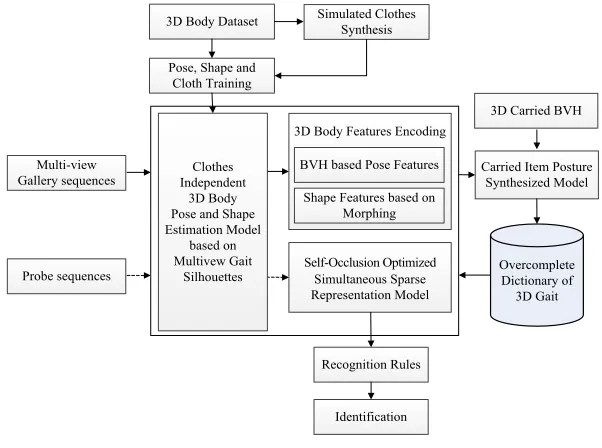
65
The most notable advantages of AVGR-BRPS are: (1) by utilizing clothes-independent 3D human pose and
66
shape estimation model learned from a database of parametric 3D shapes and simulated clothes, it reconstructs
67
parametric 3D human body from 2D or 2.5D data to achieve robustness to variation in significant view changes,
68
heavy or loose clothing variation, difference in carried items, and occlusions, e.g., missing body parts or
69
segmentation noise; (2) by using carrying-item posture synthesized model, synthesized virtue carrying postures are
70
used to extend the dictionary of 3D gait which makes AVGR-BRPS more robust and improves its recognition rate;
71
(3) by constructing an over-complete dictionary of 3D gait database and using self-occlusion optimized
72
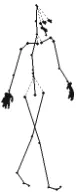
simultaneous sparse representation model, it achieves view-invariant recognition that does not require a complete
73
gait cycle data and the subject to walk in a similar trajectory.
The rest of this paper is organized as follows. Section 2 presents the related work. Section 3 presents
75
AVGR-BRPS. Section 4 presents the experimental results and Section 5 concludes the paper.
76
2 Related work
77
Video sequences captured by multiple cameras have been used to create a 3D human skeleton model in [11]
78
where static parameters and dynamic features are combined to describe gait. Although the model enables
79
robustness to changes in viewpoints and clothing variation, the recognition method uses multiple cameras and the
80
initial subject’s pose is extracted manually. The use of recursive Bayesian sampling and pose-viewpoint manifold
81
for view invariant 3-D gait tracking with a high perspective effect is proposed in [12]. However, its invariant
82
monocular 3-D human pose tracking must operate in man-made environments and assumes the subject moves on a
83
known ground plane. The method in [8] uses an articulated human model constructed from 3D volume sequences
84
to address a viewpoint-free framework. The method in [13] uses an image-based visual hull to construct a 3D gait
85
model. The method in [14] uses a multi-view synthesizing method based on 2.5D point cloud registration to
86
generate 3D gait model to achieve view-invariant gait recognition. The accuracy of the above-mentioned 3D
87
models is limited due to the use of 2D images without depth information or point cloud data captured by
88
low-resolution 3D scanner with missing data.
89
Multi-view gait recognition based on view transformation model (VTM) learns projection relationships of
90
multi-view gaits features by singular value decomposition (SVD). It realizes multi-view gait recognition by
91
transforming all gait views onto the same view. The VTM method in [15] transforms a probe gait onto the virtue
92
view that exists in the training database for multi-view gait recognition. The method in [16] uses sparse
93
regression-based VTM, where regression is used to formulate and model correlated motions among gaits under
94
different views. In [17] the VTM is constructed using multi-layer perceptron as a regression tool, and a selected
95
region of interest (ROI) from source view(s) is used to estimate gait from target view. The method in [18] uses an
96
arbitrary VTM that accurately matches a pair of gait traits from an arbitrary view. The gait recognition is realized
97
by projecting the 3D gait volume sequences onto the same views of 2D gait silhouette sequences as the target
98
views. Although VTM related multi-view gait recognition methods demonstrate significant advantage over other
99
approaches, they require a larger number of training samples to construct a more generic VTM, and better
100
performance is achieved by learning from more varieties of gait samples. The parameters of the VTM are sensitive
101
to the training multi-view images.
102
By extracting view-normalized or view-invariant gait features, several view-invariant gait recognition methods
103
have been proposed. In [19], gait silhouette features that can represent gait dynamics and reflect the view variation
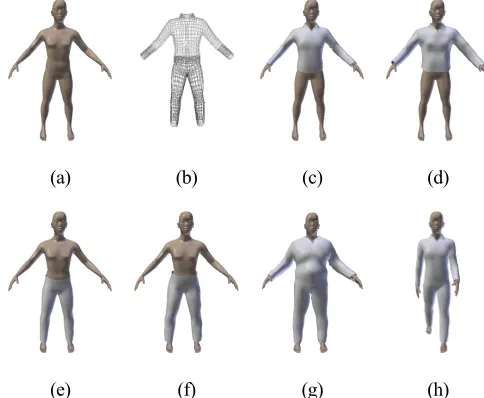
104
are extracted, and deterministic learning theory is introduced to achieve view-invariant gait recognition. The
105
method in [20] uses the 2D trajectories of both feet and head extracted from tracked silhouettes as gait features. It
106
uses view normalization based on homography transformation to make the walking appears to have been observed
107
from a fronto-parallel view. However, self-occlusion or significant changes in views significantly affect the
108
extraction of trajectories, thus making the method less practical for realistic scenarios. The method in [21] uses
109
view-invariant gait features derived from pose estimation of the joint positions of walking subjects. In [22]
110
view-normalization is performed in the input gait silhouettes to normalize gaits from arbitrary views by using
111
corresponding domain transformation obtained via invariant low-rank textures. In [23], the multi-view gait features
112
are extracted by view-invariant discriminative projection and matched without knowing or estimating the viewing
113
angles. However, by using linear projection, it is impossible to achieve the ideal performance when the viewing
angle changes significantly. The method in [24] uses a sparse local discriminant canonical correlation analysis
115
(CCA) to model the correlation of gait features from cross views, and uses patch distribution feature to classify the
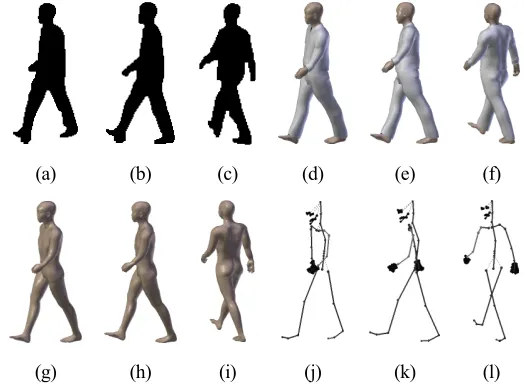
116
view. Thus, it does not require the gait to be transformed to a virtue view. However, the gait features are less
117
correlated when the gait views are significantly changed.
118
Numerous gait recognition methods have been proposed to deal with multiple covariates (e.g., occlusion,
119
clothing invariant, carrying conditions, speed and incomplete sequences). The method in [25] uses a dynamic
120
frame difference energy image to reduce the influence of incomplete silhouette caused by occlusion or missing
121
body parts. To address substantial clothing variation, the method in [26] divides the subject’s body into eight
122
clothing related sections assigned with different weight for matching. It requires a large-scale gait dataset with
123
clothing variations for gait training, making it impractical. The method in [27] successfully extracts wavelet based
124
silhouettes of a subject without carried items or a subject with heavy clothing from infrared thermal images. The
125
gait entropy image introduced in [28] is designed mainly for mitigating the effect of changes in covariate
126
conditions that affect gait feature extraction rather than the gait itself. To address the situation where full gait cycle
127
information is not always available, the method in [29] uses skeleton joint information and fractional gait energy
128
image for frontal gait recognition. The method in [7] uses view-invariant multiscale gait recognition method
129
(VI-MGR) to achieve robustness to variation in clothing and presence of a carried item.The method in [30] selects
130
the most discriminative human body part based on group Lasso of motion to reduce the intra-class variation so as
131
to improve the recognition performance. In [31], sparse coding multiview hypergraph learning re-ranking
132
(SCMHLRR) method, integrated sparse coding and multi-view hypergraph learning are explored for recognizing a
133
pedestrian under uncooperative setting, i.e., carrying factors, walking speed and noise. Most of these methods
134
address different covariates with limited gait views, mainly using frontal view of the gallery and probe gait
135
sequences, or the experiments only focus on one condition at a time. They hardly explore the covariate conditions
136
simultaneously, i.e. factor of views, carrying items and clothes variation together. In fact, it is usually hard for a 2D
137
training dataset to cover all conditions, especially different carrying and clothes variations that affect the overall
138
body shape directly.
139
AVGR-BRPS is proposed to address the above-mentioned gait recognition problems with multiple views and
140
robustness for different clothing and various carrying conditions. An accurate and unified I-posture 3D parametric
141
human body model is used to estimate 3D gait model from multi-view 2D gait silhouettes using clothes-independent
142
3D human pose and shape estimation method. Since a gait period comprises several gait frames, it is time consuming
143
to estimate the different posture 3D gait models from the initial standard I-posture. In order to overcome this problem,
144
we also propose an optimized approach for 3D gait model reconstruction based on extended standard gait models in a
145
gait period. The k-means clustering is used to determine the key standard gait postures. Using the 3D parametric gait
146
model reconstruction method, different gait models are obtained and are used as galleries in the training process. To
147
achieve high recognition rate, virtual gait models of postures with different carrying items conditions are synthesized
148
to create an over-complete 3D gait dictionary, and a self-occlusion optimized simultaneous sparse representation
149
model is introduced.
150
3 Proposed method:AVGR-BPRS
151
A general parametric 3D human model is normally created from 3D scans by combining multi-view body data of
153
a subject with tight clothing walking past multiple scanners, where the scanners are typically expensive and limited
154
for fast estimation of the body shape underneath the clothes. Also, the use of multiple sensors in training or
155
recognition is often not practical. A 2.5D gait voxel model reconstructed by a range sensor like Kinect is used for gait
156
recognition in [14] in order to overcome the high computational cost of 3D gait modelling. However, 2.5D gait model
157
cannot address the problems of the lack of robustness to covariates such as heavy or loose clothing, differences in
158
carried items, etc. In order to overcome these problems, we adopted a unified and clothing-independent parametric
159
3D modelling method for 3D gait recognition. We estimate both the body shape and posture from motion sequences
160
of a clothed subject. The overview of AVGR-BPRS is shown in Fig. 1.
161
3D Body Features Encoding
Carried Item Posture Synthesized Model
Self-Occlusion Optimized Simultaneous Sparse Representation Model
Recognition Rules
Identification Clothes
Independent 3D Body Pose and Shape Estimation Model
based on Multivew Gait
Silhouettes 3D Body Dataset
Pose, Shape and Cloth Training
BVH based Pose Features
Shape Features based on Morphing
Overcomplete Dictionary of
3D Gait 3D Carried BVH Simulated Clothes
Synthesis
Multi-view Gallery sequences
Probe sequences
[image:6.595.153.454.232.456.2]162
Figure 1. Overview of AVGR-BPRS.
163
We use the statistical model of body pose and shape like SCAPE which has been used to accurately identify a
164
human subject with numerous challenging factors of realistic scenarios [32] to estimate 3D body pose and shape in a
165
gait cycle using gait silhouettes. In our work, the model is re-trained on a dataset of dense full-body 3D scans,
166
obtained from the software Makehuman which incorporates 1170 morphings for effective parametric modelling. The
167
parametric body model in Makehuman is optimized for subdivision surfaces modelling with 15128 vertexes, which is
168
suitable for gait modelling. We synthesized simulated clothes for all the training bodies in order to learn the clothes
169
modelling used in the clothes-independent 3D human body reconstruction process.
170
Following the estimation of the 3D gait model, static shape features such as gender, body height, weight, body fat
171
scale, body fat percentage, percentage of muscle tissue etc., and dynamic motion features like initial pose of the
172
skeleton and joints position are encoded separately. By storing these semantic variables, the 3D gait model can be
173
expressed simply, and by using these estimated high-level semantic variables, body shape morphing can be applied
174
and appropriate body reconstructed as necessary. The motion capture data format of BVH encodes the dynamic
175
motion features, such as the position of the root and orientation of joints. The skeleton structure of BVH is shown in
176
Fig. 2. Embedding the skeleton in the body model enables virtual poses to be synthesized to form an over-complete
177
dictionary of 3D gait dataset. The self-occlusion optimized simultaneous sparse representation model based on
178
compressed sensing enables arbitrary view gait recognition that does not require a complete gait cycle data in similar
179
trajectory.
[image:7.595.293.333.70.167.2]
181
Figure 2. Skeleton structure of BVH.
182
3.2 3D parametric statistical model of body pose and shape 183
The automatic generation of realistic 3D human body according to several constraints is important in 3D body
184
pose recognition, human tracking or 3D gait recognition. In gait applications, the arbitrary view gait recognition
185
problem has become one of the major issues that must be overcome. The traditional multi-view gait recognition based
186
on 2D gait silhouettes is not robust to varying practical environments. By lacking the unified and prior knowledge of
187
human body, the recognition rate decreases dramatically when there is occlusion or missing data in a gait cycle. The
188
carrying problem has also not been well addressed. Existing methods only focus on mitigating the effect of
189
changes in covariate conditions that affect gait feature extraction rather than the gait itself. For an example, in order
190
to improve the gait recognition rate for ball carrying in MoBo dataset only the lower part of the body is used. 3D
191
gait recognition approaches have been explored to address this problem. However, the 3D gait model used is either
192
visual hull appearance model or 3D scanning voxel model, which requires either multiple cameras or numerous
193
multi-images. None of the models embed the human skeleton for motion feature capture or generation of virtual
194
pose. In this paper we introduce a statistical model of human body pose and shape in our 3D gait model
195
reconstruction process. The model learns a probability distribution from a 3D human body dataset with varying
196
shapes and poses.
197
In [33] a statistical shape model is learned by principal component analysis (PCA) and used to synthesize
198
individual subjects using a template-based method. The pose of the morphing models is similar to the template. In
199
[32] a data-driven method is proposed for building a human shape model that spans variation in both subject shape
200
and pose that encodes the surface relative to an embedded skeleton. In [34] a rotation invariant encoding of
201
parametric 3D human body is used to create a model with a given posture by training semantically meaningful
202
regressors.
203
Publicly available 3D human shape dataset is used in our parametric model of body pose and shape training. The
204
database of k input scans with s as subject identifier and p as pose is denoted asSs p, . All modelSs p, are
205
parameterized by the parameter vector Y consisting of n points 1t,..., t
t n
P = p p and l faces 1,...,
t t t
l
T =t t . All models 206
are in full point-to-point correspondence and each model mesh has the same set of points and faces. The
207
parameterized models are then encoded by the rotation invariant model representation approach in [34] where the
208
differences between a pair of scans can easily be extracted in training.
209
First, a parameterized model with a standard posture is selected as a template. Each faces ti in the remaining
210
pose models is encoded as a transformation
U
i=
R S
i⋅
i, where Riare rotation matrices and Siis stretching 211deformation. The encoding is achieved by storing relative rotations between pairs of adjacent faces, i.e., [34]
212
1 ,
i j i j
R R R−
where i and j are adjacent faces. In the reconstruction process, the rotation of each facesRiis recovered from the
214
relative rotationsRi j, by solving the sparse linear system
215
, 0.
i j j i
R ⋅R −R = (2) 216
Using the rotation invariant model, body shape and pose are jointly encoded. A 3D parametric statistical model
217
is then learned based on the ideas in [32] and [34]. The purpose of the training is to learn the pose and shape related
218
to semantic values such as gender, body height, weight, body fat scale, percentage of muscle tissue or joint angle etc.
219
Using a regression approach, our system morphs a new subject with some constant semantic constraints.
220
Denote a set of encoded parametric model A =
[
a1 . . . ai]
and discretised semantic values function 221[
1 . . .]
T il= l l . By solving 222
[ , ] arg min[1| ]
o s
o
A l
s ⎡ ⎤
− ⎢ ⎥ ⎣ ⎦
(3)
223
in the least-squares sense using a non-linear support vector regression, a gradient direction s and a corresponding
224
offset o is obtained [34].
225
Using the learned parameterssando, and setting discretised semantic values las constant constraints, a new
226
morphable model is created. The semantic values l are then separated into two sets: static body shape parameters
227
such as body height, body weight etc. denoted by
S
=
[ ,..., ]
β
1β
k and motion posture parameters such as joint angles 228denoted by
ψ
=
[ ,..., ]
γ
1γ
k .229
3.3 3D parametric statistical models with clothes 230
The scanned human bodies used for training in publicly available 3D datasets are wearing body-fitting clothes
231
to reduce the influence of the clothes. However, in gait recognition or other surveillance applications, the subjects
232
are wearing different clothes, e.g., even heavy or loose clothing. As a result the estimated body shape may be
233
inaccurate. Current solutions to this problem are learning about likely body shapes using different methods,
234
especially on the naked body [35, 36, 37]. Existing methods perform well on scans of subjects with body-fitting
235
clothes, but are poor in estimating body shape and postures from motion sequences of 2D images of subjects with
236
varying types of clothes. In order to overcome the problem, simulated clothes are synthesized on human body to
237
predict realistic human body shapes and postures as illustrated in Fig. 3. Two sets of simulated clothes are
238
introduced on the same body of Fig. 3(a): one set is body-fitting clothes (shirt in Fig. 3(c) and trouser in Fig. 3(e));
239
and one set is loose clothes that is 15% larger (shirt in Fig. 3(d) and trouser in Fig.3 (f)). The clothes are deformed
240
from the same template clothes. They are shown separately to avoid the same body with loose clothes being
241
perceived as a larger body with tight clothes.
242
The simulated clothes are predicted for different body shapes parameters S using our proposed clothes
243
model. First, a template clothes CTis synthesized manually from our template body shape using the publicly
244
available software Blender. The template is a parametric model similar to the human body consisting of m points
245
and L faces t 1t, ... , t L
CT =ct ct . Second, using the clothes model, we synthesized all the clothes Ci for each
246
training human body shape using rotation and stretching deformation for each faces CTt. The deformed faces are 247
encoded as a transformation
CU
i=
CR CS
i⋅
i related to the corresponding template clothes faces. Third, the248
clothes model is then learned using the method similar to the 3D parametric statistical model by solving a
non-linear support vector regression problem in Eq. (3). In this situation the discretised semantic values are only
250
the shape parameters and function
[
1 . . . i]
Tl= l l =S. As a result, if the body shape parameter S is known, the 251
corresponding clothes mesh model can be predicted and fitted to the body. The kth body with clothes is
252
denoted by Y Sk( ,
ψ
k,C Sp( )), wherep=0indicate body-fitting clothes and p=1is loose clothes. 253(a) (b) (c) (d)
[image:9.595.180.422.158.357.2](e) (f) (g) (h)
Figure 3. 3D body template: (a) model; (b) mesh model; (c) with body-fitting clothes; (d) with loose clothes; (e) with body-fitting
254
clothes; (f) with loose clothes; (g) fat body shape with body-fitting clothes; and (h) with clothes in walk posture.
255
3.4 3D pose and shape estimation underneath clothes 256
We use multi-view 2D or 2.5D gallery sequences for 3D pose and shape estimation based on 3D parametric
257
model of pose and body shape with gait silhouette as constraint.
258
1) Skeleton based posture and shape estimation
259
(a) (b) (c) (d) (e)
(f) (g) (h) (i) (g)
Figure 4. 3D body template: (a) model skeleton; (b) & (g) model at 0° view; (c) & (h) model at 45° view; (d) & (i) model at 90°
260
view; and (e) & (g) model silhouette at 90° view; and (f) model simulated clothes.
261
A symmetric morphable template with standard I-posture in a gait cycle is shown in Fig. 4. A skeleton structure
262
of BVH is fitted to the template. The standard 3D model is projected onto 2D space at θ view, and denoted
[image:9.595.199.409.484.689.2]
byB Sθ( , ,
ψ
C Sp( )), where Sis body shape parameter, ψ is joint angle of I-posture and C Sp( ) is clothes264
model parameter withSbody shape andptype.
265
[image:10.595.189.428.122.216.2](a) (b) (c) (d) (e) (f)
Figure 5. Multiview gait silhouettes at: (a) 0° view; (b) 36° view; (c) 72° view; (d) 90° view; (e) 126° view; and (f) at 162° view.
266
The silhouette contour at θview is extracted as a set of markers in 2D or 2.5D galleries as shown in Fig.5. They
267
are denoted by
268
1
( ) ,...,
silhouette I
Zθ Extract Xθ zθ zθ
= = (4) 269
whereXθis 2D or 2.5D gallery at
θ view, and I is the maximum discrete point number. The silhouettes are used 270
to estimate the shape features, motion features ψ and clothes type p using template model by minimizing the
271
silhouette cost function
272
[image:10.595.172.434.499.691.2]{
}
2[ , , ] 1
arg min I i ( ( , , ( )) )
silhouette p i S p i
Extract B S C S zθ θ
ψ θ
ψ
∈Φ =
−
∑ ∑
, (5)273
whereΦis a multi-view set, and i ( ) silhouette
Extract ⋅ is the ithsilhouette contour marker extracted from projected
274
templateB Sθ( , ,
ψ
C Sp( )).275
By solving the optimization problem in Eq. (5) the 3D pose and shape are estimated, and the parametric 3D body
276
without clothes
Y S
( , )
ψ
is reconstructed using features Sand ψ . Fig. 6 shows the raw gait images and their277
estimated model in 2D plane.
278
(a) (b) (c) (d) (e) (f)
(g) (h) (i) (j) (k) (l)
Figure 6. Raw gait images and the estimated models with and without clothes in 2D plane: (a), (d) & (g) at 36°view; (b), (e) & (h) at
279
90°view; (c), (f) & (i) at 126°view; and (j)-(l) the corresponding BVH skeletons.
280
2) Encoding 3D gait features
The 3D gait features estimated in Step 1 include static shape features Sand motion features ψ such as joint
282
angles. Since a gait cycle comprises several gait models with different postures, we store all the motion features ψ 283
in a gait cycle as BVH data. A BVH skeleton data has two parts, a header section that describes the hierarchy and
284
initial pose of the skeleton, and a data section that contains the motion data.
285
3) Optimized for 3D gait Pose and Shape Estimation
286
Using multi-view silhouettes cost function, 3D shape and pose can be reconstructed. However, a problem is
287
encountered if the pose is significantly different to the initial standard I-posture. In order to solve this problem, a group
288
of standard 3D gait models with different postures in a gait cycle are constructed. In STS-DM [38], a gait period is
289
divided into ten phases, and the silhouettes of the ten phases are manually extracted from stance phase to swing phase.
290
Unlike STS-DM, AVGR-BPRS uses a clustering algorithm to confirm the phases. The 129 silhouettes of 5 subjects
291
at θ =90° view in CASIA B data set within a gait sequence are collected as observations. The discrete gait
292
silhouette contours of the observations are first obtained using Eq. (4), whereI is set to 128. The n=129
293
observations are denoted by
{
x x1, ,...,2 xn}
, where each observation is a 128-dimensional real vector. k-means294
clustering is used to partition n observations into k clusters in which each observation belongs to the cluster with
295
the nearest silhouette mean. Setting k classes
c
=
{ , ,...,
c
1c
2c
k}
and ujas jth cluster mean, the problem reduces 296to minimizing the within-cluster sum of squares
297
2
1
arg min .
j j
k
j j c j x c
x u
= ∈
−
∑ ∑
(6)298
Fig. 7 shows the k-means clustering results in 3D space. The different symbols denote the observations
299
belonging to different clusters, and the filled circles represent the mean of points incj. Since the observation data is a
300
128-dimensional real vector, the multi-dimension data is reduced to 3D space by multidimensional scaling (MDS).
[image:11.595.196.418.488.648.2]301
Fig. 8 shows ten mean silhouettes after K-means clustering.
302
-150 -100
-50 0
50
100 -100
-50 0
50 100 -50
0 50
303
Figure 7. k-means clustering in 3D space by MDS.
304
Following k-means clustering, ten silhouettes Xθ
{
x x1θ, ,...,nθ xkθ}
= with the minimal distance to their
305
within-cluster mean are selected as the template objects. CASIA dataset B [3], a large multi-view gait database, is
306
used for 3D template model construction. There are 124 subjects, and the gait data was captured from 11 views. Three
307
used to estimate the ten phases, since the lateral view of gait contains the most information of gait. The
309
corresponding gait silhouettes in ten other views associated with the same phases to the template objects are
310
extracted to construct the multi-view silhouettes setX {Xθ}
= , where θ ∈ Φ and Φ={0°, 18°, 36°, 54°, 72°,
311
90°, 108°, 126°, 144°, 162°, 180°}. The subjects and silhouettes of the corresponding phases in the other
312
views are manually selected and extracted. The multi-view silhouettes set X {Xθ}
= is then used to
313
reconstruct the 3D parametric template gait models using Eq. (5).
314 0 50 0 20 40 60 80 100
1st Class center
0 50 0 20 40 60 80 100
2nd Class center
0 50 0 20 40 60 80 100
3rd Class center
0 50 0 20 40 60 80 100
4th Class center
0 50 0 20 40 60 80 100
5th Class center
0 50 0 20 40 60 80 100
6th Class center
0 50 0 20 40 60 80 100
7th Class center
0 50 0 20 40 60 80 100
8th Class center
0 50 0 20 40 60 80 100
9th Class center
0 50 0 20 40 60 80 100
[image:12.595.170.444.189.364.2]10th Class center 315
Figure 8. Ten mean silhouettes after K-means clustering.
316
The 3D parametric template models in a gait period with k phase are denoted as
Y S
k( ,
ψ
k)
. B Skθ( ,ψ
k)317
are the 2D silhouettes that are projected from the 3D model Ykat θview. They are used for fast 3D gait pose and
318
shape estimation using Eq. (5). To estimate the most similar k phase from the 3D parametric template models
319
k
Y in a gait period of any given gait sequence, we apply silhouette comparison based on weighted
320
Krawtchouk moments to obtain similarity scores [38], i.e.,
321
2
arg min k n
ROI ROI
n
Rf −Tr , (7)
322
where the reference ROI, i.e., k ROI
Rf , is the bottom segment of gait silhouette B Skθ( ,
ψ
k), the target ROI, 323i.e.,
Tr
ROI, is set to the same silhouette segments of all frames of a subject’s gait period, and n denotes the324
frame number. The frame whose n ROI
Tr results in the least squares with the corresponding k ROI
Rf is
325
extracted as the kth phase and the process continues by comparing the next k ROI
Rf with the remaining n ROI
Tr 326
until all ten phases are obtained. The 3D shape feature Sand posture features ψkof k phases are then
327
estimated using the method in Section 3.3 with the corresponding template gait modelYk. Using the estimated
328
parametersSand ψk, the 3D gait models in any gait sequence are reconstructed.
329
3.5. Carrying-Item Posture Synthesized Model 330
The 3D gait models are encoded using the shape featuresSbased on morphing which is invariant to views and
331
the motion features based posture parameters ψ . The identification of subjects is achieved by comparing Sand ψ .
332
Unlike the view-invariant and carrying unrelated shape features S, the posture associated gait motion features ψ 333
are much sensitive to the carried items and carrying conditions that influence the body skeleton pose, e.g., ball
carrying makes the hand in a static state which leads to significant change in silhouettes compared to the training
335
silhouettes without carried items. Existing methods especially the model-free GEI or silhouette-based approaches just
336
mitigate the effect of changes in carrying conditions that affect gait feature extraction. These methods cannot
337
estimate the silhouettes that are not in the training dataset, thus reducing the recognition. To address such a problem,
338
the carrying item posture synthesized model is used to synthesize virtue carrying postures to extend the dictionary
339
of 3D gaits.
340
1) Different 3D Carrying BVH Data Extraction
341
Multiple 3D BVH motion data is collected according to M different sets of carried items. Let , ,
k n m
A θ denote the
342
nth subject silhouette contour vector extracted at θ view from 2D gait silhouette with mth carried item that
343
corresponds to the kth phase in a gait period. The 3D parametric gait models are then reconstructed using silhouette
344
contour vector , ,
k n m
A θ using the method in Section 3.3. The BVH motion data of skeleton 1: ,k n m
BVH based on posture
345
parameters k n,
m
ψ
is then extracted. The mean skeleton based BVH motion data with mth carried item is given by346
1: 1: ,
1 1
.
N
k k n
m m
n
BVH BVH
N =
=
∑
(8) 347The skeletons extracted from different carrying conditions are defined as carrying item or non-standard skeletons.
348
2) Embedding Carried Item Skeletons to 3D Gait Models
349
The BVH motion data is skeleton based and it is the representation of the posture parameters. Using the
350
parametric 3D model reconstruction, the carried items are excluded from the body. The carrying-item skeletons
351
extracted from different carrying conditions are then embedded to the 3D gait models that represent normal walking.
352
As a result, the virtual carrying-item gait models are synthesized. Fig. 9 illustrates the process of synthesizing the
353
virtual gait model from the BVH skeleton data of carrying a ball. Using the proposed method, the virtual
354
carrying-item gait models can be synthesized from 3D normal-walking models with different body shape and posture
355
data.
356
The carried items mostly influence the carrying associated part of the skeleton, and the other skeleton data of the
357
gait associated with a subject will not be changed. Therefore, the virtual synthetic skeleton comprising carrying data
358
from carrying-item skeleton and the remaining data from the standard 3D gait skeleton is synthesized first. Since
359
multiple carrying conditions may lead to different carrying associated parts, these parts could include different bones
360
and joint angles of the body skeleton, and they are defined as the ROI of carrying item skeleton. For an example in the
361
ball carrying condition, the ROI may include the bones and joints associated with the upper and lower arm of the two
362
hands as shown in Fig. 9(f). The ROI from the carrying-item skeleton is denoted as 1:k( ) m
BVH ROI . The other
363
skeleton data from the normal 3D gait model is denoted by 1: 1
, ( )
k S m
BVH ROI− , where Sis body shape 364
parameter. As shown in Fig. 9 (h), the ROI−1of normal-walking skeleton defines the bones and joints 365
excluding the ROI associated ones. They are 1: ,k n m
BVH and are used to obtain the synthesized skeleton data
366
1:
,S( )
k m
BVH synthesized as shown in Fig. 9(i). UsingS and 1: ,
k m S
ψ
extracted from 1:,
k m S
BVH , the virtual
367
carrying-item posture synthetic model ( , k, ) k m S
Y S
ψ
is reconstructed, where ( , k, )k m S
B Sθ
ψ
is the 2D silhouette368
from the 3D model at θview. The carrying-item posture synthesized model is given by
369
1
, 3
( , k ) ( , ( k) ( k))
k m S D ROI m ROI S
where fROI( )⋅ denotes the function that extracts the ROI data of the carrying item skeleton, and fROI−1( )⋅ denotes 371
the function that extracts the rest of the skeleton.
F
3D( )
⋅
is the 3D reconstruction process usingSand k, m Sψ
. Using372
the carrying-item posture synthesized model, virtual gait postures with different carrying conditions that are not
373
included in the training data set are synthesized using the prior knowledge of carrying items BVH.
374
(a) (b) (c) (d) (e) (f)
[image:14.595.158.449.163.349.2](g) (h) (i) (j) (k) (l)
Figure 9. Synthesizing virtual gait model: (a)-(d): multiview gait data with a ball; (e) 3D reconstructed gait model with skeleton
375
embedded; (f) ROI of carrying-item skeleton; (g) normal-walking 3D gait model with skeleton embedded; (h) ROI−1of 376
normal-walking skeleton; (i) synthesized skeleton using (f) and (h); (j) the carrying-item posture synthesized model using (i); (k)
377
3D gait model with fat body shape; and (l) the carrying-item posture synthesized model using the proposed method.
378
3.6 Complete 3D parametric template models 379
In order to conduct fast 3D parametric model reconstruction, a group of normal standard 3D gait models with
380
different postures in a gait cycle are constructed first. Together with the extended carrying-item posture synthetic
381
models, the 3D parametric template models are enlarged to enable fast 3D reconstruction under different
382
conditions. The extended template models are denoted by k 3 ( , k, )
m D T m S
T =F S
ψ
, where T labels the template383
parameters.
384
The multi-view gait data and the corresponding views are the priori knowledge for 3D reconstruction and
385
multi-view gait training. However, in the recognition process, the gait views θ and the mth carrying conditions may
386
be unknown. Thus, the parameters should be detected that correspond to the most similar 3D parametric template
387
models from the template dataset. To estimate the gait view θ and the mth carrying condition, the GEIs at θ view
388
are computed from the template 3D gait models, i.e., , , 1
1 K
GEI k
m m
k B K
θ θ
=
ϒ =
∑
, where K is the number of gait template 389models within a gait period fixed by k-clustering, and k, m
B θ denotes 2D silhouettes from the 3D template model at
390
θ view and k phase of a gait period under mth carrying condition. The gait view directions are quantized into L
391
directions. , l
GEI mθ
ϒ is defined as the
N
Gdimension vector of GEIs gait feature of mth carrying condition 392re-projected onto viewθ. The GEIs gait vectors with L view directions and M carrying conditions are then collected
393
as training data set. Using the GEIs gait features associated with different carrying conditions, a matrix is constructed
394
where the rows represent the view directions and the columns indicate the carrying conditions in the training data set
395
which is decomposed by SVD, i.e.,
1 1 1
1, ,
1
1, ,
. . .
. . .
. . . L
L L GEI GEI M T M GEI GEI M P
USV v v
P
θ θ θ
θ θ θ
⎡ϒ ϒ ⎤ ⎡ ⎤
⎢ ⎥ ⎢ ⎥
⎡ ⎤
Θ=⎢ ⎥= =⎢ ⎥ ⎣ ⎦
⎢ϒ ϒ ⎥ ⎢ ⎥
⎣ ⎦
⎣ ⎦
M O M M , (10)
397
where U is the
LN
G×
M
orthogonal matrix, V is the M M× orthogonal matrix, Sis theM M× diagonal398
matrix composed of singular values
l
Pθ ,l=1,2, .. . ,L , which is the
N
G×
M
submatrix of US,
399m
v
,
m=1,2, .. . ,M, and M is the M dimensional column vector. The vector v is an intrinsic feature vector400
of the mth carrying condition that is independent of view directions. Pθl is the operator factor for carrying
401
condition and is a projection matrix which is independent of the carrying condition. It projects the intrinsic
402
vector v to the feature vector ϒ for view direction θ, i.e.,
403
,l l .
GEI m
mθ P vθ
ϒ =
(11) 404
Given a probe gait GEIs ˆ , l
GEI mθ
ϒ at θl view, the carrying condition identity coefficient is
405
1 , ˆ ˆ ( )l GEIl.
m
v= Pθ − ϒ θ (12)
406
The maximum probability information of identity that is selected to achieve carrying condition is
407
2 2
ˆ ˆ
( | ) exp[ m / (2 )].
p p v∞ − v v−
σ
(13)408
To automatically determine the mth carrying condition of the probe subject, the gait viewθlmust be
409
estimated first. The SGEIs in [38] are introduced for arbitrary gait view estimation. SGEIs are obtained by
410
cropping the region enclosed between the bottom of the GEIs and up to the anatomical positions of knee, i.e.,
411
0.285H, where H is the height of GEI. SGEI is more effective for view detection than the method CCA [39]
412
due to its ability to overcome the adverse effect of clothing and carried items based on anthropometric
413
analysis. However, neither SGEIs based gait view detection method nor the method CCA is suitable for
414
classifying the front and back views (i.e., at 0° and 180°, respectively) and views close to them (i.e., at 18°
415
and 162°),as the shape characteristics of a subject remain almost similar in these cases. Also, the degradation
416
in performance for views 72° and 108° is attributed to the similar shape characteristics with the subjects at
417
90° [7]. In order to overcome these problems, the silhouette size gradient score is introduced as an additional
418
constraint for further classification of the estimated gait views. The silhouette size gradient score is defined
419 as 1 ( ) N size mean n
Score F n Gθ
=
=
∑
∇ − , whereF
size( )
n
denotes the original gait silhouette size of nth frame in a gait 420period, N is total number of gait frames and Gmeanθ is mean silhouette size gradient of θ view (estimated 421
using training data set). The original gait silhouette size is calculated from image pixels. The walking
422
direction is indicated by
[
]
1
( ) N
size n
Dir I F n =
=
∑
∇ where I[ ]⋅ is an indicator that is 1 if gradient is greater than423
0 and -1 otherwise. IfDir≥0, the estimated gait view ranges from 0° to 90°, otherwise from 90° to 180°.
424
This is due to the silhouette increasing in size while the subject walks towards the camera and the silhouette
425
size gradient is greater than zero. When walking away from the camera, the situation is reversed. By our
426
proposed method, the gait views can be first estimated using SGEIs and be further determined by
427
arg minScore
θ
and walking direction indicator. Using the gait silhouette size gradient and direction indicator,
0° and 180° that have the same shape characteristics are easily distinguished. 72° and 108° that are attributed
429
to the similar shape characteristics differ significantly in the walking direction indicators.
430
3.7. Self-occlusion optimized simultaneous Sparse Representation Model 431
1) Gait sparse representation
432
The original goal of sparse approximation is to find a line combination of regressors to represent a
433
signal vector for compression purpose. Wright et al. [40] exploited the discriminative nature of sparse
434
representation for classification. They proposed a 2D face recognition method based on sparse representation from
435
frontal views with varying expression and illumination, as well as occlusion and facial disguise. In sparse
436
representation, a complete dictionary is necessary in which the elements are chosen to achieve sparse linear
437
combination. The dictionary is usually constructed from standard bases (e.g., Fourier and Gabor atoms). However, in
438
face, gait and other image-based recognition, the base elements of an over-complete dictionary are the training
439
samples.
440
Given sufficient ni training samples of the ith object class [ ,1 2,..., ] i i
m n
i i i i
n
A
γ γ
γ
×= ∈ ℜ , any probe
441
sampley m
∈ℜ from the same class is approximated from the linear combination of the training samples associated 442
with object i [40], i.e.,
443
1 1 2 2 ... i i
i i i i i i i
n n i
y x=
γ
+xγ
+ +xγ
=A x, (14)444
where i i n
x ∈ℜdenotes the weighting coefficient and i [ ,1i 2i,..., ii] n
x = x x x is a vector composed by the
445
weighting coefficient for each training sample belonging to ith object class. Since the class i is initially unknown
446
for the probe object, the linear representation of y is redefined in terms of all training samples as
447
1 2
1 2
,..., ,
, K 0..., ,0 i, i,..., ii,0,...,0 T
n
y=Ax=⎡⎣A A A ⎤⎦ ⎣⎡ x x x ⎤⎦ , (15) 448
where A [A A1, 2,...,AK]
= represents the dictionary for the entire training set including the K sub 449
dictionaryAK, andxdenotes the sparse description vector whose entries are zero except those associated 450
with the ith class. To realize the sparse representation of probe y, the sparse vector x is computed by
451
solving
452
1
ˆ arg min x
x= x subject to Ax y− 2 ≤
ε
, (16)453
whereε>0 is an optional error tolerance. The probe y is classified as ith object class by minimizing the
454
residual between y andyˆi, i.e.,
455
2 2
ˆ ˆ
arg min ( ) arg min i
i
i i
i= y A−
δ
x = y Ax− , (17) 456where ( ) n
i x
δ
∈ℜ is a vector whose only nonzero entries are the entries in x that are associated with ith class.457
458 459
2) Gait recognition based on Self-occlusion Optimized Simultaneous Sparse Representation model.
460
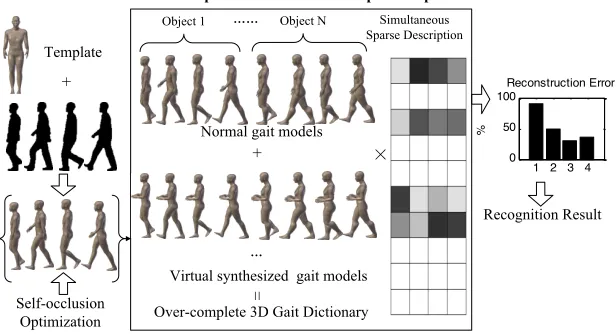
Fig. 10 shows the gait recognition process based on self-occlusion optimized simultaneous sparse representation
461
model. First the over-complete dictionary Aof 3D gait is constructed with variant-phase 3D gait models.
462
Variant-phase gait models are reconstructed using the multi-views 2D gait silhouettes corresponding to different
463
phase in a gait period as in Section 3.3. They are 3D parametric gait models with different postures.
1 2 3 4 0
50 100
%
Reconstruction Error Self-occlusion Optimized Simultaneous Sparse Representation model
Recognition Result
Simultaneous Sparse Description
×
Over-complete 3D Gait Dictionary
Object 1
Normal gait models
Virtual synthesized gait models
Object N
=
……
Self-occlusion Optimization
… +
Template
+
[image:17.595.150.458.80.247.2]465
Figure 10. Gait recognition process based on simultaneous spare representation model.
466
According to the theory of sparse representation and compressed sensing, any probe model y can be represented
467
by the linear combination of the atoms in dictionary if given sufficient training samples. In order to obtain sufficient
468
training samples, the different virtual 3D gait models with variant-phase are synthesized in multiple carrying
469
conditions. Together with the normal variant-phase 3D gait models, the over-complete dictionary is constructed.
470
For the parametric gait model, the unified 3D model is fast reconstructed by morphing using the estimated static
471
shape features Sand motion features ψ . The shape vector Sand motion vector ψ are then combined to form the
472
3D gait vector ii
{
ii, ii}
n Sn nγ
=ψ
, where nidenotes the total training samples of ith object with different postures. As a 473result, the ith object sub dictionary [ ,1 2,..., ]
i
i i i i
n
A =
γ γ
γ
is constructed. The over-complete dictionary for the entire 474training set includes the K object class, where each class is composed of 3D normal gait models together with
475
different carrying condition, and synthesized virtual gait models. It is denoted by
476
1 2
1 2 ,..., ,..., ,..
[ , ] [ , ., ]
i
K i i i K m n n n
A A A A
γ γ
γ
γ
×= = ∈ℜ , (18)
477
where 1
K
i i
n n
=
=
∑
equals the total training samples. Given any 3D model y in a gait period, it can be sparsely478
represented by
y Ax
=
0, where x0 denotes the sparse weighting coefficient vector. 479Since a gait period is composed by several gait phases with different postures, it is sufficiently distinct to enable
480
subject identification using a sufficient number of reconstructed 3D gait models in a period. The multi-phase gait
481
models are then collected as input data set denoted by
Y
=
{ , ,...,
y y
1 2y
M}
, where M is the total number of input 482gait models in a gait period. The sparse representation problem is solved by
483
1 { } 2
1 ˆ
{ } arg min i
M M
i i x i
i
x = x
=
=
∑
(19) 484subject to
2 1
, 1 .
M
i i i
y Ax
ε
i M=
− ≤ ∀ ≤ ≤
∑
485In 2D gait recognition, gait silhouettes in a period are usually averaged in various ways to form GEI [10], GFI
486
[41], CGI [42], DNGR [43] or similar gait energy features for recognition. The averaged gait features are usually
487
sensitive to the accurate detection of the gait period. If occlusion occurs resulting in only a few gait silhouettes or the
488
subject deviates significantly from the expected straight trajectory, the recognition rate would decrease significantly.
489
In order to overcome these problems, Self-Occlusion Optimized Simultaneous Sparse Representation Model