warwick.ac.uk/lib-publications
Original citation:
Heger, Jens, Branke, Jürgen, Hildebrandt, Torsten and Scholz-Reiter, Bernd. (2016) Dynamic adjustment of dispatching rule parameters in flow shops with sequence dependent setup times. International Journal of Production Research.
Permanent WRAP URL:
http://wrap.warwick.ac.uk/78472
Copyright and reuse:
The Warwick Research Archive Portal (WRAP) makes this work by researchers of the University of Warwick available open access under the following conditions. Copyright © and all moral rights to the version of the paper presented here belong to the individual author(s) and/or other copyright owners. To the extent reasonable and practicable the material made available in WRAP has been checked for eligibility before being made available.
Copies of full items can be used for personal research or study, educational, or not-for profit purposes without prior permission or charge. Provided that the authors, title and full bibliographic details are credited, a hyperlink and/or URL is given for the original metadata page and the content is not changed in any way.
Publisher’s statement:
“This is an Accepted Manuscript of an article published by Taylor & Francis in International Journal of Production Research on 28/04/2016 available online:
http://www.tandfonline.com/10.1080/00207543.2016.1178406
A note on versions:
The version presented here may differ from the published version or, version of record, if you wish to cite this item you are advised to consult the publisher’s version. Please see the ‘permanent WRAP url’ above for details on accessing the published version and note that access may require a subscription.
Dynamic adjustment of dispatching rule parameters in flow shops with
sequence dependent setup times
Abstract
Decentralized scheduling with dispatching rules is applied in many fields
of production and logistics, especially in highly complex manufacturing
systems. Since dispatching rules are restricted to their local information
horizon, there is no rule that outperforms other rules across various
objectives, scenarios and system conditions. In this paper, we present an
approach to dynamically adjust the parameters of a dispatching rule
depending on the current system conditions. The influence of different
parameter settings of the chosen rule on system performance is estimated
by a machine learning method, whose learning data is generated by
preliminary simulation runs. Using a dynamic flow shop scenario with
sequence dependent setup times, we demonstrate that our approach is
capable of significantly reducing the mean tardiness of jobs.
Keywords: scheduling; simulation; production; artificial intelligence;
flexible manufacturing systems; Gaussian processes
1 Introduction
Many real-world scheduling problems are dynamically changing over time, e.g., due to
new job arrivals, stochastic processing times or machine breakdowns (Aytug et al.,
2005; Oulhadj and Petrovic, 2009). According to the classification of Ouelhadj and
Petrovic (Oulhadj and Petrovic, 2009), there are three categories of dynamic scheduling:
completely reactive, reactive-predictive and robust pro-active scheduling. Dispatching
rules belong to the completely reactive class of scheduling heuristics (e.g., (Haupt 1989;
Blackstone, Philips and Hogg, 1982)) and are widely used to schedule complex shop
floors, e.g., in the field of semiconductor manufacturing (Gupta and Sivakumar, 2006;
Pfund, Mason and Fowler, 2006).
that works best over all scenarios and system conditions. One approach to improve
dispatching rule-based scheduling is thus to switch between dispatching rules
dynamically depending on the current system conditions. Which rule is best for a
particular condition can be determined by simulations? To save simulation time and be
able to handle complex scenarios, machine learning techniques may be applied to
estimate the rule performance and select the best rule (e.g., (Mouelhi-Chibani and
Pierreval, 2010; Heger, Hildebrandt and Scholz-Reiter 2013a; Heger, Hildebrandt and
Scholz-Reiter 2013b). Similarly, the parameters of a compound rule (combining basic
rules) can be set according to the current system conditions. This usually allows more
fine-grained control of rule behavior. In this paper, we present a simulation study of a
flow-shop scenario with sequence-dependent setup times. We have selected the ATCS
(Apparent Tardiness Cost with Setups) (Lee, Bhaskaran and Pinedo, 1997) rule since it
performs well in scenarios with sequence-dependent setup times (Pickardt and Branke,
2011). ATCS is a combination of three different basic rules: WSPT (weighted shortest
processing time), a minimum slack rule as well as the minimum setup time rule. It has
two scaling factors (see equation (1) below), k1 for slack (remaining time until due date
minus remaining processing time) and k2 for setup-avoidance. Setting these parameters
appropriately is crucial for a good performance.
In this paper, we dynamically adjust the k1 and k2 parameters depending on the current
system conditions (e.g., product mix) based on preliminary simulation runs and
performance estimates from Gaussian process (GP) regression models (Williams and
Rasmussen, 1996; Rasmussen and Williams, 2006). In our two-stage approach, we
combine global information based on offline simulation runs with adaptive priority rules
using local information. In contrast to previous work in this area, our approach
considers a truly dynamic scenario, i.e., system conditions are estimated online.
This paper is organized as follows. In Section 2, we give a review of previous research
on dispatching rules especially including setup times and machine learning in
scheduling. In Section 3, our chosen scenario and the experimental design are described.
Section 4 presents the results of our experiments. The paper concludes with a short
2 Problem description and related work
2.1 Scheduling with setup-oriented dispatching rules
Scheduling is “the determination of the order in which a set of jobs (tasks) {i | i = 1, ...,
n) is to be processed through a set of machines (processors, work stations) (k | k=1...m)”
(Haupt, 1989). Most scheduling problems are NP-hard, which means that only very
small problems can be solved optimally in a reasonable time (Monma and Potts, 1989).
But even if realistic static scheduling problems could be solved optimally, in scenarios
with high variability and dynamics, the periodic (re-)calculation of new schedules on a
rolling time horizon would not necessarily lead to overall optimality (Branke, Chick and
Schmidt, 2005). Therefore, in real world settings heuristics are commonly applied.
Heuristics work either in a centralized way (e.g., shifting bottleneck heuristic (Admas,
Balas and Zawack, 1988; Mason, Fowler and Carlye, 2002; Rego and Duarte, 2009)) or
decentralized with decisions made locally regarding the current information available at
the decision point. Decentralized scheduling is applied in scenarios facing high
variability and complexity with continuously arriving new jobs, job changes,
breakdowns, re-entrant processes etc.. Dispatching rules are one class of decentralized
scheduling heuristics (e.g., (Haupt, 1989; Blackstone, Philips and Hogg, 1982)), which
are widely used to schedule complex shop floors. Dispatching rules as a special kind of
priority rules are applied to assign a job to a machine each time the machine becomes
idle and there are jobs waiting. The dispatching rule assigns a priority to each job based
on job, machine or system attributes. The job with the highest priority is chosen to be
processed next.
For scenarios with sequence-dependent setup times, special dispatching rules have been
developed with the objective of avoiding frequent and lengthy changeovers. A recent
overview is given by Pickardt and Branke (2011). Their findings show that the ATCS
rule (Lee, Bhaskaran and Pinedo, 1997) performs well, especially if the objective
function is tardiness related. Mönch, Zimmermann, and Otto (2006) show in their
simulation study of a semiconductor wafer fabrication facility that the total weighted
tardiness and the sum of setup times is sensitive to the k2 setup scaling factor. Chiang
and Fu (2012) proposed the Enhanced Critical Ratio3 (ECR3) rule, which is optimized
for three due date-based objectives. Pfund, Fowler, Gadkari and Chen (2008) suggest
allows non-ready jobs to be scheduled. This means a machine is allowed to stay idle
while waiting for a new job. Van der Zee et al. (2010, 2011 and 2013) have studied the
special case of family based dispatching with batching and sequence-dependent setup
times. Vinod and Sridharan (2009) also study family based dispatching heuristics with
batching. Both results showed that non-exhaustive heuristics can lead to improvements
depending on the system conditions (e.g., utilisation).
2.2 Automatic rule selection / adjustment in static scenarios
Lee and Pinedo (1997) introduced a three-phase heuristic for a problem with one-step
parallel machines and sequence dependent setup times. With four factors describing the
static scenarios, they estimate best values for k1 and k2 of the adapted ATCS rule with a
formula they derived from extensive experiments. The schedule resulting from applying
the dispatching rule is post-processed by a simulated annealing algorithm for
fine-tuning.
Park, Kim, and Lee (2000) extended the approach from Lee and Pinedo (1997) by
adding an additional factor, the setup time range. To determine the scaling parameters k1
and k2 of the ATCS rule, they trained an artificial neural network with five input
parameters and k1 and k2 as outputs with data from preliminary simulation runs of static
scenarios. Their approach was able to outperform the approach introduced by Lee,
Bhaskaran and Pinedo (1997). Another extension has been presented by Chen, Pfund,
and Fowler (2010) who consider the one-stage parallel machine problem with four
characterizing factors as Lee and Pinedo (1997). However, Park, Kim, and Lee (2000)
and Chen, Pfund, and Fowler (2010) only evaluated a one-stage production scenario.
Their approach would need further adaption to be able to continuously estimate the
system parameters and use these to dynamically adapt the ATCS rule.
Mönch, Zimmermann, and Otto (2006) studied a single-stage parallel batch machine
problem with a similar approach. They compared a neural network with an inductive
decision tree to select the k – parameter of the BATC rule, which is an adaption of the ATC rule for batch machines (Balasubramanian, Mönch, Fowler and Pfund 2004). They
considered dynamic job arrivals in their experiments and used system parameters
similar to Lee and Pinedo (1997) and Park, Kim, and Lee (2000). Their results showed
Sequence-dependent setup times were not considered.
Dabbas and Fowler (2003) combine local and global dispatching criteria into a single
rule. A linear combination of rules is combined with relative weights, which are
adjusted regularly dependent on the current WIP.
Pierreval and Mebarki (1997) developed a dispatching approach where the most suited
dispatching rule to the current system state is selected by a new rule. Metan,
Sabuncuoglub, and Pierreval (2010) used a decision tree approach using simulation and
data mining techniques.
2.3. Automatic rule selection / adjustment in dynamic scenarios
As mentioned before, different dispatching rules work well for different settings and
objective functions (Rajendran and Holthaus, 1999; Mouelhi-Chibani and Piereval,
2010). To further improve the performance of rule-based scheduling, the idea of
dynamically switching to the (probably) best rule for the current situation has been
pursued. In most approaches preliminary simulation runs and machine learning
techniques are combined to estimate the performance of candidate rules for the next
decision (Heger, Hildebrandt and Scholz-Reiter, 2013b; Scholz-Reiter, Heger and
Hildebrandt, 2010). A review of machine learning in dynamic scheduling of flexible
manufacturing systems is presented by Priore, de la Fuente, Gomez, and Puente (2010).
Most approaches use artificial neural networks as a machine learning technique.
Sun and Yih (1996) propose a neural network-based controller, which basically selects a
dispatching rule depending on the user’s objective and the current status. The training
samples are calculated by a single-machine simulation and modified to reflect the
impacts of different dispatching rules on the system performance.
Zimmermann and Mönch (2004) present a parameterization scheme of a dispatching
rule to solve a parallel machine batching problem with an inductive decision tree
approach. They adapt the parameter of the BATC rule, which is used for scheduling one
batch machine group.
El-Bouri and Shah (2006) use a neural network to select dispatching rules in a job shop.
that it is limited to scenarios with only a few machines and jobs.
El-Bouri (2012) also introduced a cooperative dispatching approach, which consults
downstream machines before making a decision on the current machine. It basically
represents a look-ahead priority rule-based approach and outperforms standard rules;
however ATC is not considered. His study is performed on a dynamic flow shop
without sequence dependent setup times.
Mouelhi-Chibani and Pierreval (2010) use a neural network to dynamically switch rules
on every machine depending on the current system state. Their scenario consists of only
two machines and the set of dispatching rules consists of the SPT and EDD rule. They
outperform the static use of rules, but not significantly.
Scholz-Reiter et al. and Heger et al. presented the first studies applying Gaussian
processes as a machine learning technique for the selection of dispatching rules
(Scholz-Reiter, Heger and Hildebrandt, 2010; Heger, Hildebrandt and Scholz-(Scholz-Reiter, 2013b).
Gaussian process regression models are used to estimate rule performance in a 10
machine job-shop scenario taken from literature. Preliminary simulation runs are used
to calculate the Gaussian process regression models. They show that these models lead
to better estimates than neural networks in the chosen settings. Mean tardiness can be
improved by more than 6 % in the dynamic scenario.
2.4 Summary of the state-of-the-art
In summary, many different approaches to improve scheduling in a dynamic stochastic
environment have been pursued. First, various priority rules have been proposed, mostly
specialized for particular objective functions or production settings. Nevertheless, due
to the nature of the rules, there is not one best rule for all scenarios, settings and
objective functions. Second, there are studies trying to tackle this drawback by adapting
the rules to the current situation. However, the most relevant studies from Park, Kim,
and Lee (2000) and Mönch, Zimmermann, and Otto (2006) do not consider really
dynamic scenarios simulating the long-term operation of a system, with conditions
changing over time. Mönch, Zimmermann, and Otto (2006) did not study scenarios with
sequence dependent setup times either. The third group of studies investigates neural
study from Mouelhi-Chibani and Pierreval (2010) considers a dynamic scenario, but
only with two machines and no sequence-dependent setup-times.
In our paper, we consider for the first time a complex scheduling problem with setup
times and jobs arriving dynamically over time and an automatic adaptation of the
priority rule parameters.
3 Approach and Experimental setup
The focus of our work is to develop a new scheduling method for manufacturing
scenarios with sequence-dependent setup times, which automatically adjusts to the
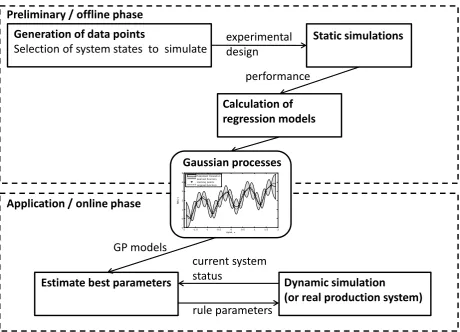
current system conditions (e.g., product mix). To this end, we suggest performing
preliminary static simulation runs in an offline phase to investigate which parameter
setting works best for each system state. Since there are many possible combinations
and simulation runs can be computationally expensive, we use Gaussian process
regression models to estimate the performance of unknown parameter settings. In the
application phase, these Gaussian process models are used for the dynamic setting of
the rule parameters depending on the current system situation. An overview of the
Figure 1. Overview of the dynamic adjustment approach
3.1 Scenario description
The type of problems we address are shop scenarios with new jobs arriving dynamically
over time. Our computational experiments used to demonstrate the advantages of our
approach are based on a dynamic flow-shop scenario, which extends the flow-shop
scenario from Rajendran and Holthaus (1999). In total there are 10 machines on the
shop floor, each job has the same route, i.e., machine visitation order is strict, and there
are no re-entrant flows. Processing times are drawn from a uniform discrete distribution
ranging from 1 to 49 minutes. The due dates of the jobs are determined by a due date
tightness factor x, a job’s due date is set to x times the job’s total processing time +
release time. Job arrival is a Poisson process, i.e., inter-arrival times of jobs follow an
exponential distribution. The arrival rate is set to yield a desired long term utilization
level on each machine. We consider three product types with the setup matrix for each
machine shown in figure 2.
Generation of data points
Selection of system states to simulate experimentaldesign Static simulations
performance Preliminary / offline phase
Calculation of regression models
Estimate best parameters Application / online phase
Dynamic simulation
(or real production system) current system
status
rule parameters -2 -1.5 -1 -0.5 0 0.5 1 1.5 2 -1
0 1 2 3 4 5
input, x
input
, y
Standard Deviation learned function training points original function
Gaussian processes
0 10 25 5 0 25
5 10 0
Figure 2. Setup matrix for 3 families
The considered objective function is mean tardiness. However, it should be
straightforward to extend the approach to other objectives.
3.2 Dispatching rules
The idea of our approach is to choose the best dispatching rule for the current system
condition. If, for example, a machine is highly utilized, a rule avoiding setups is
preferable. In low utilization, selecting the most urgent jobs should lead to a lower mean
tardiness. To achieve this, we need to use different dispatching rules for different
situations. As an alternative to switching rules, we can use composite rules that have an
integrated term for setup avoidance. These are usually based on common dispatching
rules that have proven to be effective on flow time- or tardiness-related performance
criteria (Pickardt and Branke, 2011). The ATCS rule is one of the most effective rules
with respect to mean tardiness and considers the slack (time until due date minus
remaining processing time of the job) and the setup avoidance separately. Two scaling
parameters (k1, k2) are used to tune the weights given to certain rule components. The
priority index of job j is calculated by the following formula
(
)
1 2
max ,0
: j exp j j exp ij
j j
d p t
w s
ATCS
p k p k s
− − = − −
, (1)
where wj is the weight of job
j
, pj its processing time,dj its due date, sj its setuptime, t the time of decision-making, p the average processing time of the jobs, s the average setup time of the jobs, k1 the scaling factor for slack and k2 the scaling factor
for setup time. The job with the highest priority value is chosen. Choosing the right
values for k1 and k2 is crucial for good performance (Mönch, 2007). Usually these
scaling factors are kept constant for a given scenario. Since most real life scenarios are
parameter on every machine is investigated in this paper. There are no urgent jobs
considered, so the weight of all jobs is set to 1.
3.3 Machine learning
Machine learning is a branch of artificial intelligence which tries to derive patterns or
predictions from a given dataset, usually called the training data. We are interested in a
system which can predict the value of an objective function (i.e., mean tardiness)
depending on the system characteristics and parameter settings of the control rule. This
allows to predict the best parameter setting depending on the system characteristics.
Training data is gained by surveying past production processes or performing
simulation runs. As inputs we have system attributes (e.g., product mix etc.) and
parameter settings (e.g., values for k1 and k2) affecting the output (e.g., mean
tardiness).
For our experiments we have chosen Gaussian process regression models (Rasmussen
and Williams, 2006) since studies from Rasmussen and Williams (1996), Scholz-Reiter,
Heger, Hildebrandt (2010) and Heger, Bani, and Scholz-Reiter (2012) showed that they
outperform other techniques in similar settings. Gaussian processes are relatively easy
to set up. To learn the performance models the Gaussian processes require some
training data as well as a covariance function. This covariance function, sometimes
called kernel, specifies the covariance between pairs of random variables and influences
the possible form of the function to be learned. We selected the squared exponential
(SE) covariance for our experiments:
(
)
2(
)
22
1
, exp ²
2
y p q f p q n pq
k x x x x
l
σ σ δ
= − − +
(2)
The squared exponential covariance function has three hyperparameters: the
length-scale l, the signal variance
σ
2f and the noise variance 2 nσ with δpq being a Kronecker
delta function, which is 1 if p=q and zero otherwise. The hyperparameters are used to fine-tune the Gaussian process model. Hyperparameters can also be learned by
maximizing the marginal likelihood (for further reading see ([Rasmussen and Williams
2006] chapters 2, 4 and 5, especially equation (5.9) page 114). They are set to minimize
the generalization error, which is the average error on unseen test data. This is done
training error is not optimized because this may lead to over-fitting the data.
As a mean function we used the sum of a linear and constant function initialized to 0.0
(Rasmussen and Williams, 2006). Further we have investigated the initial values for the
hyperparameters with some example data. Noise variance 2 n
σ has been set to log (0.1),
lengthscale factors have been initialized with 0.25 and the signal variance
σ
2f has beenset to 1.5. These initial parameter settings are automatically fine-tuned by minimizing
the generalization error with the leave-one-out method.
4 Experiments and Results
In preliminary simulation runs, the offline phase, we investigate which parameter
settings works best for each of a number of system states. These simulation results are
used to learn the performance models mapping system states and rule parameters to
performance. The system state changes in a dynamic scenario and needs to be estimated
to allow a control rule’s parameters to be dynamically adjusted. In the following, we
first perform a static analysis of the learning quality of our Gaussian Process model, and
then evaluate our approach with a dynamic simulation study of the selected flow shop
scenario with changing product mixes over time.
4.1 Preliminary simulation runs to create learning data
The static experiments simulate an adapted Rajendran and Holthaus (1999) flow shop
scenario. The simulation starts with an empty shop and we simulate the system until
data from jobs numbered 501 to 2500 has been collected. Data on the first 500 jobs is
discarded to focus on the shop's steady state behavior. In our study we assume a fixed
setting for the jobs’ due date factor (3.0); and the utilization level is set to 95 %. We
consider three product types with the setup matrix shown in Figure 2 for all machines.
For each product mix there is a best k k1, 2 parameter combination leading to the
smallest mean tardiness. Simulation runs are performed to get these k1 and k2 settings
for a number of product mixes. We consider combinations in 10 % steps and use the
notation [a,b,c] to specify the product mix, where a is the percentage of product 1, b is the percentage of product 2, and c is the percentage of product 3. For example [0.1, 0.5, 0.4] describes a setting with 10 % product type 1, 50 % product type 2 and 40 %
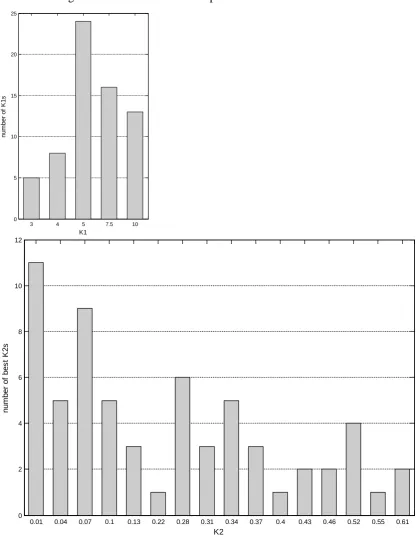
Preliminary simulation runs have shown that best values for k1 are between 0.25 and
10 and the values of k2 are best between 0.01 and 0.61 for the selected scenario. We
therefore use values in theses ranges in the remainder of this paper.
Two examples for the influence of the k2 parameter are depicted in Figure 3 and show
that there can be a huge difference in mean tardiness depending especially on k2.
Additionally, in both cases very different values for k1 and k2 lead to the best
performance. For the product mix [0.4, 0.4, 0.2] k1=8 and k2=0.04 lead to the best result,
in the case of [0.8, 0.2, 0.0] k1=5 and k2=0.52 perform best.
Figure 3. Performance values for product mix [0.8, 0.2, 0.0] (top) and product mix [0.4, 0.4, 0.2] (bottom) depending on k2with best correspondingk1 setting
To get an overview we performed simulation runs for all product mixes with all k1 and
k2combinations. The histograms in figure 4 show how often which setting leads to the
0 0.1 0.2 0.3 0.4 0.5 0.6 0.7
950 960 970 980 990 1000 1010 1020 1030 tar di nes s [ m in] K2
0 0.1 0.2 0.3 0.4 0.5 0.6 0.7
best scheduling results over all 66 different product mixes.
[image:14.595.85.502.82.626.2]
Figure 4. Histogram for k1 and k2
As can be seen, the best settings, especially for k2, vary widely and corresponding
tardiness levels are highly different.
4.2 Static analysis of the machine learning quality
Especially with more product types and more settings for k1 and k2 the number of
necessary simulation runs increases quickly. Therefore, machine learning techniques
3 4 5 7.5 10
0 5 10 15 20 25
num
ber
of
K
1s
K1
0.01 0.04 0.07 0.1 0.13 0.22 0.28 0.31 0.34 0.37 0.4 0.43 0.46 0.52 0.55 0.61 0
2 4 6 8 10 12
num
ber
of
bes
t K
2s
can be used to calculate estimates for parameter combinations that have not been
simulated before. In this study, we have 66 product mix combination with 8 settings for
k1and 21 different settings for k2 leading to 11088 simulation runs with 20 replications
each. We selected different numbers of these data points between 250 and 1000 with an
LHS (latin hypercube sampling) design (McKeay, Beckman and Conover, 1979) to
calculate Gaussian process regression models and understand the benefit of more
training data. The LHS is a statistical method for generating a sample of plausible
collections of parameter values. We use it in this context to select parameter
combinations, which we simulate. The Gaussian process regression models are used to
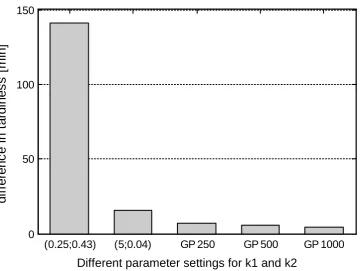
estimate the best settings for k1 and k2 for each product mix. The difference to the best
possible setting, i.e., always choosing the best k1 and k2 in each situation, is depicted in
[image:15.595.91.454.342.613.2]Figure 5.
Figure 5. Learning quality of GP models constant settings compared to always using the
optimal setting
The best constant setting for all product mix combinations is k1=5 and k2=0.04. Since
these best settings would be difficult to find in scenarios where the occurring product
mixes are not known in advance, we also selected a parameter setting leading to a
performance closest to the average results of all parameter combinations. If the best
(0.25;0.43) (5;0.04) GP 250 GP 500 GP 1000
0 50 100 150
di
ff
er
enc
e i
n t
ar
di
nes
s
[
m
in]
settings are unknown and parameters are randomly taken out the reasonable range, on
average we would get the results of the combination k1=0.25 and k2=0.43. The
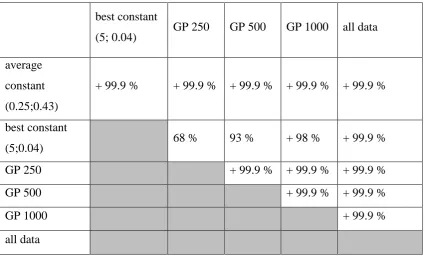
significance levels are depicted in table 1. It can be seen that the GP models perform
[image:16.595.80.506.270.528.2]better than the best constant setting and clearly better than the average setting.
Table 1. Significance levels calculated with Wilcoxon test, indicating that column
method is better than row method
best constant
(5; 0.04) GP 250 GP 500 GP 1000 all data
average
constant
(0.25;0.43)
+ 99.9 % + 99.9 % + 99.9 % + 99.9 % + 99.9 %
best constant
(5;0.04) 68 % 93 % + 98 % + 99.9 %
GP 250 + 99.9 % + 99.9 % + 99.9 %
GP 500 + 99.9 % + 99.9 %
GP 1000 + 99.9 %
all data
The results are promising and demonstrate the high quality of the learned models. A
larger training set leads to significantly better accuracy, but in absolute terms the
differences are relatively small (figure 5). The selection of best settings for each product
mix leads to lower tardiness compared a constant setting. The effects and the
application of the GP models on a dynamic scenario are investigated in the following
chapter.
4.3 Dynamic simulation and system status estimation
Since the preliminary simulation runs show (figure 3) that the best constant settings for
k1 and k2 strongly depends on the product mix, we want to determine the effect in
adjusted frequently depending on the current product mix, tardiness should be lower
compared to fixed settings. Parameters can be set only if the current system status (i.e.,
product mix) is known. Therefore, we estimate the current product mix at every
machine queue, every time it completes an operation by analyzing the historic data of
the last day of operation at this machine.
We consider the same flow shop scenario from our static preliminary simulation runs. A
suitable time span to look back is determined by a dynamic simulation study where the
product mix changes over time. Setting this look back period to a large value leads to a
(potentially too) slow reaction to changes in the product mix, setting it too short results
in frequent changes caused by random fluctuations. We select two product mixes, PM1
= [0.4, 0.4, 0.2] and PM2 = [0.8, 0.2, 0], which have different best k1 and k2values and
switch between them after 35 (PM1) and 145 (PM2) days. In 12 months this leads to 3
mix changes. As long as these periods are significantly longer than the look back
period, each period’s length can be selected arbitrarily. The data generated by the
preliminary simulation runs is used to dynamically set the ATCS parameters. The
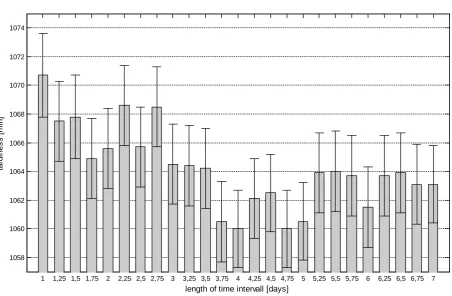
results of this simulation study are shown in figure 6. The variance is relatively high
since the actual tardiness values are close. This means that the approach is insensitive to
the look-back period, but since the setting with 4 days performed best, we select this for
the simulation runs in our studies. A setting of 4 days represents about 3 times the mean
Figure 6. Maximum look back setting in days for estimating the product mix on a
machine (with standard error)
4.3.1 Comparison between static parameter selection and dynamic switching
To evaluate our approach we select three different dynamic scenarios with changing
product mixes over 12 months to demonstrate the potential of dynamic parameter
adjustment. On each machine the rule parameters are set before each decision is made
by the rule based on the GP prediction regarding the current product mix. This means
we have a continuous adaption process instead of choosing constant parameters.
Benchmarks with best constant parameter settings for each test scenario are calculated
by simulation runs.
In the first dynamic scenario DS1 the product mix changes from [0.3, 0.4, 0.3] to [0.4,
0.6, 0.0], in DS2 it changes from [0.3, 0.5, 0.2] to [0.6, 0.4, 0.0] and from [0.4, 0.4, 0.2]
to [0.8, 0.2, 0.0] in DS3. The product mix changes after 40 days and back after 140
days, i.e., twice during a 12 months setting. The best benchmark settings for these
scenarios are depicted in table 2, showing the best constant parameter settings for each
scenario. If all three scenarios are run sequentially the best constant parameter settings
are k1=10 and k2=0.31.
Table 2. Dynamic scenarios
1 1,25 1,5 1,75 2 2,25 2,5 2,75 3 3,25 3,5 3,75 4 4,25 4,5 4,75 5 5,25 5,5 5,75 6 6,25 6,5 6,75 7 1058
1060 1062 1064 1066 1068 1070 1072 1074
tar
di
nes
s
[
m
in]
Product mix 1 Product mix 2 Best constant
parameters
DS1 [0.3, 0.4, 0.3] [0.4, 0.6, 0.0] k1=4 k2=0.07
DS2 [0.3, 0.5, 0.2] [0.6, 0.4, 0.0] k1=10 k2=0.34
DS3 [0.4, 0.4, 0.2] [0.8, 0.2, 0.0] k1=7.5 k2=0.37
Without any prior knowledge, i.e., simulation runs that provide the best settings for one
specific scenario, one could randomly select a combination out of the reasonable range
for k1 and k2. Therefore, we performed simulation runs for all k1 and k2 combinations
and calculated the average tardiness out of these runs, which gives a mean value for
random parameter selection.
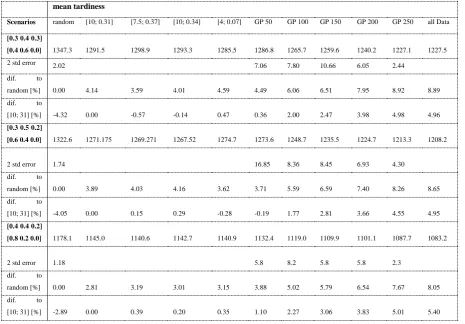
The results of simulating the selected scenarios are shown in Figure 7 and Table 3. For
each training data set size 25 different latin hypercube designs are selected. Our
experiments showed significant improvements of over 5 % using our dynamic
adjustment approach compared to the best overall setting of k1=10 and k2=0.31 and
random (4; 0.07) (10; 0.34) (7.5; 0.37) (10; 0.31) GP 50 GP 100 GP 150 GP 200 GP 250 all data 1220
1240 1260 1280 1300 1320 1340 1360
tar
di
nes
s
[
m
in]
[0.3 0.4 0.3] - [0.4 0.6 0.0]
random (4; 0.07) (10; 0.34) (7.5; 0.37) (10; 0.31) GP 50 GP 100 GP 150 GP 200 GP 250 all data 1180
1200 1220 1240 1260 1280 1300 1320 1340
tar
di
nes
s
[
m
in]
Figure 7. Results with dynamically adjusted k1andk2 values based on Gaussian process
models with different sizes of learning data sets in three scenarios (error bars indicate
twice standard error over lhs designs and random settings).
Table 3. Results of dynamic simulation runs
mean tardiness
Scenarios random [10; 0.31] [7.5; 0.37] [10; 0.34] [4; 0.07] GP 50 GP 100 GP 150 GP 200 GP 250 all Data
[0.3 0.4 0.3]
[0.4 0.6 0.0] 1347.3 1291.5 1298.9 1293.3 1285.5 1286.8 1265.7 1259.6 1240.2 1227.1 1227.5
2 std error 2.02 7.06 7.80 10.66 6.05 2.44
dif. to
random [%] 0.00 4.14 3.59 4.01 4.59 4.49 6.06 6.51 7.95 8.92 8.89 dif. to
[10; 31] [%] -4.32 0.00 -0.57 -0.14 0.47 0.36 2.00 2.47 3.98 4.98 4.96
[0.3 0.5 0.2]
[0.6 0.4 0.0] 1322.6 1271.175 1269.271 1267.52 1274.7 1273.6 1248.7 1235.5 1224.7 1213.3 1208.2
2 std error 1.74 16.85 8.36 8.45 6.93 4.30 dif. to
random [%] 0.00 3.89 4.03 4.16 3.62 3.71 5.59 6.59 7.40 8.26 8.65 dif. to
[10; 31] [%] -4.05 0.00 0.15 0.29 -0.28 -0.19 1.77 2.81 3.66 4.55 4.95
[0.4 0.4 0.2]
[0.8 0.2 0.0] 1178.1 1145.0 1140.6 1142.7 1140.9 1132.4 1119.0 1109.9 1101.1 1087.7 1083.2
2 std error 1.18 5.8 8.2 5.8 5.8 2.3
dif. to
random [%] 0.00 2.81 3.19 3.01 3.15 3.88 5.02 5.79 6.54 7.67 8.05 dif. to
[10; 31] [%] -2.89 0.00 0.39 0.20 0.35 1.10 2.27 3.06 3.83 5.01 5.40
random (4; 0.07) (10; 0.34) (7.5; 0.37) (10; 0.31) GP 50 GP 100 GP 150 GP 200 GP 250 all data
1060 1080 1100 1120 1140 1160 1180
tar
di
nes
s
[
m
in]
[image:21.595.80.546.440.764.2]The results show that dynamic adjustment of ATCS parameters leads to significant
improvements compared to static settings. In our study, the best k2 values are between
0.03 and 0.67; scenarios with different setup matrices might have bigger differences
leading to higher improvements. In real world manufacturing, the improvements can
easily get higher, since it takes some effort to have optimal constant settings available.
4.3.2 Discussion and Conclusions
In this paper, we proposed a two-stage hybrid approach combining global information
based on offline simulations with local adaptive decision rules. The global information
about the current system status is used to adjust the autonomously working priority
rules. The advantage of this approach is the combination of the robustness of priority
rules, e.g., with respect to machine failures or unforeseen events, and the optimization
through the inclusion of global information. The number of necessary simulation runs to
learn general behavior can be reduced by employing a state-of-the-art machine learning
technique, Gaussian Process regression. It has been shown, that GPs are well-suited for
this type of application. Our GP models are based on parameters calculated dynamically
during the simulation runs, which simulates the behavior of a real production system
faced with a product mix changing over time.
Using a dynamic flow shop scenario with sequence dependent setup times, we are able
to improve the objective function (mean tardiness) significantly by dynamically
adjusting the ATCS rule parameters to the current system conditions. We can achieve
improvements of almost 9 % compared to a random parameter setting and over 5 % to
best constant parameter settings in our dynamic simulation study, which are usually not
known in advance. The approach is applicable to all scenarios, where dispatching rule
scheduling is applied.
In future research more product mix combinations and more complex scenarios should
be considered. If there are bottleneck machines for example, a strategy involving
different rule parameters for different machines, might be promising.
References
Adams, J., E. Balas, and D. Zawack. 1988. “The shifting bottleneck procedure for job
Aytug, H., M. A. Lawley, K. McKay, S. Mohan, and R. Uzsoy. 2005. “Executing
production schedules in the face of uncertainties: a review and some future
directions.” European Journal of Operational Research, 161(1):86–110.
Balasubramanian, H., L. Mönch, J. Fowler, M. Pfund. 2004. “Genetic algorithm based
scheduling of parallel batch machines with incompatible job families to minimize
total weighted tardiness.” International Journal of Production Research, 42:1621-1638
Blackstone, J. H., D. T. Phillips, and G.L. Hogg, 1982. “A state-of-the-art survey of
dispatching rules for manufacturing job shop operations.” International Journal of Production Research, 20(1):27–45.
Branke, J., S. E. Chick, and C. Schmidt. 2005. „New developments in ranking and
selection: an empirical comparison of the three main approaches.” Proceedings of the 2005 Winter Simulation Conference, 708–717.
Chen, J. Y., M. E. Pfund, J. W. Fowler, D. C. Montgomery, and T. E. Callarman. 2010.
“Robust scaling parameters for composite dispatching rules.” IIE Transactions, 42(11):842–853.
Chiang, T.-C. and L.-C. Fu. 2012. “Rule-based scheduling in wafer fabrication with due
date-based objectives.” Computers and Operations Research, 39(11):2820–2835. Dabbas, R. and J. Fowler. 2003. “A new scheduling approach using combined
dispatching criteria in wafer fabs.” Semiconductor Manufacturing, IEEE Transactions on, 16(3):501–510.
El-Bouri, A. 2012. “A cooperative dispatching approach for minimizing mean tardiness
in a dynamic flowshop.” Computers and Operations Research, 39(7):1305–1314. El-Bouri, A. and P. Shah. 2006. “A neural network for dispatching rule selection in a
job shop.” The International Journal of Advanced Manufacturing Technology, 31(3-4):342–349.
Gupta, A. K. and A. I. Sivakumar. 2006. “Job shop scheduling techniques in
semiconductor manufacturing.” The International Journal of Advanced Manufacturing Technology, 27:1163–1169.
Haupt, R. 1989. “A survey of priority rule-based scheduling.” OR Spektrum, 11(1):3– 16.
Heger, J., H. Bani, and B. Scholz-Reiter. 2012. „Improving production scheduling with
machine learning.” In L. Frommberger, K. Schill, and B. Scholz-Reiter, editors,
Heger, J., T. Hildebrandt, and B. Scholz-Reiter. 2013a. „Dispatching rule selection with
gaussian processes.” Central European Journal of Operations Research, 1–15. Heger, J., T. Hildebrandt, and B. Scholz-Reiter. 2013b. „Switching dispatching rules
with gaussian processes.” In Windt, K., editor, Robust Manufacturing Control, volume 1 of Lecture Notes in Production Engineering, 73–85. Springer.
Lee, Y. H., K. Bhaskara, and M. Pinedo. 1997. “A heuristic to minimize the total
weighted tardiness with sequence-dependent setups.” IIE Transactions, 29(1):45– 52.
Lee, Y. H. and M. Pinedo. 1997. “Scheduling jobs on parallel machines with
sequence-dependent setup times.” European Journal of Operational Research, 100(3):464– 474.
Mason, S. J., J. W. Fowler, and W. M. Carlyle. 2002. “A modified shifting bottleneck
heuristic for minimizing total weighted tardiness in complex job shops.” Journal of Scheduling, 5(3):247–262.
McKay, M. D., R. J. Beckman, and W.J. Conover. 1979. “A comparison of three
methods for selecting values of input variables in the analysis of output from a
computer code.” Technometrics, 21(2):239–245.
Metan, G., I. Sabuncuoglu, and H. Pierreval. 2010. “Real time selection of scheduling
rules and knowledge extraction via dynamically controlled data mining.”
International Journal of Production Research, 48:6909-6938.
Mönch, L. 2007. “Simulation-based benchmarking of production control schemes for
complex manufacturing systems.” Control Engineering Practice, 15:1381 –1393. Mönch, L., J. Zimmermann, and P. Otto. 2006. „Machine learning techniques for
scheduling jobs with incompatible families and unequal ready times on parallel
batch machines.” Engineering Applications of Artificial Intelligence, 19(3):235-245.
Monma, C. L. and C. N. Potts. 1989. “On the complexity of scheduling with batch setup
times.” Operations Research, 37(5):798–804.
Mouelhi-Chibani, W. and H. Pierreval. 2010. “Training a neural network to select
dispatching rules in real time.” Computers and Industrial Engineering, 58(2):249 – 256.
Ouelhadj, D. and S. Petrovic. 2009. “A survey of dynamic scheduling in manufacturing
Park, Y., S. Kim and Y.-H. Lee. 2000. “Scheduling jobs on parallel machines applying
neural network and heuristic rules.” Computers and Industrial Engineering, 38(1):189–202.
Pfund, M., J. W. Fowler, A. Gadkari, and Y. Chen. 2008. “Scheduling jobs on parallel
machines with setup times and ready times.” Comput. Ind. Eng., 54(4):764–782. Pfund, M. E., S.J. Mason, and J. W. Fowler. 2006. Handbook of Production Scheduling,
volume 89 of International Series in Operations Research & Management Science, chapter Semiconductor manufacturing scheduling and dispatching, pages 213–241. Springer, New York, 1st edition.
Pickardt, C. W. and J. Branke. 2011. “Setup-oriented dispatching rules - a survey.”
International Journal of Production Research, 50(20):1–20.
Pierreval, H. and N. Mebarki. 1997. “Dynamic scheduling selection of dispatching rules
for manufacturing system” International Journal of Production Research, 35:1575-1591.
Priore, P., D. de la Fuente, A. Gomez, and J. Puente. 2001. “A review of machine
learning in dynamic scheduling of flexible manufacturing systems.” AI EDAM, 15(03):251–263.
Rajendran, C. and O. Holthaus. 1999. “A comparative study of dispatching rules in
dynamic flowshops and jobshops.” European Journal of Operational Research, 116(1):156–170.
Rasmussen, C. E. 1996. “Evaluation of gaussian processes and other methods for
non-linear regression.” PhD thesis, Department of Computer Science, University of Toronto.
Rasmussen, C. E. and C. K. I. Williams. 2006. “Gaussian Processes for Machine Learning (Adaptive Computation and Machine Learning).” The MIT Press.
Rego, C. and R. Duarte. 2009. “A filter-and-fan approach to the job shop scheduling
problem.” European Journal of Operational Research, 194(3):650–662.
Scholz-Reiter, B., J. Heger, and T. Hildebrandt. 2010. „Gaussian processes for
dispatching rule selection in production scheduling.” Procceeding of the International Workshop on Data Mining Application in Government and Industry 2010 (DMAGI10) As Part of The 10th IEEE International Conference on Data Mining., 631–638.
Sun, Y. L. and Y. Yih. 1996. “An intelligent controller for manufacturing cells.”
van der Zee, D-J. Non-exhaustive family based dispatching heuristics - exploiting
variances of processing and set-up times. International Journal of Production Research, 48(13):3783–3802, 2010.
van der Zee, D-J., Gerard J.C. Gaalman, and Gert Nomden. Family based dispatching in
manufacturing networks. International Journal of Production Research, 49(23):7059–7084, 2011.
van der Zee, D-J. Family based dispatching with batch availability. International Journal of Production Research, 51(12):3643–3653, 2013.
V. Vinod and R. Sridharan. Simulation-based metamodels for scheduling a dynamic job
shop with sequence-dependent setup times. International Journal of Production Research, 47(6):1425–1447, 2009.
Williams, C. K. I. and C. E. Rasmussen. 1996. “Gaussian processes for regression.”
Advances in Neural Information Processing Systems, 8:514–520.
Zimmermann, J. and Mönch, L.. 2004. “Simulation-based assessment of