http://wrap.warwick.ac.uk/
Original citation:O'Shea, Brian, Watson, Derrick G. and Brown, G. D. A. (Gordon D. A.) (2015) Measuring implicit attitudes : a positive framing bias flaw in the Implicit Relational Assessment Procedure (IRAP). Psychological Assessment.(In Press)
Permanent WRAP url:
http://wrap.warwick.ac.uk/67443 Copyright and reuse:
The Warwick Research Archive Portal (WRAP) makes this work of researchers of the University of Warwick available open access under the following conditions. Copyright © and all moral rights to the version of the paper presented here belong to the individual author(s) and/or other copyright owners. To the extent reasonable and practicable the material made available in WRAP has been checked for eligibility before being made available.
Copies of full items can be used for personal research or study, educational, or not-for-profit purposes without prior permission or charge. Provided that the authors, title and full bibliographic details are credited, a hyperlink and/or URL is given for the original metadata page and the content is not changed in any way.
Publisher statement:
© APA. http://www.apa.org/pubs/journals/pas/
"This article may not exactly replicate the final version published in the APA journal. It is not the copy of record."
A note on versions:
The version presented here may differ from the published version or, version of record, if you wish to cite this item you are advised to consult the publisher’s version. Please see the ‘permanent WRAP url’ above for details on accessing the published version and note that access may require a subscription.
Measuring Implicit Attitudes: A Positive Framing Bias Flaw in the Implicit Relational
Assessment Procedure (IRAP)
Brian O’Shea
Derrick G. Watson
Gordon D. A. Brown
University of Warwick, UK
Abstract
How can implicit attitudes best be measured? The Implicit Relational Assessment Procedure
(IRAP), unlike the Implicit Association Test (IAT), claims to measure absolute, not just
relative, implicit attitudes. In the IRAP, participants make congruent (Fat Person-Active:
False; Fat Unhealthy: True) or incongruent (Fat Active: True; Fat
Person-Unhealthy: False) responses in different blocks of trials. IRAP experiments have reported
positive or neutral implicit attitudes (e.g., neutral attitudes towards fat people) in cases where
negative attitudes are normally found on explicit or other implicit measures. It was
hypothesized that these results might reflect a Positive Framing Bias (PFB) that occurs when
participants complete the IRAP. Implicit attitudes towards categories with varying prior
associations (nonwords, social systems, flowers and insects, thin and fat people) were
measured. Three conditions (standard, positive framing, and negative framing) were used to
measure whether framing influenced estimates of implicit attitudes. It was found that IRAP
scores were influenced by how the task was framed to the participants, that the framing effect
was modulated by the strength of prior stimulus associations and that a default PFB led to an
overestimation of positive implicit attitudes when measured by the IRAP. Overall, the
findings question the validity of the IRAP as a tool for the measurement of absolute implicit
attitudes. A new tool (Simple Implicit Procedure: SIP) for measuring absolute, not just
relative, implicit attitudes is proposed.
Key Words: Implicit attitudes; Implicit Relational Assessment Procedure; Positive Framing
Measuring Implicit Attitudes: A Positive Framing Bias Flaw in the Implicit Relational
Assessment Procedure (IRAP)
Implicit attitudes are automatic evaluations that occur outside conscious awareness
and are measured without requiring respondents to introspect on their feelings. Explicit
attitudes in contrast are the result of deliberate introspection and controlled evaluative
judgment (Greenwald & Banaji, 1995). One reason for measuring implicit attitudes is that
participants may use self-presentation tactics or respond in a socially desirable manner on
explicit self-reports to avoid being perceived as prejudiced. Implicit measures can also be
useful in areas where participants might be unwilling to reveal personal psychological
attributes or are unaware of these psychological attributes (for a review of implicit attitudes
and the tools used to measure them see Gawronski & De Houwer, 2014).
The current gold standard method for assessing implicit attitudes is the Implicit
Association Test (IAT; Greenwald, McGhee, & Schwartz, 1998) and this tool has been
increasingly used in clinically relevant areas (see https://implicit.harvard.edu/implicit/pimh/).
The IAT has shown promise in predicting self-harm (Randall, Rowe, Dong, Nock, & Colman
2013), social anxiety disorders (Teachman & Allen, 2007) and suicidal ideation (Harrison,
Stritzke, Fay, Ellison, & Hudaib, 2014). The current study questions the validity of a recently
developed implicit measure, the Implicit Relational Assessment Procedure (IRAP;
Barnes-Holmes, Barnes-Barnes-Holmes, Stewart, & Boles, 2010a), which has also been used with vulnerable
populations.
Absolute vs. Relative Measures of Implicit Cognition
In a typical IAT (e.g., the Fat-Thin IAT) participants aresuccessively presented with
various pictures of thin and fat individuals and positive and negative words. In one of the two
critical blocks, participants have to press the E key on a computer keyboard if a positive word
person appears (congruent task). In the other critical block, participants have to press E if a
positive word or a picture of a fat person is shown and they must press the I key for a
negative word or a picture of a thin person (incongruent task). The basic idea underlying the
IAT is that participants will make faster and more accurate responses when those responses
are congruent with their current beliefs than when they are not.
Researchers using the IAT typically find a pro-thin/anti-fat bias (e.g., O'Brien,
Hunter, & Banks, 2006). Importantly, the IAT can only measure relative attitudes (e.g.,
attitudes to fat people relative to attitudes to thin people). It is therefore impossible to
determine using the IAT whether this bias is the result of a strong/weak pro-thin bias, a
strong/weak anti-fat bias or some combination of the two (see Blanton & Jaccard, 2006;
Roddy, Stewart, & Barnes-Holmes, 2011; 2012). Likewise, the IAT cannot be used to
determine how interventions that aim to increase or reduce implicit biases have their effect
(e.g., a difference in implicit attitudes could be reduced by acting on the ‘Thin Person’
category, the ‘Fat Person’ category, or both; see Lai et al., in press).
Another limitation of the IAT arises because some categories do not have an obvious
comparison group. For example, when assessing implicit self-esteem, IAT researchers can
measure the positive and negative associations a person has with the self in comparison to a
specified/unspecified other (or with “me” in comparison to “not me”). The type of
comparison category (i.e., specified vs. unspecified other) used affects implicit self-esteem
results (Karpinski, 2004). Therefore, a more appropriate approach would measure only
evaluative associations with the self without the need to use a complementary category.
To address these problems, reaction time tools which attempt to measure absolute
attitudes and do not require a relative comparison to another group have been developed. For
example, the Go/No-Go (Nosek & Banaji, 2001) and the Extrinsic Affective Simon Task (De
non-relatively/absolutely. However, both suffer from a number of problems ranging from a high
level of task difficulty to low reliability (Bar-Anan & Nosek, 2013; De Houwer & De
Bruycker, 2007). Variations of the IAT that could be described as single concept IATs, such
as the Single Target/Category IAT (e.g., Bluemke & Friese, 2008; Karpinski & Steinman,
2006) have shown promise for measuring absolute implicit attitudes. As these names suggest,
implicit attitudes towards only one concept can be measured during each test. As an example,
implicit attitudes towards fat people would be measured by having participants press the I key
when a picture of a fat person or a negative word appears (congruent task) and the E Key for
anything else. On the next block of trials participants would press the E key for pictures of fat
people or positive words (incongruent task), and the I key for everything else. The absolute
results are obtained by measuring the mean latency difference between the congruent and
incongruent block of trials. As in the standard IAT1 participants are expected to make faster
and more accurate responses on congruent tasks.
The IRAP is a recently developed alternative to the IAT that claims to measure
attitudes in both absolute and relative terms. Like the IAT, the IRAP is based on latencies of
participants’ accurate and speeded responses to stimuli. However, rather than categorizing
items with the appropriate key press (as in the IAT), participants instead have to press keys
that correspond with True or False displayed on the computer screen. “Correct” responses are
based on instructions given to participants before each block of trials begins. For example,
participants might be presented with the picture of a ‘Fat Person’ and the adjective ‘Active’.
In one condition participants are instructed to respond with a True key press (an incongruent
1
The Brief IAT (Sriram & Greenwald, 2009) is similar in methodology to the single concept
response) and in another condition they are instructed to respond with a False key press (a
congruent response).
The mean latency difference between pressing True and pressing False across the
congruent and incongruent response conditions is claimed to reflect a participant’s absolute
positive implicit attitude towards ‘Fat Person’. Similarly, an evaluation of absolute negative
implicit attitudes can be obtained by measuring the latency difference to respond True to the
association of ‘Fat Person’ with negative words (e.g., ‘Fat Person’-‘Unhealthy’), except that
the True key is now a ‘congruent response’ and the False key an ‘incongruent response’ (see
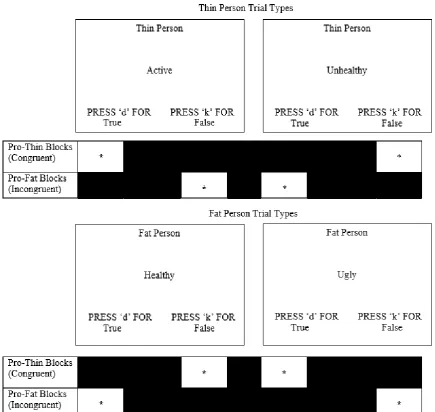
Figure 1)2. When the results from responding True or False to ‘Fat Person’ with positive
words and ‘Fat Person’ with negative words are combined/averaged, the result reveals if the
absolute attitude towards ‘Fat Person’ is positive, negative or neutral3
.
This kind of absolute attitude measurement cannot be achieved using the standard
IAT, because the latency with which a person responds to positive words (e.g., ‘Active’) and
pictures of fat people in the ‘Fat Person-Positive’ condition is uninterpretable in isolation.
The latency only becomes useful if it can be compared with the latency from the condition in
2
Separately measuring both a positive and a negative attitude towards a category can provide
a more nuanced understanding of the attitude under investigation. For example a person can
have both a strong positive attitude towards giving blood (i.e., like helping people) but also
have a strong negative attitude towards giving blood (i.e., fear of needles). Traditional bipolar
attitude measures (e.g., like-dislike) treat positive and negative evaluative processes as
reciprocally activated, equivalent and interchangeable which is not always the case (see
Cacioppo, Gardner, Berntson, 1997).
3
The IRAP normally includes a comparison group to allow researchers to carry out relative
which negative words (e.g., ‘Unhealthy’) and pictures of thin people require the same
response (i.e., the ‘Thin Person-Negtive’ condition).
The IRAP has been used in at least 20 empirical studies to date
(Golijani-Moghaddam, Hart, & Dawson, 2013). These studies have examined a number of
forensic/clinically relevant samples (for a review see Vahey, Nicholson, & Barnes-Holmes,
2015). Because the IRAP is being used with such vulnerable populations, it is important that
the validity of this tool is tested thoroughly to ensure that the method is accurately measuring
what it purports to. This is of particular importance because a number of IRAP publications
have reported unexpected or contradictory results that cannot be accounted for easily.
For example, Roddy et al. (2011, 2012; see also Nolan, Murphy, & Barnes-Holmes
2013) reported that what was driving the pro-thin/anti-fat bias in the IAT was an extremely
strong pro-thin bias with participants having a neutral implicit attitude towards fat people.
The concept of culture-based socialization that glorifies a slender figure was used to account
for these results. However, Bessenoff and Sherman (2000), using a non-relative/absolute
lexical decision making task, obtained completely opposite results to those of Roddy et al.
(2011, 2012; i.e., they found an anti-fat bias and a neutral/unbiased attitude towards thin
people).
In another example, Barnes-Holmes, Murphy, Barnes-Holmes, and Stewart (2010b)
found that participants associated pictures of a black person with a gun and pictures of a
white person with a gun as ‘Safe’ (i.e., they were faster to press True rather than False to the
joint presentation of a picture of a person with a gun and ‘Safe’). This was not what the
authors had predicted based on prior evidence that a civilian holding a gun in a neutral
press False quicker than True)4. Other counterintuitive results include findings from
unpublished studies that a normative sample of participants had an unexpected pro-death
implicit bias (Hussey & Barnes-Holmes, 2012), and one where religious participants and
atheists had unpredicted positive attitudes towards both their in-group and out-group (O’Shea
& Stewart, 2015)5. Importantly, when the data were compared relatively (like in the IAT) the
typical pro in-group/anti out-group biases were obtained. In the current study we show that
these results can be accounted for on the assumption that participants are adopting a simple
default heuristic (a Positive Framing Bias; PFB) when performing the IRAP.
Framing effects and language biases
The power of positive and negative framing has been well documented, particularly in
the area of risky decision making (for reviews, see Kuhberger, 1998). One of the best known
examples of the framing effect is Tversky and Kahneman’s (1981) ‘Asian disease problem’.
When presented with choices, if logically equivalent outcomes are phrased in terms of the
number of lives saved, people will generally select the certain/safe option. In contrast, if
outcomes are phrased in terms of the number of lives lost, people preferentially select the
risky option. Building on this evidence McKenzie and Nelson (2003) found that participants
had a bias towards describing a new treatment in terms of the percentage that survived rather
4
It could be argued that people are generally exposed to guns in a safe environment (i.e.,
guns being carried by law enforcers), resulting in the pro-safe attitude. However, we think
this is unlikely because the experiment used pictures of civilians wearing a white t-shirt and
this is likely to evoke a fight or flight response especially for the black individuals (e.g.,
Correll, Park, Judd, & Wittenbrink, 2002).
5
Atheists are generally distrusted in societies with a religious majority (e.g., Gervais, Shariff,
than died (i.e., a positively biased outcome description). Furthermore, participants were also
biased towards describing a glass as half full rather than half empty (i.e., an optimism bias;
e.g., Peterson, 2000). Importantly, it was possible to manipulate these positivity biases by
describing the reference points of the treatment outcomes differently or stating where the
liquid in the glass had been previously. For example, people were more likely to say the glass
was half empty if it had previously been full.
Language both reflects and shapes our representations of the world (Boroditsky,
2011) and language can therefore provide important insights into thought processes and
biases. English speakers appear to have a general tendency to describe changes in events or
objects as increasing rather than decreasing. To clarify, if a person’s weight has decreased,
we might describe this as ‘the person is thinner’ (thinness has increased), not ‘the person is
less fat’. In contrast, a person who has gained weight might be referred to as ‘fatter’, but not
as ‘less thin’. Additionally there is no morpheme in English that is equivalent to the suffix
‘er’ to indicate that a dimension has decreased (McKenzie & Nelson, 2003). This implies that
describing things in positive (increasing) rather than negative (decreasing) ways is a bias
inherent in the English language and therefore our thought processes.
Another strand of psycholinguistic research that emphasizes the importance of
positivity is based on markedness (see Haspelmath, 2006 for a critical review) where
‘unmarked’ is the classification for words used most frequently and which also have the most
neutral meaning (Leech, 2006). ‘Positive adjectives like good and long are stored in memory
in less complex forms than…their opposites’ (Clark, 1969, p.398) and therefore, are
described as ‘unmarked’. A speaker asking in a restaurant ‘How good is the food?’ is simply
asking for an evaluation of the food and will be satisfied with a positive or negative appraisal.
However, when asking ‘How bad is the food?’ essentially he/she is inquiring about the extent
said to be ‘unmarked’ and bad ‘marked’” (Clark, 1969, p.398). Likewise describing a board
as six meters long is acceptable to English speakers but describing it as six meters short is
not. Therefore, short would be described as ‘marked’. Finally, a morphologically negative
word is ‘marked’ as opposed to a positive one (e.g., honest vs. dishonest; happy vs. unhappy)
and therefore, humans are less efficient (in terms of processing speed) at handling negative
statements (e.g. Sherman, 1973).
Related studies (e.g., Mathews & Dylman, 2014) have shown that English speakers
have a preference to use ‘larger’ (e.g., more, taller, higher) comparisons to describe the
relationship between two magnitudes (e.g., one flag is _____ than the other). Other evidence
shows that people make a concerted effort to dampen down, mute, and even erase negative
experiences and that positive illusions promote psychological wellbeing (Taylor, & Brown,
1994). Peoples’ strong positivity biases have been described as the Pollyanna Principle (for
review see Matlin, 2004). Overall, the evidence points towards humans having a bias towards
positivity and larger or increasing descriptions (i.e., a Positive Framing Bias; PFB) and
suggests that this bias can be manipulated by framing effects.
Present Study
The present study tests the hypothesis that the absolute estimates of implicit attitudes
obtained from the IRAP are influenced by a PFB. Specifically, people might find it easier to
response True to positive descriptions of stimuli than to press False. This effect is predicted
to occur over and above any effect of congruence between the stimulus and the description
that is presented with it, and is expected to lead to an overestimation of the positivity of
absolute implicit attitudes. For example participants may be faster to respond True (rather
than False) when responding whether a stimulus category (e.g., Thin Person/Flowers) is
responding, the IRAP may not be able to measure absolute implicit attitudes in the way
intended.
Three main hypotheses were therefore tested:
H1: By default, participants will be more likely to focus on positive rather than
negatively framed associations and therefore they will be faster to respond True than False
for categories presented with positive words in the standard IRAP condition.
H2: The way the task is framed will influence estimates of a person’s absolute
implicit attitudes. If absolute attitudes as measured by the IRAP are susceptible to PFB
effects, directly manipulating how the task is framed to participants should influence the
results in predictable directions. Specifically, encouraging participants to focus on whether
positive associations are true or false should increase estimated ‘implicit positive attitudes’
towards any category. Conversely, encouraging participants to focus on whether negative
associations are true or false should increase estimates of ‘implicit negative attitudes’. The
effect of framing is predicted to be modulated by the strength of pre-existing negative or
positive associations. That is, robust positive or negative associations will be less likely to be
influenced by framing effects. Tasks that involve weak or absent prior associations will be
more strongly influenced by the framing manipulation than those with strong prior
associations. To test this we ran four different IRAP tasks, using stimuli which had differing
strengths of prior positive and negative associations.
H3: When the IRAP data are analyzed in such a way as to obtain relative attitudes (as
is done for the IAT), the framing effect will have no influence. This is because any systematic
biases will be cancelled out when the relevant conditions are combined. Tasks that use
stimuli with weak or absent prior associations will show neutral attitudes; those with strong
To test these hypotheses we manipulated the way in which tasks were framed (no
frame-standard, positive frame, and negative framing conditions) for each of four IRAP tasks,
which contained stimuli that varied in their strength of prior associations. If a PFB does exist
(i.e., if the first two hypotheses were confirmed), the use of the IRAP as a measure of
absolute, rather than just relative attitudes would be severely limited.
Method
Participants
The final sample consisted of 60 students from the University of Warwick (mean age
= 21.9, SD = 2.79), 20 in each condition (standard, positive frame and negative frame).
Fourteen participants were replaced (four from the standard, six from the positive frame and
four from the negative frame conditions)6 from the original 60 because the required
performance criteria were not met. The final sample contained 32 females and comprised 36
Asians, 19 Whites, 3 Mixed Race and 2 Blacks. Participants were recruited via an electronic
recruitment system and were paid £4. Participants were tested individually in a small room
and the experiment took approximately 40 minutes to complete.
Apparatus and Materials
Implicit Relational Assessment Procedure:(IRAP; Barnes-Holmes et al., 2010a).
Each participant completed four separate IRAPs. These were a Nonword IRAP, a Social
System IRAP, a Nature IRAP, and a Weight IRAP. These four different IRAPs were chosen
because the category stimuli in each were expected to have varying degrees of prior
associations. Both the Nature and Weight IRAP stimuli were predicted to have strong prior
associations (see Greenwald et al., 1998 and O'Brien, et al., 2006). The Social System IRAP
6
Including the original participants did not cause any significant changes to the results
stimuli were expected to have weak associations7 and the Nonword IRAP stimuli should have
no prior associations. All IRAP tests were administered using an Intel Windows 7 laptop with
a 15” LCD screen (IRAP software available from
http://irapresearch.org/wp/downloads-and-training/).
For the Weight IRAP, on each trial one of two category labels was presented at the
top of the screen (‘Thin Person’ or ‘Fat Person’) and a single positive or negative target
stimulus was presented in the center of the screen (e.g., ‘Healthy’ or ‘Ugly’). The Weight
IRAP used pictures, and the other three IRAPs used words as the category labels. Two
response options (‘True’ and ‘False’) also appeared at the bottom left and right (respectively)
of the screen (see Figure 1). The remaining IRAP tasks followed the same format but with
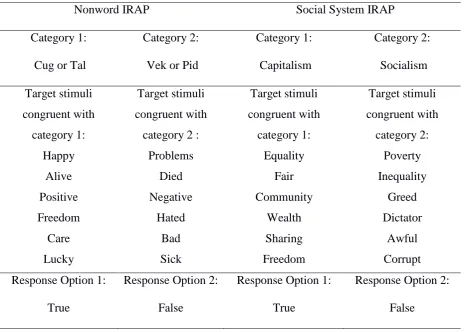
the condition-specific stimuli presented (see Tables 1 and 2 in the supplementary materials
for the full stimulus sets).
All category labels and target stimuli were matched on word length, phoneme length
and word frequency using Brysbaert and New’s (2009) film subtitle database. The positive
and negative target stimuli for the Social System IRAP were determined by asking 50
participants (via Amazon Mechanical Turk) to generate positive and negative words that they
associated strongly with Capitalism and Socialism. The most frequently reported words were
selected for use in the current study. Stimuli for the nature IRAP were chosen from past
implicit research (e.g., Greenwald et al., 1998). The 12 images for the weight IRAP were
taken from Nolan et al. (2013) and consisted of three pictures of women and three pictures of
men, before and after they had lost a significant amount of weight. These images were
7
O’Shea, (2015a) found that 17 UK and 10 Chinese undergraduates had no relative
comparison bias in favor or against Capitalism vs. Communism or Socialism. However, see
controlled on a number of dimensions (e.g., picture angle, cropping, clothing and
background). The most appropriate positive and negative target words were chosen from
studies of implicit weight biases (Roddy et al., 2010, 2011).
Design and Procedure
The study used a mixed 4 (trial type: category 1-positive words, category 1-negative
words, category 2-positive words, and category 2-negative words) X 4 (IRAP task: Nonword,
Social System, Nature and Weight) X 3 (framing condition: standard, positive, negative)
design, with IRAP task and IRAP trial type as within-subjects factors and framing condition
as a between-subjects factor.
We illustrate the procedure using the Weight IRAP task. Participants were required to
respond in a predefined way as specified before each block of trials. For example,
participants might be instructed ‘On this block please respond as if Thin Person is Positive
and Fat Person is Negative’. This would be described as a pro-Thin block of trials (congruent
responding8) and participants were required to respond True to the stimulus combination
‘Thin Person – Positive Word’ and ‘Fat Person – Negative Word’, and to respond False to
‘Thin Person – Negative Word’ and ‘Fat Person – Positive Word’. After participants
completed this pro-Thin block they were required to respond in the opposite manner on the
next block and were thus instructed: ‘On this block please respond as if Thin Person is
Negative and Fat Person is Positive’ (incongruent responding). On these pro-Fat trials
participants had to respond False to ‘Thin Person – Positive Word’ and ‘Fat Person –
8
For the Non-Word IRAP and the Social System IRAP the blocks that are referred to as
congruent or incongruent responding were arbitrarily selected. However, for the Nature and
Weight IRAP congruent responding was defined in terms of the blocks people were expected
Negative Word’ and to respond True to ‘Thin Person – Negative Word’ and ‘Fat Person –
Positive Word’.
This procedure enabled the experimenter to measure attitudes based on four separate
trial types (Thin Person – Positive Word, Thin Person – Negative Word, Fat Person –
Positive Word and Fat Person – Negative Word) by measuring the mean latency difference in
responding True vs. False in pro-Thin and pro-Fat blocks. To respond, participants pressed
either ‘D’ or ‘K’ on the keyboard. The D and K keys corresponded to the left – right positions
of the response options on the screen respectively. The locations of the two response options
interchanged quasi-randomly from left to right among trials, with the constraint that they
could not remain in the same position three times in succession.
To complete the IRAP sequence, participants completed six test blocks which
alternated between requiring Thin or Fat responses across blocks. Initial block (
pro-Thin or pro-Fat) was counterbalanced across participants. Each block consisted of 24 trials,
made up of the 6 positive and 6 negative target words presented twice in the presence of the
two category stimuli (i.e., ‘Thin Person’ or ‘Fat Person’). Trials were presented
quasi-randomly, such that the same trial type could not be repeated across two successive trials. If
participants pressed the correct response on a trial the screen cleared for 400 ms before the
next trial was presented. If an incorrect response was given a red letter (X) appeared on
screen and remained until the participant pressed the correct response key. After participants
completed a block of trials their mean accuracy and median response latency scores were
displayed on the screen. The first participant was assigned to the standard condition, the
second to the positive framing condition and the third to the negative framing condition. This
order was then repeated and maintained for the remaining participants.
Standard framing condition: For the standard condition visual instructions before
‘On this block please respond as if Thin Person is Positive and Fat Person is Negative’ and
‘On this block please respond as if Thin Person is Negative and Fat Person is Positive’ and
the next participant would always begin with Fat Person as the first category described in
each sentence.
Positive framing condition: In the positive framing condition visual explanations of
how to perform the task were always framed in a positive way prior to beginning each block
of trials (e.g., ‘On this block please respond as if Thin Person is Positive and Fat Person is
Negative’ or ‘On this block please respond as if Fat Person is Positive and ThinPerson is
Negative’)9
. These instructions were dependent on participants completing a Thin or
pro-Fat block. Unlike in the standard framing condition, each participant in this condition was
also presented witha standardized verbal explanation from the experimenter.
The script was as follows:
“A method or strategy that will help you complete this task is to keep ‘Thin Person’ and
‘Positive word’ in your mind and base all other responses off that10
. For example when a
‘Thin Person’ and a Positive word appears, press True and if this does not occur press False
(such as ‘Thin Person’ and Negative word). Then use this strategy to gauge how to respond
to the other category by responding in the opposite manner (such as ‘Fat Person’ Positive
words False; ‘Fat Person’ Negative word True) To emphasize ‘Thin Person’ is Positive,
‘Thin Person’ is Positive”
9
Since English speakers process sentences from left to right the leftmost instructions were
likely be processed first.
10
Category words in bold were replaced depending on which pro-block was presented first
and which of the four versions of the IRAPs was being conducted. Sentences in brackets were
After participants completed the first practice block they were told the following:
“Now on this block put ‘Fat Person’ is Positive into your mind ‘Fat Person’ is Positive,
‘Fat Person’ is Positive”
Participants were told the following on each successive IRAP:
“For this task use the same strategy as the last time by keeping ‘XXX’ and Positive word in
your mind.”
Negative framing condition: The negative framing condition was identical to the
positive except that the underlined words in the verbal script above were replaced with their
antonyms and the visual description before each block always described the negative
instructions first (e.g., ‘On this block please respond as if Fat Person is Negative and Thin
Person is Positive’ or ‘On this block please respond as if Thin Person is Negativeand Fat
Person is Positive’).
The remaining three IRAP tasks (Nonword, Social System and Nature) followed the
same procedure but with the condition-relevant stimuli substituted. The order of the four
IRAPs was randomized within the standard framing condition with the same set of random
orders used for the positive and negative framing conditions. For the first IRAP participants
were required to complete a minimum of two practice blocks. This was to ensure that
participants were accustomed to the IRAP’s procedure. If a participant received first pro-Fat
then pro-Thin conditions on the practice blocks this sequence was maintained for the 1st and
2nd test block, the 3rd and 4th, and the 5th and 6th test block.
To proceed to the test blocks participants had to achieve an accuracy of 79% or
above and a median response latency of less than 2200 ms on two consecutive practice
blocks. All participants met the practice block criteria but if these criteria were not
maintained throughout each test block on the four IRAP tasks, participants’ data were
replaced. When the four IRAPs were completed, participants provided demographic
information, received their payment and were thanked and debriefed.
Results
The primary data obtained from the IRAP tasks are raw latency scores defined as the
time in milliseconds that elapsed between the onset of the stimulus and the correct response
being made by the participant. The DV was participants’ mean False minus True reaction
time difference for each of the four trial types (i.e. Thin Positive Words, Thin
Person-Negative Words, Fat Person-Positive Words, Fat Person-Person-Negative Words) across the
congruent (e.g., pro-thin) vs. incongruent (e.g., pro-fat) blocks. Analysing the trial
types/categories separately provided the absolute results while averaging all the trial types
provided the relative results. Following standard procedures to control for individual
variation, (Barnes-Holmes et al., 2010a) each participant’s response latencies were
transformed using an adaption of the Greenwald, Nosek and Banaji (2003) D-algorithm. The
steps involved in calculating both the absolute and relative D-IRAP scores can be found in
the supplementary materials. Initially a stimulus Category X Word Valence X IRAP task
within-subjects ANOVA was performed on the False minus True absolute D-IRAP scores for
each of the four trial types in the standard condition. This analysis allowed us to test the first
hypothesis: H1: participants will have a faster True (vs. False) response for categories
presented with positive words. Inclusion of the factors stimulus Category and IRAP task also
allowed us to consider the generality of the effect of Word Valence.
Following this, a 4 (trial type: category 1-positive words, category 1-negative words,
category 2-positive words, category 2-negative words) X 4 (IRAP task: Nonword, Social
performed on the of absolute D-IRAP (estimate) scores11. This analysis was carried out to test
H2 (how the task is framed will influence the estimates of a person’s implicit attitudes). A
further analysis combined both the positive word and negative word D-IRAP (estimate)
scores for each of the eight categories (i.e., Fat Person, Thin Person, Flower, Insect etc.) in
the standard condition. This method provides the average absolute D-IRAP (estimate) scores
for each category and matches the standard way of calculating the IRAP’s results. This
analysis was used to test further the argument that the PFB has an influence on peoples’
responses and to examine the extent to which this can lead to potentially inflated estimates of
implicit attitudes12. Finally, tests were carried out to determine whether framing influenced
participants’ relative implicit attitudes (H3). In all analyses, whenever Mauchly’s sphericity
assumption was violated the Greenhouse-Geisser correction was applied.13
Test of H1: The influence of the PFB on prior associations in the standard condition
11
The absolute IRAP (estimate) scores were found by reversing the False minus True
D-IRAP scores for categories presented with negative words. Categories presented with positive
words were not reversed. This was carried out so that scores above zero represent a positive
attitude and those that are below the zero mark represent a negative attitude. The absolute
D-IRAP (estimate) scores were used to test H2.
12Separate analysis of each of the four IRAPs (Nonword, Social System, Nature, and Weight)
can be found in the supplementary materials.
13
Preliminary analyses revealed the sentence sequence instructions (e.g., Thin Person
described first or Fat Person described first) in the standard condition and the order of the
IRAP blocks presented (e.g. beginning with either a pro-Thin or a pro-Fat block) did not
False minus True D-IRAP scores for the standard framing condition were analyzed
using a 2 (Category) X 2 (Word Valence) X 4 (IRAP task) within-subjects ANOVA. This
revealed a significant main effect of Valence: F(1,19) = 67.05, p <. 001, ηρ² = .78, as
predicted by H1. There was also a significant Category x Valence two-way interaction:
F(1,19) = 12.26, p <. 005, ηρ² = .392, and a significant IRAP x Category x Valence
three-way interaction: F(3,57) = 5.77, p <. 005, ηρ² = .233. No other main effects or their
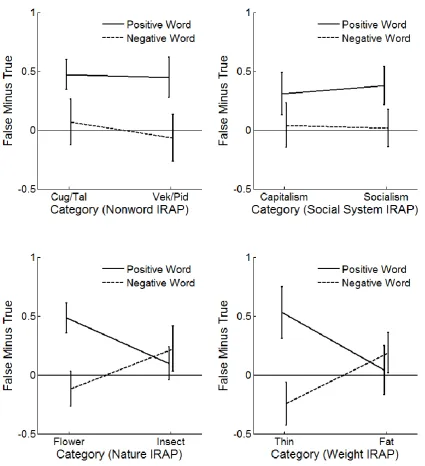
interactions were significant (all Fs < 1.57, ps > .21). As shown in Figure 2, True responses
were faster than False responses on positive word trials while for negative word trials there
were no differences between pressing True/False supporting H1. The significant three-way
interaction arises because True responses were faster than False responses for Category 1
stimuli across all four IRAPs. In contrast, for Category 2 stimuli True responses were only
faster than false responses for the Nonword and Social System IRAPs (i.e., those in which the
stimuli had relatively weak prior associations).
This pattern of results is assumed to reflect differences in the strength of prior
associations across the four IRAP types. For the two IRAPs with the weakest prior
associations (Nonword and Social System) there was little influence of whether the
description was congruent or incongruent with the stimulus being presented. Thus for those
IRAPs there was little difference between scores for Category 1 versus Category 2 stimuli but
there was an overall effect of Word Valence. That is, True vs. False responses were faster on
positive word trials. In contrast, for the IRAPs with stronger prior associations (Nature and
Weight), there was an effect of stimulus congruence. That is, congruent responses (e.g.,
positive word – flower, negative word - insect) were faster than incongruent responses
(positive word – insect, negative word – flower). As for the Nonword and Social System
IRAPs, the effect of the PFB was to increase the speed of True responses on positive word
for positive stimuli (e.g., Flowers/Thin) and a corresponding smaller difference for negative
stimuli (Insects/Fat).
Test of H2: The influence of the PFB on estimates of absolute implicit attitudes
The absolute D-IRAP (estimate) scores were analyzed with a 4 (trial type: category
1-positive words, category 1-negative words, category 2-1-positive words, category 2-negative
words) X 4 (IRAP task: Nonword, Social System, Nature, Weight) X 3 (framing: standard,
positive, negative) mixed ANOVA, with trial type and IRAP task as the within-subjects
factors and framing condition as the between-subjects factor. This analysis revealed a
significant main effect of trial type, F(3, 171) = 64.52, p < .001, ηρ² = .53, but not of IRAP
task, F(2.62, 149.34) = .40, p = .76, ηρ² = .01. Importantly, the trial type X IRAP task
interaction was significant, F(7.02, 399.99) = 10.26, p < .001, ηρ² = .15. As shown in Figure
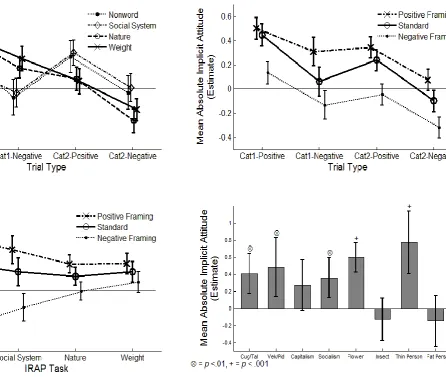
3 (top left), for stimuli with absent or weak priori associations (i.e., the Nonword IRAP and
the Social System IRAP), elevated implicit attitudes were found (see Cat1-Positive and
Cat2-Positive). For stimuli with stronger prior associations (i.e., the Nature & the Weight IRAPs)
this pattern was weaker.
A significant main effect was found for framing, F(2, 57) = 42.40, p < .001, ηρ² = .60.
As shown in Figure 3 (top right) the positive framing condition produced elevated estimates
of implicit attitudes (M = .31) whilst negative framing resulted in reduced estimates of
implicit attitudes (M = -.09). The standard framing condition showed estimates of implicit
attitudes that were in between the estimates obtained in the positive and negative framing
conditions (M = .16). Across the four trial types the framing manipulation had a similar effect
— a framing X trial type interaction was not found, F(6,171) = 1.02, p = .41, ηρ² = .04.
Crucially, the framing X IRAP task interaction was significant F(6,171) = 9.50, p < .001, ηρ²
= .25. Figure 3 (bottom left) shows that framing influenced the estimates of participants’
three way interaction was not significant F(18, 504) = .62, p = .89, ηρ² = .02. The overall
pattern of results suggest that: i) participants had positive implicit attitudes (estimates) across
all the IRAP tasks, ii) framing had a strong effect on the estimates of implicit attitudes, and
iii) the effect of framing was stronger for associations with weaker rather than stronger prior
associations.
Test of H2: Combining the positive and negative trials for each category in the standard
condition
In order to match the standard way the IRAP results are reported in the literature we
combined/averaged the absolute D-IRAP (estimate) scores for the positive and negative word
associations in each category (see Figure 3; bottom right). For example, ‘implicit attitudes’
for ‘Thin Person’ were calculated by averaging the D-IRAP (estimate) scores from the ‘Thin
Person-Positive Words’ and ‘Thin Person-Negative Words’ trials. One sample t-tests were
conducted on the resulting values which revealed that the scores for the Nonword and Social
System trials (absent/ weak prior associations) were significantly greater than (ts > 2.95, ps <
.01) or marginally greater (for Capitalism; t = 1.90, p = .07) than zero. In the Nature IRAP
there was an expected pro-flower bias (t = 7.24, p < .001). The apparent neutral attitude
towards insects (t = -1.07, p = .30) is likely due to the tendency for participants to frame the
IRAP task in a positive way, with this PFB then offsetting the negative bias people usually
possess for insects. This is similar to the Weight IRAP in which a strong positive attitude was
observed for thin people (t = 4.43, p = <.001) but a neutral attitude was found for fat people (t
= -1.03, p = .32). These findings further underline the problem of using the IRAP’s absolute
results because they are likely to overestimate the positivity of a person’s implicit attitudes.
Test of H3: The influence of the PFB on the relative IRAP results
The relative overall D-IRAP scores were analyzed using a similar method to that used
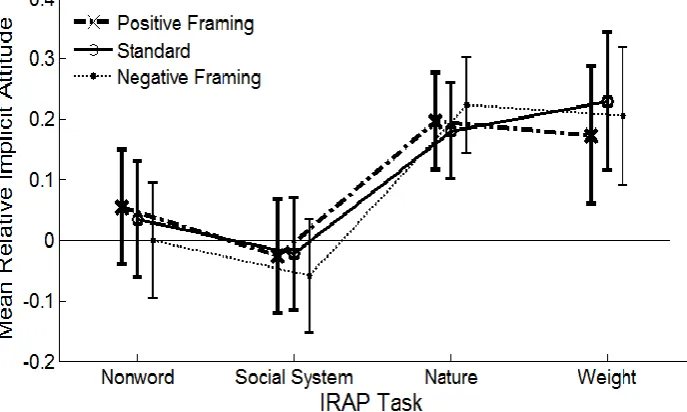
negative framing conditions for each of the four IRAP tasks. For all the IRAP tasks there
were no significant differences across the three framing conditions (Nonword = F(2, 57) =
.35, p = .70, ηρ² = .01; Social System = F(2, 57) = .19, p = .83, ηρ² = .01; Nature = F(2, 57)
= .30, p = .74, ηρ² = .01; Weight = F(2, 57) = .28, p =.78, ηρ² = .01; see Figure 4).
In each of the framing conditions for the Nonword and Social System IRAP tasks
(absent/ weak prior associations), the D-IRAP scores did not differ significantly from zero
(all ts < 1.51, ps > .15), indicating neutral attitudes to the Nonwords as well as Capitalism
relative to Socialism. In each of the framing conditions for the Nature and the Weight IRAP
tasks (strong prior associations), the D-IRAP scores were a significant distance away from
zero (all ts > 3.30, ps <.01), indicating the predicted flower/anti-insect bias and the
pro-thin/anti-fat bias.
Discussion
The main aim of the present study was to determine if default (positive) framing
biases might compromise the validity of the IRAP (Barnes-Holmes et al., 2010a). According
to previous research (Matlin, 2004; McKenzie & Nelson, 2003) people have a general and
default bias to frame events and objects in a positive way (a Positive Framing Bias; PFB) and
it is possible to manipulate this bias though framing. Based on the procedure and structure of
the IRAP we reasoned that such a PFB might have the effect of biasing estimates of absolute
attitudes. Indeed, such a bias might account for previous results which seem either
counterintuitive (e.g., Hussey & Barnes-Holmes, 2012), or inconsistent with prior research
(e.g., Roddy et al., 2011; 2012). We suggest that the effect of a positivity bias in this situation
would lead to more rapid True responses to categories presented with positive words than
False responses for the same stimuli. This in turn would lead to inflated estimates of positive
attitudes towards the stimulus set being examined. If this is indeed the case, the validity of the
We set out to test three hypotheses: (H1) participants hold a default (as measured in
the standard condition) Positive Framing Bias (PFB) which results in a decrease in the time
required for them to press True to categories presented with positive words than to press
False. (H2) framing the response task in different ways should influence the estimates of
absolute implicit attitudes obtained by the IRAP, with weak prior associations being more
malleable, and (H3) framing biases or direct manipulations would have no influence when a
relative category analysis of the data is carried out.
The Effect of a Default Positive Framing Bias (H1)
In the standard condition the absolute IRAP scores were positively biased across all
four IRAPs. In these IRAPs participants were generally faster at pressing True rather than
False when associating any category with positive words. The implication of this finding is
that researchers using the IRAP might incorrectly interpret their results as showing that
participants have a positive (absolute) attitude towards abstract categories (e.g., social
systems or atheism: O’Shea & Stewart, 2015). In contrast, the ‘true’ attitudes could be either
neutral or even negative and so this finding calls into question the validity of the IRAP
procedure. Of note, even the IRAP tasks that used stimuli with strong prior associations
(Nature and Weight) were influenced by this PFB and, as predicted, a reduction in positivity
was seen for categories that usually show a negative bias when assessed by other measures
(e.g., insects and fat people), resulting in neutral absolute attitudes as measured by the IRAP.
These findings could account for at least some of the unusual results that have been
previously published using the IRAP. For example, as detailed earlier, Roddy et al. (2011,
2012) reported a neutral bias towards fat people whereas we might expect a negative attitude.
Similarly, Barnes-Holmes et al. (2010b) reported that participants evaluated black and white
non-security related civilians with a gun as ‘Safe’ whereas we might expect that they would
PFB. That is, participants are likely to be simplifying the task by picking just one of the two
possible associations they have to perform on a block (usually the positive) and basing all
responses on that association14. This bias in turn leads to an overestimation of the absolute
positive attitude towards a stimulus set because, as we have shown, True responses to
positive associations are faster than False responses.
The Influence of Framing on Estimates of Absolute Attitudes (H2)
We also determined the effect of directly manipulating the framing of the task on
estimates of absolute implicit attitudes. If the IRAP results are influenced by framing, then
directly manipulating the frame should have a related influence on the ‘implicit attitude’
(estimate) scores obtained when an absolute analysis of the data is calculated. As argued
previously, we would expect that weak or absent prior associations would be more likely to
be influenced by the framing effect than those with strong prior associations. This prediction
was also confirmed. For the Nonword and Social System IRAP there was a strong effect of
framing. That is, in the positive framing condition scores were elevated across all trial types
14
After participants completed the current experiment those in the standard framing condition
were asked to write down any strategies they used to complete the task. This question was not
needed for the participants in the positive and negative framing condition because they were
specifically given a strategy to follow. Of the 10 participants in the standard framing
condition who made any references to focusing on mainly the associations, all mentioned the
positive associations and none made reference to a focus on the negative associations. The
remaining 10 could not describe any strategies they used other than remembering the two
possible associations they had to perform on each block of trials. This suggests that when
participants did spontaneously choose an explicit strategy they chose one based on positive
whereas in the negative framing condition scores were reduced. In contrast, for the Nature
and Weight IRAP the framing effects were smaller, particularly in the negative framing
condition.
These outcomes suggest that the reason that using the absolute results from IRAP trial
types are problematic is that responses are influenced strongly by how a person frames each
block of trials. It is noteworthy that the way in which the associations are phrased before
beginning an IRAP block (especially the sequence) are practically non-existent in published
IRAP reports. Yet we have shown that they can have an influence on the results obtained,
particularly if a researcher primes a participant in some way to focus on either the negative or
positive associations. In summary, the IRAP claims to determine absolute implicit attitudes.
However, as we have shown, framing effects can influence the absolute value of the scores
obtained, making them unreliable at best. Such framing biases can arise naturally and by
default (as in the standard condition) to frame things positively (the PFB). In addition,
differences in the way the IRAP task is explained to the participants can have large influences
(as in the positive and negative framing conditions).
The Influence of Framing on the Relative Results (H3)
The third hypothesis was that the framing effect would not have an influence on
relative attitudes (when the data were analyzed using the standard IAT methodology). Use of
stimuli with weak or no prior associations was expected to lead to neutral attitudes, while
stimuli with strong prior associations were predicted to lead to findings showing the expected
pro/anti-bias (e.g., pro-thin/anti-fat). Again all these predictions were confirmed across the
four IRAPs. When analyzed in a relative manner we found the Nonword IRAP and the Social
System IRAP indicated neutral attitudes towards the various category labels. For the Nature
pro-flower/anti-insect; pro-thin/anti-fat). This suggests that that the IRAP can still be used when a
relative analysis of the data is to be carried out.
One possible benefit of using the IRAP as a relative measure is that it appears to be
difficult for participants to fake their responses (McKenna, Barnes-Holmes, Barnes-Holmes,
& Stewart, 2007). However, the major disadvantages of the IRAP as a relative measure are
that it is more complicated, takes longer to complete and has a higher attrition rate than the
IAT (Golijani-Moghaddam et al., 2013).
Developing a New Absolute Measure of Implicit attitudes
In addition to the framing biases revealed here for the IRAP, other proposed absolute
methods also suffer from problems. As discussed earlier, there are problems with both the
Go/No-Go task and the Extrinsic Affective Simon Task for measuring absolute implicit
attitudes (Bar-Anan & Nosek, 2013; De Houwer & De Bruycker, 2007). Initial results obtained
using the single concept IAT variations (e.g., Karpinski & Steinman, 2006) have shown
promise in measuring absolute implicit attitudes. However, the IAT and its derivatives are not
without their limitations. For example, the sequence or order (Klauer & Mierke, 2005) in
which participants carry out the critical blocks has been shown to influence the IAT results.
For example beginning with the Fat Person-Positive and Thin Person-Negative block results
in a weaker pro-thin/anti-fat IAT effect than when the presentation order is the other way
around. However, it is possible that including more practice trials after the first critical block
reduces this problem (Nosek, Greenwald, & Banaji, 2005). Nonetheless, it remains to be
determined whether the PFB influences the results of the single concept IATs in a similar
way to those of the IRAP.
Diversifying the tools used to measure implicit attitudes is likely to enhance our
understanding of them. Consequently, the authors are currently developing a new implicit
brief, this tool has parallels to the IRAP but, as the name suggests, rather than participants
having to respond to two opposing associations during blocks, the SIP will only involve one
association per block. For example, before each block in the IRAP participants could be told
‘On this block please respond as if Thin Person is Negative and Fat Person is Positive’, but
during the SIP they could be told ‘On this block please respond as if Thin Person is Negative’
which is much simpler as it only requires one association to be kept in memory.
We anticipate that this change will reduce participants’ PFB because they will be
exposed to equal frequencies of instructions that are framed positively and negatively15.
Keeping just one association in memory will reduce participants’ cognitive load and hence
their need to use a simplifying strategy/method to make the task easier. To ensure that
participants do not focus solely on the positive and negative words and ignore the category
stimuli, an inhibition/alternative response key will be used in some of the trials. For example
participants will have to press the Space Bar when ‘Fat Person’ and any valenced word
appears on a ‘Thin Person’ block.
The SIP will also bring the ability to measure a single concept (e.g. self-esteem)
without the need for a comparison group. Additionally, this tool could act as both an absolute
15
In the IRAP participants have to press “True” or “False” to positively valenced word and
“True” or “False” to negative valenced words depending on which “Pro” block they are
carrying out. The SIP, however, will require participants to press “True” to the positive
valenced words in the positive association blocks and “True” to the negatively valenced
words in the negative association blocks. The mean latency difference between pressing
“True” on different block will be measured. Likewise “False” is pressed to negative words in
the positive association blocks and to positive words in negative association blocks. Using
and relative measure by simply adding in a comparison group/category. This feature would
enable researchers to obtain a general overview of participants’ attitudes through the relative
comparisons but a more complete understanding of implicit attitudes could be observed with
the absolute results. The order or sequence effect apparent in the IAT (Klauer & Mierke,
2005) is not expected to have as much of an influence when using the SIP. For example in a
Fat-Thin SIP participants will respond in one of four possible blocks of trials at any point (i.e.
Thin Person-Positive, Thin Person-Negative, Fat Person-Positive, Fat Person-Negative). Each
participant will experience a random sequence of these four blocks in the SIP (24 possible
sequences) which represents an improvement over the two possible sequences available for
the IATs. Pilot studies are currently being carried out to test the validity of the SIP.
Consideration of Special Populations
Although the current research implies that people in general have a PFB, it is possible
that the results would not generalize to specific groups, namely those with depression or other
emotional disorders. There is a wealth of evidence showing that these groups are in fact
biased towards negative thought processes (e.g., Browning, Holmes, & Harmer, 2010). It
would be illuminating to see if those with depression are more likely to focus on negative
associations, resulting in a Negative Framing Bias (NFB) when conducting the IRAP.
Indeed, Kosnes, Whelan, O’Donovan, and McHugh (2013) provided evidence for this
suggestion using the IRAP with a sub-clinically depressed sample and a normative one. The
authors claimed they were measuring participants’ responses to future thinking (i.e.,
measuring the difference between pressing True and False to ‘I expect’ or ‘I don’t expect’
which were presented with positive and negative words).
While the experimenters interpreted their results as the normative sample having
positive future thinking and the subclinical having negative future thinking, the current
expect’ are unlikely to evoke strong prior associations, similar to the Nonword IRAP and
Social System IRAP above. Therefore, the cognitive heuristics or framing strategies a
participant engages in (e.g., a normative sample having a PFB and a depressed sample having
a NFB) may be the driving factor behind Kosnes et al.’s (2013) results.
Conclusion
The current study has provided the first empirical evidence that people have a
tendency to spontaneously frame opposing associations in a positive way (Positive Framing
Bias; PFB) when put under time pressure. This bias can be accentuated when participants are
encouraged to focus on the positive associations and reversed when they are prompted to
focus on the negative associations. These findings seriously question the validity of the IRAP
References
Bar-Anan, Y., & Nosek, B. A. (2013). A comparative investigation of seven implicit
measures of social cognition. Unpublished manuscript. Retrieved from
http://ssrn.com/abstract=2074556
Barnes-Holmes, D., Barnes-Holmes, Y., Stewart, I., & Boles, S. (2010a). A sketch of the
Implicit Relational Assessment Procedure (IRAP) and the Relational Elaboration and
Coherence (REC) model. The Psychological Record, 60, 527-542.
Barnes-Holmes, D., Murphy, A., Barnes-Holmes, Y., & Stewart, I. (2010b). The Implicit
Relational Assessment Procedure (IRAP): Exploring the impact of private versus
public contexts and the response latency criterion on pro-white and anti-black
stereotyping among white Irish individuals. The Psychological Record, 60, 57-66.
Bessenoff, G. R., & Sherman, J. W. (2000). Automatic and controlled components of
prejudice toward fat people: Evaluation versus stereotype activation. Social
Cognition, 18, 329-353.
Blanton, H., & Jaccard, J. (2006). Arbitrary metrics in psychology. American Psychologist,
61, 27-41.
Bluemke, M., & Friese, M. (2008). Reliability and validity of the Single‐Target IAT (ST‐
IAT): Assessing automatic affect towards multiple attitude objects. European Journal
of Social Psychology, 38, 977-997.
Boroditsky, L. (2011). How language shapes thought. Scientific American, 304, 62-65.
Browning, M., Holmes, E. A., & Harmer, C. J. (2010). The modification of attentional bias to
emotional information: A review of the techniques, mechanisms, and relevance to
emotional disorders. Cognitive, Affective, & Behavioral Neuroscience, 10, 8-20.
Brysbaert, M., & New, B. (2009). Moving beyond Kučera and Francis: A critical evaluation
frequency measure for American English. Behavior Research Methods, 41, 977-990.
Cacioppo, J. T., Gardner, W. L., & Berntson, G. G. (1997). Beyond bipolar
conceptualizations and measures: The case of attitudes and evaluative space.
Personality and Social Psychology Review, 1, 3-25.
Clark, H. H. (1969). Linguistic processes in deductive reasoning. Psychological Review, 76,
387-404.
Correll, J., Park, B., Judd, C. M., & Wittenbrink, B. (2007). The influence of stereotypes on
decisions to shoot. European Journal of Social Psychology, 37, 1102-1117.
De Houwer, J., & De Bruycker, E. (2007). The implicit association test outperforms the extrinsic
affective Simon task as an indirect measure of inter-individual differences in attitudes.
British Journal of Social Psychology, 46, 401-421.
Gawronski, B., & De Houwer, J. (2014). Implicit measures in social and personality
psychology. In H. T. Reis, & C. M. Judd (Eds.), Handbook of research methods in
social and personality psychology (2nd edition). New York: Cambridge University
Press.
Gervais, W. M., Shariff, A. F., & Norenzayan, A. (2011). Do you believe in atheists? Distrust
is central to anti-atheist prejudice. Journal of Personality and Social Psychology, 101,
1189-1206.
Golijani-Moghaddam, N., Hart, A., & Dawson, D. L. (2013). The implicit relational
assessment procedure: Emerging reliability and validity data. Journal of Contextual
Behavioral Science, 2, 105-119.
Greenwald, A. G., & Banaji, M. R. (1995). Implicit social cognition: Attitudes, self-esteem,
and stereotypes. Psychological Review, 102, 4.
differences in implicit cognition: The implicit association test. Journal of Personality
and Social Psychology, 74, 1464-1480
Greenwald, A. G., Nosek, B. A., & Banaji, M. R. (2003). Understanding and using the
implicit association test: I. An improved scoring algorithm. Journal of Personality
and Social Psychology, 85, 197-216.
Harrison, D. P., Stritzke, W. G. K., Fay, N., Ellison, T. M., & Hudaib, A. (2014). Probing the
implicit suicidal mind: Does the Death/Suicide implicit association test reveal a desire
to die, or a diminished desire to live? Psychological Assessment, 26, 831-840.
Haspelmath, M. (2006). Against markedness (and what to replace it with). Journal of
Linguistics, 42, 25-70.
Hussey, I., & Barnes-Holmes, D. (2012, May). Experiential avoidance and pro-death implicit
attitudes in normative participants. Paper presented at the Northern Ireland Branch
Annual Conference, Co. Fermanagh.
Karpinski, A. (2004). Measuring self-esteem using the Implicit Association Test:
The role of the other. Personality and Social Psychology Bulletin, 30, 22-34.
Karpinski, A., & Steinman, R. B. (2006). The single category implicit association test as a
measure of implicit social cognition. Journal of Personality and Social Psychology,
91, 16-32.
Klauer, K. C., & Mierke, J. (2005). Task-set inertia, attitude accessibility, and compatibility-
order effects: New evidence for a task-set switching account of the Implicit
Association Test effect. Personality and Social Psychology Bulletin, 31, 208-217.
Kosnes, L., Whelan, R., O’Donovan, A., & McHugh, L. A. (2013). Implicit measurement of
positive and negative future thinking as a predictor of depressive symptoms and
hopelessness. Consciousness and Cognition, 22, 898-912.
Organizational Behavior and Human Decision Processes, 75, 23-55.
Lai, C. K., Marini, M., Lehr, S. A., Cerruti, C., Shin, J. E. L., Joy-Gaba, J. A., & Nosek, B.
A. (in press). Reducing implicit racial preferences: A comparative investigation of
17 interventions.Journal of Experimental Psychology.
Leech, G. N. (2006). A Glossary of English Grammar. New York: Columbia University
Press.
Matlin, M. W. (2004). Pollyanna Principle. In R. Pohl (Ed.), Cognitive illusions: A handbook
on fallacies and biases in thinking, judgement and memory (pp.257-271. New York:
Psychology Press.
Matthews, W. J., & Dylman, A. S. (2014). The language of magnitude comparison. Journal
of Experimental Psychology: General, 143, 510-520.
McKenna, I. M., Barnes-Holmes, D., Barnes-Holmes, Y., & Stewart, I. (2007). Testing the
fake-ability of the Implicit Relational Assessment Procedure (IRAP): The first study.
International Journal of Psychology and Psychological Therapy, 7, 253-268.
McKenzie, C. R., & Nelson, J. D. (2003). What a speaker’s choice of frame reveals:
Reference points, frame selection, and framing effects. Psychonomic Bulletin &
Review, 10, 596-602.
Nolan, J, Murphy, C., & Barnes-Holmes, D. (2013). Implicit relational assessment procedure
and body-weight bias: Influence of gender of participants and targets. The
Psychological Record, 63, 467-488.
Nosek, B. A., & Banaji, M. R. (2001). The go/no-go association task. Social Cognition, 19,
625-666.
Nosek, B. A., Greenwald, A. G., & Banaji, M. R. (2005). Understanding and using the
Implicit Association Test: II. Method variables and construct validity. Personality and
O'Brien, K. S., Hunter, J. A., & Banks, M. (2006). Implicit anti-fat bias in physical educators:
Physical attributes, ideology and socialization. International Journal of Obesity, 31,
308-314.
O’Shea, B (2015a). [The IRAP fails to measure abstract concepts absolutely]. Unpublished
raw data.
O'Shea, B. (2015b). Capitalism versus a new economic model: Implicit and explicit attitudes
of protesters and bankers. Social Movement Studies, 14, 311-330.
O’Shea, B., & Stewart, I. (2015). Implicit and explicit attitudes towards atheism and
religious belief: Limitations with the IRAP. Manuscript submitted for publication.
Peterson, C. (2000). The future of optimism. American Psychologist, 55, 44-55.
Randall, J. R., Rowe, B. H., Dong, K. A., Nock, M. K., & Colman, I. (2013). Assessment of
self-harm risk using implicit thoughts. Psychological Assessment, 25, 714-721.
Roddy, S., Stewart, I., & Barnes-Holmes, D. (2010). Anti-fat, pro-slim, or both? Using two
reaction-time based measures to assess implicit attitudes to the slim and overweight.
Journal of Health Psychology, 15, 416-425.
Roddy, S., Stewart, I., & Barnes‐Holmes, D. (2011). Facial reactions reveal that slim is good
but fat is not bad: Implicit and explicit measures of body‐size bias. European Journal
of Social Psychology, 41, 688-694.
Sriram, N., & Greenwald, A. G. (2009). The brief implicit association test. Experimental
Psychology, 56, 283-294.
Sherman, M. A. (1973). Bound to be easier? The negative prefix and sentence
comprehension. Journal of Verbal Learning and Verbal Behavior, 12, 76-84.
Taylor, S. E., & Brown, J. D. (1994). Positive illusions and well-being revisited: Separating
fact from fiction. Psychological Bulletin, 116, 21-27.
predictors of implicit and explicit fear of negative evaluation. Journal of Abnormal
Child Psychology, 35, 63-78.
Tversky, A., & Kahneman, D. (1981). The framing of decisions and the psychology of
choice. Science, 211, 453-458.
Vahey, N. A., Nicholson, E., & Barnes-Holmes, D. (2015). A meta-analysis of criterion
effects for the Implicit Relational Assessment Procedure (IRAP) in the clinical