Word Relation Autoencoder for Unseen Hypernym Extraction Using
Word Embeddings
Hong-You Chen, Cheng-Syuan Lee and Keng-Te Liao Dept of Computer Science & Information Engineering
National Taiwan University
{b03902128}, {b03902009}, {d05922001}@ntu.edu.tw
Shou-De Lin
Dept of Computer Science & Information Engineering National Taiwan University
Research Center for Information Technology, Academia Sinica
Abstract
Lexicon relation extraction given distribu-tional representation of words is an important topic in NLP. We observe that the state-of-the-art projection-based methods cannot be gener-alized to handle unseen hypernyms. We pro-pose to analyze it in the perspective of pol-lution, that is, the predicted hypernyms are limited to those appeared in training set. We propose a word relation autoencoder (WRAE) model to address the challenge and construct the corresponding indicator to measure the pollution. Experiments on several hypernym-like lexicon datasets show that our model out-performs the competitors significantly.
1 Introduction
This paper discusses the inference of relations be-tween words. For the hypernymbeerIsA drink, , denoted asIsA(x, y),beer is the hyponymx and
drink serves as the hypernym y. Relation lexi-cons are precious resource for NLP systems, while constructing the semantic graphs such as Word-Net (Fellbaum,1998) and ConceptNet (Speer and Havasi, 2012) requires expensive human efforts for labeling.
Recently, researchers have started working on extracting word relations based on pre-trained word embedding without the need of an exist-ing corpus, thanks to the success of distributional word representation models such as GloVe ( Pen-nington et al.,2014).
Comparing with hypernym classification mod-els (Lenci and Benotto,2012;Weeds et al.,2014;
Levy et al.,2015;Vylomova et al.,2016) that take a pair of entities(x,y)as inputs and output a binary
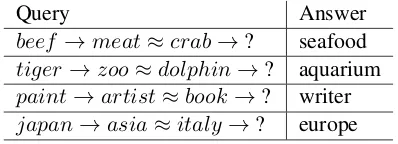
Query Answer
beef →meat≈crab→? seafood
tiger→zoo≈dolphin→? aquarium
paint→artist≈book→? writer
[image:1.595.317.516.289.361.2]japan→asia≈italy →? europe
Table 1: Unseen relation extraction examples for IsA, AtLocation, CreatedBy, and PartOf (top row to bottom row) in ConceptNet. The answers are not appeared in training.
decision about the existence of relation, there has been less work focusing on hypernym extraction task. It is a challenging task to automatically ex-tract all possible hypernyms of a given hyponym query, especially the unlabeled ones, from the vo-cabularies.
Classification-based models are not applicable for this task because the complexity of inference is O(V), where V is the size of vocabulary that often scales to billions.
Among the existing solutions, projection-based methods (Fu et al., 2014; Yamane et al., 2016;
Espinosa-Anke et al., 2016;Ustalov et al.,2017) emphasize on hypernym extraction which intu-itively represent a relation asy−x according to the linear structure of word embedding. By di-rectly learning a linear mapping Φ between two words such thatxΦ = y, the predictionyˆcan be obtained with nearest neighbor search for xΦ in the word embedding space. Moreover, the poten-tial candidates ofyare not required to be seen in advance so that the method can be used to predict unseen hypernym directly.
cluster structures in relation representationy−x
and propose to learn a piecewise linear mapping such thatxΦk = yfor each clusterCk. Their ex-periments show that domain clustering on training offset is very useful for hypernym identification.
However, we observe that each cluster contains very few distinct hypernyms. For instance, about 83% of the clusters contain fewer than 5 hyper-nyms for ConceptNet-IsA in our experiments. Hy-pernyms can be seen as the collections of related word pairs, e.g., IsA(dog, animal), IsA(cat, ani-mal), IsA(horse, animal), ... etc. The piecewise projection matrices can hardly learn the inference between hyponyms and hypernyms but only mem-orizesome words which serve as the hypernyms in the training data. Inevitably, the state-of-the-art models using piecewise projection learning face generalization problem and fail to predict unseen hypernyms correctly.
We design a novel Word Relation Autoen-coder (WRAE)framework, which adopts the con-ditional autoencoder structure (x → r → x0) that encodes hyponyms and reconstructs itself by de-coding fromr = y−x. The weights of encoder are further tied with decoder which is imposed to learn how to separate the hypernym and the hy-ponym from the relation vectors and extract the hyponym x with the intention to optimize recon-struction loss, thus effectively mitigates the men-tioned generalization problem.
We summarize our main contributions as fol-lows: (1) We propose a novel, yet more general scenario for relation extraction to handle unseen hypernyms. (2) We propose an intuitive pollu-tion indicator that allows us to empirically mea-sure whether the model learns the inference be-tween a relation pair or not. (3) We propose a novel Word Relation Autoencoder (WRAE) which can effectively reduce pollution. We conduct thor-ough experiments to show that our model outper-forms the competitors, and can be applied to other hypernym-like relations.
2 Related Work
Fu et al.(2014) first apply projection learning for generalized hypernym extraction by learning a lin-ear transformation from a hyponym word embed-ding to the corresponembed-ding hypernym word vector. They further conduct piecewise projection learn-ing, i.e., learning a projection matrix for each clus-ter and harvest significant improvements by first
applyingk-means clustering. They perform train-ing with stochastic gradient descent methods, im-plying good potential for attaching different reg-ularizers for optimization. Several recent works also follow the schema as the one proposed by
Espinosa-Anke et al.(2016) and operate the sim-ilar model at the sense level and took advan-tage of domain clustering to discover hypernyms through domain adaption between different top-ics. Yamane et al. (2016) focus on improving the performance through better cluster assignments by learning clustering and the projections jointly.
Ustalov et al. (2017) propose several regulariza-tion terms in addiregulariza-tion to the original loss funcregulariza-tion (Fu et al.,2014) using extra synonym pairs or the asymmetric property of hypernym. Nayak(2015) provides detailed technical studies on piecewise projection models.
Our work differs from all of them, as we empha-size on the setting that all hyponyms and hyper-nyms in testing vocabulary are not seen in train-ing.
3 Model Formulation
3.1 Piecewise Projection
Piecewise projection learning (Fu et al., 2014) serves as our baseline. The objective is to learn a relation transform fromxtoyon training pairs
(x, y). Piecewise projection matrixΦkis learned separately for each cluster, after applyingk-means clustering on the offset of training usingy−x be-tween each pair.
min Φk
1 |Ck|
X
(x,y)∈Ck
kxΦk−yk22, (1)
where Ck represents the size of the kth cluster. In addition, we also examine a simple solution of L2-penalized projection learning model which imposes a L2 constraint onΦin Equation1, i.e.,
αkΦkk22.
3.2 Word Relation Autoencoder (WRAE)
Our model takes the form of an autoencoder. As shown in Equation2,
min Φk
1 |Ck|
X
(x,y)∈Ck
kx−xΦkΦ∗kk 2
2, (2)
the L2-norm regularization term is not necessary for WRAE to avoid overfitting since the constraint ofΦ∗ = ΦT guaranteeskΦk22cannot be large oth-erwise the reconstruction loss will be bad. Also, the learning process is more efficient.
To release the constraint of xΦk = y−x, the objective can be further split into two terms:
min Φk
1 |Ck|
X
(x,y)∈Ck
(kxΦk−(y−x)k22
+λ(y−x)ΦTk −x
2 2),
(3)
whereλis a weighting constant.
We find that learning relation mapping from
x→(y−x)instead ofx→yeffectively mitigates the pollution problem (Lazaridou et al., 2015). A prediction is said to be polluted if the nearest neighbor of predictedyˆmatches a hypernym ap-peared in training set. The operation fundamen-tally solves the cause of pollution since each pair of input and output becomes(x, y−x)instead of
(x, y). Unlike projecting to a small number of tar-gety, the targety−xobviously differs from pair to pair thus avoiding simply overfitting the lexicons.
Conceptually, WRAE learns to extract the hy-ponym xfrom the relation vectorsr = y−x to optimize on the reconstruction loss. By encourag-ing the projection to learn the relationship between a word pair, WRAE effectively mitigates the men-tioned generalized problem.
Our model is related to Semantic Autoencoder (SAE) (Kodirov et al.,2017b). With the latent re-lation directly associates with inputx, WRAE can be regarded as a special conditional SAE where the condition is the input itself and is incorporated into the middle layer.
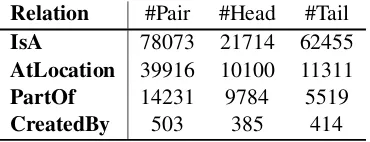
Relation #Pair #Head #Tail
IsA 78073 21714 62455
AtLocation 39916 10100 11311
PartOf 14231 9784 5519
[image:3.595.90.275.552.623.2]CreatedBy 503 385 414
Table 2: Relations from ConceptNet. For a relation pair
x→y,xis thehead andyis thetail.
4 Experiments
4.1 Setup
Different from the experimental setup in previous works (Fu et al., 2014;Ustalov et al., 2017; Ya-mane et al.,2016) that do not assume the candi-date hypernyms are unseen, in our experiments the
vocabulary sets for training and testing are com-pletely disjoint, i.e., all vocabularies in testing are not seen in training at all.
To further examine the generality of our model, we collect several hypernym-like relations listed in Table2from ConceptNet semantic graph. Con-sidering the property of these relations, we treat the head and tail words of a pair as the x and y
for our models similar to hyponym and hypernym, respectively. Examples are in Table1.
We split the datasets with ratios 0.7, 0.2, and 0.1 for training, testing, and validation, respec-tively. For all results, we report the mean of 30 random splits. We test two different settings, one usesk-means clustering and one does not (k= 1). We tune the number of cluster k unsupervisedly with the Silhouette score (Rousseeuw, 1987) on validation. The projection matrices are optimized with the Adam method (Kingma and Ba, 2014) with learning rate = 1e−3. We adopt the GloVe (Pennington et al., 2014) 300d pre-trained word embeddings1 which are trained on 6B token cor-pus (Wikipedia 2014 + Gigaword 5) with 400,000 words.
4.2 Evaluation Metrics
Hit Rate
To evaluate the precision of returned hypernyms, we followUstalov et al.(2017) andKodirov et al.
(2017a) using the hit rate measure (Frome et al.,
2013). We also adopt area under curve (AUC) measure which computes the averaged area under thel−1trapezoids of hit@lto take the ranks of ground truth into consideration:
AU Cl =
1 2(l−1)
l−1
X
i=1
(hit@i+hit@(i+ 1)),
(4)
Soft Pollution
To evaluate the degree of pollution of the extracted hypernym, we adopt a metric similar toLazaridou et al. (2015). A prediction is said to be polluted if the nearest neighbor of predicted yˆmatches a hypernym appears in the training set, noted as a binary functionpol1(ˆy).
However, it is possible that ground truth unseen hypernyms are be very close to some seen hyper-nyms inYtrainin real cases. We take ground truths
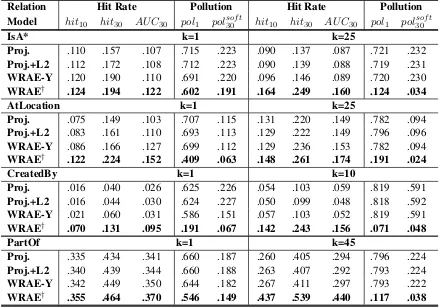
Relation Hit Rate Pollution Hit Rate Pollution Model hit10 hit30 AU C30 pol1 pol30sof t hit10 hit30 AU C30 pol1 polsof t30
IsA* k=1 k=25
Proj. .110 .157 .107 .715 .223 .090 .137 .087 .721 .232
Proj.+L2 .112 .172 .108 .712 .223 .090 .139 .088 .719 .231
WRAE-Y .120 .190 .110 .691 .220 .096 .146 .089 .720 .230
WRAE† .124 .194 .122 .602 .191 .164 .249 .160 .124 .034
AtLocation k=1 k=25
Proj. .075 .149 .103 .707 .115 .131 .220 .149 .782 .094
Proj.+L2 .083 .161 .110 .693 .113 .129 .222 .149 .796 .096
WRAE-Y .086 .166 .127 .699 .112 .129 .236 .153 .782 .094
WRAE† .122 .224 .152 .409 .063 .148 .261 .174 .191 .024
CreatedBy k=1 k=10
Proj. .016 .040 .026 .625 .226 .054 .103 .059 .819 .591
Proj.+L2 .016 .044 .030 .624 .227 .050 .099 .048 .818 .592
WRAE-Y .021 .060 .031 .586 .151 .057 .103 .052 .819 .591
WRAE† .070 .131 .095 .191 .067 .142 .243 .156 .071 .048
PartOf k=1 k=45
Proj. .335 .434 .341 .660 .187 .260 .405 .294 .796 .224
Proj.+L2 .340 .439 .344 .660 .188 .263 .407 .292 .793 .224
WRAE-Y .342 .449 .350 .644 .182 .267 .411 .297 .793 .222
[image:4.595.79.519.64.371.2]WRAE† .355 .464 .370 .546 .149 .437 .539 .440 .117 .038
Table 3: Performance on ConceptNet relation dataset. †: all results pass the hypothesis test against the other models withp <0.01. *: for IsA, we report hit@5 and hit@10. For hit rates, the higher the better. For pollution, the lower the better.
into consideration:
pollsof t(ˆy, y) =ρ·pol1(ˆy), y ∈Ytest,
ρ= (
1, if N Nl(y)∩Ytrain =φ,
2nl−−11 −1, otherwise,
(5)
wheren is for the topnnearest neighbors (from 1 to l) of y that appears in Ytrain and ρ is a factor term exponentially decreases from 1 to 0
along with the increase ofntherefore provides a smoother estimation. With pollution indications, one can understand to what degree the model suf-fers from overfitting on the seen examples.φis the empty set. Note that it is reasonable to setlequal for both hit rate and soft pollution.
4.3 Results: Unseen General Hypernym-Like Relation Extraction
We report two sets of results for all models, one with clustering and one without (k = 1). As shown in Table 3, WRAE outperforms the com-petitors significantly with and without clustering. The naive application of Equation 2 which set
xΦk =y, denoted asWRAE-Y, consistently ranks
second. They −x operation is crucial to avoid pollution thus guarantees the generalization power of the mapping. Apply simple L2-norm regular-ization Equation1forProj., denoted asProj.+L2, only slightly improves the performance. The re-sults in Table3supports our hypothesis that Proj. models deteriorate significantly for largerk, due to lack of training examples for hypernyms in each cluster. We prove that WRAE is effective against pollution. The role of regularizer is important for decoders to optimize towards better objective.
The negative effects derived from pollution im-pact accuracy. We observe severe pollution prob-lem in simple projection learning. Take IsA as example, in k = 1group the pol1 is about 71% for Proj., which implies about two of out of three returned predictions are data points from training data. Our WRAE reduces the pollution pol1 to 60% and 12% after clustering. The improvement on accuracy supports that pollution indication re-flects the inherent overfitting problem. In general, results are consistent with our claims that pollution can be viewed as valid negative indicators.
ben-efit from domain clustering if pollution is handled properly as the experiments showed.
5 Conclusion
We present an unseen hypernym extraction frame-work and analyze the pollution problem with this setup. Consequently we argue that only by us-ing unseen candidates in evaluation can truly test whether the model learns the true relation repre-sentation, instead of being polluted by the seen training examples. Future work includes relation discovery, which is to identify new relations be-sides hypernyms in an unsupervised manner.
Acknowledgments
This material is based upon work supported by Taiwan Ministry of Science and Technology (MOST) under grant number 1062218E002 -042 (machine learning related).
References
Luis Espinosa-Anke, Jos´e Camacho Collados, Clau-dio Delli Bovi, and Horacio Saggion. 2016. Super-vised Distributional Hypernym Discovery via Do-main Adaptation. InProceedings of the 2016 Con-ference on Empirical Methods in Natural Language Processing (EMNLP 2016), pages 424–435.
C Fellbaum. 1998. WordNet: An Electronic Lexical Database: Bradford Book. Cambridge, MA: MIT Press.
Andrea Frome, Gs Corrado, and Jonathon Shlens. 2013. Devise: A deep visual-semantic embedding model. Advances in neural information processing systems, pages 1–11.
Ruiji Fu, Jiang Guo, Bing Qin, Wanxiang Che, Haifeng Wang, and Ting Liu. 2014. Learning semantic hier-archies via word embeddings. InProceedings of the 52nd Annual Meeting of the Association for Compu-tational Linguistics (Volume 1: Long Papers), pages 1199–1209. Baltimore, Maryland.
Diederik P. Kingma and Jimmy Ba. 2014. Adam: A Method for Stochastic Optimization.
arXiv:1412.6980 [cs.LG].
Elyor Kodirov, Tao Xiang, and Shaogang Gong. 2017a. Semantic Autoencoder for Zero-Shot Learning. In
Computer Vision and Pattern Recognition. Com-puter Vision Foundation.
Elyor Kodirov, Tao Xiang, and Shaogang Gong. 2017b. Semantic autoencoder for zero-shot learning.
Angeliki Lazaridou, Georgiana Dinu, and Marco Ba-roni. 2015. Hubness and Pollution: Delving into
Cross-Space Mapping for Zero-Shot Learning. In
Proceedings of the 53rd Annual Meeting of the Association for Computational Linguistics and the 7th International Joint Conference on Natural Lan-guage Processing, pages 270–280. Association for Computational Linguistics.
Alessandro Lenci and Giulia Benotto. 2012. Identi-fying hypernyms in distributional semantic spaces. InProceedings of the Sixth International Workshop on Semantic Evaluation, SemEval ’12, pages 75–79, Stroudsburg, PA, USA. Association for Computa-tional Linguistics.
Omer Levy, Steffen Remus, Chris Biemann, and Ido Dagan. 2015. Do supervised distributional meth-ods really learn lexical inference relations? In Pro-ceedings of the 2015 Conference of the North Amer-ican Chapter of the Association for Computational Linguistics: Human Language Technologies, pages 970–976. Association for Computational Linguis-tics.
Neha Nayak. 2015. Learning hypernymy over word embeddings. Technical report, Stanford Univ.
Jeffrey Pennington, Richard Socher, and Christo-pher D. Manning. 2014. Glove: Global Vectors for Word Representation. In Proceedings of the 2014 Conference on Empirical Methods in Natural Language Processing (EMNLP 2014), pages 1532– 1543.
Marc’aurelio Ranzato, Y lan Boureau, and Yann Le-cun. 2008. Sparse Feature Learning for Deep Belief Networks. InAdvances in Neural Information Pro-cessing Systems 20 (NIPS 2007), pages 1185–1192. Curran Associates, Inc.
Peter J Rousseeuw. 1987. Silhouettes: a graphical aid to the interpretation and validation of cluster anal-ysis. Journal of computational and applied mathe-matics, 20:53–65.
Robert Speer and Catherine Havasi. 2012. Represent-ing General Relational Knowledge in ConceptNet 5. In International conference on language resources and evaluation (LREC), pages 3679–3686.
Dmitry Ustalov, Nikolay Arefyev, Chris Biemann, and Alexander Panchenko. 2017. Negative Sampling Improves Hypernymy Extraction Based on Projec-tion Learning. InProceedings of the 15th Confer-ence of the European Chapter of the Association for Computational Linguistics (EACL 2017), pages 543–550, Valencia, Spain. Association for Compu-tational Linguistics.
Julie Weeds, Daoud Clarke, Jeremy Reffin, David Weir, and Bill Keller. 2014. Learning to Distinguish Hypernyms and Co-Hyponyms. In Proceedings of the 25th International Conference on Compu-tational Linguistics (COLING 2014), pages 2249– 2259, Dublin, Ireland. Dublin City University and Association for Computational Linguistics.