Painless Semi-Supervised Morphological Segmentation using Conditional
Random Fields
Teemu Ruokolainena Oskar Kohonenb Sami Virpiojab Mikko Kurimoa aDepartment of Signal Processing and Acoustics, Aalto University
b Department of Information and Computer Science, Aalto University [email protected]
Abstract
We discuss data-driven morphological segmentation, in which word forms are segmented into morphs, that is the surface forms of morphemes. We extend a re-cent segmentation approach based on con-ditional random fields from purely super-vised to semi-supersuper-vised learning by ex-ploiting available unsupervised segmenta-tion techniques. We integrate the unsu-pervised techniques into the conditional random field model via feature set aug-mentation. Experiments on three di-verse languages show that this straight-forward semi-supervised extension greatly improves the segmentation accuracy of the purely supervised CRFs in a computation-ally efficient manner.
1 Introduction
We discuss data-driven morphological segmenta-tion, in which word forms are segmented into morphs, the surface forms of morphemes. This type of morphological analysis can be useful for alleviating language model sparsity inherent to morphologically rich languages (Hirsimäki et al., 2006; Creutz et al., 2007; Turunen and Kurimo, 2011; Luong et al., 2013). Particularly, we focus on a low-resource learning setting, in which only a small amount of annotated word forms are avail-able for model training, while unannotated word forms are available in abundance.
We study morphological segmentation using conditional random fields (CRFs), a discrimina-tive model for sequential tagging and segmenta-tion (Lafferty et al., 2001). Recently, Ruoko-lainen et al. (2013) showed that the CRFs can yield competitive segmentation accuracy com-pared to more complex, previous state-of-the-art techniques. While CRFs yielded generally
the highest accuracy compared to their reference methods (Poon et al., 2009; Kohonen et al., 2010), on the smallest considered annotated data sets of 100 word forms, they were outperformed by the semi-supervised Morfessor algorithm (Kohonen et al., 2010). However, Ruokolainen et al. (2013) trained the CRFs solely on the annotated data, without any use of the available unannotated data. In this work, we extend the CRF-based ap-proach to leverage unannotated data in a straight-forward and computationally efficient manner via
feature set augmentation, utilizing predictions of
unsupervised segmentation algorithms. Experi-ments on three diverse languages show that the semi-supervised extension substantially improves the segmentation accuracy of the CRFs. The ex-tension also provides higher accuracies on all the considered data set sizes and languages compared to the semi-supervised Morfessor (Kohonen et al., 2010).
In addition to feature set augmentation, there exists numerous approaches for semi-supervised CRF model estimation, exemplified by minimum entropy regularization (Jiao et al., 2006), gen-eralized expectations criteria (Mann and McCal-lum, 2008), and posterior regularization (He et al., 2013). In this work, we employ the feature-based approach due to its simplicity and the availabil-ity of useful unsupervised segmentation methods. Varying feature set augmentation approaches have been successfully applied in several related tasks, such as Chinese word segmentation (Wang et al., 2011; Sun and Xu, 2011) and chunking (Turian et al., 2010).
The paper is organized as follows. In Section 2, we describe the CRF-based morphological seg-mentation approach following (Ruokolainen et al., 2013), and then show how to extend this approach to leverage unannotated data in an efficient man-ner. Our experimental setup and results are dis-cussed in Sections 3 and 4, respectively. Finally,
we present conclusions on the work in Section 5.
2 Methods
2.1 Supervised Morphological Segmentation using CRFs
We present the morphological segmentation task as a sequential labeling problem by assigning each character to one of three classes, namely { be-ginning of a multi-character morph (B), middle of a multi-character morph (M),single character morph (S)}. We then perform the sequential label-ing uslabel-ing linear-chain CRFs (Lafferty et al., 2001). Formally, the linear-chain CRF model distribu-tion for label sequencey = (y1, y2, . . . , yT) and a word formx = (x1, x2, . . . , xT) is written as a
conditional probability
p(y|x;w)∝ T
Y
t=2
expw·φ(yt−1, yt, x, t)
,
(1) wheretindexes the character positions,wdenotes the model parameter vector, and φ the vector-valued feature extracting function. The model pa-rametersware estimated discrimatively based on a training set of exemplar input-output pairs(x, y) using, for example, the averaged perceptron algo-rithm (Collins, 2002). Subsequent to estimation, the CRF model segments test word forms using the Viterbi algorithm (Lafferty et al., 2001).
We next describe the feature set
{φi(yt−1, yt, x, t)}|i=1φ| by defining emission andtransitionfeatures. Denoting the label set {B, M, S} asY, the emission feature set is defined as
{χm(x, t)1(yt=y0t)|m∈1..M ,∀y0t∈ Y},
(2) where the indicator function 1(yt = yt0) returns
one if and only ifyt =y0
tand zero otherwise, that
is
1(yt=yt0) =
1 if yt=y0
t
0 otherwise , (3)
and{χm(x, t)}Mm=1is the set of functions
describ-ing the character position t. Following Ruoko-lainen et al. (2013), we employ binary functions that describe the positiontof wordxusing all left and right substrings up to a maximum length δ. The maximum substring lengthδmaxis considered a hyper-parameter to be adjusted using a develop-ment set. While the emission features associate the input to labels, the transition feature set
{1(yt−1 =yt0−1)1(yt=y0t)|yt0, yt0−1∈ Y} (4)
captures the dependencies between adjacent labels as irrespective of the inputx.
2.2 Leveraging Unannotated Data
In order to utilize unannotated data, we explore a straightforward approach based on feature set aug-mentation. We exploitpredictions of unsupervised segmentation algorithms by defining variants of the featuresdescribed in Section 2.1. The idea is to compensate the weaknesses of the CRF model trained on the small annotated data set using the strengths of the unsupervised methods that learn from large amounts of unannotated data.
For example, consider utilizing predictions of the unsupervised Morfessor algorithm (Creutz and Lagus, 2007) in the CRF model. In order to ac-complish this, we first learn the Morfessor model from the unannotated training data, and then ap-ply the learned model on the word forms in the annotated training set. Assuming the annotated training data includes the English word drivers, the Morfessor algorithm might, for instance, re-turn a (partially correct) segmentationdriv + ers. We present this segmentation by defining a func-tionυ(t), which returns 0 or 1, if the positiontis in the middle of a segment or in the beginning of a segment, respectively, as in
t 1 2 3 4 5 6 7
xt d r i v e r s
υ(t) 1 0 0 0 1 0 0
Now, given a set ofU functions{υu(t)}Uu=1, we
define variants of the emission features in (2) as
{υu(x, t)χm(x, t)1(yt=yt0)| ∀u∈1..U ,∀m∈1..M ,∀y0
t∈ Y}. (5)
By adding the expanded features of form (5), the CRF model learns to associate the output of the unsupervised algorithms in relation to the sur-rounding substring context. Similarly, an ex-panded transition feature is written as
{υu(x, t)1(yt−1 =yt0−1)1(yt=y0t)| ∀u∈1..U ,∀y0
t, yt0−1∈ Y}. (6)
segmentation of compound words (for example,
brain+storm), which are modeled with high ac-curacy by the unsupervised Morfessor algorithm (Creutz and Lagus, 2007), but can not be learned from the small number of annotated examples available for the supervised CRF training.
As another example of a means to augment the feature set, we make use of the fact that the output of the unsupervised algorithms does not have to be binary (zeros and ones). To this end, we employ the classic letter successor variety (LSV) scores presented originally by (Harris, 1955).1 The LSV
scores utilize the insight that the predictability of successive letters should be high within morph segments, and low at the boundaries. Conse-quently, a high variety of letters following a prefix indicates a high probability of a boundary. We use a variant of the LSV values presented by Çöltekin (2010), in which we first normalize the scores by the average score at each position t, and subse-qently logarithmize the normalized value. While LSV score tracks predictability given prefixes, the same idea can be utilized for suffixes, providing the letter predecessor variety (LPV). Subsequent to augmenting the feature set using the functions
LSV(t) and LP V(t), the CRF model learns to associate high successor and predecessor values (low predictability) to high probability of a seg-ment boundary. Appealingly, the Harris features can be obtained in a computationally inexpensive manner, as they merely require counting statistics from the unannotated data.
The feature set augmentation approach de-scribed above is computationally efficient, if the computational overhead from the unsupervised methods is small. This is because the CRF param-eter estimation is still based on the small amount of labeled examples as described in Section 2.1, while the number of features incorporated in the CRF model (equal to the number of parameters) grows linearly in the number of exploited unsu-pervised algorithms.
3 Experimental Setup
3.1 Data
We perform the experiments on the Morpho Chal-lenge 2009/2010 data set (Kurimo et al., 2009;
Ku-1We also experimented on modifying the output of the Morfessor algorithm from binary to probabilistic, but these soft cues provided no consistent advantage over the standard binary output.
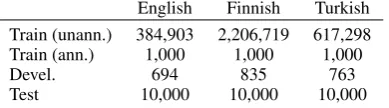
English Finnish Turkish Train (unann.) 384,903 2,206,719 617,298 Train (ann.) 1,000 1,000 1,000
Devel. 694 835 763
[image:3.595.321.516.63.117.2]Test 10,000 10,000 10,000
Table 1: Number of word types in the Morpho Challenge data set.
rimo et al., 2010) consisting of manually prepared morphological segmentations in English, Finnish and Turkish. We follow the experiment setup, in-cluding data partitions and evaluation metrics, de-scribed by Ruokolainen et al. (2013). Table 1 shows the total number of instances available for model estimation and testing.
3.2 CRF Feature Extraction and Training
The substring features included in the CRF model are described in Section 2.1. We include all sub-strings which occur in the training data. The Mor-fessor and Harris (successor and predecessor va-riety) features employed by the semi-supervised extension are described in Section 2.2. We ex-perimented on two variants of the Morfessor al-gorithm, namely, the Morfessor Baseline (Creutz and Lagus, 2002) and Morfessor Categories-MAP (Creutz and Lagus, 2005), CatMAP for short. The Baseline models were trained on word types and the perplexity thresholds of the CatMAP models were set equivalently to the reference runs in Mor-pho Challenge 2010 (English: 450, Finnish: 250, Turkish: 100); otherwise the default parameters were used. The Harris features do not require any hyper-parameters.
The CRF model (supervised and semi-supervised) is trained using the averaged perceptron algorithm (Collins, 2002). The num-ber of passes over the training set made by the perceptron algorithm, and the maximum length of substring features are optimized on the held-out development sets.
3.3 Reference Methods
We compare our method’s performance with the fully supervised CRF model and the semi-supervised Morfessor algorithm (Kohonen et al., 2010). For semi-supervised Morfessor, we use the Python implementation by Virpioja et al. (2013).
4 Results
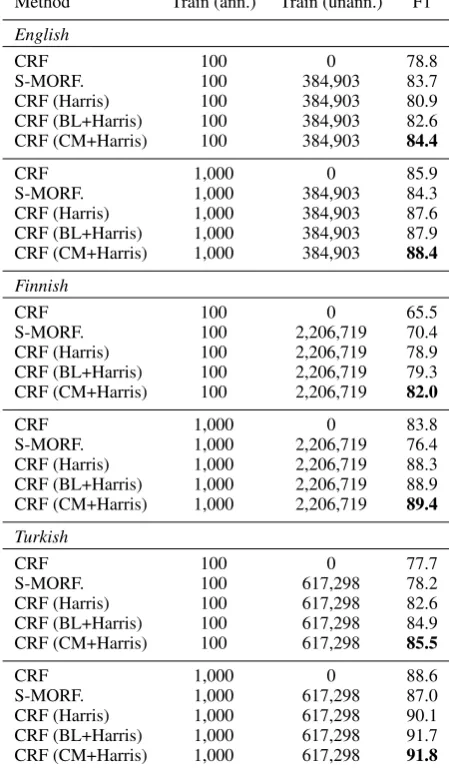
Segmentation accuracies for all languages are pre-sented in Table 2. The columns titledTrain (ann.)
and Train (unann.) denote the number of anno-tated and unannoanno-tated training instances utilized by the method, respectively. To summarize, the semi-supervised CRF extension greatly improved the segmentation accuracy of the purely super-vised CRFs, and also provided higher accuracies compared to the semi-supervised Morfessor algo-rithm2.
Appealingly, the semi-supervised CRF exten-sion already provided consistent improvement over the supervised CRFs, when utilizing the com-putationally inexpensive Harris features. Addi-tional gains were then obtained using the Morfes-sor features. On all languages, highest accuracies were obtained using a combination of Harris and CatMAP features.
Running the CRF parameter estimation (includ-ing hyper-parameters) consumed typically up to a few minutes. Computing statistics for the Harris features also took up roughly a few minutes on all languages. Learning the unsupervised Mor-fessor algorithm consumed 3, 47, and 20 min-utes for English, Finnish, and Turkish, respec-tively. Meanwhile, CatMAP model estimation was considerably slower, consuming roughly 10, 50, and 7 hours for English, Finnish and Turkish, respectively. Training and decoding with semi-supervised Morfessor took 21, 111, and 47 hours for English, Finnish and Turkish, respectively.
5 Conclusions
We extended a recent morphological segmenta-tion approach based on CRFs from purely super-vised to semi-supersuper-vised learning. We accom-plished this in an efficient manner using feature set augmentation and available unsupervised segmen-tation techniques. Experiments on three diverse
2The improvements over the supervised CRFs and semi-supervised Morfessor were statistically significant (confi-dence level 0.95) according to the standard 1-sided Wilcoxon signed-rank test performed on 10 randomly divided, non-overlapping subsets of the complete test sets.
Method Train (ann.) Train (unann.) F1 English
CRF 100 0 78.8
S-MORF. 100 384,903 83.7
CRF (Harris) 100 384,903 80.9
CRF (BL+Harris) 100 384,903 82.6 CRF (CM+Harris) 100 384,903 84.4
CRF 1,000 0 85.9
S-MORF. 1,000 384,903 84.3
CRF (Harris) 1,000 384,903 87.6
CRF (BL+Harris) 1,000 384,903 87.9 CRF (CM+Harris) 1,000 384,903 88.4
Finnish
CRF 100 0 65.5
S-MORF. 100 2,206,719 70.4
CRF (Harris) 100 2,206,719 78.9
CRF (BL+Harris) 100 2,206,719 79.3 CRF (CM+Harris) 100 2,206,719 82.0
CRF 1,000 0 83.8
S-MORF. 1,000 2,206,719 76.4
CRF (Harris) 1,000 2,206,719 88.3 CRF (BL+Harris) 1,000 2,206,719 88.9 CRF (CM+Harris) 1,000 2,206,719 89.4
Turkish
CRF 100 0 77.7
S-MORF. 100 617,298 78.2
CRF (Harris) 100 617,298 82.6
CRF (BL+Harris) 100 617,298 84.9 CRF (CM+Harris) 100 617,298 85.5
CRF 1,000 0 88.6
S-MORF. 1,000 617,298 87.0
CRF (Harris) 1,000 617,298 90.1
[image:4.595.306.531.67.454.2]CRF (BL+Harris) 1,000 617,298 91.7 CRF (CM+Harris) 1,000 617,298 91.8
Table 2: Results on test data. CRF (BL+Harris)
denotes semi-supervised CRF extension using Morfessor Baseline and Harris features, while
CRF (CM+Harris) denotes CRF extension em-ploying Morfessor CatMAP and Harris features.
languages showed that this straightforward semi-supervised extension greatly improves the seg-mentation accuracy of the supervised CRFs, while being computationally efficient. The extension also outperformed the semi-supervised Morfessor algorithm on all data set sizes and languages.
Acknowledgements
References
Michael Collins. 2002. Discriminative training meth-ods for hidden Markov models: Theory and experi-ments with perceptron algorithms. InProceedings of the 2002 Conference on Empirical Methods in Natural Language Processing (EMNLP 2002), vol-ume 10, pages 1–8. Association for Computational Linguistics.
Çagrı Çöltekin. 2010. Improving successor variety for morphological segmentation. InProceedings of the 20th Meeting of Computational Linguistics in the Netherlands.
Mathias Creutz and Krista Lagus. 2002. Unsupervised discovery of morphemes. In Mike Maxwell, editor, Proceedings of the ACL-02 Workshop on Morpho-logical and PhonoMorpho-logical Learning, pages 21–30, Philadelphia, PA, USA, July. Association for Com-putational Linguistics.
Mathias Creutz and Krista Lagus. 2005. Inducing the morphological lexicon of a natural language from unannotated text. In Timo Honkela, Ville Könönen, Matti Pöllä, and Olli Simula, editors,Proceedings of AKRR’05, International and Interdisciplinary Con-ference on Adaptive Knowledge Representation and Reasoning, pages 106–113, Espoo, Finland, June. Helsinki University of Technology, Laboratory of Computer and Information Science.
Mathias Creutz and Krista Lagus. 2007. Unsuper-vised models for morpheme segmentation and mor-phology learning. ACM Transactions on Speech and Language Processing, 4(1):3:1–3:34, January. Mathias Creutz, Teemu Hirsimäki, Mikko Kurimo,
Antti Puurula, Janne Pylkkönen, Vesa Siivola, Matti Varjokallio, Ebru Arisoy, Murat Saraçlar, and An-dreas Stolcke. 2007. Morph-based speech recog-nition and modeling of out-of-vocabulary words across languages. ACM Transactions on Speech and Language Processing, 5(1):3:1–3:29, December. Zellig Harris. 1955. From phoneme to morpheme.
Language, 31(2):190–222.
Luheng He, Jennifer Gillenwater, and Ben Taskar. 2013. Graph-based posterior regularization for semi-supervised structured prediction. In Proceed-ings of the Seventeenth Conference on Computa-tional Natural Language Learning, pages 38–46, Sofia, Bulgaria, August. Association for Computa-tional Linguistics.
Teemu Hirsimäki, Mathias Creutz, Vesa Siivola, Mikko Kurimo, Sami Virpioja, and Janne Pylkkönen. 2006. Unlimited vocabulary speech recognition with morph language models applied to Finnish. Computer Speech and Language, 20(4):515–541, October.
Feng Jiao, Shaojun Wang, Chi-Hoon Lee, Russell Greiner, and Dale Schuurmans. 2006. Semi-supervised conditional random fields for improved
sequence segmentation and labeling. In Proceed-ings of the 21st International Conference on Com-putational Linguistics and the 44th annual meeting of the Association for Computational Linguistics, pages 209–216. Association for Computational Lin-guistics.
Oskar Kohonen, Sami Virpioja, and Krista Lagus. 2010. Semi-supervised learning of concatenative morphology. InProceedings of the 11th Meeting of the ACL Special Interest Group on Computational Morphology and Phonology, pages 78–86, Uppsala, Sweden, July. Association for Computational Lin-guistics.
Mikko Kurimo, Sami Virpioja, Ville Turunen, Graeme W. Blackwood, and William Byrne. 2009. Overview and results of Morpho Challenge 2009. In Working Notes for the CLEF 2009 Workshop, Corfu, Greece, September.
Mikko Kurimo, Sami Virpioja, and Ville Turunen. 2010. Overview and results of Morpho Chal-lenge 2010. In Proceedings of the Morpho Chal-lenge 2010 Workshop, pages 7–24, Espoo, Finland, September. Aalto University School of Science and Technology, Department of Information and Com-puter Science. Technical Report TKK-ICS-R37.
John Lafferty, Andrew McCallum, and Fernando Pereira. 2001. Conditional random fields: Prob-abilistic models for segmenting and labeling se-quence data. In Carla E. Brodley and Andrea Po-horeckyj Danyluk, editors,Proceedings of the Eigh-teenth International Conference on Machine Learn-ing, pages 282–289, Williamstown, MA, USA. Mor-gan Kaufmann.
Minh-Thang Luong, Richard Socher, and Christo-pher D Manning. 2013. Better word representa-tions with recursive neural networks for morphol-ogy. In Proceedings of the Seventeenth Confer-ence on Computational Natural Language Learning (CoNLL), pages 29–37. Association for Computa-tional Linguistics, August.
Gideon Mann and Andrew McCallum. 2008. General-ized expectation criteria for semi-supervised learn-ing of conditional random fields. In Proceedings of ACL-08: HLT, pages 870–878. Association for Computational Linguistics.
Hoifung Poon, Colin Cherry, and Kristina Toutanova. 2009. Unsupervised morphological segmentation with log-linear models. In Proceedings of Human Language Technologies: The 2009 Annual Confer-ence of the North American Chapter of the Associa-tion for ComputaAssocia-tional Linguistics, pages 209–217. Association for Computational Linguistics.
the Seventeenth Conference on Computational Nat-ural Language Learning (CoNLL), pages 29–37. As-sociation for Computational Linguistics, August. Weiwei Sun and Jia Xu. 2011. Enhancing Chinese
word segmentation using unlabeled data. In Pro-ceedings of the Conference on Empirical Methods in Natural Language Processing, pages 970–979. As-sociation for Computational Linguistics.
Joseph Turian, Lev Ratinov, and Yoshua Bengio. 2010. Word representations: a simple and general method for semi-supervised learning. InProceedings of the 48th Annual Meeting of the Association for Compu-tational Linguistics, pages 384–394. Association for Computational Linguistics.
Ville Turunen and Mikko Kurimo. 2011. Speech re-trieval from unsegmented Finnish audio using statis-tical morpheme-like units for segmentation, recog-nition, and retrieval. ACM Transactions on Speech and Language Processing, 8(1):1:1–1:25, October. Sami Virpioja, Peter Smit, Stig-Arne Grönroos, and
Mikko Kurimo. 2013. Morfessor 2.0: Python im-plementation and extensions for Morfessor Baseline. Report 25/2013 in Aalto University publication se-ries SCIENCE + TECHNOLOGY, Department of Signal Processing and Acoustics, Aalto University. Yiou Wang, Yoshimasa Tsuruoka Jun’ichi Kazama,