Toward Statistical Machine Translation without Parallel Corpora
Alexandre Klementiev Ann Irvine Chris Callison-Burch David Yarowsky
Center for Language and Speech Processing Johns Hopkins University
Abstract
We estimate the parameters of a phrase-based statistical machine translation sys-tem frommonolingualcorpora instead of a
bilingualparallel corpus. We extend exist-ing research on bilexist-ingual lexicon induction to estimatebothlexical and phrasal trans-lation probabilities for MT-scale phrase-tables. We propose a novel algorithm to es-timate reordering probabilities from mono-lingual data. We report translation results for an end-to-end translation system us-ing these monolus-ingual features alone. Our method only requires monolingual corpora in source and target languages, a small bilingual dictionary, and a small bitext for tuning feature weights. In this paper, we ex-amine an idealization where a phrase-table is given. We examine the degradation in translation performance when bilingually estimated translation probabilities are re-moved and show that 80%+ of the loss can be recovered with monolingually estimated features alone. We further show that our monolingual features add 1.5 BLEU points when combined with standard bilingually estimated phrase table features.
1 Introduction
The parameters of statistical models of transla-tion are typically estimated from large bilingual parallel corpora (Brown et al., 1993). However, these resources are not available for most lan-guage pairs, and they are expensive to produce in quantities sufficient for building a good transla-tion system (Germann, 2001). We attempt an en-tirely different approach; we use cheap and plen-tiful monolingual resources to induce an end-to-end statistical machine translation system. In par-ticular, we extend the long line of work on in-ducing translation lexicons (beginning with Rapp (1995)) and propose to use multiple independent cues present in monolingual texts to estimate lex-ical and phrasal translation probabilities for large, MT-scale phrase-tables. We then introduce a
novel algorithm to estimate reordering features from monolingual data alone, and we report the performance of a phrase-based statistical model (Koehn et al., 2003) estimated using these mono-lingual features.
Most of the prior work on lexicon induction is motivated by the idea that it could be applied to machine translation but stops short of actu-ally doing so. Lexicon induction holds the po-tential to create machine translation systems for languages which do not have extensive parallel corpora. Training would only require two large monolingual corpora and a small bilingual dictio-nary, if one is available. The idea is that intrin-sic properties of monolingual data (possibly along with a handful of bilingual pairs to act as exam-ple mappings) can provide independent but infor-mative cues to learn translations because words (and phrases) behave similarly across languages. This work is the first attempt to extend and apply these ideas to an end-to-end machine translation pipeline. While we make an explicit assumption that a table of phrasal translations is given a priori, we induce every other parameter of a full phrase-based translation system from monolingual data alone. The contributions of this work are:
• In Section 2.2 we analyze the challenges of using bilingual lexicon induction for sta-tistical MT (performance on low frequency items, and moving from words to phrases).
• In Sections 3.1 and 3.2 we use multiple cues present in monolingual data to estimate lexi-cal and phrasal translation scores.
• In Section 3.3 we propose a novel algo-rithm for estimating phrase reordering fea-tures from monolingual texts.
• Finally, in Section 5 we systematically drop feature functions from a phrase table and then replace them with monolingually es-timated equivalents, reporting end-to-end translation quality.
2 Background
We begin with a brief overview of the stan-dard phrase-based statistical machine translation model. Here, we define the parameters which we later replace with monolingual alternatives. We continue with a discussion of bilingual lex-icon induction; we extend these methods to es-timate the monolingual parameters in Section 3. This approach allows us to replace expensive/rare bilingual parallel training data with two large monolingual corpora, a small bilingual dictionary, and ≈2,000 sentence bilingual development set, which are comparatively plentiful/inexpensive.
2.1 Parameters of phrase-based SMT
Statistical machine translation (SMT) was first formulated as a series of probabilistic mod-els that learn word-to-word correspondences from sentence-aligned bilingual parallel corpora (Brown et al., 1993). Current methods, includ-ingphrase-based(Och, 2002; Koehn et al., 2003) andhierarchicalmodels (Chiang, 2005), typically start by word-aligning a bilingual parallel cor-pus (Och and Ney, 2003). They extract multi-word phrases that are consistent with the Viterbi word alignments and use these phrases to build new translations. A variety of parameters are es-timated using the bitexts. Here we review the pa-rameters of the standard phrase-based translation model (Koehn et al., 2007). Later we will show how to estimate them using monolingual texts in-stead. These parameters are:
• Phrase pairs. Phrase extraction heuristics (Venugopal et al., 2003; Tillmann, 2003; Och and Ney, 2004) produce a set of phrase pairs(e, f)that are consistent with the word alignments. In this paper we assume that the phrase pairs are given (without any scores), and we induce every other parameter of the phrase-based model from monolingual data.
• Phrase translation probabilities. Each phrase pair has a list of associated fea-ture functions (FFs). These include phrase translation probabilities,φ(e|f)andφ(f|e), which are typically calculated via maximum likelihood estimation.
• Lexical weighting. Since MLE overestimates
φ for phrase pairs with sparse counts, lexi-cal weighting FFs are used to smooth.
Aver-How much should you charge for your
Wieviel sollte man aufrgund seines Profi
ls
in Facebook verdienen
profile s
d m m m
[image:2.595.318.508.72.262.2]d d
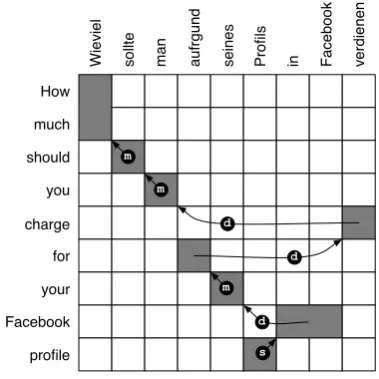
Figure 1: The reordering probabilities from the phrase-based models are estimated from bilingual data by cal-culating how often in the parallel corpus a phrase pair
(f, e)is orientated with the preceding phrase pair in the 3 types of orientations (monotone, swapped, and discontinuous).
age word translation probabilities,w(ei|fj), are calculated via phrase-pair-internal word alignments.
• Reordering model. Each phrase pair (e, f)
also has associated reordering parameters,
po(orientation|f, e), which indicate the dis-tribution of its orientation with respect to the previously translated phrase. Orientations aremonotone, swap, discontinuous(Tillman, 2004; Kumar and Byrne, 2004), see Figure 1.
• Other features. Other typical features are n-gram language model scores and a phrase penalty, which governs whether to use fewer longer phrases or more shorter phrases. These are not bilingually estimated, so we can re-use them directly without modifica-tion.
2.2 Bilingual lexicon induction for SMT
Bilingual lexicon inductiondescribes the class of algorithms that attempt to learn translations from monolingual corpora. Rapp (1995) was the first to propose using non-parallel texts to learn the translations of words. Using large, unrelated En-glish and German corpora (with 163m and 135m words) and a small German-English bilingual dic-tionary (with 22k entires), Rapp (1999) demon-strated that reasonably accurate translations could be learned for 100 German nouns that were not contained in the seed bilingual dictionary. His al-gorithm worked by (1) building a context vector representing an unknown German word by count-ing its co-occurrence with all the other words in the German monolingual corpus, (2) project-ing this German vector onto the vector space of English using the seed bilingual dictionary, (3) calculating the similarity of this sparse projected vector to vectors for English words that were con-structed using the English monolingual corpus, and (4) outputting the English words with the highest similarity as the most likely translations.
A variety of subsequent work has extended the original idea either by exploring different mea-sures of vector similarity (Fung and Yee, 1998) or by proposing other ways of measuring simi-larity beyond co-occurence within a context win-dow. For instance, Schafer and Yarowsky (2002) demonstrated that word translations tend to co-occurin timeacross languages. Koehn and Knight (2002) used similarityin spellingas another kind of cue that a pair of words may be translations of one another. Garera et al. (2009) defined context vectors usingdependency relationsrather than ad-jacent words. Bergsma and Van Durme (2011) used the visual similarity of labeled web images to learn translations of nouns. Additional related work on learning translations from monolingual corpora is discussed in Section 6.
In this paper, we apply bilingual lexicon in-duction methods to statistical machine translation. Given the obvious benefits of not having to rely on scarce bilingual parallel training data, it is sur-prising that bilingual lexicon induction has not been used for SMT before now. There are sev-eral open questions that make its applicability to SMT uncertain. Previous research on bilingual lexicon induction learned translations only for a small number of high frequency words (e.g. 100
●
● ●
● ● ● ● ●
●
0 100 200 300 400 500 600
0
10
20
30
40
Accur
acy
, %
Corpus Frequency
● Top 1
[image:3.595.308.521.87.249.2]Top 10
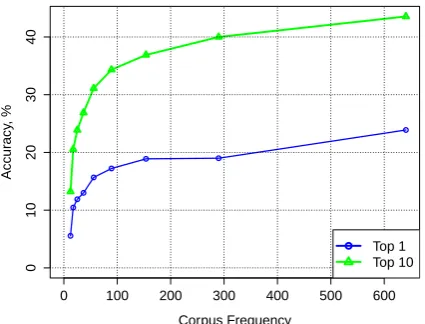
Figure 2: Accuracy of single-word translations in-duced using contextual similarity as a function of the source word corpus frequency. Accuracy is the pro-portion of the source words with at least one correct (bilingual dictionary) translation in the top 1 and top 10 candidate lists.
nouns in Rapp (1995), 1,000 most frequent words in Koehn and Knight (2002), or 2,000 most fre-quent nouns in Haghighi et al. (2008)). Although previous work reported high translation accuracy, it may be misleading to extrapolate the results to SMT, where it is necessary to translate a much larger set of words and phrases, including many low frequency items.
In a preliminary study, we plotted the accuracy of translations against the frequency of the source words in the monolingual corpus. Figure 2 shows the result for translations induced using contex-tual similarity (defined in Section 3.1). Unsur-prisingly, frequent terms have a substantially bet-ter chance of being paired with a correct transla-tion, with words that only occur once having a low chance of being translated accurately.1 This prob-lem is exacerbated when we move to multi-token phrases. As with phrase translation features esti-mated from parallel data, longer phrases are more sparse, making similarity scores less reliable than for single words.
Another impediment (not addressed in this paper) for using lexicon induction for SMT is the number of translations that must be learned. Learning translations for all words in the source language requires n2 vector comparisons, since each word in the source language vocabulary must
1
s1 s2 s3
sN-1 sN
✓
✓
✓
t1 t2 t3
tM-1 tM ✓
✓
dict.
project ✓
✓ ✓
✓
✓
✓
compare
para crecer
to expand activity of
economic activity policy growth foreign economico
tasa planeta
empleo extranjero
policy para crecer
(projected) ES Context
Vector
Projected ES Context Vector
[image:4.595.307.520.69.186.2]EN Context Vectors
Figure 3: Scoring contextual similarity of phrases: first, contextual vectors are projected using a small seed dictionary and then compared with the target lan-guage candidates.
be compared against the vectors for all words in the target language vocabulary. The size of then2
comparisons hugely increases if we compare vec-tors for multi-word phrases instead of just words. In this work, we avoid this problem by assuming that a limited set of phrase pairs is given a pri-ori (but without scores). By limiting ourselves to phrases in a phrase table, we vastly limit the search space of possible translations. This is an idealization because high quality translations are guaranteed to be present. However, as our lesion experiments in Section 5.1 show, a phrase table without accurate translation probability estimates is insufficient to produce high quality translations. We show that lexicon induction methods can be used to replace bilingual estimation of phrase- and lexical-translation probabilities, making a signifi-cant step towards SMT without parallel corpora.
3 Monolingual Parameter Estimation
We use bilingual lexicon induction methods to es-timate the parameters of a phrase-based transla-tion model from monolingual data. Instead of scores estimated from bilingual parallel data, we make use of cues present in monolingual data to provide multiple orthogonal estimates of similar-ity between a pair of phrases.
3.1 Phrasal similarity features
Contextual similarity. We extend the vector space approach of Rapp (1999) to compute sim-ilarity between phrases in the source and tar-get languages. More formally, assume that
(s1, s2, . . . sN)and(t1, t2, . . . tM)are (arbitrarily indexed) source and target vocabularies, respec-tively. A source phrasef is represented with an
terrorist (en) terrorista (es)
Occurrences
terrorist (en) riqueza (es)
Occurrences
Time
Figure 4: Temporal histograms of the English phrase
terrorist, its Spanish translationterrorista, andriqueza
(wealth) collected from monolingual texts spanning a 13 year period. While the correct translation has a good temporal match, the non-translationriquezahas a distinctly different signature.
N- and target phrase e with an M-dimensional vector (see Figure 3). The component values of the vector representing a phrase correspond to how often each of the words in that vocabulary appear within a two word window on either side of the phrase. These counts are collected using monolingual corpora. After the values have been computed, a contextual vectorf is projected onto the English vector space using translations in a seed bilingual dictionary to map the component values into their appropriate English vector posi-tions. This sparse projected vector is compared to the vectors representing all English phrasese. Each phrase pair in the phrase table is assigned a contextual similarity scorec(f, e) based on the similarity betweeneand the projection off.
Various means of computing the component values and vector similarity measures have been proposed in literature (e.g. Rapp (1999), Fung and Yee (1998)). Following Fung and Yee (1998), we compute the value of the k-th component off’s contextual vector as follows:
wk=nf,k×(log(n/nk) + 1)
wherenf,kandnkare the number of timessk ap-pears in the context off and in the entire corpus, andnis the maximum number of occurrences of any word in the data. Intuitively, the more fre-quently sk appears withf and the less common it is in the corpus in general, the higher its com-ponent value. Similarity between two vectors is measured as the cosine of the angle between them.
[image:4.595.79.287.73.180.2]be scored in terms of their temporal similarity (Schafer and Yarowsky, 2002; Klementiev and Roth, 2006; Alfonseca et al., 2009). The intu-ition is that news stories in different languages will tend to discuss the same world events on the same day. The frequencies of translated phrases over time give them particular signatures that will tend to spike on the same dates. For instance, if the phrase asian tsunami is used frequently dur-ing a particular time span, the Spanish transla-tion maremoto asi´atico is likely to also be used frequently during that time. Figure 4 illustrates how the temporal distribution ofterroristis more similar to Spanish terrorista than to other Span-ish phrases. We calculate the temporal similar-ity between a pair of phrases t(f, e) using the method defined by Klementiev and Roth (2006). We generate a temporal signature for each phrase by sorting the set of (time-stamped) documents in the monolingual corpus into a sequence of equally sized temporal bins and then counting the number of phrase occurrences in each bin. In our exper-iments, we set the window size to 1 day, so the size of temporal signatures is equal to the num-ber of days spanned by our corpus. We use cosine distance to compare the normalized temporal sig-natures for a pair of phrases(f, e).
Topic similarity. Phrases and their translations are likely to appear in articles written about the same topic in two languages. Thus, topic or cat-egory information associated with monolingual data can also be used to indicate similarity be-tween a phrase and its candidate translation. In order to score a pair of phrases, we collect their topic signatures by counting their occurrences in each topic and then comparing the resulting vec-tors. We again use the cosine similarity mea-sure on the normalized topic signatures. In our experiments, we use interlingual links between Wikipedia articles to estimate topic similarity. We treat each linked article pair as a topic and collect counts for each phrase across all articles in its cor-responding language. Thus, the size of a phrase topic signature is the number of article pairs with interlingual links in Wikipedia, and each compo-nent contains the number of times the phrase ap-pears in (the appropriate side of) the correspond-ing pair. Our Wikipedia-based topic similarity feature,w(f, e), is similar in spirit to polylingual topic models (Mimno et al., 2009), but it is scal-able to full bilingual lexicon induction.
3.2 Lexical similarity features
In addition to the three phrase similarity features used in our model –c(f, e), t(f, e)andw(f, e)– we include four additional lexical similarity fea-turesfor each of phrase pair. The first three lex-ical features clex(f, e), tlex(f, e) and wlex(f, e) are the lexical equivalents of the phrase-level con-textual, temporal and wikipedia topic similarity scores. They score the similarity of individual words within the phrases. To compute these lexical similarity features, we average similarity scores over all possible word alignments across the two phrases. Because individual words are more frequent than multiword phrases, the accu-racy ofclex, tlex, andwlextends to be higher than their phrasal equivalents (this is similar to the ef-fect observed in Figure 2).
Orthographic / phonetic similarity. The final lexical similarity feature that we incorporate is
o(f, e), which measures the orthographic similar-ity between words in a phrase pair. Etymolog-ically related words often retain similar spelling across languages with the same writing system, and low string edit distance sometimes signals translation equivalency. Berg-Kirkpatrick and Klein (2011) present methods for learning cor-respondences between the alphabets of two lan-guages. We can also extend this idea to language pairs not sharing the same writing system since many cognates, borrowed words, and names re-main phonetically similar. Transliterations can be generated for tokens in a source phrase (Knight and Graehl, 1997), with o(f, e) calculating pho-netic similarity rather than orthographic.
The three phrasal and four lexical similarity scores are incorporated into the log linear trans-lation model as feature functions, replacing the bilingually estimated phrase translation probabil-itiesφand lexical weighting probabilitiesw. Our seven similarity scores are not the only ones that could be incorporated into the translation model. Various other similarity scores can be computed depending on the available monolingual data and its associated metadata (see, e.g. Schafer and Yarowsky (2002)).
3.3 Reordering
Input: Source and target phrasesfande,
Source and target monolingual corporaCfandCe, Phrase table pairsT={(f(i), e(i))}N
i=1.
Output: Orientation features (pm, ps, pd).
Sf←sentences containingfinCf;
Se←sentences containingeinCe;
(Bf,−,−)←CollectOccurs(f,∪Ni=1f(i), Sf); (Be, Ae, De)←CollectOccurs(e,∪Ni=1e(i), Se);
cm=cs=cd= 0;
foreachuniquef0inB
fdo
foreachtranslatione0off0inTdo
cm=cm+ #Be(e0);
cs=cs+ #Ae(e 0);
cd=cd+ #De(e 0);
c←cm+cs+cd;
return(cm c ,
cs c,
cd c)
CollectOccurs(r,R,S)
B←();A←();D←();
foreachsentences∈Sdo
foreachoccurrence of phraserinsdo
B←B+(longest precedingrand inR);
A←A+(longest followingrand inR);
D←D+(longest discontinuous w/rand in
R);
return(B,A,D);
Figure 5: Algorithm for estimating reordering probabilities from monolingual data.
po(orientation|f, e) from two monolingual cor-pora instead a bitext.
Figure 1 illustrates how the phrase pair orienta-tion statistics are estimated in the standard phrase-based SMT pipeline. For a phrase pair like (f =
“Profils”, e = “profile”), we count its orien-tation with the previously translated phrase pair (f0 =“in Facebook”,e0 =“Facebook”) across all translated sentence pairs in the bitext.
In our pipeline we do not have translated sen-tence pairs. Instead, we look for monolingual sentences in the source corpus which contain the source phrase that we are interested in, like
f = “Profils”, and at least one other phrase that we have a translation for, like f0 = “in Facebook”. We then look for all target lan-guage sentences in the target monolingual cor-pus that contain the translation of f (here e =
“profile”) and any translation off0. Figure 6 il-lustrates that it is possible to find evidence for
po(swapped|Profils,profile), even from the non-parallel, non-translated sentences drawn from two independent monolingual corpora. By looking for foreign sentences containing pairs of adjacent for-eign phrases (f, f0) and English sentences
con-Das Anlegen eines Profi
ls
in Facebook ist einfach
s
What
does
your
profile
[image:6.595.317.506.72.222.2]reveal
Figure 6: Collecting phrase orientation statistics for a English-German phrase pair (“profile”, “Profils”) from non-parallel sentences (the German sentence translates as“Creating a Facebook profile is easy”).
taining their corresponding translations(e, e0), we are able to increment orientation counts for(f, e)
by looking at whether e and e0 are adjacent, swapped, or discontinuous. The orientations cor-respond directly to those shown in Figure 1.
One subtly of our method is that shorter and more frequent phrases (e.g. punctuation) are more likely to appear in multiple orientations with a given phrase, and therefore provide poor evi-dence of reordering. Therefore, we (a) collect the longest contextual phrases (which also appear in the phrase table) for reordering feature estima-tion, and (b) prune the set of sentences so that we only keep a small set of least frequent contex-tual phrases (this has the effect of dropping many function words and punctuation marks and and re-lying more heavily on multi-word content phrases to estimate the reordering).2
Our algorithm for learning the reordering pa-rameters is given in Figure 5. The algorithm estimates a probability distribution over mono-tone, swap, and discontinuous orientations (pm,
ps, pd) for a phrase pair (f, e) from two mono-lingual corpora Cf and Ce. It begins by calling
CollectOccurs to collect the longest
match-ing phrase table phrases that precedef in source monolingual data (Bf), as well as those that pre-cede (Be), follow (Ae), and are discontinuous (De) withein the target language data. For each unique phrasef0precedingf, we look up transla-tions in the phrase tableT. Next, we count3how
2The pruning step has an additional benefit of minimizing
the memory needed for orientation feature estimations.
3#L(x)
[image:6.595.84.288.112.369.2]Monolingual training corpora
Europarl Gigaword Wikipedia date range 4/96-10/09 5/94-12/08 n/a
uniq shared dates 829 5,249 n/a
Spanish articles n/a 3,727,954 59,463 English articles n/a 4,862,876 59,463 Spanish lines 1,307,339 22,862,835 2,598,269 English lines 1,307,339 67,341,030 3,630,041 Spanish words 28,248,930 774,813,847 39,738,084 English words 27,335,006 1,827,065,374 61,656,646
[image:7.595.93.509.70.190.2]Spanish-English phrase table Phrase pairs 3,093,228 Spanish phrases 89,386 English phrases 926,138 Spanish unigrams 13,216 Avg # translations 98.7 Spanish bigrams 41,426 Avg # translations 31.9 Spanish trigrams 34,744 Avg # translations 13.5
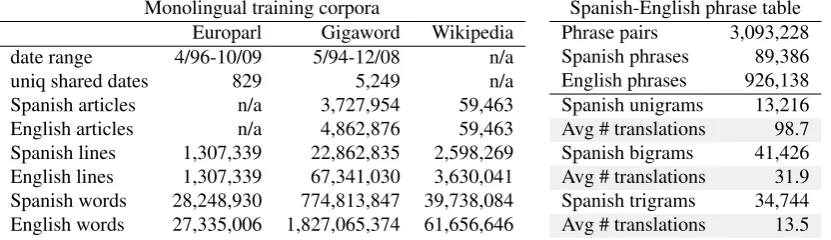
Table 1: Statistics about the monolingual training data and the phrase table that was used in all of the experiments.
many translations e0 off0 appeared before, after or were discontinuous with e in the target lan-guage data. Finally, the counts are normalized and returned. These normalized counts are the values we use as estimates ofpo(orientation|f, e).
4 Experimental Setup
We use the Spanish-English language pair to test our method for estimating the parameters of an SMT system from monolingual corpora. This al-lows us to compare our method against the nor-mal bilingual training procedure. We expect bilin-gual training to result in higher translation qual-ity because it is a more direct method for learn-ing translation probabilities. We systematically remove different parameters from the standard phrase-based model, and then replace them with our monolingual equivalents. Our goal is to re-cover as much of the loss as possible for each of the deleted bilingual components.
The standard phrase-based model that we use as our top-line is the Moses system (Koehn et al., 2007) trained over the full Europarl v5 par-allel corpus (Koehn, 2005). With the exception of maximum phrase length (set to 3 in our ex-periments), we used default values for all of the parameters. All experiments use a trigram lan-guage model trained on the English side of the Europarl corpus using SRILM with Kneser-Ney smoothing. To tune feature weights in minimum error rate training, we use a development bitext of 2,553 sentence pairs, and we evaluate per-formance on a test set of 2,525 single-reference translated newswire articles. These development and test datasets were distributed in the WMT shared task (Callison-Burch et al., 2010).4 MERT
4
Specifcially,news-test2008plusnews-syscomb2009for dev andnewstest2009for test.
was re-run for every experiment.
We estimate the parameters of our model from two sets of monolingual data, detailed in Table 1:
• First, we treat the two sides of the Europarl parallel corpus as independent, monolingual corpora. Haghighi et al. (2008) also used this method to show how well translations could be learned from monolingual corpora under ideal conditions, where the contextual and temporal distribution of words in the two monolingual corpora are nearly identical.
• Next, we estimate the features from truly monolingual corpora. To estimate the con-textualandtemporalsimilarity features, we use the Spanish and English Gigaword cor-pora.5 These corpora are substantially larger than the Europarl corpora, providing 27x as much Spanish and 67x as much English for contextual similarity, and 6x as many paired dates for temporal similarity. Topical simi-larity is estimated using Spanish and English Wikipedia articles that are paired with inter-language links.
To project context vectors from Spanish to En-glish, we use a bilingual dictionary containing en-tries for 49,795 Spanish words. Note that end-to-end translation quality is robust to substantially reducing dictionary size, but we omit these ex-periments due to space constraints. The con-text vectors for words and phrases incorporate co-occurrence counts using a two-word window on either side.
The title of our paper uses the wordtowards be-cause we assume that an inventory of phrase pairs is given. Future work will explore inducing the
5
BLEU 0 5 10 15 20 25 21.87 21.54 12.86 4.00 10.52 15.35 14.02 14.78 16.85 17.50 22.92 -/ -B/ B
B/- -/B -/M t/- o/- c/- M/
-M/
M
BM/
B
1 2 3 4 5 6 7 8 9 10 11
Exp Phrase scores / orientation scores 1 B/B bilingual / bilingual (Moses) 2 B/- bilingual / distortion 3 -/B none / bilingual 4 -/- none / distortion
5, 12 -/M none / mono 6, 13 t/- temporal mono / distortion 7,14 o/- orthographic mono / distortion 8, 15 c/- contextual mono / distortion 16 w/- Wikipedia topical mono / distorion 9, 17 M/- all mono / distortion 10, 18 M/M all mono / mono
11, 19 BM/B bilingual + all mono / bilingual
Estimated Using Europarl
Estimated Using Monolingual Corpora
BL EU 14.02 BLEU 0 5 10 15 20 25 10.15
13.13 14.02 14.07
17.00 17.92 18.79 23.36 23.36 18.79 17.92 17.00 BM/ B M/ M M/ - w/-c/ - o/- t/--/ M 0 5 10 15 20 25 BL EU 14.07 14.02 13.13 10.15 18 19 17 16 15 14 13 12 BLEU 0 5 10 15 20 25 21.87 21.54 12.86 4.00 10.52 15.35 14.02 14.78 16.85 17.50 22.92 -/ -B/ B B/ --/ B -/
M t/- o/- c/
-M/ -M/ M BM/ B
1 2 3 4 5 6 7 8 9 10 11
Exp Phrase scores / orientation scores 1 B/B bilingual / bilingual (Moses) 2 B/- bilingual / distortion 3 -/B none / bilingual 4 -/- none / distortion 5, 12 -/M none / mono 6, 13 t/- temporal mono / distortion 7,14 o/- orthographic mono / distortion 8, 15 c/- contextual mono / distortion 16 w/- Wikipedia topical mono / distorion 9, 17 M/- all mono / distortion 10, 18 M/M all mono / mono 11, 19 BM/B bilingual + all mono / bilingual
Estimated Using Europarl
Estimated Using Monolingual Corpora
BL EU 14.02 BLEU 0 5 10 15 20 25 10.15
13.13 14.02 14.07
[image:8.595.77.523.67.189.2]17.00 17.92 18.79 23.36 23.36 18.79 17.92 17.00 BM/ B M/ M M/ - w/-c/ - o/- t/--/ M 0 5 10 15 20 25 BL EU 14.07 14.02 13.13 10.15 18 19 17 16 15 14 13 12
Figure 7: Much of the loss in BLEU score when bilingually estimated features are removed from a Spanish-English translation system (experiments 1-4) can be recovered when they are replaced with monolingual equiva-lents estimated from monolingual Europarl data (experiments 5-10). The labels indicate how the different types of parameters are estimated, the first part is for phrase-table features, the second is for reordering probabilities.
BLEU 0 5 10 15 20 25 21.87 21.54 12.86 4.00 10.52 15.35 14.02 14.78 16.85 17.50 22.92 -/ -B/ B B/ --/ B -/
M t/- o/- c/
-M/ -M/ M BM/ B
1 2 3 4 5 6 7 8 9 10 11
Exp Phrase scores / orientation scores 1 B/B bilingual / bilingual (Moses) 2 B/- bilingual / distortion 3 -/B none / bilingual 4 -/- none / distortion
5, 12 -/M none / mono 6, 13 t/- temporal mono / distortion 7,14 o/- orthographic mono / distortion 8, 15 c/- contextual mono / distortion 16 w/- Wikipedia topical mono / distorion 9, 17 M/- all mono / distortion 10, 18 M/M all mono / mono
11, 19 BM/B bilingual + all mono / bilingual
Estimated Using Europarl
Estimated Using Monolingual Corpora
BL EU 14.02 BLEU 0 5 10 15 20 25 10.15
13.13 14.02 14.07
17.00 17.92 18.79 23.36 23.36 18.79 17.92 17.00 BM/ B M/ M M/ - w/-c/ - o/- t/--/ M 0 5 10 15 20 25 BL EU 14.07 14.02 13.13 10.15 18 19 17 16 15 14 13 12
Figure 8: Performance of monolingual features de-rived from truly monolingual corpora. Over 82% of the BLEU score loss can be recovered.
phrase table itself from monolingual texts. Across all of our experiments, we use the phrase table that the bilingual model learned from the Europarl parallel corpus. We keep its phrase pairs, but we drop all of its scores. Table 1 gives details of the phrase pairs. In our experiments, we estimated similarity and reordering scores for more than 3 million phrase pairs. For each source phrase, the set of possible translations was constrained and likely to contain good translations. However, the average number of possible translations was high (ranging from nearly 100 translations for each un-igram to 14 for each trun-igram). These contain a lot of noise and result in low end-to-end transla-tion quality without good estimates of translatransla-tion quality, as the experiments in Section 5.1 show.
Software. Because many details of our estima-tion procedures must be omitted for space, we dis-tribute our full set of code along with scripts for running our experiments and output translations. These may be downed fromhttp://www.cs. jhu.edu/˜anni/papers/lowresmt/
5 Experimental Results
Figures 7 and 8 give experimental results. Figure 7 shows the performance of the standard phrase-based model when each of the bilingually esti-mated features are removed. It shows how much of the performance loss can be recovered using our monolingual features when they are estimated from the Europarl training corpus but treating each side as an independent, monolingual cor-pus. Figure 8 shows the recovery when using truly monolingual corpora to estimate the parameters.
5.1 Lesion experiments
Experiments 1-4 remove bilingually estimated pa-rameters from the standard model. For Spanish-English, the relative contribution of the phrase-table features (which include the phrase transla-tion probabilitiesφand the lexical weightsw) is greater than the reordering probabilities. When the reordering probability po(orientation|f, e) is eliminated and replaced with a simple distance-based distortion feature that does not require a bitext to estimate, the score dips only marginally since word order in English and Spanish is simi-lar. However, when both the reordering and the phrase table features are dropped, leaving only the LM feature and the phrase penalty, the result-ing translation quality is abysmal, with the score dropping a total of over 17 BLEU points.
5.2 Adding equivalent monolingual features estimated using Europarl
reordering probabilities from monolingual data (– /M) adds 5 BLEU points, which is 73% of the po-tential recovery going from the model (–/–) to the model with bilingual reordering features (–/B).
Of thetemporal, orthographic, and contextual monolingual features the temporal feature per-forms the best. Together (M/–), they recover more than each individually. Combining mono-lingually estimated reordering and phrase table features (M/M) yields a total gain of 13.5 BLEU points, or over 75% of the BLEU score loss that occurred when we dropped all features from the phrase table. However, these results use “mono-lingual” corpora which have practically identical phrasal and temporal distributions.
5.3 Estimating features usingtruly monolingualcorpora
Experiments 12-18 estimate all of the features from truly monolingual corpora. Our novel al-gorithm for estimating reordering holds up well and recovers 69% of the loss, only 0.4 BLEU points less than when estimated from the Europarl monolingual texts. The temporal similarity fea-ture does not perform as well as when it was esti-mated using Europarl data, but the contextual fea-ture does. The topic similarity using Wikipedia performs the strongest of the individual features.
Combining the monolingually estimated re-ordering features with the monolingually esti-mated similarity features (M/M) yields a total gain of 14.8 BLEU points, or over 82% of the BLEU point loss that occurred when we dropped all features from the phrase table. This is equiv-alent to training the standard system on a bi-text with roughly 60,000 lines or nearly 2 million words (learning curve omitted for space).
Finally, we supplement the standard bilingually estimated model parameters with our monolin-gual features (BM/B), and we see a 1.5 BLEU point increase over the standard model. There-fore, our monolingually estimated scores capture some novel information not contained in the stan-dard feature set.
6 Additional Related Work
Carbonell et al. (2006) described a data-driven MT system that used no parallel text. It produced translation lattices using a bilingual dictionary and scored them using an n-gram language model.
Their method has no notion of translation similar-ity aside from a bilingual dictionary. Similarly, S´anchez-Cartagena et al. (2011) supplement an SMT phrase table with translation pairs extracted from a bilingual dictionary and give each a fre-quency of one for computing translation scores.
Ravi and Knight (2011) treat MT without paral-lel training data as a decipherment task and learn a translation model from monolingual text. They translate corpora of Spanish time expressions and subtitles, which both have a limited vocabulary, into English. Their method has not been applied to broader domains of text.
Most work on learning translations from mono-lingual texts only examine small numbers of fre-quent words. Huang et al. (2005) and Daum´e and Jagarlamudi (2011) are exceptions that improve MT by mining translations for OOV items.
A variety of past research has focused on min-ing parallel or comparable corpora from the web (Munteanu and Marcu, 2006; Smith et al., 2010; Uszkoreit et al., 2010). Others use an existing SMT system to discover parallel sentences within independent monolingual texts, and use them to re-train and enhance the system (Schwenk, 2008; Chen et al., 2008; Schwenk and Senellart, 2009; Rauf and Schwenk, 2009; Lambert et al., 2011). These are complementary but orthogonal to our research goals.
7 Conclusion
References
Enrique Alfonseca, Massimiliano Ciaramita, and Keith Hall. 2009. Gazpacho and summer rash: lexical relationships from temporal patterns of web search queries. InProceedings of EMNLP.
Taylor Berg-Kirkpatrick and Dan Klein. 2011. Simple effective decipherment via combinatorial optimiza-tion. In Proceedings of the 2011 Conference on Empirical Methods in Natural Language Process-ing (EMNLP-2011), Edinburgh, Scotland, UK. Shane Bergsma and Benjamin Van Durme. 2011.
Learning bilingual lexicons using the visual simi-larity of labeled web images. InProceedings of the International Joint Conference on Artificial Intelli-gence.
Peter Brown, John Cocke, Stephen Della Pietra, Vin-cent Della Pietra, Frederick Jelinek, Robert Mercer, and Paul Poossin. 1988. A statistical approach to language translation. In12th International Confer-ence on Computational Linguistics (CoLing-1988). Peter Brown, Stephen Della Pietra, Vincent Della Pietra, and Robert Mercer. 1993. The mathemat-ics of machine translation: Parameter estimation.
Computational Linguistics, 19(2):263–311, June. Chris Callison-Burch, Philipp Koehn, Christof Monz,
Kay Peterson, Mark Przybocki, and Omar Zaidan. 2010. Findings of the 2010 joint workshop on sta-tistical machine translation and metrics for machine translation. InProceedings of the Workshop on Sta-tistical Machine Translation.
Jaime Carbonell, Steve Klein, David Miller, Michael Steinbaum, Tomer Grassiany, and Jochen Frey. 2006. Context-based machine translation. In Pro-ceedings of AMTA.
Boxing Chen, Min Zhang, Aiti Aw, and Haizhou Li. 2008. Exploiting n-best hypotheses for SMT self-enhancement. InProceedings of ACL/HLT, pages 157–160.
David Chiang. 2005. A hierarchical phrase-based model for statistical machine translation. In Pro-ceedings of ACL.
Hal Daum´e and Jagadeesh Jagarlamudi. 2011. Do-main adaptation for machine translation by mining unseen words. InProceedings of ACL/HLT. Pascale Fung and Lo Yuen Yee. 1998. An IR approach
for translating new words from nonparallel, compa-rable texts. InProceedings of ACL/CoLing. Nikesh Garera, Chris Callison-Burch, and David
Yarowsky. 2009. Improving translation lexicon in-duction from monolingual corpora via dependency contexts and part-of-speech equivalences. In Thir-teenth Conference On Computational Natural Lan-guage Learning (CoNLL-2009), Boulder, Colorado. Ulrich Germann. 2001. Building a statistical machine translation system from scratch: How much bang for the buck can we expect? InACL 2001 Workshop
on Data-Driven Machine Translation, Toulouse, France.
Aria Haghighi, Percy Liang, Taylor Berg-Kirkpatrick, and Dan Klein. 2008. Learning bilingual lexi-cons from monolingual corpora. InProceedings of ACL/HLT.
Fei Huang, Ying Zhang, and Stephan Vogel. 2005. Mining key phrase translations from web corpora. InProceedings of EMNLP.
Alexandre Klementiev and Dan Roth. 2006. Weakly supervised named entity transliteration and discov-ery from multilingual comparable corpora. In Pro-ceedings of the ACL/Coling.
Kevin Knight and Jonathan Graehl. 1997. Machine transliteration. InProceedings of ACL.
Philipp Koehn and Kevin Knight. 2002. Learning a translation lexicon from monolingual corpora. In
ACL Workshop on Unsupervised Lexical Acquisi-tion.
Philipp Koehn, Franz Josef Och, and Daniel Marcu. 2003. Statistical phrase-based translation. In Pro-ceedings of HLT/NAACL.
Philipp Koehn, Hieu Hoang, Alexandra Birch, Chris Callison-Burch, Marcello Federico, Nicola Bertoldi, Brooke Cowan, Wade Shen, Christine Moran, Richard Zens, Chris Dyer, Ondrej Bojar, Alexandra Constantin, and Evan Herbst. 2007. Moses: Open source toolkit for statistical machine translation. InProceedings of the ACL-2007 Demo and Poster Sessions.
Philipp Koehn. 2005. Europarl: A parallel corpus for statistical machine translation. In Proceedings of the Machine Translation Summit.
Shankar Kumar and William Byrne. 2004. Local phrase reordering models for statistical machine translation. InProceedings of HLT/NAACL. Patrik Lambert, Holger Schwenk, Christophe
Ser-van, and Sadaf Abdul-Rauf. 2011. Investigations on translation model adaptation using monolingual data. InProceedings of the Workshop on Statistical Machine Translation, pages 284–293, Edinburgh, Scotland, UK.
David Mimno, Hanna Wallach, Jason Naradowsky, David Smith, and Andrew McCallum. 2009. Polylingual topic models. In Proceedings of EMNLP.
Dragos Stefan Munteanu and Daniel Marcu. 2006. Extracting parallel sub-sentential fragments from non-parallel corpora. In Proceedings of the ACL/Coling.
Franz Josef Och and Hermann Ney. 2003. A sys-tematic comparison of various statistical alignment models. Computational Linguistics, 29(1):19–51. Franz Josef Och and Hermann Ney. 2004. The
Franz Joseph Och. 2002. Statistical Machine Transla-tion: From Single-Word Models to Alignment Tem-plates. Ph.D. thesis, RWTH Aachen.
Franz Josef Och. 2003. Minimum error rate training for statistical machine translation. InProceedings of ACL.
Reinhard Rapp. 1995. Identifying word translations in non-parallel texts. InProceedings of ACL. Reinhard Rapp. 1999. Automatic identification of
word translations from unrelated English and Ger-man corpora. InProceedings of ACL.
Sadaf Abdul Rauf and Holger Schwenk. 2009. On the use of comparable corpora to improve SMT perfor-mance. InProceedings of EACL.
Sujith Ravi and Kevin Knight. 2011. Deciphering for-eign language. InProceedings of ACL/HLT. Vctor M. S´anchez-Cartagena, Felipe
S´anchez-Martnez, and Juan Antonio P´erez-Ortiz. 2011. Integrating shallow-transfer rules into phrase-based statistical machine translation. In Proceedings of the XIII Machine Translation Summit.
Charles Schafer and David Yarowsky. 2002. Inducing translation lexicons via diverse similarity measures and bridge languages. InProceedings of CoNLL. Holger Schwenk and Jean Senellart. 2009.
Transla-tion model adaptaTransla-tion for an Arabic/French news translation system by lightly-supervised training. In
MT Summit.
Holger Schwenk. 2008. Investigations on large-scale lightly-supervised training for statistical machine translation. InProceedings of IWSLT.
Jason R. Smith, Chris Quirk, and Kristina Toutanova. 2010. Extracting parallel sentences from compa-rable corpora using document level alignment. In
Proceedings of HLT/NAACL.
Christoph Tillman. 2004. A unigram orientation model for statistical machine translation. In Pro-ceedings of HLT/NAACL.
Christoph Tillmann. 2003. A projection extension al-gorithm for statistical machine translation. In Pro-ceedings of EMNLP.
Jakob Uszkoreit, Jay M. Ponte, Ashok C. Popat, and Moshe Dubiner. 2010. Large scale parallel docu-ment mining for machine translation. In Proceed-ings of CoLing.