Original Article
Unplanned reoperations in neurosurgery:
a single center experience
Jing Zhang1, Yanlin Song2, Nian Li3, Min He1, Qingqing Ren1, Yunhui Zeng1, Zhiyong Liu1, Hao Liu1, Jianguo Xu1
1Department of Neurosurgery, 2West China School of Medicine, 3Medical Quality Control Office, West China
Hospi-tal, Sichuan University, Chengdu 610041, PR China
Received July 18, 2017; Accepted December 30, 2017; Epub July 15, 2018; Published July 30, 2018
Abstract: Objective: The purpose of this study was to comprehensively analyze the unplanned reoperations in neurosurgery within our center and to explore potential factors associated with unplanned reoperations. Methods: The authors retrospectively reviewed the patients who underwent unplanned reoperations in the Department of Neurosurgery of West China Hospital of Sichuan University from May 2015 to October 2016. The patients’ basic characteristics, perioperative data of the initial surgeries and reoperations, outcomes, length of stay (LOS) and hos-pitalization expenses were collected for analysis. Factors associated with unplanned reoperations were identified using univariate analysis and multivariate logistic regression modeling. Results: A total of 115 patients and 129 un-planned reoperations were included. The overall incidence of unun-planned reoperations was 1.37%. The principal dis-eases were tumors (50.4%), aneurysms (18.3%) and vascular malformations (11.3%). The most common causes of unplanned reoperations were postoperative hemorrhage (42.6%) and postoperative hydrocephalus (25.6%). Higher age and supratentorial location were risk factors for postoperative hemorrhage. Risk factors for postoperative hydro-cephalus included younger age, infratentorial location, leukocytosis and rotation of first-line doctors. Patients who underwent unplanned reoperations had poorer outcomes, longer LOS and higher hospitalization expenses. Conclu-sions: Identifying patients at a higher risk for unplanned reoperations may improve the quality of surgical care. More studies are warranted to explore the risk factors for unplanned reoperations. We recommended standard report and regular discussion on the reoperated cases. Besides, it is urgent to perform systematic root-cause analyses and to establish perioperative protocols through multidisciplinary work to reduce the frequency of unplanned reoperations.
Keywords: Reoperation, neurosurgery, complication
Introduction
Surgery accounts for the majority of inpatient adverse events, with the proportion estimated from 48% to 79% [1]. Higher incidence of surgi-cal adverse events would result in poorer out-comes, higher costs, less efficiently used health care resources and poorer patient satis-faction [2-4]. Systematic measurements of these adverse events and prospective record-ing can help in quality improvement [5-7]. At present, the primary method to assess surgical quality is to review morbidity and mortality. [8-10]. However, due to the rare mortality rate and procedure-specific complications, they would not be ideal measures across all surgical specialties [11, 12].
In recent years, unplanned reoperation rate, which is a surrogate for surgical adverse events,
has been suggested as a quality indicator in surgical care [11, 13]. Like surgical adverse events, unplanned reoperation has a negative impact on outcomes and costs, and may even lead to conflict between the patient and sur-geon [2, 4]. Unplanned reoperation rate can be compared across departments and hospitals, and the quality of services can be improved by monitoring it [7, 11].
neurosurgi-and all causes in both adults neurosurgi-and children [10]. Furthermore, research on unplanned reopera-tions with respect to neurosurgical procedures is scarce in China [12].
In this study, we retrospectively reviewed all the patients who underwent unplanned reopera-tions during a time period of 18 months in our department. We analyzed the incidence rate, causes, outcomes, and further explored poten-tial factors associated with unplanned reoper- ations.
Materials and methods
Patient population and data collection
This study was approved by the Institutional Review Board of our hospital. In our hospital (tertiary), the details of the patients who under-go unplanned reoperations are required to be reported to the Medical Quality Control Office and the Department of Medical Administration. We retrospectively reviewed the reports of the patients from the Department of Neurosurgery from May 1st, 2015 to October 31st, 2016. The medical records and radiological images of these patients were also reviewed for more information. The extracted data included age, gender, admission type (index hospitalization or emergency admission), primary disease and location, preoperative blood pressure, preop-erative plate count and coagulation function, preoperative white blood cell count, details of the initial surgery (elective/emergency, opera-tion type, American Society of Anesthesiologists’ ASA anaesthesia grade, operation time and blood transfusion during operation), reason of the unplanned reoperation, time interval to reoperation, details of the unplanned reopera-tion, discharge status (home/to rehabilitation ward/against-advice discharge/dead), length of stay (LOS) and hospitalization expenses. The information of the patients in our whole depart-ment and whole hospital during the same peri-od was also collected: total number of neuro-surgical procedures, mean LOS and mean hospitalization expenses in our department, total number of surgical procedures and the number of unplanned reoperations in our hos- pital.
formed after the initial surgery, either during the same admission or during a readmission. A second or third unplanned reoperation follow-ing the first unplanned reoperation was also defined as an unplanned reoperation. Favorable outcomes were defined as discharged home or to the rehabilitation ward. Against-advice dis-charge meant that the patient or the family members gave up treatment. The rotation of first-line doctors was regarded as a potential risk factor for unplanned reoperations. The ini-tial surgeries were categorized into “normal period group” and “rotation period group” (4-week period after the rotation of first-line doctors).
Statistical analysis
The data were summarized as mean ± stan-dard deviations (SD) with range for continuous variables and percentage for categorical vari-ables. Univariate binary logistic regression analysis was used to identify potential risk fac-tors for unplanned reoperations caused by hemorrhage or hydrocephalus. Significant or near-significant factors were then tested using multivariate logistic regression models. Sta- tistical analyses were performed using SPSS, version 24.0 (SPSS Inc., Chicago, IL, USA). Significance was determined at p<0.05, and p
value <0.20 was considered near-significant.
Results
Our study included 115 patients who under-went unplanned reoperations. The majority of patients underwent one unplanned tion. Ten patients had two unplanned reopera-tions and two patients had three unplanned reoperations. Thus, a total of 129 unplanned reoperations were performed on them. The overall incidence of unplanned reoperations in our department was 1.37%, which was much higher than that in our whole hospital (0.37%) during the same time period.
Patient characteristics and initial surgical details
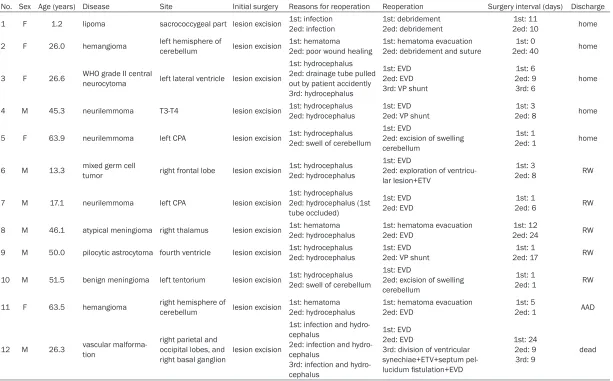
Thirty-Table 1. Characteristics of the patients with two or three unplanned reoperations
No. Sex Age (years) Disease Site Initial surgery Reasons for reoperation Reoperation Surgery interval (days) Discharge
1 F 1.2 lipoma sacrococcygeal part lesion excision 1st: infection2ed: infection 1st: debridement2ed: debridement 2ed: 101st: 11 home
2 F 26.0 hemangioma left hemisphere of cerebellum lesion excision 1st: hematoma2ed: poor wound healing 1st: hematoma evacuation2ed: debridement and suture 2ed: 401st: 0 home
3 F 26.6 WHO grade II central neurocytoma left lateral ventricle lesion excision
1st: hydrocephalus 2ed: drainage tube pulled out by patient accidently 3rd: hydrocephalus
1st: EVD 2ed: EVD 3rd: VP shunt
1st: 6 2ed: 9
3rd: 6 home
4 M 45.3 neurilemmoma T3-T4 lesion excision 1st: hydrocephalus2ed: hydrocephalus 1st: EVD 2ed: VP shunt 2ed: 81st: 3 home
5 F 63.9 neurilemmoma left CPA lesion excision 1st: hydrocephalus2ed: swell of cerebellum 1st: EVD 2ed: excision of swelling cerebellum
1st: 1
2ed: 1 home
6 M 13.3 mixed germ cell tumor right frontal lobe lesion excision 1st: hydrocephalus2ed: hydrocephalus 1st: EVD 2ed: exploration of ventricu-lar lesion+ETV
1st: 3
2ed: 8 RW
7 M 17.1 neurilemmoma left CPA lesion excision 1st: hydrocephalus2ed: hydrocephalus (1st tube occluded)
1st: EVD
2ed: EVD 2ed: 61st: 1 RW
8 M 46.1 atypical meningioma right thalamus lesion excision 1st: hematoma 2ed: hydrocephalus 1st: hematoma evacuation2ed: EVD 2ed: 241st: 12 RW
9 M 50.0 pilocytic astrocytoma fourth ventricle lesion excision 1st: hydrocephalus2ed: hydrocephalus 1st: EVD 2ed: VP shunt 2ed: 171st: 1 RW
10 M 51.5 benign meningioma left tentorium lesion excision 1st: hydrocephalus2ed: swell of cerebellum 1st: EVD 2ed: excision of swelling cerebellum
1st: 1
2ed: 1 RW
11 F 63.5 hemangioma right hemisphere of cerebellum lesion excision 1st: hematoma 2ed: hydrocephalus 1st: hematoma evacuation2ed: EVD 2ed: 11st: 5 AAD
12 M 26.3 vascular malforma-tion right parietal and occipital lobes, and
right basal ganglion lesion excision
1st: infection and hydro-cephalus
2ed: infection and hydro-cephalus
3rd: infection and hydro-cephalus
1st: EVD 2ed: EVD
3rd: division of ventricular synechiae+ETV+septum pel-lucidum fistulation+EVD
1st: 24 2ed: 9
3rd: 9 dead
[image:3.792.92.705.85.466.2]tients with WHO grade I meningiomas (20 cases) and neurilemmomas (11 cases) account-ed for the most tumor cases. The lesion sites included 72 supratentorial (62.6%), 36 infraten-torial (31.3%), 5 intraspinal (4.3%), 1 skull lesion (0.8%) and 1 scalp lesion (0.8%). As to the initial surgeries, 14 (12.2%) were emergen-cy surgeries. The principal operations were for excision of space-occupying lesion (68 cases, 59.1%) and aneurysm clipping (16 cases, 13.9%).
Characteristics of the reoperations
The most common causes of unplanned reop-erations were postoperative hemorrhage (55 cases, 42.6%) and postoperative hydrocepha-lus (37 cases, 28.7%). The mean time interval between the unplanned reoperation and last surgery was 5.8±0.7 days (range 0-56 days), and 48 unplanned reoperations (37.2%) were performed within one day. The mean time inter-val to reoperation was 3.0±0.5 days for postop-erative hemorrhage and 6.7±1.2 days for post-operative hydrocephalus. Most reoperations (113 cases, 87.6%) were emergency surgeries. The principal reoperations were hematoma evacuation (47 cases, 36.4%) and external ven-tricular drain (28 cases, 21.7%). Compared to the initial surgeries, the ASA anaesthesia grade, operation time and blood transfusion of the reoperations were different. The proportion of ASA grade 4-6 in the reoperations (28.4%) was much higher than that in the initial surger-ies (9.5%). Eighty-one initial surgersurger-ies (62.8%) needed more than three hours to complete, while only 44 reoperations (38.3%) exceeded three hours. Nineteen percent patients needed blood transfusion during the initial surgeries and the proportion dropped to 12% for the reoperations.
Patients with two or three unplanned reopera-tions
The details of the 12 patients with two or three unplanned reoperations were shown in Table 1. The initial surgeries of all the patients were lesion excision. Half of the patients (6 cases) underwent at least two reoperations for post-operative hydrocephalus. Most of these
Patients’ outcomes
Among the 115 patients, 84 (73.0%) turned better and were discharged home (29 cases, 25.2%) or to the rehabilitation ward (55 cases, 47.8%). Twenty-four patients (19.3%) were dis-charged against-advice. The mortality was 5.2% (6 cases). One patient is still in hospital and has been in the neurosurgical intensive care unit (NICU) for more than one year.
The mean LOS of the 114 patients was 29.3±2.9 days (except for the patient still in hospital), which was much longer compared with the mean LOS of 10.2 days for patients in our whole department during the study period. The mean LOS was the longest for the patients discharged home (43.9 days), and was the shortest for the patients discharged against-advice (19.3 days).
Compared with the mean hospitalization ex- penses of 7,267 USD for the patients in our whole department, the mean hospitalization expenses of the 114 patients was 22,855± 1,356 USD (except for the patient still in hospi-tal, 74,472 USD for herself).
The four principal diseases
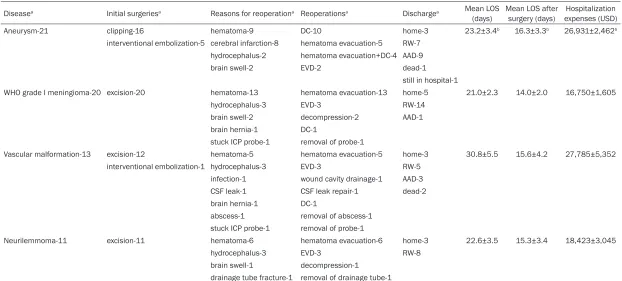
The main characteristics of the patients with the four principal diseases were shown in Table 2. The most common reason for reoperation was all postoperative hemorrhage in patients with the four types of diseases. As to the out-come, higher rates of favorable outcome were observed in patients with WHO grade I menin-gioma and neurilemmoma (95% and 100%, respectively), compared to the patients with aneurysm and vascular malformation (48% and 62%, respectively). The mean hospitalization expenses were also higher in the patients with aneurysm and vascular malformation than those in the patients with WHO grade I menin-gioma and neurilemmoma.
The two major reasons
Table 2. Characteristics of the patients with the four principal diseases
Diseasea Initial surgeriesa Reasons for reoperationa Reoperationsa Dischargea Mean LOS
(days) Mean LOS after surgery (days) expenses (USD)Hospitalization Aneurysm-21 clipping-16 hematoma-9 DC-10 home-3 23.2±3.4b 16.3±3.3b 26,931±2,462b
interventional embolization-5 cerebral infarction-8 hematoma evacuation-5 RW-7 hydrocephalus-2 hematoma evacuation+DC-4 AAD-9
brain swell-2 EVD-2 dead-1
still in hospital-1
WHO grade I meningioma-20 excision-20 hematoma-13 hematoma evacuation-13 home-5 21.0±2.3 14.0±2.0 16,750±1,605
hydrocephalus-3 EVD-3 RW-14
brain swell-2 decompression-2 AAD-1 brain hernia-1 DC-1
stuck ICP probe-1 removal of probe-1
Vascular malformation-13 excision-12 hematoma-5 hematoma evacuation-5 home-3 30.8±5.5 15.6±4.2 27,785±5,352 interventional embolization-1 hydrocephalus-3 EVD-3 RW-5
infection-1 wound cavity drainage-1 AAD-3 CSF leak-1 CSF leak repair-1 dead-2 brain hernia-1 DC-1
abscess-1 removal of abscess-1 stuck ICP probe-1 removal of probe-1
Neurilemmoma-11 excision-11 hematoma-6 hematoma evacuation-6 home-3 22.6±3.5 15.3±3.4 18,423±3,045
hydrocephalus-3 EVD-3 RW-8
brain swell-1 decompression-1 drainage tube fracture-1 removal of drainage tube-1
ICP intracranial pressure, CSF cerebrospinal fluid, DC decompressive craniectomy, EVD external ventricular drain, RW rehabilitation ward, AAD against-advice discharge, LOS length of stay, USD US dollar. awith
compared to the patients with postoperative hemorrhage.
Factors associated with postoperative hemor-rhage or postoperative hydrocephalus
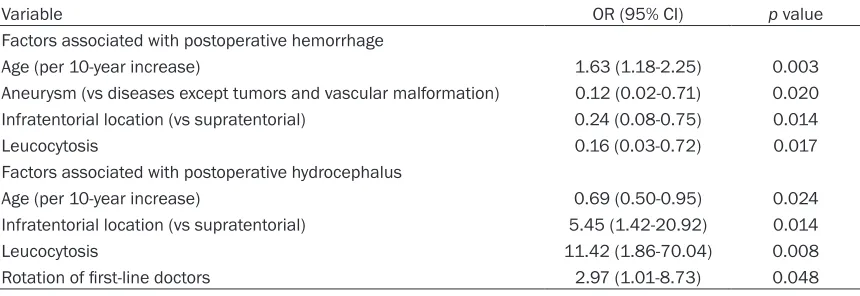
On multivariate analysis, several factors asso-ciated with postoperative hemorrhage or post-operative hydrocephalus were identified (Table 4). Higher age was a risk factor for postopera-tive hemorrhage, but was a favorable factor for postoperative hydrocephalus. Favorable fac-tors for postoperative hemorrhage included aneurysm disease, infratentorial location and leukocytosis. Risk factors for postoperative hydrocephalus included infratentorial location, leukocytosis and rotation of first-line doctors.
Discussion
In this study, the rate of unplanned reopera-tions for all causes was 1.37% in our depart-ment. Tumors and aneurysms constituted most primary diseases. The most common causes of unplanned reoperations were postoperative
ciated with postoperative hemorrhage or post-operative hydrocephalus. The patients who underwent unplanned reoperations had poorer outcomes, longer LOS and higher hospitaliza-tion expenses.
The rate of unplanned reoperations in neuro-surgery varied depending on the definition, dif-ference in case series, and detecting method among different hospitals [7, 10, 14]. McLau- ghlin et al. reported that the incidence of unplanned reoperations within 7 days of the index surgery was 2.6% [10]. Mukerji et al.
[image:6.612.92.521.96.317.2]reported that the unplanned reoperation rate was 28% in pediatric neurosurgery [7]. Da- senbrock et al. reported an unplanned reopera-tion rate of 3.1% among patients who under-went cranial tumor resection extracted from the prospective National Surgical Quality Improvement Program (NSQIP) registry (2012-2014) [17]. With the same standard in our hos-pital, the unplanned reoperation rate in the neurosurgical department was much higher than that in our whole hospital during the same
Table 3. Characteristics of the patients reoperated for postoperative hemorrhage and postoperative hydrocephalus
Reason for
reoperationa Reoperationsa Dischargeaa Mean LOS (days)b Mean LOS after surgery (days)b expenses (USD)Hospitalization b
Hematoma-55 hematoma evacuation-47 home-10 25.0±2.3 16.9±2.0 22,205±1,786 hematoma evacuation+DC-7 RW-30
hematoma
evacuation+cortical elec-trode removal+epileptogenic focus resection-1
AAD-12
dead-3
Hydrocephalus-29c EVD-28 home-8 38.7±10.3 26.0±10.6 26,549±3,590
VP shunt-6 RW-12
exploration of ventricular
lesion+ETV-1 AAD-8
right ventricle
fistulation+decompression-1 dead-1 division of ventricular
synechiae+ETV+septum pel-lucidum fistulation+EVD-1
In McLaughlin’s case series, shunt-related dis-ease and intracranial tumor accounted for most of their cases, which is different from our series [10]. In that study, a larger proportion of cases were pediatric cases (about 30%), which may explain the discrepancy. Accordingly, the most common indication for early unplanned reoperations in that study was shunt failure, fol-lowed by postoperative bleeding. In another two studies on pediatric neurosurgery, the most common cause of unplanned reoperations was also shunt failure [7, 15]. In two studies investi-gating unplanned reoperations after removal of intracranial tumors, postoperative hemorrhage was the most common cause [17, 18]. Park et al. found that compromised distal blood flow was the most common reason for an unplanned reoperation in patients with unruptured intra-cranial aneurysms [14, 16]. In our study, the most common cause for unplanned reopera-tions in patients with intracranial aneurysms was postoperative bleeding. One possible explanation might be that most of our patients were with ruptured intracranial aneurysms. From the published literature and our study, we can roughly conclude that, the most common causes for unplanned reoperations are shunt failure and postoperative bleeding after pediat-ric neurosurgery and removal of intracranial tumors respectively, and that the most com-mon reasons for unplanned reoperations are postoperative bleeding and compromised dis-tal blood flow in patients with aneurysms. As to the factors associated with postoperative hemorrhage or postoperative hydrocephalus, several were identified on multivariate analysis.
Our study found that, with the age increasing by 10 years, patients have a 1.6 times higher risk for postoperative hemorrhage. Previous stud-ies did not identify age as a risk factor for post-operative hemorrhage after craniotomy [2, 12]. But studies focusing on other surgeries, like tonsillectomy, found higher age to be a risk fac-tor for postoperative hemorrhage [19, 20]. We also found that aneurysm disease, infratentori-al location and leukocytosis were favorable fac-tors for postoperative hemorrhage. Still, previ-ous studies did not identify aneurysm disease and infratentorial location as associated fac-tors for postoperative hemorrhage [2, 12]. Dasenbrock et al. found that leukocytosis was a predictor of reoperation for hematoma, which was contrary to our finding. With regard to post-operative hydrocephalus, risk factors included younger age, infratentorial location, leukocyto-sis and rotation of first-line doctors. It is easy to understand infratentorial location as a risk fac-tor for postoperative hydrocephalus, since infratentorial occupation and surgical proce-dure could result in obstructive hydrocephalus by interfering normal cerebrospinal fluid path-way [21]. Lin et al. found that younger patients with posterior fossa tumors were at higher risk for the development of persistent hydrocepha-lus, which was consistent with our results [21]. Despite the present findings, more studies are warranted to explore risk factors for postopera-tive hemorrhage and postoperapostopera-tive hydroce- phalus.
Quite few studies investigated the postopera-tive outcomes, LOS and hospitalization expens-es in patients who underwent unplanned
reop-Table 4. Variables significantly associated with postoperative hemorrhage and postoperative hydro-cephalus on multivariate logistic regression analysis
Variable OR (95% CI) p value
Factors associated with postoperative hemorrhage
Age (per 10-year increase) 1.63 (1.18-2.25) 0.003
Aneurysm (vs diseases except tumors and vascular malformation) 0.12 (0.02-0.71) 0.020 Infratentorial location (vs supratentorial) 0.24 (0.08-0.75) 0.014
Leucocytosis 0.16 (0.03-0.72) 0.017
Factors associated with postoperative hydrocephalus
Age (per 10-year increase) 0.69 (0.50-0.95) 0.024
Infratentorial location (vs supratentorial) 5.45 (1.42-20.92) 0.014
Leucocytosis 11.42 (1.86-70.04) 0.008
Rotation of first-line doctors 2.97 (1.01-8.73) 0.048
[image:7.612.92.522.97.245.2]erations [10, 18]. In our study, without surprise, we found that patients who underwent un- planned reoperations had relatively poorer out-comes, longer LOS and higher hospitalization expenses. Thus, we suggest the rate of un- planned reoperations be a quality indicator in surgical care. Besides, the rate of unplanned reoperations is easy to track and may be suit-able for comparison between departments and hospitals [10]. However, there are some limita-tions for the use of the rate of unplanned reop-erations as a quality indicator at present. Firstly, under some circumstances, the rate of unplanned reoperations may reflects the sever-ity or the complexsever-ity of the underlying condition and the related initial procedure, other than suboptimal initial surgery [10]. Furthermore, the difference in definitions, detecting methods and practices may influence the calculation of the rates [10]. So we are in favor of McLaughlin’s suggestions to explore an adjusted reoperation rate and to adopt several other complementary indicators with a weighted value.
The ultimate aim to use unplanned reoperation rate as a quality indicator is to reduce the rate of unplanned reoperations. In our hospital, the surgeons are required to report the details of every patient who underwent unplanned reop-erations to the Medical Quality Control Office and the Department of Medical Administration, with the intent of improving healthcare quality and preparing to deal with potential conflict between the patient and surgeon given the tense relationship between doctors and patients in China. Also, our department began to discuss the cases that underwent unplanned reoperations after the weekly mortality confer-ence, which was considered useful to decrease unplanned reoperation rates [1]. Hence, we recommend standard report and regular dis-cussion on the cases that underwent unplanned reoperations. Moreover, it is crucial to perform systematic root-cause analyses and to estab-lish perioperative protocols by the multidisci-plinary workforces [10].
There were several limitations in our study. Firstly, it was a retrospective study and the included cases were from a single hospital, which can lessen the generalizability of this
strength of the risk model. And we did not fol-low up the patients after they were dis- charged.
The rate of unplanned reoperations was rela-tively higher in neurosurgical patients. The most common causes of unplanned reopera-tions were postoperative hemorrhage and po- stoperative hydrocephalus in our center. Identi- fying patients at a higher risk for unplanned reoperations may improve the quality of surgi-cal care. However, more studies are warranted to explore the risk factors for an unplanned reoperation. The patients who underwent un- planned reoperations had poorer outcomes, longer LOS and higher hospitalization expens-es, suggesting the necessity to monitor the rate of unplanned reoperations. But the rate of unplanned reoperations as a quality indicator is still open to discuss. Moreover, we recommend standard report and regular discussion on the reoperated cases, and it is urgent to perform systematic root-cause analyses and to estab-lish perioperative protocols through multidisci-plinary work to reduce the frequency of un- planned reoperations.
Disclosure of conflict of interest
None.
Address correspondence to: Jianguo Xu, Department of Neurosurgery, West China Hospital, 37 Guoxue Alley, Chengdu 610041, PR China. Tel: +86 187- 82976448; E-mail: [email protected]
References
[1] Marini H, Merle V, Derrey S, Lebaron C, Josset V, Langlois O, Gilles Baray M, Frebourg N, Proust F and Czernichow P. Surveillance of un-planned return to the operating theatre in neu-rosurgery combined with a mortality--morbidity conference: results of a pilot survey. BMJ Qual Saf 2012; 21: 432-438.
[2] Algattas H, Kimmell KT and Vates GE. Risk of reoperation for hemorrhage in patients after craniotomy. World Neurosurg 2016; 87: 531-539.
cal causes. BMC Musculoskelet Disord 2016; 17: 28.
[5] Kald A and Nilsson E. Quality assessment in hernia surgery. Qual Assur Health Care 1991; 3: 205-210.
[6] Froschl U, Sengstbratl M, Huber J and Fugger R. Unplanned reoperations for infection com-plications: a survey for quality control. Surg In-fect (Larchmt) 2006; 7: 263-268.
[7] Mukerji N, Jenkins A, Nicholson C and Mitchell P. Unplanned reoperation rates in pediatric neurosurgery: a single center experience and proposed use as a quality indicator. J Neuro-surg Pediatr 2012; 9: 665-669.
[8] Dimick JB, Welch HG and Birkmeyer JD. Surgi-cal mortality as an indicator of hospital quality: the problem with small sample size. JAMA 2004; 292: 847-851.
[9] Krell RW, Hozain A, Kao LS and Dimick JB. Reli-ability of risk-adjusted outcomes for profiling hospital surgical quality. JAMA Surg 2014; 149: 467-474.
[10] McLaughlin N, Jin P and Martin NA. Assessing early unplanned reoperations in neurosurgery: opportunities for quality improvement. J Neu-rosurg 2015; 123: 198-205.
[11] Birkmeyer JD, Hamby LS, Birkmeyer CM, Deck-er MV, Karon NM and Dow RW. Is unplanned return to the operating room a useful quality indicator in general surgery? Arch Surg 2001; 136: 405-411.
[12] Zheng XR, Chen T, Yang YF, Rao W, Wang GY, Zhang SH and Fei Z. Unplanned reoperations in neurosurgical patients due to postoperative bleeding: a single-center experience and litera-ture review. Medicine (Baltimore) 2015; 94: e739.
[13] Kroon HM, Breslau PJ and Lardenoye JW. Can the incidence of unplanned reoperations be used as an indicator of quality of care in sur-gery? Am J Med Qual 2007; 22: 198-202.
[14] Park W, Ahn JS, Park JC, Kwon DH, Kwun BD and Kim CJ. Re-exploration of the craniotomy after surgical treatment of unruptured intra-cranial aneurysms. Acta Neurochir (Wien) 2014; 156: 869-877.
[15] van Lindert EJ, Delye H and Leonardo J. Pro-spective review of a single center’s general pe-diatric neurosurgical intraoperative and post-operative complication rates. J Neurosurg Pediatr 2014; 13: 107-113.
[16] Park W, Ahn JS, Lee SH, Park JC and Kwun BD. Results of re-exploration because of compro-mised distal blood flow after clipping unrup-tured intracranial aneurysms. Acta Neurochir (Wien) 2015; 157: 1015-1024; discussion 1024.
[17] Dasenbrock HH, Yan SC, Chavakula V, Gormley WB, Smith TR, Claus E and Dunn IF. 145 Un-planned reoperation after craniotomy for tu-mor: a national surgical quality improvement program analysis. Neurosurgery 2016; 63 Suppl 1: 159.
[18] Chernov MF and Ivanov PI. Urgent reoperation for major regional complications after removal of intracranial tumors: outcome and prognos-tic factors in 100 consecutive cases. Neurol Med Chir (Tokyo) 2007; 47: 243-248; discus-sion 248-249.
[19] Tomkinson A, Harrison W, Owens D, Harris S, McClure V and Temple M. Risk factors for post-operative hemorrhage following tonsillectomy. Laryngoscope 2011; 121: 279-288.
[20] Harju T and Numminen J. Risk factors for sec-ondary post-tonsillectomy haemorrhage follow-ing tonsillectomy with bipolar scissors: four-year retrospective cohort study. J Laryngol Otol 2017; 131: 155-161.