Learning to Solve Arithmetic Word Problems with Verb Categorization
Mohammad Javad Hosseini1, Hannaneh Hajishirzi1, Oren Etzioni2, and Nate Kushman3
1{hosseini, hannaneh}@washington.edu,2[email protected],3[email protected] 1University of Washington,2Allen Institute for AI,3Massachusetts Institute of Technology
Abstract
This paper presents a novel approach to learning to solve simple arithmetic word problems. Our system, ARIS, analyzes
each of the sentences in the problem state-ment to identify the relevant variables and their values. ARIS then maps this
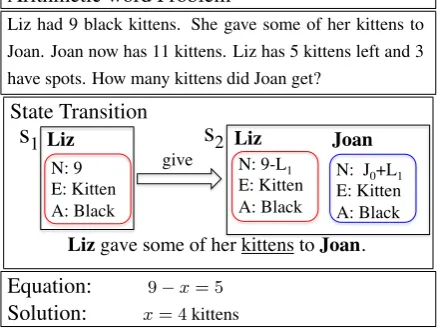
infor-mation into an equation that represents the problem, and enables its (trivial) so-lution as shown in Figure 1. The pa-per analyzes the arithmetic-word problems “genre”, identifying seven categories of verbs used in such problems. ARISlearns
to categorize verbs with 81.2% accuracy, and is able to solve 77.7% of the problems in a corpus of standard primary school test questions. We report the first learning re-sults on this task without reliance on pre-defined templates and make our data pub-licly available.1
1 Introduction
Designing algorithms to automatically solve math and science problems is a long-standing AI chal-lenge (Feigenbaum and Feldman, 1963). For NLP, mathematical word problems are particularly at-tractive because the text is concise and relatively straightforward, while the semantics reduces to simple equations.
Arithmetic word problems begin by describing a partial world state, followed by simple updates or elaborations and end with a quantitative ques-tion. For a child, the language understanding part is trivial, but the reasoning may be challenging; for our system, the opposite is true. ARISneeds to
1Our data is available at https://www.cs. washington.edu/nlp/arithmetic.
Arithmetic word Problem
Liz had 9 black kittens. She gave some of her kittens to Joan. Joan now has 11 kittens. Liz has 5 kittens left and 3 have spots. How many kittens did Joan get?
State Transition
s
1 LizN: 9 E: Kitten A: Black
Liz gave some of her kittens to Joan.
s
2 Liz N: 9-L1E: Kitten A: Black
Joan N: J0+L1 E: Kitten A: Black give
Equation: 9−x= 5
[image:1.595.307.526.257.422.2]Solution: x= 4kittens
Figure 1:Example problem and solution.
make sense of multiple sentences, as shown in Fig-ure 2, withouta priorirestrictions on the syntax or vocabulary used to describe the problem. Figure 1 shows an example where ARISis asked to infer
how many kittens Joan received based on facts and constraints expressed in the text, and represented by the state diagram and corresponding equation. While the equation is trivial, the text could have involved assembling toy aircraft, collecting coins, eating cookies, or just about any activity involving changes in the quantities of discrete objects.
This paper investigates the task of learning to solve such problems by mapping the verbs in the problem text into categories that describe their im-pact on the world state. While the verbs category is crucial (e.g., what happens if “give” is replaced by “receive” in Figure 1?), some elements of the problem are irrelevant. For instance, the fact that three kittens have spots is immaterial to the solu-tion. Thus, ARIShas to determine what
informa-tion is relevant to solving the problem.
To abstract from the problem text, ARIS maps
the text to a state representation which consists of
a set of entities, their containers, attributes, quan-tities, and relations. A problem text is split into fragments where each fragment corresponds to an observation or an update of the quantity of an en-tity in one or two containers. For example in Fig-ure 1, the sentence “Liz has 5 kittens left and 3 have spots” has two fragments of “Liz has 5 kit-tens left” and “3 have spots”.
The verb in each sentence is associated with one or two containers, and ARIS has to classify each
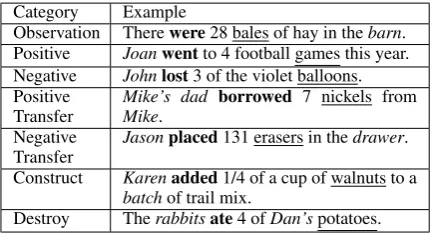
verb in a sentence into one of seven categories that describe the impact of the verb on the con-tainers (Table 1). ARISlearns this classifier based
on training data as described in section 4.2. To evaluate ARIS, we compiled a corpus of
about 400 arithmetic (addition and subtraction) word problems and utilized cross validation to both train ARIS and evaluate its performance
over this corpus. We compare its performance to the template-based learning method developed independently and concurrently by Kushman et al. (2014). We find that our approach is much more robust to domain diversity between the train-ing and test sets.
Our contributions are three-fold: (a) We present ARIS, a novel, fully automated method that learns
to solve arithmetic word problems; (b) We intro-duce a method to automatically categorize verbs for sentences from simple, easy-to-obtain train-ing data; our results refine verb senses in Word-Net (Miller, 1995) for arithmetic word problems; (c) We introduce a corpus of arithmetic word prob-lems, and report on a series of experiments show-ing high efficacy in solvshow-ing addition and subtrac-tion problems based on verb categorizasubtrac-tion.
2 Related Work
Understanding semantics of a natural language text has been the focus of many researchers in nat-ural language processing (NLP). Recent work fo-cus on learning to align text with meaning repre-sentations in specific, controlled domains. A few methods (Zettlemoyer and Collins, 2005; Ge and Mooney, 2006) use an expensive supervision in the form of manually annotated formal representa-tions for every sentence in the training data. More recent work (Eisenstein et al., 2009; Kate and Mooney, 2007; Goldwasser and Roth, 2011; Poon and Domingos, 2009; Goldwasser et al., 2011; Kushman and Barzilay, 2013) reduce the amount of required supervision in mapping sentences to
meaning representations while taking advantage of special properties of the domains. Our method, on the other hand, requires small, easy-to-obtain training data in the form of verb categories that are shared among many different problem types.
Our work is also closely related to the grounded language acquisition research (Snyder and Barzi-lay, 2007; Branavan et al., 2009; Branavan et al., 2012; Vogel and Jurafsky, 2010; Chen et al., 2010; Hajishirzi et al., 2011; Chambers and Jurafsky, 2009; Liang et al., 2009; Bordes et al., 2010) where the goal is to align a text into underlying en-tities and events of an environment. These meth-ods interact with an environment to obtain super-vision from the real events and entities in the envi-ronment. Our method, on the other hand, grounds the problem into world state transitions by learn-ing to predict verb categories in sentences. In addi-tion, our method combines the representations of individual sentences into a coherent whole to form the equations. This is in contrast with the previous work that study each sentence in isolation from the other sentences.
Previous work on studying math word and logic problems uses manually aligned meaning repre-sentations or domain knowledge where the seman-tics for all the words is provided (Lev, 2007; Lev et al., 2004). Most recently, Kushman et al. (2014) introduced an algorithm that learns to align al-gebra problems to equations through the use of templates. This method applies to broad range of math problems, including multiplication, division, and simultaneous equations, while ARISonly
han-dles arithmetic problems (addition and subtrac-tion). However, our empirical results show that for the problems it handles, ARIS is much more
robust to diversity in the problem types between the training and test data.
3 Arithmetic Problem Representation
We address solving arithmetic word problems that include addition and subtraction. A problem text is split into fragments where each fragment is rep-resented as a transition between two world states in which the quantities of entities are updated or observed (Figure 2). We refer to these fragments as sentences. We represent the world state as a tu-plehE, C, Ri consisting of entitiesE, containers
C, and relationsRamong entities, containers, at-tributes, and quantities.
corre-N: W0-13 E: tree A: walnut Liz had 9 black kittens. She gave some of her kittens to Joan. Joan has now 11 kittens. Liz has 5 kitten
left and 3 has spots. How many kittens did Joan get?
Liz had 9 black kittens
s
0s
1 LizN: 9 E: Kitten
A: Black Sheof her kittens to gave some
Joan
s
2 LizN: 9-L1 E: Kitten A: Black
Joan
N: J0+L1 E: Kitten A: Black
Joan has now 11 kittens
Liz has 5 kitten left
And 3 has spots
Liz
N: 9-L1 E: Kitten A: Black
Joan
N: 11 E: Kitten A: Black
s
3 LizN: 5 E: Kitten A: Black
Joan
N: 11 E: Kitten A: Black
s
4Liz
N: 5 E: Kitten A: Black
Joan
N: 11 E: Kitten A: Black unknown
N:3 E: Kitten
s
5There are 42 walnut trees and 12 orange trees currently in the park. Park workers cut down 13 walnut trees that were damaged. How many walnut trees will be in the park when the workers are finished?
There are 42 walnut trees and 12 orange trees currently in the park.
s
0s
1 ParkN: 42 E: tree
A: walnut Park that were damagedworkers cut down 13 walnut trees N: 12
E: tree A: orange
s
2Park
N: 42-13 E: tree A: walnut
N: 12 E: tree A: orange
[image:3.595.78.524.61.258.2]Workers
Figure 2:A figure sketching different steps of our method — a sequence of states.
sponding to an object whose quantity is observed or is changing throughout the problem. For in-stance, kitten and tree are entities in Fig-ure 2. In addition, every entity hasattributesthat modify the entity. For instance, blackis an at-tribute ofkittens, andwalnutis an attribute oftree(more details on attributes in section 4.1). Relations describing attributes are invariant to the state changes. For instance kittens stay black throughout the problem of Figure 1.
Containers: A container is a mention in the text representing a set of entities. For instance, Liz,Joan,park, andworkersare containers in Figure 2. Containers usually correspond to the
person possessing entities or a location contain-ing entities. For example, in the sentence “There are 43 blue marbles in the basket. John found 32 marbles.”, basket and John are containers of
marbles.
Quantities: Containers include entities with their corresponding quantities in a particular world state. Quantities can be known numbers (e.g. 9), unknown variables (e.g.L1), or numerical
expres-sions over unknown quantities and numbers (e.g.
9−L1). For instance, in state 2 of Figure 2, the
nu-merical expression corresponding toLizis9−L1
and corresponding toJoanisJ0+L1, whereJ0
is a variable representing the number ofkittens thatJoanhas started with.
Hereinafter, we will refer to a generic entity as
e, container asc, number asnum, attribute asa. We represent the relation between a container, an entity, and a number in the form of a quantity
ex-Category Example
Observation Therewere28 bales of hay in thebarn. Positive Joanwentto 4 football games this year. Negative Johnlost3 of the violet balloons. Positive
Transfer Mike’s dadMike. borrowed 7 nickels from Negative
Transfer Jasonplaced131 erasers in thedrawer. Construct Karenadded1/4 of a cup of walnuts to a
batchof trail mix.
Destroy Therabbitsate4 ofDan’spotatoes.
Table 1: Examples for different verb categories in sen-tences. Entities are underlined; containers are italic, and
verbsare bolded.
pression N(c,e). Figure 2 shows the quantity relations in different world states.
State transitions: Sentences depict progression of the world state (Figure 2) in the form of ob-servations of updates of quantities. We assume that every sentencewconsists of a verbv, an en-titye, a quantity num(might be unknown), one or two containers c1, c2, and attributes a. The
presence of the second container, c2, will be
dic-tated by the category of the verb, as we discuss below. Sentences abstract transitions(st→ st+1)
[image:3.595.307.525.303.420.2]Pos-itive transfer: the quantity is transferred from the second container to the first one, Negative trans-fer: the quantity is transferred from the first con-tainer to the second one, Construct: the quantity is increased for both containers, andDestroy: the quantity is decreased for both containers.
Figure 2 shows how the state transitions are determined by the verb categories. The sen-tence “Liz has 9 black kittens” initializes the quantity of kittens in the container Liz to 9. In addition, the sentence “She gave some of her kittens to Joan.” shows the negative transfer of L1 kittens from Liz to
Joan represented as N(Liz,kitten)=9-L1
andN(Joan,kitten)=J0+L1.
Given a math word problem, ARISgrounds the
world state into entities (e.g., kitten), contain-ers (e.g.,Liz), attributes (e.g.,black), and quan-tities (e.g., 9) (Section 4.1). In addition, ARIS
learns state transitions by classifying verb cate-gories in sentences (Section 4.2). Finally, from the world state and transitions, it generates an arith-metic equation which can be solved to generate the numeric answer to the word problem.
4 Our Method
In this section we describe how ARIS maps an
arithmetic word problem into an equation (Fig-ure 2). ARIS consists of three main steps
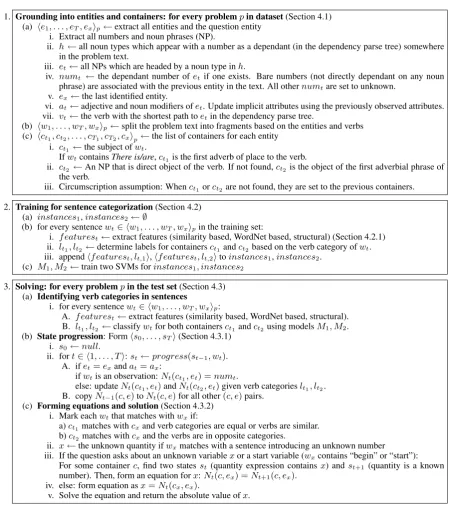
(Fig-ure 3): (1) grounding the problem into entities and containers, (2) training a model to classify verb categories in sentences, and (3) solving the prob-lem by updating the world states with the learned verb categories and forming equations.
4.1 Grounding into Entities and Containers ARIS automatically identifies entities, attributes,
containers, and quantities corresponding to every sentence fragment (details in Figure 3 step 1). For every problem, this module returns a sequence of sentence fragmentshw1, . . . , wT, wxiwhere every
wtconsists of a verb vt, an entityet, its quantity
numt, its attributesat, and up to two containers
ct1, ct2. wx corresponds to the question sentence
inquiring about an unknown entity. ARISapplies
the Stanford dependency parser, named entity rec-ognizer and coreference resolution system to the problem text (de Marneffe et al., 2006; Finkel et al., 2005; Raghunathan et al., 2010). It uses the predicted coreference relationships to replace pro-nouns (including possessive propro-nouns) with their
coreferenent links. The named entity recognition output is used to identify numbers and people. Entities: Entities are references to some object whose quantity is observed or changing through-out the problem. So to determine the set of entities, we define h as the set of noun types which have a dependent number (in the depen-dency parse) somewhere in the problem text. The set of entities is then defined as all noun phrases which are headed by a noun type in h. For in-stance kitten in the first sentence of Figure 1 is an entity because it is modified by the number 9, whilekittenin the second sentence of Fig-ure 1 is an entity becausekittenwas modified by a number in the first sentence. Every number in the text is associated with one entity. Num-bers which are dependents of a noun are associ-ated with its entity. Bare numbers (not dependent on a noun) are associated with the previous entity in the text. The entity in the last sentence is identi-fied as the question entityex. Finally, ARISsplits the problem text into T + 1 sentence fragments
hw1, . . . wT, wxisuch that each fragment contains a single entity and it’s containers. For simplicity we refer to these fragments as a sentences. Containers: Each entity is associated with one or two container noun phrases using the algorithm described in in Figure 3 step 1c. As we saw earlier with numbers, arithmetic problems often include sentences with missing information. For example in Figure 2, the second container in the the sen-tence “Park workers had to cut down 13 walnut trees that were damaged.” is not explicitly men-tioned. To handle this missing information, we use the circumscription assumption (McCarthy, 1980). The circumscription assumption formal-izes the commonsense assumption that things are as expected unless otherwise specified. In this set-ting, we assume that the set of containers are fixed in a problem. Thus if the container(s) for a given entity cannot be identified they are set to the con-tainer(s) for the previous entity with the same head word. For example in Figure 2 we know from the previous sentence thattreeswere in thepark. Therefore, we assume that the unmentioned con-tainer is thepark.
Attributes:ARISselects attributesAas modifiers
1. Grounding into entities and containers: for every problempin dataset(Section 4.1) (a) he1, . . . , eT, exip←extract all entities and the question entity
i. Extract all numbers and noun phrases (NP).
ii. h←all noun types which appear with a number as a dependant (in the dependency parse tree) somewhere in the problem text.
iii. et←all NPs which are headed by a noun type inh.
iv. numt ←the dependant number ofet if one exists. Bare numbers (not directly dependant on any noun
phrase) are associated with the previous entity in the text. All othernumtare set to unknown.
v. ex←the last identified entity.
vi. at←adjective and noun modifiers ofet. Update implicit attributes using the previously observed attributes.
vii. vt←the verb with the shortest path toetin the dependency parse tree.
(b) hw1, . . . , wT, wxip←split the problem text into fragments based on the entities and verbs
(c) hct1, ct2, . . . , cT1, cT2, cxip←the list of containers for each entity
i. ct1 ←the subject ofwt.
IfwtcontainsThere is/are,ct1is the first adverb of place to the verb.
ii. ct2 ←An NP that is direct object of the verb. If not found,ct2 is the object of the first adverbial phrase of
the verb.
iii. Circumscription assumption: Whenct1orct2are not found, they are set to the previous containers.
2. Training for sentence categorization(Section 4.2) (a) instances1,instances2← ∅
(b) for every sentencewt∈ hw1, . . . , wT, wxipin the training set:
i. featurest←extract features (similarity based, WordNet based, structural) (Section 4.2.1)
ii. lt1, lt2←determine labels for containersct1andct2based on the verb category ofwt.
iii. appendhfeaturest, lt,1i,hfeaturest, lt,2itoinstances1,instances2.
(c) M1, M2 ←train two SVMs forinstances1, instances2
3. Solving: for every problempin the test set(Section 4.3) (a) Identifying verb categories in sentences
i. for every sentencewt∈ hw1, . . . , wT, wxip:
A. featurest←extract features (similarity based, WordNet based, structural).
B. lt1, lt2 ←classifywtfor both containersct1andct2using modelsM1, M2.
(b) State progression: Formhs0, . . . , sTi(Section 4.3.1)
i. s0←null.
ii. fort∈ h1, . . . , Ti:st←progress(st−1, wt).
A. ifet=exandat=ax:
ifwtis an observation:Nt(ct1, et) =numt.
else: updateNt(ct1, et)andNt(ct2, et)given verb categorieslt1, lt2.
B. copyNt−1(c, e)toNt(c, e)for all other(c, e)pairs.
(c) Forming equations and solution(Section 4.3.2) i. Mark eachwtthat matches withwxif:
a)ct1matches withcxand verb categories are equal or verbs are similar.
b)ct2matches withcxand the verbs are in opposite categories.
ii. x←the unknown quantity ifwxmatches with a sentence introducing an unknown number
iii. If the question asks about an unknown variablexor a start variable (wxcontains “begin” or “start”):
For some containerc, find two statesst (quantity expression containsx) andst+1 (quantity is a known
number). Then, form an equation forx:Nt(c, ex) =Nt+1(c, ex).
iv. else: form equation asx=Nt(cx, ex).
[image:5.595.71.521.53.567.2]v. Solve the equation and return the absolute value ofx.
Figure 3:ARIS: a method for solving arithmetic word problems.
used to prune the irrelevant information in pro-gressing world states.
Arithmetic problems usually include sentences with no attributes for the entities. For example, the attributeblackhas not been explicitly men-tioned for thekittenin the second sentence. In particular, ARISupdates an implicit attribute using
the previously observed attribute. For example, in “Joan went to 4 football games this year. She went to 9 games last year.”, ARISassignsfootballas
an attribute of thegamein both sentences.
4.2 Training for Verb Categories
This step involves training a model to identify verb categories for sentences. This entails predicting one label (increasing, decreasing) for each (verb, container) pair in the sentence. Each possible set-ting of these binary labels corresponds to one of the seven verb categories discussed earlier. For ex-ample, ifc1is increasing andc2is decreasing this
is apositive transferverb.
cat-egories from Table 1.
For training, we compile a list of sentences from all the problems in the dataset and split sentences into training and test sets in two settings. In the first setting no instance from the same domain appears in the training and test sets in order to study the robustness of our method to new prob-lem types. In the second setting no verb is re-peated in the training and test sets in order to study how well our method predicts categories of unseen verbs.
For every sentencewtin the problems, we build two data instances,(wt, c1)and(wt, c2), wherec1
andc2are containers extracted from the sentence.
For every instance in the training data, we assign training labels using the verb categories of the sen-tences instead of labeling every sentence individu-ally. The verb can be increasing or decreasing cor-responding to every container in the sentence. For positive (negative) and construction (destruction) verbs, both instances are labeled positive (nega-tive). For transfer positive (negative) verbs, the first instance is labeled positive (negative) and the second instance is labeled negative (positive). For observation verbs, both instances are labeled pos-itive. We assume that the observation verbs are known (total of 5 verbs). Finally, we train Support Vector Machines given the extracted features and training labels explained above (Figure 3 step 2). In the following, we describe the features used for training.
4.2.1 Features
There are three sets of features: similarity based, Wordnet-based, and structural features. The first two sets of features focus on the verb and the third set focuses on the dependency structure of the sen-tence. All of our features are unlexicalized. This allows ARIS to handle verbs in the test questions
which are completely different from those seen in the training data.
Similarity-based Features: For every instance
(w, c), the feature vector includes similarity
be-tween the verb of the sentencewand a list of seed verbs. The list of seed verbs is automatically se-lected from a setVcontaining the2000most com-mon English verbs using`1regularized feature
se-lection technique. We select a small set of seed verbs to avoid dominating the other feature types (structural and WordNet-based features).
The goal is to automatically select verbs from
V that are most discriminative for each of the 7 verb categories in Table 1. We define 7 classifi-cation tasks: “Is a verb a member of each cate-gory?” Then, we select the three most represen-tative verbs for each category. To do so, we ran-domly select a set of 65 verbsVl, from all the verbs in our dataset (118 in total) and manually anno-tate the verb categories. For every classification task, the feature vectorX includes the similarity scores (Equation 1) between the verbvand all the verbs in theV. We train an`1 regularized
regres-sion model (Park and Hastie, 2007) over the fea-ture vectorXto learn each category individually. The number of original (similarity based) features inXis relatively large, but`1 regularization
pro-vides a sparse weight vector. ARISthen selects the
three most common verbs (without replacement) among the features (verbs) with non-zero weights. This accounts for 21 total seed verbs to be used for the main classification task. We find that in prac-tice using this selection technique leads to better performance than using either all the verbs inV or using just the 65 randomly selected verbs.
Our method computes the similarity between two verbsv1andv2from the similarity between all
the senses (from WordNet) of these verbs (Equa-tion 1). We compute the similarity between two senses using linear similarity (Lin, 1998). The similarity between two synsetssv1andsv2are
pe-nalized according to the order of each sense for the corresponding verb. Intuitively, if a synset appears earlier in the set of synsets of a verb, it is more likely to be considered as the correct meaning. Therefore, later occurrences of a synset should re-sult in reduced similarity scores. The similarity between two verbsv1andv2is the maximum
sim-ilarity between two synsets of the verbs:
sim(v1, v2) = max
sv:synsets(v)
lin-sim(sv1, sv2)
log(p1+p2) (1)
wheresv1,sv2are two synsets,p1,p2are the
in-clude “verb.communication”, “verb.possession”, and “verb.creation”. In addition, WordNet in-cludes the frequency measurefcsv indicating how
often the sensesvhas appeared in a reference cor-pus. For each categoryi, we define the featurefi as the ratio of the frequency of the sensesvi over the total frequency of the verb i.e.,fi=fcsvi/fcv.
Structural Features: For structural features, we use the dependency relations between the verb and the sentence elements since they can be a good proxy of the sentence structure. ARIS uses a
bi-nary vector including 35 dependency relations be-tween the verb and other elements. For example, in the sentence “Joan picked 2 apples from the ap-ple tree”, the dependency between (‘picked’ and ‘tree’) and (‘picked’ and ‘apples’) are depicted as ‘prep-from’ and ‘dobj’ relations in the dependency parser, respectively. In addition, we include the length of the path in the dependency parse from the entity to the verb.
4.3 Solving the Problem
So far, ARIS grounds every problem into entities,
containers, and attributes, and learns verb cate-gories in sentences. Solving the problem consists of two main steps: (1) progressing states based on verb categories in sentences and (2) forming the equation.
4.3.1 State Progression with Verb Categories This step (Figure 3 step 3b) involves forming stateshs1, . . . , sTiby updating quantities in every container using learned verb categories (Figure 3 step 3a). ARISinitializess0 to an empty state. It
then iteratively updates the statestby progressing the statest−1 given the sentencewtwith the verb
v, entitye, numbernum, and containersc1andc2.
For a given sentencet, ARISattempts to match
et and ct to entities and categories in st−1. An
entity/category is matched if has the same head word and same set of attributes as an existing en-tity/category. If an entity or category cannot be matching to one inst−1, then a new one is created
inst.
The progress subroutine prunes the irrelevant sentences by checking if the entity e and its at-tributesaagree with the question entityexand its attributes ax in the question. For example both gameentities agree with the question entity in the problem “Joan went to 4 football games this year. She went to 9 games last year. How many football
games did Joan go?”. The first entity has an ex-plicitfootballattribute, and the second entity has been assigned the same attribute (Section 4.1). Even if the question asks about games without mentioning football, the two sentences will match the question. Note that the second sentence would have not been matched if there was an ex-plicit mention of the ‘basketball game’ in the sec-ond sentence.
For the matched entities, ARISinitializes or
up-dates the values of the containersc1,c2in the state
st. ARIS uses the learned verb categories in sen-tences (Section 4.2) to update the values of con-tainers. For an observation sentencewt, the value of c1 in the state st is assigned to the observed quantity num. For other sentence types, if the containercdoes not match to a container the pre-vious state, its value is initialized with a start vari-ableC0. For example, the containerJoanis
ini-tialized withJ0 at the states1 (Figure 2).
Other-wise, the values ofc1andc2are updated according
to the verb category in the sentence. For instance, if the verb category in the sentence is a positive transfer thenNt(c1, e) =Nt−1(c1, e)−numand
Nt(c2, e) = Nt−1(c2, e) + numwhere Nt(c, e) represents the quantity of e in the containerc at statest(Figure 2).
4.3.2 Forming Equations and Solution The question entityexcan match either to an en-tity in the final state, or to some unknown gener-ated during the state progression. Concretely, the question sentencewxasks about the quantityxof the entityex in a containercxat a particular state
su or a transition after the sentencewu (Figure 3 step 3c).
To determine ifexmatches to an unknown vari-able, we define a matching subroutine between the question sentence wx and every sentence wt to check entities, containers, and verbs (Figure 3 step 3(c)i). We consider two cases. 1) When
wxcontains the words “begin”, or “start”, the un-known variable is about the initial value of an en-tity, and it is set to the start variable of the con-tainer cx (Figure 3 step 3(c)iii). For example, in “Bob had balloons. He gave 9 to his friends. He now has 4 balloons. How many balloons did he have to start with?”, the unknown variable is set to the start variableB0. 2) When the question verb
step 3(c)iii). For example, the second sentence in Figure 1 introduces an unknown variable over
kittens. The matching subroutine matches this
entity with the question entity since the question container, i.e. Joan, matches with the second container and verb categories are complementary.
In order to solve for the unknown variable x, ARIS searches through consecutive states st and
st+1, where inst, the quantity ofexfor a container
c is an expression overx, and in st+1, the
quan-tity is a known number for a container matched toc. It then forms an equation by comparing the quantities for containers matched between the two states. In the previous example, the equation will
be B0 −9 = 4 by comparing states s2 and s3,
where the numerical expression overballoons isB0−9in the states2, and the quantity is a known
number in the states3.
When neither of the two above cases apply, ARIS matches ex to an entity in the final state,
sT and returns its quantity, (Figure 3 step 3(c)iv). In the football example of the previous sec-tion, the equation will bex = Nt(cx, ex), where
Nt(cx, ex)is the quantity in the final state. Finally, the equation will be solved for the un-known variablexand the absolute value of the un-known variable is returned.
5 Experiments
To experimentally evaluate our method we build a dataset of arithmetic word problems along with their correct solutions. We test our method on the accuracy of solving arithmetic word problems and identifying verb categories in sentences.
5.1 Experimental Setup
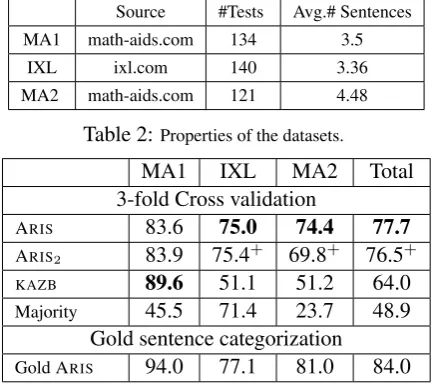
Datasets: We compiled three diverse datasets MA1, MA2, IXL (Table 2) of Arithmetic word problems on addition and subtraction for third, fourth, and fifth graders. These datasets have sim-ilar problem types, but have different characteris-tics. Problem types include combinations of ad-ditions, subtractions, one unknown equations, and U.S. money word problems. Problems in MA2 in-clude more irrelevant information compared to the other two datasets, and IXL includes more infor-mation gaps. In total, they include 395 problems, 13,632 words, 118 verbs, and 1,483 sentences. Tasks and Baselines: We evaluate ARISon two
tasks: 1) solving arithmetic word problems in the three datasets and 2) classifying verb categories in
Source #Tests Avg.# Sentences
MA1 math-aids.com 134 3.5
IXL ixl.com 140 3.36
[image:8.595.308.525.64.257.2]MA2 math-aids.com 121 4.48
Table 2:Properties of the datasets.
MA1 IXL MA2 Total 3-fold Cross validation
ARIS 83.6 75.0 74.4 77.7
ARIS2 83.9 75.4+ 69.8+ 76.5+
KAZB 89.6 51.1 51.2 64.0
Majority 45.5 71.4 23.7 48.9
Gold sentence categorization
Gold ARIS 94.0 77.1 81.0 84.0
Table 3: Accuracy of solving arithmetic word problems in three datasets MA1, IXL, and MA2. This table compares our method, ARIS, ARIS2with the state-of-the-artKAZB. All
methods are trained on two (out of three) datasets and tested on the other one. ARIS2is trained when no verb is repeated
in the training and test sets. Gold ARISuses gold verb
cat-egories. The improvement of ARIS(boldfaced) and ARIS2
(denoted by+) are significant over KAZBand the majority
baseline withp <0.05.
sentences. We use the percentage of correct an-swers to the problems as the evaluation metric for the first task and accuracy as the evaluation metric for the second task. We use Weka’s SVM (Wit-ten et al., 1999) with default parameters for clas-sification which is trained with verb categories in sentences (as described in Section 4.2).
For the first task, we compare ARIS with KAZB (Kushman et al., 2014), majority baseline,
ARIS2, and Gold ARIS. KAZB requires training
data in the form of equation systems and numeri-cal answers to the problems. The majority base-line classifies every instance as increasing. In ARIS2 (a variant of ARIS) the system is trained in
a way that no verb is repeated in the training and test sets. Gold ARIS uses the ground-truth
sen-tence categories instead of predicted ones. For the second task, we compare ARISwith a baseline that
uses WordNet verb senses. 5.2 Results
We evaluate ARIS in solving arithmetic word
problems in the three datasets and then evaluate its ability in classifying verb categories in sentences. 5.2.1 Solving Arithmetic Problems
Table 3 shows the accuracy of ARIS in
significantly outperforms KAZB and the
major-ity baseline. As expected, ARIS shows a larger
gain on the two more complex datasets MA2 and IXL; our method shows promising results in deal-ing with irrelevant information (dataset MA2) and information gaps (dataset IXL). This is because ARIS learns to classify verb categories in
sen-tences and does not require observing similar pat-terns/templates in the training data. Therefore, ARIS is more robust to differences between the
training and test datasets and can generalize across different dataset types. As discussed in the ex-perimental setup, the datasets have mathematically similar problems, but differ in the natural language properties such as in the sentence length and irrel-evant information (Table 2).
Table 3 also shows that the sentence categoriza-tion is performed with high accuracy even if the problem types and also the verbs are different. In particular, there are a total of 118 verbs among which 64 verbs belong to MA datasets and 54 are new to IXL. To further study this, we train our method ARIS2 in which no verb can be repeated
in the training and test sets. ARIS2 still
signifi-cantly outperformsKAZB. In addition, we observe
only a slight change in accuracy between ARIS
and ARIS2.
To further understand our method, we study the effect of verb categorization in sentences in solv-ing problems. Table 3 shows the results of Gold ARIS in solving arithmetic word problems with
gold sentence categorizations. In addition, com-paring ARIS with Gold ARIS suggests that our
method is able to reliably identify verb categories in sentences.
We also perform an experiment where we pool all of the problems in the three datasets and randomly choose 3 folds for the data (instead of putting each original dataset into it’s own fold). We compare our method with KAZBin
this scenario. In this setting, our method’s accu-racy is 79.5% while KAZB’s accuracy is 81.8%.
As expected, our method’s performance has not changed significantly from the previous setting, whileKAZB’s performance significantly improves
because of the reduced diversity between the train-ing and test sets in this scenario.
5.2.2 Sentence Categorization
Table 4 compares accuracy scores of sentence categorization for our method with different fea-tures, a baseline that uses WordNet verb senses,
and the majority baseline that assigns every (verb, container) pair as increasing. Similar to ARIS2,
we randomly split verbs into three equal folds and assign the corresponding sentences to each fold. No verb is shared between training and test sets. We then directly evaluate the accuracy of the SVM’s verb categorization (explained in Sec-tion 4.2). This table shows that ARIS performs
well in classifying sentence categories even with new verbs in the test set. This suggests that our method can generalize well to predict verb cate-gories for unseen verbs.
Table 4 also details the performance of four variants of our method that ablate various features of ARIS. The table shows that similarity,
contex-tual, and WordNet features are all important to the performance of ARIS in verb categorization,
whereas the WordNet features are less important for solving the problems. In addition, it shows that similarity features play more important roles. We also performed another experiment to study the ef-fect of the proposed feature selection method for similarity-based features. The accuracy of ARIS
in classifying sentence categories is 69.7%when we use all the verbs inV in the similarity feature vector. This shows that our feature selection algo-rithm for selecting seed verbs is important towards categorizing verbs.
Finally, Table 4 shows that our method signif-icantly outperforms the baseline that only uses WordNet verb sense. An interesting observation is that the majority baseline in fact outperforms WordNet verb senses in verb categorization, but is significantly worse in solving arithmetic word problems. In addition, we evaluate the accuracy of predicting only verb categories by assigning the verb label according to the majority of its labels in the sentence categories. The accuracy of verb categories is 78.2%confirming that ARIS is able
to successfully categorize verbs. 5.2.3 Error Analysis
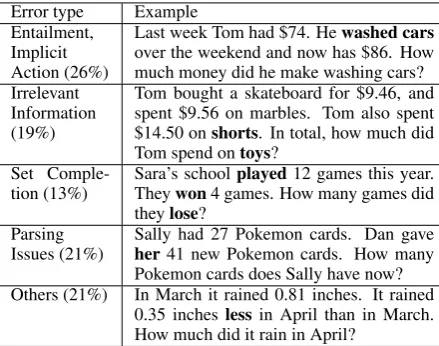
We analyzed all 63 errors of Gold ARIS and
present our findings in Table 5. There are five ma-jor classes of errors. In the first category, some in-formation is not mentioned explicitly and should be entailed. For example, ‘washing cars’ is the source of ‘making money’. Despite the improve-ments that come from ARIS, a large portion of the
Categorization Solution
ARIS 81.2+ 76.5+
No similarity features 68.8 65.4
No WordNet features 75.3 78.0+
No structural features 75.5 72.4+
Baseline (WordNet) 67.8 68.4
[image:10.595.75.288.62.161.2]Majority Baseline 73.4 48.9
Table 4: Ablation study and baseline comparisons: this ta-ble reports the accuracy of verb categorization in sentences and solutions for ARIS with ablating features. It also
pro-vides comparisons to WordNet and majority baselines. The improvement of ARIS(boldfaced) and ablations denoted by+
are statistically significant over the baselines (withp <0.05) for both tasks.
Error type Example Entailment,
Implicit Action (26%)
Last week Tom had $74. Hewashed cars
over the weekend and now has $86. How much money did he make washing cars? Irrelevant
Information (19%)
Tom bought a skateboard for $9.46, and spent $9.56 on marbles. Tom also spent $14.50 onshorts. In total, how much did Tom spend ontoys?
Set
Comple-tion (13%) Sara’s schoolTheywon4 games. How many games didplayed12 games this year. theylose?
Parsing
Issues (21%) Sally had 27 Pokemon cards. Dan gaveher41 new Pokemon cards. How many Pokemon cards does Sally have now? Others (21%) In March it rained 0.81 inches. It rained
0.35 incheslessin April than in March. How much did it rain in April?
Table 5:Examples of different error categories and relative frequencies. The cause of error isbolded.
about set completions. For example, the ‘played’ games can be split into ‘win’ and ‘lost’ games. Finally, parsing and coreference mistakes are an-other source of errors for ARIS.
6 Discussions and Conclusion
In this paper we introduce ARIS, a method for
solving arithmetic word problems. ARIS learns
to predict verb categories in sentences using syn-tactic and (shallow) semantic features from small, easy-to-obtain training data. ARIS grounds the
world state into entities, sets, quantities, attributes, and their relations and takes advantage of the cir-cumscription assumption and successfully fills in the information gaps. Finally, ARIS makes use
of attributes and discards irrelevant information in the problems. Together these provide a new rep-resentation and a learning algorithm for solving arithmetic word problems.
This paper is one step toward building a sys-tem that can solve any math and logic word
problem. Our empirical evaluations show that our method outperforms a template-based learn-ing method (developed recently by Kushman et al. (2014)) on solving addition and subtraction prob-lems with diversity between the training and test sets. In particular, our method generalizes bet-ter to data from different domains because ARIS
only relies on learning verb categories which al-leviates the need for equation templates for arith-metic problems. In this paper, we have focused on addition and subtraction problems. However,
KAZB can deal with more general types of
prob-lems such as multiplication, division, and simulta-neous equations.
We have observed a complementary behavior between our method and that of Kushman et al. This suggests a hybrid approach that can bene-fit from the strengths of both methods while be-ing applicable to more general problems while ro-bust to the errors specific to each. In addition, we plan to focus on incrementally collecting domain knowledge to deal with missing information gaps. Another possible direction is to improve parsing and coreference resolution.
Acknowledgments
The research was supported by the Allen Institute for AI, and grants from the NSF (IIS-1352249) and UW-RRF (65-2775). We thank Ben Hixon and the anonymous reviewers for helpful com-ments and the feedback on the work.
References
Antoine Bordes, Nicolas Usunier, and Jason Weston. 2010. Label ranking under ambiguous supervision for learning semantic correspondences. InProc. International Confer-ence on Machine Learning (ICML).
SRK Branavan, Harr Chen, Luke S. Zettlemoyer, and Regina Barzilay. 2009. Reinforcement learning for mapping in-structions to actions. InProc. of the Annual Meeting of the Association for Computational Linguistics and the Inter-national Joint Conference on Natural Language Process-ing of the AFNLP (ACL-AFNLP).
SRK Branavan, Nate Kushman, Tao Lei, and Regina Barzi-lay. 2012. Learning high-level planning from text. In
Proc. of the Annual Meeting of the Association for Com-putational Linguistics (ACL).
Nathanael Chambers and Dan Jurafsky. 2009. Unsupervised learning of narrative schemas and their participants. In
[image:10.595.73.293.250.423.2]David Chen, Joohyun Kim, and Raymond Mooney. 2010. Training a multilingual sportscaster: Using perceptual context to learn language. Journal of Artificial Intelli-gence Research, 37.
Marie-Catherine de Marneffe, Bill MacCartney, and Christo-pher D. Manning. 2006. Generating typed dependency parses from phrase structure parses. InProc. Language Resources and Evaluation Conference (LREC).
Jacob Eisenstein, James Clarke, Dan Goldwasser, and Dan Roth. 2009. Reading to learn: Constructing features from semantic abstracts. InProc. Conference on Empiri-cal Methods in Natural Language Processing (EMNLP). Edward A. Feigenbaum and Julian Feldman, editors. 1963.
Computers and Thought. McGraw Hill, New York. Jenny Rose Finkel, Trond Grenager, and Christopher
Man-ning. 2005. Incorporating non-local information into information extraction systems by gibbs sampling. In
Proc. of the Annual Meeting of the Association for Com-putational Linguistics (ACL).
Ruifang Ge and Raymond J. Mooney. 2006. Discriminative reranking for semantic parsing. InProc. of the Annual Meeting of the Association for Computational Linguistics (ACL).
Dan Goldwasser and Dan Roth. 2011. Learning from natural instructions. InProceedings of International Joint Con-ference on Artificial Intelligence (IJCAI).
Dan Goldwasser, Roi Reichart, James Clarke, and Dan Roth. 2011. Confidence driven unsupervised semantic parsing. InProc. of the Annual Meeting of the Association for Com-putational Linguistics (ACL).
Hannaneh Hajishirzi, Julia Hockenmaier, Erik T. Mueller, and Eyal Amir. 2011. Reasoning about robocup soccer narratives. InProc. Conference on Uncertainty in Artifi-cial Intelligence (UAI).
Rohit J. Kate and Raymond J. Mooney. 2007. Learn-ing language semantics from ambiguous supervision. In
Proc. Conference of the Association for the Advancement of Artificial Intelligence (AAAI).
Nate Kushman and Regina Barzilay. 2013. Using seman-tic unification to generate regular expressions from natu-ral language. InProceeding of the Annual Meeting of the North American Chapter of the Association for Computa-tional Linguistics.
Nate Kushman, Yoav Artzi, Luke Zettlemoyer, and Regina Barzilay. 2014. Learning to automatically solve algebra word problems. In Proc. of the Annual Meeting of the Association for Computational Linguistics (ACL). Iddo Lev, Bill MacCartney, Christopher D. Manning, , and
Roger Levy. 2004. Solving logic puzzles: From robust processing to precise semantics. In Workshop on Text Meaning and Interpretation at Association for Computa-tional Linguistics (ACL).
Iddo Lev. 2007.Packed Computation of Exact Meaning Rep-resentations. Ph.D. thesis, CS, Stanford University. Percy Liang, Michael I. Jordan, and Dan Klein. 2009.
Learn-ing semantic correspondences with less supervision. In
Proc. of the Annual Meeting of the Association for Com-putational Linguistics and the International Joint Con-ference on Natural Language Processing of the AFNLP (ACL-AFNLP).
Dekang Lin. 1998. An information-theoretic definition of similarity. InProc. International Conference on Machine Learning (ICML).
John McCarthy. 1980. Circumscription—a form of non-monotonic reasoning.Artificial Intelligence, 13.
George A Miller. 1995. Wordnet: a lexical database for en-glish.Communications of the ACM, 38.
Mee Young Park and Trevor Hastie. 2007. L1-regularization path algorithm for generalized linear models. Journal of the Royal Statistical Society: Series B (Statistical Method-ology), 69.
Hoifung Poon and Pedro Domingos. 2009. Unsupervised se-mantic parsing. InProc. Conference on Empirical Meth-ods in Natural Language Processing (EMNLP).
Karthik Raghunathan, Heeyoung Lee, Sudarshan Rangara-jan, Nathanael Chambers, Mihai Surdeanu, Dan Jurafsky, and Christopher Manning. 2010. A multi-pass sieve for coreference resolution. InProc. Conference on Empirical Methods in Natural Language Processing (EMNLP). Philip Resnik. 1995. Using information content to evaluate
semantic similarity in a taxonomy. InInternational joint conference on Artificial intelligence (IJCAI).
Benjamin Snyder and Regina Barzilay. 2007. Database-text alignment via structured multilabel classification. In Pro-ceedings of International Joint Conference on Artificial Intelligence (IJCAI).
Adam Vogel and Daniel Jurafsky. 2010. Learning to follow navigational directions. InProc. of the Annual Meeting of the Association for Computational Linguistics (ACL). Ian H Witten, Eibe Frank, Leonard E Trigg, Mark A Hall,
Ge-offrey Holmes, and Sally Jo Cunningham. 1999. Weka: Practical machine learning tools and techniques with java implementations.