Proceedings of the 2019 Conference on Empirical Methods in Natural Language Processing 2068
Guiding the Flowing of Semantics: Interpretable Video Captioning via
POS Tag
Xinyu Xiao1,2, Lingfeng Wang1, Bin Fan1, Shiming Xiang1,2, Chunhong Pan1 1NLPR, Institute of Automation, Chinese Academy of Sciences
2School of Artificial Intelligence, University of Chinese Academy of Sciences {xinyu.xiao, lfwang, bfan, smxiang, chpan}@nlpr.ia.ac.cn
Abstract
In the current video captioning models, the video frames are collected in one network and the semantics are mixed into one feature, which not only increase the difficulty of the caption decoding, but also decrease the inter-pretability of the captioning models. To ad-dress these problems, we propose an Adaptive Semantic Guidance Network (ASGN), which instantiates the whole video semantics to dif-ferent POS-aware semantics with the supervi-sion of part of speech (POS) tag. In the encod-ing process, the POS tag activates the related neurons and parses the whole semantic infor-mation into corresponding encoded video rep-resentations. Furthermore, the potential of the model is stimulated by the POS-aware video features. In the decoding process, the related video features of noun and verb are used as the supervision to construct a new adaptive tention model which can decide whether to at-tend to the video feature or not. With the ex-plicit improving of the interpretability of the network, the learning process is more transpar-ent and the results are more predictable. Ex-tensive experiments demonstrate the effective-ness of our model when compared with state-of-the-art models.
1 Introduction
Video captioning, which transforms the semantic information in a video to a natural statement, has
received wide attention recently. The series of
scenes (both related and unrelated) in video frames bring a huge challenge for the task of video cap-tioning. Therefore, mastering the ability to pro-cess the correlated and irrelevant semantic infor-mation can improve the performance and inter-pretability of the model of video captioning.
The classical deep learning based video
cap-tioning methods (Venugopalan et al.,2015a,b)
in-corporate both CNN and LSTM together as an
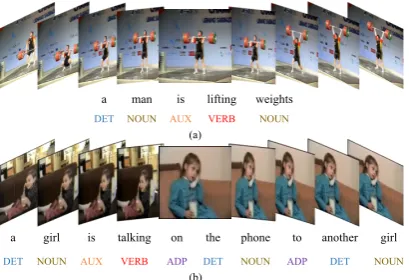
a man is lifting weights
DET NOUN AUX VERB NOUN
a girl is talking on the phone to another girl
DET NOUN AUX VERB ADP DET NOUN ADP DET NOUN
(a)
[image:1.595.314.519.222.362.2](b)
Figure 1: Examples of video description and its POS tags. The definition of POS tag can be seen in Section 3.1. From these examples, it can be seen that the words that are belonging to the same POS tags undergo inflec-tion for similar semantic properties and different POS tags reflect different semantic properties distinctly.
encoder-decoder architecture which extracts all the semantic information in one stream and fuses them in a single feature. In the architecture, the transformation of the semantics to words
predic-tion is uncertainty. Some other recent studies
(Dong et al., 2017; Wu et al., 2018) attempt to improve the interpretability of the transformation
process. But the flowing of different semantic
information in the network streams and the acti-vated neurons in network are still ambiguous. To address these issues, the first is to take the dis-crimination of different semantic information into
consideration. According to (Horoufchin et al.,
A POS tag is the category of words which has
similar grammatical properties. The words
as-signed to the same POS tag generally reflect sim-ilar properties within the grammatical structure of
sentence. Fig.1 (a) shows a video and its
cap-tion “a man is lifting weights”. The nouns “man”, “weights” and the verb “lifting” are belonging to different POS tags and referring to different
se-mantic information in video. Moreover, in Fig. 1
(b), the caption of video is “a girl is talking on the phone to another girl”. The words of “girl”, “talking” and “phone” distinctly have their corre-sponding visual signals in the video, but the oth-ers are uncertain. This example indicates that the nouns of objects and verbs of actions are generally referred to visual words. Another property of the POS tag is that when given a fixed sentence, the POS tags of all the words in the sentence are fixed. It ensures the reliability of the POS tag in helping to extract and guide corresponding semantics.
According to Merity et al. (Merity et al.,2016),
the prediction of the next word not always need to attend the visual feature. The gradients from non-visual words could mislead and diminish the effectiveness of the visual signal in guiding
cap-tion generacap-tion. To this end, Lu et al. (Lu et al.,
2016) proposed a “visual sentinel”, which applies
the hidden state in LSTM as supervision to adap-tively decide if it is necessary to input visual fea-ture to the language model when generating the next word. However, the supervision information from the hidden state isn’t credible which cannot make sure it contains the corresponding visual de-cision signals. According to the properties of the POS tag, the nouns and verbs can be applied as the supervision to distinguish whether the remain-ing words in the sentence are visual words or not.
In this paper, to explicitly improve the inter-pretability of video captioning model, we pro-pose an Adaptive Semantic Guidance Network (ASGN), which instantiates the whole video se-mantics by part of speech (POS) tags to different POS-aware semantics. At first, a POS-aware se-mantic guider is proposed. It predicts the POS tags of the words in descriptions, and guides differ-ent POS-aware semantic information of video into corresponding network streams by the predicted POS tags. In this process, the specific CNN neu-rons are activated under the supervision of POS tags and the whole visual semantics are parsed into POS tags related video features. Moreover,
de-pending on the POS-aware video features, a new adaptive attention operation is introduced. The video features related to noun and verb are used as a supervision to get a sentinel gate, which de-cides how much the attended feature can be im-ported into the decoder LSTM when generating
the next word. A reinforcement learning (RL)
method is applied to optimize our model which further demonstrates the validity of our method on the video captioning task.
The main contributions of this paper are:
- Designing a POS-aware semantic guider to predict the POS tags of words and guide dif-ferent semantic information of video into cor-responding network streams. Under the su-pervision of POS tags, the CNN neurons are selectively activated and aware of the related POS tags, so that the whole video semantics are parsed into the corresponding POS-aware video features.
- Depending on the noun and verb instanti-ated video features, a new adaptive attention model is constructed to decide how much the visual feature is imported into the decoder.
- Due to the guiding of POS tags, the flow-ing of the type of semantic in which network stream can be easily clarified. With the super-vision of the noun and verb related features, the judgment of the predicted word is visual word or not is more reasonable. These make the learning process more interpretable while achieving state-of-the-art performance.
2 Related Works
Here, we first review the recent implements of the POS tag in computer vision, then review the most relevant works on video description task like attention-based methods and interpretable im-proved models.
The POS tag has been received attention in some computer vision tasks, like visual question
answering (Wang et al., 2018b) and image
cap-tioning (A et al.,2019). He et al. (He et al.,2017)
utilized the POS tag of each word to determine whether it is essential to input image
representa-tion into the word generator. Wang et al. (Wang
CNN
CNN
CNN
CNN
LSTMp LSTMp LSTMp LSTMp LSTMw LSTMw LSTMw LSTMw LSTMd LSTMd LSTMd LSTMd
NUM NOUN AUX EOS
BOS two men boat
two men are EOS
Description Generator Learning
POS Tag Learning
v1
v2
vi
vNs
● ● ●
● ● ●
● ● ●
● ● ●
2D CNN
●●● ●●● ●●●
●●● ●●●
3D CNN
v V
gna gna gna gna
V V V V
● ● ●
● ●
● ●●
●
[image:3.595.77.520.62.213.2]V
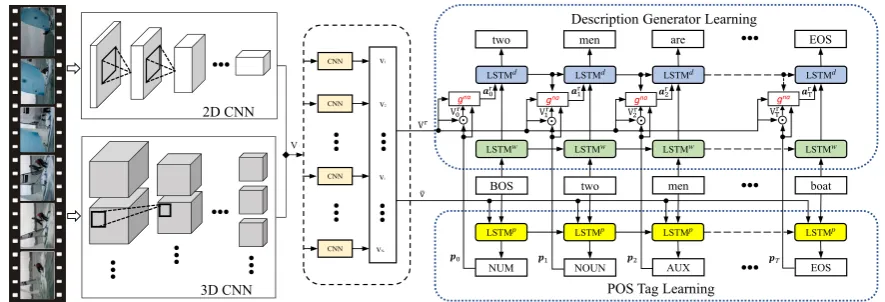
Figure 2: The architecture of our Adaptive Semantic Guidance Network (ASGN) which can shunt the re-quired semantic information into different video features when generating every word in caption. The features
{v1,v2, . . . ,vNs}are extracted by the CNN modules.is the hadamard product module.g
nais the new adaptive
attention model. A single-layer LSTM is set as the POS tag decoder and a two-layer stacked LSTM is set as the language model. The BOS and EOS denote the begin-of-sentence and end-of-sentence, respectively.
of the POS tag in the linguistic computer vision. However, they ignore the important property of POS tag, which relates to different visual seman-tics with different types of POS tag.
Attention-based methods have been widely
used in visual captioning models. Yao et al. (Yao
et al., 2015) considered the temporal structure of video and proposed a temporal attention
mecha-nism to generate descriptions. Lu et al. (Lu et al.,
2016) proposed an adaptive attention model in
im-age captioning which can decide either to look at the image or to rely on the context of sentence to generate the next word.
Because of the highly nonlinearity and unclear working mechanism of neural networks, the op-erational processes of neural networks are always
treated as black-box processes. For the video
description task, some researchers (Dong et al.,
2017;Wu et al., 2018) attempted to improve the interpretability of video description models. Dong
et al. (Dong et al.,2017) interpreted the learned
features of each neuron by a wide range of visual concepts in the video description task. Wu et al. (Wu et al.,2018) considered both the motion infor-mation and the sentence semantic structure with an attentive structured localization mechanism to enhance the captioning model’s interpretability.
In this paper, we find the POS tag can be em-ployed as a supervision to process irrelevant or relevant semantic information in video descrip-tion task. Under the supervision of POS tag, an Adaptive Semantic Guidance Network (ASGN) is proposed to guide different POS-aware semantic information of video into corresponding network
streams. Moreover, the video features related to noun and verb are used to get a sentinel gate which can decide how much the attended feature can be imported to the decoding process.
3 Our Method
In this section, we describe our ASGN in detail. First, the POS-aware semantic guider with the POS tag learning model is introduced. Next, an adaptive attention model which constructs a new sentinel gate will be presented. Finally, the de-scription generator and its learning methods are introduced.
3.1 POS-Aware Semantic Guider
The key of the proposed POS-aware semantic guider is the POS tag, which is used to guide different semantic information of video into cor-responding network streams. Supposing that we
have a video described by a textual sentence S,
which consists of T words. The POS tag set of
each word inS is defined asP. To achieve this, a
POS tag learning model is designed to predict the POS tags of the words in description.
We refer to (Al-Rfou et al., 2013) and
anno-tate the POS tags of captions in training set by
the polyglot toolkit1. Polyglot toolkit is a
natu-ral language pipeline that supports massive multi-lingual applications, including the POS tag identi-fication. According to the setting of the polyglot toolkit, there are seventeen categories of POS tags: noun (NOUN), verb (VERB), adjective (ADJ),
adposition (ADP), adverb (ADV), auxiliary verb (AUX), coordinating conjunction (CONJ), de-terminer (DET), interjection (INTJ), numeral (NUM), particle (PART), pronoun (PRON), proper noun (PROPN), punctuation (PUNCT), subordi-nating conjunction (SCONJ), symbol (SYM) and other unknown types (X). Different POS tags have different descriptions or embellishments. Follow-ing the universal set of this toolkit, the number of
POS tag categories is defined asNs= 17.
Based on these POS tag categories, an encoder-decoder framework is proposed to predict the spe-cific POS tag of each word in sentences, which
can be seen in Fig. 2. Specifically, the video
fea-tureVis concatenated from the extractions of the
2D CNN and 3D CNN. Then,Vis flowed intoNs
semantic guiding CNN modules. Each CNN mod-ule relates to a corresponding POS tag category.
The outputs of these CNN modules areNs video
features vi, where i = 1, . . . , Ns. The
mean-pooled featurev¯ = N1
s P
i=1vi and the sentence
S = {s0,s1, . . . ,sT} are taken as the inputs to
the POS tag decoder LSTMp, wheres0 is defined
as the begin-of-sentence (BOS). All the POS tags of words in caption are sequentially generated by
LSTMp. The hidden statehpt is updated at time
stept∈ {0, . . . , T}through:
hpt =LSTMp(Wpest,v¯,hpt−1), (1)
whereWpe ∈ RNh×V is the word embedding
ma-trix,Nhis the length of hidden state andV denotes
the vocabulary size of the corresponding dataset’s text library.
Given the ground-truth POS tags which are an-notated to the corresponding sentence. Therefore,
the associated POS tags of the k-th video V are
Pk={pk
0, . . . , pkT}. We define the POS tag learn-ing loss as:
Lp=−
1 N
N X
k=1
T X
t=0
log(p(pkt|pk0:t−1,v¯k)), (2)
where N is the number of training examples.
In the encoder-decoder framework, the POS tag
probability vector pt is predicted at time step
t. The mapping function is pt = f(hpt) =
Softmax(FC(hpt)), wheref : hpt → pt is a
Soft-max mixed function and FC is a full connection layer. The predicted POS tag has the maximum
probability inpt. Similar to visual captioning, the
learned POS-aware semantic guider applies each
predicted word to predict the POS tag of the next word in testing.
The learned ptis used to guide the flowing of
semantics from theNsCNN modules at time step
t. Thei-th CNN module is related to thei-th POS
tag category. The outputs of the CNN modules are
concatenated as Vr = [v1,v2, . . . ,vNs], where
vi is generated by the specific neuron of thei-th
CNN module. The POS tag vector pt is applied
to activate the specific CNN module at the t-th
step. The operation is implemented by a hadamard product module on the channel level:
Vrt =Vrpt, (3)
where Vrt represents the video representation at
time stept. Then the video featureVtrwhich
con-tains relevant visual semantic information will be
inputted into the language model at time stept.
Generally, the learned POS tag representations can be used to activate the specific neurons of the CNN encoder and parse the whole video represen-tation to guide semantic information into corre-sponding feature representations at each time step. Compared with the normal CNN+LSTM model, our POS-aware semantic guider constructs a cor-relation between different types of POS-aware se-mantic and the corresponding CNN modules.
3.2 Adaptive Attention Model
Although, Lu et al. (Lu et al., 2016) proposed a
sentinel to decide whether the predicted words are visual words or not. Their model is learning from the gradient of back propagation, which is still an ambiguous process. The video features related to different POS tags have different properties. For example, the video features related to noun and verb always have sufficient visual signals. Accord-ing to the properties of POS tags, we propose a more credible adaptive spatial attention model to predict next word. Specifically, the related video features of noun and verb are applied as the su-pervision to get a sentinel gate. Through the sen-tinel gate, when generating the next word, we can distinguish its visual word or not and decide how much the attended feature can be imported into the decoder LSTM.
First, the video featureVrt is reshaped toVrt =
[vrt1,vtr2, . . . ,vtmr ], where m is the value of the
width times height ofVrt. Normal attention model
is defined asga(Vrt,hdt−1). hdt−1 is generated by
Fig. 2. Formally, for thet-th time step, the
atten-tion part of the modelgais defined as follows:
ztr = tanh((WrVrt +br)⊕Whrhdt−1),
αrt = sof tmax(Wαrztr+bαr), (4)
whereWr∈Rl×(Nc∗Ns),Whr∈
Rl×Nh,Wαr∈
Rl×1are the transformation matrices that map the
CNN feature and hidden state to the same size;Nc
is the channel size ofvi; br ∈ Rlandbαr ∈ R1
are the model biases. αrt is the attention weight
related toVr
t.
Second, to improve the structure of ga, our
model learns to use the related video features of noun and verb as a supervision to distinguish whether the words in a sentence are visual words
or not. All of theNs video features are extracted
after the ReLU operation, and thus the values in these feature maps are not less than zero. It indi-cates that the value of the feature map can reflect the response activation of the corresponding CNN module. We assign the related feature maps of noun and verb as the reference and obtain a value
R=mean[21mPm
j=1(vn+vv)], wherevnandvv
are the related features of noun and verb fromVr.
Depending on the attended visual feature, a
formu-lae is introduced to ascertain whether the currentt
word is a visual word or not:
cvt =
Ns X
i=1
{pit if mean(
m X
j=1
αrtjvjri)≥R}, (5)
wherecvt is the weight of visual word at time step
t,pitisi-th value in thet-th POS tag representation
pt. Therefore, the weight of non-visual word is
cnvt = 1−cvt. In our method, the sentinel gate is
defined as:
βt=
1
1 + exp(−log(cvt cnv
t ))
. (6)
The design of the sentinel gate can avoid the
gate value ofβtbeing too small or too large. Based
on βt, the new adaptive attention modelgna can
decide how much the attended feature can be im-ported into the decoder LSTM as follows:
art =βtga=βt
m X
j=1
αrtjvrtj. (7)
3.3 Description Generator
In the description generation stage, we adopt a stacked two-layer LSTM to generate captions,
namely LSTMw and LSTMd. Following (
Don-ahue et al.,2015), the first LSTM layer LSTMwis applied to encode the inputted sentence to enhance the textual context information of each word vec-torhwt.
In the decoding stage, the encoded word vector
hwt and the processed video featureart are taken as
the inputs atttime step. The updating procedure
from 0 toT of LSTMdis written below:
hdt = LSTMd(hwt ,art,hdt−1), (8)
wherehdt is the current output of LSTMdat time
stept, thehd−1 can be set as a null vector.
3.3.1 Description Generator Learning
Maximum Likelihood Estimation: Given thek
-th video Vk and the associated sentence Wk =
{wk
0, . . . , wkT}, the generator loss can be formu-lated as follows with the optimization of maxi-mum likelihood estimation (MLE):
Ls =−
λ N
N X
k=1
T X
t=0
log(p(wtk|w0:kt−1,Vk)), (9)
wherep(wk
t|wk0:t−1,Vk)is obtained from a
Soft-max mixed function;λis the hyper-parameter.
Policy Gradient Optimization: For a fair
com-parison with recent works, the policy gradient (PG) technique is adopted as the optimizer to training our model. The objective in learning is to minimize the negative expected reward of the
complete sampled sentenceWs={ws
0, . . . , wTs}:
Lθ =EWs∼p θ[r(W
s)], (10)
wherer(Ws)is calculated by comparing sampled
caption with the reference caption in the speci-fied evaluation metric. Following the
implemen-tation in (Rennie et al., 2017), we apply a single
Monte-Carlo sample to calculate the relative
re-ward∆r(Ws), which is computed by a baseline
rewardb. bis obtained by performing greedy
de-coding:
b=r( ˆW), Wˆ = arg max p(wt|hdt),
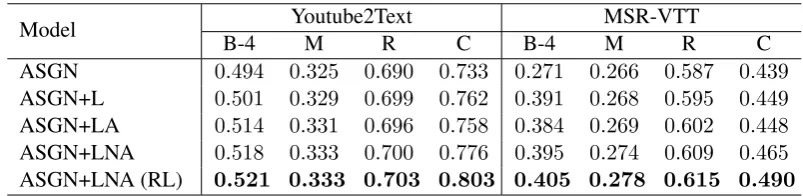
Table 1: Ablation studies of our proposed video captioning model on Youtube2Text and MSR-VTT datasets. The (RL) indicates this model is optimized by the reinforcement learning. The best results are in bold.
Model Youtube2Text MSR-VTT
B-4 M R C B-4 M R C
ASGN 0.494 0.325 0.690 0.733 0.271 0.266 0.587 0.439
ASGN+L 0.501 0.329 0.699 0.762 0.391 0.268 0.595 0.449
ASGN+LA 0.514 0.331 0.696 0.758 0.384 0.269 0.602 0.448
ASGN+LNA 0.518 0.333 0.700 0.776 0.395 0.274 0.609 0.465
ASGN+LNA (RL) 0.521 0.333 0.703 0.803 0.405 0.278 0.615 0.490
4 Experiments
4.1 Dataset and Evaluation
We report the results of our method on the
Youtube2Text (Guadarrama et al., 2013) and
MSR-VTT (Xu et al., 2016) datasets. The
Youtube2Text dataset contains 1970 YouTube video clips. According to the publicly provided
splits (Venugopalan et al.,2015b), 1200 videos are
used for training, 100 videos for validation and the rest are used for testing. MSR-VTT is the largest public dataset for video captioning up to now.
We follow the public splits (Venugopalan et al.,
2015a) and divide them into 6,513, 497 and 2,990 samples for training, validation and testing, re-spectively. We reserve the words that appear in the training set and yield two vocabularies which con-tain 12,182 and 16,630 words for Youtube2Text and MSR-VTT datasets, respectively.
In evaluation, we report the following metrics:
B-N (N=2,3,4) (Papineni et al., 2002), Meteor
(Banerjee and Lavie,2005), Rouge-L (Lin,2004)
and CIDEr (Vedantam et al., 2015). All the
met-rics are computed by the MS-COCO caption
eval-uation tool2.
4.2 Training Details
CNN Encoder: For the video representations, we
use a 2D CNN and a 3D CNN as the CNN encoder collectively. The 3D CNN can operate all video frames as a whole, which ensures the extracted visual features contain all the semantic informa-tion. The 2D CNN has more efficient learning and representation capacity. The details of these two CNNs can be seen as follows:
• 2D CNN We use ResNet-152 (He et al.,
2016) as the 2D CNN model. The feature
map is taken from the res5c layer
(2,048-dim).
2https://github.com/tylin/coco-caption
• 3D CNNThe C3D (Tran et al.,2015) is
ap-plied as the 3D CNN model. The feature map
is extracted from theconv5blayer.
The equally-spaced 16 and 32 frames are sam-pled from one video clip for Youtube2Text and MSR-VTT, respectively. We perform a mean op-eration among all the 2D CNN features. The
rep-resentationVof each video is composed by a
con-catenation of the 3D CNN feature and the 2D CNN
feature. Then, the feature mapVis processed by
Ns semantic separating CNN modules. A
resid-ual block is adopted as the CNN module in our method. The hidden state dimension of the LSTM units is 1,024.
The Adam optimizer is adopted in training. We first train the POS tag learning model in the POS-aware semantic guider. In the later training, the pa-rameters of the POS tag learning model are fixed. The other parameters of our model is learned with
MLE.λis set to be 1. The maximum number of
epochs of the MLE training is 30. The RL method is applied to optimize the MLE trained model with the CIDEr metric. At each epoch, the validation set is used to evaluate the training model, and the best CIDEr score model is selected for the final testing. All of our experiments are implemented
with Pytorch (Paszke et al., 2017) and are
con-ducted on a Titan X GPU with 12G memory. In caption testing, the beam search is adopted for caption generation. The search size is set to be
5in experiments.
4.3 Compared Approaches
Our method is compared withHRNE(Pan et al.,
2016),VideoLAB(Ramanishka et al.,2016),
SA-LSTM (Wang et al., 2018a) and attention-based
methods like MA (Hori et al., 2017),SCN (Gan
et al.,2016) and recently proposedPickNet(Chen et al., 2018) and state-of-the-art RL optimized
Table 2: Performance compared with state-of-the-art methods on Youtube2Text dataset. The (−) is an un-known metric.
Model B-4 M R C
LSTM-I 0.446 0.297 − −
HRNE 0.438 0.331 − −
MA 0.504 0.318 − 0.699
SCN 0.511 0.335 − 0.777
TSA 0.517 0.340 − 0.749
SA-LSTM 0.523 0.341 0.698 0.803
PickNet 0.523 0.333 0.696 0.765
[image:7.595.308.523.215.251.2]ASGN+LNA 0.547 0.342 0.717 0.813
Table 3: Performance compared with state-of-the-art methods on MSR-VTT dataset.
Model B-4 M R C
VideoLAB 0.391 0.277 0.606 0.441
SA-LSTM 0.391 0.266 0.593 0.427
Weakly 0.414 0.283 0.611 0.489
CIDEnt-RL 0.405 0.284 0.614 0.517
HRL 0.413 0.287 0.617 0.480
PickNet 0.413 0.277 0.598 0.441
ASGN+LNA 0.420 0.282 0.621 0.505
(Pasunuru and Bansal,2017),HRL (Wang et al.,
2017). Moreover, we compare our method with
in-terpretable improvement methodsLSTM-I(Dong
et al.,2017) andTSA(Wu et al.,2018).
4.4 Ablation Study
We perform the ablation studies on the
Youtube2Text and MSR-VTT datasets for
our video captioning model. The results are
shown in Table 1. ASGN which imports video
feature into different network streams without the POS tag guidance is adopted as the baseline
model. ASGN+L predicts the POS tag of each
word and applies the POS tag to guide the semantic separation. “L” denotes the POS-aware
semantic guider. ASGN+LA adds an attention
model proposed by Lu et al. (Lu et al., 2016).
As a comparison, our proposed new adaptive
attention model is introduced toASGN+LNA.
It can be seen that the ASGN+LNA achieves the best performances in all metrics, which indi-cates our proposed sentinel gate is more effective-ness and reasonable to decide the quantity of at-tended feature to the decoder LSTM. Compared with the baseline model, the introduction of POS
[image:7.595.72.291.279.404.2]tag in ASGN+L, which activates the specific neu-rons and parses the whole visual representation of video, can assign appropriate POS-aware seman-tic information and achieve better performance. Comparing with the results of MLE-based and RL-based methods, the RL method can improve the performance of MLE-based model by signifi-cant margins across all metrics.
Table 4: Human evaluation between ASGN and
ASGN+L models.
Indifference ASGN+L Wins ASGN Wins
0.418 0.329 0.253
Table 5: The results under different supervisions of POS tags on Youtube2Text dataset.
Model B-4 M R C
A+A 0.489 0.325 0.695 0.756
V 0.506 0.330 0.699 0.762
N 0.509 0.330 0.701 0.773
N+V 0.518 0.333 0.700 0.776
4.5 Quantitative Analysis
In Table 2 and Table 3, we compare our
ASGN+LNA model with the state-of-the-art mod-els on the Youtube2Text and MSR-VTT datasets.
Following the operation of (Gan et al.,2016;
Pa-sunuru and Bansal,2017), ASGN+LNA is the av-erage ensemble of 5 ASGN+LNA (RL) models trained with different initializations. From the re-sults, our method achieves the competitive perfor-mance on the two datasets. Compared with the
other interpretable improvement methods (Dong
et al., 2017; Wu et al., 2018), interpretability of our neural network is explicitly improved, and the performance of our model is more competitive.
0 0.2 0.4 0.6 0.8 1
Youtube2Text Acc B-2 B-3 B-4 MSR-VTT
[image:7.595.308.525.299.379.2] [image:7.595.309.526.603.727.2]0.9999 0.7663
0.9899
0.5586
0.9992 0.998 0.8664
A man is sitting on a couch
Captions
0.9999
0.8519 1 0.8551 0.9855 0.8836 0.9959
A woman is lying on a bed
0.9998 0.8383
1 0.99 0.9964 0.9686
A woman is slicing a tomato
0.9963
0.4381
0.9995 0.9887
0.4191 0.5592 0.9144
0.2265 0.2608
A man is putting out in a big pole
NOUN
VERB DET
AUX
ADP
[image:8.595.81.517.63.228.2]ADJ
Figure 4: Visualizations of the probabilities of each word and corresponding POS tag in caption.
We introduce the human evaluation from (
Pa-sunuru and Bansal,2017) for comparison between ASGN and ASGN+L models. The relevance mea-sures how related is the generated caption w.r.t, to the video content is adopted as the metric.
In Table 4, the results of 150 samples from the
Youtube2Text test set are studied. It can be found that the proposal of the semantic guider signifi-cantly improves the semantic extraction ability of network.
Moreover, to better verify the reliability of the supervision of nouns and verbs, we add com-parisons by adjusting the supervision to single nouns (N), single verbs (V), adjectives and ad-verbs (A+A), nouns and ad-verbs (N+V), respec-tively. The results on the Youtube2Text are
pre-sented in Table5. It can be found that the model
under the supervision of V+N achieves the best performance. Compared to verbs, the model under the supervision of nouns is more reliable. Under the supervision of A+A, the results of the model indicate the words of adjectives or adverbs are not always related to visual signals.
4.6 Visualized Analysis
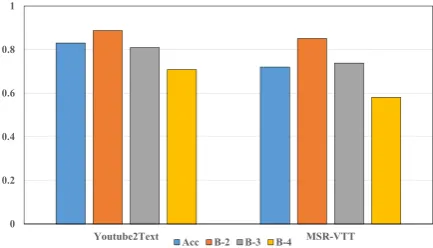
To examine the reliability of the POS tag pre-diction, the performance of the POS tag learning model is measured using accuracy (Acc) and B-N (N=2,3,4) over the test datasets of Youtube2Text
and MSR-VTT. The results are shown in Fig. 3.
The metric of Acc is to test the total predict per-formance and the metric of B-N is to test the con-tinuity of prediction. To better illustrate the ef-fectiveness of the model, we set the beam search size to be 1 which is the same with the training process. These results indicate that the POS tag learning model can provide reliable POS tag
rep-resentations to guide the semantics’ separation to corresponding network streams.
Fig. 4 gives some results of generated
cap-tions and the corresponding probability of words
and POS tags. In Fig. 4, we can see that the
POS-aware semantic guider successfully guides the POS-aware semantic to the generation of cap-tions. The POS-aware neurons have higher prob-ability are activated to extract corresponding se-mantics to predict the relevant words at each time step. In the first example, the POS tags of the generated words with the highest probability have high probability as well. It demonstrates the im-provement of interpretability of our model.
To further present the interpretability of our model, the neuron activations associated with the POS tags, the weights of the sentinel gate, the gen-erated video captions, and the real POS tags of the
captions are visualized in Fig. 5. Each element
of these samples is illustrated along with the word prediction in sequence. Through these examples, the process of the POS-aware semantic informa-tion extracinforma-tion and guidance in corresponding net-work stream can be visualized explicitly. From the illustration between the activated neuron and the truth POS tags of the captions. It can be found that the corresponding POS-aware neurons have high
activations through time. For example, in Fig. 5
Description:
A person is slicing a potato
POS tags:
DET NOUN VERB VERB DET NOUN
DET
NOUN
Description:
A man is flying into the water
POS tags:
DET NOUN AUX VERB ADP DET NOUN
NOUN
VERB DET
Description:
A woman is putting a frying of hot of a pan
POS tags:
DET NOUN AUX VERB DET NOUN ADP ADJ ADP DET NOUN
NOUN VERB DET
Description:
The girls are dancing
POS tags: DET NOUN VERB VERB
Description:
A dog is running on a field
POS tags:
DET NOUN AUX VERB ADP DET NOUN
Description:
Two girls are being in the other
POS tags:
NUM NOUN VERB VERB ADP DET ADJ
(a) (b) (c)
(d) (e) (f)
VERB
0 1
Weights of sentinel gate
AUX
ADP
0 1
Weights of sentinel gate
AUX
ADP
ADJ
0 2
Weights of sentinel gate
DET
VERB
0 1
Weights of sentinel gate
0 1
Weights of sentinel gate
DET
AUX
ADP NOUN
VERB
NOUN
VERB DET
NUM
ADP ADJ
0 2
Weights of sentinel gate
[image:9.595.84.515.60.307.2]NOUN
Figure 5: Visualization of the sampled video frames, the neuron activations associated with the POS tags, the weights of the sentinel gate, the generated captions, and the real POS tags of the captions.
From Fig. 5(a), the words of “person”, “slicing”
and “potato” are obviously visual words which have related visual signals in video, and our model successfully extracts their visual information.
5 Conclusion
In this paper, we have proposed an Adaptive Se-mantic Guidance Network (ASGN), which ex-tracts as well as guides the POS-aware semantic information into the corresponding encoded visual representations under the supervision of POS tag. Moreover, a new sentinel gate is introduced to determine how much the attended feature can be imported into the decoding process. It indicates that interpretable improvement not only makes the learning process more transparent, but also gives model more space to explore. The promising per-formance and interpretability improved merits of our method demonstrate the effectiveness of the POS tag. Furthermore, the proposed ASGN has a good flexibility which can be employed to the other language and vision fields, such as image captioning, visual question answering, and so on.
6 Acknowledgment
We thank the anonymous reviewers for their help-ful comments. This work was supported by the National Natural Science Foundation of China un-der Grants 91646207, 61773377, and 61573352, the Young Elite Scientists Sponsorship Program
by CAST (2018QNRC001), and the Beijing Natu-ral Science Foundation under Grant L172053.
References
Deshpande A, Aneja J, and Wang L. 2019. Diverse and accurate image captioning guided by part-of-speech. InCVPR, pages 10695–10704.
Rami Al-Rfou, Bryan Perozzi, and Steven Skiena. 2013. Polyglot: Distributed word representations for multilingual NLP. InCoNLL, pages 183–192.
Satanjeev Banerjee and Alon Lavie. 2005. Meteor: An automatic metric for mt evaluation with improved correlation with human judgments. In ACL Work-shop, volume 29, pages 65–72.
Yangyu Chen, Shuhui Wang, Weigang Zhang, and Qingming Huang. 2018. Less is more: Picking in-formative frames for video captioning. In ECCV, pages 367–384.
Jeff Donahue, Lisa Hendricks, Sergio Guadarrama, Marcus Rohrbach, Subhashini Venugopalan, Trevor Darrell, and Kate Saenko. 2015. Long-term recur-rent convolutional networks for visual recognition and description. InCVPR, pages 2625–2634.
Yinpeng Dong, Hang Su, Jun Zhu, and Bo Zhang. 2017. Improving interpretability of deep neural net-works with semantic information. InCVPR, pages 975–983.
Zhe Gan, Chuang Gan, Xiaodong He, Yunchen Pu, Kenneth Tran, Jianfeng Gao, Lawrence Carin, and Li Deng. 2016. Semantic compositional networks for visual captioning. Computing Research Reposi-tory (CoRR), abs/1611.08002.
Sergio Guadarrama, Niveda Krishnamoorthy, Girish Malkarnenkar, Subhashini Venugopalan, Raymond Mooney, Trevor Darrell, and Kate Saenko. 2013. Youtube2text: Recognizing and describing arbitrary activities using semantic hierarchies and zero-shot recognition. InICCV, pages 2712–2719.
Kaiming He, Xiangyu Zhang, Shaoqing Ren, and Jian Sun. 2016. Deep residual learning for image recog-nition. InCVPR, pages 770–778.
Xinwei He, Baoguang Shi, Xiang Bai, Gui-Song Xia, Zhaoxiang Zhang, and Weisheng Dong. 2017. Im-age caption generation with part of speech guidance. Pattern Recognition Letters.
Chiori Hori, Takaaki Hori, Teng-Yok Lee, Ziming Zhang, Bret Harsham, John Hershey, Tim Marks, and Kazuhiko Sumi. 2017. Attention-based multi-modal fusion for video description. InICCV, pages 4203–4212.
Houpand Horoufchin, Danilo Bzdok, Giovanni Buc-cino, Anna Borghi, and Ferdinand Binkofski. 2018. Action and object words are differentially anchored in the sensory motor system - a perspective on cog-nitive embodiment. 8.
Chin Lin. 2004. Rouge: A package for automatic eval-uation of summaries. InACL Workshop, volume 8.
Jiasen Lu, Caiming Xiong, Devi Parikh, and Richard
Socher. 2016. Knowing when to look:
Adap-tive attention via A visual sentinel for image cap-tioning. Computing Research Repository (CoRR), abs/1612.01887.
Stephen Merity, Caiming Xiong, James Bradbury, and Richard Socher. 2016. Pointer sentinel mixture models. Computing Research Repository (CoRR), abs/1609.07843.
Pingbo Pan, Zhongwen Xu, Yi Yang, Fei Wu, and Yuet-ing Zhuang. 2016. Hierarchical recurrent neural en-coder for video representation with application to captioning. InCVPR, pages 1029–1038.
Kishore Papineni, Salim Roukos, Todd Ward, and Wei-Jing Zhu. 2002. Bleu: a method for automatic eval-uation of machine translation. InACL, pages 311– 318.
Ramakanth Pasunuru and Mohit Bansal. 2017. Rein-forced video captioning with entailment rewards. In EMNLP, pages 979–985.
Adam Paszke, Sam Gross, Soumith Chintala, Gre-gory Chanan, Edward Yang, Zachary DeVito, Zem-ing Lin, Alban Desmaison, Luca Antiga, and Adam Lerer. 2017. Automatic differentiation in pytorch. InNeruIPS Workshop.
Vasili Ramanishka, Abir Das, Dong Park, Subhashini Venugopalan, Lisa Hendricks, Marcus Rohrbach, and Kate Saenko. 2016. Multimodal video descrip-tion. Inthe ACM International Conference on Mul-timedia, pages 1092–1096.
Steven Rennie, Etienne Marcheret, Youssef Mroueh, Jarret Ross, and Vaibhava Goel. 2017. Self-critical sequence training for image captioning. InCVPR, pages 1179–1195.
Zhiqiang Shen, Jianguo Li, Zhou Su, Minjun Li, Yurong Chen, Yu-Gang Jiang, and Xiangyang Xue. 2017. Weakly supervised dense video captioning. InCVPR, pages 5159–5167.
Du Tran, Lubomir Bourdev, Rob Fergus, Lorenzo Torresani, and Manohar Paluri. 2015. Learning spatiotemporal features with 3d convolutional net-works. InICCV, pages 4489–4497.
Ramakrishna Vedantam, C. Zitnick, and Devi Parikh. 2015. Cider: Consensus-based image description evaluation. InCVPR, pages 4566–4575.
Subhashini Venugopalan, Marcus Rohrbach, Jeffrey Donahue, Raymond Mooney, Trevor Darrell, and Kate Saenko. 2015a. Sequence to sequence - video to text. InICCV, pages 4534–4542.
Subhashini Venugopalan, Huijuan Xu, Jeff Donahue, Marcus Rohrbach, Raymond Mooney, and Kate Saenko. 2015b. Translating videos to natural lan-guage using deep recurrent neural networks. In NAACL, pages 1494–1504.
Bairui Wang, Lin Ma, Wei Zhang, and Wei Liu. 2018a. Reconstruction network for video cap-tioning. Computing Research Repository (CoRR), abs/1803.11438.
Xin Wang, Wenhu Chen, Jiawei Wu, Yuan-Fang Wang, and William Yang Wang. 2017. Video captioning via hierarchical reinforcement learning. Computing Research Repository (CoRR), abs/1711.11135.
Zhe Wang, Xiaoyi Liu, Limin Wang, Yu Qiao, Xiao-hui Xie, and Charless Fowlkes. 2018b. Structured triplet learning with pos-tag guided attention for vi-sual question answering. In WACV, pages 1888– 1896.
Xian Wu, Guanbin Li, Qingxing Cao, Qingge Ji, and Liang Lin. 2018. Interpretable video captioning via trajectory structured localization. In CVPR, pages 6829–6837.
Jun Xu, Tao Mei, Ting Yao, and Yong Rui. 2016. MSR-VTT: A large video description dataset for bridging video and language. InCVPR, pages 5288– 5296.