Proceedings of the 2019 Conference on Empirical Methods in Natural Language Processing and the 9th International Joint Conference on Natural Language Processing, pages 2230–2240,
2230
How well do NLI models capture verb veridicality?
Alexis Ross Harvard University
alexis [email protected]
Ellie Pavlick Brown University
ellie [email protected]
Abstract
In natural language inference (NLI), contexts are considered veridical if they allow us to infer that their underlying propositions make true claims about the real world. We inves-tigate whether a state-of-the-art natural lan-guage inference model (BERT) learns to make correct inferences about veridicality in verb-complement constructions. We introduce an NLI dataset for veridicality evaluation con-sisting of 1,500 sentence pairs, covering 137 unique verbs. We find that both human and model inferences generally follow theoretical patterns, but exhibit a systematic bias towards assuming that verbs are veridical–a bias which is amplified in BERT. We further show that, encouragingly, BERT’s inferences are sensi-tive not only to the presence of individual verb types, but also to the syntactic role of the verb, the form of the complement clause (to- vs. that-complements), and negation.
1 Introduction
A context is veridical when the propositions it contains are taken to be true, even if not explic-itly asserted. For example, in the sentence “He does not know that the answer is 5”, “know”is veridical with respect to“The answer is 5”, since a speaker cannot felicitously say the former sen-tence unless they believe the latter proposition to be true. In contrast,“think”would not be veridical here, since“He does not think that the answer is 5”is felicitous whether or not it is taken to be true that“The answer is 5”. Understanding veridical-ity requires semantic subtlety and is still an open problem for computational models of natural lan-guage inference (NLI) (Rudinger et al.,2018).
This paper deals specifically with veridicality in verb-complement constructions. Prior work in this area has focused on characterizing verb classes–e.g. factives like “know that”(Kiparsky
and Kiparsky,1968) and implicatives like
“man-age to” (Karttunen, 1971)–and on incorporating such lexical semantic information into computa-tional models (MacCartney and Manning, 2009). However, increasingly, linguistic evidence sug-gests that inferences involving veridicality rely heavily on non-lexical information and are better understood as a graded, pragmatic phenomenon
(de Marneffe et al.,2012;Tonhauser et al.,2018).
Thus, in this paper, we revisit the question of whether neural models of natural language inference–which are not explicitly endowed with knowledge of verbs’ lexical semantic categories– learn to make inferences about veridicality consis-tent with those made by humans. We solicit hu-man judgements on 1,500 sentence pairs involv-ing 137 verb-complement constructions. Analy-sis of these annotations provides new evidence of the importance of pragmatic inference in model-ing veridicality judgements. We use our collected annotations to analyze how well a state-of-the-art NLI model (BERT,Devlin et al.,2018) is able to mimic human behavior on such inferences. The results suggest that, while not yet solved, BERT represents non-trivial properties of veridicality in context. Our primary contributions are:
• We collect a new NLI evaluation set of 1,500 sentence pairs involving verb-complement constructions (§4).1
• We discuss new analysis of human judge-ments of veridicality and implications for NLI system development going forward (§5).
• We evaluate the state-of-the-art BERT model on these inferences and present evidence that, while there is still work to be done, the
1https://github.com/alexisjihyeross/
model appears to capture non-trivial proper-ties about verbs’ veridicality in context (§6).
2 Background and Related Work
There is significant work, both in linguistics and NLP, on veridicality and closely-related topics (factuality, entailment, etc). We view past work on veridicality within NLP as largely divisible into two groups, which align with two differing per-spectives on the role of the NLI task: the sentence-meaning perspective and the speaker-sentence-meaning per-spective. Briefly, thesentence meaningapproach to NLI takes the position that NLP systems should strive to model the aspects of a sentence’s seman-tics which are closely derivable from the lexicon and which hold independently of context (Zaenen
et al.,2005). In contrast, thespeaker meaning
ap-proach to NLI takes the position that NLP sys-tems should prioritize representation of the goal-directed meaning of a sentence within the context in which it was generated (Manning,2006). Work on veridicality which aligns with the sentence-meaning perspective tends to focus on charac-terizing verbs according to their lexical seman-tic classes (or “signatures”), while work which aligns with the speaker-meaning approach focuses on representing “world knowledge” and evaluat-ing inferences in naturalistic contexts.
Lexical Semantics (Sentence Meaning). Most prior work treats veridicality as a lexical semantic phenomenon. Such work is largely based on lex-icons of verb signatures which specify the types of inferences licensed by individual verbs (
Kart-tunen, 2012;Nairn et al.,2006;Falk and Martin,
2017). White and Rawlins (2018); White et al.
(2018) evaluated neural models’ ability to carry out inferences in line with these signatures, mak-ing use of templatized “semantically bleached” stimuli (e.g.“someone knew something”) in order to avoid confounds introduced by world knowl-edge and pragmatic inference. McCoy et al.
(2019) perform a similar study, though without specific focus on veridicality lexicons.
Most applied work related to veridicality also falls under the lexical semantic approach. In nearly all cases, relevant system development in-volves explicit incorporation of verb lexicons and associated logical inference rules. MacCartney
and Manning(2009);Angeli and Manning(2014);
and others incorporated knowledge of verb signa-tures within a natural logic framework (
MacCart-ney, 2009; S´anchez Valencia, 1991) in order to
perform natural language inference. Richardson
and Kuhn(2012) incorporated signatures into a
se-mantic parsing system. Several recent models of event factuality similarly make use of veridicality lexicons as input to larger machine-learned sys-tems for event factuality (Saur´ı and Pustejovsky,
2012;Lotan et al., 2013;Stanovsky et al., 2017;
Rudinger et al., 2018). Cases et al. (2019) used
nested veridicality inferences as a test case for a meta-learning model, again assuming verb signa-tures as “meta information” knowna priori.
Pragmatics (Speaker Meaning). Geis and
Zwicky (1971) observed that implicative verbs
often give rise to “invited inferences”, beyond what is explainable by the lexical semantic type of the verb. For example, on hearing“He did not refuse to speak”, one naturally concludes that“He spoke” unless additional qualifications are made (e.g. “...he just didn’t have anything to say”).
de Marneffe et al. (2012) explored this idea in
depth and presented evidence that such pragmatic inferences are both pervasive and annotator-dependent, but nonetheless systematic enough to be relevant for NLP models. Karttunen et al.
(2014) makes similar observations specifically in the case of evaluative adjectives, andPavlick and
Callison-Burch (2016) specifically in the case of
simple implicative verbs. In non-computational linguistics,Simons et al.(2017,2010);Tonhauser
et al. (2018) take a strong stance and argue that
veridicality judgements are entirely pragmatic, dependent solely on the question under discussion (QUD) within the given discourse.
This Work. This paper assumes the speaker-meaning approach: we take the position that mod-els which consistently mirror human inferences about veridicality in context can be said to un-derstand veridicality in general. We acknowledge that the question of what is the “right” approach to NLI has existed since the original definition of the recognizing textual entailment (RTE) task (Dagan
et al., 2006) and remains open. However, there
has been a de factoendorsement of the speaker-meaning definition, evidenced by the widespread adoption of NLI datasets which favor informal, “natural” inferences over prescriptivist annotation guidelines (Manning,2006;Bowman et al.,2015;
Williams et al.,2018). (Note, recently, there have
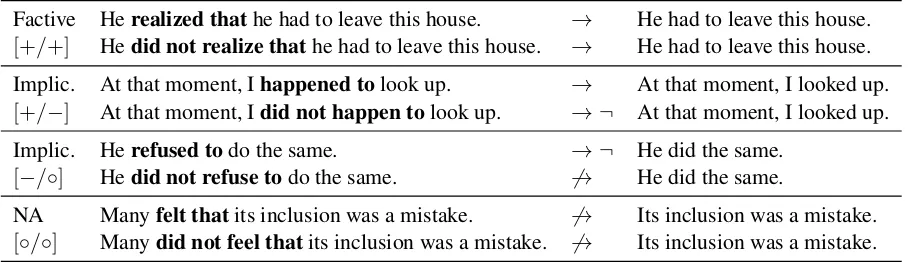
Factive Herealized thathe had to leave this house. → He had to leave this house. [+/+] Hedid not realize thathe had to leave this house. → He had to leave this house.
Implic. At that moment, Ihappened tolook up. → At that moment, I looked up. [+/−] At that moment, Idid not happen tolook up. → ¬ At that moment, I looked up.
Implic. Herefused todo the same. → ¬ He did the same.
[−/◦] Hedid not refuse todo the same. 6→ He did the same.
[image:3.595.73.529.63.194.2]NA Manyfelt thatits inclusion was a mistake. 6→ Its inclusion was a mistake. [◦/◦] Manydid not feel thatits inclusion was a mistake. 6→ Its inclusion was a mistake.
Table 1: Examples of several verb signatures and illustrative contexts for each. Signatures1/s2denotes that the complement will project with polaritys1in a positive environment and polaritys2in a negative environment.
and Boleda(2019)). Thus, from this perspective,
we ask: do NLI models which arenotspecifically endowed with lexical semantic knowledge pertain-ing to veridicality nonetheless learn to model this semantic phenomenon?
3 Projectivity and Verb Signatures
Veridicality is typically treated as a lexical seman-tic property of verbs, specified by the verb’s sig-nature. These signatures can indicate that a verb licenses positive (+), negative (−), or neutral (◦) inferences. Specifically,Karttunen(2012) defines these as two-bit signatures, to reflect that verbs2
may behave differently in positive vs. negative environments. For example, a factive verb con-struction like “know that” has a +/+signature, indicating that the complement projects positively in both positive and negative environments. That is, both “He knows that the answer is 5” and “He does not know that the answer is 5” imply that “The answer is 5”. In contrast, a verb like “manage to” has the signature +/− since, in a positive environment, the complement projects (“I managed to pass”→“I passed”) but, in a neg-ative environment, the negation of the comple-ment projects (“I did not manage to pass”→ ¬“I passed”). Other verbs may exhibit veridicality only in positive or negative environments but not in both. For example, “refuse to” has signature −/◦: “She refused to dance”→ ¬“She danced”, but“She did not refuse to dance”neither implies nor contradicts the claim “She danced”. Still other verbs are entirely non-veridical (◦/◦). For example,“hope to”is not expected to license any inferences about the truth of its complement. We
2Karttunen(2012) actually discusses these signatures for implicative verbs only. We adopt the notation, but use it in for factives and uncategorized verbs as well.
consider 8 signatures3 in total. Table1 provides several examples. Table2lists all of the signatures and the corresponding verbs we consider.
4 Data
For our analysis, we collect an NLI dataset for veridicality evaluation derived from the MNLI corpus. This data is publicly available athttps: //github.com/alexisjihyeross/ verb_veridicality.
4.1 Generating NLI Pairs
We generate NLI-style premise/hypothesis pairs based on sentences drawn from the train+dev splits of the MultiNLI (Williams et al., 2018) corpus. Specifically, we collect all sentences appearing in MNLI4 which contain any verb-complement construction, e.g. any sequence matching the pattern: verb {“to”|“that”} {VP|S}. Since we aim to manipulate the environ-ment (positive vs. negative) ourselves in a con-trolled manner, we filter out sentences which al-ready contain explicit negation words (e.g. “no”, “not”, “never”, “n’t”), conditionals (“if ”), and passive constructions (“was intended to”). From the selected sentences, we take a stratified sample over the lemma ofverb. For use in later analysis, we associate each lemma with a signature using a manually-curated dictionary5of implicative and factive verbs, and assign the signature of ◦/◦ to verbs which do not appear in the dictionary. We sample a set of sentences for every lemma, taking
3
Seven from http://web.stanford.edu/ group/csli_lnr/Lexical_Resources/, plus◦/◦.
4We removed sentences from the telephone genre, since the parses on these tended to be noisy and thus our manipula-tions often yielded incorrect or difficult to interpret sentences.
5http://web.stanford.edu/group/csli_
no more than 40 sentences per lemma, and weight-ing our samplweight-ing to prefer shorter sentences, in or-der to reduce cognitive load on our raters.
+/+realize that (34) know that (32) remember that (17) find that (12) notice that (12) reveal that (12) acknowledge that (11) admit that (11) learn that (11) observe that (11) see that (11) note that (10) recognize that (10) understand that (10) discover that (8)+/−manage to (30) begin to (12) serve to (11) start to (11) dare to (8) use to (7) get to (6) come to (5)−/+ forget to (15) fail to (10)◦/+suspect that (11) explain that (10) mean to (10) predict that (10)◦/−attempt to (28)−/◦refuse to (36) decline to (12) remain to (7)+/◦show that (12) confirm that (11) demonstrate that (10) ensure that (9) help to (9) tend to (8)◦/◦try to (34) hope that (20) hope to (18) mention that (14) like to (12) continue to (12) expect that (12) agree that (12) love to (12) reply that (12) conclude that (12) say that (12) complain that (12) speculate that (12) state that (12) suggest that (12) worry that (12) mean that (12) intend to (11) insist that (11) imply that (11) indicate that (11) plan to (11) promise to (11) prove to (11) saw that (11) seem that (11) tell that (11) think that (11) felt that (11) write that (11) decide to (11) assume that (11) believe that (11) assert that (11) concern that (11) estimate that (11) convince that (11) decide that (11) appear that (11) argue that (11) aim to (11) cease to (10) strive to (10) proceed to (10) choose to (10) seem to (10) prove that (10) provide that (10) seek to (10) appear to (10) comment that (10) contend that (10) want to (10) doubt that (10) feel that (10) fear that (10) agree to (10) announce that (9) claim that (9) struggle to (9) hear that (9) propose to (9) wish to (9) say to (9) turn to (8) wish that (8) work to (8) advise that (8) move to (8) claim to (8) expect to (8) report that (8) happen to (8) propose that (8) hold that (8) declare that (8) prefer to (8) need to (8) give that (7) deserve to (7) threaten to (7) exist to (7) be that (7) prepare to (6) wait to (6) pretend to (6) ask to (6) return to (6) request that (5) demand that (4) recommend that (4) require that (4)
Table 2: 137 verbs belonging to 8 signatures. Paren-theses denote number of contexts in which each verb appears in our final, annotated dataset (§4)
.
We consider each sampled sentence S to be a candidate premise. We then generate premise/hypothesis pairs as follows. We use the parse tree provided by MNLI to extract the com-plement clauseC. When needed, we inflect6 the verb in the complement to match the tense of the main verb. We then generate twohp, hipairs: the sentence and the complement as-ishS, Ci, and the negated sentence plus the complement h¬S, Ci. For example, given an original sentence like“He knows that the answer is 5”, we would generate two hp, hi pairs: h“He knows that the answer is 5”, “The answer is 5”i andh“He does not know that the answer is 5”, “The answer is 5”i. The examples shown in Table1 illustrate hp, hi pairs drawn from our dataset, generated this way.
4.2 Annotation
For eachhp, hipair, we collect human judgements on Amazon Mechanical Turk. We have raters la-bel entailment on a 5-point likert scale in which −2means thathis definitelynottrue givenpand 2means thathis definitely true givenp. This ordi-nal labelling scheme7matches prior work on com-mon sense inference (Zhang et al.,2017), and on
6https://www.clips.uantwerpen.be/
pages/pattern-en
7Full annotation guidelines in Supplementary.
veridicality specifically (de Marneffe et al.,2012). We do not provide examples for boundary cases (the difference between−2,−1 or 1,2) to avoid biasing raters by providing explicit guidance about the extent to which common sense can factor in. Raters have the option of indicating with a check box that one or both sentences does not make sense, and thus that they are unable to judge. We require that raters have had at least 100 approved tasks, have maintained an 98% approval rating, and are located in an primarily English-speaking country (US, AU, GB, CA). We collect three an-notations perp/hpair, and pay $0.10 per set of six pairs labelled.
Quality Controls and Exclusion Criteria. We remove all sentence pairs in which one or more raters checked the “does not make sense” box. We remove sentences from our analysis unless both the hS, Ci and the h¬S, Ci pairs passed this fil-ter. Finally, we remove verbs from our analysis which, after the above filtering, do not appear with at least 4 sentences (i.e. 8 p/h pairs). Our fi-nal dataset contains 137 verb types across 1,498 sentences (2,996 pairs). Table2lists the verbs in-cluded in our dataset and the number of sentences in which each appears.8 To measure inter-rater agreement, for each example and each of the three raters assigned to the example, we calculated the correlation between that rater’s score and the aver-aged score of the other two raters. The Spearman correlation among raters, averaged across the three raters for each example, was0.78for positive con-texts and0.74for negative contexts.
4.3 Aggregation
We take the mean of the three human judgements for each sentence pair. We then represent each verbv(in the context of a given sentenceS) using a continuous analog of the projectivity signatures discussed in§3. That is, we take the mean score forhS, Cias a measure of the veridicality ofv(in the context ofS) in a positive environment, and the mean score forh¬S, Cias a measure of the veridi-cality in a negative environment. For example, given S=“David Plotz failed to change my mind” andC=“David Plotz changed my mind”, we get a soft projectivity “signature” of−2.0/1.67, which is consistent with the expected (discrete)−/+ sig-nature for“fail to”.
[ ] [ ] [+]
[
]
[
]
[+
]
Negative Context
Fact +/ +
[ ] [ ] [+]
Impl +/
[ ] [ ] [+]
Impl / +
[ ] [ ] [+]
Impl / +
[ ] [ ] [+]
Impl /
[ ] [ ] [+]
Impl /
[ ] [ ] [+]
Impl +/
[ ] [ ] [+]
NA /
(a) Human Judgements
[ ] [ ] [+]
[
]
[
]
[+
]
Negative Context
Fact +/ +
[ ] [ ] [+]
Impl +/
[ ] [ ] [+]
Impl / +
[ ] [ ] [+]
Positive Context Impl / +
[ ] [ ] [+]
Impl /
[ ] [ ] [+]
Impl /
[ ] [ ] [+]
Impl +/
[ ] [ ] [+]
NA /
[image:5.595.76.524.63.235.2](b) Model Predictions
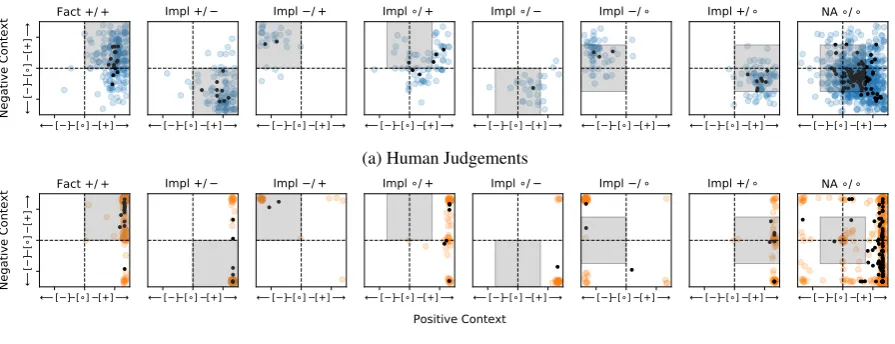
Figure 1: Human judgements (top, blue) and model predictions (bottom, orange) for verbs in each category. Gray squares denote the region in which judgements are expected fall, given the signature. Each colored dot corresponds to a single context (verb within a specific sentence); each black dot corresponds to a single verb (averaged score over all contexts in which it was judged).
5 Analysis of Human Judgements
Figure 1a plots these soft veridicality signatures for each sentence. We see that, averaged across all the contexts in which they are judged, verbs tend to behave as expected given their assigned lexi-cal semantic signature. However, we observe two noteworthy trends, discussed below. We note that these observations are consistent with arguments made byde Marneffe et al.(2012) about the strong effects of pragmatics on veridicality judgments.
Veridicality Bias. First, we observe a system-atic “veridicality bias”, in which inferences about complements are often made (positive or nega-tive), even in environments when the expectation is that the verb is non-veridical (◦signature). This trend is most evident in the case of verbs with◦/◦ signatures, for example, “think that”, “want to”. While embedding under such verbs should not li-cense any inferences about the truth of the comple-ment, we observe that, in practice, these verbs tend to behave like +/−verbs. That is, the comple-ment is taken as true in positive environcomple-ments and as false in negative environments. Table3shows some examples for which this is the case.
Within-Verb Variation. Second, we observe that, while individual verb types tend to behave in line with their expected signatureson average, signatures provide a weak signal for predicting the inferences licensed by the verb in any sentence in-dividually. That is, within each signature, we see high variance across contexts, in all cases
span-[+] (1.7) The GAO has indicated thatit is unwilling to compromise.
→It is unwilling to compromise. [−] (−1.0) The GAO hasnot indicated thatit
is unwilling to compromise. → ¬It is unwilling to compromise.
[+] (1.3) But most visitors prefer to linger in Formentera.
→ But most visitors linger in For-mentera.
[−] (−1.3) But most visitors do notprefer to
linger in Formentera.
→ ¬ But most visitors linger in Formentera.
Table 3: Examples of verbs which are expected to be
◦/◦, but which behave like+/−in context. We refer to this trend as a general “veridicality bias”.
ning at least2points (on our−2to2 scale). Ta-ble 4 shows examples of words receiving differ-ent signatures based on context. Quantitatively, in an ordinary least squares regression9, we find that using verb signature alone to predict the human judgments in a given context explains only a small amount of the observed variation (R2≈0.11).10
9statsmodels.regression.linear_model.
OLS.html
10
[image:5.595.308.532.327.524.2]note-[+] (1.7) Everyone knows that the CPI is the most accurate.
→The CPI is the most accurate. [+] (1.7) Everyone does not know thatthe
CPI is the most accurate. →The CPI is the most accurate.
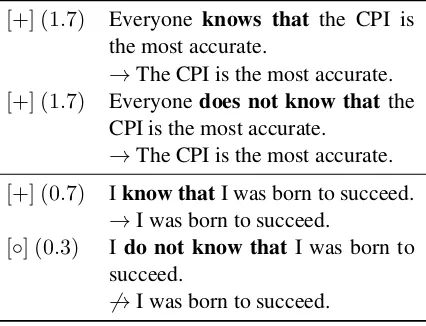
[+] (0.7) Iknow thatI was born to succeed. →I was born to succeed.
[◦] (0.3) I do not know thatI was born to succeed.
[image:6.595.76.289.63.226.2]6→I was born to succeed.
Table 4: Examples of how the factive verb“know that” can exhibit different signatures, depending on context.
Takeaways. Overall, we interpret the above analysis as evidence that veridicality judgments rely heavily on contextual as opposed to purely lexical semantic factors. While this is not a novel conclusion (Simons et al.,2010;de Marneffe et al.,
2012), it is still frequently the case that system development concerned with improving veridical-ity judgements nearly always proceeds by incor-porating explicit lexical semantic knowledge into the pipeline or architecture (Richardson and Kuhn,
2012;Lotan et al., 2013;Stanovsky et al., 2017;
MacCartney and Manning,2009;Angeli and
Man-ning, 2014; Saur´ı and Pustejovsky, 2012; Cases
et al., 2019; Rudinger et al., 2018). Our
analy-sis suggests such approaches are likely to yield only incremental gains. While admittedly more difficult to encode, focusing on context-specific factors first, e.g. predicate classes and pragmat-ics (de Marneffe et al., 2012) or question under discussion (Simons et al., 2010), would likely be more productive and may ultimately override the need for verb signatures altogether.
6 Analysis of BERT Predictions
We now turn to our primary question: do cur-rent NLI models capture the veridicality of verbs? In particular, we are interested in the behavior of a distributional model that is not specifically en-dowed with lexical semantic information related
worthy effects. It is likely that more careful featurization of highly relevant concepts–e.g. at-issueness (Tonhauser et al., 2018)–could yield more conclusive insights about which as-pects of context lead to within-signature, or within-verb, vari-ation. We leave such analysis for future work, and conclude simply that endowing NLI models with knowledge of projec-tivity signature is not alone sufficient for producing human-like inferences on such sentences.
to veridicality. We ask two questions. First: does such a model learn to make inferences consis-tent with those made by humans? Second: if the model does mirror human inferences, are the pre-dictions based solely on the presence of specific lexical items, or are they sensitive to structural fac-tors (namely, syntactic position and complement type)? Again, we prioritize modeling speaker meaning. Thus, we believe the model should ide-ally reflect the same biases and variation observed in the human judgments, not necessarily the infer-ences expected based on the lexical semantic sig-natures of the verbs.
6.1 Setup
We use the state-of-the-art BERT-based NLI model. Specifically, we use the original Tensor-Flow implementation11 of the NLI model built on top of the pertained BERT language model
(Devlin et al., 2018). We use the model
off-the-shelf, with default training setup and hyper-parameters. To fine-tune the model for the NLI task, we use the standard train/dev splits from the MNLI corpus, but, to avoid confounds, we remove the 1,500p/h pairs from which our new test set is derived (as described in §4).12 The model is trained to make a softmax classification over three classes: {ENTAILMENT,CONTRADICTION, NEU -TRAL}. When necessary to compare these discrete predictions to our continuous human judgments, we map the prediction to a continuous value using P(ENTAILMENT) −P(CONTRADICTION). This score ranges from −1 to 1 and is comparable to our human scores. Conversely, when necessary to compare the continuous human score to the dis-crete predictions, we discretize scores into evenly-sized bins13. Overall, similar performance trends hold whether we compare in discrete space or continuous space. In the analyses below, we use whichever is most interpretable, as reported.
6.2 Overall Prediction Performance
We first measure raw prediction performance: do the inferences made by the BERT mirror the infer-ence that our human raters made? Figure1bshows scatter plots of the models predictions (mapped into continuous space) side-by-side with the
hu-11
https://github.com/google-research/ bert
12
See Supplementary Material for a discussion of the prevalence of veridicality phenomena in MNLI train.
13
CON:s <−2
3;NEU:− 2 3 ≤s <
2 3;ENT:
Count Positive Negative
Sent. Verb Exp. Acc. ρ Exp. Acc. ρ Example Verbs
Fact 212 15 + 0.62 0.17 + 0.29 0.40 realize that, know that Impl 100 9 + 0.57 0.51 − 0.73 0.51 manage to, begin to Impl 25 2 − 0.80 0.61 + 0.52 0.39 forget to, fail to
Impl 63 6 ◦ 0.27 0.21 + 0.43 0.43 suspect that, explain that Impl 28 1 ◦ 0.11 0.25 − 0.71 0.45 attempt to
Impl 55 3 − 0.93 0.70 ◦ 0.02 -0.10 refuse to, decline to Impl 80 8 + 0.38 0.21 ◦ 0.54 0.21 show that, confirm that NA 935 93 ◦ 0.21 0.35 ◦ 0.44 0.47 try to, hope to
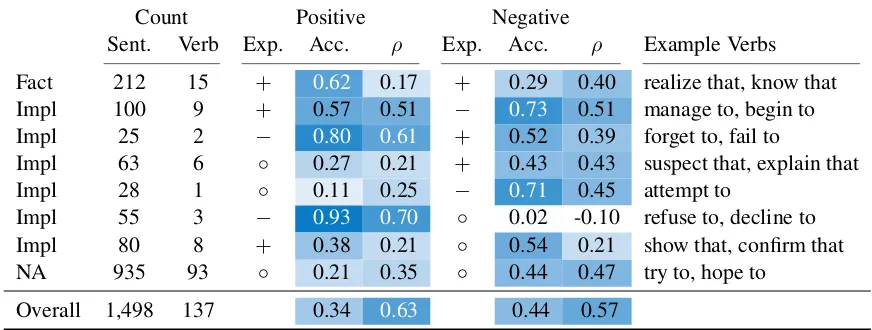
[image:7.595.80.516.64.229.2]Overall 1,498 137 0.34 0.63 0.44 0.57
Table 5: Accuracy and Spearman correlation of BERT MNLI model predictions against human judgements. The
+/−/◦ symbols denote the expected labels based on the lexical semantic category of the verb, and are not necessarily the labels given by our human annotators (compare against Figure1).
man scores just discussed. Table 5 shows per-formance evaluated against human judgements in terms of both (discrete) classification accuracy and (continuous) Spearman correlation. Broadly speaking, the model’s predictions appear to fol-low the same trends as the humans’ ratings (Fig-ure 1). That is, averaged across contexts, the model’s treatment of verbs is the same as the hu-mans’ treatment: largely in line with the signa-tures, but with a bias against assuming neutral (non-veridical) behavior. However, whereas the humans’ judgments span all levels of certainty (taking a range of values from −2 to 2), the model tends to make predictions with high con-fidence. This is especially the case in positive environment, where the model nearly always pre-dicts with99 + %confidence. In negative environ-ments, the model expresses a grater range of un-certainty values, and is much more closely in line with what we observe in human judgements. In terms of quantitative measures of accuracy (Table
5), the most notable trend is that the model per-formance is highest for cases in which the nega-tion of the complement is expected to project (− signatures). This is true regardless of whether that behavior occurs in a positive or negative en-vironment. We note that, for such cases, human judgements closely align with the lexical semantic predictions. The model performs worst in posi-tive environments when the verb is expected to be non-veridical (◦signatures). This appears to result from the model’s tendency to over-exaggerate the veridicality bias: i.e. whereas humans show a gen-eral tendency to assume the complement projects
in these cases, the model predicts ENTAILMENT with near certainty (see Figure1).
6.3 Counterfactual Analysis
Next, we ask: are the above-observed trends in BERT’s predictions driven predominantly by lex-ical priors–i.e. the presence of a specific verb–or are they sensitive to other lexicosyntactic factors that should ideally affect the inference?
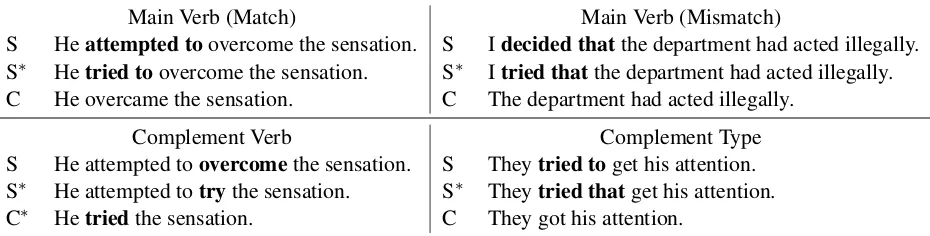
Experimental Design. For each verb construc-tion vt (e.g. “try to” or “realize that”) in our dataset, we perform several manipulations in which we insertv ort into sentences where they did not originally appear, and observe the effect this has on the distribution of the model’s predic-tions. Our specific manipulations and the expected effects are described below. Table6shows exam-ples. For convenience, we useD to refer to the set of all the hS, Ci pairs in our dataset, Dvt to
refer to all the pairs in which vt appears as the main verb clause inS, andDto(Dthat) to refer to
all the pairs in whichCis ato-complement (that -complement). When clear from context, we abuse notation and use e.g.Dto refer both to the dataset itself and to the distribution of the model’s predic-tions when run over the dataset.
distribu-Main Verb (Match) Main Verb (Mismatch)
S Heattempted toovercome the sensation. S Idecided thatthe department had acted illegally. S∗ Hetried toovercome the sensation. S∗ Itried thatthe department had acted illegally. C He overcame the sensation. C The department had acted illegally.
Complement Verb Complement Type
S He attempted toovercomethe sensation. S Theytried toget his attention. S∗ He attempted totrythe sensation. S∗ Theytried thatget his attention.
[image:8.595.75.540.64.182.2]C∗ Hetriedthe sensation. C They got his attention.
Table 6: Examples of counterfactual manipulations with the target verb construction“try to”.
tion of predictions over all of D. We differenti-ate between settings with “matched” complement types, where we generate S∗ from pairs in Dt,
from those with “mismatched” complement types, where we generate from pairs in D¬t. E.g., for
a targetvt = “try to”, we consider substitutions into premises fromDto as “matched” and
substi-tutions into Dthat as “mismatched”. Preserving
this distinction allows us to both avoid confounds due to ungrammatical substitutions, and to investi-gate whether the model is sensitive to verbs which behave differently when they take different com-plements. For example,“forget”is−/+when it takestobut+/+when it takesthat.
Replace Complement Verb: For each
hS, Ci ∈D, we replace the main verb inC with the target verbv, generating a new hypothesisC∗. We expect that, if the model is sensitive not just to the presence ofv, but also its syntactic role, then the distribution of predictions over all hS, C∗i
pairs should resemble the baseline distribution overDmore than the target distribution overDvt. Replace Complement Type: For each pair hS, Ci ∈ Dvt, we replace thetinS with the
al-ternative complement type (“to”→“that”;‘that” →“to”), generating a new premiseS∗. This gen-erates ungrammatical sentences, and serves as a control experiment, to check whether the model is considering the entirety of the context in which the verb construction appears, or merely thevt bi-gram. We expect that, if the model is considering the whole context, the distribution of predictions over allhS∗, Cishould resemble the target distri-butionDvtmore than the baseline distributionDt.
Results. Table 7 shows, for verbs within each signature, the KL divergence between the post-manipulation prediction distribution (D∗) and 1) the baseline distribution (D) and 2) the target dis-tribution (Dvt). Results are shown for both the
main and complement verb manipulations. A few trends are worth highlighting. First, we do see evidence that the model’s prediction de-pends at least in part on the individual verb type. This is supported by the fact that, across verb sig-natures, manipulation of the main verb leads to distributions which are more similar to the target verb distribution Dvt than to the baseline
distri-butionD. This trend is strongest for verbs which involve− signatures. Second, we see encourag-ing, though not overwhelmencourag-ing, evidence that the model’s prediction are sensitive to the syntactic position of the verb. This is supported by the fact that, in general, the similarity betweenD∗andDvt
is much lower (higher KL) when the manipulation occurs in the complement clause compared than when it occurs in the main clause. Note that, ide-ally, this manipulation should not effect the pre-diction distribution at all. Nonetheless, the trend is clear and points in the right direction.
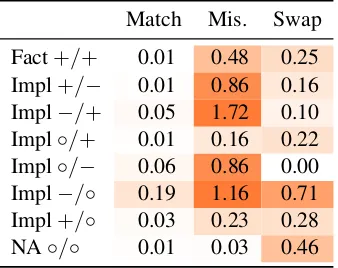
Table 8shows the KL divergence between D∗ and the target verb distributionDvtin the matched
and mismatched cases.14 We see that BERT be-haves as we hope–namely, it makes different pre-dictions forv toconstructions andv that construc-tions, even when the v is the same. Manipulat-ing the main verb only substantially affects pre-dictions when the manipulation occurs in a context with the right complement type (matched); when the manipulation results in a ungrammatical sen-tence (mismatched), the prediction remains close to baseline. An example of such verb-construction differentiation is shown in Figure 2 for the verb know that, but this is a trend seen across verbs. Moreover, we see that this effect is not just driven by sensitivity to the specific vt bigram. That is, simply swapping“to”with“that”(or vice-versa) in a naturally-occurring context leads to a small
Main Verb Compl. Verb Pos. Neg. Pos. Neg.
+/+ D∗kDvt 0.00 0.01 0.02 0.14
D∗kD 0.17 0.43 0.05 0.08
+/− D∗kDvt 0.01 0.02 0.17 0.01 D∗kD 0.17 0.67 0.04 0.39
−/+ D∗kDvt 0.04 0.06 1.36 1.39 D∗kD 1.32 1.40 0.04 0.42
◦/+ D∗kDvt 0.01 0.02 0.01 0.06 D∗kD 0.12 0.22 0.03 0.05
◦/− D∗kDvt 0.05 0.07 0.13 0.01
D∗kD 0.01 0.76 0.04 0.42
−/◦ D∗kDvt 0.28 0.11 1.90 0.53
D∗kD 0.65 0.26 0.03 0.35
+/◦ D∗kDvt 0.00 0.06 0.05 0.31
D∗kD 0.14 0.04 0.00 0.02
◦/◦ D∗kDvt 0.00 0.02 0.01 0.06
[image:9.595.71.292.63.355.2]D∗kD 0.02 0.00 0.00 0.02
Table 7: Comparison (KL divergence) of post-manipulation prediction distribution to target verb dis-tribution (Dvt, top row) and baseline distribution (D,
bottom row). High similarity toDvtsuggests the model
changed its predictions in response to the manipulation.
shift in the distribution of the model’s predictions away from the targetDvt distribution, but not to
the same degree as replacing a“that”-taking verb with a “to”-taking verb in a naturally-occurring “that” context (or vice-versa). This result pro-vides some evidence that BERT’s prediction is in-fluenced by aspects of the context other than just the presence of thevtbigram.
Match Mis. Swap
[image:9.595.318.514.64.202.2]Fact+/+ 0.01 0.48 0.25 Impl+/− 0.01 0.86 0.16 Impl−/+ 0.05 1.72 0.10 Impl◦/+ 0.01 0.16 0.22 Impl◦/− 0.06 0.86 0.00 Impl−/◦ 0.19 1.16 0.71 Impl+/◦ 0.03 0.23 0.28 NA◦/◦ 0.01 0.03 0.46
Table 8: KL divergence betweenD∗andDvtfor
[image:9.595.98.267.571.705.2]com-plement type manipulations (“to”vs. “that”). Insert-ing v into a context affects BERT’s predictions only when the complement is compatible withv.
Figure 2: Results for the main verb replacement exper-iment for the verbknow that. In examples with theVB thatconstruction, the replacement results in predictions that resemble those forknow that. ForVB toexamples, the resulting counterfactual predictions resemble those of the base examples.
7 Conclusion
We investigate how well BERT, a neural NLI model not explicitly endowed with knowledge of lexical semantic verb signatures, is able to learn to make correct inferences about veridicality. We collect a new NLI dataset of human veridicality judgements. We observe that human judgments often differ from what is predicted given the lexi-cal semantic types of verbs, and that BERT is able to replicate many of these judgments, although there is still significant room for improvement. Through counterfactual experiments, we show that individual verbs strongly influence BERT’s pre-dictions, and that these cues interact with syntactic information in desirable ways.
Acknowledgments
Thank you to Sam Bowman and Ben Van Durme for helpful feedback early on in this project. Thank you to the rest of the JSALT 2018 Sen-tence Representation Team for support through-out. Much of this work was conducted at the 2018 Frederick Jelinek Memorial Summer Work-shop on Speech and Language Technologies, and supported by Johns Hopkins University with un-restricted gifts from Amazon, Facebook, Google, Microsoft and Mitsubishi Electric Research Labo-ratories.
References
reasoning. In Proceedings of the 2014 conference on empirical methods in natural language process-ing (EMNLP), pages 534–545.
Samuel R. Bowman, Gabor Angeli, Christopher Potts, and Christopher D. Manning. 2015. A large an-notated corpus for learning natural language infer-ence. In Proceedings of the 2015 Conference on Empirical Methods in Natural Language Processing (EMNLP). Association for Computational Linguis-tics.
Ignacio Cases, Clemens Rosenbaum, Matthew Riemer, Atticus Geiger, Tim Klinger, Alex Tamkin, Olivia Li, Sandhini Agarwal, Joshua D Greene, Dan Ju-rafsky, et al. 2019. Recursive routing networks: Learning to compose modules for language under-standing. InProceedings of the 2019 Conference of the North American Chapter of the Association for Computational Linguistics: Human Language Tech-nologies, volume 1.
Ido Dagan, Oren Glickman, and Bernardo Magnini. 2006. The pascal recognising textual entailment challenge. In Machine learning challenges. evalu-ating predictive uncertainty, visual object classifica-tion, and recognising tectual entailment, pages 177– 190. Springer.
Jacob Devlin, Ming-Wei Chang, Kenton Lee, and Kristina Toutanova. 2018. Bert: Pre-training of deep bidirectional transformers for language understand-ing. arXiv preprint arXiv:1810.04805.
Ingrid Falk and Fabienne Martin. 2017. Towards an inferential lexicon of event selecting predicates for French. InIWCS 2017 - 12th International Confer-ence on Computational Semantics - Long papers.
Michael L Geis and Arnold M Zwicky. 1971. On in-vited inferences. Linguistic inquiry, 2(4):561–566.
Lauri Karttunen. 1971. Implicative verbs. Language, pages 340–358.
Lauri Karttunen. 2012. Simple and phrasal implica-tives. In*SEM 2012: The First Joint Conference on Lexical and Computational Semantics – Volume 1: Proceedings of the main conference and the shared task, and Volume 2: Proceedings of the Sixth In-ternational Workshop on Semantic Evaluation (Se-mEval 2012), pages 124–131, Montr´eal, Canada. Association for Computational Linguistics.
Lauri Karttunen, Stanley Peters, Annie Zaenen, and Cleo Condoravdi. 2014. The chameleon-like nature of evaluative adjectives. Empirical Issues in Syntax and Semantics, 10:233–250.
Paul Kiparsky and Carol Kiparsky. 1968. Fact. Lin-guistics Club, Indiana University.
Amnon Lotan, Asher Stern, and Ido Dagan. 2013. Truthteller: Annotating predicate truth. In Proceed-ings of the 2013 Conference of the North Ameri-can Chapter of the Association for Computational
Linguistics: Human Language Technologies, pages 752–757.
Bill MacCartney. 2009. Natural language inference. Ph.D. thesis, Citeseer.
Bill MacCartney and Christopher D Manning. 2009. Natural language inference. Citeseer.
Christopher D Manning. 2006. Local textual inference: its hard to circumscribe, but you know it when you see it–and nlp needs it.
Marie-Catherine de Marneffe, Christopher D Man-ning, and Christopher Potts. 2012. Did it happen? the pragmatic complexity of veridicality assessment. Computational linguistics, 38(2):301–333.
R Thomas McCoy, Ellie Pavlick, and Tal Linzen. 2019. Right for the wrong reasons: Diagnosing syntac-tic heurissyntac-tics in natural language inference. arXiv preprint arXiv:1902.01007.
Rowan Nairn, Cleo Condoravdi, and Lauri Karttunen. 2006. Computing relative polarity for textual infer-ence. InProceedings of the fifth international work-shop on inference in computational semantics (icos-5).
Ellie Pavlick and Chris Callison-Burch. 2016. Tense manages to predict implicative behavior in verbs. In Proceedings of the 2016 Conference on Empiri-cal Methods in Natural Language Processing, pages 2225–2229.
Kyle Richardson and Jonas Kuhn. 2012. Light textual inference for semantic parsing. In Proceedings of COLING 2012: Posters, pages 1007–1018, Mum-bai, India. The COLING 2012 Organizing Commit-tee.
Rachel Rudinger, Aaron Steven White, and Benjamin Van Durme. 2018. Neural models of factuality. In Proceedings of the 2018 Conference of the North American Chapter of the Association for Compu-tational Linguistics: Human Language Technolo-gies, Volume 1 (Long Papers), pages 731–744, New Orleans, Louisiana. Association for Computational Linguistics.
V´ıctor Manuel S´anchez Valencia. 1991.Studies on nat-ural logic and categorial grammar. VM Sanchez Valencia.
Roser Saur´ı and James Pustejovsky. 2012. Are you sure that this happened? assessing the factuality de-gree of events in text. Computational Linguistics, 38(2):261–299.
Mandy Simons, Judith Tonhauser, David Beaver, and Craige Roberts. 2010. What projects and why. In Semantics and linguistic theory, volume 20, pages 309–327.
Gabriel Stanovsky, Judith Eckle-Kohler, Yevgeniy Puzikov, Ido Dagan, and Iryna Gurevych. 2017. In-tegrating deep linguistic features in factuality pre-diction over unified datasets. InProceedings of the 55th Annual Meeting of the Association for Compu-tational Linguistics (Volume 2: Short Papers), pages 352–357.
Judith Tonhauser, David I Beaver, and Judith Degen. 2018. How projective is projective content? gradi-ence in projectivity and at-issueness.
Matthijs Westera and Gemma Boleda. 2019. Dont blame distributional semantics it cant do entailment. InProceedings of the 13th International Conference on Computational Semantics.
Aaron Steven White and Kyle Rawlins. 2018. The role of veridicality and factivity in clause selection. In Proceedings of the 48th Annual Meeting of the North East Linguistic Society, to appear. Amherst, MA: GLSA Publications.
Aaron Steven White, Rachel Rudinger, Kyle Rawlins, and Benjamin Van Durme. 2018. Lexicosyntactic inference in neural models. In Proceedings of the 2018 Conference on Empirical Methods in Natu-ral Language Processing, pages 4717–4724, Brus-sels, Belgium. Association for Computational Lin-guistics.
Adina Williams, Nikita Nangia, and Samuel Bowman. 2018. A broad-coverage challenge corpus for sen-tence understanding through inference. In Proceed-ings of the 2018 Conference of the North American Chapter of the Association for Computational Lin-guistics: Human Language Technologies, Volume 1 (Long Papers), pages 1112–1122. Association for Computational Linguistics.
Annie Zaenen, Lauri Karttunen, and Richard Crouch. 2005. Local textual inference: can it be defined or circumscribed? In Proceedings of the ACL work-shop on empirical modeling of semantic equivalence and entailment, pages 31–36. Association for Com-putational Linguistics.