Proceedings of the 2019 Conference on Empirical Methods in Natural Language Processing and the 9th International Joint Conference on Natural Language Processing, pages 5285–5296,
5285
Weakly Supervised Cross-lingual Semantic Relation
Classification via Knowledge Distillation
Yogarshi Vyas
Department of Computer Science University of Maryland [email protected]
Marine Carpuat
Department of Computer Science University of Maryland [email protected]
Abstract
Words in different languages rarely cover the exact same semantic space. This work charac-terizes differences in meaning between words across languages using semantic relations that have been used to relate the meaning of En-glish words. However, because of transla-tion ambiguity, semantic relatransla-tions are not al-ways preserved by translation. We intro-duce a cross-lingual relation classifier trained only with English examples and a bilingual dictionary. Our classifier relies on a novel attention-based distillation approach to ac-count for translation ambiguity when trans-ferring knowledge from English to cross-lingual settings. On new English-Chinese and English-Hindi test sets, the resulting models largely outperform baselines that more na¨ıvely rely on bilingual embeddings or dictionaries for cross-lingual transfer, and approach the performance of fully supervised systems on English tasks.
1 Introduction
Natural Language Processing (NLP) often uses translation lexicons for projecting models and data from one language to another under the assump-tion that words and their translaassump-tions in these lexicons are synonyms (Mayhew et al., 2017;
Tsvetkov et al.,2014). However, translation lex-icons include semantic relations other than syn-onymy in practice, as can be seen (Table1) in ex-amples drawn from the MUSE dictionary ( Lam-ple et al.,2018). Peirsman and Pad´o(2011) show that distributional translation lexicons contain hy-ponyms and co-hyhy-ponyms, and that treating all translations as synonyms hurts cross-lingual pro-jection performance. In the Paraphrase Database (Ganitkevitch et al., 2013), Pavlick et al. (2015) find that the diversity of semantic relations discov-ered in word-aligned parallel corpora yields para-phrases that span the lexical relations defined in
Lexicon Entry Semantic Relation
writer,rcnAkAr writeris more specific than rcnAkAr(creator)
council,m\E/pErqX councilis more general than m\E/pErqX(council of ministers)
father,ccA fatheris mutually exclusive to
ccA(father’s brother)
Table 1: Semantic relations between word pairs in an English-Hindi lexicon (Lample et al.,2018)
the natural logic framework of MacCartney and Manning(2009). These non-synonymous transla-tions are not just noise. They can be found even in high-quality parallel corpora, since the strategies used by professional translators to deal with words that do not have a direct equivalent in the target language include replacement by near-synonyms, hypernyms or negated antonyms (Baker, 2011;
Venuti,2012;Chesterman,2016).
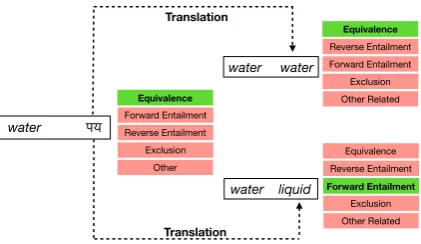
In this work, we classify semantic relations be-tween words in different languages. Given a word pair (water,py), the classification task is to select
one of the five entailment classes (Figure 1) de-fined under the natural logic framework of Mac-Cartney and Manning (2009). This cross-lingual task cannot be solved by translation, as transla-tion does not preserve semantic relatransla-tions. We also cannot assume that labeled examples exist for all language pairs and learning from English labeled examples is complicated by translation ambiguity (Figure1).
We introduce BILEXNET, a neural classifier for semantic relations based on cross-lingual dis-tributional and path-based features inspired by the monolingual LEXNET model (Shwartz and Dagan, 2016a,b) (Section 3). We then design a novel training procedure for BILEXNET that
dic-water पय
Equivalence
Forward Entailment Reverse Entailment
Exclusion Other
Equivalence
Reverse Entailment Forward Entailment
Exclusion Other Related
water water
Equivalence Reverse Entailment
Forward Entailment
Exclusion Other Related
water liquid
Translation
[image:2.595.75.286.65.187.2]Translation
Figure 1: On the left, we illustrate cross-lingual seman-tic relation classification: given the pair (water, py) as input, the task is to select theEquivalenceclass (in bold/green) from the five possible relations. On the right, we show that semantic relations change by trans-lation. pytranslates toliquidandwater, and their re-spective semantic relations withwaterdiffer.
tionaries (Hinton et al., 2014) (Section 4). We collect and release MULTILEXREL, a crowd-sourced benchmark to evaluate models for this task on a high-resource (English-Chinese) and a low-resource (English-Hindi) language pair (Sec-tion 5). Experiments show that BILEXNET
sub-stantially outperforms translation baselines and approaches the performance of a fully super-vised English semantic relation classifier (Sec-tion 7). Code for BILEXNET and the MUL
-TILEXREL dataset are available at https://
github.com/yogarshi/BiLexNet/.
2 Related Work
Cruse (1986) describes how lexical relations can be organized into congruence relations of identity (synonymy: dog-canine), inclusion (hy-ponymy: dog-animal), overlap (compatibility: dog-pet), disjunction (incompatibility: cat-dog), and antonyms (open-shut), and how these rela-tions can be used to characterize differences in meaning. Variations on these fundamental rela-tions have been used within semantic networks such as WordNet (Fellbaum, 1998), or as the ba-sis of a framework for inference without formal logic representations (MacCartney and Manning,
2009). Recent work on semantic relation pre-diction largely focuses on a single relation be-tween words in the same language (mostly En-glish) (Nastase et al., 2013; Vuli´c and Mrkˇsi´c,
2018; Glavaˇs and Ponzetto, 2017; Ono et al.,
2015). Methods that deal with multiple seman-tic relations are fewer (Pantel and Pennacchiotti,
2006; Pennacchiotti and Pantel, 2006; Turney,
2008), and recent shared tasks have shown that this
is a challenging problem, especially when ontolo-gies and other structured resources are not avail-able, and models are trained only on raw cor-pora (Santus et al.,2016).
In cross-lingual settings, studies of semantic re-lations between words are mostly limited to the translation equivalence relation. Dictionary induc-tion aims to automatically discover words that are translations of each other using monolingual or comparable corpora (Rapp, 1995;Fung and Yee,
1998;Irvine and Callison-Burch,2017). The task is typically framed as unsupervised learning, and models rely on distributional properties to dis-cover words that have the same meaning in the two languages. Recently, dictionary induction has also been used to evaluate multilingual word embed-dings (Lample et al., 2018; Artetxe et al., 2018;
Søgaard et al., 2018), leading to significant ad-vances on the state-of-the-art.
However, Peirsman and Pad´o(2011) show that automatically induced bilingual lexicons exhibit multiple semantic relations including not only synonymy, but also hypernymy and co-hyponymy. This has prompted work on identifying hyper-nymy in cross-lingual settings (Vyas and Carpuat,
2016;Upadhyay et al.,2018). This paper broad-ens the scope of relations studied in cross-lingual settings, and addresses for the first time the task of distinguishing between multiple semantic rela-tions for words in different languages.
Previous work studying semantic relations in multiple languages has focused on the different task of cross-lingual transfer. In such settings, the focus is on identifying semantic relations be-tween two words in the same language, without training data in that language. There are broadly two strategies to solve this problem. One line of work (Glavaˇs and Vuli´c, 2018; Mrkˇsi´c et al.,
2017) uses model transfer, where a single model is trained on data from a high-resource language, and is then ported to the target language using cross-lingual embeddings. In contrast, Roth and Upadhyay(2019) translate training data from En-glish into a target language using a combination of unsupervised cross-lingual embeddings (Artetxe et al.,2018) and monolingual information from the target language.
among participating teams on the CogALex-V shared task on identification of semantic rela-tions (Santus et al., 2016) without ontologies or structured information. We adapt LEXNET to make cross-lingual predictions by proposing to model cross-lingual relations using lexico-syntactic paths from both languages.
Finally, our training procedure uses knowledge distillation (Hinton et al., 2014) to alleviate the lack of annotated cross-lingual pairs. Knowl-edge distillation has been proposed to compress a model with many parameters (theteachermodel) to a model with fewer parameters (the student
model). It has also been used successfully to learn mappings between languages (Nakashole and Flauger,2017) or to transfer knowledge from models trained on one language to a different tar-get language for text classification (Xu and Yang,
2017) and belief tracking (Chen et al.,2018a), in settings where the classification labels are transla-tion invariant. This work adapts distillatransla-tion to a setting where labels might change when samples are translated.
3 BILEXNET: a Classifier for
Cross-Lingual Semantic Relations
The task of classifying semantic relations is a multi-class classification problem, where the classes are the set of five semantic relations from Pavlick et al. (2015): Equivalence (X is the same as Y), Forward Entail (X is more specific than/ is a type of Y), Backward
Entail(X is more general than/encompasses Y),
Exclusion(X is mutually exclusive with/is
op-posite to Y), andOther (X is not related or re-lated in other ways to Y). We choose these rela-tions as they have been useful in describing lexi-cal relations between English paraphrases (Pavlick et al., 2015), and in downstream natural lan-guage inference systems (MacCartney and Man-ning,2007,2009).
Our classifier, BILEXNET, adapts the LEXNET
English classifier (Shwartz and Dagan,2016a,b) to cross-lingual settings. BILEXNET represents the input word pair (x,y) by a feature vectorvxy, con-sisting of complementary distributional and path-based features i.e. vxy= [vx;vy;vpaths(x,y)]. The
distributional semanticproperties of x andy are captured by bilingual word embeddings vx and
vy. vpaths(x,y)encodeslexico-syntactic pathsthat represent the relation between words x and y in
.. different species of animals including pigs .. .. सुअरसिहतिविभन्नप्रजाितकेजानवरों ..
nmod nmod
nmod nmod root
root
Figure 2: The English path between
animals and pigs has three edges:
[X/NOUN/nmod/>, species/NOUN/root/∧, andY/NOUN/nmod/>]. The path between animals andsar is defined as a combination of the English path and the Hindi path betweenяAnvro\andsar.
context (Hearst,1992;Snow et al.,2004;Shwartz et al., 2016). For classification, vxy is input to a multi-class classifier, parameterized as a feed-forward neural network with a single hidden layer.
lout=W2∗ReLU(W1∗vxy)
ˆ
li=
exp(lout,i)
Pk
j=1exp(lout,j)
lpred= arg max i
ˆli (1)
W1 andW2 are the weights of the network, and the biases have been omitted for simplicity.
3.1 Cross-lingual Paths
In LEXNET, a lexico-syntactic path is the se-quenceof edges that lead fromxtoyin the depen-dency tree of a sentence. Each edge contains the word and part-of-speech tag of the source node, the dependency label of the edge, and the edge di-rection between two subsequent nodes (see Fig-ure2 for an example of the path connectingpigs
andanimals). The vector representation of each edge is formed by the concatenation of the vec-tors of these four components. vpaths(x,y) is ob-tained by encoding the sequence of edges using an LSTM (Hochreiter and Schmidhuber,1997).
In English, these paths are extracted from sen-tences wherexandyco-occur. However, whenx
andy are in different languages, a new path defi-nition is required. For a cross-lingual pair (xe,yf), we extract cross-lingual pathsvpaths(xe,yf)from a word-aligned parallel corpus (Figure2). We first extract all parallel sentences which containxe on the source side andyf on the target side. For each sentence, using word alignments, we can extract
word aligned toyf. We then extract a path con-necting the two word in the source sentence i.e.xe andye. Similarly, we also extract a corresponding path connecting the two word in the target sen-tence i.e. xf and yf, since different languages can encode the same information differently due to structural divergences (Dorr,1994). Thus, if the parallel corpus contains m sentence pairs where
xe occurs on the source side andyf on the target side, we extract a total of2mpaths. All of the2m
paths paths are encoded using a single LSTM, and averaged to formvpaths(xe,yf).
Two special cases arise from this definition. First, a path can be a single alignment link ifxe andyf are aligned to each other i.e. xf =yf and
ye=xe. Second if no path is found in the corpus,
vpaths(xe,yf)is set to the zero vector.
4 Weakly Supervised Training via Knowledge Distillation
Cross-lingual examples that would enable fully su-pervised training of BILEXNETare hard to obtain: examples of relations such as synonymy or hy-pernymy can be derived from multilingual Word-Nets (Bond and Foster,2013), but such resources are not available for many languages, and only cover a subset of semantic relations. Instead, we introduce a dictionary-guided variant of knowl-edge distillationto train BILEXNET. This proce-dure only relies on a set of monolingual labeled examples that are readily available for various lex-ical relations in English, and a translation dictio-nary that maps words in the source language to the target language.
Our approach transfers knowledge from a monolingualteacher modelto a cross-lingual stu-dent model. Theteacher modelis a monolingual LEXNET model (sayMe) trained on the source-language examplesS={(xe;i, ye;i,li)}. Here,xe;i andye;i are a pair of words in the same language andli ∈ Rcis a one-hot encoding of the relation betweenxe;iandye;i(the number of possible rela-tions isc). Given (xe;i, ye;i,li)∈S,Meis trained by minimizing the cross-entropy loss between the predicted outputˆle→eand the gold labelˆli:
L1 =− c
X
j=1
lij logˆlje→e (2)
BILEXNETplays the role of thestudent model (denoted Mef) and is trained to make predic-tions that agree with those of the teacher model.
The student model is trained using weak super-vision which is obtained by using a bilingual dictionary D to translate the right side of each training pair into the target languageS to obtain
S0={(xe;i, Ti,li)}, whereTi={ti1, ti2, .., tin}is the set of translations ofye;i inD. S0 serves as weak supervision because semantic relations are not translation invariant (Figure1), and hence the labelliis not correct for every(xe;i, tik)pair.
To extract useful training signals from the weak supervision, we use an attention mechanism which guides the model to attend to translations that preserve the monolingual label. The atten-tion component constructs the input representa-tion for the cross-lingual model Mef in Equa-tion 1 by averaging representations for all trans-lation candidates, giving more weight to those that are likely to preserve the monolingual label. Given a training sample (xe;i, Ti, li) ∈ S0 with
Ti = {ti1, ti2, .., tin}, the score for a candidate translationtikis calculated using the word embed-dings ofxe;iandtik, along withl, an embedding of the gold labelli as features to a feed-forward net-work f (with one hidden layer). l is provided to help select translations that are consistent with the correct label for the monolingual pair. The scores for all translations are converted to probabilities using the softmax function, and the input features
v0xe;iye;ifor the student modelMef are a sum of the features obtained from each of these translations, weighted by the probabilities.
score((xe;i, tik),li) =f([xi;tik;l]) (3)
p(tik) =
exp(score(tik))
Pn
j=1exp(score(tij))
v0xe;iye;i =
n
X
k=1
p(tik)vxe;itik (4)
The student model is then trained to maximize the distillation objective:
L2 =− c
X
j=1
[(1−α)lij logˆlje→f+
αˆlje→elog( ˆ
lje→f
ˆ
le→e j
)] (5)
whereˆle→e is calculated usingMe,ˆle→f is cal-culated using the attended representationv0xe;iye;i
पशु प्राणी जंतु vcat
.. ..
vजंतु
.. ..
vpaths(cat, जंतु)
.. ..
MLP
vcat
vanimal
vpaths(cat, animal) MLP
cat animal
Dictionary Lookup
+ 0.1 0.2 0.4 0.2 0.1
̂
le→e
0.1 0.2 0.5 0.1 0.1
̂
le→f
True Label = Forward Entailment
0.0 0.0 1.0 0.0 0.0 l
[image:5.595.151.453.64.250.2]p(..) p(जंतु)
Figure 3: Illustration of weakly supervised training: For a given English example (cat,animal), we generate predic-tionsˆle→eusing the monolingual English teacher model. Simultaneously, we also generate predictionsˆle→fusing
the cross-lingualstudentmodel after translating one of the two English words using a dictionary. The cross-lingual classifier attends to all translation candidates and predicts a class based on a weighted average of their features. The loss is defined as CROSS-ENTROPY(ˆle→e,l) + CROSS-ENTROPY(ˆle→f,l) + KL-DIVERGENCE(ˆle→f,ˆle→e).
that aims to measure how well the cross-lingual model Mef predicts the relation given v0xe;iye;i.
The second term uses KL-Divergence (Kullback and Leibler,1951) to penalize differences in pre-dictions byMef on the cross-lingual inputv0xe;iye;i
and the predictions byMeon the monolingual in-putvxe;iye;i. As is typical in distillation, we flatten
the softmax of both inputs to the KL-Divergence term with a temperature parameterτ.
5 MULTILEXREL: A Dataset for
Cross-lingual Semantic Relations
Existing resources containing annotated cross-lingual lexical relations are limited in scope, qual-ity, and quantity. For instance, in previous work (Upadhyay et al.,2018), we provide datasets annotated cross-lingual hypernymy, but do not consider other relations. On the other hand, re-sources such as bilingual dictionaries or the Open Multilingual WordNet (Bond and Foster, 2013) can be mined for examples of synonyms, hyper-nyms and hypohyper-nyms, but these are likely to be noisy as these resources are created in a semi-automatic way.
In this work, we crowdsource1MULTILEXREL, a set of new high-quality annotations for English-Hindi (En-Hi) and English-Chinese (En-Zh) word pairs using the natural logic relations laid out in Section 3. We leverage monolingual annotations
1Viahttp://figure-eight.com/
Relation En-Hi En-Zh
Equivalence 158 174
Forward Entail 220 240
Backward Entail 215 236
Exclusion 124 154
Other 323 94
[image:5.595.319.514.340.452.2]Total 1040 898
Table 2: Distribution of the five semantic relations for the two crowdsourced test sets.
to speed up the process and enable comparisons between monolingual and cross-lingual models. We use Google Translate to translate one side of a randomly sampled subset of the gold-standard dataset of semantic relations created by Pavlick et al.(2015), and ask crowdworkers whether the semantic relation holds after translation. Each ex-ample is annotated by five annotators and anno-tations are aggregated using MACE (Hovy et al.,
2013), a Bayesian model that estimates the trust-worthiness of annotators and accordingly assigns a label to each instance. The distributions of the five relations for each language pair are shown in Table2. 40-45% of the examples shown to annota-tors were deemed to not preserve the monolingual relation after translation. The final test sets consist of the remaining 55-60% examples.2
6 Experimental Settings
MULTILEXRELis used as a test set to evaluate our models. Training only requires English labeled examples, and other resources derived from raw monolingual and parallel corpora.
6.1 Data
English Supervision The English training sam-ples are derived from the English Lexical-XXXL PPDB. After filtering away pairs containing non-alphabetic characters, we choose a random sam-ple as training pairs. The number of samsam-ples for all classes is balanced, exceptExclusion(since there are fewer examples of this class in PPDB). All in all, the size of the training set is∼20K pairs. Like previous work (Levy et al.,2015), we ensure a lexical split where the English words in the test data are not seen in the training data. This makes the task challenging as it prevents the model from memorizing patterns of words such as their “proto-typicality” for certain relations i.e. whether certain words are likely to appear in specific relations.
Validation data Since we assume no access to labeled cross-lingual examples, we need to define a validation set using the resources available to us. We construct a validation set by randomly remov-ing 1000 pairs from the trainremov-ing data, and auto-matically translating the right side of each exam-ple with the bilingual dictionary used for training. This process yields a noisy validation set, which is solely used for tuning hyper-parameters.
Unlabeled Resources The bilingual dictionary for knowledge distillation is obtained from the MUSE project (Lample et al., 2018) for Hi, while the MDBG dictionary is used for En-Zh.3 We use FastText bilingual embeddings ( Bo-janowski et al.,2017).4 We extract English paths for the monolingual model from a dump of the English Wikipedia.5 Cross-lingual paths are ex-tracted from a random sample of the WMT18 par-allel corpora6for En-Zh (∼5M sentences) and the IIT Bombay English-Hindi corpus ( Kunchukut-tan et al.,2018) for En-Hi (∼1M sentences). All corpora are parsed using YaraParser (Rasooli and
3https://www.mdbg.net/chinese/
dictionary?page=cc-cedict
4
https://fasttext.cc/docs/en/aligned-vectors.html 5
https://dumps.wikimedia.org/enwiki/
6http://statmt.org/wmt18/
translation-task.html
Tetreault,2015) trained on the treebank of the cor-responding language from the Universal Depen-dencies (v2.2) project (McDonald et al., 2013). Tokenization is performed using the Moses tok-enizer for English (Koehn et al., 2007), the Indic NLP tokenizer for Hindi,7and the Jieba word seg-menter for Chinese.8
6.2 Model Configurations and Baselines
Model Configuration The path-encoder LSTM has two layers with 60 hidden units each, with dropout (Srivastava et al.,2014) applied after the first layer. All feed-forward neural networks have a single hidden layer with 50 hidden units and dropout regularization. All models are trained in mini-batches of size 4 using the Adam opti-mizer (Kingma and Ba, 2015) with initial learn-ing rate set to 10−3. The temperature parameterτ
for knowledge distillation is tuned over{1.0, 1.5, 2.0, 5.0}, and the interpolation parameterα over {0.75, 0.90}.
English-only Model: EnLexNet We also use a vanilla LEXNET model applied to a monolin-gual test set in order to measure the gap between cross-lingual performance and monolingual per-formance. ENLEXNET is trained on the same English samples used for training the BILEXNET
model, and evaluated on the En-En examples used to generate cross-lingual examples in Section5.9
Baselines Our experiments aim to assess how the direct cross-lingual modeling of semantic re-lations in BILEXNETimpacts predictions, and to isolate the impact of key training components: knowledge distillation and translation selection via attention. We compare against the following baselines:
RANDOM BASELINE: Randomly assign one of
the five semantic relations to each word pair.
TRANSLATION BASELINE: This baseline
com-bines dictionary translation and the English-only system ENLEXNETto gauge the relative difficulty of predicting semantic relations across languages rather than in English only. Each pair (xe,yf) in the test set is translated into English using the bilingual dictionaryD. Sinceyfcan have multiple
7
https://github.com/anoopkunchukuttan/ indic_nlp_library
8
https://github.com/fxsjy/jieba
9We re-implement the L
EXNET model and verify its
translations, we pairxewith each of these transla-tions, and use ENLEXNET to predict the relation for each of these pairs. The relation for(xe, yf) is then chosen as the most general relation among those predicted for the translated pairs according to the order in which they appear in Table2.10
BILEXNET (NO DISTILLATION) A simple
strategy for cross-lingual transfer consists of seed-ing a vanilla LEXNET model with bilingual em-beddings in the source and target languages before training. This strategy has been successfully used for other NLP tasks (Klementiev et al.,2012;Guo et al., 2015, inter alia). By keeping the embed-dings fixed, we can use source language data to train the monolingual LEXNET model using fea-tures based on source embeddings and source lan-guage paths as usual. At inference time, the model uses both the source and target embeddings as in-put, and the cross-lingual paths defined above.
SPECIALIZED TENSOR MODEL (STM) How
does a model that has primarily been used for comparing words in the same language perform on cross-lingual comparisons? Our final base-line aims to answer this question. Proposed by
Glavaˇs and Vuli´c (2018), STM is a neural ar-chitecture for identifying semantic relations that achieves state-of-the-art performance on two En-glish dataset. STM is based on the hypothesis that specialized word embeddings are necessary to ac-curately disambiguate between semantic relations. More precisely, STM assumes that different specializations of generic word embeddings are needed to recognize different relations and that interactions between the specialized vectors can be used to identify the semantic relations. These different specializations are implemented usingK
feed-forward neural networks. Given a word pair, STM takes in as input a pair of generic word em-beddings for the word pair which are then special-ized by theKtransformations. Each pair of corre-sponding specialized embeddings is used to calcu-late a score based on a non-linear transformation of their bilinear product. Finally, theKscores ob-tained fromKpairs of specialized embeddings are used as features to train a multi-class classifier.
Besides English, STM has also been used for cross-lingual transfer, where a model trained on one language (say English) is used to test on
word-10We also experimented with a voting based approach for
combination, but it generally performed worse.
pairs in another language (say German). Here, we use STM in a new setting to predict the semantic relation between two words in different languages. We use the official implementation of STM11 with the same bilingual embeddings used by BILEXNET. We tune three hyperparameters on the validation set (a) The size of the specialized tensors {100, 200, 300, 500}(b) The number of specialization functions {3, 5, 7}, and (c) The learning rate{0.0001, 0.0003}. Default values are used for all other hyper-parameters.
7 Results
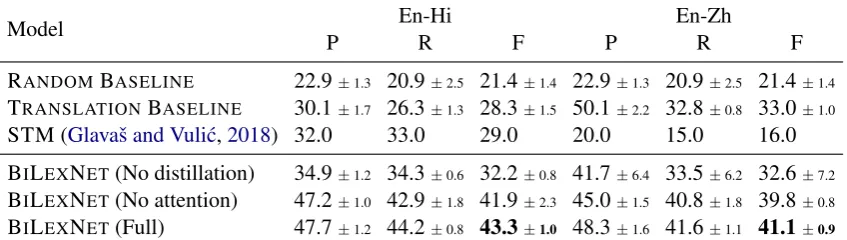
Tables3summarizes results obtained on the MUL
-TILEXREL test sets. BILEXNET achieves F1 scores that are roughly double of those obtained by the random baseline for 5-way classification.
Impact of cross-lingual modeling We assess the impact of direct cross-lingual modeling in BILEXNETby comparing against the TRANSLA
-TIONBASELINE. Using a translation dictionary to
na¨ıvely convert cross-lingual relation prediction to an English-only task, the translation baseline F1 scores are 8 to 13 points higher than RANDOM
for both language pairs. This difference can be at-tributed to easy examples where English semantic relations are preserved by simple dictionary trans-lation. BILEXNET further improves F1 by 8 to 15 points over the TRANSLATIONBASELINE, pri-marily by improving recall.
Supervised English system Without cross-lingual training samples, we cannot compare weakly supervised and fully supervised training for BILEXNETin a controlled fashion. However, the supervised monolingual ENLEXNET model (Section 6) evaluated on the En-En test set of-fers a reference point: remarkably the F1 scores of BILEXNETare only 1 to 3 points lower than those obtained by the supervised English model (∼44 on the En-En test set).
Impact of knowledge distillation We compare the full BILEXNET model to the na¨ıve baseline
(BILEXNET (NO DISTILLATION)) that only
re-lies on embeddings for cross-lingual transfer and does not perform cross-lingual distillation. This approach performs on par with or a little better than the translation baseline, but∼9 points worse than the full BILEXNET model, losing on both
Model En-Hi En-Zh
P R F P R F
RANDOMBASELINE 22.9±1.3 20.9±2.5 21.4±1.4 22.9±1.3 20.9±2.5 21.4±1.4
TRANSLATION BASELINE 30.1±1.7 26.3±1.3 28.3±1.5 50.1±2.2 32.8±0.8 33.0±1.0
STM (Glavaˇs and Vuli´c,2018) 32.0 33.0 29.0 20.0 15.0 16.0
[image:8.595.88.512.65.185.2]BILEXNET(No distillation) 34.9±1.2 34.3±0.6 32.2±0.8 41.7±6.4 33.5±6.2 32.6±7.2 BILEXNET(No attention) 47.2±1.0 42.9±1.8 41.9±2.3 45.0±1.5 40.8±1.8 39.8±0.8 BILEXNET(Full) 47.7±1.2 44.2±0.8 43.3±1.0 48.3±1.6 41.6±1.1 41.1±0.9
Table 3: Precision (P), Recall (R) and F1-score (F) for BILEXNETand contrastive baselines on the two MULTI -LEXRELtest sets. All configurations (except STM) are trained with five random seeds. We report the mean score and standard deviation. The full BILEXNETmodel performs best and is consistently better with attention.
precision and recall. This result confirms the ben-efit of aligning training and test conditions for our model with knowledge distillation and not relying solely on embeddings. These results are consis-tent with prior findings on distributional represen-tations:
• Distributional representations have difficul-ties in discriminating between multiple se-mantic relations (Chersoni et al., 2016). As such, relying solely on word embeddings for cross-lingual transfer can cause loss of knowledge during transfer.
• Syntactic divergences cause differences in paths in the source and target languages. This can cause a distribution shift between the fea-tures seen by the classifier during training and test time, thereby affecting performance. Again, word embeddings are not sufficient to bridge the gap between the distributions of the two languages (Chen et al.,2018b).
Impact of attention We test the impact of the at-tention model in BILEXNETby removing it, and instead translating training samples for distillation using the single most frequent translation. Remov-ing attention yields small but consistent degrada-tions, suggesting that attending to multiple trans-lations is beneficial, but leaves room for improve-ment. We analyze the behavior of the attention model in the next section.
Specialization Finally, we observe F1 scores of STM are significantly worse than those of BILEXNET. In fact, it is the weakest model for
En-Zh, and is only 3 points better than the trans-lation baseline for En-Hi. The relatively poor per-formance of STM highlights that our cross-lingual
task, which directly compares words in two lan-guages, is fundamentally different from the cross-lingual transfer task, where models trained in one language are ported to other languages. Thus, models such as STM, which have been designed for transfer, may not be directly suitable for our task.
8 Analysis
This section further breaks down the results, and highlight some successes and failures of BILEXNETto guide future work on cross-lingual semantic relation classification.
Performance Per Class We break down the performance of the BILEXNET model per tar-get relation (Table 4). The Equivalence and
Exclusionclasses are the hardest to predict
cor-rectly, which is consistent with our monolingual results and those from prior work (Shwartz and Dagan, 2016a): distributional models have trou-ble distinguishing synonyms from antonyms (Yih et al., 2012) and synonyms rarely occur in the same sentence, and hence path-based methods are less useful for this class. However, in BILEXNET, words of the Equivalence class can occur in a parallel sentence pair where they are aligned to each other. Thus, there is a direct signal for exam-ples of this class which helps discriminate between
EquivalenceandExclusion.
Co-Class En-Hi En-Zh En-En
Equivalence 33 30 31
Exclusion 33 28 23
Forward Entail 47 48 48
Backward Entail 45 58 48
Other 51 29 53
Table 4: Per-class F1 scores for median Hi and En-Zh BILEXNETmodel and the ENLEXNET model.
gALex shared task (Santus et al.,2016), where the first part of the task is to eliminatecompletely un-relatedpairs, before predicting relations on the re-maining pairs. However, filtering out unrelated
pairs is an easier task than filtering pairs in the
Othercategory.
Missing cross-lingual paths Cross-lingual paths might not exist for all word pairs, particu-larly for language pairs with limited parallel data such as En-Hi. BILEXNETwould then only rely on word embeddings as features to predict se-mantic relations. We assess the impact of missing paths by comparing the classification performance on pairs which have cross-lingual paths (70% of the test), against pairs which do not have paths in the En-Hi setting. The former subset has a higher F1 score (44.6) than the latter (40.2), mainly due to differences in recall. This difference in performance also confirms that the cross-lingual paths complement word embeddings, in the same way that monolingual paths do.
Attention Analysis We complement ablation experiments in Table 3 by examining a random sample of 25 monolingual training pairs (xe, ye) where ye has multiple translations in the bilin-gual dictionary. We manually check for how many pairs the model places the highest attention weight on a translation that preserves the relation label of the monolingual pair. This happens in 64% of the cases (16 out of 25). The attention model is of-ten able to modulate the choice of the right trans-lation of ye based on the context provided byxe and the gold label. For example, given the mono-lingual example (drop,fall,Forward Entail) the model places the highest weight on the Hindi word EgrA, which captures the “moving down-ward” sense. On the other hand, for the example (autumn, fall, Equivalence), the model cor-rectly identifiesptJXas the right translation.
There still remains a lot of overhead for
improv-ing the attention component. Some failure cases in the 25 examples occur for pairs where the set of translations ofyecontains an incorrect translation which is totally unrelated toxe orye. For exam-ple, given (country, uganda), the model chooses the wordk{\Xl(transliteration forcandle) and not
ygA\XA(transliteration foruganda). Of course, this is an extreme example, but such errors are also more likely to occur when the noisy translation is in the same domain asxeandye. Fixing such er-rors can help improve the training process.
9 Conclusion
This work contributes data and models to the task of classifying semantic relations between words in different languages with only monolingual En-glish supervision. We introduced MULTILEXREL, a dataset of about 1000 English-Hindi and 900 English-Chinese word pairs annotated with the natural logic lexical entailment classes of Mac-Cartney and Manning (2007), and BILEXNET, a cross-lingual relation classification model.
We also proposed a knowledge distillation algo-rithm for BILEXNET, which only needs annotated
monolingual examples and a bilingual dictionary. Unlike previous uses of knowledge distillation for cross-lingual transfer, our approach does not as-sume that labels are translation invariant, and re-lies on an attention mechanism to select transla-tions that best explain a given label. Experiments show that this method largely outperforms base-lines that use bilingual embeddings or dictionar-ies more na¨ıvely for cross-lingual transfer, and that it approaches the performance of fully supervised systems on an English-only version of the task.
Acknowledgements
The authors would like to thank members of the CLIP Lab and the anonymous reviewers for feed-back on previous versions of this paper. This mate-rial is based upon work supported by the National Science Foundation under Award No. 1750695.
References
Mikel Artetxe, Gorka Labaka, and Eneko Agirre. 2018.
A robust self-learning method for fully unsupervised cross-lingual mappings of word embeddings. In
Mona Baker. 2011. In other words: A coursebook on translation. Routledge.
Piotr Bojanowski, Edouard Grave, Armand Joulin, and Tomas Mikolov. 2017. Enriching Word Vectors with Subword Information. Transactions of the Associa-tion for ComputaAssocia-tional Linguistics, 5:135–146.
Francis Bond and Ryan Foster. 2013. Linking and ex-tending an open multilingual wordnet. In Proceed-ings of the 51st Annual Meeting of the Association for Computational Linguistics (Volume 1: Long Pa-pers), pages 1352–1362. Association for Computa-tional Linguistics.
Wenhu Chen, Jianshu Chen, Yu Su, Xin Wang, Dong Yu, Xifeng Yan, and William Yang Wang. 2018a.
XL-NBT: A Cross-lingual Neural Belief Tracking Framework. In Proceedings of the 2018 Confer-ence on Empirical Methods in Natural Language Processing, pages 414–424.
Xilun Chen, Yu Sun, Ben Athiwaratkun, Claire Cardie, and Kilian Weinberger. 2018b. Adversarial Deep Averaging Networks for Cross-Lingual Sentiment Classification. Transactions of the Association for Computational Linguistics, 6:557–570.
Emmanuele Chersoni, Giulia Rambelli, and Enrico Santus. 2016. CogALex-V Shared Task: ROOT18. InProceedings of the 5th Workshop on Cognitive As-pects of the Lexicon (CogALex - V), pages 98–103, Osaka, Japan. The COLING 2016 Organizing Com-mittee.
Andrew Chesterman. 2016.Memes of translation: The spread of ideas in translation theory, volume 123. John Benjamins Publishing Company.
David Alan Cruse. 1986. Lexical semantics. Cam-bridge university press.
Bonnie Dorr. 1994. Machine Translation Divergences: A Formal Description and Proposed Solution. Com-putational Linguistics, 20(4):597–633.
Christiane Fellbaum, editor. 1998. WordNet: An Elec-tronic Lexical Database. MIT Press.
Pascale Fung and Lo Yuen Yee. 1998. An IR Approach for Translating New Words from Nonparallel, Com-parable Texts. InProceedings of the 17th International Conference on ComputaInternational Linguistics
-Volume 1, COLING ’98, pages 414–420,
Strouds-burg, PA, USA. Association for Computational Lin-guistics.
Juri Ganitkevitch, Benjamin Van Durme, and Chris Callison-Burch. 2013. PPDB: The Paraphrase Database. InHLT-NAACL, pages 758–764.
Goran Glavaˇs and Simone Paolo Ponzetto. 2017.
Dual tensor model for detecting asymmetric lexico-semantic relations. InProceedings of the 2017 Con-ference on Empirical Methods in Natural Language Processing, pages 1757–1767. Association for Com-putational Linguistics.
Goran Glavaˇs and Ivan Vuli´c. 2018. Discriminating be-tween Lexico-Semantic Relations with the Special-ization Tensor Model. InProceedings of the 2018 Conference of the North American Chapter of the Association for Computational Linguistics: Human Language Technologies, Volume 2 (Short Papers), pages 181–187, New Orleans, Louisiana. Associa-tion for ComputaAssocia-tional Linguistics.
Jiang Guo, Wanxiang Che, David Yarowsky, Haifeng Wang, and Ting Liu. 2015. Cross-lingual De-pendency Parsing Based on Distributed Represen-tations. InProceedings of the 53rd Annual Meet-ing of the Association for Computational LMeet-inguis- Linguis-tics and the 7th International Joint Conference on Natural Language Processing (Volume 1: Long Pa-pers), pages 1234–1244. Association for Computa-tional Linguistics.
Marti A. Hearst. 1992. Automatic acquisition of hy-ponyms from large text corpora. InCOLING 1992 Volume 2: The 15th International Conference on Computational Linguistics.
Geoffrey Hinton, Oriol Vinyals, and Jeffrey Dean. 2014. Distilling the Knowledge in a Neural Net-work. InNIPS Deep Learning and Representation Learning Workshop.
Sepp Hochreiter and J¨urgen Schmidhuber. 1997. Long short-term memory. Neural Comput., 9(8):1735– 1780.
Dirk Hovy, Taylor Berg-Kirkpatrick, Ashish Vaswani, and Eduard Hovy. 2013. Learning Whom to Trust with MACE. In Proceedings of the 2013 Confer-ence of the North American Chapter of the Associ-ation for ComputAssoci-ational Linguistics: Human Lan-guage Technologies, pages 1120–1130. Association for Computational Linguistics.
Ann Irvine and Chris Callison-Burch. 2017. A Com-prehensive Analysis of Bilingual Lexicon Induction.
Computational Linguistics, 43(2):273–310.
Diederick P. Kingma and Jimmy Ba. 2015. Adam: A Method for Stochastic Optimization. In Inter-national Conference on Learning Representations (ICLR).
Alexandre Klementiev, Ivan Titov, and Binod Bhat-tarai. 2012. Inducing Crosslingual Distributed Rep-resentations of Words. InProceedings of COLING 2012, pages 1459–1474. The COLING 2012 Orga-nizing Committee.
Sessions, pages 177–180. Association for Compu-tational Linguistics.
S. Kullback and R. A. Leibler. 1951. On Information and Sufficiency.The Annals of Mathematical Statis-tics, 22(1):79–86.
Anoop Kunchukuttan, Pratik Mehta, and Pushpak Bhattacharyya. 2018. The IIT Bombay English-Hindi Parallel Corpus. In Proceedings of the Eleventh International Conference on Language
Re-sources and Evaluation (LREC 2018), Miyazaki,
Japan. European Language Resources Association (ELRA).
Guillaume Lample, Alexis Conneau, Marc’Aurelio Ranzato, Ludovic Denoyer, and Herv Jgou. 2018.
Word translation without parallel data. In Interna-tional Conference on Learning Representations.
Omer Levy, Steffen Remus, Chris Biemann, and Ido Dagan. 2015. Do supervised distributional meth-ods really learn lexical inference relations? In Pro-ceedings of the 2015 Conference of the North Amer-ican Chapter of the Association for Computational Linguistics: Human Language Technologies, pages 970–976. Association for Computational Linguis-tics.
Bill MacCartney and Christopher D. Manning. 2007.
Natural logic for textual inference. In Proceed-ings of the ACL-PASCAL Workshop on Textual En-tailment and Paraphrasing - RTE ’07, page 193, Prague, Czech Republic. Association for Computa-tional Linguistics.
Bill MacCartney and Christopher D. Manning. 2009.
An extended model of natural logic. InProceedings of the Eighth International Conference on Compu-tational Semantics - IWCS-8 ’09, page 140, Tilburg, The Netherlands. Association for Computational Linguistics.
Stephen Mayhew, Chen-Tse Tsai, and Dan Roth. 2017.
Cheap Translation for Cross-Lingual Named Entity Recognition. In Proceedings of the 2017 Confer-ence on Empirical Methods in Natural Language Processing, pages 2536–2545.
Ryan McDonald, Joakim Nivre, Yvonne Quirmbach-Brundage, Yoav Goldberg, Dipanjan Das, Kuzman Ganchev, Keith Hall, Slav Petrov, Hao Zhang, Oscar T¨ackstr¨om, Claudia Bedini, N´uria Bertomeu, and Jungmee Lee. 2013. Universal Dependency Annota-tion for Multilingual Parsing. InProceedings of the 51st Annual Meeting of the Association for Compu-tational Linguistics (Volume 2: Short Papers), pages 92–97.
Nikola Mrkˇsi´c, Ivan Vuli´c, Diarmuid ´O S´eaghdha, Ira Leviant, Roi Reichart, Milica Gaˇsi´c, Anna Korho-nen, and Steve Young. 2017. Semantic special-ization of distributional word vector spaces using monolingual and cross-lingual constraints. Transac-tions of the Association of Computational Linguis-tics, 5:309–324.
Ndapandula Nakashole and Raphael Flauger. 2017.
Knowledge Distillation for Bilingual Dictionary In-duction. InProceedings of the 2017 Conference on Empirical Methods in Natural Language Process-ing, pages 2497–2506.
Vivi Nastase, Preslav Nakov, Diarmuid ´O S´eaghdha, and Stan Szpakowicz. 2013. Semantic Relations Be-tween Nominals.Synthesis Lectures on Human Lan-guage Technologies, 6(1):1–119.
Masataka Ono, Makoto Miwa, and Yutaka Sasaki. 2015. Word Embedding-based Antonym Detection using Thesauri and Distributional Information. In
Proceedings of the 2015 Conference of the North American Chapter of the Association for Computa-tional Linguistics: Human Language Technologies, pages 984–989. Association for Computational Lin-guistics.
Patrick Pantel and Marco Pennacchiotti. 2006.
Espresso: Leveraging Generic Patterns for Au-tomatically Harvesting Semantic Relations. In
Proceedings of the 21st International Conference on Computational Linguistics and 44th Annual Meeting of the Association for Computational Linguistics, pages 113–120.
Ellie Pavlick, Johan Bos, Malvina Nissim, Charley Beller, Benjamin Van Durme, and Chris Callison-Burch. 2015. Adding Semantics to Data-Driven Paraphrasing. pages 1512–1522. Association for Computational Linguistics.
Yves Peirsman and Sebastian Pad´o. 2011. Semantic relations in bilingual lexicons. ACM Transactions on Speech and Language Processing, 8(2):1–21.
Marco Pennacchiotti and Patrick Pantel. 2006. A Boot-strapping Algorithm for Automatically Harvesting Semantic Relations. In Proceedings of the Fifth International Workshop on Inference in Computa-tional Semantics (ICoS-5).
Reinhard Rapp. 1995. Identifying word translations in non-parallel texts. InProceedings of the 33rd An-nual Meeting on Association for Computational Lin-guistics -, page 320, Cambridge, Massachusetts. As-sociation for Computational Linguistics.
Mohammad Sadegh Rasooli and Joel R. Tetreault. 2015. Yara Parser: A Fast and Accurate Depen-dency Parser. CoRR, abs/1503.06733.
Michael Roth and Shyam Upadhyay. 2019.Combining Discourse Markers and Cross-lingual Embeddings for Synonym–Antonym Classification. In Proceed-ings of the 2019 Conference of the North American Chapter of the Association for Computational Lin-guistics: Human Language Technologies, Volume 1 (Long and Short Papers), pages 3899–3905.
on Cognitive Aspects of the Lexicon (CogALex - V), pages 69–79. The COLING 2016 Organizing Com-mittee.
Vered Shwartz and Ido Dagan. 2016a. CogALex-V Shared Task: LexNET - Integrated Path-based and Distributional Method for the Identification of Se-mantic Relations. In Proceedings of the 5th Work-shop on Cognitive Aspects of the Lexicon (CogALex - V), pages 80–85. The COLING 2016 Organizing Committee.
Vered Shwartz and Ido Dagan. 2016b. Path-based vs. Distributional Information in Recognizing Lexical Semantic Relations. InProceedings of the 5th Work-shop on Cognitive Aspects of the Lexicon (CogALex - V), pages 24–29. The COLING 2016 Organizing Committee.
Vered Shwartz, Yoav Goldberg, and Ido Dagan. 2016.
Improving hypernymy detection with an integrated path-based and distributional method. In Proceed-ings of the 54th Annual Meeting of the Association for Computational Linguistics (Volume 1: Long Pa-pers), pages 2389–2398. Association for Computa-tional Linguistics.
Rion Snow, Daniel Jurafsky, and Andrew Y. Ng. 2004.
Learning syntactic patterns for automatic hypernym discovery. In L. K. Saul, Y. Weiss, and L. Bottou, editors,Advances in Neural Information Processing Systems 17, pages 1297–1304. MIT Press.
Anders Søgaard, Sebastian Ruder, and Ivan Vuli´c. 2018. On the Limitations of Unsupervised Bilin-gual Dictionary Induction. In Proceedings of the 56th Annual Meeting of the Association for Compu-tational Linguistics (Volume 1: Long Papers), pages 778–788. Association for Computational Linguis-tics.
Nitish Srivastava, Geoffrey Hinton, Alex Krizhevsky, Ilya Sutskever, and Ruslan Salakhutdinov. 2014. Dropout: A Simple Way to Prevent Neural Networks from Overfitting. Journal of Machine Learning Re-search, 15:1929–1958.
Yulia Tsvetkov, Leonid Boytsov, Anatole Gershman, Eric Nyberg, and Chris Dyer. 2014. Metaphor De-tection with Cross-Lingual Model Transfer. In Pro-ceedings of the 52nd Annual Meeting of the Associa-tion for ComputaAssocia-tional Linguistics (Volume 1: Long Papers), pages 248–258, Baltimore, Maryland. As-sociation for Computational Linguistics.
Peter Turney. 2008. A Uniform Approach to Analo-gies, Synonyms, Antonyms, and Associations. In
Proceedings of the 22nd International Confer-ence on Computational Linguistics (COLING 2008), pages 905–912. COLING 2008 Organizing Com-mittee.
Shyam Upadhyay, Yogarshi Vyas, Marine Carpuat, and Dan Roth. 2018. Robust Cross-Lingual Hypernymy Detection Using Dependency Context. In Proceed-ings of the 2018 Conference of the North American
Chapter of the Association for Computational Lin-guistics: Human Language Technologies, Volume 1 (Long Papers), pages 607–618.
Lawrence Venuti. 2012.The translation studies reader. Routledge.
Ivan Vuli´c and Nikola Mrkˇsi´c. 2018. Specialising Word Vectors for Lexical Entailment. In Proceed-ings of the 2018 Conference of the North American Chapter of the Association for Computational Lin-guistics: Human Language Technologies, Volume 1 (Long Papers), pages 1134–1145, New Orleans, Louisiana. Association for Computational Linguis-tics.
Yogarshi Vyas and Marine Carpuat. 2016. Sparse Bilingual Word Representations for Cross-lingual Lexical Entailment. In Proceedings of the 2016 Conference of the North American Chapter of the Association for Computational Linguistics: Human Language Technologies, pages 1187–1197.
Ruochen Xu and Yiming Yang. 2017. Cross-lingual Distillation for Text Classification. In Proceed-ings of the 55th Annual Meeting of the Association for Computational Linguistics (Volume 1: Long Pa-pers), pages 1415–1425. Association for Computa-tional Linguistics.
Wen-tau Yih, Geoffrey Zweig, and John Platt. 2012.
Polarity Inducing Latent Semantic Analysis. In
Proceedings of the 2012 Joint Conference on Em-pirical Methods in Natural Language Processing
and Computational Natural Language Learning,