Proceedings of the 2019 Conference on Empirical Methods in Natural Language Processing 3076
Concept Pointer Network for Abstractive Summarization
Wang Wenbo1, Gao Yang1,2∗, Huang Heyan1,2and Zhou Yuxiang1
1 School of Computer Science and Technology, Beijing Institute of Technology 2Beijing Engineering Research Center of High Volume Language
Information Processing and Cloud Computing Applications [email protected]
Abstract
A quality abstractive summary should not only copy salient source texts as summaries but should also tend to generate new conceptual words to express concrete details. Inspired by the popular pointer generator sequence-to-sequence model, this paper presents a concept pointer network for improving these aspects of abstractive summarization. The network lever-ages knowledge-based, context-aware concep-tualizations to derive an extended set of candi-date concepts. The model then points to the most appropriate choice using both the con-cept set and original source text. This joint ap-proach generates abstractive summaries with higher-level semantic concepts. The train-ing model is also optimized in a way that adapts to different data, which is based on a novel method of distantly-supervised learning guided by reference summaries and testing set. Overall, the proposed approach provides sta-tistically significant improvements over sev-eral state-of-the-art models on both the DUC-2004 and Gigaword datasets. A human evalu-ation of the model’s abstractive abilities also supports the quality of the summaries pro-duced within this framework.
1 Introduction
Abstractive summarization (ABS) has gained overwhelming success owing to a tremendous development of sequence-to-sequence (seq2seq) model and its variants (Rush et al.,2015;Chopra et al.,2016;Paulus et al.,2017;Guo et al.,2018; Gao et al., 2019). In tandem with seq2seq mod-els, pointer generator was developed bySee et al. (2017) as a solution to tackle the rare words and out-of-vocabulary (OOV) problem associated with generative-based models. The idea behind is to use attention as a pointer to determine the prob-ability of generating a word from both a
vocab-∗
[image:1.595.308.533.222.316.2]Corresponding author
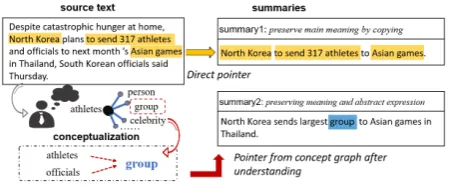
Figure 1: “summary1” only copies keyword from the source text, while “summary2” generates new concepts to convey the meaning.
ulary distribution and the source text. Pointer generator networks have also been extensively ac-cepted by the ABS community due to their effi-cacy with long document summaries (Chen and Bansal, 2018;Hsu et al.,2018), title summariza-tion (Sun et al.,2018), etc.
However, the current power of abstractive sum-marization falls short of their potential. As the ex-ample in Figure1shows, a seq2seq model with a pointer mechanism (marked as the direct pointer) is likely to merely copy parts of the original text to form a summary using keywords and phrases, such as “317 athletes”. Conversely, a more human-like summary would be based on one’s own un-derstanding of the detail in the words, expressed as higher-level concepts drawn from world knowl-edge—like using the word “group” to replace “athletes and officials”. This indicates that a good summary should not simply copy original mate-rial, it should also generate new and even abstract concepts that reflect high-level semantics.
us-ing concepts from world knowledge to assist with abstractive summarization. Our developed model not only points to informative source texts but also leverages conceptual words from human knowl-edge in the summaries it generates.
Hence, in this paper, we propose a novel model based on a concept pointer generator that encour-ages the generation of conceptual and abstract words. As a hidden benefit, the model also alle-viates the OOV problems. Our model uses pointer network to capture the salient information from a source text, and then employs another pointer to generalize the detailed words according to their upper level of expressions. Finally, the output is also consistent with language model by the seq2seq generator. Unique to our concept pointer is a set of concept candidates particular for a word that is drawn from a huge knowledge base. The set of candidates adheres to a concept distribution, where the probability of each concept being gen-erated is linked to how strongly the candidate rep-resents each word. Moreover, the concept distri-bution is iteratively updated to better explain the target word given the context of the source mate-rial and inherent semantics in the texts. Hence, the learned concept pointer points to the most suitable and expressive concepts or words. The optimiza-tion funcoptimiza-tion is adaptive so as to cater for different datasets with distantly-supervised training. The network is then optimized end-to-end using rein-forcement learning, with the distant-supervision strategy as a complement to further improve the summary.
Overall, the contributions of this paper are: 1) a novel concept pointer generator network that leverages context-aware conceptualization and a concept pointer, both of which are jointly in-tegrated into the generator to deliver informa-tive and abstract-oriented summaries; 2) a novel distant supervision training strategy that favors model adaptation and generalization, which re-sults in performance that outperforms the well-accepted evaluation-based reinforcement learning optimization on a test-only dataset in terms of ROUGE metrics; 3) a statistical analysis of quan-titative results and human evaluations from com-parative experiments with several state-of-the-art models that shows the proposed method provides promising performance.
2 Related Work
Abstractive summarization supposedly digests and understands the source content and, consequently, the generated summaries are typically a reorgani-zation of the wording that sometimes form new sentences. Historically, abstractive summariza-tion has been performed through rule-based sen-tence selection (Dorr et al., 2003), key informa-tion extracinforma-tion (Genest and Lapalme, 2011), syn-tactic parsing (Bing et al.,2015) and so on. How-ever, more recently, seq2seq models with attention have played a more dominant role in generating abstractive summaries (Rush et al.,2015;Chopra et al., 2016; Nallapati et al., 2016; Zhou et al., 2017). Extensions to the seq2seq approach include an intra-decoder attention (Paulus et al.,2017) and coverage vectors (See et al.,2017) to decrease rep-etition in phrasing. Copy mechanism (Gu et al., 2016) has been integrated into these models to tackle OOV problem. Zhou et al. (2018) went on to propose SeqCopyNet which copies complete sequences from an input sentence to further main-tain the readability of the generated summary.
Pointer mechanism (Vinyals et al., 2015) has drawn much attention in text summarization (See et al.,2017), because this technique not only pro-vides a potential solution for rare words and OOV but also extends abstractive summarization in a flexible way (C¸ elikyilmaz et al., 2018). Further, pointer generator models can effectively adaptive to both extractor and abstractor networks (Chen and Bansal, 2018), and summaries can be gen-erated by incorporating a pointer-generator and multiple relevant tasks (Guo et al., 2018), such as question or entailment generation, or multiple source texts (Sun et al.,2018).
3 The Proposed Model
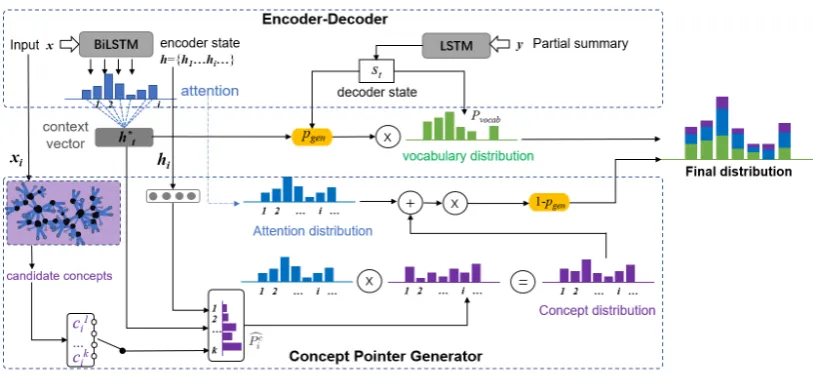
Neural abstractive summarization can be de-scribed as a generation process where a sequen-tial input is summarized into a shorter sequensequen-tial output through a neural network. Suppose that the sequential inputx={x1, . . . , xi, . . . , xn}is a se-quence ofnnumber of words, andiis the index of the input. The shorter (i.e., summarized) sequence of output is denoted asy = {y1, . . . , yt, . . . , ym} with number of m words, and tindicates a time step. As Figure 2 shows, our model consists of two sub-modules —an encoder-decoder module and the proposed concept pointer generator mod-ule.
3.1 Encoder-Decoder Framework
This process is formulated as an encoder-decoder framework that consists of an encoder and an attention-equipped decoder. We use a two-layer bi-directional LSTM-RNN encoder and one-layer uni-directional LSTM-RNN decoder along with attention mechanism.
Formally, the encoder produces sequential hid-den states as(−→h1, . . . ,−→hn)and(
←−
h1, . . . ,←h−n)in the corresponding positions, and the bi-directional
hi = fLST M(hi−1, xi). Each word xi in the sequence can be represented as a concatenation of the bi-directional hidden states, i.e., hi =
[−→hi,
←−
hi]. The decoder generates a target sum-mary from a vocabulary distribution Pvocab(w), which is based on a context vectorh∗t through the following process:
Pvocab(w) =P(yt|y<t,x;θ)
=sfm(W2(W1[st,h∗t] +b1) +b2)
(1)
wherestis the hidden state of the decoder at time step t , andh∗t is the context vector at time step
t. W1,W2, b1,b2 are trainable parameters, and
sfm(·) is short for softmax function.
The context vector h∗t is computed by a weighted sum of the hidden representations of the source text, and the weight is denoted as the atten-tionαt,i.
h∗t =Xn
i=1αt,ihi
αt,i =sfm(v>tanh(Whhi+Wsst+b)) (2)
The softmax function normalizes the vector of a distribution over the input position, and
v,Wh,Ws,bare trainable parameters.
3.2 Concept Pointer Generator
Pointer networks use attention as a pointer to se-lect segments of the input as outputs (Vinyals et al., 2015). As such, a pointer network is a suitable mechanism for extracting salient informa-tion, while remaining flexible enough to interface with a seq2seq model for generating an abstractive summarization (See et al., 2017). Our proposed model is essentially an upgrade to this configura-tion that integrates a new concept pointer network within a unified framework.
3.2.1 Context-aware Conceptualization “Understanding” the instances of a word requires a taxonomic knowledge base that relates those words to a concept space. In our model, we use an isA taxonomy, called the Microsoft Concept Graph1 (Wang et al.,2015), to serve this purpose for two reasons (Wang and Wang, 2016). First, this graph provides a huge concept space with multi-word terms that cover concepts of worldly facts as concepts, instances, relationships, and val-ues2. Second, the relationships between concepts and entities are probabilistic as a measure of how strongly they are related. Moreover, the proba-bilities are trustworthy given they have been de-rived from evidence found in billions of webpages, search log data, and other existing taxonomies. Our model is data-driven and, therefore, is more easily adaptable with probabilities. All these char-acteristics make the Microsoft Concept Graph a suitable choice for our model. More detailed ex-amples are available in Appendix A.
The concept graph specifies the probability that each instance x belongs to a concept c, p(c|x). Given a wordx, we have a distribution over a set of related concepts. Yet, this raises the question of how to identify a context-appropriate concept for a word from the distributional set of candidate con-cepts. For instance,applein the context of “an ap-ple is good for you health” tends to be associated with the concept offruitinstead ofcompany. For-mally, given a wordxiin a training sentence, a set ofkconcept candidates,Ci ={c1i, c2i,· · · , cki}, is linked to the word from the knowledge base, with distributional probabilities over the concepts, i.e.,
1The Microsoft concept graph was derived from
Probase project. The public data can be downloaded via the provided API:https://concept.research. microsoft.com/Home/API
2The current version is mined from billions of web pages,
Figure 2: The architecture of our model. Blue bar represents the attention distribution over the inputs. Purple bar represents the concept distribution over the inputs. Noted that, this distribution can be sparse since not every word has its upper concept. Green bar represents the vocabulary distribution generated from seq2seq component.
P(C|xi) = {p(c1i), p(c2i),· · · , p(cki)}. The task is to find the most suitable concept cji to fit the updated context, represented by the vector h∗t in Equation (2), at each time stept.
In the case of generating summaries given up-dated contexts, a weighted update of the distribu-tional concept candidates needs to be performed. In the model, the updated weight, denoted as βij, is estimated by a softmax classifier that is jointly conditioned on the hidden representation of the wordhi, the context vectorsh∗t, and each of con-cept vectors:
βij =softmax(Wh0[hi,h∗t,cj
i]) (3)
where j ∈ [1, k], Wh0 is a trainable parameter,
andcji is the vector of thejth concept candidate, which is a representation of the input embeddings. Together with the concept probability from the existing knowledge base p(cji) and the updated weights based on the contextsβij, a context-aware conceptualized probability ofjth concept for the wordxi,Pi,jc , is finally estimated as
Pi,jc =p(cji) +γβij (4)
whereγis a tunable parameter. Theoretically, we will end up with a number ofkrelevant concepts for each word Ci = {c1i,· · ·, cki} with a proba-bility distribution over the set, which is learned as
Pic={Pi,c1,· · ·, Pi,jc ,· · ·, Pi,kc }.
3.2.2 Concept Pointer Generator
The basic pointer generator network contains two sub-modules, one is the pointer network and the
other is the generation network. These two sub-modules jointly determine the probabilities of the words in the final generated summary. The gener-ation probabilitypgen for the generation network (See et al.,2017) is learned by
pgen =σ(Wh∗h∗
t +Wsst+Wyyt−1+bgen) (5) whereσis a sigmoid function.
For the pointer network, our model consists of a pointer to the source text and a further concept pointer to the relevant concepts that have arisen from the source content. These two separate point-ers are calculated as follows. The first pointer is taken based on the attention distributionαt,i over the source text. The second concept pointer is op-erated over a concept distribution of the source text that is scaled element-wise by the attention distri-bution.
To train the model, given the likelihood of each concept in the current context, the updates could be performed in two ways. In a hard assignment, the concept that receives the highest score would be selected for the update:
c Pc
iargmax=P
c
i,a,wherea= arg maxj (β j i) (6)
where a is the index of maximized generated weight based on the contexts, andPi,ac is obtained by Eqs. (4).
In random selection, each of the concept can-didates could be trained randomly to update the parameters:
c Pc
irandom=P
c
where j represents the selected concept index. Considering the above baseline generation net-work and both the pointer netnet-works, our final out-put distribution is
Pfinal(w) =pgenPvocab(w) + (1−pgen)
(X
i:wi=w
αt,i+
X
i:wi=w
αt,i×Pcic)
(8)
where Pcic can be updated by Pcic
arg max, or
c
Picrandom. The difference between these two choices is demonstrated in the Experiments sec-tion.
3.3 Objective Learning
3.3.1 Basic MLE
The baseline objective is derived by maximiz-ing the likelihood trainmaximiz-ing for the seq2seq gen-eration, given a reference summary y∗ =
{y1∗, y2∗,· · · , ym∗0} for document x. The
train-ing objective is to minimize the negative log-likelihood of the target word sequence:
LM LE =−Pm 0
t=1logP(y∗t|y1∗,· · · , y∗t−1,x)
(9)
3.3.2 Evaluation based Reinforcement Learning (RL)
Similar to Paulus et al. (2017), policy gradient methods can directly optimize discrete target eval-uation metrics, such as ROUGE. The basic idea is to explore new sequences and compare them to the best greedy baseline sequence. Once the baseline sequence yˆ, or sampled sequence ys, are gener-ated, they are compared against the reference se-quencey∗to compute the rewardsr(ˆy)andr(ys), respectively. In the RL training stage, two sep-arate output candidates at each time step are pro-duced:ysis sampled from the probability distribu-tionP(yst|y1s,· · ·, yst−1, x), andyˆis the baseline output. The training objective is then to minimize
LRL= (r(ˆy)−r(ys))Pm
0
t=1logP(yts|y1s,· · ·, yst−1, x)
(10) It is noteworthy that the samplesysare selected from a wide range of vocabularies extended by all the concept candidates. This strategy ensures that the model learns to generate sequences with higher rewards by better exploring a set of close concepts. Thus, the combination of these two objectives yield improved task-specific scores while cater-ing a better language model: Lf inal = λLRL +
(1−λ)LM LE, whereλis a soft-switch between
the two objectives. The model is pre-trained with MLE loss, then switch to the final loss.
3.3.3 Distant Supervision (DS) for Model Adaption
Our intuition is that, if the summary-document pairs are dissimilar to the testing set, the model could be retrained to adapt to weaken the influence of the dissimilarity on the final loss. The result would be a training model that better fits the spe-cific testing data. The challenge is that there are no explicit supervision labels to indicate whether the training set is close to the testing set, so a new training paradigm is needed. In answer to this need and also to provide end-to-end functional-ity in the model, we developed a simple approach for labeling summary-document pairs by calculat-ing the Kullback-Leibler (KL) divergence between each training reference summary and a set of test-ing documents. In this way, the traintest-ing pairs are distantly-labelled for training the model.
Specifically, the representations of the refer-ence summaries and the testing set are computed by summing all the involved word embeddings. Given a testing document xd
l, where l ∈ [1, Nd] andNdis the size of the testing corpus, the vector-based representation of one document is xdl = exp(Pn0
i=1xdi), where n0 is the number of docu-ment words involved. The reference summary is represented by y∗ = exp(Pm0
t=1y
∗
t). We nor-malize these vectors through a softmax function to cater for KL calculation. The model adaption with the distant labels is defined as:
L
DS= (
π
−
N1dP
Ndl=1
D
KL(
y
∗,
x
dl))
L
MLE (11) where DKL(.) indicates the KL divergencebe-tween y∗ and xd
l, and π is a constant parame-ter that is tuned via adaption to the testing set. The divergences are averaged within the testing set, which indicates the overall distances between testing set and each of the reference summary-document pairs. In this way, the samples in the training corpus are distantly annotated as either relevant or irrelevant for model adaption, noting that the model is pre-trained with the MLE loss before switching to distantly-supervised training.
4 Experiments
test-Table 1: ROUGE F1 evaluation results on the Gigaword and ROUGE recall on DUC-2004 test set. The results with
†mark are taken from the corresponding papers. Underlined scores are the best without additional optimization. Bold scores are the best between the two optimization strategies. ?mark indicates the improvements from the baselines to the concept pointer are statistically significant using a two-tailed t-test (p <0.01).
Models Gigaword DUC-2004
RG-1 RG-2 RG-L RG-1 RG-2 RG-L
ABS+†(Rush et al.,2015) 29.76 11.88 26.96 28.18 8.46 23.81
Luong-NMT†(Luong et al.,2015) 33.10 14.45 30.71 28.55 8.79 24.43
RAS-Elman†(Chopra et al.,2016) 33.78 15.97 31.15 28.97 8.26 24.06
lvt5k-lsent†(Nallapati et al.,2016) 35.30 16.64 32.62 28.61 9.42 25.24
SEASS†(Zhou et al.,2017) 36.15 17.54 33.63 29.21 9.56 25.51
Seq2seq+att?(our impl.) 33.11 14.67 31.06 28.57 9.31 24.81
Pointer-generator?(our impl.) (See et al.,2017) 35.98 15.99 33.33 28.28 10.04 25.69 Pointer-Cov.-Entail.-Quest.†(Guo et al.,2018) 35.98 17.76 33.63 - - -Seq2seq-Sel.-MTL-ERAM†(Li et al.,2018) 35.33 17.27 33.19 29.33 10.24 25.24
CGU†(Lin et al.,2018) 36.3 18.0 33.8 - -
-Concept pointer 36.62 16.40 33.98 29.17 10.38 26.34
Concept pointer+RL 38.02 16.97 35.43 29.34 9.84 26.60
Concept pointer+DS 37.01 17.10 34.87 30.39 10.78 27.53
ing on two popular datasets. The first was the En-glish Gigaword Fifth Edition corpus (Parker et al., 2011). We replicated the pre-processing steps in (Rush et al., 2015) to obtain the same train-ing/testing data. After pre-processing, the corpus contained about 3.8M sentence-summary pairs as training set and 189K pairs as the development set. Once pairs with empty titles were removed, the testing set numbered 1951 pairs. The second dataset, DUC2004, was only used for testing. This dataset consists of 500 document-headline sum-mary pairs, where each document is paired with four reference summaries written by humans.
Evaluation Metrics: We used ROUGE (Lin, 2004) as the evaluation metric, which measures the quality of a summary by computing the over-lapping lexical elements between the candidate summary and a reference summary. Following previous practice, we assessed RG-1 (unigram), RG-2 (bigram) and RG-L (longest common subse-quence - LCS). Noted that the English Gigaword3 testing set contains references of different lengths, while the DUC-20044 testing set fixes the sum-mary length to 75 bytes.
Training Setups: We initialize word embed-dings with 128-d vectors and fine-tune them dur-ing traindur-ing. Concepts share the same embedddur-ings
3
The ROUGE evaluation option is, -m -n 2 -s
4The ROUGE evaluation option is, -n 2 -m -b 75 -s
with the words. The vocabulary size was set to 150k for both the source and target text. The hid-den state size was set to 256. The vocabulary size is increased from around 602 to 2216 con-cepts w.r.t the different number (k= 1,· · ·,5) of concept candidates for each word. Note that the generated concepts with UNKs were subsequently deleted. Our code is available on https:// github.com/wprojectsn/codes, and the vocabularies and candidate concepts are also in-cluded.
We trained our models on a single GTX TI-TAN GPU machine. We used the Adagrad opti-mizer with a batch size of 64 to minimize the loss. The initial learning rate and the accumulator value were set to 0.15 and 0.1, respectively. We used gradient clipping with a maximum gradient norm of 2. At the time of decoding, the summaries were produced through a beam search of size 8. The hyper-parameter settings wereλ= 0.99,γ = 0.1,
π = 2.92on DUC-2004 andπ = 1.68 on Giga-word. We trained our concept pointer generator for 450k iterations yielded the best performance, then took the optimization using RL rewards for RG-L at 95K iterations on DUC-2004 and at 50K iterations on Gigaword. We took the distance-supervised training at 5K iterations on DUC-2004 and at 6.5K iterations on Gigaword.
[image:6.595.77.523.117.328.2]Table 2: OOV problem analysis: percentages (%(NO. UNK/NO. all generated words)) of generating UNK w.r.t the following three models on Gigaword and DUC-2004 datasets.
Method Gigaword DUC-2004
seq2seq+att 4.02%(570/14183) 2.08%(85/4079) Pointer generator 1.16%(207/17859) 0.31% (16/5140) Concept pointer 1.12%(202/17950) 0.23%(12/5230)
et al., 2015) is a tuned ABS model with addi-tional features. Luong-NMT(Luong et al.,2015) is a two-layer LSTM encoder-decoder. RAS-Elman (Chopra et al.,2016) is a convolution en-coder and an Elman RNN deen-coder with atten-tion. Seq2seq+attis two-layer BiLSTM encoder and one-layer LSTM decoder equipped with at-tention. lvt5k-lsent (Nallapati et al., 2016) uses temporal attention to keep track of the past atten-tive weights of the decoder and restrains the rep-etition in later sequences. SEASS (Zhou et al., 2017) includes an additional selective gate to con-trol information flow from the encoder to the de-coder. Pointer-generator (See et al., 2017) is an integrated pointer network and seq2seq model. We implemented this baseline without its coverage mechanism since this is not our focus. Baseline models also include two pointer-generator based extensions (Guo et al.,2018;Li et al.,2018).CGU (Lin et al., 2018) sets a convolutional gated unit and self-attention for global encoding.
5 Results and Analysis
The following analysis focuses on investigating whether our model is, first, able to generate ab-stract and new concepts, and, second, how the overall quality performs against the baselines.
5.1 Quantitative Analysis
The results are presented in Table1. We observe that our model outperformed all the strong state-of-the-art models on both datasets in all metrics except for RG-2 on Gigaword. In terms of the pointer generator performance, the improvements made by our concept pointer are statistically sig-nificant (p <0.01) across all metrics.
OOV and Summary Length: OOV is another major challenge for current abstractive summa-rization models. Although generating longer sum-maries or less UNKs is not our focus, our model still showed improvements in this regard (Table 2). We counted the number of UNKs and all
Table 3: Abstractiveness: percentage of noveln-grams on Gigaword dataset.
Models Noveln-gram (%)
1-gram 2-gram 3-gram Pointer generator 14.3 41.9 63.4 Concept pointer 17.2 45.8 68.5 Reference summary 25.4 65.6 78.4
generated summary words and measured the pro-portions in both testing sets. The OOV percent-ages dropped from 4.02% to 1.12% on Gigaword and from 2.08% to 0.23% on DUC-2004, which demonstrates that our model is effective at alle-viating OOV problems. This result also supports the superior of the concept pointer over the base-line pointer generator. From the statistics, we found that the summaries generated by our con-cept pointer averaged around 10.46 words, while the pointer generator summaries averaged 10.28 words per summary on DUC-2004. This shows the concept pointer is able to capture more salient content by generating relatively longer summaries.
Abstractiveness: According to Chen and Bansal (2018), abstractiveness scores are com-puted as the percentage of novel n-grams in the generated summaries that are not included in the source documents. As shown in Table 3, compared with human-written summaries which receive the highest novelty in terms of abstractiveness, our concept pointer generator achieves closest performance with human-written summaries against the baseline. This result demonstrates a further advantage of our model in producing new and abstract concepts. Our model is designed to improve semantic relevance and promote higher abstraction. More generated summary examples can be found in Appendix B.
5.2 Analysis on Training Strategies
To evaluate the relative impact of each training strategy with the model, we tested different combi-nations for comparison with each other and against the baselines.
1 2 3 4 5
K
15 20 25 30 35
ROUGE-1 ROUGE-2 ROUGE-L
(a) Gigaword:dPC
i random
1 2 3 4 5 K 10
15 20 25 30
ROUGE-1 ROUGE-2 ROUGE-L
(b) DUC-2004:dPC
i random
1 2 3 4 5 K 15
20 25 30 35
ROUGE-1 ROUGE-2 ROUGE-L
(c) Gigaword:dPC
i arg max
1 2 3 4 5 K 10
15 20 25 30
ROUGE-1 ROUGE-2 ROUGE-L
(d) DUC-2004:dPC
i arg max
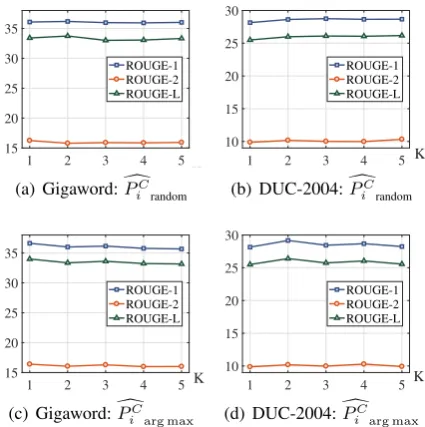
Figure 3: ROUGE metrics on Gigaword and DUC-2004 w.r.t a different number of concept candi-dates. Updates were conducted by hard assignment
d PC
i arg maxand random selectiondP
C i random.
evaluated with the three ROUGE metrics as shown in Figure3. The results only vary slightly accord-ing to the number of concepts with the random se-lection strategy (Eq.(7)), as shown in Figure3(a) and3(b). This indicates that a random strategy is not very sensitive to the number of extracted top-ics. This is, in part, because the concept pointer may or may not be able to point to the correct con-cepts from multiple candidates. While in Figure 3(c)and3(d), the optimum settings are clearly ap-parent, i.e., k = 1 on Gigaword and k = 2 on DUC-2004. Overall, the hard assignment strategy (Eq.(6)) provided the best performance in practical terms, while random selection (Eq.(7)) performs stably with different settings.
[image:8.595.75.288.69.283.2]Training with DS vs. RL: As shown in Ta-ble1, our model with either a distant supervision strategy (concept pointer+DS) or reinforcement learning (concept pointer+RL) were both supe-rior to the basic concept pointer generator on both datasets. Further, the relative improvement of the concept pointer+DS over the concept pointer+RL ranged from 3.5% to 9.6% on DUC-2004 but was inferior to concept pointer+RL on Gigaword. In comparing the results, it is clear that DS training has a noticeable effect when the testing set is sub-stantially semantically different from the training set but provides less improvement than RL when
Table 4: Human evaluation: scoring of three models in terms of abstraction and overall quality by human eval-uators (the higher the better). The score range could be 0-20. ?indicates the improvements from the baselines to the concept pointer are statistically significant.
Method abstraction overall quality
seq2seq+att? 5.85 5.65
Pointer generator? 8.95 8.10 Concept pointer 10.00 9.60
the two are close. From this analysis, we conclude that the DS strategy is better for model adaption with abstractive summarization.
5.3 Human Evaluations
To explore the correctness of our model using hu-man judgment, we conducted a hu-manual evalua-tion with 20 post-graduate volunteers. We primar-ily used the following criteria to assess the gener-ated summaries:abstraction, i.e., Are the abstract concepts contained in the summary appropriate?; andoverall quality, i.e., Is the summary readable, informative, relevant, etc.? To conduct the eval-uation, we randomly selected 20 examples from the DUC 2004 testing set and asked the volun-teers to subjectively assess the summaries. Each example consisted of an article and three sum-maries, i.e., a summary by the seq2seq model, the pointer generator model, and our proposed con-cept pointer model. The volunteers chose the best summaries for each of the articles according to the above criteria (can be multiple choices). Ob-viously, the summaries were randomly shuffled, and the model used to produce each was unknown to prevent bias. The scores for each model were ranked by how many times the volunteers chose a summary w.r.t each criteria, averaged by the num-ber of participants. The results are presented in Table4, which show that our model outperformed both the seq2seq model and the pointer generator (See et al.,2017) in both criteria.
demon-strates that our solution is a promising research di-rection to further pursue. Additionally, the gener-ated summaries are long, fluent, and informative.
6 Conclusion
This paper presents a novel concept pointer gener-ator model to improve the abstractive summariza-tion model and generate concept-oriented sum-maries. We also propose a novel distant super-vision strategy for model adaption to different datasets. Both empirical and subjective experi-ments show that our model makes a statistically significant quality improvement over the state-of-the-art baselines on two popular datasets.
Acknowledgement
This work was supported by National Natu-ral Science Foundation of China (No.61602036, 61751201), partially supported by the Research Foundation of Beijing Municipal Science & Tech-nology Commission (No. Z181100008918002), and partially supported by Ministry of Educa-tion China Mobile Research FoundaEduca-tion (No. MCM20170302).
References
Lidong Bing, Piji Li, Yi Liao, Wai Lam, Weiwei Guo, and Rebecca J. Passonneau. 2015. Abstractive multi-document summarization via phrase selection and merging. In Proceedings of the 53rd Annual Meeting of the Association for Computational Lin-guistics and the 7th International Joint Conference on Natural Language Processing of the Asian Feder-ation of Natural Language Processing, ACL, Volume 1: Long Papers, pages 1587–1597.
Asli C¸ elikyilmaz, Antoine Bosselut, Xiaodong He, and Yejin Choi. 2018. Deep communicating agents for abstractive summarization. In Proceedings of the 2018 Conference of the North American Chapter of the Association for Computational Linguistics: Hu-man Language Technologies, NAACL-HLT, Volume 1 (Long Papers), pages 1662–1675.
Yen-Chun Chen and Mohit Bansal. 2018. Fast abstrac-tive summarization with reinforce-selected sentence rewriting. arXiv preprint arXiv:1805.11080.
Sumit Chopra, Michael Auli, and Alexander M. Rush. 2016. Abstractive sentence summarization with at-tentive recurrent neural networks. InConference of the North American Chapter of the Association for Computational Linguistics: Human Language Tech-nologies, pages 93–98.
Bonnie Dorr, David Zajic, and Richard Schwartz. 2003. Hedge trimmer: A parse-and-trim approach
to headline generation. InProceedings of the HLT-NAACL 03 on Text summarization workshop-Volume 5, pages 1–8. Association for Computational Lin-guistics.
Yang Gao, Yang Wang, Luyang Liu, Yidi Guo, and Heyan Huang. 2019. Neural abstractive summa-rization fusing by global generative topics. Neural Computing and Applications.
Pierre-Etienne Genest and Guy Lapalme. 2011. Framework for abstractive summarization using text-to-text generation. In Proceedings of the Workshop on Monolingual Text-To-Text Generation, pages 64–73.
Jiatao Gu, Zhengdong Lu, Hang Li, and Victor OK Li. 2016. Incorporating copying mechanism in sequence-to-sequence learning. In Proceedings of the 54th Annual Meeting of the Association for Com-putational Linguistics (Volume 1: Long Papers), volume 1, pages 1631–1640.
Han Guo, Ramakanth Pasunuru, and Mohit Bansal. 2018. Soft layer-specific multi-task summarization with entailment and question generation. In Pro-ceedings of the 56th Annual Meeting of the Associa-tion for ComputaAssocia-tional Linguistics, ACL 2018, Vol-ume 1: Long Papers, pages 687–697.
Yidi Guo, Heyan Huang, Yang Gao, and Chi Lu. 2017. Conceptual multi-layer neural network model for headline generation. InChinese Computational Lin-guistics and Natural Language Processing Based on Naturally Annotated Big Data, pages 355–367. Springer.
Wan-Ting Hsu, Chieh-Kai Lin, Ming-Ying Lee, Kerui Min, Jing Tang, and Min Sun. 2018. A uni-fied model for extractive and abstractive summa-rization using inconsistency loss. arXiv preprint arXiv:1805.06266.
Wojciech Kryscinski, Romain Paulus, Caiming Xiong, and Richard Socher. 2018. Improving abstraction in text summarization. InProceedings of the 2018 Conference on Empirical Methods in Natural Lan-guage Processing, pages 1808–1817.
Haoran Li, Junnan Zhu, Jiajun Zhang, and Chengqing Zong. 2018. Ensure the correctness of the sum-mary: Incorporate entailment knowledge into ab-stractive sentence summarization. InProceedings of the 27th International Conference on Computational Linguistics, COLING 2018, pages 1430–1441.
Chin-Yew Lin. 2004. Rouge: A package for auto-matic evaluation of summaries. Text Summarization Branches Out.
Junyang Lin, Xu Sun, Shuming Ma, and Qi Su. 2018. Global encoding for abstractive summarization. In
Fei Liu, Jeffrey Flanigan, Sam Thomson, Norman Sadeh, and Noah A Smith. 2018. Toward abstrac-tive summarization using semantic representations.
arXiv preprint arXiv:1805.10399.
Thang Luong, Hieu Pham, and Christopher D. Man-ning. 2015. Effective approaches to attention-based neural machine translation. In Proceedings of the 2015 Conference on Empirical Methods in Natural Language Processing, EMNLP 2015, pages 1412– 1421.
Ramesh Nallapati, Bowen Zhou, C´ıcero Nogueira dos Santos, C¸ aglar G¨ulc¸ehre, and Bing Xiang. 2016. Abstractive text summarization using sequence-to-sequence RNNs and beyond. InProceedings of the 20th SIGNLL Conference on Computational Natural Language Learning, CoNLL, pages 280–290.
Robert Parker, David Graff, Junbo Kong, Ke Chen, and Kazuaki Maeda. 2011. English gigaword fifth edi-tion ldc2011t07. dvd. Philadelphia: Linguistic Data Consortium.
Romain Paulus, Caiming Xiong, and Richard Socher. 2017. A deep reinforced model for abstractive sum-marization.arXiv preprint arXiv:1705.04304.
Alexander M. Rush, Sumit Chopra, and Jason Weston. 2015. A neural attention model for abstractive sen-tence summarization. In Proceedings of the 2015 Conference on Empirical Methods in Natural Lan-guage Processing, EMNLP, pages 379–389.
Abigail See, Peter J. Liu, and Christopher D. Man-ning. 2017. Get to the point: Summarization with pointer-generator networks. In Proceedings of the 55th Annual Meeting of the Association for Com-putational Linguistics, ACL 2017, Volume 1: Long Papers, pages 1073–1083.
Fei Sun, Peng Jiang, Hanxiao Sun, Changhua Pei, Wenwu Ou, and Xiaobo Wang. 2018. Multi-source pointer network for product title summarization. In
Proceedings of the 27th ACM International Confer-ence on Information and Knowledge Management, pages 7–16. ACM.
Oriol Vinyals, Meire Fortunato, and Navdeep Jaitly. 2015. Pointer networks. InAdvances in Neural In-formation Processing Systems, pages 2692–2700.
Zhongyuan Wang and Haixun Wang. 2016. Under-standing short texts. In the Association for Com-putational Linguistics (ACL) (Tutorial).
Zhongyuan Wang, Haixun Wang, Ji-Rong Wen, and Yanghua Xiao. 2015. An inference approach to ba-sic level of categorization. In Proceedings of the 24th acm international on conference on informa-tion and knowledge management, pages 653–662. ACM.
Noah Weber, Leena Shekhar, Niranjan Balasubrama-nian, and Kyunghyun Cho. 2018. Controlling de-coding for more abstractive summaries with copy-based networks. arXiv preprint arXiv:1803.07038.
Qingyu Zhou, Nan Yang, Furu Wei, and Ming Zhou. 2017. Selective encoding for abstractive sentence summarization. InProceedings of the 55th Annual Meeting of the Association for Computational Lin-guistics, Volume 1: Long Papers, pages 1095–1104.