Proceedings of the 2019 Conference on Empirical Methods in Natural Language Processing 3936
Style Transfer for Texts: Retrain, Report Errors, Compare with Rewrites
Alexey Tikhonov∗
Yandex Berlin, Germany
Viacheslav Shibaev∗
Ural Federal University Ekaterinburg, Russia
Aleksander Nagaev
Ural Federal University/Sberbank Ekaterinburg, Russia
Aigul Nugmanova
Speech Technology Center St. Petersburg, Russia
Ivan P. Yamshchikov∗
Max Planck Institute for Mathematics in the Sciences
Leipzig, Germany
[email protected] Abstract
This paper shows that standard assessment methodology for style transfer has several sig-nificant problems. First, the standard metrics for style accuracy and semantics preservation vary significantly on different re-runs. There-fore one has to report error margins for the obtained results. Second, starting with cer-tain values of bilingual evaluation understudy (BLEU) between input and output and accu-racy of the sentiment transfer the optimization of these two standard metrics diverge from the intuitive goal of the style transfer task. Finally, due to the nature of the task itself, there is a specific dependence between these two met-rics that could be easily manipulated. Under these circumstances, we suggest taking BLEU between input and human-written reformula-tions into consideration for benchmarks. We also propose three new architectures that out-perform state of the art in terms of this metric.
1 Introduction
Deep generative models attract a lot of attention in recent years (Hu et al.,2017b). Such methods as variational autoencoders (Kingma and Welling, 2013) or generative adversarial networks ( Good-fellow et al., 2014) are successfully applied to a variety of machine vision problems including im-age generation (Radford et al., 2017), learning interpretable image representations (Chen et al., 2016) and style transfer for images (Gatys et al., 2016). However, natural language generation is more challenging due to many reasons, such as the discrete nature of textual information (Hu et al., 2017a), the absence of local information continu-ity and non-smooth disentangled representations (Bowman et al., 2015). Due to these difficulties, text generation is mostly limited to specific narrow
∗
Equal contribution
applications and is usually working in supervised settings.
Content and style are deeply fused in natural lan-guage, but style transfer for texts is often addressed in the context of disentangled latent representations (Hu et al.,2017a;Shen et al.,2017;Fu et al.,2018; John et al.,2018;Romanov et al.,2018;Tian et al., 2018). Intuitive understanding of this problem is apparent: if an input text has some attributeA, a system generates new text similar to the input on a given set of attributes with only one attributeA
changed to the target attribute A˜. In the major-ity of previous works, style transfer is obtained through an encoder-decoder architecture with one or multiple style discriminators to learn disentan-gled representations. The encoder takes a sentence as an input and generates a style-independent con-tent representation. The decoder then takes the content representation and the target style repre-sentation to generate the transformed sentence. In (Subramanian et al., 2018) authors question the quality and usability of the disentangled representa-tions for texts and suggest an end-to-end approach to style transfer similar to an end-to-end machine translation.
human-written reformulations.
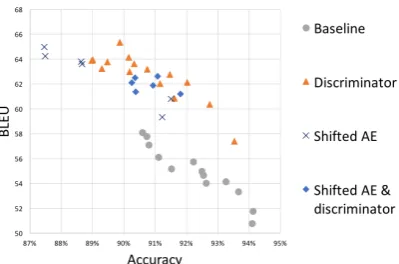
Figure 1: Test results of multiple runs for four different architectures retrained several times from scratch. In-depth description of the architectures can be found in Section3.
2 Related Work
Style of a text is a very general notion that is hard to define in rigorous terms (Xu,2017). However, the style of a text can be characterized quantitatively (Hughes et al.,2012); stylized texts could be gen-erated if a system is trained on a dataset of stylisti-cally similar texts (Potash et al.,2015); and author-style could be learned end-to-end (Tikhonov and Yamshchikov,2018b,c;Vechtomova et al.,2018). A majority of recent works on style transfer focus on the sentiment of text and use it as a target at-tribute. For example, in (Li et al.,2018;Kabbara and Cheung, 2016;Xu et al.,2018) estimate the quality of the style transfer with binary sentiment classifier trained on the corpora further used for the training of the style-transfer system. (Ficler and Goldberg,2017) and especially (Fu et al., 2018) generalize this ad-hoc approach defining a style as a set of arbitrary quantitively measurable categorial or continuous parameters. Such parameters could include the’style of the time’(Hughes et al.,2012), author-specific attributes (see (Xu et al.,2012) or (Jhamtani et al.,2017) on ’shakespearization’), po-liteness (Sennrich et al.,2016), formality of speech (Rao and Tetreault,2018), and gender or even po-litical slant (Prabhumoye et al.,2018).
A significant challenge associated with narrowly defined style-transfer problems is that finding a good solution for one aspect of a style does not guarantee that you can use the same solution for a different aspect of it. For example, Guu et al. (2018) build a generative model for sentiment
trans-fer with a retrieve-edit approach. In (Li et al.,2018) a delete-retrieve model shows good results for sen-timent transfer. However, it is hard to imagine that these retrieval approaches could be used, say, for the style of the time or formality, since in these cases the system is often expected to paraphrase a given sentence to achieve the target style.
this is the matter of future work.
Subramanian et al.(2018) state that learning a latent representation, which is independent of the attributes specifying its style, is rarely attainable. There are other works on style transfer that are based on the ideas of neural machine translation with (Carlson et al., 2018) and without parallel corpora (Zhang et al.,2018) in line with (Lample et al.,2017) and (Artetxe et al.,2017).
It is important to underline here that majority of the papers dedicated to style transfer for texts treat sentiment of a sentence as a stylistic rather than semantic attribute despite particular concerns (Tikhonov and Yamshchikov,2018a). It is also cru-cial to mention that in line with (Fu et al.,2018) ma-jority of the state of the art methods for style trans-fer use an external pre-trained classifier to measure the accuracy of the style transfer. BLEU computes the harmonic mean of precision of exact matching n-grams between a reference and a target sentence across the corpus. It is not sensitive to minute changes, but BLEU between input and output is often used as the coarse measure of the semantics preservation. For the corpora that have human writ-ten reformulations, BLEU between the output of the model and human text is used. These metrics are used alongside with a handful of others such as PINC (Paraphrase In N-gram Changes) score (Carlson et al., 2018), POS distance (Tian et al., 2018), language fluency (John et al., 2018), etc. Figure2 shows self-reported results of different models in terms of two most frequently measured performance metrics, namely, BLEU and Accuracy of the style transfer.
This paper focuses on Yelp! reviews dataset1 that was lately enhanced with human written re-formulations by (Li et al.,2018). These are Yelp! reviews, where each short English review of a place is labeled as a negative or as a positive once. This paper studies three metrics that are most common in the field at the moment and questions to which extent can they be used for the performance assess-ment. These metrics are the accuracy of an external style classifier that is trained to measure the accu-racy of the style transfer, BLEU between input and output of a system, and BLEU between output and human-written texts.
[image:3.595.313.521.62.324.2]1https://www.yelp.com/dataset
Figure 2: Overview of the self-reported results for sen-timent transfer on Yelp! reviews. Results of (Romanov et al.,2018) are not displayed due to the absence of self-reported BLEU scores. Later in the paper we show that on different reruns BLEU and accuracy can vary from these self-reported single results.
3 Style transfer
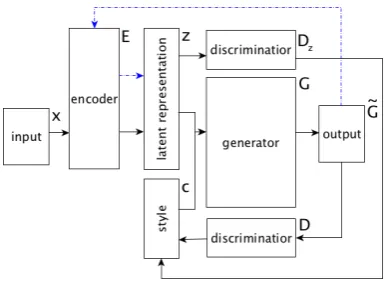
In this work we experiment with extensions of a model, described in (Hu et al.,2017a), using Texar (Hu et al., 2018) framework. To generate plausi-ble sentences with specific semantic and stylistic features every sentence is conditioned on a rep-resentation vectorz which is concatenated with a particular codecthat specifies desired attribute, see Figure3. Under notation introduced in (Hu et al.,2017a) the base autoencoder (AE) includes a conditional probabilistic encoderEdefined with parametersθE to infer the latent representationz given inputx
z∼E(x) =qE(z, c|x).
GeneratorGdefined with parametersθGis a GRU-RNN for generating and outputxˆdefined as a se-quence of tokensxˆ= ˆx1, ...,xˆT conditioned on the latent representationzand a stylistic componentc
that are concatenated and give rise to a generative distribution
ˆ
These encoder and generator form an AE with the following loss
Lae(θG, θE;x, c) =−EqE(z,c|x)[logqG(x|z, c)]. (1) This standard reconstruction loss that drives the generator to produce realistic sentences is com-bined with two additional losses. The first discrimi-nator provides extra learning signals which enforce the generator to produce coherent attributes that match the structured code inc. Since it is impossi-ble to propagate gradients from the discriminator through the discrete samplexˆ, we use a determin-istic continuous approximation a ”soft” generated sentence, denoted asG˜ = ˜Gτ(z, c)with ”temper-ature”τ set toτ → 0 as training proceeds. The resulting soft generated sentence is fed into the discriminator to measure the fitness to the target attribute, leading to the following loss
Lc(θG, θE;x) =−EqE(z,c|x)
h
logqD(c|G)˜
i
.
(2) Finally, under the assumption that each struc-tured attribute of generated sentences is controlled through the corresponding code incand is inde-pendent fromzone would like to control that other not explicitly modelled attributes do not entangle withc. This is addressed by the dedicated loss
Lz(θG;x) =−EqE(z,c|x)qD(c|x)
h
logqE(z|G)˜
i
.
(3) The training objective for the baseline, shown in Figure 3, is therefore a sum of the losses from Equations (1) – (3) defined as
minθGLbaseline=Lae+λcLc+λzLz, (4)
whereλcandλzare balancing parameters. Let us propose two further extensions of this baseline architecture. To improve reproducibility of the research the code of the studied models is open2. Both extensions aim to improve the qual-ity of information decomposition within the latent representation. In the first one, shown in Figure4, a special dedicated discriminator is added to the model to control that the latent representation does not contain stylistic information. The loss of this discriminator is defined as
LDz(θG;x, c) =−EqE(z|x)[logqDz(c|z)]. (5)
[image:4.595.312.518.63.209.2]2https://github.com/VAShibaev/text style transfer
Figure 3: The generative model, where style is a struc-tured code targeting sentence attributes to control. Blue dashed arrows denote the proposed independence con-straint of latent representation and controlled attribute, see (Hu et al.,2017a) for the details.
Here a discriminator denoted asDz is trying to predict codecusing representationz. Combining the loss defined by Equation (4) with the adversar-ial component defined in Equation (5) the following learning objective is formed
minθGL=Lbaseline−λDzLDz, (6)
whereLbaseline is a sum defined in Equation (4),
λDz is a balancing parameter.
Figure 4: The generative model with dedicated discrim-inator introduced to ensure that semantic part of the latent representation does not have information on the style of the text.
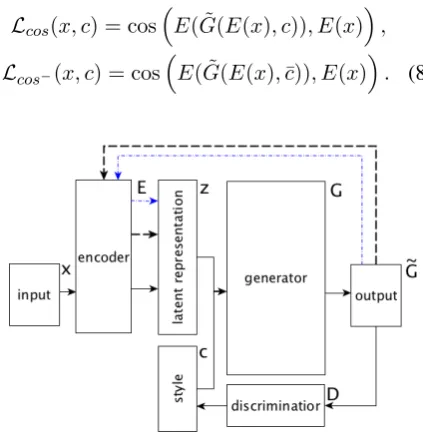
The second extension of the baseline architec-ture does not use an adversarial componentDzthat is trying to eradicate information oncfrom com-ponentz. Instead, the system, shown in Figure5 feeds the ”soft” generated sentenceG˜into encoder
[image:4.595.311.505.456.597.2]to the original representationz=E(x)in terms of the cosine distance. We further refer to it asshifted autoencoderor SAE. Ideally, bothE( ˜G(E(x), c))
and E( ˜G(E(x),¯c)), where c¯denotes an inverse style code, should be both equal to E(x)3. The loss of the shifted autoencoder is
minθGL=Lbaseline+λcosLcos+λcos−Lcos−, (7) whereλcosand λcos− are two balancing
parame-ters, with two additional terms in the loss, namely, cosine distances between the softened output pro-cessed by the encoder and the encoded original input, defined as
Lcos(x, c) = cosE( ˜G(E(x), c)), E(x),
Lcos−(x, c) = cos
[image:5.595.310.505.61.205.2]
E( ˜G(E(x),c)), E¯ (x). (8)
Figure 5: The generative model with a dedicated loss added to control that semantic representation of the out-put, when processed by the encoder, is close to the se-mantic representation of the input.
We also study a combination of both approaches described above, shown on Figure6.
In Section4we describe a series of experiments that we have carried out for these architectures using Yelp! reviews dataset.
4 Experiments
We have found that the baseline, as well as the proposed extensions, have noisy outcomes, when retrained from scratch, see Figure1. Most of the papers mentioned in Section 2 measure the per-formance of the methods proposed for the senti-ment transfer with two metrics: accuracy of the
3This notation is valid under the assumption that every
[image:5.595.73.285.254.473.2]stylistic attribute is a binary feature
Figure 6: A combination of an additional discriminator used in Figure4with a shifted autoencoder shown in Figure5
external sentiment classifier measured on test data, and BLEU between the input and output that is regarded as a coarse metric for semantic similarity.
In the first part of this section, we demonstrate that reporting error margins is essential for the per-formance assessment in terms that are prevalent in the field at the moment, i.e., BLEU between input and output and accuracy of the external sentiment classifier. In the second part, we also show that both of these two metrics after a certain threshold start to diverge from an intuitive goal of the style transfer and could be manipulated.
4.1 Error margins matter
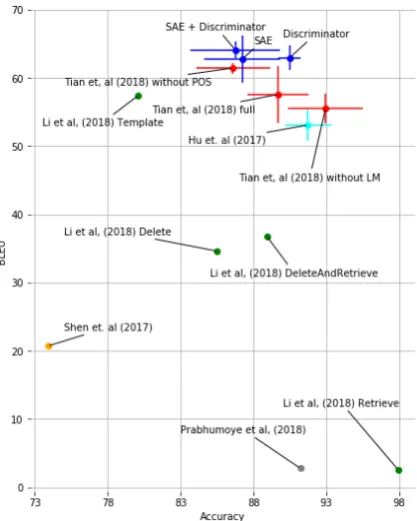
To put obtained results into perspective, we have retrained every model from scratch five times in a row. We have also retrained the models ofTian et al. (2018) five times since their code is published on-line. Figure7shows the results of all models with error margins. It is also enhanced with other self-reported results on the same Yelp! review dataset for which no code was published.
Figure 7: Overview of the self-reported results for sen-timent transfer on Yelp! reviews alongside with the re-sults for the baseline model (Hu et al.,2017a), architec-ture with additional discriminator, shifted autoencoder (SAE) with additional cosine losses, and a combination of these two architectures averaged after five re-trains alongside with architectures proposed by (Tian et al., 2018) after five consecutive re-trains. Results of ( Ro-manov et al.,2018) are not displayed due to the absence of self-reported BLEU scores.
One can see that error margins of the models, for which several reruns could be performed, overlap significantly. In the next subsection, we carefully study BLEU and accuracy of the external classifier and discuss their aptness to measure style transfer performance.
4.2 Delete, duplicate and conquer
One can argue that as there is an inevitable entan-glement between semantics and stylistics in natural language, there is also an apparent entanglement between BLEU of input and output and accuracy
estimation of the style. Indeed, the output that copies input gives maximal BLEU yet clearly fails in terms of the style transfer. On the other hand, a wholly rephrased sentence could provide a low BLEU between input and output but high accuracy. These two issues are not problematic when both BLEU between input and output and accuracy of the transfer are relatively low. However, since style transfer methods have significantly evolved in re-cent years, some state of the art methods are now sensitive to these issues. The trade-off between these two metrics can be seen in Figure1as well as in Figure7.
As we have mentioned above, the accuracy of an external classifier and BLEU between output and input are the most widely used methods to assess the performance of style transfer at this moment. However, both of these metrics can be manipulated in a relatively simple manner. One can extend the generative architecture with internal pre-trained classifier of style and then perform the following heuristic procedure:
• measure the style accuracy on the output for a given batch;
• choose the sentences that style classifier labels as incorrect;
• replace them with duplicates of sentences from the given batch that have correct style according to the internal classifier and show the highest BLEU with given inputs.
This way One can replace all sentences that push measured accuracy down and boost reported accu-racy to 100%. To see the effect that this manipula-tion has on the key performance metric we split all sentences with wrong style in 10 groups of equal size and replaces them with the best possible du-plicates of the stylistically correct sentences group after group. The results of this process are shown in Figure8.
et al.,2018) also grows. Figure8shows that for SAE but all four architectures described in Section 3demonstrate similar behavior.
Figure 8: Manipulating the generated output in a way that boosts accuracy one can change BLEU between output and input. Moreover, such manipulation in-creases BLEU between output and human written re-formulations. The picture shows behavior of SAE, but other architectures demonstrate similar behavior. The results are an average of four consecutive retrains of the same architecture.
Our experiments show that though we can ma-nipulate BLEU between output and human-written text, it tends to change monotonically. That might be because of the fact that this metric incorporates information on stylistics and semantics of the text at the same time, preserving inevitable entangle-ment that we have entangle-mentioned earlier. Despite being costly, human-written reformulations are needed for future experiments with style transfer. It seems that modern architectures have reached a certain level of complexity for which naive proxy met-rics such as accuracy of an external classifier or BLEU between output and input are already not enough for performance estimation and should be combined with BLEU between output and human-written texts. As the quality of style transfer grows further one has to improve the human-written data sets: for example, one would like to have data sets similar to the ones used for machine translation with several reformulations of the same sentence.
[image:7.595.82.285.119.291.2]On Figure9one can see how new proposed ar-chitectures compare with another state of the art approaches in terms of BLEU between output and human-written reformulations.
Figure 9: Overview of the BLEU between output and human-written reformulations of Yelp! reviews. Ar-chitecture with additional discriminator, shifted autoen-coder (SAE) with additional cosine losses, and a com-bination of these two architectures measured after five re-runs outperform the baseline by (Hu et al.,2017a) as well as other state of the art models. Results of ( Ro-manov et al.,2018) are not displayed due to the absence of self-reported BLEU scores
5 Conclusion
References
Mikel Artetxe, Gorka Labaka, Eneko Agirre, and Kyunghyun Cho. 2017. Unsupervised neural ma-chine translation. InarXiv preprint.
Samuel R. Bowman, Gabor Angeli, Christopher Potts, and Christopher D. Manning. 2015. A large anno-tated corpus for learning natural language inference. In Proceedings of the 2015 Conference on Empiri-cal Methods in Natural Language Processing, pages 632–642.
Keith Carlson, Allen Riddell, and Daniel Rockmore. 2018. Evaluating prose style transfer with the bible.
Royal Society open science, 5(10):171920.
Xi Chen, Yan Duan, Rein Houthooft, John Schul-man, Ilya Sutskever, and Pieter Abbeel. 2016. In-fogan: Interpretable representation learning by in-formation maximizing generative adversarial nets.
Advances in neural information processing systems, pages 2172–2180.
Jessica Ficler and Yoav Goldberg. 2017. Controlling linguistic style aspects in neural language genera-tion. InProceedings of the Workshop on Stylistic Variation, volume 94-104.
Zhenxin Fu, Xiaoye Tan, Nanyun Peng, Dongyan Zhao, and Rui Yan. 2018. Style transfer in text: Explo-ration and evaluation. AAAI.
Leon A. Gatys, Alexander S. Ecker, and Matthias Bethge. 2016. Image style transfer using convolu-tional neural network. Computer Vision and Pattern Recognition (CVPR), 2016 IEEE Conference, pages 2414–2423.
Ian J. Goodfellow, Jean Pouget-Abadie, Mehdi Mirza, Bing Xu, David Warde-Farley, Sherjil Ozair, Aaron Courville, and Yoshua Bengio. 2014. Generative ad-versarial nets. Advances in neural information pro-cessing systems, pages 2672–2680.
Ankush Gupta, Arvind Agarwal, Prawaan Singh, and Piyush Rai. 2018. A deep generative framework for paraphrase generation. InThirty-Second AAAI Con-ference on Artificial Intelligence.
Kelvin Guu, Tatsunori B. Hashimoto, Yonatan Oren, and Percy Liang. 2018. Generating sentences by editing prototypes. Transactions of the Association of Computational Linguistics, 6:437–450.
Zhiting Hu, Haoran Shi, Zichao Yang, Bowen Tan, Tiancheng Zhao, Junxian He, Wentao Wang, Xingjiang Yu, Lianhui Qin, Di Wang, Xuezhe Ma, Hector Liu, Xiaodan Liang, Wanrong Zhu, Deven-dra Singh Sachan, and Eric P. Xing. 2018. Texar: A modularized, versatile, and extensible toolkit for text generation. InarXiv preprint.
Zhiting Hu, Zichao Yang, Xiaodan Liang, Ruslan Salakhutdinov, and Eric P. Xing. 2017a. Toward controlled generation of text. InInternational Con-ference on Machine Learning, pages 1587–1596.
Zhiting Hu, Zichao Yang, Ruslan Salakhutdinov, and Eric Xing. 2017b.On unifying deep generative mod-els. InarXiv preprint.
James M. Hughes, Nicholas J. Foti, David C. Krakauer, and Daniel N. Rockmore. 2012. Quantitative pat-terns of stylistic influence in the evolution of litera-ture. Proceedings of the National Academy of Sci-ences, 109(20):7682–7686.
Harsh Jhamtani, Varun Gangal, Eduard Hovy, and Eric Nyberg. 2017. Shakespearizing modern language using copy-enriched sequence-to-sequence models. In Proceedings of the Workshop on Stylistic Varia-tion, pages 10–19.
Vineet John, Lili Mou, Hareesh Bahuleyan, and Olga Vechtomova. 2018. Disentangled representation learning for text style transfer. InarXiv preprint.
Jad Kabbara and Jackie Chi Kit Cheung. 2016. Stylis-tic transfer in natural language generation systems using recurrent neural networks. Proceedings of the Workshop on Uphill Battles in Language Process-ing: Scaling Early Achievements to Robust Methods, pages 43–47.
Diederik P. Kingma and Max Welling. 2013. Auto-encoding variational bayes. InarXiv preprint.
Guillaume Lample, Alexis Conneau, Ludovic Denoyer, and Marc’Aurelio Ranzato. 2017. Unsupervised ma-chine translation using monolingual corpora only. InarXiv preprint.
Juncen Li, Robin Jia, He He, and Percy Liang. 2018. Delete, retrieve, generate: A simple approach to sen-timent and style transfer. InProceedings of the 2018 Conference of the North American Chapter of the Association for Computational Linguistics: Human Language Technologies, volume 1, pages 865–1874.
Kishore Papineni, Salim Roukos, Todd Ward, and Wei-Jing Zhu. 2002.Gbleu: a method for automatic eval-uation of machine translation. InProceedings of the 40th Annual Meeting of the Association for Compu-tational Linguistics (ACL), pages 311–318.
Peter Potash, Alexey Romanov, and Anna Rumshisky. 2015. Ghostwriter: Using an lstm for automatic rap lyric generation. InProceedings of the 2015 Con-ference on Empirical Methods in Natural Language Processing, pages 1919–1924. Association for Com-putational Linguistics.
Shrimai Prabhumoye, Yulia Tsvetkov, Alan W. Black, and Ruslan Salakhutdinov. 2018. Style transfer through back-translation. InarXiv preprint.
Aaditya Prakash, Sadid A. Hasan, Kathy Lee, Vivek Datla, Ashequl Qadir, Joey Liu, and Oladimeji Farri. 2016. Neural paraphrase generation with stacked residual lstm networks. InarXiv preprint.
Sudha Rao and Joel Tetreault. 2018. Dear sir or madam, may i introduce the gyafc dataset: Corpus, benchmarks and metrics for formality style trans-fer. InProceedings of the Conference of the North American Chapter of the Association for Computa-tional Linguistics: Human Language Technologies, volume 1, pages 129–140.
Alexey Romanov, Anna Rumshisky, Anna Rogers, and David Donahue. 2018. Adversarial decomposition of text representation. InarXiv preprint.
Aurko Roy and David Grangier. 2019. Unsupervised paraphrasing without translation. InarXiv preprint.
Rico Sennrich, Barry Haddow, and Alexandra Birch. 2016. Controlling politeness in neural machine translation via side constraints. In Proceedings of the 2016 Conference of the North American Chap-ter of the Association for Computational Linguistics: Human Language Technologies, pages 35–40.
Tianxiao Shen, Tao Lei, Regina Barzilay, and Tommi Jaakkola. 2017. Style transfer from non-parallel text by cross-alignment. 31st Conference on Neural In-formation Processing Systems, pages 6833–6844.
Sandeep Subramanian, Guillaume Lample, Eric M. Smith, Ludovic Denoyer, Marc Aurelio Ranzato, and Y-Lan Boureau. 2018. Multiple-attribute text style transfer. InarXiv preprint.
Youzhi Tian, Zhiting Hu, and Zhou Yu. 2018. Struc-tured content preservation for unsupervised text style transfer. InarXiv preprint.
Alexe Tikhonov and Ivan P. Yamshchikov. 2018a. What is wrong with style transfer for texts? InarXiv preprint.
Alexey Tikhonov and Ivan P. Yamshchikov. 2018b. Guess who? Multilingual approach for the auto-mated generation of author-stylized poetry. InIEEE Spoken Language Technology Workshop (SLT), pages 787–794.
Alexey Tikhonov and Ivan P. Yamshchikov. 2018c. Sounds Wilde. Phonetically extended embeddings for author-stylized poetry generation. In Proceed-ings of the Fifteenth Workshop on Computational Research in Phonetics, Phonology, and Morphology, pages 117–124.
Olga Vechtomova, Hareesh Bahuleyan, Amirpasha Ghabussi, and Vineet John. 2018. Generating lyrics with variational autoencoder and multi-modal artist embeddings. InarXiv preprint.
Jingjing Xu, Xu Sun, Qi Zeng, Xuancheng Ren, Xi-aodong Zhang, Houfeng Wang, and Wenjie Li. 2018. Unpaired sentiment-to-sentiment translation: A cy-cled reinforcement learning approach. In arXiv preprint.
Wei Xu. 2017. From shakespeare to twitter: What are language styles all about? Proceedings of the Work-shop on Stylistic Variation, pages 1–9.
Wei Xu, Alan Ritter, William B. Dolan, Ralph Grish-man, and Colin Cherry. 2012. Paraphrasing for style.
Proceedings of COLING, pages 2899–2914.
Zhirui Zhang, Shuo Ren, Shujie Liu, Jianyong Wang, Peng Chen, Mu Li, Ming Zhou, and Enhong Chen. 2018. Style transfer as unsupervised machine trans-lation. InarXiv preprint.
Junbo Jake Zhao, Yoon Kim, Kelly Zhang, Alexan-der M. Rush, and Yann LeCun. 2017. Adversari-ally regularized autoencoders for generating discrete structures. InProceedings of the 2015 Conference on Empirical Methods in Natural Language Process-ing. CoRR.
A Supplemental Material
Here are some examples characteristic for different systems. An output of a system follows the input. Here are some successful examples produced by the system with additional discriminator:
• it’s not much like an actual irish pub, which is depressing.→it’s definitely much like an actual irish pub, which is grateful.
• i got a bagel breakfast sandwich and it was delicious!→i got a bagel breakfast sandwich and it was disgusting!
• i love their flavored coffee. →i dumb their flavored coffee.
• i got a bagel breakfast sandwich and it was delicious!→i got a bagel breakfast sandwich and it was disgusting!
• i love their flavored coffee. →i dumb their flavored coffee.
• nice selection of games to play. → typical selection of games to play.
• i’m not a fan of huge chain restaurants. →
i’m definitely a fan of huge chain restaurants.
Here are some examples of typical faulty refor-mulations:
• only now i’m really hungry, and really pissed off.→kids now i’m really hungry, and really extraordinary off.
• what a waste of my time and theirs.→what a wow. of my time and theirs.
• cooked to perfection and very flavorful. →
• the beer was nice and cold! →the beer was nice and consistant!
• corn bread was also good!→corn bread was also unethical bagged
Here are some successful examples produced by the SAE:
• our waitress was the best, very accommodat-ing. →our waitress was the worst, very ac-commodating.
• great food and awesome service!→horrible food and nasty service!
• their sandwiches were really tasty. → their sandwiches were really bland.
• i highly recommend the ahi tuna.→i highly hated the ahi tuna.
• other than that, it’s great! →other than that, it’s horrible!
Here are some examples of typical faulty refor-mulations by SAE:
• good drinks, and good company. → 9:30 drinks, and 9:30 company.
• like it’s been in a fridge for a week. → like it’s been in a fridge for a true.
• save your money & your patience. →save your smile & your patience.
• no call, no nothing. →deliciously call, deli-ciously community.
• sounds good doesn’t it?→sounds good does keeps it talented
Here are some successful examples produced by the SAE with additional discriminator:
• best green corn tamales around. → worst green corn tamales around.
• she did the most amazing job.→she did the most desperate job.
• very friendly staff and manager. →very in-consistent staff and manager.
• even the water tasted horrible. → even the water tasted great.
• go here, you will love it.→go here, you will avoid it.
Here are some examples of typical faulty refor-mulations by the SAE with additional discrimina-tor:
• num - num % capacity at most , i was the only one in the pool.→sweetness - stylish % fountains at most, i was the new one in the
• this is pretty darn good pizza!→this is pretty darn unsafe pizza misleading
• enjoyed the dolly a lot.→remove the short-age a lot.
• so, it went in the trash.→so, it improved in the hooked.