84
Predicting Algorithm Classes for Programming Word Problems
Vinayak Athavale∗1 Aayush Naik∗2 Rajas Vanjape1 Manish Shrivastava1
(vinayak.athavale, rajas.vanjape)@research.iiit.ac.in, [email protected], [email protected]
1Language Technologies Research Center, IIIT Hyderabad
2IIIT Hyderabad
Abstract
We introduce the task of algorithm class pre-diction for programming word problems. A programming word problem is a problem writ-ten in natural language, which can be solved using an algorithm or a program. We define classes of various programming word prob-lems which correspond to the class of algo-rithms required to solve the problem. We present four new datasets for this task, two multiclass datasets with 550 and 1159 prob-lems each and two multilabel datasets having 3737 and 3960 problems each. We pose the problem as a text classification problem and train neural network and non-neural network based models on this task. Our best perform-ing classifier gets an accuracy of 62.7 per-cent for the multiclass case on the five class classification dataset, Codeforces Multiclass-5 (CFMC5). We also do some human-level anal-ysis and compare human performance with that of our text classification models. Our best classifier has an accuracy only 9 percent lower than that of a human on this task. To the best of our knowledge, these are the first reported results on such a task. We make our code and datasets publicly available.
1 Introduction
In this paper we introduce and work on the prob-lem of predicting algorithms classes for program-ming word problems (PWPs). A PWP is a prob-lem written in natural language which can be solved using a computer program. These prob-lems generally map to one or more classes of al-gorithms, which are used to solve them. Binary search, disjoint-set union, and dynamic program-ming are some examples. In this paper, our aim is to automatically map programming word prob-lems to the relevant classes of algorithms. We
ap-∗
[image:1.595.311.520.217.403.2]* denotes equal contribution
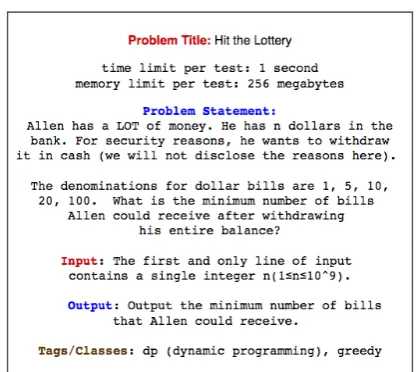
Figure 1: An example programming word problem. Note that the example shown here is one of the easy Codeforces problems – most problems are much harder.
proach this problem by treating it as a classifica-tion task.
Programming word problems A program-ming word problem (PWP) requires the solver to design correct and efficient programs. The cor-rectness and efficiency is checked by various test-cases provided by the problem writer. A PWP usually consists of three parts – the problem state-ment, a well-defined input and output format, and time and memory constraints. An example PWP can be seen in Figure1.
effi-cient with respect to the given time and memory constraints. An outgrowth of this is that, the al-gorithm required to solve a particular problem not only depends on the problem statement, but also the constraints. Consider that there may be two different algorithms which will generate the cor-rect output, for example, linear search, and binary search, but only one of those will abide by the time and memory constraints.
With the growing popularity of these prob-lems, various competitions like ACM-ICPC, and Google CodeJam have emerged. Additionally, several companies including Google, Facebook, and Amazon evaluate problem-solving skills of candidates for software-related jobs (McDowell, 2016) using PWPs. Consequently, as noted by Foriˇsek(2010), programming problems have been becoming more difficult over time. To solve a PWP, humans get information from all its parts, not just the the problem statement. Thus, we pre-dict algorithms from the entire text of a PWP. We also try to identify which parts of a PWP con-tribute the most towards predicting algorithms.
Significance of the ProblemMany interesting real-world problems can be solved and optimised using standard algorithms. Time spent grocery shopping can be optimised by posing it as a graph traversal problem (Gertin, 2012). Arranging and retrieving items like mail, or books in a library can be done more efficiently using sorting and searching algorithms. Solving problems using al-gorithms can be scaled by using computers, trans-forming the algorithms into programs. A program is an algorithm that has been customised to solve a specific task under a specific set of circumstances using a specific language. Converting textual de-scriptions of such real-world problems into algo-rithms, and then into programs has largely been a human endeavour. An AI agent that could au-tomatically generate programs from natural lan-guage problem descriptions could greatly increase the rate of technological advancement by quickly providing efficient solutions to the said real-world problems. A subsystem that could identify algo-rithm classes from natural language would signif-icantly narrow down the search space of possible programs. Consequently, such a subsystem would be a useful feature for, or likely be even part of, such an agent. Therefore, building a system to predict algorithms from programming word prob-lems is potentially an important first step toward
an automatic program generating AI. More imme-diately, such a system could serve as an applica-tion to help people in improving their algorithmic problem-solving skills for software job interviews, competitive programming, and other uses.
As per our knowledge, this task has not been addressed in the literature before. Hence, there is no standard dataset available for this task. We generate and introduce new datasets by extracting problems from Codeforces1, a sport programming platform. We release the datasets and our experi-ment code at2.
Contribution The major contributions of this paper are: Four datasets on programming word problems - two multiclass3 datasets having 5 and 10 classes and two multilabel4 datasets having 10 and 20 classes. Evaluation of Classifierson var-ious multiclass and multilabel classifiers that can predict classes for programming word problems on our datasets along with the human baseline. We define our problem more clearly in section2. Then we explain our datasets – their generation and format along with human evaluation in sec-tion 3. We describe the models we use for mul-ticlass and multilabel classification in section 4. We delineate our experiments, models, and eval-uation metrics in section 5. We report our clas-sification results in section 6. We analyse some dataset nuances in section7. Finally, we discuss related work and the conclusion in sections8and 9respectively.
2 Problem Definition
The focus of this paper is the problem of mapping a PWP to one or more classes of algorithms. A classof algorithms is a set containing more spe-cific algorithms. For example, breadth-first search, and Dijkstra’s algorithm belong to the class of graph algorithms. A PWP can be solved using one of the algorithms in the class it is mapped to. Prob-lems on the Codeforces platform have tags that correspond to the class of algorithms.
Thus, our aim is to find a tagging function,f∗ :
S → P(T)which maps a PWP string,s∈ S, to a
set of tags,{t1, t2, ...} ∈ P(T). We also consider
another variant of the problem. For the PWPs that only have one tag, we focus on finding a tagging
1codeforces.com 2
https://github.com/aayn/codeforces-clean 3
Dataset Size Vocab classes Avg. words Class percentage
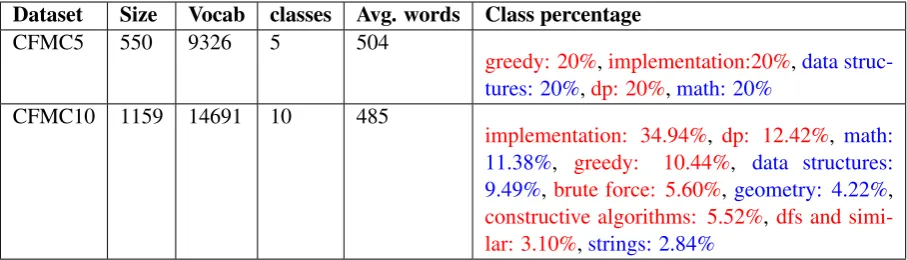
CFMC5 550 9326 5 504
greedy: 20%,implementation:20%,data struc-tures: 20%,dp: 20%,math: 20%
CFMC10 1159 14691 10 485
[image:3.595.72.526.62.192.2]implementation: 34.94%, dp: 12.42%, math: 11.38%, greedy: 10.44%, data structures: 9.49%, brute force: 5.60%,geometry: 4.22%, constructive algorithms: 5.52%, dfs and simi-lar: 3.10%,strings: 2.84%
Table 1: Dataset statistics for multiclass datasets. CFMC5 has 550 problems with a balanced class distribution. CFMC10 has 1159 problems and has a class imbalance. CFMC5 is a subset of CFMC10. Redclasses belong to the solution category;blueclasses belong to the problem category.
Dataset Size Vocab N classes Avg. len Label card Label den Label subsets
CFML10 3737 28178 10 494 1.69 0.169 231
CFML20 3960 29433 20 495 2.1 0.105 808
Table 2: Dataset statistics for multilabel datasets. The problems of the CFML10 dataset are a subset of those in the CFML20 dataset.
function,f1∗ :S → T, which maps a PWP string,
s∈ S, to a tag,t∈ T. We approximatef∗andf1∗
by training models on data.
3 Dataset
3.1 Data Collection
We collected the data from a popular sport pro-gramming platform called Codeforces. Code-forces was founded in 2010, and now has over 43000 active registered participants5. We first col-lected a total of 4300 problems from this platform. Each problem has associated tags, with most of the problems having more than one tag. These tags correspond to the algorithm or class of al-gorithms that can be used to solve that particular problem. The tags for a problem are given by the problem writer and they can only be edited only by high-rated (expert) contestants who have solved the problem. Next, we performed basic filtering on the data – removing the problems which had non-algorithmic tags, problems with no tags as-signed to them, and also the problems wherein the problem statement was not extracted completely. After this filtering, we got 4019 problems with 35 different tags. This forms the Codeforces dataset. The label (tag) cardinality (average number of la-bels/tags per problem) was 2.24. Since the Code-forces dataset is the first dataset generated for a new problem, we select different subsets of this
5http://codeforces.com/ratings/page/219
dataset with differing properties. This is to check if classification models are robust to different vari-ations of the problem.
3.2 Multilabel Datasets
We found that a large number of tags had a very low frequency. Hence, we removed those prob-lems and tags from the Codeforces dataset as fol-lows. First, we got the list of 20 most frequently occurring tags, ordered by decreasing frequency. We observed that the20thtag in this list had a fre-quency of 98, in other words, 98 problems had this tag. Next, for each problem, we removed the tags that are not in this list. After that, all problems that did not have any tags left were removed.
This led to the formation of the Codeforces Multilabel-20 (CFML20) dataset, which has 20 tags. We used the same procedure for the 10 most frequently occurring tags to get the Codeforces Multilabel-10 (CFML10) dataset. The CFML20 has 98.53 (3960 problems) percent of the prob-lems of the original dataset and the label (tag) car-dinality only reduces from 2.24 to 2.21. CFML10 on the other hand has 92.9 percent of the problems with label (tag) cardinality 1.69. Statistics about both these multilabel datasets are given in Table2.
3.3 Multiclass Datasets
such problems. From those, we selected the prob-lems whose tags occur in the list of 10 most com-mon tags. These problems formed the Codeforces Multiclass-10 (CFMC10) dataset which contains 1159 examples. We found that the CFMC10 dataset has a class (tag) imbalance. We also make a balanced dataset, Codeforces Multiclass-5 (CFMC5), in which the prior class (tag) distribu-tion is uniform. The CFMC5 dataset has five tags, each having 110 problems. To make CFMC5, first we extracted the problems whose tags are among the five most common tags. The fifth most com-mon tag occurs 110 times. We sampled 110 ran-dom problems corresponding to the other four tags to give a total of 550 problems. Statistics about both the multiclass datasets are given in Table1.
3.4 Dataset Format
Each problem in the datasets follows the same for-mat (refer to Figure 1 for an example problem). The header contains the problem title, and the time and memory constraints for a program running on the problem testcases. The problem statement is the natural language description of the problem framed as a real world scenario. The input and output format describe the input to, and the out-put from a valid solution program. It also contains constraints that will be put on the size of inputs (for example, max size of input array, max size of 2 input values). The tags associated with the prob-lem are the algorithm classes that we are trying to predict using the above information.
3.5 Class Categories in the Dataset
The classes for PWPs can be divided into two cat-egories: Problem category classes tell us what kind of broad class of problem the PWP belongs to. For instance, math, and string are two such classes. Solution category classes tell us what kind of algorithm can solve a particular PWP. For example, a PWP of class dp or binary search would need a dynamic programming or binary search based algorithm to solve it.
Problem category PWPs are easier to classify because, in some cases, simple keyword mapping may lead to the classification (an equation in the problem is a strong indicator that a problem is of math type). Whereas, for solution category PWPs, a deeper understanding of the problem is required. The classes belong to problem and solution cat-egories for CFML20 are mentioned in the supple-mentary material.
3.6 Human Evaluation
In this section, we evaluate and analyze the per-formance of an average competitor on the task of predicting an algorithm for a PWP. The tags for a given PWP are added by its problem setter or other high-rated contestants who have solved it. Our test participants were recent computer science graduates with some experience in algorithms and competitive programming. We gave 5 participants the problem text along with all the constraints, and the input and output format. We also provided them with a list of all the tags and a few exam-ple problems for each tag. We randomly samexam-ple 120 problems from the CFML20 dataset and split them into two parts – containing 20 and 100 prob-lems respectively. The 20 probprob-lems were given along with their tags to familiarize the participants with the task. For the remaining 100 problems, the participants were asked to predict the tags (one or more) for each problem. We chose to sample the problems from the CFML20 dataset as it is the closest to a real-world scenario of predicting algo-rithms for solving problems. We find that there is some variation in the accuracy reported by differ-ent humans with the highest F1 micro score being 11 percent greater than that of the the lowest. (see supplementary material for more details). The F1 micro score averaged over all 5 participants was 51.8 while the averaged F1 Macro was 42.7. The results are not surprising since this task is like any other problem solving task, and people based on their proficiency would get different results. This shows us that the problem is hard even for humans with a computer science education.
4 Classification Models
To test the compatibility of our problem with text classification paradigm, we apply to it some stan-dard text classification models from recent litera-ture.
4.1 Multiclass Classification
To approximate the optimal tagging function f1∗
uni-grams and biuni-grams as features. We also try apply-ing TF-IDF to these features.
Multi-layer Perceptron (MLP) An MLP is a class of artificial neural network that uses back-propagation for training in a supervised setting (Rumelhart et al.,1986). MLP-based models are standard for text classification baselines (Glorot et al.,2011).
Convolutional Neural Network (CNN) We also train a Convolutional Neural Network (CNN) based model, similar to the one used by Kim (2014) in their paper, to classify the prob-lems. We use the model both with and without pre-trained GloVe word-embeddings (Pennington et al.,2014).
CNN ensemble Hansen and Salamon (1990) introduce neural network ensemble learning, in which many neural networks are trained and their predictions combined. These neural network sys-tems show greater generalization ability and pre-dictive power. We train five CNN networks and combine their predictions using the majority vot-ing system.
4.2 Multilabel Classifiers
To approximate,f∗ (see section2), we apply the following augmentations to the models described above.
Multinomial Naive Bayes (MNB) and Sup-port Vector Machine (SVM)For applying these models to the multilabel case, we use the one-vs-rest (or, one-vs-all) strategy. This strategy involves training a single classifier for each class, with the samples of that class as positive samples and all other samples as negatives (Bishop,2006).
Multi-layer Perceptron (MLP) Nam et al. (2014) use MLP-based models for multilabel text classification. We use similar models, but use the MSE loss instead of the cross-entropy loss.
Convolutional Neural Network (CNN) For multilabel classification we use a CNN based fea-ture extractor similar to the one used in (Kim, 2014). The output is passed through a sigmoid activation function, σ(x) = 1+e1−x. The labels
which have a corresponding activation greater than 0.5 are considered (Liu et al., 2017). Similar to the multiclass case, we train the model both with and without pre-trained GloVe (Pennington et al., 2014) word-embeddings.
CNN ensemble We train five CNNs and add their output linear activation values. We pass this
sum through a sigmoid function and consider the labels (tags) with activation greater than 0.5.
5 Experiment setup
Classifier CFMC5 CFMC10 Acc F1 W Acc F1 W CNN Random 25.0 22.1 35.2 19.2
MNB 47.6 47.5 43.9 37.4
SVM BoW 49.3 49.1 47.9 43.2
SVM TFIDF 47.8 47.6 45.7 41.2
MLP 47.8 47.6 49.3 46.2
CNN 61.7 61.3 54.7 51.3
[image:6.595.74.293.62.198.2]CNN Ensemble 62.7 62.2 53.5 50.5 CNN GloVe 62.2 61.3 54.5 51.4
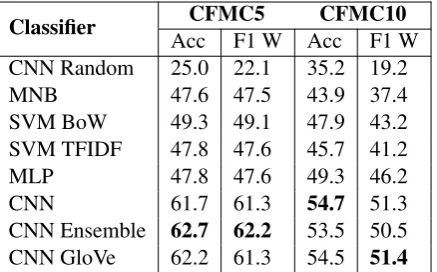
Table 3: Classification Accuracy for single label classi-fication. Note that all results were obtained on 10-fold cross validation. CNN Random refers to a CNN trained on a random labelling of the dataset. F1 W stands for weighted macro F1-score.
6 Results
6.1 Multiclass Results
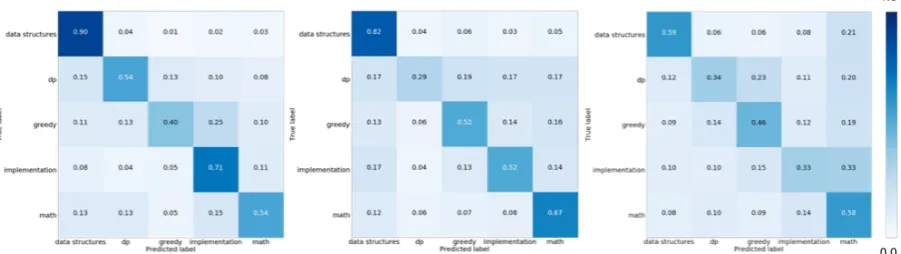
We see that the classification accuracy of the best performing classifier, CNN ensemble, for the CFMC5 dataset is 62.7 %. The highest accu-racy for the CFMC10 dataset was achieved by the CNN classifer which does not use any pretrained embeddings. For all the multiclass classification results refer to table 3. We observe that CNN-based classifiers perform better than other classi-fiers – MLP, MNB, and SVM for both CFMC5 and CFMC10 datasets. Since these are the first learning results on the task of algorithm prediction for PWPs, we train a CNN classifier on a random labelling of the dataset. The results are given in the row called CNN random. To obtain this ran-dom labelling we shuffle the current mapping from problem to tag randomly. This ensures that the class distribution of the datasets remain the same. We see that all the classifiers significantly outper-form the peroutper-formance on the random dataset. We also observe that the classification accuracy is not the same for every class. We get the highest ac-curacy (see Fig. 2) for the class,data structures, at 90%, while, the lowest accuracy is for the class, greedy, at 40%. These results are on the CFMC5 dataset.
6.2 Multilabel Results
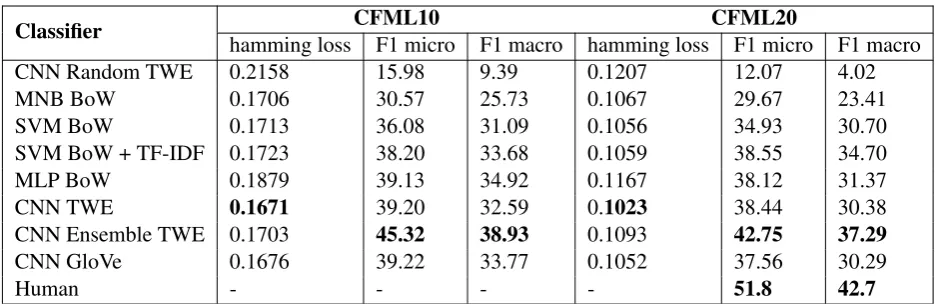
We see that CNN-based classifiers give the best re-sults for the CFML10 and CFML20 datasets. The best F1 micro and macro scores for the CFML10 dataset were 45.32, 38.9 respectively. These were obtained by the CNN Ensemble model. For
com-plete results see table 4. The best performing model on the CFML20 dataset was also the CNN ensemble. As we did in the multiclass case, we train a CNN model on the randomly shuffled la-belling for both CFML10, CFML20 datasets. We find that all the classifers significantly outperform the model trained on a shuffled labelling. The human-level F1 micro and macro scores on a sub-set of the CFML20 datasub-set were 51.2 and 40.5. In comparison, our best performing classifier on the CMFL20 dataset, CNN Ensemble, got F1 macro and micro scores of 42.75, 37.29 respectively. We see that the performance of our best classifiers trail average human performance by about 8.45% and 3.21% on F1 micro and F1 macro scores respec-tively.
7 Analysis
7.1 Experiments with various subsets of the problem
As described in section1, a PWP consists of three components – the problem statement, input and output format, and time and memory constraints. We seek to answer the following questions. Does one component contribute to the accuracy more than any other? Does the contribution of different components vary over the problem class? We per-formed some experiments to address these ques-tions. We split the problem into two parts – 1) the problem statement, and 2) the input and out-put format, and time and memory constraints. We train an SVM, and a CNN on these two compo-nents independently.
Classifier CFML10 CFML20
hamming loss F1 micro F1 macro hamming loss F1 micro F1 macro
CNN Random TWE 0.2158 15.98 9.39 0.1207 12.07 4.02
MNB BoW 0.1706 30.57 25.73 0.1067 29.67 23.41
SVM BoW 0.1713 36.08 31.09 0.1056 34.93 30.70
SVM BoW + TF-IDF 0.1723 38.20 33.68 0.1059 38.55 34.70
MLP BoW 0.1879 39.13 34.92 0.1167 38.12 31.37
CNN TWE 0.1671 39.20 32.59 0.1023 38.44 30.38
CNN Ensemble TWE 0.1703 45.32 38.93 0.1093 42.75 37.29
CNN GloVe 0.1676 39.22 33.77 0.1052 37.56 30.29
[image:7.595.71.539.60.212.2]Human - - - - 51.8 42.7
Table 4: Classification Accuracy for multi-label classification. TWE stands for trainable word embeddings ini-tialized with a normal distribution. Note that all results were obtained on 10-fold cross validation. CNN Random refers to a CNN trained on a random labelling of the dataset.
when trained on the problem statement, whereas the other classes perform much better on the for-mat and constraints. For each class exceptgreedy, we see an additive trend – the accuracy is im-proved by combining both these features. Refer to figure2for more details.
Multilabel partial problem results We also tabulate the classifier accuracies on the CFML20 dataset by training it only on the format and con-straints, and the problem statement. Even here, we observe similar trends as the multiclass par-tial problem experiments. We find that classifiers are more accurate when trained only on the format and constraints than only on the problem state-ment. Again, the accuracy is improved by combin-ing both these features. Refer to table5for more details.
7.2 Problem category and Solution category results
We find that correctly classifying PWPs of the so-lution category is harder than correctly classify-ing PWPs of the problem category (table5). For instance, take a look at the row corresponding to CFMC5 dataset and ”all prob” feature. The ac-curacy for solution category is 54.24% as com-pared to 71.36% for the problem category. This trend is followed for both CFMC5 and CFML20 datasets and also when using different features of the PWPs. In spite of the difficulty, the classifi-cation scores for the solution category are signifi-cantly better than random.
8 Related Work
Our work is related to three major topics of re-search, math word problem solving, text document
classification and program synthesis.
Dataset Features Classifier Soln. category Prob. category all F1 Mi F1 Ma F1 Mi F1 Ma F1 Mi F1 Ma CFMC5 only statement cnn 42.73 46.14 51.32 64.35 46.13 45.20
CFMC5 only i/o cnn 44.24 51.73 74.73 81.31 56.42 55.41
CFMC5 all prob cnn 54.24 59.91 71.36 78.32 61.71 61.32
CFML20 only statement cnn 30.83 17.32 38.64 41.82 33.59 28.34
CFML20 only i/o cnn 34.63 19.59 44.49 44.34 38.44 30.38
[image:8.595.75.526.63.172.2]CFML20 all prob cnn 34.39 19.23 45.36 44.02 39.20 32.59
Table 5: Performance on different categories of PWPs for different parts of the PWPs. The rows with ”only statement” features use only the problem description part of the PWP, the rows with ”only i/o” use only the I/O and constraint information, and ”all prob” use the entire PWP. The results under the ”Soln category”, ”Prob category” columns are for the problems which have the label under problem, solution category respectively. ”All” is for the entire dataset. So, for example, the F1 Micro score using only I/O and constraint for solution category problems of CFML20 is 34.63. Note that for CFMC5, F1 Mi (F1 Micro) is the same as accuracy, and F1 Ma (F1 Macro) score is a weighted Macro F1-score.
Figure 2: Confusion matrices for different parts of the problem on CFMC5. Whole problem text (left), only format and constraints information (center), and only problem statement (right). Perfomance on the whole problem is the highest, followed by only format and constraints information. Performance across different classes (exceptgreedy) is additive, which shows that features extracted from both the parts are of importance
Other approaches include a Recurrent Convolu-tional Neural Network based approach (Lai et al., 2015) or the fasttext model (Joulin et al., 2016) which uses bag-of-words features and a hierarchi-cal softmax.Nam et al.(2014) use a feed-forward neural network with binary cross entropy per la-bel to perform multilala-bel document classification. Kurata et al.(2016) leverage label co-occurrence to improve multilabel classification. Liu et al. (2017) use a CNN based architecture to perform extreme multilabel classification.
9 Conclusion
We introduced a new problem of predicting the al-gorithm classes for programming word problems. For this task we generated four datasets – two mul-ticlass (CFMC5 and CFMC10), having five and 10 classes respectively, and two multilabel (CFML10 and CFML20), having 10 and 20 classes
respec-tively. Our classifiers are falling short only by about 9 percent of the human score. We also did some experiments which show that increasing the size of the train dataset improves the accuracy (see supplementary material). These problems are much harder than high school math word problems as they require a good knowledge of various com-puter science algorithms and an ability to reduce a problem to these known algorithms. Even our hu-man analysis shows that trained computer science graduates only get an F1 of 51.8. Based on these results, we see that algorithm class prediction is compatible with and can be solved using text clas-sification.
References
[image:8.595.76.527.282.409.2]Chih chung Chang and Chih-Jen Lin. 2001. Libsvm: a library for support vector machines.
Rong-En Fan, Kai-Wei Chang, Cho-Jui Hsieh, Xiang-Rui Wang, and Chih-Jen Lin. 2008. LIBLINEAR: A library for large linear classification. Journal of Machine Learning Research, 9:1871–1874.
Michal Foriˇsek. 2010. The difficulty of program-ming contests increases. In International Confer-ence on Informatics in Secondary Schools-Evolution and Perspectives, pages 72–85. Springer.
Thomas Gertin. 2012. Maximizing the cost of short-est paths between facilities through optimal product category locations. Ph.D. thesis.
Xavier Glorot and Yoshua Bengio. 2010. Understand-ing the difficulty of trainUnderstand-ing deep feedforward neu-ral networks. InIn Proceedings of the International Conference on Artificial Intelligence and Statistics (AISTATS10). Society for Artificial Intelligence and Statistics.
Xavier Glorot, Antoine Bordes, and Yoshua Bengio. 2011. Domain adaptation for large-scale sentiment classification: A deep learning approach. In Pro-ceedings of the 28th international conference on ma-chine learning (ICML-11), pages 513–520.
Sumit Gulwani, Oleksandr Polozov, Rishabh Singh, et al. 2017. Program synthesis. Foundations and TrendsR in Programming Languages, 4(1-2):1– 119.
L. K. Hansen and P. Salamon. 1990. Neural network ensembles. IEEE Transactions on Pattern Analysis and Machine Intelligence, 12(10):993–1001.
Marti A. Hearst, Susan T Dumais, Edgar Osuna, John Platt, and Bernhard Scholkopf. 1998. Support vec-tor machines. IEEE Intelligent Systems and their ap-plications, 13(4):18–28.
Matthew Honnibal and Ines Montani. 2017. spacy 2: Natural language understanding with bloom embed-dings, convolutional neural networks and incremen-tal parsing. To appear.
Mark Hopkins, Cristian Petrescu-Prahova, Roie Levin, Ronan Le Bras, Alvaro Herrasti, and Vidur Joshi. 2017. Beyond sentential semantic parsing: Tack-ling the math sat with a cascade of tree transducers. In Proceedings of the 2017 Conference on Empiri-cal Methods in Natural Language Processing, pages 795–804.
Mohammad Javad Hosseini, Hannaneh Hajishirzi, Oren Etzioni, and Nate Kushman. 2014. Learning to solve arithmetic word problems with verb catego-rization. InProceedings of the 2014 Conference on Empirical Methods in Natural Language Processing (EMNLP), pages 523–533.
Jeremy Howard and Sebastian Ruder. 2018. Universal language model fine-tuning for text classification. In
Proceedings of the 56th Annual Meeting of the As-sociation for Computational Linguistics (Volume 1: Long Papers), volume 1, pages 328–339.
Srinivasan Iyer, Ioannis Konstas, Alvin Cheung, and Luke Zettlemoyer. 2016. Summarizing source code using a neural attention model. InProceedings of the 54th Annual Meeting of the Association for Com-putational Linguistics (Volume 1: Long Papers), volume 1, pages 2073–2083.
Armand Joulin, Edouard Grave, Piotr Bojanowski, and Tomas Mikolov. 2016. Bag of tricks for efficient text classification.arXiv preprint arXiv:1607.01759.
Yoon Kim. 2014. Convolutional neural net-works for sentence classification. arXiv preprint arXiv:1408.5882.
Diederik P Kingma and Jimmy Ba. 2014. Adam: A method for stochastic optimization. arXiv preprint arXiv:1412.6980.
Gakuto Kurata, Bing Xiang, and Bowen Zhou. 2016. Improved neural network-based multi-label classifi-cation with better initialization leveraging label co-occurrence. InProceedings of the 2016 Conference of the North American Chapter of the Association for Computational Linguistics: Human Language Technologies, pages 521–526.
Nate Kushman, Yoav Artzi, Luke Zettlemoyer, and Regina Barzilay. 2014. Learning to automatically solve algebra word problems. InProceedings of the 52nd Annual Meeting of the Association for Compu-tational Linguistics (Volume 1: Long Papers), vol-ume 1, pages 271–281.
Siwei Lai, Liheng Xu, Kang Liu, and Jun Zhao. 2015. Recurrent convolutional neural networks for text classification. In AAAI, volume 333, pages 2267– 2273.
Xi Victoria Lin, Chenglong Wang, Deric Pang, Kevin Vu, Luke Zettlemoyer, and Michael D Ernst. 2017. Program synthesis from natural language using re-current neural networks. University of Washington Department of Computer Science and Engineering, Seattle, WA, USA, Tech. Rep. UW-CSE-17-03-01.
Jingzhou Liu, Wei-Cheng Chang, Yuexin Wu, and Yiming Yang. 2017. Deep learning for extreme multi-label text classification. InProceedings of the 40th International ACM SIGIR Conference on Re-search and Development in Information Retrieval, pages 115–124. ACM.
Gayle Laakmann McDowell. 2016. Cracking the Cod-ing Interview: 189 ProgrammCod-ing Questions and So-lutions. CareerCup, LLC.
Purvanshi Mehta, Pruthwik Mishra, Vinayak Athavale, Manish Shrivastava, and Dipti Sharma. 2017. Deep neural network based system for solving arithmetic word problems. Proceedings of the IJCNLP 2017, System Demonstrations, pages 65–68.
Jinseok Nam, Jungi Kim, Eneldo Loza Menc´ıa, Iryna Gurevych, and Johannes F¨urnkranz. 2014. Large-scale multi-label text classificationrevisiting neural networks. InJoint european conference on machine learning and knowledge discovery in databases, pages 437–452. Springer.
Adam Paszke, Sam Gross, Soumith Chintala, Gre-gory Chanan, Edward Yang, Zachary DeVito, Zem-ing Lin, Alban Desmaison, Luca Antiga, and Adam Lerer. 2017. Automatic differentiation in pytorch. InNIPS-W.
F. Pedregosa, G. Varoquaux, A. Gramfort, V. Michel, B. Thirion, O. Grisel, M. Blondel, P. Pretten-hofer, R. Weiss, V. Dubourg, J. Vanderplas, A. Pas-sos, D. Cournapeau, M. Brucher, M. Perrot, and E. Duchesnay. 2011. Scikit-learn: Machine learning in Python. Journal of Machine Learning Research, 12:2825–2830.
Jeffrey Pennington, Richard Socher, and Christo-pher D. Manning. 2014. Glove: Global vectors for word representation. InIn EMNLP.
David E. Rumelhart, Geoffrey E. Hinton, and Ronald J. Williams. 1986. Learning internal representations by error propagation. In David E. Rumelhart and James L. Mcclelland, editors, Parallel Distributed Processing: Explorations in the Microstructure of Cognition, Volume 1: Foundations, pages 318–362. MIT Press, Cambridge, MA.
S Sudha, A Arun Kumar, M Muthu Nagappan, and R Suresh. 2017. Classification and recommendation of competitive programming problems using cnn. In
International Conference on Intelligent Information Technologies, pages 262–272. Springer.
Sida Wang and Christopher D. Manning. 2012. Base-lines and bigrams: Simple, good sentiment and topic classification. InProceedings of the 50th An-nual Meeting of the Association for Computational Linguistics: Short Papers - Volume 2, ACL ’12, pages 90–94, Stroudsburg, PA, USA. Association for Computational Linguistics.
Yan Wang, Xiaojiang Liu, and Shuming Shi. 2017. Deep neural solver for math word problems. In Pro-ceedings of the 2017 Conference on Empirical Meth-ods in Natural Language Processing, pages 845– 854.
Zichao Yang, Diyi Yang, Chris Dyer, Xiaodong He, Alex Smola, and Eduard Hovy. 2016. Hierarchi-cal attention networks for document classification.
InProceedings of the 2016 Conference of the North American Chapter of the Association for Computa-tional Linguistics: Human Language Technologies, pages 1480–1489.
Victor Zhong, Caiming Xiong, and Richard Socher. 2017. Seq2sql: Generating structured queries from natural language using reinforcement learning.