Proceedings of the 2019 Conference on Empirical Methods in Natural Language Processing 5581
Human-Like Decision Making: Document-level Aspect Sentiment
Classification via Hierarchical Reinforcement Learning
Jingjing Wang1, Changlong Sun2, Shoushan Li1,∗, Jiancheng Wang1, Luo Si2, Min Zhang1, Xiaozhong Liu2, Guodong Zhou1
1School of Computer Science and Technology, Soochow University, China 2Alibaba Group, China
{djingwang, lishoushan, minzhang, gdzhou}@suda.edu.cn,
[email protected],{changlong.scl, xiaozhong.lxz, luo.si}@alibaba-inc.com
Abstract
Recently, neural networks have shown promis-ing results on Document-level Aspect Senti-ment Classification (DASC). However, these approaches often offer little transparency w.r.t. their inner working mechanisms and lack in-terpretability. In this paper, to simulating the steps of analyzing aspect sentiment in a docu-ment by human beings, we propose a new Hi-erarchical Reinforcement Learning (HRL) ap-proach to DASC. This apap-proach incorporates clause selection and word selection strategies to tackle the data noise problem in the task of DASC. First, a high-level policy is pro-posed to select aspect-relevant clauses and dis-card noisy clauses. Then, a low-level policy is proposed to select sentiment-relevant words and discard noisy words inside the selected clauses. Finally, a sentiment rating predictor is designed to provide reward signals to guide both clause and word selection. Experimental results demonstrate the impressive effective-ness of the proposed approach to DASC over the state-of-the-art baselines.
1 Introduction
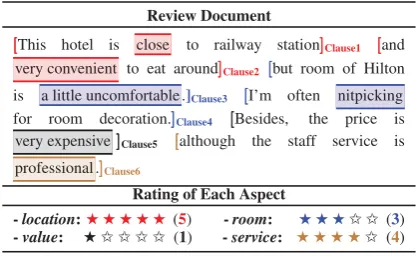
Document-level Aspect Sentiment Classification (DASC) is a fine-grained sentiment classification task in the field of sentiment analysis (Pang and Lee, 2007; Li et al., 2010). This task aims to predict the sentiment rating for each given aspect mentioned in a document-level review. For in-stance, Figure 1 shows a review document with four given aspects of a hotel (i.e.,location,room,
value, service). The goal of DASC is to predict the rating score towards each aspect by analyz-ing the whole document. In the last decade, this task has been drawing more and more interests of researchers in the Natural Language Processing community (Titov and McDonald,2008;Yin et al.,
2017;Li et al., 2018). In previous studies, neu-∗Corresponding author
Review Document
[[[This hotel is close to railway station]]]Clause1 [[[and very convenient to eat around]]]Clause2 [[[but room of Hilton
is a little uncomfortable .]Clause3 [[[I’m often nitpicking
for room decoration.]]]Clause4 [[[Besides, the price is
very expensive]]]Clause5 [[[although the staff service is
professional .]]]Clause6
Rating of Each Aspect
-location:# # # # # (5) -room: # # #$ $(3)
[image:1.595.308.517.222.358.2]-value: # $ $ $ $(1) -service: # # # #$ (4)
Figure 1: An example of a review document, where clauses and words with different colors refer to
different aspects.
ral models have shown to be effective for perfor-mance improvement on DASC. Despite the advan-tages, these complex neural network approaches often offer little transparency w.r.t. their inner working mechanisms and suffer from the lack of interpretability. However, clearly understanding where and how such a model makes such a deci-sion is rather important for developing real-world applications (Liu et al.,2018;Marcus,2018).
As human beings, if asked to evaluate the senti-ment rating for a specific aspect in a docusenti-ment, we often perform sentiment prediction in two steps. First, we select some aspect-relevant snippets
(e.g., sentences/clauses) inside the document. Sec-ond, we select some sentiment-relevant words
(e.g., sentiment words) inside these snippets to make a rating decision. For instance, for aspect
location in Figure 1, we first select the aspect-relevant clauses, i.e., Clause1 and Clause2, and then select sentiment-relevant words, i.e., “close” and “very convenient” inside the two clauses, for making the rating decision (5 stars).
solution, two major challenges exist which are il-lustrated as follows.
The first challenge is how to select aspect-relevant clauses and discard those iraspect-relevant and noisy clauses. For instance, for aspect location, Clause5 mentioning another aspect value (only 1 star) may induce the noise and should be dis-carded, because the noise can provide wrong sig-nals to mislead the model into assigning very low sentiment rating to aspect location. One possi-ble way to alleviate this noisy propossi-blem is to lever-age the soft-attention mechanism as proposed in
Li et al. (2018) and Wang et al. (2018). How-ever, this soft-attention mechanism has the lim-itation that the softmax function always assigns small but non-zero probabilities to noisy clauses, which will weaken the attention given to the few truly significant clauses for a particular aspect. Therefore, a well-behaved approach should dis-card noisy clauses for a specific aspect during model training.
The second challenge is how to select sentiment-relevant words and discard those irrelevant and noisy words. For instance, for aspectlocation, words “this”, “is” in Clause1 are noisy words and should be discarded since they make no contribution to implying the sentiment rating. One possible way to alleviate this problem is to also leverage the soft-attention mechanism as proposed in Li et al. (2018). However, this soft-attention mechanism may induce additional noise and lack interpretability because it tends to assign higher weights to some domain-specific words rather than real sentiment-relevant words (Mudinas et al., 2012; Zou et al., 2018). For instance, this soft-attention mechanism tends to regard the name of a hotel “Hilton” with a good reputation in Clause3 as a positive word which could mislead the model into assigning a higher rating to aspectroom. Therefore, a well-behaved approach should highlight sentiment-relevant words and discard noisy words for a specific aspect during model training.
In this paper, we propose a Hierarchical Rein-forcement Learning (HRL) approach with a high-level policy and a low-high-level policy to address the above two challenges in DASC. First, a high-level policy is leveraged to select aspect-relevant clauses and discard noisy clauses during model training. Then, a low-level policy is leveraged to select sentiment-relevant words and discard noisy
words inside the above selected clauses. Finally, a sentiment rating predictor is designed to pro-vide reward signals to guide both clause and word selection. The empirical studies show that the proposed approach performs well by incorporat-ing the clause selection and word selection strate-gies and significantly outperforms several state-of-the-art approaches including those with the soft-attention mechanism.
2 Hierarchical Reinforcement Learning
Figure2shows the overall framework of our Hier-archical Reinforcement Learning (HRL) approach which contains three components: a high-level policy for clause selection (Section 2.2); a low-level policy for word selection (Section 2.3); a sen-timent rating predictor for providing reward sig-nals to guide both the above clause and word se-lection (Section 2.4).
As a preprocessing, we adopt RST style dis-course segmentation1 (MANN,1988) to segment all documents in corpus C into Elementary Dis-course Units (EDUs), and consider thse EDUs as clauses by followingWang et al.(2018).
In summary, we formulate the task of DASC as a semi-Markov Decision process (Sutton et al.,
1999b), i.e., hierarchical reinforcement learning with a high-level policy and a low-level policy. In particular, our HRL approach for DASC works as follows. Given a review document with a clause sequence and an aspect, the high-level policy de-cides whether a clause mentions this aspect. If yes, the high-level policy selects this clause and launches the low-level policy, which scans the words inside this selected clause one by one in or-der to select sentiment-relevant words. Otherwise, the high-level policy skips current clause and turns to the next clause until all clauses in the review document are scanned. During clause and word selection, a sentiment rating predictor is employed to provide reward signals to guide the above clause and word selection.
2.1 Clause Selection with High-level Policy
Assume that a review document D with a given aspect xaspect has been segmented into a clause sequence{u1, ..., un}, high-level policy πh aims
1
XL LSTMK
LSTMO L [LM [LM discard XL
Clause Sequence
Word Sequence Aspect
[DVSHFW
RL= 0
t W
Word Selection with Low-level Policy SO
Clause Selection with High-level Policy SK
select XL
XL
XL
[LM [LM
XL discard[LM
XL select XL
discard XL
RL= 0
Reward Signals
[image:3.595.107.489.57.218.2]Sentiment Rating Predictor concatenate
Figure 2: Overall architecture of our Hierarchical Reinforcement Learning (HRL) approach.
to select clause ui which truly mentions aspect
xaspect and discard noisy ones. Here, clause ui
consists ofkiwords{xi,1, ..., xi,ki}. Once a clause is selected, it is passed to the low-level policy for further word selection.
During clause selection, we adopt a stochastic policy as high-level policyπh, which can gener-ate a conditional probability distribution πh(o|·) over option (i.e., high-level action) sequenceo=
[o1, ..., on]. Here,oi = 1indicatesui is selected;
otherwiseoi = 0indicatesui is discarded. More specifically, we adopt a LSTM model LSTMh to construct high-level policy πh for performing clause selection over the clause sequence. In
LSTMh, the hidden state ˆv
i ∈ Rd of clause ui
and memory cellchi ati-th time-step are given by,
ˆ
vi, chi =
f(ˆvi−1, cih−1, vi) oi = 1 ˆ
vi−1, chi−1 oi = 0
(1)
wherevi is the vector representation of clause ui and initialized by hidden state wˆi,ki of the last word xˆi,ki in clause ui. Here, wˆi,ki is obtained from the pre-trainedLSTMl (presented in line 3 of Algorithm 1);f denotes all gate functions and update function ofLSTMh. Note that ifoi = 0,
LSTMh will skip (i.e., discard) and not encode
clauseui, memory cellchi and hidden state vˆi of current time-step iare then directly copied from the previous time-stepi−1.
In principle, the high-level policyπhuses a Re-wardto guide clause selection over the clause se-quence. It samples an Optionoi with the
proba-bilityπh(oi|shi;θh) at each State shi. More con-cretely, the state, option and reward ofπh are de-fined as follows.
• State. The state shi at i-th time-step should provide adequate information for deciding to
se-lect a clause or not forxaspect. Thus, stateshi ∈
R4dis composed of four parts, i.e.,vˆ
i−1,chi−1,vi
andva, defined as shi = ˆvi−1 ⊕chi−1 ⊕vi ⊕va, whereva∈Rdis aspect embedding2ofxaspect.
•Option.πhsamplesoptionoi ∈ {0,1}by the
conditional probabilityπh(oi|shi;θh)which could be cast as a binary classification problem. Thus, we adopt logistic function to defineπh(oi|shi;θh).
oi∼πh(oi|shi;θh) =oiσ(Whshi +bh) +(1−oi)(1−σ(Whshi +bh))
(2)
whereθh ={Wh ∈ R1×4d, bh ∈ R}is the train-able parameter;∼denotes sampling operation; σ denotes sigmod function.
• Reward. In order to select aspect-relevant clauses inside a clause sequence {u1, ..., un}, given a sampled option trajectory τh =
(sh
1, o1, rh1, ..., shn, on, rhn) ∼ πh, we compute the
high-level cumulative rewardrhi ati-th time-step as follows:
rh i =λ1
n
t=i
γt−ilog cos(v a,vˆt)
+λ2
n
t=i
γt−irl(u
t) +λ3logpθ(y|vˆn)
(3)
whererhi consists of three different terms:1)The first term log cos(va,ˆvt) is a cosine intermediate reward computed bycosinesimilarity between as-pect embeddingva∈Rdand hidden stateˆvt∈Rd of the t-th clause ut. This reward provides as-pect supervision signals to guide the policy to se-lect aspect-relevant clauses. 2)The second term
2
rl(u t) =
kt
j=1rlt,jis an intermediate reward from
low-level policy after the word selection in the se-lected clause ut is finished. Note that if clause
ut is discarded, rl(ut) = 0. This reward
pro-vides a feedback to indicate how well clause se-lection is. 3)The third termlogpθ(y|ˆvn)is a de-lay reward from sentiment rating predictor. After
LSTMh finishes all options, we feed the last
hid-den statevˆnofLSTMhto the softmax decoder of sentiment rating predictor and then obtain a rating probabilitypθ(y|ˆvn) for ground-truth rating label
yto compute this delay reward. This reward pro-vides additional reward signals to guide policy to select discriminative clauses. Besides,γis the dis-count factor;λ1,λ2andλ3are weight parameters.
2.2 Word Selection with Low-level Policy
Given a word sequence {xi,1, ..., xi,ki} of clause
uiselected by the high-level policy, low-level
pol-icyπl aims to select the sentiment-relevant word
xi,j and discard noisy ones.
During word selection, we still adopt a stochas-tic policy as low-level policy πl, which can gen-erate a conditional probability distributionπl(a|·) over action sequence a = [ai,1, ..., ai,ki], where
ai,j = 1indicates j-th wordxij ini-th clause is
selected;ai,j = 0indicatesxi,j is discarded. Sim-ilar to clause selection, we adopt another LSTM model LSTMl to construct low-level policy πl for performing word selection over word sequence
{xi,1, ..., xi,ki}of each clause (Note that, as shown
in Figure 2, LSTMl is shared by all selected clauses from high-level policy). In LSTMl, the hidden statewˆi,j ∈ Rdof wordxi,j and memory cellclj atj-th time-step (Here, we omit the clause index and only usej to denote thej-th time-step ini-th clauseui) are given by,
ˆ
wi,j, cli,j =
f( ˆwi,j−1, ci,jl −1, wi,j) ai,j = 1 ˆ
wi,j−1, cli,j−1 ai,j = 0
(4) wherewi,j is word embedding ofxi,j. Similar to
LSTMh, in LSTMl, if a
i,j = 0, i.e., word xi,j
is discarded, memory cell and hidden state of cur-rent time-step are directly copied from the previ-ous time-step. Then, we illustrate state, action and reward of low-level policy as follows.
• State. The state sli,j atj-th time-step should provide adequate information for deciding to se-lect a word or not. Thus, the statesli,j ∈ R3dis composed of three parts, i.e.,wˆi,i−1, cli,j−1, wi,j, defined assli,j = ˆwi,j−1⊕cli,j−1⊕wi,j.
•Action.πlsamplesactionai,j ∈ {0,1}by the conditional probabilityπl(ai,j|sli,j;θl). Thus, sim-ilar to high-level policy, we adopt logistic function to defineπl(ai,j|sli,j;θl).
ai,j ∼πl(ai,j|sli,j;θl) =ai,jσ(Wlsli,j+bl) +(1−ai,j)(1−σ(Wlsli,j+bl))
(5)
whereθl={Wl∈R1×3d, bl∈R}is the trainable parameter.
• Reward. Similarly, in order to select sentiment-relevant words inside a word sequence
{xi,1, ..., xi,ki}, given a sampledactiontrajectory
τl = (sl
i,1, ai,1, ri,l1, ..., sli,ki, ai,ki, rli,ki) ∼πl, we
compute the low-level cumulative rewardrli,jatj -th time-step as:
rl
i,j =λ1logpθ(y|wˆi,ki) +λ2(−N)/N (6)
where ri,jl consists of two terms: 1) Similar to high-level policy, the first term logpθ(y|wˆi,ki) is a delay reward provided by sentiment rating pre-dictor. AfterLSTMlfinishes all actions, we feed last hidden statewˆi,kiini-th clause to softmax de-coder of sentiment rating predictor and then we can obtain this delay reward. This reward pro-vides rating supervision information to guide pol-icy to select discriminative words, i.e., sentiment-relevant words. 2) The second term γ(−N)/N is a penalty delay reward. N = ki
j=1ai,j
de-notes the number of selected words. The basic idea of using this penalty reward is to select words as small as possible because sentiment-relevant words is usually a small subset of all words inside the clause. Note that, we could also adopt external sentiment lexicons to achieve this goal, but senti-ment lexicons are difficult to obtain in many real-world applications. Besides,λ1,λ2are weight pa-rameters.
2.3 Sentiment Rating Predictor
The goal of sentiment rating predictor lies in two-fold. On one hand, during model training, the goal of sentiment rating predictor is to use a softmax decoder to provide rating probabilities as the re-ward signals (see Eq.(3) and Eq.(6)) to guide both clause and word selection.
ˆ
wn,kn of LSTMl as the representation of all
se-lected words. Then, we concatenatevˆnandwˆn,kn to compute the final representationzof the review documentD as: z = ˆvn⊕wˆn,kn, where ⊕ de-notes concatenation operation. Finally, to perform DASC, we feedzto a softmax decoder as follows:
Softmax Decoder. We first feed z to a soft-max classifier m = W z + b, where m ∈ RC is output vector; θ = {W, b} is trainable param-eter. Then, the probability of labeling sentence with sentiment ratingyˆ ∈ [1, C]is computed by
pθ(ˆy|z) = Cexp(myˆ)
=1exp(m). Finally, the label with the
highest probability stands for the predicted senti-ment rating forxaspect.
Note that, for an aspect, if no clauses and words are finally selected from a review document, the model will assign a random rating for this aspect.
2.4 Model Training via Policy Gradient and Back-Propagation
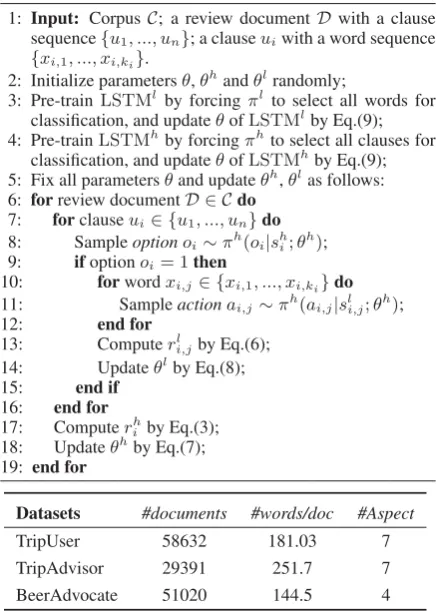
The parameters in HRL are learned according to Algorithm1. Specifically, these parameters can be divided into two groups:1)θhandθlof high-level policyπh and low-level policyπl respectively. 2)
θofLSTMh,LSTMland softmax decoder. Forθh of high-level policy, we optimize it with policy gradient (REINFORCE) (Williams, 1992;
Sutton et al., 1999a). The policy gradient w.r.t.
θh is computed by differentiating the maximized
expected rewardJ(θh)as follows:
∇θhJ(θh) =Eτh∼πh[ n
i=1
Rh∇
θhlogπh(oi|shi;θh)]
(7)
whereRh=rhi −b(τh)is the advantage estimate of the high-level reward. Here,b(τh)is the base-line(Williams,1992) which is used to reduce the variance of the high-level reward without altering its expectation theoretically. In practical use, we sample some trajectories τ1h, τ2h, ..., τmh over the clause sequence with the current high-level policy. The model will assign a reward score to each se-quence according to the designed scores function, and then estimates b(τh) as the average of those rewards. Similarly, the policy gradient w.r.t. θl of low-level policy is given by,
∇θlJ(θl) =Eτl∼πl[ ki
j=1
Rl∇
θllogπl(ai,j|sli,j;θl)]
(8)
Algorithm 1Hierarchical reinforcement learning
1: Input: CorpusC; a review document Dwith a clause
sequence{u1, ..., un}; a clauseuiwith a word sequence
{xi,1, ..., xi,ki}.
2: Initialize parametersθ,θhandθlrandomly;
3: Pre-train LSTMlby forcing πl to select all words for classification, and updateθofLSTMlby Eq.(9); 4: Pre-trainLSTMhby forcingπhto select all clauses for
classification, and updateθofLSTMhby Eq.(9); 5: Fix all parametersθand updateθh,θlas follows: 6: forreview documentD ∈ Cdo
7: forclauseui∈ {u1, ..., un}do 8: Sampleoptionoi∼πh(oi|shi;θh); 9: ifoptionoi= 1then
10: forwordxi,j∈ {xi,1, ..., xi,ki}do
11: Sampleactionai,j∼πh(ai,j|sli,j;θh);
12: end for
13: Computerli,jby Eq.(6); 14: Updateθlby Eq.(8);
15: end if
16: end for
17: Computerhi by Eq.(3); 18: Updateθhby Eq.(7);
19: end for
Datasets #documents #words/doc #Aspect
TripUser 58632 181.03 7
TripAdvisor 29391 251.7 7
[image:5.595.307.526.76.382.2]BeerAdvocate 51020 144.5 4
Table 1: Statistics of three datasets.#words/doc denotes the number of words (average per document). #Aspectdenotes the number of aspects in each dataset. The rating scales of TripAdvisor and BeerAdvocate
are 1-5 and 1-10 respectively.
whereRl=ri,jl −b(τl)is the advantage estimate of the low-level reward. Similarly,b(τl)is used to reduce the variance of the low-level reward.
For θ, we optimize it with back-propagation. The objective of learning θ is to minimize the cross-entropy loss in the classification phase, i.e.,
J(θ) =E(D,xaspect,y)∼C[−logpθ(y|z)] +δ2||θ||22
(9)
where(D, xaspect, y) denotes a review document
Dwith a given aspectxaspect from corpusC;yis ground-truth sentiment rating for aspectxaspect.δ is aL2regularization.
3 Experimentation
3.1 Experimental Settings
Approaches
TripUser TripAdvisor BeerAdvocate
Development Test Development Test Development Test
Acc.↑ MSE↓ Acc.↑ MSE↓ Acc.↑ MSE↓ Acc.↑ MSE↓ Acc.↑ MSE↓ Acc.↑ MSE↓ SVM - - 46.35† 1.025† 34.30‡ 1.982‡ 35.26‡ 1.963‡ 25.70‡ 3.286‡ 25.79‡ 3.270‡ LSTM 53.23 0.787 52.74 0.794 43.85‡ 1.525‡ 44.02‡ 1.470‡ 35.23‡ 2.112‡ 34.78‡ 2.097‡ MAMC - - 55.49† 0.583† 46.21‡ 1.091‡ 46.56‡ 1.083‡ 39.43‡ 1.696‡ 38.06‡ 1.755‡
HARN - - 58.15† 0.528† - - 48.21‡ 0.923‡ 39.81 1.672 38.19 1.751
HUARN - - 60.70† 0.514† - - -
-C-HAN 58.49 0.602 57.38 0.543 47.61 0.914 47.08 0.955 38.67 1.703 37.95 1.801 HS-LSTM 59.75 0.566 59.01 0.524 48.45 0.947 46.84 1.013 37.43 1.870 36.83 1.912 RL-Word-Selection 60.15 0.475 59.55 0.519 48.55 0.913 48.51 0.917 39.92 1.648 38.45 1.697 RL-Clause-Selection 61.32 0.433 60.54 0.461 51.05 0.762 50.02 0.781 41.39 1.505 39.76 1.622
[image:6.595.80.517.64.225.2]HRL 62.97 0.336 62.84 0.351 52.71 0.652 52.27 0.662 43.41 1.416 41.39 1.503
Table 2: Comparison of our approaches and other baseline approaches to DASC. The results with symbol†are retrieved fromLi et al.(2018) and those with‡are fromYin et al.(2017)
Tool3to segment all reviews in the three datasets
into EDUs (i.e., clauses). Moreover, we adopt training/development/testing settings (8:1:1) by following Yin et al.(2017);Li et al. (2018). Ta-ble1shows the statistics of the three datasets.
Implementation Details. We adopt the pre-trained 200-dimension word embeddings provided by Yin et al. (2017). The dimension of LSTM hidden states is set to be 200. The other hyper-parameters are tuned according to the performance in the development set. Specifically, we adopt Adam optimizer (Kingma and Ba, 2014) with an initial learning rate of 0.012 for cross-entropy training and adopt SGD optimizer with a learning rate of 0.008 for all policy gradients training. For rewards of high-level and low-level policies, γ is 0.8; λ1, λ2 andλ3 are 0.25, 0.25 and 0.5 respec-tively. λ1, λ2 are 0.6 and 0.4. Additionally, the batch size is set to be 64, regularization weight is set to be10−5and the dropout rate is 0.2.
Evaluation Metrics. The performance is eval-uated using Accuracy (Acc.) and MSE as Yin et al. (2017). Moreover, t-test is used to evalu-ate the significance of the performance difference between two approaches (Yang and Liu,1999).
Baselines. We compare HRL with the follow-ing baselines: 1) SVM (Yin et al., 2017). This approach only adopts unigram, bigram as fea-tures to train an SVM classifier. 2) LSTM(Tang et al., 2015). This is a neural network approach to document-level sentiment classification which employs gated LSTM to learn text representation.
3) MAMC (Yin et al., 2017). This approach employs hierarchical iterative attention to learn aspect-specific representation. This is a
state-of-3
http://alt.qcri.org/tools/discourse-parser/
the-art approach to DASC. 4) HARN (Li et al.,
2018). This approach adopts hierarchical attention to incorporate overall rating and aspect informa-tion so as to learn aspect-specific representainforma-tion. This is another state-of-the-art approach to DASC.
5) HUARN (Li et al., 2018). This approach ex-tends HARN by integrating additional user infor-mation. This is another state-of-the-art approach to DASC.6) C-HAN(Wang et al.,2018). This ap-proach adopts hierarchical attention to incorporate clause and aspect information so as to learn text representation. Although this is a state-of-the-art approach to sentence-level ASC, it could also be directly applied in DASC. 7) HS-LSTM (Zhang et al.,2018). This is a reinforcement learning ap-proach to text classification, which employs a hi-erarchically LSTM to learn text representation.8) RL-Word-Selection. Our approach which lever-ages only the word selection strategy by using the low-level policy. 9) RL-Clause-Selection. Our approach which leverages only the clause selec-tion strategy by using the high-level policy.
3.2 Experimental Results
Table 2 shows the performance comparison of different approaches. From this table, we can see that, all LSTM-based approaches outperform
SVM, showing that LSTM has potentials in au-tomatically learning text representations and can bring performance improvement for DASC.
Four state-of-the-art ASC approaches including
consid-Approaches TripUser TripAdvisor BeerAdvocate
Acc.↑ MSE↓ Acc.↑ MSE↓ Acc.↑ MSE↓
HRL 62.84 0.351 52.27 0.662 41.39 1.503
w/o cosineintermediate reward in Eq.(3) 60.15 0.487 49.02 0.811 38.72 1.673
[image:7.595.130.471.60.160.2]w/o penalty delay reward in Eq.(6) 61.52 0.425 51.15 0.711 40.13 1.577 w/o the representation of selected clauses 58.40 0.622 46.33 1.207 38.61 1.684 w/o the representation of selected words 60.08 0.497 48.94 0.886 39.92 1.626 using sentence splitting instead of clause 59.74 0.504 50.11 0.842 39.33 1.651
Table 3: Ablation study of HRL on three different datasets.
ering aspect information can achieve comparable performance withMAMC,HARN,C-HAN, and even beatMAMCon two datasetsTripUser and
TripAdvisor, which demonstrates that using rein-forcement learning is a good choice to learn text representation for DASC.
Our approach RL-Word-Selection and RL-Clause-Selection outperform most above ap-proaches and they only perform slightly worse thanHUARN. This result encourages to perform clause or word selection in DASC. Among all these approaches, our approach HRL performs best and it significantly outperforms (p-value < 0.01) strong baselineHUARNwhich actually con-siders some other kinds of external information, such as the overall rating and the user information. These results encourage to perform both clause and word selection in DASC.
Ablation Study. Further, we conduct the abla-tion study of HRL to evaluate the contribuabla-tion of each component. The results are shown in Table
3. From this table, we can see that1)Usingcosine
intermediate reward in Eq.(3) can averagely im-prove Acc. by 2.87% on three different datasets.
2)Using penalty delay reward in Eq.(6) can aver-agely improve Acc. by 1.23%. 3)To concatenate additional representation of the selected clauses in rating predictor can improve Acc. by 4.38%. 4)
To concatenate additional representation of the se-lected words in rating predictor can improve Acc. by 2.72%. 5)Using the clause splitting instead of sentence splitting could improve Acc. by 2.44%. This confirms that it is more appropriate to con-sider clauses as the segmentation units than sen-tences. This is because that 90% of clauses con-tain only one opinion expression as proposed in
Bayoudhi et al.(2015). For instance, as shown in Figure1, if we use the sentences as the segmenta-tion units, Clause1-Clause3 will be assigned into one unit while they talk about two aspects, i.e., lo-cationandroom. In this scenario, sentence selec-tion will not be able to discard noisy parts inside
10 20 30 40 50
0 0.25 0.5 0.75
Training Epochs
A
v
erage
Reward
High-level Reward Low-level Reward
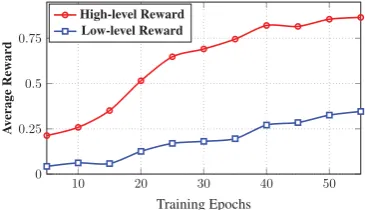
Figure 3: Training reward with different epochs
the sentence for the aspectlocationorroom.
4 Analysis and Discussion
Analysis of HRL Training. Figure3shows two average rewards (each epoch) of high-level and low-level policy on BeerAdvocate respectively. To clearly observe the change of the reward, follow-ingLillicrap et al.(2016), all rewards are normal-ized to(0,1). From this figure, we can see that, both the high-level and low-level reward increase as the training algorithm iterates. This result indi-cates that our HRL approach is capable of stably revising its policies to obtain more discriminative clauses and words for better performing.
Analysis of Clause and Word Selection. Fig-ure4 shows visualizations of our HRL approach which performs the clause selection and word se-lection on a review document. From this fig-ure, we can see that HRL is able to precisely select aspect-relevant clauses, i.e., Clause1 and Clause2, for aspectlocationwhile select Clause3 and Clause4 forroom. Further, HRL is able to se-lect all sentiment-relevant words, such as “close” and “very convenient” for aspect location, while “a little uncomfortable” and “nitpicking”forroom.
[image:7.595.321.504.193.298.2][This hotel is close to railway station ] [and very convenient to eat around]
[although the staff service is professional .] [but room of Hilton is a little uncomfortable .] [I am often nitpicking for room decoration .] [Besides , the price is very expensive]
Clause1 Clause2
Clause3 Clause4 Clause5 Clause6
(a) For aspectlocation
[This hotel is close to railway station] [and very convenient to eat around]
[although the staff service is professional .] [but room of Hilton is a little uncomfortable .] [I am often nitpicking for room decoration .] [Besides , the price is very expensive]
Clause1 Clause2
Clause3 Clause4
Clause5 Clause6
[image:8.595.83.523.68.153.2](b) For aspectroom
Figure 4: Visualizations of clause selection (along with the row↓) and word selection (along with the column→) for aspect (a)locationand (b)room. Red denotes the clause has been selected, blue denotes the word has been
selected and other colors denote the token has been discarded.
“good”, but fail to select the negation word “not”. This inspires us to work on optimizing our ap-proach in order to capture negation scope better in our future work. (2) The second type of er-rors are due to comparative opinions. For instance, for the review “The room of Sheraton is much bet-ter than this one.”, HRL incorrectly predicts high rating (5 stars) to aspect room. It would be in-teresting to see if incorporating syntactic informa-tion can solve this problem and bring performance improvement. (3)Finally, some errors are due to mistakes during clause splitting (i.e., EDU split-ting). For instance, for the review “[This hotel having good location] [often needs lots of time to check in.]”, it is assigned into one clause while it talks two aspects, i.e.,locationandcheck in/front desk. This encourages to improve the performance of clause splitting for informal review texts.
5 Related Work
Aspect Sentiment Classification. Traditional studies for DASC mainly focus on feature en-gineering to explore efficient features for DASC (Titov and McDonald, 2008; Lu et al., 2011;
McAuley et al.,2012). Recently, neural networks with the characteristic of automatically mining features have shown promising results on DASC.
Lei et al. (2016) focused on extracting rationales for aspects and build a neural text regressor to pre-dict aspect rating;Yin et al.(2017) focused on us-ing hierarchical iterative attention to learn aspect-specific text representation for DASC; Li et al.
(2018) employed a hierarchical attention approach to DASC which incorporates both the external user and overall rating information. Besides, neural networks have been widely adopted for perform-ing a closely related task, i.e., Sentence-level As-pect Sentiment Classification (Wang et al., 2016;
Tang et al.,2016;Wang and Lu,2018).
Reinforcement Learning. In recent years,
re-inforcement learning has been applied success-fully to some NLP tasks. Guo (2015) employed deep Q-learning to improve the seq2seq model for the text generation task; Li et al. (2016) showed how to apply deep reinforcement learn-ing to model future reward in the chatbot dia-logue task; Takanobu et al. (2018) employed hi-erarchical reinforcement learning to model the re-lation extraction task; Zhang et al. (2018) com-bined LSTM with reinforcement learning to learn structured representations for the text classifica-tion task, which is inspiraclassifica-tional to our approach.
Unlike all above studies, inspired by the cogni-tive process of human beings, this paper proposes a new HRL approach to DASC task. To the best of our knowledge, this is the first attempt to address DASC with HRL.
6 Conclusion
In this paper, we propose a hierarchical reinforce-ment learning approach to DASC. The main idea of the proposed approach is to perform sentiment classification like human beings. Specifically, our approach employs a high-level policy and a low-level policy to perform clause selection and word selection in DASC respectively. Experimentation shows that both the clause and word selection are effective for DASC and the proposed approach significantly outperforms several state-of-the-art baselines for DASC.
Acknowledgments
We thank our anonymous reviewers for their help-ful comments. This work was supported by three NSFC grants, i.e., No.61672366, No.61702149 and No.61525205. This work was also supported by the joint research project of Alibaba Group and Soochow University, and a Project Funded by the Priority Academic Program Development of Jiangsu Higher Education Institutions (PAPD).
References
A. Bayoudhi, H. Ghorbel, H. Koubaa, and L. Belguith. 2015. Sentiment classification at discourse segment level: Experiments on multi-domain arabic corpus. JLCL, 30(1).
Hongyu Guo. 2015. Generating text with deep rein-forcement learning.CoRR, abs/1510.09202.
D. Kingma and J. Ba. 2014. Adam: A method for stochastic optimization. CoRR, abs/1412.6980.
T. Lei, R. Barzilay, and T. Jaakkola. 2016. Rationaliz-ing neural predictions. InProceedings of EMNLP.
J. Li, H. Yang, and C. Zong. 2018. Document-level multi-aspect sentiment classification by jointly mod-eling users, aspects, and overall ratings. In
Proceed-ings of COLING.
Jiwei Li, Will Monroe, Alan Ritter, Michel Galley, Jianfeng Gao, and Dan Jurafsky. 2016. Deep rein-forcement learning for dialogue generation. CoRR, abs/1606.01541.
S. Li, C. Huang, G. Zhou, and Sophia Yat Mei Lee. 2010. Employing personal/impersonal views in su-pervised and semi-susu-pervised sentiment classifica-tion. InProceedings of ACL.
Timothy P. Lillicrap, Jonathan J. Hunt, Alexander Pritzel, Nicolas Heess, Tom Erez, Yuval Tassa, David Silver, and Daan Wierstra. 2016. Continuous control with deep reinforcement learning. In Pro-ceedings of ICLR.
X. Liu, L. Mou, H. Cui, Z. Lu, and S. Song. 2018.
JUMPER: learning when to make classification de-cisions in reading.CoRR, abs/1807.02314.
B. Lu, M. Ott, C. Cardie, and B. K. Tsou. 2011. Multi-aspect sentiment analysis with topic models. In
Pro-ceedings of ICDM.
W. MANN. 1988. Rhetorical structure theory : To-ward a functional theory of text organization. Text, 8(3):243–281.
G. Marcus. 2018. Deep learning: A critical appraisal. CoRR, abs/1801.00631.
J. McAuley, J. Leskovec, and D. Jurafsky. 2012. Learn-ing attitudes and attributes from multi-aspect re-views. InProceedings of ICDM.
Andrius Mudinas, Dell Zhang, and Mark Levene. 2012. Combining lexicon and learning based approaches for concept-level sentiment analysis. InProceedings of the first international workshop on issues of
sen-timent discovery and opinion mining, page 5. ACM.
B. Pang and L. Lee. 2007. Opinion mining and senti-ment analysis. Foundations and Trends in Informa-tion Retrieval, 2(1-2).
R. Sutton, D. McAllester, and etc. 1999a. Policy gra-dient methods for reinforcement learning with func-tion approximafunc-tion. InProceedings of NIPS.
R. Sutton, D. Precup, and S. Singh. 1999b. Between mdps and semi-mdps: A framework for temporal ab-straction in reinforcement learning.Artif. Intell.
Ryuichi Takanobu, Tianyang Zhang, Jiexi Liu, and Minlie Huang. 2018. A hierarchical framework for relation extraction with reinforcement learning. CoRR, abs/1811.03925.
D. Tang, B. Qin, and T. Li. 2015.Document modeling with gated recurrent neural network for sentiment classification. InProceedings of EMNLP.
D. Tang, B. Qin, and T. Liu. 2016. Aspect level sen-timent classification with deep memory network. In
Proceedings of EMNLP.
I. Titov and R. McDonald. 2008.A joint model of text and aspect ratings for sentiment summarization. In
Proceedings of ACL.
B. Wang and W. Lu. 2018. Learning latent opinions for aspect-level sentiment classification. In Proceed-ings of AAAI.
H. Wang, Y. Lu, and C. Zhai. 2010. Latent aspect rat-ing analysis on review text data: a ratrat-ing regression approach. InProceedings of KDD.
J. Wang, J. Li, S. Li, Y. Kang, M. Zhang, L. Si, and G. Zhou. 2018.Aspect sentiment classification with both word-level and clause-level attention networks. InProceedings of IJCAI.
Y. Wang, M. Huang, X. Zhu, and L. Zhao. 2016.
Attention-based LSTM for aspect-level sentiment classification. InProceedings of EMNLP.
R. Williams. 1992. Simple statistical gradient-following algorithms for connectionist reinforce-ment learning.Machine Learning, 8.
Y. Yang and X. Liu. 1999. A re-examination of text categorization methods. InProceedings of SIGIR.
T. Zhang, M. Huang, and L. Zhao. 2018. Learning structured representation for text classification via reinforcement learning. InProceedings of AAAI.