Proceedings of the 2019 Conference on Empirical Methods in Natural Language Processing
6122
Learning to Copy for Automatic Post-Editing
Xuancheng Huang†, Yang Liu†‡∗, Huanbo Luan†, Jingfang Xu§and Maosong Sun† †Institute for Artificial Intelligence
State Key Laboratory of Intelligent Technology and Systems
Department of Computer Science and Technology, Tsinghua University, Beijing, China Beijing National Research Center for Information Science and Technology
§Sogou Inc., Beijing, China
‡Beijing Advanced Innovation Center for Language Resources
[email protected], [email protected], [email protected], [email protected], [email protected]
Abstract
Automatic post-editing (APE), which aims to correct errors in the output of machine trans-lation systems in a post-processing step, is an important task in natural language processing. While recent work has achieved considerable performance gains by using neural networks, how to model the copying mechanism for APE remains a challenge. In this work, we pro-pose a new method for modeling copying for APE. To better identify translation errors, our method learns the representations of source sentences and system outputs in an interac-tive way. These representations are used to explicitly indicate which words in the system outputs should be copied, which is useful to help CopyNet (Gu et al.,2016) better generate post-edited translations. Experiments on the datasets of the WMT 2016-2017 APE shared tasks show that our approach outperforms all best published results.1
1 Introduction
Automatic post-editing (APE) is an important nat-ural language processing (NLP) task that aims to automatically correct errors made by machine translation systems (Knight and Chander, 1994). It can be considered as an efficient way to modify translations to a specific domain or to incorporate additional information into translations rather than translating from scratch (McKeown et al., 2012;
Chatterjee et al.,2015,2018).
Approaches to APE can be roughly divided into two broad categories: statistical and neural ap-proaches. While early efforts focused on statis-tical approaches relying on manual feature en-gineering (Simard et al., 2007; B´echara et al.,
2011), neural network based approaches capa-ble of learning representations from data have
∗
Corresponding author: Yang Liu
1The source code is available at https://github. com/THUNLP-MT/L2Copy4APE
src I ate a cake yesterday
mt IchesseeinenHamburger
pe Ichhatte gesterneinenKuchen gegessen
Table 1: Example of automatic post-editing (APE). Given a source sentence (src) and a machine trans-lation (mt), the goal of APE is to post-edit the erro-neous translation to obtain a correct translation (pe). Our work aims to explicitly model how to copy words frommttope(highlighted in bold), which is a com-mon phenomenon in APE.
shown remarkable superiority over their statisti-cal counterparts (Varis and Bojar, 2017; Chatter-jee et al., 2017; Junczys-Dowmunt and Grund-kiewicz,2017;Unanue et al.,2018). Most of them cast APE as a multi-source sequence-to-sequence learning problem (Zoph and Knight,2016): given a source sentence (src) and a machine translation (mt), APE outputs a post-edited translation (pe).
A common phenomenon in APE is that many words in mt can be copied to pe. As shown in Table1, two German words “Ich” and “einen” oc-cur in both mt and pe. Note that the positions of copied words inmt andpeare not necessarily identical (e.g., “einen” in Table1). Our analysis on the datasets of the WMT 2016 and 2017 APE shared tasks shows that over 80% of words inmt
are copied to pe. As APE models not only need to decide which words in mt should be copied correctly, but also should place the copied words in appropriate positions inpe, it is challenging to model copying for APE. Our experiments show that the state-of-the-art APE method ( Junczys-Dowmunt and Grundkiewicz,2018) only achieves a copying accuracy of 64.63% (see Table7).
We believe that existing approaches to APE (Varis and Bojar, 2017; Chatterjee et al., 2017;
Junczys-Dowmunt and Grundkiewicz, 2017;
src:I ate a cake yesterday
pe :Ich hatte gestern einen Kuchen gegessen
mt :Ich esse einen Hamburger 1 0 1 0
generate copy
[image:2.595.130.473.63.147.2]interact
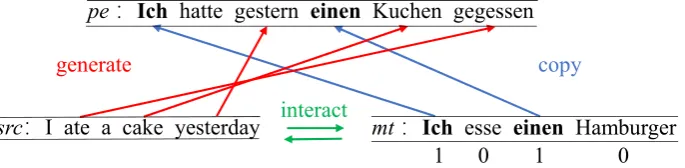
Figure 1: Learning to copy for APE. Our work is based on two key ideas. As bothsrcandmtplay important roles in APE, the first idea is thatsrcandmtshould “interact” with each other during representation learning to better generate words fromsrcand copy words frommtduring inference. The second idea is to predict which target words inmtshould be copied since it is easy to obtain labeled data automatically by comparingmtandpe. The words to be copied (e.g., “Ich”) inmtare labeled with 1’s and other words (e.g., “esse”) with 0’s.
drawbacks when modeling the copying mecha-nism. First, the representations of src and mt
are learned separately. APE is a two-source sequence-to-sequence learning problem in which bothsrcandmtplay important roles. On the one hand, if src is ignored, it is difficult to identify translation errors related to adequacy in mt, especially for fluent but inadequate translations (e.g., mt in Figure 1). On the other hand, mt
serves as a major source for generating pe since many words (e.g., “Ich” and “einen” in Figure1) are copied frommt tope. Intuitively, it is likely to be easier to decide which words inmt should be copied ifsrcandmtfully “interact” with each other during representation learning. Although CopyNet (Gu et al., 2016) can be adapted for explicitly modeling the copying mechanism in multi-source sequence-to-sequence learning, the lack of the interaction between src and mt still remains a problem.
Second, there is no explicit labeling that indi-cates which target words inmtshould be copied. Existing approaches only rely on the attention between the encoder and decoder to implicitly choose target words to be copied. Givenmt and
pe, it is easy to decide whether a target word in
mt should be copied or not. In Figure 1, the words inmtthat should be copied are labeled with 1’s. Other words are labeled with with 0’s, which should be re-generated fromsrc. These labels can served as useful supervision signals to help better copy words frommttope, even when CopyNet is used.
In this work, we propose a new method for mod-eling the copying mechanism for APE. As shown in Figure1, our work is based on two key ideas. First, our method is capable of learning the rep-resentations of input in an interactive way by en-ablingsrcandmt to attend to each other during
representation learning. This might be useful for deciding when to generate words from src and when to copy words frommtduring post-editing. Second, it is possible to predict which words in
mtshould be copied because it is easy to automat-ically construct labeled data by comparingmtand
pe. Such predictions can be combined with Copy-Net to better model copying for APE. Experiments show that our approach outperforms the best pub-lished results on the datasets of the WMT 2016-2017 APE shared tasks.
2 Background
2.1 Multi-source Sequence-to-Sequence Learning
Multi-source sequence-to-sequence learning has been widely used in APE in recent years ( Junczys-Dowmunt and Grundkiewicz, 2018; Pal et al.,
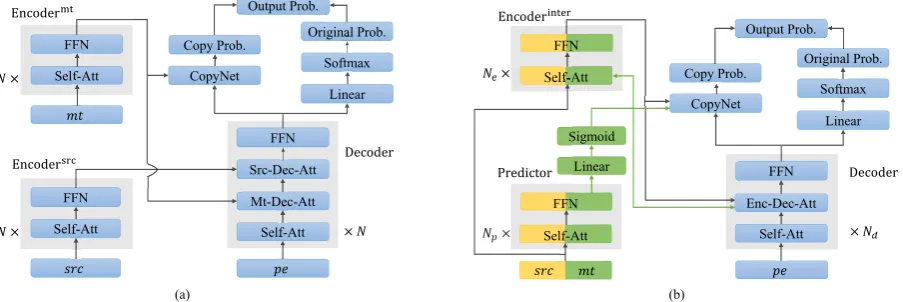
2018;Tebbifakhr et al.,2018;Shin and Lee,2018). The architecture of multi-source Transformer is shown in Figure 2(a). It can be equipped with CopyNet (see Section2.2) to serve as a baseline in our experiments. It is worth noting thatsrcand
mtare encoded separately.
Let x = x1. . . xI be a source sentence (i.e.,
src) with I words, ˜y = ˜y1. . .y˜K be a
transla-tion output by a machine translatransla-tion system (i.e.,
mt) withKwords, andy=y1. . . yJ be the
post-edited translation (i.e.,pe) withJwords. The APE model is given by
P(y|x,˜y;θ) =
J
Y
j=1
P(yj|x,y˜,y<j;θ), (1)
where yj is the j-th target word in pe, y<j = y1. . . yj−1 is a partial translation, θ is a set of
model parameters, and P(yj|x,˜y,y<j;θ) is a
Self-Att FFN
×
Mt-Dec-Att
Self-Att Linear Softmax Self-Att
FFN
Original Prob.
Src-Dec-Att ×
× CopyNet
Copy Prob.
Output Prob.
FFN
Self-Att Linear Softmax Original Prob.
FFN ×
× Copy Prob.
Output Prob.
×
FFN Linear Sigmoid Self-Att
FFN
CopyNet
Enc-Dec-Att
Self-Att Predictor Encoder
Decoder
(a) (b)
Decoder Encoder
Encoder
Figure 2: (a) The architecture of multi-source Transformer (Junczys-Dowmunt and Grundkiewicz,2018) equipped with CopyNet (Gu et al.,2016) and (b) the architecture of our approach. While the existing work learns the representations ofsrcandmtseparately, our approach allows for learning the representations ofsrcandmtin an interactive way by concatenating them as a single input. In addition, our approach introduces a Predictor module to explicitly indicate which words inmtshould be copied.
The word-level translation probability in Eq. (1) is computed as
Hsrc= Encodersrc(x,θ), (2)
Hmt= Encodermt(˜y,θ), (3) hpej = Decoder(y<j,Hsrc,Hmt,θ), (4)
P(yj|x,˜y,y<j;θ)∝exp(hpej Wg), (5)
where Encodersrc(·) is the encoder for src, Hsrc is the real-valued representation of src,
Encodermt(·) is the encoder for mt, Hmt is the representation of mt, Decoder(·) is the decoder, hpej is the representation of thej-th target wordyj
inpe. Wg ∈ Rd×Vy is a weight matrix, dis the dimension of hidden states, and Vy is the target vocabulary size.
A limitation of the aforementioned model is that
srcandmtare encoded separately without inter-acting with each other, which might lead to the inability to find which src word is untranslated and which mt word is incorrect. For example, the mt sentence in Figure 1 is fluent and mean-ingful. Withoutsrc, the APE system is unable to identify translation errors. In addition, the multi-source Transformer does not explicitly model the copying betweenmtandpein neither the Encoder nor the Decoder.
2.2 CopyNet
CopyNet (Gu et al.,2016) is a widely used method for modeling copying in sequence-to-sequence learning. It has been successfully applied to single-turn dialogue (Gu et al., 2016), text
sum-marization (See et al.,2017), and grammar error correction (Zhao et al.,2019).
It is possible to extend the multi-source Trans-former with CopyNet to explicitly model the copy-ing mechanism, as shown in Figure 2(a). Copy-Net defines the word-level translation probability in Eq. (1) as a linear interpolation of copying and generating probabilities:
P(yj|x,˜y,y<j;θ) =γj×Pcopy(yj)
+ (1−γj)×Pgen(yj),
(6)
wherePcopy(yj)is the copying probability foryj,
Pgen(yj) is the generating probability foryj, and γj is a gating weight. They are defined as follows:
Pcopy(yj)∝exp(g(Hmt,hpej )), (7)
Pgen(yj)∝exp(hpej Wg), (8)
γj =u(Hmt,hpej ), (9)
whereg(·)andu(·)are non-linear functions. See (Zhao et al.,2019) for more details.
[image:3.595.75.527.68.219.2]Cross-lingual Embeddings
src ×
Interactive Representations
mt
Copying Scores
0.6 0.8
0.2
Sentences
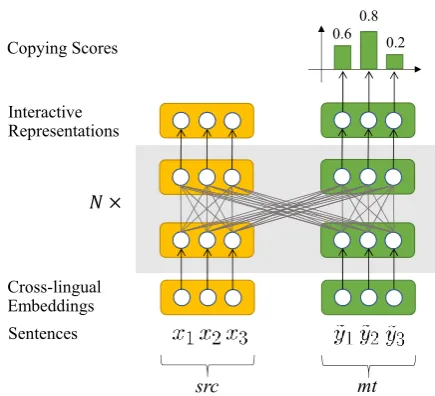
Figure 3: Interactive representation learning. Concate-nated to serve as a single input,srcandmtattend to each other during representation learning. Note that learnable weights ofsrcandmtare shared. Interactive representation learning is used in both Predictor and Encoder. For example, copying scores are predicted based on the learned representations (see Eq. (13)).
3 Approach
Figure2(b) shows the overall architecture of our approach. It differs from previous work in two as-pects. First, we propose to letsrcandmt “inter-act” with each other to learn better representations (Section3.1). Second, our approach introduces a Predictor module to predict words to be copied (Section3.2). Section 3.3 describes how to train our APE model.
3.1 Interactive Representation Learning
We propose an interactive representation learn-ing method by maklearn-ingsrcandmtattend to each other. FollowingLample and Conneau(2019) and
He et al. (2018), we concatenate src and mt in the dimension of sentence length with additional position and language embeddings:
Xi=Etoken[xi] +Epos[i] +Elang[0], (10)
˜
Yk=Etoken[˜yk] +Epos[k] +Elang[1], (11)
whereXiis the embedding of thei-th source word xi,Y˜kis the embedding of thek-th target wordy˜k,
andEtoken,Epos, andElangare the token, position and language embedding matrices.
As shown in Figure3, the representation ofsrc
andmtcan be learned jointly:
Hinter= Encoderinter([X;Y˜],θ), (12)
where Encoderinter(·) is the interactive Encoder and[X;Y˜]is the concatenation ofXandY˜ in the dimension of sentence length.
As shown in Figure2(b), the multi-source En-coders are replaced by the interactive Encoder, which enablessrcandmtto attend to each other.2 We expect that enabling the interactions between them can help to strengthen the ability of the model to find which words insrcis untranslated and which words inmtis correct. Note that inter-active representation learning is used both in Pre-dictor and Encoder. In the following, we will de-scribe how to predict which words in mt should be copied based on these learned representations.
3.2 Predicting Words to be Copied
Givenmtandpe, we can label each word inmtas 0 or 1. We use 1 to denote that the word is to be copied (e.g. “Ich” and “einen” in Figure1) and 0 not to be copied (e.g. “esse” and “Hamburger” in Figure1). It is possible to use the Longest Com-mon Sequence (LCS) (Wagner and Fischer,1974) algorithm to obtain common sequences between
mt and pe. If the word in mt also appears in the common sequences, it will be labeled 1; other-wise, it will be labeled 0. We denote these labels asl1. . . lK.
We propose a Predictor module to predict words to be copied. As discrete labels are non-differentiable during training, the Predictor mod-ule outputscopying scores instead for the target words inmt:
s= sigmoid([HpredI+1;· · ·;HpredI+K]Ws), (13)
where s ∈ RK×1 is a vector of copying scores corresponding to the K words in mt, Hpred ∈
R(I+K)×dis the representation ofsrcandmt:
Hpred= Predictor([X;Y˜];θ), (14)
and Ws ∈ Rd×1 is a weight matrix. Only the representation ofmt(i.e.,[HpredI+1;· · ·;HpredI+K]) is used for calculating copying scores.3
As shown in Figure 2(b), copying scores can be incorporated into three parts of our model: the
2Note that the Predictor and Encoder do not share their
weights because we found that sharing leads to degraded per-formance in experiments.
3
It is also possible to predict which source words insrc
[image:4.595.69.287.59.257.2]pe
src mt
Copying Scores
[image:5.595.115.249.62.188.2]0.8 0.6 0.2
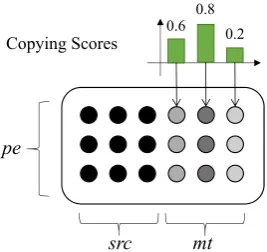
Figure 4: Copying scores as scaling masks. The copy-ing scores are used to modify the attention layers of the Encoder, Decoder, and CopyNet.
Encoder, the Decoder, and the CopyNet. Inspired byYang et al.(2018)’s strategy to integrate local-ness to self-attention, we propose to incorporate copying scores into our model by modifying atten-tion weights involved in the aforemenatten-tioned three modules.
The original scaled dot-product attention (Vaswani et al.,2017) is defined as
energy = qK >
√
d , (15)
Att(q,K) = softmax(energy), (16)
where q ∈ R1×d is the query vector, K ∈
R(I+K)×d is the key matrix, and energy ∈ R1×(I+K)is the “energy” vector.
As shown in Figure 4, the copying scores can be used to form a scaling mask on the attention sub-layer:4
Att(q,K) = softmaxenergy[m;s]>,
(17) where m = {1.0}I is a masking vector
corre-sponding to srcand s ∈ RK×1 is the vector of
copying scores calculated by Eq. (13) correspond-ing to mt. Note that copying scores are used to only change the attention weights related to mt
while thesrcpart is unchanged.
3.3 Training
The training objective of our approach Lall(θ)
consists of three parts:
Lall(θ) = (1−α)×(Lape(θ) +λ×Lcopy(θ)) +α×Lpred(θ),
(18)
4Actually, we let “energy” vector minus its minimum
value to keep it non-negative.
whereαandλare hyper-parameters.
The first part is the original log-likelihood loss function of APE:5
Lape(θ) =−logP(y|x,˜y;θ). (19)
The second part is related to the CopyNet:
Lcopy(θ) = 1
K K
X
k=1
(lk−ck)2, (20)
wherelkis the ground-truth label (see Section3.2)
andck is a quantity that measures how likely the k-th word inmtto be copied by CopyNet:
ck= J
X
j=1
γj×Pcopy(˜yk). (21)
Note thatγ×Pcopy(y)is the term related to copy-ing the target wordyin Eq. (6).
The third part is a cross-entropy loss related to the Predictor:
Lpred(θ) =−
K
X
k=1 h
lklog(sk)
+ (1−lk)log(1−sk)
i
,
(22)
whereskis the copying score of thek-th wordy˜k
inmt.
Finally, we use an optimizer to find the model parameters that minimize the overall loss function:
ˆ
θ = argmin
θ
n
Lall(θ) o
. (23)
4 Experiments
4.1 Setup
Datasets
We evaluated our approach on the WMT APE datasets, which often distinguish between two tasks: phrase-based statistical machine translation (i.e., PBSMT) and neural machine translation (i.e., NMT). All these APE datasets consist of English-German triplets containing source text (src), the translations (mt) from a “black-box” MT system and the corresponding human-post-edits (pe). The statistics for the WMT APE datasets are shown in Table2. In addition to the official dataset, the or-ganizers also recommend using additional datasets
5For simplicity, we use sentence-level loss functions here.
Category Dataset # Sent.
PBSMT
training set 23,000
dev2016 1,000
test2016 2,000
test2017 2,000
NMT training set 13,442
dev2018 1,000
Additional
artificial-small 526,368
artificial-big 4,391,180
eSCAPE-PBSMT 7,258,533
[image:6.595.347.486.61.149.2]eSCAPE-NMT 7,258,533
Table 2: Statistics of the English-German datasets in the WMT APE task. Note that the NMT official data only contains training and development sets.
(Junczys-Dowmunt and Grundkiewicz,2016; Ne-gri et al.,2014).
We used the WMT official dataset for the PB-SMT task and the NMT task separately. The arti-ficial training data (Junczys-Dowmunt and Grund-kiewicz,2016) was also used for both tasks. More precisely, we used the concatenation of the of-ficial training data and the artiof-ficial-small data to learn a truecasing model (Koehn et al., 2007) and obtain sub-word units using byte-pair en-coding (BPE) (Sennrich et al., 2015) with 32k merges. Then, we applied truecasing and BPE to all datasets. We oversampled the official train-ing data 20 times and concatenated them with both artificial-small and artificial-big datasets ( Junczys-Dowmunt and Grundkiewicz, 2018). Finally, we obtained a dataset containing nearly 5M triplets for both tasks. To test our approach on a larger PBSMT dataset, we used the eSCAPE synthetic dataset (Negri et al.,2014), which contains 7.2M sentences. By including the eSCAPE dataset, the training set is enlarged to nearly 12M sentences.
Hyper-Parameter Settings
For the original Transformer model, CopyNet and our approach, the hidden size was set to 512 and the filter size was set to 2,048. The number of indi-vidual attention heads was set to 8 for multi-head attention. We setN = Ne = Nd = 6, Np = 3
and we tied all three src, mt, pe embeddings for
saving memory. The embeddings and softmax
weights were also tied. In training, we used Adam (Kingma and Ba, 2014) for optimization. Each mini-batch contains approximately 25K tokens. We used the learning rate decay policy described
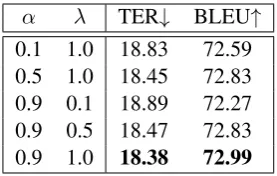
α λ TER↓ BLEU↑
0.1 1.0 18.83 72.59
0.5 1.0 18.45 72.83
0.9 0.1 18.89 72.27
0.9 0.5 18.47 72.83
[image:6.595.75.286.61.216.2]0.9 1.0 18.38 72.99
Table 3: Effect ofαandλ. The TER and BLEU scores are calculated on the WMT 2016 APE official develop-ment set.
by (Vaswani et al.,2017). In decoding, the beam size was set to 4. We used the length penalty (Wu et al., 2016) and set the hyper-parameter to 1.0. The other hyper-parameter settings were the same as the Transformer model (Vaswani et al.,2017). We implemented our approach on top of the open-source toolkit THUMT (Zhang et al.,2017).6
Evaluation Metrics
We used the same evaluation metrics as the official WMT APE task (Chatterjee et al., 2018): case-sensitive BLEU and TER. BLEU is computed by multi-bleu.perl(Koehn et al.,2007). TER is cal-culated using TERcom.7
Baselines
We compared our approach with the following seven baselines:
1. ORIGINAL: the originalmtwithout any
post-editing.
2. COPYNET (Gu et al., 2016; Zhao et al.,
2019): the multi-source Transformer
equipped with CopyNet (see Figure2(a)).
3. NPI-APE (Vu and Haffari, 2018): a neural
programmer-interpreter approach.
4. MS UEDIN (Junczys-Dowmunt and Grund-kiewicz,2018): a multi-source Transformer-based APE system that shares the encoders of
srcandmt. It is the champion of the WMT 2018 APE shared task.
5. USAAR DFKI (Pal et al., 2018): a multi-source Transformer-based APE system with a joint encoder that attends over a combination of two encoded sequences. It is a participant of the WMT 2018 APE shared task.
6
https://github.com/THUNLP-MT/THUMT
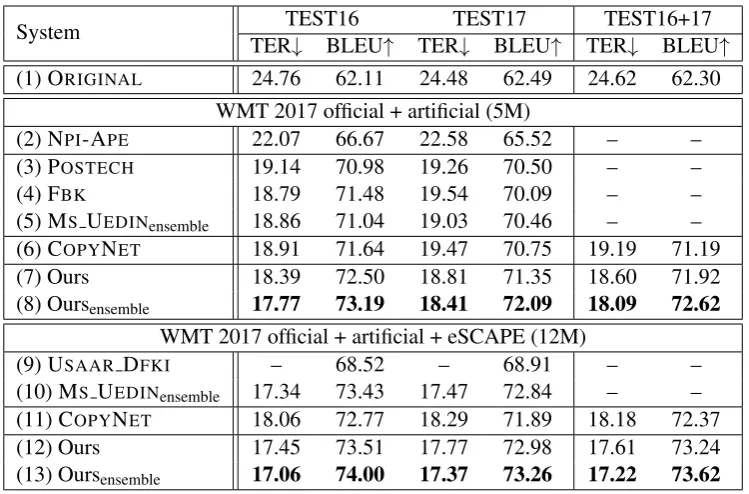
System TEST16 TEST17 TEST16+17
TER↓ BLEU↑ TER↓ BLEU↑ TER↓ BLEU↑
(1) ORIGINAL 24.76 62.11 24.48 62.49 24.62 62.30
WMT 2017 official + artificial (5M)
(2) NPI-APE 22.07 66.67 22.58 65.52 – –
(3) POSTECH 19.14 70.98 19.26 70.50 – –
(4) FBK 18.79 71.48 19.54 70.09 – –
(5) MS UEDINensemble 18.86 71.04 19.03 70.46 – –
(6) COPYNET 18.91 71.64 19.47 70.75 19.19 71.19
(7) Ours 18.39 72.50 18.81 71.35 18.60 71.92
(8) Oursensemble 17.77 73.19 18.41 72.09 18.09 72.62
WMT 2017 official + artificial + eSCAPE (12M)
(9) USAAR DFKI – 68.52 – 68.91 – –
(10) MS UEDINensemble 17.34 73.43 17.47 72.84 – –
(11) COPYNET 18.06 72.77 18.29 71.89 18.18 72.37
(12) Ours 17.45 73.51 17.77 72.98 17.61 73.24
[image:7.595.112.487.60.307.2](13) Oursensemble 17.06 74.00 17.37 73.26 17.22 73.62
Table 4: Results on the English-German PBSMT sub-task. “TEST16+17” is the concatenation of “TEST16” and “TEST17”. MSUEDINensembleand Oursensembleused ensembles of four models.
6. POSTECH (Shin and Lee, 2018): a multi-source Transformer-based APE system with two encoders. It is a participant of the WMT 2018 APE shared task.
7. FBK(Tebbifakhr et al.,2018): a multi-source Transformer-based APE system with two en-coders. It is a participant of the WMT 2018 APE shared task.
We implemented COPYNET also on top of
THUMT (Zhang et al., 2017). The results of all other baselines were taken from the corresponding original papers.
4.2 Effect of Hyper-parameters
We first investigated the effect of the hyper-parametersαandλin Eq. (18). As shown in Table
3, using α = 0.9 andλ = 1.0achieves the best performance in terms of TER and BLEU on the WMT 2016 development set, suggesting that both the Predictor and CopyNet play important roles in our approach. Therefore, we setα = 0.9 and
λ= 1.0in the following experiments.
4.3 Main Results
Results on the PBSMT Sub-task
Table4shows the results of the PBSMT sub-task. We used the development set of the WMT 2016
System TER↓ BLEU↑
ORIGINAL 15.08 76.76
POSTECH 14.94 77.26
COPYNET 15.12 77.05
[image:7.595.342.490.362.437.2]Ours 14.88 77.40
Table 5: Experiments on the WMT 2018 English-German NMT sub-task. The TER and BLEU scores are calculated on the WMT 2018 APE NMT sub-task development set.
APE PBSMT sub-task for model selection for our approach.
Under the small-data training condition (i.e., 5M), our single model (i.e., System 7) outperforms all single-model baselines on all test sets. The su-periority over COPYNET(i.e., System 6) suggests that interactive representation learning and incor-porating copying scores are effective in improving APE. Our approach that uses the ensemble of four models (i.e., System 8) also improves over the best published result (i.e., System 5).
ID Module DEV16 TEST16+17
Interactive Predictor CopyNet Joint Training TER↓ BLEU↑ TER↓ BLEU↑
1 √ × × × 18.74 72.21 19.11 71.03
2 × × √ × 19.33 71.86 19.19 71.19
3 × √ √ √ 19.11 72.03 19.07 71.30
4 √ × √ × 18.62 72.42 18.91 71.53
5 √ √ × × 18.53 72.53 18.85 71.54
6 √ √ √ × 18.44 72.96 18.77 71.75
[image:8.595.82.518.60.190.2]7 √ √ √ √ 18.38 72.99 18.60 71.92
Table 6: Ablation study. “Interactive” denotes interactive representation learning (Section3.1), “Predictor” de-notes detecting correct words (Section3.2), “CopyNet” denotes the CopyNet used in our approach (Section2.2), and “Joint Training” denotes the combination of three loss functions (Section3.3).
Results on the NMT Sub-task
Table 5 shows the results on the NMT sub-task. Besides ORIGINALand COPYNET, we also com-pared our approach with POSTECH(Shin and Lee,
2018), which is the only participating system that released the results on the development set of the WMT 2018 NMT sub-task.8 We find that our ap-proach also outperforms all baselines.
4.4 Ablation Study
Table 6shows the results of ablation study. It is clear that interactive representation learning plays a critical role since removing it impairs post-editing performance (line 3). As shown in line 4, the Predictor is also an essential part of our ap-proach. CopyNet and joint training are also shown to be beneficial for improving APE (lines 5 and 6) but seem to have relatively smaller contribu-tions than interactive representation learning and predicting words to be copied.
4.5 Results on Prediction Accuracy
The Predictor is an important module in our ap-proach as it predicts which words inmtshould be copied. Given the ground-truth labels, it is easy to calculate prediction accuracyby casting the pre-diction as a binary classification problem. We find that the Predictor achieves a prediction accuracy of 85.09% on the development set.
4.6 Comparison of Copying Accuracies
A target wordyin a machine translationy˜is called to becorrectlycopied to an automatic edited trans-lationyˆif and only if the positions whereyoccurs
8As P
OSTECHonly used small data for training, the eS-CAPE datasets were not used in this experiment for a fair comparison.
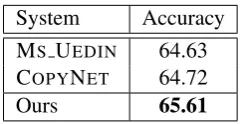
System Accuracy
MS UEDIN 64.63
COPYNET 64.72
[image:8.595.356.478.257.319.2]Ours 65.61
Table 7: Comparison of copying accuracies.
in yˆ and y (i.e., the ground-truth edited transla-tion) are identical. Therefore, it is easy to define copying accuracy to measure how well the copy-ing mechanism works.
Table 7 shows the comparison of copying ac-curacies between MS UEDIN, COPYNET, and our approach. We find that our approach outperforms the two baselines. However, the copying accuracy of our approach is almost 20% lower than the pre-diction accuracy (i.e., 65.61% vs. 85.09%), indi-cating that it is much more challenging to place the copied words in correct positions.
4.7 Visualization
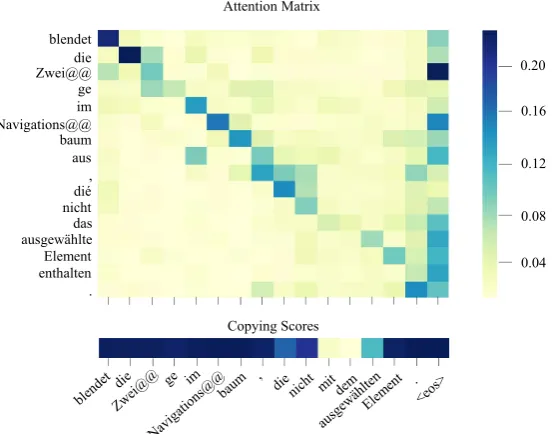
Figure 5 gives an example that illustrates how copying scores influence attention. It shows the heatmap of the Enc-Dec-Attention, which aver-ages over 8 different heads. Only the attention weights beweenpeandmtare included. We take the second layer of Enc-Dec-Attention for exam-ple. The x-axis representsmtand the y-axis rep-resents pe. The darker the color, the higher the copying scores.
We find that words “mit” and “dem” are iden-tified by the Predictor. Accordingly, the atten-tion weights corresponding to these words are de-creased since the columns corresponding to these words have lighter color. As a result, all words in
blendet die Zwei@@ ge im Navigations@@ baum aus , dié nicht das ausgewählte Element enthalten .
0.20
0.16
0.12
0.08
0.04
[image:9.595.162.439.64.281.2]Copying Scores Attention Matrix
Figure 5: Example of the heatmap of attention and copying scores. The x-axis ismtand the y-axis ispe. The Predictor successfully detects the incorrect word “mit” and “dem” and gives low copying scores to these words and then decrease the importance of them in attention. Other words inmtare correctly copied tope.
5 Related Work
5.1 Multi-source Sequence-to-Sequence Learning
Recently, multi-source Transformer-based APE systems (Junczys-Dowmunt and Grundkiewicz,
2018;Pal et al.,2018;Tebbifakhr et al.,2018;Shin and Lee, 2018) have achieved the state-of-the-art results on the datasets of the WMT APE shared task. Our work differs from prior studies by en-abling interactions between src and mt and ex-plicitly detecting words to be copied.
5.2 The Copying Mechanism
Zhao et al.(2019) apply CopyNet (Gu et al.,2016) to grammar error correction. Their approach gen-erates labels similar to ours, but only uses them to perform mutli-task learning. Libovick´y et al.
(2016) first introduce CopyNet to APE but do not provide a detailed description of their method and experimental results. We show that interactive representation learning and explicit indication of words are important for modeling copying in APE.
5.3 Interactive Representation Learning
Niehues et al.(2016) simply concatenate the out-put of the PBSMT system and the source sentence to serve as the input the NMT system without en-abling multi-layer interactive learning. Lample and Conneau(2019) used cross-lingual setting to
enable cross-lingual language model pre-training. We propose to letsrcandmt fully interact with each other to make it easier to decide which words inmtshould be copied.
6 Conclusion
We have presented a new method for modeling the copying mechanism for automatic post-editing. By making the source sentence and machine trans-lation attend to each other, representations learned in such an interactive way help to identify whether a target word should be copied or be re-generated. We also find that explicitly predicting words to be copied is beneficial for improving the perfor-mance of post-editing. Experiments show that our approach achieves new state-of-the-art results on the WMT 2016 & 2017 APE PBSMT sub-tasks.
Acknowledgments
We thank all anonymous reviewers for their
valuable comments. This work is supported
References
Hanna B´echara, Yanjun Ma, and Josef van Genabith. 2011. Statistical post-editing for a statistical mt sys-tem. InMT Summit.
Rajen Chatterjee, M. Amin Farajian, Matteo Negri, Marco Turchi, Ankit Srivastava, and Santanu Pal. 2017. Multi-source neural automatic post-editing: Fbk’s participation in the wmt 2017 ape shared task. InProceedings of WMT.
Rajen Chatterjee, Matteo Negri, Rapha¨el Rubino, and Marco Turchi. 2018. Findings of the wmt 2018 shared task on automatic post-editing. In Proceed-ings of WMT.
Rajen Chatterjee, Marion Weller, Matteo Negri, and Marco Turchi. 2015. Exploring the planet of the apes: a comparative study of state-of-the-art meth-ods for mt automatic post-editing. InProceedings of ACL.
Jiatao Gu, Zhengdong Lu, Hang Li, and Victor O. K. Li. 2016. Incorporating copying mechanism in sequence-to-sequence learning. In Proceedings of ACL.
Tianyu He, Xu Tan, Yingce Xia, Di He, Tao Qin, Zhibo Chen, and T. M. Liu. 2018. Layer-wise coordina-tion between encoder and decoder for neural ma-chine translation. InProceedings of NeurIPS.
Marcin Junczys-Dowmunt and Roman Grundkiewicz. 2016. Log-linear combinations of monolingual and bilingual neural machine translation models for au-tomatic post-editing. InProceedings of WMT.
Marcin Junczys-Dowmunt and Roman Grundkiewicz. 2017. An exploration of neural sequence-to-sequence architectures for automatic post-editing. InProceedings of IJCNLP.
Marcin Junczys-Dowmunt and Roman Grundkiewicz. 2018. Ms-uedin submission to the wmt2018 ape shared task: Dual-source transformer for automatic post-editing. InProceedings of WMT.
Diederik P. Kingma and Jimmy Ba. 2014. Adam: A method for stochastic optimization. InProceedings of ICLR.
Kevin Knight and Ishwar Chander. 1994. Automated postediting of documents. InProceedings of AAAI.
Philipp Koehn, Hieu Hoang, Alexandra Birch, Chris Callison-Burch, Marcello Federico, Nicola Bertoldi, Brooke Cowan, Wade Shen, Christine Moran, Richard Zens, Chris Dyer, Ondrej Bojar, Alexandra Constantin, and Evan Herbst. 2007. Moses: Open source toolkit for statistical machine translation. In Proceedings of ACL.
Guillaume Lample and Alexis Conneau. 2019. Cross-lingual language model pretraining. arXiv preprint arXiv:1901.07291.
Jindrich Libovick´y, Jindrich Helcl, Marek Tlust´y, Pavel Pecina, and Ondrej Bojar. 2016. Cuni system for wmt16 automatic post-editing and multimodal translation tasks. InProceedings of WMT.
Kathleen McKeown, Kristen Parton, Nizar Habash, Gonzalo Iglesias, and Adri`a de Gispert. 2012. Can automatic post-editing make mt more meaningful? InProceedings of EAMT.
Matteo Negri, Marco Turchi, Rajen Chatterjee, and Nicola Bertoldi. 2014. escape: a large-scale syn-thetic corpus for automatic post-editing. In Proceed-ings of LREC.
Jan Niehues, Eunah Cho, Thanh-Le Ha, and Alexan-der H. Waibel. 2016. Pre-translation for neural ma-chine translation. InProceedings of COLING.
Santanu Pal, Nico Herbig, Antonio Kr¨uger, and Josef van Genabith. 2018. A transformer-based multi-source automatic post-editing system. In Proceed-ings of WMT.
Abigail See, Peter J. Liu, and Christopher D. Manning. 2017. Get to the point: Summarization with pointer-generator networks. InProceedings of ACL.
Rico Sennrich, Barry Haddow, and Alexandra Birch. 2015. Neural machine translation of rare words with subword units. InProceedings of ACL.
Jaehun Shin and Jong-Hyeok Lee. 2018. Multi-encoder transformer network for automatic post-editing. InProceedings of WMT.
Michel Simard, Cyril Goutte, and Pierre Isabelle. 2007. Statistical phrase-based post-editing. In Proceed-ings of HLT-NAACL.
Amirhossein Tebbifakhr, Ruchit Agrawal, Matteo Ne-gri, and Marco Turchi. 2018. Multi-source trans-former for automatic post-editing. InProceedings of CLiC-it.
Inigo Jauregi Unanue, Ehsan Zare Borzeshi, and Mas-simo Piccardi. 2018. A shared attention mechanism for interpretation of neural automatic post-editing systems. InProceedings of NMT@ACL.
Dusan Varis and Ondrej Bojar. 2017. Cuni system for wmt17 automatic post-editing task. InProceedings of WMT.
Ashish Vaswani, Noam Shazeer, Niki Parmar, Jakob Uszkoreit, Llion Jones, Aidan N. Gomez, Lukasz Kaiser, and Illia Polosukhin. 2017. Attention is all you need. InProceedings of NeurIPS.
Thuy-Trang Vu and Gholamreza Haffari. 2018. Auto-matic post-editing of machine translation: A neural programmer-interpreter approach. In Proceedings of EMNLP.
Yonghui Wu, Mike Schuster, Zhifeng Chen, Quoc V. Le, Mohammad Norouzi, Wolfgang Macherey, Maxim Krikun, Yuan Cao, Qin Gao, Klaus Macherey, Jeff Klingner, Apurva Shah, Melvin Johnson, Xiaobing Liu, Lukasz Kaiser, Stephan Gouws, Yoshikiyo Kato, Taku Kudo, Hideto Kazawa, Keith Stevens, George Kurian, Nishant Patil, Wei Wang, Cliff Young, Jason Smith, Jason Riesa, Alex Rudnick, Oriol Vinyals, Gregory S. Corrado, Macduff Hughes, and Jeffrey Dean. 2016. Google’s neural machine translation system: Bridg-ing the gap between human and machine translation. arXiv preprint arXiv:1609.08144.
Baosong Yang, Zhaopeng Tu, Derek F. Wong, Fandong Meng, Lidia S. Chao, and Tong Zhang. 2018. Mod-eling localness for self-attention networks. In Pro-ceedings of EMNLP.
Jiacheng Zhang, Yanzhuo Ding, Shiqi Shen, Yong Cheng, Maosong Sun, Huan-Bo Luan, and Yang Liu. 2017. Thumt: An open source toolkit for neural machine translation. arXiv preprint arXiv:1706.06415.
Wei Ke Zhao, Liang Wang, Kewei Shen, Ruoyu Jia, and Jingming Liu. 2019. Improving grammatical error correction via pre-training a copy-augmented architecture with unlabeled data. InProceedings of NAACL-HLT.