Proceedings of the 10th International Workshop on Health Text Mining and Information Analysis (LOUHI 2019), pages 28–33 28
Syntax-aware Multi-task Graph Convolutional Networks
for Biomedical Relation Extraction
Diya Li∗, Heng Ji†‡
∗
Computer Science Department, Rensselaer Polytechnic Institute [email protected]
†
Department of Computer Science‡Department of Electrical and Computer Engineering University of Illinois at Urbana-Champaign
Abstract
In this paper we tackle two unique challenges in biomedical relation extraction. The first challenge is that the contextual information between two entity mentions often involves sophisticated syntactic structures. We propose a novel graph convolutional networks model that incorporates dependency parsing and con-textualized embedding to effectively capture comprehensive contextual information. The second challenge is that most of the bench-mark data sets for this task are quite imbal-anced because more than 80% mention pairs are negative instances (i.e., no relations). We propose a multi-task learning framework to jointly model relation identification and clas-sification tasks to propagate supervision sig-nals from each other and apply a focal loss to focus training on ambiguous mention pairs. By applying these two strategies, experiments show that our model achieves state-of-the-art F-score on the 2013 drug-drug interaction ex-traction task.
1 Introduction
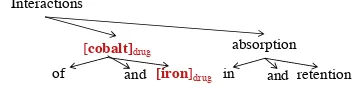
Recently relation extraction in biomedical litera-ture has attracted increasing interests from med-ical language processing research community as an important stage for downstream tasks such as question answering (Hristovski et al., 2015) and decision making (Agosti et al., 2019). Biomed-ical relation extraction aims to identify and clas-sify relations between two entity mentions into pre-defined types based on contexts. In this paper we aim to extract drug-drug interactions (DDIs), which occur when taking two or more drugs within a certain period of time that alters the way one or more drugs act in human body and may result in unexpected side effects (Figure1). Extracting DDI provides important clues for research in drug safety and human health care.
[cobalt]drug
[iron]drug
Interactions
of and in
absorption
and retention
mention pair: <drug, drug>
relation: mechanism, pharmacokinetic mechanism of two entities
[image:1.595.328.510.243.287.2]Interactions of [cobalt]drugand [iron]drugin absorption and retention
Figure 1: Example of drug-drug interaction on depen-dency tree.
Dependency parses are widely used in relation extraction task due to the advantage of shorten-ing the distance of words which are syntactically related. As shown in Figure 1, the partial de-pendency path {iron ← cobalt ← interactions} reveals that these two drugs are interactive, and the path{interactions→absorption→retention} further indicates the mechanismrelation between these two mentions. Therefore capturing the syn-tactic information involving the word interaction
on the dependency path {iron ← cobalt ← in-teractions→ absorption→ retention} can effec-tively help on the classification of the relation be-tween these two mentions hcobalt, ironi. In or-der to capture indicative information from wide contexts, we adopt the graph convolutional net-works (GCN) (Kipf and Welling,2016; Marcheg-giani and Titov,2017) to obtain the syntactic infor-mation by encoding the dependency structure over the input sentence with graph convolution opera-tions. To compensate the loss of local context in-formation in GCN, we incorporate the contextual-ized word representation pre-trained by the BERT model (Devlin et al.,2019) in large-scale biomed-ical corpora containing over 200K abstracts from PubMed and over 270K full texts from PMC (Lee et al.,2019) .
are usually very sparse. Over 80% candidate men-tion pairs have no relamen-tion in DDI 2013 ( Herrero-Zazo et al., 2013) training set. To tackle this problem, we propose a binary relation identifica-tion task as an auxiliary task to facilitate the main multi-classification task. For instance, the detec-tion of drug interacdetec-tion on dependency path{iron
← cobalt ← interactions → absorption → re-tention} will assist the prediction of the relation typemechanismby using the signals from binary classification as an inductive bias to avoid misclas-sifying it as no relation. We also exploit the focal loss (Lin et al.,2017) to potentially help the multi-class relation multi-classification task by forcing the loss implicitly focus on ambiguous examples.
To recap, our contributions are twofold: First, we adopt the syntax-aware graph convolutional networks incorporating contextualized represen-tation. Second, we further design an auxiliary task to solve the data imbalance problem, which achieves the state-of-the-art micro F-score on the DDIExtraction 2013 shared task.
2 Methods
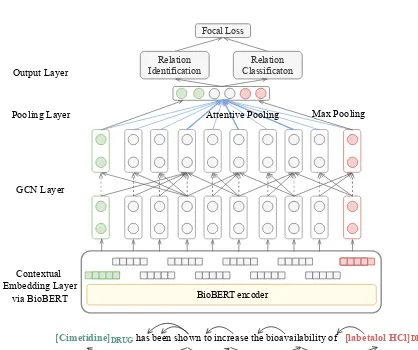
Contextual Embedding Layer
via BioBERT GCN Layer Pooling Layer Output Layer
Relation Identification
Relation Classificaton
Max Pooling
[image:2.595.73.282.391.566.2]BioBERT encoder
[Cimetidine]DRUG has been shown to increase the bioavailability of [labetalol HCl]DRUG
Attentive Pooling
Focal Loss
Figure 2: Framework of syntax-aware multi-task graph convolutional networks.
2.1 Contextual and Syntax-aware GCN
As a variant of the convolutional neural net-works (LeCun et al., 1998), the graph convolu-tional networks (Kipf and Welling, 2016) is de-signed for graph data and it has been proven ef-fective in modeling text data via syntactic depen-dency graphs (Marcheggiani and Titov,2017).
We encode the tokens in a biomedical sentence of sizenasx={x1, . . . ,xn}, wherexiis a vec-tor which concatenates the representation of the
tokeniand the position embeddings correspond-ing to the relative positions from candidate men-tion pairs. We feed the token vectors into a L -layer GCN to obtain the hidden representations of each token which are directly influenced by its neighbors no more than L edges apart in the de-pendency tree. We apply the Stanford dede-pendency parser (Chen and Manning,2014) to generate the dependency structure:
h(l)i =σ( n
X
j=1
e
AijW(l)hlj−1/di+b(l))
whereAe =A+IwithAis the adjacent matrix of
tokens in dependency tree,Iis the identity matrix.
W(l)is a linear transformation,b(l)is a bias term, and σ is a nonlinear function. Following Zhang et al.(2018),diis the degree of the tokeniin de-pendency tree with an additional self-loop.
We notice that some token representations are more informative by gathering information from syntactically related neighbors through GCN. For example, the representation of the token interac-tions from a 2-layer GCN operating on its two edges apart neighbors provides inductive informa-tion for predicting a mechanismrelation. Thus, we adopt attentive pooling (Zhou et al., 2016) to achieve the optimal pooling:
α=sof tmax(wT tanh(h))
hattentive=hαT
wherewis a trained parameter to assign weights based on the importance of each token representa-tion.
We obtain the final representation by concate-nating the sentence from attentive pooling and the mention representations from max pooling. We fi-nally obtain the prediction of relation type by feed-ing the final representations into a fully connected neural network followed by a softmax operation.
Graph neural networks (Zhou et al., 2018b) can learn effective representations but suffer from the loss of local context information. We be-lieve the local context information is also crucial for biomedical relation extraction. For example, in the following sentence “The response to [Fac-trel]DRUGmay be blunted by [phenothiazines]DRUG and [dopamine antagonists]DRUG”, it’s intuitive
have no interaction according to the sentence or-der. However, GCNs treat the three drugs as inter-acting with each other as they are close in depen-dency structure with no order information.
BERT (Devlin et al., 2019) is a recently pro-posed model based on a multi-layer bidirectional Transformer (Vaswani et al., 2017). Using pre-trained BERT has been proven effective to create contextualized word embeddings for various NLP tasks (Han et al., 2019;Wang et al., 2019). The BioBERT (Lee et al., 2019) is a biomedical lan-guage representation model pre-trained on large-scale biomedical corpora. The output of each en-coder layer of the input token can be used as a feature representation of that token. As shown in Figure 2, we encode the input tokens as con-textualized embeddings by leveraging the last hid-den layer of the corresponding token in BioBERT. As the BERT model uses WordPiece (Wu et al., 2016) to decompose infrequent words into fre-quent subwords for unsupervised tokenization of the input token, if the token has multiple BERT subword units, we use the first one. After getting the contextualized embedding of each token, we feed them into the GCN layer to make our model context-aware.
2.2 Auxiliary Task Learning with Focal Loss
In the DDIExtraction 2013 task, all possible inter-actions between drugs within one sentence are an-notated, which means a single sentence with mul-tiple drug mentions will lead to separate instances of candidate mention pairs (Herrero-Zazo et al., 2013). There are 21,012 mention pairs generated from 3,790 sentences in training set and over 80% have no relations. This data imbalance problem due to sparse relation distribution is a main reason for low recall in DDI task (Zhou et al.,2018a;Sun et al.,2019).
Here we address this relation type imbalance problem by adding an auxiliary task on top of the syntax-aware GCN model. To conduct the auxil-iary task learning, we add a separate binary classi-fier for relation identification as shown in Figure2. All classifiers share the same GCN representation and contextualized embeddings, and thus they can potentially help each other by propagating their supervision signals.
Additionally, instead of setting the objective function as the negative log-likelihood loss, here we optimize the parameters in training by
mini-mizing a focal loss (Lin et al., 2017) which fo-cuses on hard relation types. For instance, the
intrelation indicates drug interaction without pro-viding any extra information (e.g.,Some [anticon-vulsants]DRUGmay interact with [Mephenytoin]DRUG
). This relation type only accounts for 0.82% in training set and is often misclassified into other relation types. We denoteti andpi as the ground truth and the conditional probability value of the type i in relation types C, the focal loss can be defined as:
L=−
C
X
i
(αi(1−pi)γtilog(pi)) +λ||θ||2
whereα is a weighting factor to balance the im-portance of samples from various types, γ is the focusing parameter to reduce the influence of well-classified samples in the loss. λis theL2 regular-ization parameter andθis the parameter set.
The auxiliary task along with the focal loss en-hances our model’s ability to handle imbalance data by leveraging the inductive signal from the easier identification task and meanwhile down-weighting the influence of easy classified in-stances thus directing the model to focus on dif-ficult relation types.
3 Experiments
3.1 Datasets and Task Settings
System Prec Rec F1
CNN (Liu et al.,2016) 75.70 64.66 69.75
Multi Channel CNN (Quan et al.,
2016)
75.99 65.25 70.21
GRU (Yi et al.,2017) 73.67 70.79 72.20
AB-LSTM (Sahu and Anand,
2018)
74.47 64.96 69.39
CNN-GCNN (Asada et al.,2018) 73.31 71.81 72.55
Position-aware LSTM (Zhou
et al.,2018a)
75.80 70.38 72.99
RHCNN (Sun et al.,2019) 77.30 73.75 75.48
LSTM baseline 69.34 62.74 65.88
GCN baseline 71.96 67.14 69.47
–without attentive pooling 77.12 75.03 76.06
–without BioBERT 76.51 73.56 75.01
–without multi-task learning 76.01 71.92 73.91
Our Model 77.62 75.69 76.64
Table 1: Precision (Prec), recall (Rec) and micro F-score (F1) results on DDI 2013 corpus.
of a DDI), Advice(a recommendation or advice regarding a DDI) and Int (a DDI simply occurs without extra information). We randomly choose 10% from the training dataset as the development set. Following previous work (Liu et al., 2016; Quan et al., 2016;Zhou et al.,2018a;Sun et al., 2019), we use a negative instance filtering strat-egy to filter out some negative drug pairs based on manually-formulated rules. Instances contain-ing drug pair referrcontain-ing to the same thcontain-ing and drug pair appearing in the same coordinate structure with more than two drugs (e.g., drug1, drug2, and drug3) will be filtered. Entity mentions are masked withDRUGfor better generalization and avoiding overfitting.
We train the model with GCN hidden state size of 200, the SGD optimizer with a learning rate of 0.001, a batch size of 30, and 50 epochs. Dropout is applied with a rate of 0.5 for regularization. The contextual embedding size from BioBERT is 768. The focusing parameter γ is set as 1. All hyper-parameters are tuned on the development set.
3.2 Results and Analysis
The experiment results are reported from a 2-layer GCN which achieves the best performance and shown in Table 1. Our model significantly out-performs all previous methods at the significance level of 0.05. To analyze the contributions and effects of the various components in our model, we also perform ablation tests. The ablated GCN model outperforms the LSTM baseline by 3.6% F1 score, which demonstrates the effectiveness of GCN on modeling mention relations through de-pendency structure. The utilization of contextu-alized embedding from BioBERT which encodes the contextual information involving sequence or-der and word disambiguation implicitly helps the model to learn contextual relation patterns, there-fore the performance is further improved. We obtain a significant F-score improvement (2.7%) by applying multi-task learning. As over 80% mention pairs are negative samples, the multi-task learning effectively solves the problem by jointly modeling relation identification and classification tasks and applying focal loss to focusing on am-biguous mention pairs, and thus we also gain 3.8% absolute score on recall. Specifically, the F1 score ofinttype is increased from 54.38% to 59.79%.
For the remaining errors, we notice that our model often fails to predict relations when the
sen-tence are parsed poorly due to the complex con-tent which suggests us to seek for more powerful parser tools. Besides, we also observe some errors occurring in extremely short sentences. For exam-ple, in the following sentence “[Calcium]DRUG Sup-plements/[Antacids]DRUG”, our model cannot
cap-ture informative representations as the mentions are masked with DRUG and the sentence is too concise to offer indicative evidence.
4 Related Work
Traditional feature/kernel-based models for biomedical relation extraction rely on engineered features which suffer from low portability and generalizability (Kim et al., 2015; Zheng et al., 2016;Raihani and Laachfoubi, 2017). To tackle this problem, recent studies apply Convolutional Neural Networks (CNNs) and Recurrent Neural Networks (RNNs) to automatically learn feature representations with input words encoded as pre-trained word embeddings (Zhao et al., 2016; Liu et al., 2016; Quan et al., 2016;Zhang et al., 2017; Zhou et al., 2018a; Sun et al., 2019). Learning representations of graphs are widely studied and several graph neural networks have been applied in the biomedical domain.Lim et al. (2018) proposed recursive neural network based model with a subtree containment feature. Asada et al. (2018) encoded drug pairs with CNNs and used external knowledge base to encode their molecular pairs with two graph neural networks. Here we directly apply syntax-aware GCNs on biomedical text to extract drug-drug interaction.
5 Conclusions and Future Work
Acknowledgments
This work was supported by the U.S. NSF No. 1741634 and Air Force No. FA8650-17-C-7715. The views and conclusions contained in this doc-ument are those of the authors and should not be interpreted as representing the official policies, ei-ther expressed or implied, of the U.S. Govern-ment. The U.S. Government is authorized to re-produce and distribute reprints for Government purposes notwithstanding any copyright notation here on.
References
Maristella Agosti, Giorgio Maria Di Nunzio, Stefano Marchesin, and Gianmaria Silvello. 2019. A rela-tion extracrela-tion approach for clinical decision sup-port. arXiv preprint arXiv:1905.01257.
Masaki Asada, Makoto Miwa, and Yutaka Sasaki. 2018. Enhancing drug-drug interaction extraction from texts by molecular structure information. In Proc. ACL2018.
Danqi Chen and Christopher Manning. 2014. A fast and accurate dependency parser using neural net-works. InProc. EMNLP2014.
Jacob Devlin, Ming-Wei Chang, Kenton Lee, and Kristina Toutanova. 2019. Bert: Pre-training of deep bidirectional transformers for language understand-ing. InProc. NAACL-HLT2019.
Rujun Han, Mengyue Liang, Bashar Alhafni, and Nanyun Peng. 2019. Contextualized word em-beddings enhanced event temporal relation ex-traction for story understanding. arXiv preprint arXiv:1904.11942.
Mar´ıa Herrero-Zazo, Isabel Segura-Bedmar, Paloma Mart´ınez, and Thierry Declerck. 2013. The ddi corpus: An annotated corpus with pharmacological substances and drug–drug interactions. Journal of biomedical informatics, 46(5):914–920.
Dimitar Hristovski, Dejan Dinevski, Andrej Kastrin, and Thomas C Rindflesch. 2015. Biomedical ques-tion answering using semantic relaques-tions. BMC bioinformatics, 16(1):6.
Sun Kim, Haibin Liu, Lana Yeganova, and W John Wilbur. 2015. Extracting drug–drug interactions from literature using a rich feature-based linear ker-nel approach. Journal of biomedical informatics, 55:23–30.
Thomas N Kipf and Max Welling. 2016. Semi-supervised classification with graph convolutional networks. arXiv preprint arXiv:1609.02907.
Yann LeCun, L´eon Bottou, Yoshua Bengio, Patrick Haffner, et al. 1998. Gradient-based learning ap-plied to document recognition. Proceedings of the IEEE, 86(11):2278–2324.
Jinhyuk Lee, Wonjin Yoon, Sungdong Kim, Donghyeon Kim, Sunkyu Kim, Chan Ho So, and Jaewoo Kang. 2019. Biobert: pre-trained biomed-ical language representation model for biomedbiomed-ical text mining. arXiv preprint arXiv:1901.08746.
Sangrak Lim, Kyubum Lee, and Jaewoo Kang. 2018. Drug drug interaction extraction from the litera-ture using a recursive neural network. PloS one, 13(1):e0190926.
Tsung-Yi Lin, Priya Goyal, Ross Girshick, Kaiming He, and Piotr Doll´ar. 2017. Focal loss for dense ob-ject detection. InProceedings of the IEEE interna-tional conference on computer vision, pages 2980– 2988.
Shengyu Liu, Buzhou Tang, Qingcai Chen, and Xiao-long Wang. 2016. Drug-drug interaction extraction via convolutional neural networks. Computational and mathematical methods in medicine, 2016.
Diego Marcheggiani and Ivan Titov. 2017. En-coding sentences with graph convolutional net-works for semantic role labeling. arXiv preprint arXiv:1703.04826.
Chanqin Quan, Lei Hua, Xiao Sun, and Wenjun Bai. 2016. Multichannel convolutional neural network for biological relation extraction. BioMed research international, 2016.
Anass Raihani and Nabil Laachfoubi. 2017. A rich feature-based kernel approach for drug-drug inter-action extrinter-action. International journal of advanced computer science and applications, 8(4):324–3360.
Sunil Kumar Sahu and Ashish Anand. 2018. Drug-drug interaction extraction from biomedical texts us-ing long short-term memory network. Journal of biomedical informatics, 86:15–24.
Xia Sun, Ke Dong, Long Ma, Richard Sutcliffe, Fei-juan He, Sushing Chen, and Jun Feng. 2019. Drug-drug interaction extraction via recurrent hybrid con-volutional neural networks with an improved focal loss. Entropy, 21(1):37.
Ashish Vaswani, Noam Shazeer, Niki Parmar, Jakob Uszkoreit, Llion Jones, Aidan N Gomez, Łukasz Kaiser, and Illia Polosukhin. 2017. Attention is all you need. InAdvances in neural information pro-cessing systems, pages 5998–6008.
Yonghui Wu, Mike Schuster, Zhifeng Chen, Quoc V Le, Mohammad Norouzi, Wolfgang Macherey, Maxim Krikun, Yuan Cao, Qin Gao, Klaus Macherey, et al. 2016. Google’s neural ma-chine translation system: Bridging the gap between human and machine translation. arXiv preprint arXiv:1609.08144.
Zibo Yi, Shasha Li, Jie Yu, Yusong Tan, Qingbo Wu, Hong Yuan, and Ting Wang. 2017. Drug-drug inter-action extrinter-action via recurrent neural network with multiple attention layers. In International Confer-ence on Advanced Data Mining and Applications, pages 554–566.
Yijia Zhang, Wei Zheng, Hongfei Lin, Jian Wang, Zhi-hao Yang, and Michel Dumontier. 2017. Drug–drug interaction extraction via hierarchical rnns on se-quence and shortest dependency paths. Bioinformat-ics, 34(5):828–835.
Yuhao Zhang, Peng Qi, and Christopher D Manning. 2018. Graph convolution over pruned dependency trees improves relation extraction. arXiv preprint arXiv:1809.10185.
Zhehuan Zhao, Zhihao Yang, Ling Luo, Hongfei Lin, and Jian Wang. 2016. Drug drug interac-tion extracinterac-tion from biomedical literature using syn-tax convolutional neural network. Bioinformatics, 32(22):3444–3453.
Wei Zheng, Hongfei Lin, Zhehuan Zhao, Bo Xu, Yi-jia Zhang, Zhihao Yang, and Jian Wang. 2016. A graph kernel based on context vectors for extracting drug–drug interactions. Journal of biomedical infor-matics, 61:34–43.
Deyu Zhou, Lei Miao, and Yulan He. 2018a. Position-aware deep multi-task learning for drug–drug inter-action extrinter-action. Artificial intelligence in medicine, 87:1–8.
Jie Zhou, Ganqu Cui, Zhengyan Zhang, Cheng Yang, Zhiyuan Liu, and Maosong Sun. 2018b. Graph neu-ral networks: A review of methods and applications. arXiv preprint arXiv:1812.08434.