Proceedings of the 2019 Conference on Empirical Methods in Natural Language Processing and the 9th International Joint Conference on Natural Language Processing, pages 5953–5959,
5953
A Gated Self-attention Memory Network for Answer Selection
Tuan Lai∗1, Quan Hung Tran∗2, Trung Bui2, Daisuke Kihara1 {lai123,dkihara}@purdue.edu,{qtran,bui}@adobe.com
1Purdue University, West Lafayette, IN 2Adobe Research, San Jose, CA
Abstract
Answer selection is an important research problem, with applications in many areas. Pre-vious deep learning based approaches for the task mainly adopt the Compare-Aggregate ar-chitecture that performs word-level compari-son followed by aggregation. In this work, we take a departure from the popular Compare-Aggregate architecture, and instead, propose a new gated self-attention memory network for the task. Combined with a simple transfer learning technique from a large-scale online corpus, our model outperforms previous meth-ods by a large margin, achieving new state-of-the-art results on two standard answer selec-tion datasets: TrecQA and WikiQA.
1 Introduction and Related Work
Answer selection is an important task, with appli-cations in many areas (Lai et al., 2018). Given a question and a set of candidate answers, the task is to identify the most relevant candidate. Previous work on answer selection typically relies on fea-ture engineering, linguistic tools, or external re-sources (Wang et al., 2007;Wang and Manning,
2010;Heilman and Smith,2010;Yih et al.,2013;
Yao et al.,2013). Recently, with the renaissance of neural network models, many deep learning based methods have been proposed to address the task (Tay et al.,2017b;Shen et al.,2017;Wang et al.,
2017; Bian et al., 2017; Tymoshenko and Mos-chitti, 2018; Tay et al., 2018;Tayyar Madabushi et al.,2018;Yoon et al.,2019). They outperform traditional techniques. A common trait of a num-ber of these deep learning methods is the use of the Compare-Aggregate architecture (Wang and Jiang,2017). Typically in this architecture, con-textualized vector representations of small units such as words of the question and the candidate
∗
Equal contributions. The work was conducted while the first author interned at Adobe Research.
are firstcompared and aligned. After that, these comparison results are then aggregated to calcu-late a score indicating the relevance between the question and the candidate. On standard answer selection datasets such as TrecQA (Wang et al.,
2007) or WikiQA (Yang et al., 2015), Compare-Aggregate approaches achieve very competitive performance. However, they still have some limi-tations. For example, the first few layers of most previous Compare-Aggregate models encode the question-candidate pair into sequences of contex-tualized vector representations separately (Wang et al.,2017;Shen et al.,2017;Bian et al.,2017). These sequences are independent and completely ignore the information from the other sequence.
In this work, we take a departure from the popular Compare-Aggregate architecture, so in-stead, we propose a mix between two very successful architectures in machine comprehen-sion and sequence modeling, the memory net-work (Sukhbaatar et al., 2015) and the self-attention architecture (Vaswani et al., 2017). In the context of answer selection, the self-attention architecture allows us to learn the contextual rep-resentation of elements in the sequence with re-spect to both the question and the answer, while the multi-hop reasoning memory network allows us to refine the decision over multiple steps. To this end, we propose a new memory-based, gated self-attention architecture for the task of answer selection. Combined with a simple transfer learn-ing technique from a large-scale online corpus, our model achieves new state-of-the-art results on the TrecQA and WikiQA datasets.
work in Section 5.
2 Gated Self-Attention Memory Network
2.1 The gated self-attention mechanism
The gated attention mechanism (Dhingra et al.,
2017;Tran et al.,2017) extends the popular scalar-based attention mechanism by calculating a real vector gate to control the flow of information, in-stead of a scalar value. Let’s denote the sequence of input vectors as X = [x1..xn]. If we have
context informationc, then in traditional attention mechanism, association scoreαi is usually
calcu-lated as a normalized dot product between the two vectorscandxi (Equation1) wherei∈[1..n].
αi =
exp(cTxi)
P
j∈[1..n]exp(cT xj)
(1)
For the gated attention mechanism, the associ-ation between two vectorscandxi is represented by gate vectorgias follows:
gi=σ f(c,xi)
(2)
whereσ denotes the element-wise sigmoid func-tion. Functionf is a parameterized function and thus, is more flexible in modelling the interaction between vectorscandxi.
In this work, we propose a new type of self-attention based on the gated self-attention mechanism described above, and we refer to it as the gated self-attention mechanism (GSAM). We want to condition the gate vector not only on a context vec-tor and a single input vecvec-tor but also on the entire sequence of inputs. Therefore, we design function fto be dependent on all the inputs in the sequence and the context vector. To calculate the gate for inputxi, first, each of the inputs in the input se-quence and the context vector will present an indi-vidual gate “vote”. Then, the votes are aggregated to calculate gate gi for xi. This process is illus-trated in Equation3:
vj =Wxj +b; vc=Wc+b
sji =xTi vj ; sci =xTi vc
αji = exp(s j i)
P
k∈[1..n]exp(ski) + exp(sci)
αci = exp(s c i)
P
k∈[1..n]exp(ski) + exp(sci) gi =fi(c, X)
=σ X
j
αji xj
+αcic
!
(3)
where W and b are learnable parameters shared among functionsf1... fn. Vectors vs are
linear-transformed inputs which are used to calculate the self attentions. sji is the unnormalized attention score of inputxjput onxiandαjiis the normalized score. We use affine-transformed inputs v andx
to calculate the self-attention instead of just x to break the attention symmetry phenomenon.
2.2 Combining with the memory network
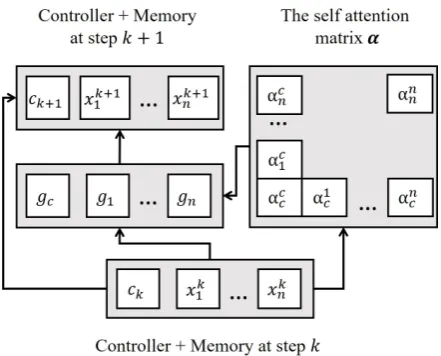
In most previous memory network architectures, interactions between memory cells are relatively limited. At each hop, a single control vector is used to interpret each memory cell independently. To overcome this limitation, we combine GSAM described in Section 2.1 with the memory net-work architecture to create a new netnet-work called the Self-Attention Memory Network (GSAMN). Figure1shows the simplified computation flow of GSAMN. In each reasoning hop, instead of using only context vector c to interpret the inputs, we use GSAM. Letckbe the controlling context and xk1...xkn be the memory values at thekth reason-ing hop. Each memory cell update from the kth hop to the next hop is calculated as the gated self-attention update (Equation4).
gi =fi(ck, X)
xk+1i =gixki (4)
The controller’s update is a combination of the gated self-attention above, and the memory net-work’s traditional aggregate update. As the mem-ory state values have already been attended to by the gating mechanism, we only need to average them (not weighted average).
.
gc=fc(ck, X)
ck+1=gcck+ 1
n X
i
xk+1i (5)
2.3 GSAMN for answer selection
In the context of answer selection, we concatenate question Q and candidate answer A to a single se-quence and treat the task as a binary classification problem. Given the GSAMN architecture above, we can use final controller statecT as the
represen-tation of the sequence. The matching probability P(A|Q)is finally calculated as follows:
P(A|Q) =σ
WccT +bc
Figure 1: Simplified computation flow of the Gated Self-Attention Memory Network
where Wc and bc are learnable parameters. We can initialize the memory values x01...x0n us-ing any representation model such as word2vec (Mikolov et al.,2013), GloVe (Pennington et al.,
2014), ELMo (Peters et al.,2018), or BERT ( De-vlin et al., 2018). The control vector c is a ran-domly initialized learnable vector.
3 Transfer Learning
Previous studies on answer selection have focused mostly on small-scale datasets. On the other hand, many community question answering (CQA) plat-forms such as Yahoo Answers and Stack Exchange have become an essential source of information for many people. The amount of data (i.e., ques-tions and answers) in these CQA platforms is huge and encompasses many domains and topics. This provides a great opportunity to apply transfer learning techniques to improve answer selection systems trained on limited datasets.
We crawled question-answer pairs related to various topics from Stack Exchange1. After that, we removed every pair that contains text written in a language different from English. Furthermore, to ensure that in each collected pair the answer is highly relevant to the question, we removed pairs whose answers have less than two up-votes from community users. Finally, because training an-swer selection models also require negative exam-ples, for each question, we sampled several real answers not related to the question to build up neg-ative pairs. In the end, our dataset has 628,706
1https://stackexchange.com/
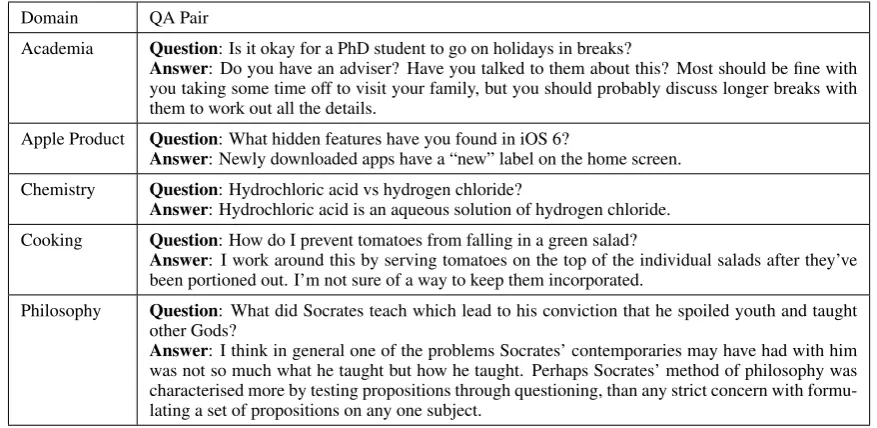
positive pairs and 9,874,758 negative pairs in to-tal. We refer to our newly collected dataset as StackExchangeQA. Table1shows some examples of positive question-answer pairs from the dataset. The dataset has question-answer pairs from many different domains and topics. The code for con-structing the StackExchangeQA dataset is avail-able online2.
In this work, we employ a basic transfer learn-ing technique. The first step is to pre-train our answer selection model on the StackExchangeQA dataset. Then, the second step is to fine-tune the same model on a target dataset of interest such as TrecQA or WikiQA. Despite the simplicity of the technique, the performance of our model im-proves substantially compared to not using trans-fer learning. Diftrans-ferent from previous works which use source datasets that were manually annotated (Min et al.,2017;Chung et al.,2018), our source dataset required minimal effort to obtain and pre-process. The choice of crawling question-answer pairs from the Stack Exchange website was arbi-trary. We could also have crawled data from web-sites such as Yahoo Answers instead.
4 Experiments and Results
To evaluate the effectiveness of our proposed answer selection model, we use two datasets: TrecQA and WikiQA. The TrecQA dataset (Wang et al., 2007) was created from the TREC Ques-tion Answering tracks. There are two versions of TrecQA: raw and clean. Both versions have the same training set but their development and test sets differ. In this study, we use the clean version of the dataset that removed questions in development and test sets with no answers or only positive/negative answers. The clean version has 1,229/65/68 questions and 53,417/1,117/1,442 question-answer pairs for the train/dev/test split. The WikiQA dataset (Yang et al.,2015) was con-structed from real queries of Bing and Wikipedia. Following the literature (Yang et al., 2015;Bian et al., 2017; Shen et al., 2017), we removed all questions with no correct answers before training and evaluating answer selection models. The excluded WikiQA has 873/126/243 questions and 8,627/1,130/2,351 question-answer pairs for train/dev/test split.
Similar to previous work, we report the model
2https://github.com/laituan245/
Domain QA Pair
Academia Question: Is it okay for a PhD student to go on holidays in breaks?
Answer: Do you have an adviser? Have you talked to them about this? Most should be fine with you taking some time off to visit your family, but you should probably discuss longer breaks with them to work out all the details.
Apple Product Question: What hidden features have you found in iOS 6?
Answer: Newly downloaded apps have a “new” label on the home screen.
Chemistry Question: Hydrochloric acid vs hydrogen chloride?
Answer: Hydrochloric acid is an aqueous solution of hydrogen chloride.
Cooking Question: How do I prevent tomatoes from falling in a green salad?
Answer: I work around this by serving tomatoes on the top of the individual salads after they’ve been portioned out. I’m not sure of a way to keep them incorporated.
Philosophy Question: What did Socrates teach which lead to his conviction that he spoiled youth and taught other Gods?
[image:4.595.79.518.62.276.2]Answer: I think in general one of the problems Socrates’ contemporaries may have had with him was not so much what he taught but how he taught. Perhaps Socrates’ method of philosophy was characterised more by testing propositions through questioning, than any strict concern with formu-lating a set of propositions on any one subject.
Table 1: Examples of positive question-answer pairs from the StackExchangeQA dataset
performance as the mean average precision (MAP) and mean reciprocal rank (MRR)3. In all experi-ments, we use the base version of BERT (Devlin et al., 2018) to initialize the memory of our pro-posed architecture. We fine-tune the BERT em-beddings during training. We set the number of reasoning hops to be 2. We use the Adam op-timizer with a learning rate of 5e-5, β1 = 0.9,
β2 = 0.999, L2 weight decay of 0.01, learning
rate warmup over the first 10 percent of the total number of training steps, and linear decay of the learning rate. We did hyper-parameter tuning on the development sets.
It is worth noting that, we have experimented with various values for the number of reasoning hops. We found that using 2 hops gives the best performance on the tested datasets while using larger number of hops decreases the performance slightly. We attribute the diminishing returns in in-creasing the number of hops to the limited size of the TrecQA and WikiQA datasets. Many previous works related to memory networks also use small number of memory hops (Weston et al., 2015;
Sukhbaatar et al.,2015;Miller et al.,2016;Zhang et al.,2018).
4.1 Comparison with Previous Methods
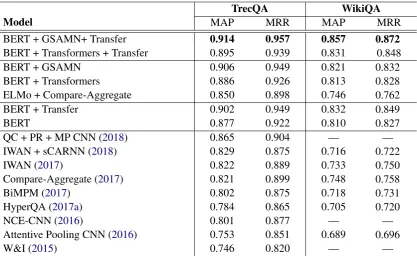
Table2summarizes the performances of our pro-posed models and compares them to the base-lines on the TrecQA and WikiQA datasets. The
3https://aclweb.org/aclwiki/Question_
Answering_(State_of_the_art)
full model [BERT + GSAMN+ Transfer Learning] outperforms the previous state-of-the-art methods by a large margin. Note that by simply fine-tuning the pre-trained BERT embeddings, one can eas-ily achieve very competitive performance on both datasets. This is expected as BERT has been pre-trained on a massive amount of unlabeled data. However, our proposed techniques do add a signif-icant amount of performance. The gain from using all of our proposed techniques is larger than the difference between fine-tuning BERT model com-pared to previous systems in the TrecQA dataset.
4.2 Ablation Analysis
We aim to analyze the relative effectiveness of dif-ferent components of our full model. From the original BERT baseline, we add one component at a time and evaluate the performance of the par-tial models on the datasets. From Table2, we can see that both the variants [BERT + GSAMN] and [BERT + Transfer Learning] have better perfor-mance than the original BERT baseline. However, both of the partial variants still perform worse than the one with all the techniques. This shows that al-though each of our proposed components is effec-tive by itself, we need to combine them together in order to achieve the best performance.
4.3 GSAMN versus Transformer
architec-Model
TrecQA WikiQA
MAP MRR MAP MRR
BERT + GSAMN+ Transfer 0.914 0.957 0.857 0.872
BERT + Transformers + Transfer 0.895 0.939 0.831 0.848
BERT + GSAMN 0.906 0.949 0.821 0.832
BERT + Transformers 0.886 0.926 0.813 0.828
ELMo + Compare-Aggregate 0.850 0.898 0.746 0.762
BERT + Transfer 0.902 0.949 0.832 0.849
BERT 0.877 0.922 0.810 0.827
QC + PR + MP CNN (2018) 0.865 0.904 — —
IWAN + sCARNN (2018) 0.829 0.875 0.716 0.722
IWAN (2017) 0.822 0.889 0.733 0.750
Compare-Aggregate (2017) 0.821 0.899 0.748 0.758
BiMPM (2017) 0.802 0.875 0.718 0.731
HyperQA (2017a) 0.784 0.865 0.705 0.720
NCE-CNN (2016) 0.801 0.877 — —
Attentive Pooling CNN (2016) 0.753 0.851 0.689 0.696
[image:5.595.90.508.61.321.2]W&I (2015) 0.746 0.820 — —
Table 2: Results on the TrecQA and WikiQA datasets
ture or simply from having more parameters due to added complexity. To this end, we evaluated the performances of two variants [BERT + Trans-formers] and [BERT + Transformers + Transfer Learning]. These model variants simply use two Transformer layers (Vaswani et al.,2017) on top of BERT instead of using our GSAMN architecture. Table 2 clearly shows that GSAMN outperforms the Transformer based variants, with or without the transfer learning component.
We have experimented with adding more Trans-former layers on top of BERT but the performance did not improve. For example, using 6 extra Trans-former layers only achieves a MAP score of 0.885 on the TrecQA dataset. This is reasonable be-cause BERT by itself already contains 12 Trans-former layers. Without a new kind of layer such as our proposed GSAMN architecture, stacking more Transformer layers will not be helpful, especially in this case where the tested datasets are not large.
4.4 GSAMN versus Compare-Aggregate
Finally, we have a comparison between our full model and the Compare-Aggregate frame-work. Most previous Compare-Aggregate archi-tectures use traditional word embeddings such as word2vec (Mikolov et al., 2013) or GloVe ( Pen-nington et al.,2014). In contrast, our full model uses BERT which is an arguably more powerful language representation model. To this end, we
implemented a Compare-Aggregate variant that uses dynamic-clip attention (Bian et al., 2017). We use ELMo (Peters et al., 2018) to represent the input words to the implemented Compare-Aggregate architecture. We use ELMo instead of BERT because BERT is in subword-level while one of the intuitions behind the Compare-Aggregate variant is about comparing word-level representations. In addition, we have tested the variant [BERT + Compare-Aggregate] but found it to be worse than the version [ELMo + Compare-Aggregate]. The results in Table 2 show that our model significantly outperforms [ELMo + Compare-Aggregate] as well.
5 Conclusions
[image:5.595.86.511.62.321.2]References
Weijie Bian, Si Kan Li, Zhao Yang, Guang Chen, and Zhiqing Lin. 2017. A compare-aggregate model with dynamic-clip attention for answer selection. In CIKM.
Yu-An Chung, Hung yi Lee, and James R. Glass. 2018. Supervised and unsupervised transfer learning for question answering. InNAACL-HLT.
Jacob Devlin, Ming-Wei Chang, Kenton Lee, and Kristina Toutanova. 2018. Bert: Pre-training of deep bidirectional transformers for language understand-ing. CoRR, abs/1810.04805.
Bhuwan Dhingra, Hanxiao Liu, William W. Cohen, and Ruslan R. Salakhutdinov. 2017. Gated-attention readers for text comprehension. InACL.
Michael Heilman and Noah A. Smith. 2010. Tree edit models for recognizing textual entailments, para-phrases, and answers to questions. InHuman Lan-guage Technologies: The 2010 Annual Conference of the North American Chapter of the Associa-tion for ComputaAssocia-tional Linguistics, HLT ’10, pages 1011–1019, Stroudsburg, PA, USA. Association for Computational Linguistics.
Tuan Manh Lai, Trung Bui, and Sheng Li. 2018. A review on deep learning techniques applied to an-swer selection. In Proceedings of the 27th Inter-national Conference on Computational Linguistics, pages 2132–2144, Santa Fe, New Mexico, USA. As-sociation for Computational Linguistics.
Tomas Mikolov, Ilya Sutskever, Kai Chen, Greg Cor-rado, and Jeffrey Dean. 2013. Distributed represen-tations of words and phrases and their composition-ality. InProceedings of the 26th International Conference on Neural Information Processing Systems -Volume 2, NIPS’13, pages 3111–3119, USA. Curran Associates Inc.
Alexander H. Miller, Adam Fisch, Jesse Dodge, Amir-Hossein Karimi, Antoine Bordes, and Jason We-ston. 2016. Key-value memory networks for directly reading documents. InEMNLP.
Sewon Min, Min Joon Seo, and Hannaneh Hajishirzi. 2017. Question answering through transfer learning from large fine-grained supervision data. InACL.
Jeffrey Pennington, Richard Socher, and Christo-pher D. Manning. 2014. Glove: Global vectors for word representation. InEMNLP.
Matthew E. Peters, Mark Neumann, Mohit Iyyer, Matt Gardner, Christopher Clark, Kenton Lee, and Luke S. Zettlemoyer. 2018. Deep contextualized word representations. InNAACL-HLT.
Jinfeng Rao, Hua He, and Jimmy Lin. 2016. Noise-contrastive estimation for answer selection with deep neural networks. In Proceedings of the 25th ACM International on Conference on Information and Knowledge Management, pages 1913–1916. ACM.
C´ıcero Nogueira dos Santos, Ming Tan, Bing Xiang, and Bowen Zhou. 2016. Attentive pooling net-works. ArXiv, abs/1602.03609.
Gehui Shen, Yunlun Yang, and Zhi-Hong Deng. 2017. Inter-weighted alignment network for sentence pair modeling. InEMNLP.
Sainbayar Sukhbaatar, Jason Weston, Rob Fergus, et al. 2015. End-to-end memory networks. InAdvances in neural information processing systems, pages 2440–2448.
Yi Tay, Anh Tuan Luu, and Siu Cheung Hui. 2017a. Enabling efficient question answer retrieval via hy-perbolic neural networks. CoRR, abs/1707.07847.
Yi Tay, Minh C. Phan, Anh Tuan Luu, and Siu Cheung Hui. 2017b. Learning to rank question answer pairs with holographic dual lstm architecture. InSIGIR.
Yi Tay, Luu Anh Tuan, and Siu Cheung Hui. 2018. Multi-cast attention networks. InKDD.
Harish Tayyar Madabushi, Mark Lee, and John Barn-den. 2018. Integrating question classification and deep learning for improved answer selection. In Proceedings of the 27th International Conference on Computational Linguistics, pages 3283–3294, Santa Fe, New Mexico, USA. Association for Computa-tional Linguistics.
Quan Hung Tran, Gholamreza Haffari, and Ingrid Zuk-erman. 2017. A generative attentional neural net-work model for dialogue act classification. In Pro-ceedings of the 55th Annual Meeting of the Associa-tion for ComputaAssocia-tional Linguistics (Volume 2: Short Papers), pages 524–529.
Quan Hung Tran, Tuan Lai, Gholamreza Haffari, Ingrid Zukerman, Trung Bui, and Hung Bui. 2018. The context-dependent additive recurrent neural net. In NAACL-HLT.
Kateryna Tymoshenko and Alessandro Moschitti. 2018. Cross-pair text representations for answer sentence selection. InProceedings of the 2018 Con-ference on Empirical Methods in Natural Language Processing, pages 2162–2173, Brussels, Belgium. Association for Computational Linguistics.
Ashish Vaswani, Noam Shazeer, Niki Parmar, Jakob Uszkoreit, Llion Jones, Aidan N Gomez, Łukasz Kaiser, and Illia Polosukhin. 2017. Attention is all you need. InAdvances in neural information pro-cessing systems, pages 5998–6008.
Mengqiu Wang, Noah A. Smith, and Teruko Mita-mura. 2007. What is the jeopardy model? a quasi-synchronous grammar for qa. InEMNLP-CoNLL.
Shuohang Wang and Jing Jiang. 2017. A compare-aggregate model for matching text sequences. CoRR, abs/1611.01747.
Zhiguo Wang, Wael Hamza, and Radu Florian. 2017. Bilateral multi-perspective matching for natural lan-guage sentences. InIJCAI.
Zhiguo Wang and Abraham Ittycheriah. 2015. Faq-based question answering via word alignment. ArXiv, abs/1507.02628.
Jason Weston, Sumit Chopra, and Antoine Bordes. 2015. Memory networks.CoRR, abs/1410.3916.
Yi Yang, Wen tau Yih, and Christopher Meek. 2015. Wikiqa: A challenge dataset for open-domain ques-tion answering. InEMNLP.
Xuchen Yao, Benjamin Van Durme, Chris Callison-burch, and Peter Clark. 2013. Answer extraction as sequence tagging with tree edit distance. InNorth American Chapter of the Association for Computa-tional Linguistics (NAACL).
Scott Wen-tau Yih, Ming-Wei Chang, Chris Meek, and Andrzej Pastusiak. 2013. Question answering using enhanced lexical semantic models. ACL Associa-tion for ComputaAssocia-tional Linguistics.
Seunghyun Yoon, Franck Dernoncourt, Deok Seong Kim, Trung Bui, and Kyomin Jung. 2019. A compare-aggregate model with latent clustering for answer selection. ArXiv, abs/1905.12897.