Proceedings of NAACL-HLT 2019, pages 3477–3486 3477
Mining Discourse Markers
for Unsupervised Sentence Representation Learning
Damien Sileo3,1, Tim Van De Cruys2, Camille Pradel1, and Philippe Muller3
1Synapse D´eveloppement, Toulouse, France 2IRIT, CNRS, France
3IRIT, University of Toulouse, France [email protected]
Abstract
Current state of the art systems in NLP heav-ily rely on manually annotated datasets, which are expensive to construct. Very little work ad-equately exploits unannotated data – such as discourse markers between sentences – mainly because of data sparseness and ineffective ex-traction methods. In the present work, we pro-pose a method to automatically discover sen-tence pairs with relevant discourse markers, and apply it to massive amounts of data. Our resulting dataset contains 174 discourse mark-ers with at least 10Kexamples each, even for rare markers such ascoincidentallyor amaz-ingly. We use the resulting data as supervision for learning transferable sentence embeddings. In addition, we show that even though sen-tence representation learning through predic-tion of discourse markers yields state of the art results across different transfer tasks, it is not clear that our models made use of the semantic relation between sentences, thus leaving room for further improvements. Our datasets are publicly available1
1 Introduction
An important challenge within the domain of nat-ural language processing is the construction of ad-equate semantic representations for textual units – from words over sentences to whole documents. Recently, numerous approaches have been pro-posed for the construction of vector-based repre-sentations for larger textual units, especially sen-tences. One of the most popular frameworks aims to induce sentence embeddings as an intermedi-ate representation for predicting relations between sentence pairs. For instance, similarity judge-ments (paraphrases) or inference relations have been used as prediction tasks, and the resulting embeddings perform well in practice, even when
1https://github.com/
synapse-developpement/Discovery
the representations are transfered to other seman-tic tasks (Conneau et al.,2017). However, the kind of annotated data that is needed for such super-vised approaches is costly to obtain, prone to bias, and arguably fairly limited with regard to the kind of semantic information captured, as they single out a narrow aspect of the entire semantic content. Unsupervised approaches have also been pro-posed, based on sentence distributions in large cor-pora in relation to their discourse context. For in-stance,Kiros et al.(2015) construct sentence rep-resentations by trying to reconstruct neighbouring sentences, which allows them to take into account different contextual aspects of sentence meaning. In the same vein,Logeswaran et al.(2016) propose to predict if two sentences are consecutive, even though such local coherence can be straightfor-wardly predicted with relatively shallow features (Barzilay and Lapata, 2008). A more elaborate setting is the prediction of the semantic or rhetor-ical relation between two sentences, as is the goal of discourse parsing. A number of annotated cor-pora exist, such as RST-DT (Carlson et al.,2001) and PDTB (Prasad et al., 2008), but in general the available data is fairly limited, and the task of discourse relation prediction is rather difficult. The problem, however, is much easier when there is a marker that makes the semantic link explicit (Pitler et al., 2008), and this observation has of-ten been used in a semi-supervised setting to pre-dict discourse relations in general (Rutherford and Xue,2015). Building on this observation, one ap-proach to learn sentence representations is to pre-dict such markers or clusters of markers explicitly (Jernite et al.,2017;Malmi et al.,2018;Nie et al.,
2017). Consider the following sentence pair:
I live in Paris. But I’m often abroad.
s1 Paul Prudhomme’s Louisiana Kitchen created a sensation when it was published in 1984. c happily,
s2’ This family collective cookbook is just as good
Table 1: Sample from ourDiscoverydataset
lives in Paris) and the second sentence (the speaker is often abroad). The marker can thus be straightforwardly used as a label between sen-tence pairs. In this case, the task is to pre-dictc = but(among other markers) for the pair (I live in Paris,I’m often abroad). Note that dis-course markers can be considered as noisy labels for various semantic tasks, such as entailment (c= therefore), subjectivity analysis (c = personally) or sentiment analysis (c = sadly). More gener-ally, discourse markers indicate how a sentence contributes to the meaning of a text, and they pro-vide an appealing supervision signal for sentence representation learning based on language use.
A wide variety of discourse usages would be desirable in order to learn general sentence rep-resentations. Extensive research in linguistics has resulted in elaborate discourse marker inventories for many languages.2 These inventories were cre-ated by manual corpus exploration or annotation of small-scale corpora: the largest annotated cor-pus, the English PDTB consists of a few tens of thousand examples, and provides a list of about 100 discourse markers, organized in a number of categories.
Previous work on sentence representation learn-ing with discourse markers makes use of even more restricted sets of discourse markers, as shown in table2. Jernite et al.(2017) use 9 cate-gories as labels, accounting for 40 discourse mark-ers in total. It should be noted that the aggregate labels do not allow for any fine-grained distinc-tions; for instance, the TIME label includes both nowandnext, which is likely to impair the super-vision. Moreover, discourse markers may be am-biguous; for examplenowcan be used to express contrast. On the other hand,Nie et al.(2017) make use of 15 discourse markers, 5 of which are ac-counting for more than80%of their training data. In order to ensure the quality of their examples, they only select pairs matching a dependency pat-tern manually specified for each marker. As such,
2See for instance a sample of language on the Textlink
project website: http://www.textlink.ii.metu. edu.tr/dsd-view
both of these studies use a restricted or impover-ished set of discourse markers; they also both use the BookCorpus dataset, whose size (4.7M sen-tences that contain a discourse marker, according toNie et al., 2017) is prohibitively small for the prediction of rare discourse markers.
In this work we use web-scale data in order to explore the prediction of a wide range of discourse markers, with more balanced frequency distribu-tions, along with application to sentence represen-tation learning. We use English data for the exper-iments, but the same method could be applied to any language that bears a typological resemblance with regard to discourse usage, and has sufficient amounts of textual data available (e.g. German or French). Inspired by recent work (Dasgupta et al.,
2018;Poliak et al.,2018;Levy et al.,2018; Glock-ner et al., 2018) on the unexpected properties of recent manually labelled datasets (e.g. SNLI), we will also analyze our dataset to check whether la-bels are easy to guess, and whether the proposed model architectures make use of high-level rea-soning for their predictions. Our contributions are as follows:
– we propose a simple and efficient method to discover new discourse markers, and present a curated list of 174 markers for English;
– we provide evidence that many connectives can be predicted with only simple lexical fea-tures;
– we investigate whether relation prediction ac-tually makes use of the relation between sen-tences;
– we carry out extensive experiments based on the Infersent/SentEval framework.
2 Discovering discourse markers
2.1 Rationale
author discourse markers / classes classes markers
Jernite et al.(2017) ADDITION,CONTRAST,TIME,RESULT,SPECIFIC,COMPARE,
STRENGTH,RETURN,RECOGNIZE
9 40
Nie et al.(2017) and, but, because, if, when, before, though, so, as, while, after, still, also, then, although
15 15
current work later, often, understandably, gradually, or, ironi-cally, namely, . . .
174 174
Table 2: Discourse markers or classes used by previous work on unsupervised representation learning
but simpler than a full-fledged encoder-decoder `a laSkip-Thought. In that respect, discourse rela-tions are an interesting compromise, if we can re-liably extract them in large quantities. This ob-jective is shared with semi-supervised approaches to discourse relation prediction, where automati-cally extracted explicit instances feed a model tar-getting implicit instances (Marcu and Echihabi,
2002;Sporleder and Lascarides,2008;Pitler and Nenkova, 2009; Rutherford and Xue, 2015). In this perspective, it is important to collect unam-biguous instances of potential discourse markers. To do so, previous work used heuristics based on specific constructs, especially syntactic patterns for intra-sentential relations, based on a fixed list of manually collected discourse markers. Since we focus on sentence representations, we limit ourselves to discourse arguments that are well-formed sentences, thus also avoiding clause seg-mentation issues.
Following a heuristic fromRutherford and Xue
(2015), also considered byMalmi et al.(2018) and
Jernite et al.(2017), we collect pairs of sentences (s1, s2) where s2 starts with markerc. We only
consider the case wherecis a single word, as de-tecting longer adverbial constructions is more dif-ficult. We removecfrom the beginning ofs2 and
call the resulting sentences02. Malmi et al.(2018) make use of a list of the 80 most frequent discourse markers in the PDTB in order to extract suitable sentence pairs. We stay faithful toRutherford and Xue(2015)’s heuristic, as opposed toMalmi et al.
(2018);Jernite et al.(2017): ifs2starts withc
fol-lowed by a comma, andcis an adverbial or a con-junction, then it is a suitable candidate. By limit-ing ourselves to sentences that contain a comma, we are likely to ensure that s02 is meaningful and grammatical. As opposed to all the cited work mentioned above, we do not restrict the pattern to a known list of markers, but try to collect new
re-liable cues.
This pattern is decisively restrictive, since dis-course markers often appear at the clausal level (e.g. I did it but now I regret it). But clauses are not meant to be self contained, and it is not obvious that they should be included in a dataset forsentencerepresentation learning. At the same time, one could easily think of cases where c is not a discourse marker, e.g.(s1, s2)= (“It’s cold.”,
“Very, very cold.”). However, these uses might be easily predicted with shallow language models. In the next section, we use the proposed method for the discovery of discourse markers, and we inves-tigate whether the resulting dataset leads to im-proved model performance.
2.2 Methodology
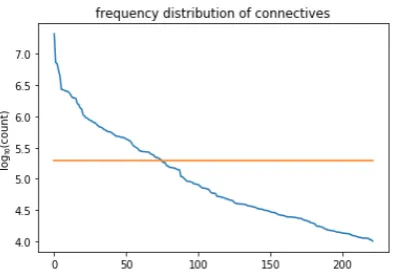
con-Figure 1: Frequency distribution of candidate discourse markers; the horizontal line indicates the subsampling threshold.
tains 19Mpairs.
We discovered 243 discourse marker candi-dates. Figure 1 shows their frequency distribu-tions. As expected, the most frequent markers dominate the training data, but when a wide range of markers is included, the rare ones still con-tribute up to millions of training instances. Out of the 42 single word PDTB markers that precede a comma, 31 were found by our rule. Some mark-ers are missing because of NLTK errors, which mainly result from morphological issues.3
2.3 Controlling for shallow features
As previously noted, some candidates discovered by our rule may not be actual discourse markers. In order to discard them, we put forward the hy-pothesis that actual discourse markers cannot be predicted with shallow lexical features. Inspired by Gururangan et al. (2018), we use a Fasttext classifier (Joulin et al., 2016) in order to predict
c froms02. The Fasttext classifier predicts labels from an average of word embeddings fed to a lin-ear classifier. We split the dataset in 5 folds, and we predict markers for each fold, while training on the remaining folds. We use a single epoch, ran-domly initialized vectors of size 100 (that can be unigrams, bigrams or trigrams) and a learning rate of 0.5.
In addition, we predictcfrom the concatenation ofs1 ands02 (using separate word representations
for each case). One might assume that the predic-tion of cin this case relies on the interaction be-tweens1 ands2; however, the features ofs1 and
s2within Fasttext’s setup only interact additively,
3For instance,
lovelyis tagged as an adverb because of its suffix, whilebesideswas never tagged as an adverb
which means that the classification most likely re-lies on individual cues in the separate sentences, rather than on their combination. In order to test this hypothesis, we introduce arandom shuffle op-eration: for each example (s1,s02,c),s02is replaced
by a random sentence from a pair that is equally linked byc(we perform this operation separately in train and test sets).
Table 3 indicates that shallow lexical fea-tures indeed yield relatively high prediction rates. Moreover, the shuffle operation indeed increases accuracy, which corroborates the hypothesis that classification with shallow features relies on indi-vidual cues from separate sentences, rather than their combination.
features accuracy (%)
majority rule 1.2
s2 18.6
s1-s2’ 21.9
s1-s2’ (shuffled) 24.8
Table 3: Accuracy when predicting candidate discourse markers using shallow lexical features
Tables 4 and 5 show the least and most pre-dictable discourse markers, and the corresponding recognition rate with lexical features.
candidate marker accuracy (%)
evidently, 0.0
frequently, 0.0
meantime, 0.0
truthfully, 0.0
[image:4.595.83.282.63.201.2]supposedly, 0.1
Table 4: Candidate discourse markers that are the most difficult to predict from shallow features
candidate marker accuracy (%)
defensively, 65.5
afterward 71.1
preferably, 71.9
this, 72.7
very, 90.7
[image:4.595.339.494.276.355.2] [image:4.595.337.495.618.713.2]Interestingly, the two most predictable candi-dates are not discourse markers. Upon inspection of harvested pairs, we noticed that even legitimate discourse markers can be guessed with relatively simple heuristics in numerous examples. For ex-ample,c=thirdlyis very likely to occur ifs1
con-tainssecondly. We use this information to option-ally filter out such simple instances, as described in the next section.
2.4 Dataset variations
In the following, we call our method Discovery. We create several variations of the sentence pairs dataset. In DiscoveryHard, we remove examples where the candidate marker was among the top 5 predictions in our Fasttext shallow model and keep only the 174candidate markers with a fre-quency of at least10k. Instances are then sampled randomly so that each marker appears exactly10k
times in the dataset.
Subsequently, the resulting set of discourse markers is also used in the other variations of our dataset. DiscoveryBasedesignates the dataset for which examples predicted with the Fasttext model were not removed. In order to measure the ex-tent to which the model makes use of the rela-tion between s1 and s02, we also create a
Dis-coveryShuffled dataset, which is the Discovery-Basedataset subjected to therandom shuffle oper-ation described previously. To isolate the contribu-tion of our discovery method, the dataset Discov-eryAdvdiscards all discourse markers from PDTB that were not found by our method. Also, in or-der to measure the impact of label diversity, Dis-covery10uses 174k examples for each of the10 most frequent markers,4thus totalling as many in-stances as DiscoveryBase. Finally,DiscoveryBig contains almost twice as many instances as Dis-coveryBase, i.e. 20kinstances for each discourse marker (although, for a limited number of mark-ers, the number of instances is slightly lower due to data sparseness).
3 Evaluation of sentence representation learning
3.1 Setup
Our goal is to evaluate the effect of using our various training datasets on sentence encoding, given encoders of equivalent capacity and similar
4They are:
however, hence, moreover, additionally, never-theless, furthermore, alternatively, again, next, therefore
setups. Thus, we follow the exact setup of In-fersent (Conneau et al., 2017), also used in the Dissent (Malmi et al., 2018) model: we learn to encode sentences into h with a bi-directional LSTM sentence encoder using element-wise max pooling over time. The dimension size of h is 4096. Word embeddings are fixed GloVe embed-dings with 300 dimensions, trained on Common Crawl 840B.5 A sentence pair (s1, s2) is
repre-sented with [h1, h2, h1 h2,|h2 −h1|],6 which
is fed to a softmax in order to predict a marker
c. Our datasets are split in 90% train, 5% vali-dation, and 5% test. Optimization is done with SGD (learning rate is initialized at0.1, decayed by 1%at each epoch and by80%if validation accu-racy decreases; learning stops when learning rate is below10−5 and the best model on training task
validation loss is used for evaluation; gradient is clipped when its norm exceeds5). Once the sen-tence encoder has been trained on a base task, the resulting sentence embeddings are tested with the SentEval library (Conneau et al.,2017).
We evaluate the different variations of our dataset we described above in order to analyze their effect, and compare them to a number of ex-isting models. Table7displays the tasks used for evaluation. For further analysis, table 9 displays the result ofLinguistic Probingusing the method byConneau et al.(2018). Although these tasks are primarily designed for understanding the content of embeddings, they also focus on aspects that are desirable to perform well in general semantic tasks (e.g. prediction of tense, or number of object).
3.2 Results
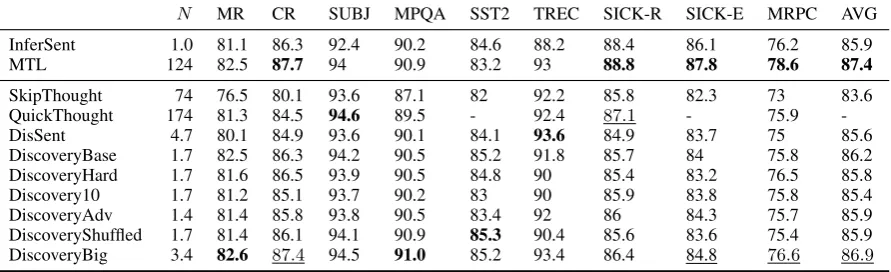
Table 6 gives an overview of transfer learning evaluation, also comparing to other supervised and unsupervised approaches. Note that we outper-form DisSent on all tasks except TREC7with less than half the amount of training examples. In ad-dition, our approach is arguably simpler and faster. MTL (Subramanian et al.,2018) only achieves stronger results than our method on the MRPC and SICK tasks. The MTL model uses 124M train-ing examples with an elaborate multi-task setup, training on 45M sentences with manual transla-tion,1M pairs from SNLI/MNLI,4M parse trees of sentences, and74Mconsecutive sentence pairs.
5
https://nlp.stanford.edu/projects/glove/
6h
1h2= (h11.h21, .., h1i.h2i, ...)
7This dataset is composed of questions only, which are
N MR CR SUBJ MPQA SST2 TREC SICK-R SICK-E MRPC AVG
InferSent 1.0 81.1 86.3 92.4 90.2 84.6 88.2 88.4 86.1 76.2 85.9 MTL 124 82.5 87.7 94 90.9 83.2 93 88.8 87.8 78.6 87.4
SkipThought 74 76.5 80.1 93.6 87.1 82 92.2 85.8 82.3 73 83.6 QuickThought 174 81.3 84.5 94.6 89.5 - 92.4 87.1 - 75.9 -DisSent 4.7 80.1 84.9 93.6 90.1 84.1 93.6 84.9 83.7 75 85.6 DiscoveryBase 1.7 82.5 86.3 94.2 90.5 85.2 91.8 85.7 84 75.8 86.2 DiscoveryHard 1.7 81.6 86.5 93.9 90.5 84.8 90 85.4 83.2 76.5 85.8 Discovery10 1.7 81.2 85.1 93.7 90.2 83 90 85.9 83.8 75.8 85.4 DiscoveryAdv 1.4 81.4 85.8 93.8 90.5 83.4 92 86 84.3 75.7 85.9 DiscoveryShuffled 1.7 81.4 86.1 94.1 90.9 85.3 90.4 85.6 83.6 75.4 85.9 DiscoveryBig 3.4 82.6 87.4 94.5 91.0 85.2 93.4 86.4 84.8 76.6 86.9
Table 6: SentEval evaluation results with our models trained on various datasets. The first two models are su-pervised, the other ones unsupervised. All scores are accuracy percentages, except SICK-R, which is Pearson correlation percentage. InferSent is fromConneau et al.(2017), MTL is the multi-task learning based model from Subramanian et al.(2018). Evaluation tasks are described in table7, andN denotes the number of examples for each dataset (in millions). Dissent is fromNie et al.(2017), QuickThought is fromLogeswaran and Lee(2018) with fixed embeddings configuration. The best result per task appears in bold, the best result for unsupervised setups is underlined.
The model also fine-tunes word embeddings in or-der to achieve a higher capacity. It is therefore re-markable that our model outperforms it on many tasks. Besides, MTL is not a direct competitor to our approach since its main contribution is its multi-task setup, and it could benefit from using our training examples.
Our best model rivals (and indeed often out-performs) QuickThought on all tasks, except re-latedness (SICK-R). QuickThought’s training task is to predict whether two sentences are contigu-ous, which might incentivize the model to perform well on a relatedness task. We also outperform In-ferSent on many tasks except entailment and relat-edness. Entailment prediction is the explicit train-ing signal for Infersent.
To help the analysis of our different model vari-ations, table 8 displays the test scores on each dataset for the original training task. It also shows the related PDTB implicit relation predic-tion scores. The PDTB is annotated with a hierar-chy of relations, with 5 classes at level 1 (includ-ing the EntRel relation), and 16 at level 2 (with one relation absent from the test). It is interest-ing to see that this form of simple semi-supervised learning for implicit relation prediction performs quite well, especially for fine-grained relations, as the best model slightly beats the best current ded-icated model, listed at 40.9% inXue et al.(2017). DiscoveryHardscores lower on its training task than DiscoveryBase, and it also performs worse on transfer learning tasks. This makes sense, since lexical features are important to solve the
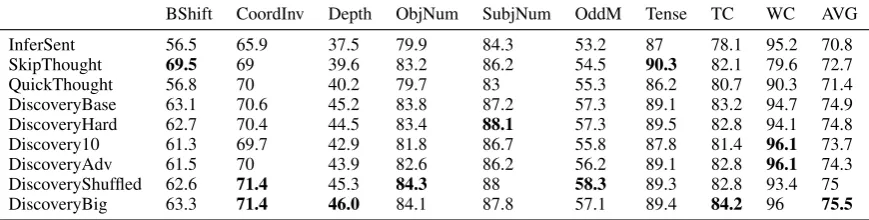
evaluation tasks. Our initial hypothesis was that more difficult instances might force the model to use higher-level reasoning, but this does not seem to be the case. More surprisingly, prevent-ing the encoders to use the relationship between sentences, as inDiscoveryShuffled, does not sub-stantially hurt the transfer performance, which re-mains on average higher than Nie et al. (2017). Additionally, our models score well on linguistic probing tasks. They outperform Infersent on all tasks, which seems to contradict the claim that SNLI data allows for learning of universal sen-tence representations (Conneau et al.,2017). And a final interesting outcome is that the diversity of markers (e.g. usingDiscoveryBaseinstead of Dis-covery10) seems to be important for good perfor-mance on those tasks, since Discovery10has the worst overall performance on average.
name N task C
MR 11k sentiment (movie reviews) 2 CR 4k sentiment (product reviews) 2 SUBJ 10k subjectivity/objectivity 2 MPQA 11k opinion polarity 2
TREC 6k question-type 6
SST 70k sentiment (movie reviews) 2
SICK-E 10k entailment 3
SICK-R 10k relatedness 3
MRPC 4k paraphrase detection 2 PDTB5 17k implicit discourse relation (coarse) 5
[image:6.595.77.523.64.200.2]PDTB16 17k implicit discourse relation (fine) 15
30 20 10 0 10 20 30 30 20 10 0 10 20 notably, especially, first, and ironically, further, particularly, realistically, for_example alternatively but regardless, yet, then, incidentally, typically, [no-marker] really, truthfully, suddenly, for_instance secondly, importantly, second, in_other_words theoretically, locally, because_of_that simultaneously actually, because_of_this undoubtedly, thereby, by_doing_this, meaning, specifically, essentially, later, thirdly, ideally, technically, in_contrast, honestly, frequently, by_then presumably, hopefully, nonetheless anyway, thankfully, originally, seriously, currently, firstly, strangely, generally, altogether, separately, frankly, in_particular, initially, indeed, occasionally, arguably, afterward normally, amazingly, otherwise, nationally, ultimately, apparently, collectively, previously, slowly, naturally, in_fact, maybe, historically, on_the_contrary, namely, surprisingly, though, by_contrast, in_short, personally, together, finally, here, next, plus, usually, alternately, often, subsequently, surely, certainly, recently, conversely interestingly, this, absolutely, unsurprisingly, in_turn, inevitably, traditionally, elsewhere, in_the_end, obviously, thus, or, once, luckily, in_sum, by_comparison, increasingly, moreover nevertheless third, instead, on_the_other_hand unfortunately, thereafter, sadly, consequently meantime, perhaps, mostly, already, truly, oddly, curiously, lately, overall, lastly, evidently, similarly, again, rather, hence, accordingly furthermore only, also, likewise, soon, in_the_meantime, significantly, fortunately, clearly, eventually, therefore optionally, presently, meanwhile, admittedly, still, remarkably, coincidentally, probably, well, supposedly, immediately, although, now, happily, additionally preferably, however so, as_a_result, gradually, besides, sometimes, basically,
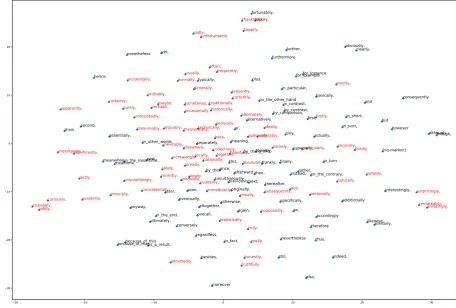
Figure 2: TSNE visualization of the softmax weights from ourDiscoveryBigmodel for each discourse marker, after unit norm normalization. Markers discovered by our method (e.g. absent from PDTB annotations) are colored in red. PDTB5 coarse PDTB16 fine T
InferSent 46.7 34.2
-DisSent 48.9 36,9
[image:7.595.86.275.434.546.2]-DiscoveryBase 52.5 40.0 20.6 DiscoveryHard 50.7 39.8 9.3 Discovery10 48.3 37.7 51.9 DiscoveryAdv 49.7 37.6 26.1 DiscoveryShuffled 51.0 39.5 11.5 DiscoveryBig 51.3 41.3 22.2
Table 8: Test results (accuracy) on implicit discursive relation prediction task (PDTB relations level 1 and 2, i.e coarse-grained and fine-grained) and training tasks
T. Note that scores forT are not comparable since the test set changes for each version of the dataset.
3.3 Visualisation
The softmax weights learned during the training phase can be interpreted as embeddings for the markers themselves, and used to visualize their relationships. Figure 2 shows a TSNE (van der Maaten and Hinton, 2008) plot of the markers’ representations. Proximity in the feature space seems to reflect semantic similarity (e.g.
usu-ally/normally). In addition, the markers we dis-covered, colored in red, blend with the PDTB markers (depicted in black). It would be interest-ing to cluster markers in order to empirically de-fine discourse relations, but we leave this for future work.
4 Related work
Though discourse marker prediction in itself is an interesting and useful task (Malmi et al., 2017), discourse markers have often been used as a train-ing cue in order to improve implicit relation pre-diction (Marcu and Echihabi,2001;Sporleder and Lascarides, 2005; Zhou et al., 2010; Braud and Denis, 2016). This approach has been extended to general representation learning byJernite et al.
BShift CoordInv Depth ObjNum SubjNum OddM Tense TC WC AVG
[image:8.595.82.517.64.174.2]InferSent 56.5 65.9 37.5 79.9 84.3 53.2 87 78.1 95.2 70.8 SkipThought 69.5 69 39.6 83.2 86.2 54.5 90.3 82.1 79.6 72.7 QuickThought 56.8 70 40.2 79.7 83 55.3 86.2 80.7 90.3 71.4 DiscoveryBase 63.1 70.6 45.2 83.8 87.2 57.3 89.1 83.2 94.7 74.9 DiscoveryHard 62.7 70.4 44.5 83.4 88.1 57.3 89.5 82.8 94.1 74.8 Discovery10 61.3 69.7 42.9 81.8 86.7 55.8 87.8 81.4 96.1 73.7 DiscoveryAdv 61.5 70 43.9 82.6 86.2 56.2 89.1 82.8 96.1 74.3 DiscoveryShuffled 62.6 71.4 45.3 84.3 88 58.3 89.3 82.8 93.4 75 DiscoveryBig 63.3 71.4 46.0 84.1 87.8 57.1 89.4 84.2 96 75.5
Table 9: Accuracy of various models on linguistic probing tasks using logistic regression on SentEval. BShift is detection of token inversion. CoordInv is detection of clause inversion. ObjNum/SubjNum is prediction of the number of object resp. subject. Tense is prediction of the main verb tense. Depth is prediction of parse tree depth. TC is detection of common sequences of constituents. WC is prediction of words contained in the sentence. OddM is detection of random replacement of verbs/nouns by other verbs/nouns. AVG is the average score of those tasks for each model. For more details seeConneau et al.(2018). SkipThought and Infersent results come fromPerone et al.(2018), QuickThought results come fromBrahma(2018).
which uses a much simpler training task. Both of these rely on pre-established lists of discourse markers provided by the PDTB, and both per-form a manual annotation for each marker—Nie et al.(2017) uses dependency patterns, while Jer-nite et al.(2017) uses broad discourse categories. Our work is the first to automatically discover dis-course markers from text.
More generally, various automatically extracted training signals have been used for unsupervised learning tasks. Hashtags (Felbo et al.,2017) have been sucessfully exploited in order to learn sen-timent analysis from unlabelled tweets, but their availability is mainly limited to the microblog-ging domain. Language modeling provides a gen-eral training signal for representation learning, even though there is no obvious way to derive sentence representations from language models. BERT (Devlin et al., 2018) currently holds the best results in transfer learning based on language modeling, but it relies on sentence pair classifi-cation in order to compute sentence embeddings, and it makes use of a simple sentence contigu-ity detection task (like QuickThought); this task does not seem challenging enough since BERT re-portedly achieves 98% detection accuracy. Phang et al.(2018) showed that the use of SNLI datasets yields significant gains for the sentence embed-dings from Radford (2018), which are based on language modeling.
For the analysis of our models, we draw inspira-tion from critical work on Natural Language Infer-ence datasets (Dasgupta et al., 2018;Levy et al.,
2018). Gururangan et al. (2018); Poliak et al.
(2018) show that baseline models that disregard
the hypothesis yield good results on SNLI, which suggests that the model does not perform the high level reasoning we would expect in order to pre-dict the correct label. They attribute this effect to bias in human annotations. In this work, we show that this issue is not inherent to human la-beled data, and propose theshuffleperturbation in order to measure to what extent the relationship between sentences is used.
5 Conclusion
range of discourse markers, such as multi-word markerse.
References
Regina Barzilay and Mirella Lapata. 2008. Model-ing Local Coherence: An Entity-Based Approach. Computational Linguistics, 34(1):1–34.
Steven Bird, Ewan Klein, and Edward Loper. 2009.
Natural Language Processing with Python, vol-ume 43.
Siddhartha Brahma. 2018. Unsupervised learning of sentence representations using sequence consis-tency. CoRR, abs/1808.04217.
Chlo´e Braud and Pascal Denis. 2016. Learning connective-based word representations for implicit discourse relation identification. InProceedings of the 2016 Conference on Empirical Methods in Nat-ural Language Processing, pages 203–213, Austin, Texas. Association for Computational Linguistics.
Lynn Carlson, Daniel Marcu, and Mary Ellen Okurovsky. 2001. Building a discourse-tagged cor-pus in the framework of rhetorical structure theory. InProceedings of the SIGDIAL 2001 Workshop, The 2nd Annual Meeting of the Special Interest Group on Discourse and Dialogue, Saturday, September 1, 2001 to Sunday, September 2, 2001, Aalborg, Den-mark.
Alexis Conneau, Douwe Kiela, Holger Schwenk, Lo¨ıc Barrault, and Antoine Bordes. 2017. Supervised learning of universal sentence representations from natural language inference data. InEMNLP, pages 670–680. Association for Computational Linguis-tics.
Alexis Conneau, Germ´an Kruszewski, Guillaume Lample, Lo¨ıc Barrault, and Marco Baroni. 2018. What you can cram into a single vector: Probing sentence embeddings for linguistic properties. In Proceedings of the 56th Annual Meeting of the As-sociation for Computational Linguistics (Volume 1: Long Papers), pages 2126–2136. Association for Computational Linguistics.
Ishita Dasgupta, Demi Guo, Andreas Stuhlm¨uller, Samuel J. Gershman, and Noah D. Goodman. 2018. Evaluating Compositionality in Sentence Embed-dings. (2011).
Jacob Devlin, Ming-Wei Chang, Kenton Lee, and Kristina Toutanova. 2018. Bert: Pre-training of deep bidirectional transformers for language understand-ing. arXiv preprint arXiv:1810.04805.
Bjarke Felbo, Alan Mislove, Anders Sogaard, Iyad Rahwan, and Sune Lehmann. 2017. Using millions of emoji occurrences to learn any-domain represen-tations for detecting sentiment, emotion and sar-casm. InEMNLP.
Max Glockner, Vered Shwartz, and Yoav Goldberg. 2018. Breaking NLI Systems with Sentences that Require Simple Lexical Inferences. Proceedings of the 56th Annual Meeting of the Association for Com-putational Linguistics (Short Papers), (3):1–6.
Edouard Grave, Piotr Bojanowski, Prakhar Gupta, Ar-mand Joulin, and Tomas Mikolov. 2018. Learning Word Vectors for 157 Languages. InProceedings of the Eleventh International Conference on Language Resources and Evaluation (LREC 2018), Miyazaki, Japan. European Language Resources Association (ELRA).
Suchin Gururangan, Swabha Swayamdipta, Omer Levy, Roy Schwartz, Samuel R. Bowman, and Noah A. Smith. 2018. Annotation Artifacts in Nat-ural Language Inference Data.
Yacine Jernite, Samuel R. Bowman, and David Sontag. 2017. Discourse-Based Objectives for Fast Unsu-pervised Sentence Representation Learning.
Armand Joulin, Edouard Grave, Piotr Bojanowski, and Tomas Mikolov. 2016. Bag of tricks for efficient text classification. Cite arxiv:1607.01759.
Ryan Kiros, Yukun Zhu, Ruslan R Salakhutdinov, Richard Zemel, Raquel Urtasun, Antonio Torralba, and Sanja Fidler. 2015. Skip-thought vectors. In Advances in neural information processing systems, pages 3294–3302.
Omer Levy, Samuel R Bowman, and Noah A Smith. 2018. Annotation Artifacts in Natural Language In-ference Data. Proceedings of NAACL-HLT 2018, pages 107–112.
Lajanugen Logeswaran and Honglak Lee. 2018. An efficient framework for learning sentence represen-tations. pages 1–16.
Lajanugen Logeswaran, Honglak Lee, and Dragomir Radev. 2016. Sentence Ordering using Recurrent Neural Networks. pages 1–15.
Laurens van der Maaten and Geoffrey Hinton. 2008. Visualizing data using t-SNE. Journal of Machine Learning Research, 9:2579–2605.
Eric Malmi, Daniele Pighin, Sebastian Krause, and Mikhail Kozhevnikov. 2017. Automatic Prediction of Discourse Connectives.
Eric Malmi, Daniele Pighin, Sebastian Krause, and Mikhail Kozhevnikov. 2018. Automatic Prediction of Discourse Connectives. In Proceedings of the Eleventh International Conference on Language Re-sources and Evaluation (LREC 2018), Miyazaki, Japan. European Language Resources Association (ELRA).
Daniel Marcu and Abdessamad Echihabi. 2002. An unsupervised approach to recognizing discourse re-lations. InProceedings of the 40th Annual Meeting on Association for Computational Linguistics, pages 368–375.
Allen Nie, Erin D. Bennett, and Noah D. Goodman. 2017. DisSent: Sentence Representation Learning from Explicit Discourse Relations.
Alexander Panchenko, Eugen Ruppert, Stefano Far-alli, Simone P Ponzetto, and Chris Biemann. 2017. Building a Web-Scale Dependency-Parsed Corpus from Common Crawl. pages 1816–1823.
Christian S. Perone, Roberto Silveira, and Thomas S. Paula. 2018. Evaluation of sentence embeddings in downstream and linguistic probing tasks. CoRR, abs/1806.06259.
Jason Phang, Thibault F´evry, and Samuel R. Bowman. 2018. Sentence encoders on stilts: Supplementary training on intermediate labeled-data tasks. CoRR, abs/1811.01088.
Emily Pitler and Ani Nenkova. 2009. Using syntax to disambiguate explicit discourse connectives in text. InACL 2009, Proceedings of the 47th Annual Meet-ing of the Association for Computational LMeet-inguistics and the 4th International Joint Conference on Natu-ral Language Processing of the AFNLP, 2-7 August 2009, Singapore, Short Papers, pages 13–16.
Emily Pitler, Mridhula Raghupathy, Hena Mehta, Ani Nenkova, Alan Lee, and Aravind Joshi. 2008. Eas-ily identifiable discourse relations. InColing 2008: Companion volume: Posters, pages 87–90. Coling 2008 Organizing Committee.
Adam Poliak, Jason Naradowsky, Aparajita Haldar, Rachel Rudinger, and Benjamin Van Durme. 2018. Hypothesis Only Baselines in Natural Language In-ference.Proceedings of the 7th Joint Conference on Lexical and Computational Semantics, (1):180–191.
Rashmi Prasad, Nikhil Dinesh, Alan Lee, Eleni Milt-sakaki, Livio Robaldo, Aravind Joshi, and Bon-nie Webber. 2008. The penn discourse tree-bank 2.0. In Proceedings of the Sixth Inter-national Conference on Language Resources and Evaluation (LREC’08), Marrakech, Morocco. Eu-ropean Language Resources Association (ELRA). Http://www.lrec-conf.org/proceedings/lrec2008/.
Alec Radford. 2018. Improving language understand-ing by generative pre-trainunderstand-ing.
Attapol Rutherford and Nianwen Xue. 2015. Im-proving the inference of implicit discourse rela-tions via classifying explicit discourse connectives. In NAACL HLT 2015, The 2015 Conference of the North American Chapter of the Association for Computational Linguistics: Human Language Tech-nologies, Denver, Colorado, USA, May 31 - June 5, 2015, pages 799–808.
Caroline Sporleder and Alex Lascarides. 2005. Ex-ploiting linguistic cues to classify rhetorical rela-tions. InProceedings of Recent Advances in Natural Langauge Processing (RANLP), Bulgaria.
Caroline Sporleder and Alex Lascarides. 2008. Using automatically labelled examples to classify rhetori-cal relations: an assessment.Natural Language En-gineering, 14(3):369–416.
Sandeep Subramanian, Adam Trischler, Yoshua Ben-gio, and Christopher J Pal. 2018. Learning gen-eral purpose distributed sentence representations via large scale multi-task learning. International Con-ference on Learning Representations.
Nianwen Xue, Vera Demberg, and Attapol Rutherford. 2017. A systematic study of neural discourse mod-els for implicit discourse relation. InProceedings of the 15th Conference of the European Chapter of the Association for Computational Linguistics, EACL 2017, Valencia, Spain, April 3-7, 2017, Volume 1: Long Papers, pages 281–291.