2248
Latent Code and Text-based Generative Adversarial Networks for
Soft-text Generation
Md. Akmal Haidar, Mehdi Rezagholizadeh, Alan Do-Omri and Ahmad Rashid Huawei Noah’s Ark Lab, Montreal Research Center, Canada
[email protected], [email protected] [email protected], [email protected]
Abstract
Text generation with generative adversarial networks (GANs) can be divided into the text-based and code-text-based categories according to the type of signals used for discrimination. In this work, we introduce a novel text-based ap-proach called Soft-GAN to effectively exploit GAN setup for text generation. We demon-strate how autoencoders (AEs) can be used for providing a continuous representation of sentences, which we will refer to as soft-text. This soft representation will be used in GAN discrimination to synthesize similar soft-texts. We also propose hybrid latent code and text-based GAN (LATEXT-GAN ) approaches with one or more discriminators, in which a combination of the latent code and the soft-text is used for GAN discriminations. We per-form a number of subjective and objective ex-periments on two well-known datasets (SNLI and Image COCO) to validate our techniques. We discuss the results using several evalua-tion metrics and show that the proposed tech-niques outperform the traditional GAN-based text-generation methods.
1 Introduction
Text generation is an active research area and has many real-world applications, including, but not limited to, machine translation (Bahdanau et al., 2014), AI chat bots (Li et al., 2017), im-age captioning (Xu et al., 2014), question an-swering and information retrieval (Wang et al.,
2017). Recurrent neural network language mod-els (RNNLMs) (Mikolov et al.,2010) is the most popular approach for text generation which rely on maximum likelihood estimation (MLE) solu-tions such as teacher forcing (Williams and Zipser,
1989) (i.e. the model is trained to predict the next word given all the previous predicted words); however, it is well-known in the literature that MLE is a simplistic objective for this complex
NLP task (Li et al.,2017). It is reported that MLE-based methods suffer from exposure bias (Huszr,
2015), which means that at training time the model is exposed to gold data only, but at test time it ob-serves its own predictions. Hence, wrong predic-tions quickly accumulate and result in poor text generation quality.
However, generative adversarial networks (GANs) (Goodfellow et al., 2014) which are based on an adversarial loss function suffers less from the mentioned problems of the MLE solutions. The great success of GANs in image generation framework (Salimans et al., 2016) motivated researchers to apply its framework to NLP applications as well. GANs have been exten-sively used recently in various NLP applications such as machine translation (Wu et al., 2017;
Yang et al., 2017a), dialogue models (Li et al.,
2017), question answering (Yang et al., 2017b), and natural language generation (Gulrajani et al.,
2017; Rajeswar et al., 2017; Press et al., 2017;
Kim et al.,2017;Zhang et al.,2017;Cifka et al.,
2018;Spinks and Moens,2018;Haidar and Reza-gholizadeh,2019;Gagnon-Marchand et al.,2019;
Rashid et al.,2019). However, applying GAN in NLP is challenging due to the discrete nature of the text. Consequently, back-propagation would not be feasible for discrete outputs and it is not straightforward to pass the gradients through the discrete output words of the generator.
mod-eling text directly. Text-based solutions, such as reinforcement learning (RL) based methods or ap-proaches based on continuous approximation of discrete sampling, focus on generating text di-rectly from the generator. RL-based methods treat the distribution of GAN generator as a stochas-tic policy and hold the discriminator responsible for providing proper reward for the generator’s ac-tions. However, the RL-based methods often need pre-training and are computationally more expen-sive compared to the methods of the other two categories. In the continuous approximation ap-proach for generating text with GANs, the goal is to find a continuous approximation of the dis-crete sampling by using the Gumbel Softmax tech-nique (Kusner and Hern´andez-Lobato, 2016) or approximating the non-differentiable argmax op-erator with a continuous function (Zhang et al.,
2017;Gulrajani et al.,2017).
In this paper, we introduce Soft-GAN as a new solution for the main bottleneck of using GAN for text generation. Our solution is based on an AE to derive a soft representation of the real text (i.e. soft-text). This soft-text is fed to the GAN discriminator instead of the conventional one-hot representation used in (Gulrajani et al., 2017). Furthermore, we propose hybrid latent code and text-based GAN (LATEXT-GAN) approaches and show that how we can improve code-based and text-based text generation techniques by consider-ing both signals in the GAN framework. We sum-marize the main contributions of this paper as:
• We introduce a new text-based solution Soft-GAN using the above soft-text discrimina-tion. We also demonstrate the rationale be-hind this approach.
• We introduce LATEXT-GAN approaches for GAN-based text generation using both latent code and soft-text discrimination. To the best of our knowledge, this is the first time where a GAN-based text generation framework uses both code and text-based discrimination.
• We evaluate our methods using subjective and objective evaluation metrics. We show that our proposed approaches outperform the conventional GAN-based text generation techniques that do not need pre-training.
2 Background
Generative adversarial networks include two sepa-rate deep networks: a generator and a discrimina-tor. The generatorGθtakes in a random variable,z
following a distributionPz(z)and attempt to map
it to the real data distributionPx(x). The output
distribution of the generator is expected to con-verge to the real data distribution during the train-ing. On the other hand, the discriminator fw is
expected to discern real samples from generated ones by outputting zeros and ones, respectively. During training, the generator and discriminator generate samples and classify them, respectively by adversarially affecting the performance of each other. In this regard, an adversarial loss function is employed for training (Goodfellow et al.,2014):
min
θ maxw (Ex∼Px(x)fw(x)+
Ez∼Pz(z)(1−fw(Gθ(z))))
(1)
As stated, using GANs for text generation is challenging because of the discrete nature of text. The main bottleneck is theargmaxoperator which is not differentiable and blocks the gradient flow from the discriminator to the generator.
min
θ Ez∼Pz(z)(1−fw(argmax(Gθ(z)))) (2)
3 Related Work
Morever, several versions of the RL-based tech-niques using GAN have been introduced in the literature including Seq-GAN (Yu et al., 2017), RankGAN (Lin et al., 2017), MaliGAN (Che et al., 2017), LeakGAN (Guo et al., 2017), and MaskGAN (Fedus et al.,2018).
Code-based Solutions AEs have been ex-ploited along with GANs in different architec-tures for computer vision application such as AAE (Makhzani et al., 2015), ALI (Dumoulin et al., 2016), and HALI (Belghazi et al., 2018). Similarly, AEs can be used with GANs for gen-erating text. For instance, ARAE was proposed in (Kim et al.,2017) where it employs a discrete auto-encoder to learn continuous codes based on discrete inputs with a WGAN objective to learn an implicit probabilistic model over these codes. ARAE aims at exploiting GANs ability to push the generator to follow a continuous code space corresponding to the encoded real text in the AE. The generated code is then used by the decoder to generate the synthetic texts. A different version of the ARAE method was also introduced in (Spinks and Moens,2018). In (Subramanian et al.,2018), sentence embeddings were learned by a generator to model a pre-trained sentence representation ob-tained by a general-purpose sentence encoder. A temperature sweeping framework was discussed in (Caccia et al., 2018) to evaluate the text gen-eration models over whole quality-diversity spec-trum and pointed out the fundamental flaws of quality-only evaluation. The Variational autoen-coders (VAEs) (Kingma and Welling,2013) were also applied for text generation in (Bowman et al.,
2015;Hu et al.,2017).
4 Methodology
In this section, we introduce a new text-based so-lution by discriminating the reconstructed output of an AE (i.e., soft-text) with the synthesized gen-erated text and we call it as Soft-GAN. Here, we use the decoder of the AE as the generator to gen-erate the synthesized texts from random noise data
z. The model is described in Figure 1a. We demonstrate the rationale behind this soft-GAN approach, which is to make the discrimination task of the discriminator between the real and synthetic texts more difficult and consequently providing a richer signal to the generator. We also introduce three LATEXT-GAN approaches where both code and text-based signals will be used in the GAN
framework. We introduce LATEXT-GAN I ap-proach on top of the AAE method. LATEXT-GAN II and III approaches will be proposed based on the ARAE approach. In the LATEXT-GAN I and II techniques, we use separate discriminators for the code and text discriminations. In the LATEXT-GAN III approach, the concatenation of the syn-thetic code and the synsyn-thetic text tries to mimic the concatenation of the latent code and the soft-text using a discriminator. The schematic diagram of the LATEXT-GAN I, II, and III approaches are described in Figures 1b, 1c, and 1d respectively. We share the parameters of the decoder of the AE to generate the synthesized text xˆ. In order to
x One-hot representation of the training text
˜
x Soft-text: Reconstructed output of the AE
ˆ
x Synthesized generated text
¯
x [¯x∼Px¯]←α[˜x∼Px˜] + (1−α) [ˆx∼Pxˆ] z∼N Random data drawn from a normal
distribution
c Latent code representation of the training text
ˆ
c Synthesized generated code
¯
c [¯c∼P¯c]←α[c∼Pc] + (1−α) [ˆc∼Pˆc] ¯
cz [ ¯cz∼Pcz]¯ ←α[c∼Pc] + (1−α) [z∼Pz] wt+c Parameters of the combination of text
and code-based discriminator
wt Parameters of the text-based discriminator
wc Parameters of the code-based discriminator φ Parameters of the encoder
ψ Parameters of the decoder
θ Parameters of the generator
λ Gradient penalty co-efficient
[image:3.595.310.527.270.495.2]∇ describes gradient
Table 1: Notations that are used in this paper
train these approaches, we train the auto-encoder and the GAN alternatingly by minimizing their loss functions using the WGAN-gradient penalty (WGAN-GP) approach (Gulrajani et al., 2017). In each iteration, the first step is the AE training in all of these techniques followed by the GAN loss functions. The autoencoder can be trained by using a cross-entropy or mean-squared loss func-tions. The inputxto the AE is mapped to a latent code representation c which is decoded to soft-text x˜. In our experiments, we train the auto-encoder using mean-squared loss min
(φ,ψ)
||x−x˜||2.
(a) Soft-GAN (b) LATEXT-GAN I (c) LATEXT-GAN II (d) LATEXT-GAN III
Figure 1: Proposed Approaches
4.1 Soft-GAN
As stated, in conventional text-based discrimina-tion approach IWGAN (Gulrajani et al., 2017), the real and the synthesized generated text are de-scribed by the one-hot and the softmax represe-nation respectively. A disadvantage of this tech-nique is that the discriminator is able to tell apart the one-hot input from the softmax input very eas-ily. One way to avoid this issue is to derive a con-tinuous representation of words rather than their one-hot and train the discriminator to differenti-ate between the continuous representations. We use a conventional AE to replace the one-hot rep-resentation with softmax reconstructed output (x˜), which we refer to as soft-text. This soft-text rep-resentation is used as the real input to the discrim-inator. The synthetic generated textxˆis obtained by inputting the random noise datazto the shared decoder. We define the proposed method as Soft-GAN. In each iteration, the model is trained using the following steps after the AE training step:
• Train the text-based discriminator fwt fork times and the decoder once using the loss
Lcritict to maximize the ability of thefwt to discriminate betweenx˜andxˆ:
Lcritict = min (wt,ψ)
(−E˜x∼P˜x[fwt(˜x)] +Eˆx∼Pˆx
[fwt(ˆx)] +λEx¯∼Px¯[(||∇x¯fwt(¯x)||2−1) 2])
(3)
• Train the decoder based on the loss Lgen
to fool the discriminator with improving the representationxˆ:
Lgen= min
ψ (−Exˆ∼Pxˆ[fwt(ˆx)] +Ex˜∼Px˜
[fwt(˜x)])
(4)
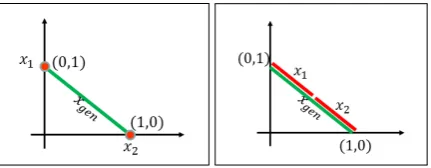
Figure 2: Locus of the input vectors to the discriminatorfwtfor a two-word language; Left panel: IWGAN, Right panel: Soft-GAN
4.1.1 Rationale: Why Soft-GAN should Work Better than IWGAN?
Suppose we have a language of vocabulary size of two words: x1 andx2. In the IWGAN approach, the one-hot representation of these two words (as two points in the Cartesian coordinates) and the span of the generated softmax outputs (as a line segment connecting them) is depicted in the left panel of Figure2. As evident graphically, the task of the critic is to discriminate the points from the line connecting them, which is a rather simple very easy task, which makes it more prone to vanishing gradient.
On the other hand, the output locus of the soft-GAN decoder would be two red line segments as depicted in Figure2 (Right panel) instead of two points (in the one-hot case). The two line seg-ments lie on the output locus of the generator, which will make the generator more successful in fooling the critic.
4.2 LATEXT-GAN I
random noise data to the shared decoder. The code-based discriminatorfwc is used to discrim-inate the random noise datazwith the latent code
cin the AAE setting which was explored for im-age generation. In the AAE setting (Makhzani et al., 2015), the encoder enhances its represen-tation to a prior distributionz. It can be seen that the LATEXT-GAN I can be obtained by adding the above code-based discriminatorfwc into the Soft-GAN. In each iteration, the model is trained us-ing the followus-ing steps after the AE trainus-ing step and the Equation3 step of the Soft-GAN in sec-tion4.1:
• Train the code-based discriminatorfwc fork times using the lossLcriticc to maximize the ability of thefwc to discriminate betweenc andz:
Lcriticc = min
wc
(Ec∼Pc[fwc(c)]−
Ez∼Pz[fwc(z)]+
λEcz¯∼Pcz¯[(||∇cz¯fwc( ¯cz)||2−1) 2])
(5)
• Train the encoder and the decoder neural net-works once with the lossLgento fool the
dis-criminatorsfwc andfwt with improving the representationscandxˆrespectively:
Lgen = min
(φ,ψ)(−Eˆx∼Pˆx[fwt(ˆx)] +E˜x∼P˜x
[fwt(˜x)] +Ez∼Pz[fwc(z)]−Ec∼Pc[fwc(c)]) (6)
4.3 LATEXT-GAN II
The LATEXT-GAN II approach (Figure 1c) is similar to the LATEXT-GAN I approach except the training of the code-based discriminator fwc is done as the ARAE training. The critic fwc is used to discriminate the synthetic codeˆcwith the latent code c. Here, the synthetic code is formed by using the ARAE method (Spinks and Moens,
2018). For each iteration in the model training, the AE training step and the Equation3step of the Soft-GAN in section4.1are carried out first. Then the following two steps are performed:
• Train the code-based discriminator fwc for
ktimes and the encoder once using the loss
Lcriticc to maximize the ability of thefwc to discriminate betweencandcˆ:
Lcriticc = min (wc,φ)
(−Ec∼Pc[fwc(c)] +Ecˆ∼Pˆc
[fwc(ˆc)] +λE¯c∼P¯c[(||∇¯cfwc(¯c)||2−1) 2])
(7)
• Train the generator and the decoder neural networks once using the lossLgento fool the
discriminators fwt and fwc with improving the representationsxˆandˆcrespectively:
Lgen = min
(θ,ψ)(
−Exˆ∼Pxˆ[fwt(ˆx)] +E˜x∼Px˜
[fwt(˜x)]−Ecˆ∼Pˆc[fwc(ˆc)] +Ec∼Pc[fwc(c)]) (8)
4.4 LATEXT-GAN III
In the third approach (Figure1d), the combination of latent codec generated by ARAE (Spinks and Moens,2018) and the soft-text outputx˜of an AE is used to signal the discriminator. We performed this combination by getting inspiration from an Adversarially Learned Inference (ALI) paper (Du-moulin et al., 2016) introduced for image genera-tion. We call it as LATEXT-GAN III. Here, the discriminatorfwt+ctries to determine which com-bination of the samples derive from the latent code and the soft-text, (x˜,c), and which (x,ˆ ˆc) are gener-ated from the noisez. After the AE training step
min
(φ,ψ)
||x − x˜||2, the LATEXT-GAN III model is
trained using the next two steps in each iteration:
• Train the discriminatorfwt+cforktimes, the encoder and the decoder once using the loss
Lcritict+c to maximize the ability of the dis-criminator network to discriminate between (x˜,c) and (x,ˆ ˆc):
Lcritict+c = min (wt+c,φ,ψ)
(−E(˜x,c)∼Px˜,Pc
[fwt+c(˜x, c)] +E(ˆx,ˆc)∼Pˆx,Pˆc[fwt+c(ˆx,cˆ)]+
λE(¯x,¯c)∼Px¯,P¯c[(||∇(¯x,¯c)fwt+c(¯x,¯c)||2−1) 2]) (9)
• Train the generator and the decoder once based onLgento fool the discriminatorfwt+c with improving the representation (x,ˆ ˆc):
Lgen = min
(θ,ψ)(
−E(ˆx,cˆ)∼Pˆx,Pcˆ[fwt+c(ˆx,ˆc)]
+E(˜x,c)∼Px˜,Pc[fwt+c(˜x, c)])
(10) 5 Experiments
5.1 Dataset and Experimental Procedures
We do our experiments on two different datasets: the Stanford Natural Language Inference (SNLI) corpus 1, which contains 714,667 sentences for
training and 13323 sentences for testing, and the Image COCO 2 dataset’s image caption annota-tions, where we sample 3 10,000 sentences as training set and another 10,000 as test set (Zhu et al., 2018). We perform word-based experi-ments. For the SNLI dataset, we use a vocabulary size of 10000 words and use the maximum sen-tence length of size 15. For the COCO dataset, we use a vocabulary size of 5000 and perform experi-ments using the maximum sentence length of sizes 15 and 20. We train a simple AE using one layer with 512 LSTM cells (Hochreiter and Schmidhu-ber, 1997) for both the encoder and the decoder. For decoding, the output from the previous time step is used as the input to the next time step. We use the hidden code c from the last time step of the encoder and applied as an additional input at each time step of decoding. We normalize the code and then added an exponentially decaying noise before decoding. The greedy search approach is applied to get the best output. We train the auto-encoder using Adam (Diederik and Jimmy,2014) optimizer with learning rate = 0.001,β1= 0.9, and
β2= 0.999. We use CNN-based generator and dis-criminator with residual blocks (Gulrajani et al.,
2017). Thetanh function is applied on the out-put of the ARAE generator (Kim et al., 2017). We train the generator and the discriminator using Adam optimizer with learning rate = 0.0001,β1= 0.5, andβ2= 0.9. We do not apply any kind of at-tention mechanisms (Bahdanau et al.,2014;Zhang et al.,2018) and pre-training (Zhu et al.,2018) in our experiments. We use the WGAN-GP ( Gul-rajani et al.,2017) approach with 5 discriminator updates for every generator update and a gradient penalty co-efficient ofλ=10 unlike a setup in (Zhu et al.,2018). For the AAE-based experiments, we normalize the data drawn from a prior distribution
z. We train the models for 200000 iterations where in each iteration we sample a random batch and train the networks of the models.
5.2 Quantitative Evaluation
We use the frequently used BLEU metric ( Pap-ineni et al., 2002) to evaluate the word similar-ity between sentences and the perplexsimilar-ity to eval-uate our techniques. We calculate BLEU-n scores for n-grams without a brevity penalty (Zhu et al.,
2018). The results with the best BLEU-n scores in the synthesized generated texts are reported.
2
http://cocodataset.org
3https://github.com/geek-ai/Texygen/tree/master/data
To calculate the BLEU-n scores, we generate ten batches of sentences as candidate texts, i.e. 640 sentences and use the entire test set as reference texts. As the GAN-based models usually suffer from mode collapse (i.e., generating same samples over and over again), evaluating models by only BLEU metric is not appropriate. So, we also cal-culate recently proposed self-BLEU scores for the COCO dataset using maximum sentence length of size 20 and 10k synthetic sentences to evaluate the diversity (Zhu et al., 2018). Using one synthetic sentence as hypothesis and others as reference, the BLEU is calculated for every synthetic sentence, and define the average BLEU score as the self-BLEU (Zhu et al., 2018). A higher self-BLEU score describe less diversity. For the perplexity evaluations, we generate 100k and 10k sentences for the SNLI and the COCO datasets respectively using the models of the last iteration.
5.2.1 BLEU-n Scores evaluation
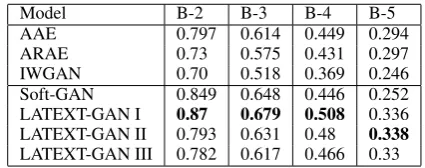
The BLEU score results for the n-grams of the synthesized texts are depicted in Table 2 and 3
with maximum sentence length of 15 for the SNLI and the COCO datasets respectively. We also re-port experimental results with a longer maximum sentence length of 20 using the COCO dataset to differentiate the effectiveness of code and text-based solutions (in Table4). Furthermore, we re-port the BLEU and self-BLEU score results of our proposed approaches in Table5and6respectively for the COCO dataset to compare with the results of the existing approaches reported in (Zhu et al.,
2018).
Model B-2 B-3 B-4 B-5
AAE 0.797 0.614 0.449 0.294
ARAE 0.73 0.575 0.431 0.297
IWGAN 0.70 0.518 0.369 0.246
Soft-GAN 0.849 0.648 0.446 0.252 LATEXT-GAN I 0.87 0.679 0.508 0.336 LATEXT-GAN II 0.793 0.631 0.48 0.338 LATEXT-GAN III 0.782 0.617 0.466 0.33
Table 2: BLEU-n (B-n) scores results using SNLI dataset and 640 synthetic sentences
[image:6.595.309.522.535.619.2]be-Model B-2 B-3 B-4 B-5
AAE 0.733 0.477 0.284 0.156
ARAE 0.676 .457 0.287 0.172
IWGAN 0.636 0.417 0.258 0.155
[image:7.595.76.287.61.146.2]Soft-GAN 0.781 0.492 0.296 0.155 LATEXT-GAN I 0.758 0.496 0.294 0.155 LATEXT-GAN II 0.707 0.489 0.316 0.198 LATEXT-GAN III 0.701 0.483 0.311 0.193
Table 3: BLEU-n (B-n) scores results for COCO dataset with maximum sentence length of size 15 and 640 synthetic sentences
Model B-2 B-3 B-4 B-5
AAE 0.751 0.475 0.287 0.167
ARAE 0.665 0.447 0.279 0.162
IWGAN 0.669 0.454 0.294 0.178
[image:7.595.309.525.126.230.2]Soft-GAN 0.799 0.520 0.317 0.190 LATEXT-GAN I 0.77 0.503 0.314 0.185 LATEXT-GAN II 0.687 0.456 0.283 0.174 LATEXT-GAN III 0.680 0.466 0.292 0.178
Table 4: BLEU-n (B-n) scores results for COCO dataset with maximum sentence length of size 20 and over 640 synthetic sentences
cause for longer sequence length experiments, the hidden code of the last time step might not be able to keep all the information from the earlier time steps. On the other hand, the LATEXT-GAN I and the Soft-GAN improve their performance with increasing maximum sentence length to 20. This might be because of the encoder enhances its representation better to the prior distribution,z
from which the text is generated. Furthermore, the Soft-GAN outperforms all the proposed LATEXT GAN approaches.
We also compare our proposed approaches with TextGAN (Zhang et al., 2017), some RL-based approaches (SeqGAN (Yu et al., 2017), RankGAN (Lin et al.,2017), MaliGAN (Che et al.,
2017)) and MLE approach described in a bench-mark platform (Zhu et al., 2018) where they ap-ply pre-training before apap-plying adversarial train-ing. We evaluate the BLEU and Self-BLEU score results on 10k synthetic sentences using the max-imum sentence length of size 20 for the COCO dataset with a vocabulary of size 5000 as in (Zhu et al.,2018). The BLEU and the self-BLEU score results are reported in Table5and6respectively. From Table5, it can be noted that our proposed ap-proaches show comparable results to the RL-based solutions for the BLEU score results. We can also see that our proposed LATEXT-GAN III approach gives lower self-BLEU scores in Table 6. From the above experimental results, we can note that
LATEXT-GAN III can generate real-like and more diverse sentences compare to some approaches re-ported in (Zhu et al.,2018) and our other proposed approaches.
Model B-2 B-3 B-4 B-5
TextGAN 0.593 0.463 0.277 0.207
SeqGAN 0.745 0.498 0.294 0.180
RankGAN 0.743 0.467 0.264 0.156
MaliGAN 0.673 0.432 0.257 0.159
MLE 0.731 0.497 0.305 0.189
[image:7.595.75.287.204.291.2]Soft-GAN 0.787 0.496 0.286 0.150 LATEXT-GAN I 0.736 0.447 0.258 0.146 LATEXT-GAN II 0.672 0.430 0.257 0.147 LATEXT-GAN III 0.660 0.435 0.260 0.149
Table 5:BLEU-n (B-n)scores results for COCO dataset using sequence length 20 and 10k generated sentences
Model B-2 B-3 B-4 B-5
TextGAN 0.942 0.931 0.804 0.746
SeqGAN 0.950 0.840 0.670 0.489
RankGAN 0.959 0.882 0.762 0.618
MaliGAN 0.918 0.781 0.606 0.437
MLE 0.916 0.769 0.583 0.408
Soft-GAN 0.988 0.950 0.847 0.612 LATEXT-GAN I 0.991 0.957 0.854 0.613 LATEXT-GAN II 0.896 0.755 0.523 0.263 LATEXT-GAN III 0.874 0.706 0.447 0.205
Table 6: Self-BLEU scores results for COCO dataset using sequence length 20 and 10k generated sentences
5.2.2 Perplexity Evaluation
[image:7.595.311.522.284.386.2]2018) and/or the IWGAN. The forward perplex-ity for the IWGAN is the worst which means that the synthetic sentences of the IWGAN model are not fluent or real-like sentences. For the SNLI dataset, we can note that the LATEXT-GAN II and III approaches can generate more fluent sen-tences than the other approaches. For the COCO dataset, it can be seen that the forward perplex-ity of the LATEXT-GAN I (51.39) is far lower than the real data (67.05) which means the model suffers from mode-collapse. The Soft-GAN, the LATEXT-GAN II and III approaches suffer less from the mode-collapse.
Models F-PPL R-PPL F-PPL R-PPL
SNLI SNLI COCO COCO
Real 16.01 - 67.05
-AAE 74.56 48.04 83.34 257.21
ARAE 66.70 315.58 64.63 185.20
IWGAN 193.30 53.96 94.95 80.99
[image:8.595.355.477.60.155.2]Soft-GAN 110.95 142.13 61.42 170.17 LATEXT-GAN I 86.24 56.78 51.39 158.21 LATEXT-GAN II 53.22 144.80 63.32 203.39 LATEXT-GAN III 54.80 143.42 71.60 214.76
Table 7: Forward (F) and Reverse (R) perplexity (PPL) results for the SNLI and COCO datasets using synthetic sentences of maximum length 15 and 20 respectively.
5.3 Human Evaluation
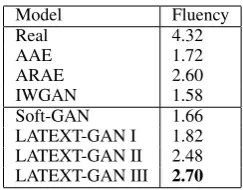
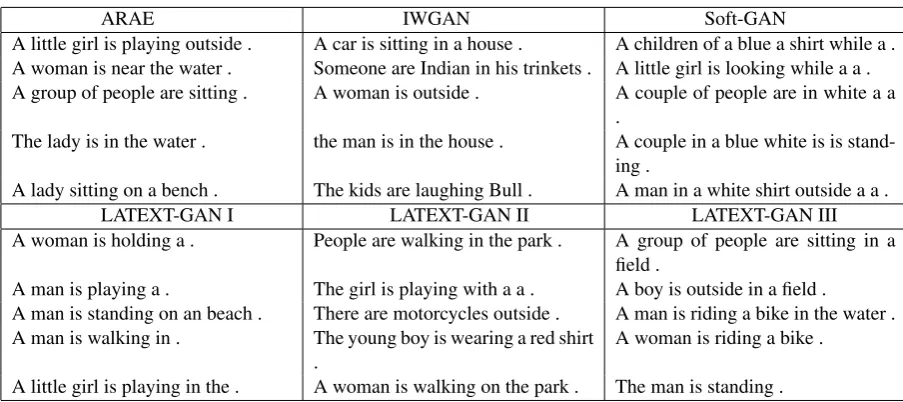
The subjective judgments of the synthetic sen-tences of the models trained using the COCO dataset with maximum sentence length of size 20 is reported in Table8. We used 20 different ran-dom synthetic sentences generated by using the last iteration of each model and gave them to a group of 5 people. We asked them to rate the sentences based on a 5-point Likert scale accord-ing to their fluency. The raters are asked to score 1 which corresponds to gibberish, 3 corresponds to understandable but ungrammatical, and 5 corre-spond to naturally constructed and understandable sentences (Cifka et al., 2018). From Table8, we can note that the proposed LATEXT-GAN III proach get the higher rate compare to the other ap-proaches. From all the above different evaluations, we can note that the synthetic sentences by using the LATEXT-GAN II and III approaches are more balanced in diversity and fluency compare to the other approaches. We also depicted some exam-ples of the synthetic sentences for the COCO and the SNLI datasets in Table9and10respectively.
Model Fluency
Real 4.32
AAE 1.72
ARAE 2.60
IWGAN 1.58
Soft-GAN 1.66
[image:8.595.71.295.257.362.2]LATEXT-GAN I 1.82 LATEXT-GAN II 2.48 LATEXT-GAN III 2.70
Table 8: Human Evaluation on the synthetic sentences
6 Conclusion and Future Work
In this paper, we introduced Soft-GAN as a new solution for the main bottleneck of using GAN for generating text, which is the discontinuity of text. This is based on applying soft-text to the GAN discriminator instead of the one-hot representa-tion in the tradirepresenta-tional approach. We also intro-duced three LATEXT-GAN approaches by com-bining the reconstructed output (soft-text) of an auto-encoder to the latent code-based GAN ap-proaches (AAE and ARAE) for text generation. LATEXT-GAN I is formed on top of AAE method. LATEXT-GAN II and III approaches were formed based on ARAE. The LATEXT-GAN I and II ap-proaches used separate discriminators for the syn-thetic text and the synsyn-thetic code discriminations. The LATEXT-GAN III used the combination of the soft-text and the latent code to compare with the concatenation of the synthetic text and the syn-thetic code by using a single discriminator. We evaluated the proposed approaches over the SNLI and the COCO datasets using subjective and ob-jective evaluation metrics. The results of the ex-periments are consistent with different evaluation metrics. We showed the superiority of our pro-posed techniques, especially the LATEXT-GAN III method over other conventional GAN-based techniques which does not require pre-training. Finally, we summarize our plan for future work in the following:
1. We trained the GAN using WGAN-GP approach. Spectral normalization tech-nique (Miyato et al.,2018) can be applied to stabilize the GAN training which could gen-erate more diverse text in our settings.
2. The proposed approaches are the pure GAN-based techniques for text generation and they are not very powerful in generating long sen-tences. RL or self-attention (Zhang et al.,
ac-ARAE IWGAN Soft-GAN a motorcycle parked outside of a
counter street .
a small hang bathroom with a park and side .
a man is sitting with a counter counter .
a plane scene with focus on a toilet .
a group of kitchen sits near a sliding .
a dog with a people above a street .
a cat standing down the of a bath-room .
a picture from a giraffe in a garlic . a blue of cat sitting in a red wall .
a bathroom with a toilet, a wall and .
a man shorts on a large table over . a woman is looking with a red .
a white cat sits in the kitchen bowl . a car is hidden from a small kitchen .
a dog is sitting in a bathroom .
LATEXT-GAN I LATEXT-GAN II LATEXT-GAN III
a bathroom bathroom with with toi-let and and mirror .
a bathroom with a sink and and white plane .
there are a park with ride on around display .
a man kitchen next to a kitchen cab-inets and .
a kitchen filled with wooden sink and a large window .
a kitchen with white cabinets and a black tub .
a man standing at a kitchen in a . a person is parked on a city road . a bathroom has a sink and a toilet . a man in in front a a bathroom with
.
a cat sitting on a bench of a city street .
a woman riding a bike with a large on .
a plane is sitting with the sky at . a group of people sitting on a city bench .
[image:9.595.75.528.61.326.2]a picture of a kitchen with a a skies .
Table 9: Example generated sentences with models trained using COCO dataset with maximum sentence length of size 20
ARAE IWGAN Soft-GAN
A little girl is playing outside . A car is sitting in a house . A children of a blue a shirt while a . A woman is near the water . Someone are Indian in his trinkets . A little girl is looking while a a . A group of people are sitting . A woman is outside . A couple of people are in white a a
.
The lady is in the water . the man is in the house . A couple in a blue white is is stand-ing .
A lady sitting on a bench . The kids are laughing Bull . A man in a white shirt outside a a .
LATEXT-GAN I LATEXT-GAN II LATEXT-GAN III
A woman is holding a . People are walking in the park . A group of people are sitting in a field .
A man is playing a . The girl is playing with a a . A boy is outside in a field .
A man is standing on an beach . There are motorcycles outside . A man is riding a bike in the water . A man is walking in . The young boy is wearing a red shirt
.
A woman is riding a bike .
A little girl is playing in the . A woman is walking on the park . The man is standing .
Table 10: Example generated sentences with models trained using SNLI dataset with maximum sentence length of size 15
commodate this weakness.
3. We used the hidden code from the last time step of the encoder. Attention mechanism can be applied for decoding. Furthermore, the powerful transformer (Vaswani et al., 2017) can be applied for the auto-encoder which could improve the performance of the pro-posed approaches. Pre-train the auto-encoder before adversarial training can also improve the performance.
Acknowledgments
We would like to thank Professor Qun Liu, Chief Scientist of Speech and Language Computing, Huawei Noah’s Ark Lab for his valuable com-ments on the paper.
References
[image:9.595.74.526.363.564.2]learning to align and translate. arXiv preprint arXiv:1409.0473.
Mohamed Ishmael Belghazi, Sai Rajeswar, Olivier Mastropietro, Negar Rostamzadeh, Jovana Mitro-vic, and Aaron Courville. 2018. Hierarchical adversarially learned inference. arXiv preprint arXiv:1802.01071.
Yoshua Bengio, J´erˆome Louradour, Ronan Collobert, and Jason Weston. 2009. Curriculum learning. In ICML, pages 41–48.
Samuel R Bowman, Luke Vilnis, Oriol Vinyals, An-drew M Dai, Rafal Jozefowicz, and Samy Ben-gio. 2015. Generating sentences from a continuous space. arXiv preprint arXiv:1511.06349.
Massima Caccia, Lucas Caccia, William Fedus, Hugo Larochelle, Joelle Pineau, and Laurent Charlin. 2018. Language GANs falling short. arXiv preprint arXiv:1811.02549.
Tong Che, Yanran Li, Ruixiang Zhang, Devon R Hjelm, Wenjie Li, Yangqiu Song, and Yoshua Ben-gio. 2017. Maximum-likelihood augmented discrete generative adversarial networks. arXiv preprint arXiv:1702.07983.
Ondrej Cifka, Aliaksei Severyn, Enrique Alfonseca, and Katja Filippova. 2018. Eval all, trust a few, do wrong to none: Comparing sentence generation models. arXiv preprint arXiv:1804.07972.
P Kingma Diederik and Ba Jimmy. 2014. Adam: A method for stochastic optimization. arXiv preprint arXiv:1412.6980.
Vincent Dumoulin, Ishmael Belghazi, Ben Poole, Olivier Mastropietro, Alex Lamb, Martin Arjovsky, and Aaron Courville. 2016. Adversarially learned inference. arXiv preprint arXiv:1606.00704.
William Fedus, Ian Goodfellow, and Andrew M Dai. 2018. MaskGAN: Better text generation via filling in the . arXiv preprint arXiv:1801.07736.
Jules Gagnon-Marchand, Hamed Sadeghi, Md. Akmal Haidar, and Mehdi Rezagholizadeh. 2019. SALSA-TEXT: Self attentive latent space based adversarial text generation. InCanadian AI 2019.
Ian Goodfellow, Jean Pouget-Abadie, Mehdi Mirza, Bing Xu, David Warde-Farley, Sherjil Ozair, Aaron Courville, and Yoshua Bengio. 2014. Generative ad-versarial nets. InNIPS, pages 2672–2680.
Ishaan Gulrajani, Faruk Ahmed, Martin Arjovsky, Vincent Dumoulin, and Aaron Courville. 2017. Improved training of wasserstein GANs. arXiv preprint arXiv:1704.00028.
Jiaxian Guo, Sidi Lu, Han Cai, Weinan Zhang, Yong Yu, and Jun Wang. 2017. Long text generation via adversarial training with leaked information. arXiv preprint arXiv:1709.08624.
Md. Akmal Haidar and Mehdi Rezagholizadeh. 2019. TextKD-GAN: Text generation using knowledge distillation and generative adversarial networks. In Canadian AI 2019.
Sepp Hochreiter and Jrgen Schmidhuber. 1997. Long short-term memory. Neural computation, 9(8):17351780.
Zhiting Hu, Zichao Yang, Xiaodan Liang, Ruslan Salakhutdinov, and Eric P Xing. 2017. Toward con-trolled generation of text. In ICML, pages 1587– 1596.
Ferenc Huszr. 2015. How (not) to train your generative model: Scheduled sampling, likelihood, adversary? arXiv preprint arXiv:1511.05101.
Yoon Kim, Kelly Zhang, Alexander M Rush, Yann LeCun, et al. 2017. Adversarially regularized au-toencoders for generating discrete structures. arXiv preprint arXiv:1706.04223.
Diederik P Kingma and Max. Welling. 2013. Auto-encoding variational bayes. arXiv preprint arXiv:1312.6114.
Matt J Kusner and Jos´e Miguel Hern´andez-Lobato. 2016. GANs for sequences of discrete elements with the gumbel-softmax distribution. arXiv preprint arXiv:1611.04051.
Jiwei Li, Will Monroe, Tianlin Shi, Alan Ritter, and Dan Jurafsky. 2017. Adversarial learning for neural dialogue generation. arXiv preprint arXiv:1701.06547.
Kevin Lin, Dianqi Li, Xiaodong He, Zhengyou Zhang, and Ming-Ting Sun. 2017. Adversarial ranking for language generation. arXiv preprint arXiv:1705.11001.
Alireza Makhzani, Jonathon Shlens, Navdeep Jaitly, Ian Goodfellow, and Brendan Frey. 2015. Adversar-ial autoencoders. arXiv preprint arXiv:1511.05644.
Tom Mikolov, Martin Karafit, Luk Burget, Jan ernocky, and Sanjeev Khudanpur. 2010. Recurrent neural network based language model. INTERSPEECH.
Takeru Miyato, Toshiki Kataoka, Masanori Koyama, and Yuichi Yoshida. 2018. Spectral normalization for generative adversarial networks. arXiv preprint arXiv:1802.05957.
Kishore Papineni, Salim Roukos, Todd Ward, and Wei-Jing Zhu. 2002. BLEU: a method for automatic evaluation of machine translation. In ACL, pages 311–318.
Sai Rajeswar, Sandeep Subramanian, Francis Dutil, Christopher Pal, and Aaron Courville. 2017. Adver-sarial generation of natural language.arXiv preprint arXiv:1705.10929.
Ahmad Rashid, Alan Do-Omri, Md. Akmal Haidar, Qun Liu, and Mehdi Rezagholizadeh. 2019. Bilingual-GAN: A step towards parallel text genera-tion. InNeuralGen 2019.
Tim Salimans, Ian Goodfellow, Wojciech Zaremba, Vicki Cheung, Alec Radford, and Xi Chen. 2016. Improved techniques for training GANs. InNIPS, pages 2234–2242.
Graham Spinks and Marie-Francine Moens. 2018. Generating continuous representations of medical texts. InNAACL-HLT, pages 66–70.
Sandeep Subramanian, Sai Rajeswar, Alessandro Sor-doni, Adam Trischler, Aaron Courville, and Christo-pher Pal. 2018. Towards text generation with adver-sarially learned neural outlines.NeurIPS.
Ashish Vaswani, Noam Shazeer, Niki Parmar, Jakob Uszkoreit, Llion Jones, Aidan N. Gomez, Lukasz Kaiser, and Illia Polosukhin. 2017. Attention is all you need. arXiv preprint arXiv:1706.03762.
Jun Wang, Lantao Yu, Weinan Zhang, Yu Gong, Yinghui Xu, Benyou Wang, Peng Zhang, and Zhang Dell. 2017. Irgan: A minimax game for unifying generative and discriminative information retrieval models. InSIGIR.
Ronald J Williams and David Zipser. 1989. A learning algorithm for continually running fully recurrent neural networks. Neural Computation, 1(2):270280.
Lijun Wu, Yingce Xia, Li Zhao, Fei Tian, Tao Qin, Jianhuang Lai, and Tie-Yan Liu. 2017. Adver-sarial neural machine translation. arXiv preprint arXiv:1704.06933.
Kelvin Xu, Jimmy Lei Ba, Ryan Kiros, Kyunghyun Cho, Aaron Courville, Ruslan Salakhutdinov, and Yoshua Bengio. 2014. Show, attend and tell: Neu-ral image caption generation with visual attention. arXiv preprint arXiv:1502.03044.
Zhen Yang, Wei Chen, Feng Wang, and Bo Xu. 2017a. Improving neural machine translation with condi-tional sequence generative adversarial nets. arXiv preprint arXiv:1703.04887.
Zhilin Yang, Junjie Hu, Ruslan Salakhutdinov, and William W Cohen. 2017b. Semi-supervised QA with generative domain-adaptive nets. arXiv preprint arXiv:1702.02206.
Lantao Yu, Weinan Zhang, Jun Wang, and Yong Yu. 2017. SeqGAN: Sequence generative adversarial nets with policy gradient. In AAAI, pages 2852– 2858.
Wojciech Zaremba, Ilya Sutskever, and Oriol Vinyals. 2015. Recurrent neural network regularization. arXiv preprint arXiv:1409.2329.
Han Zhang, Ian Goodfellow, Dimitris Metaxas, and Augustus Odena. 2018. Self-attention gen-erative adversarial networks. arXiv preprint arXiv:1805.08318.
Yizhe Zhang, Zhe Gan, Kai Fan, Zhi Chen, Ricardo Henao, Dinghan Shen, and Lawrence Carin. 2017. Adversarial feature matching for text generation. arXiv preprint arXiv:1706.03850.