Abstract—One of the dominant traits of civilized societies is the establishment and ever increasing development of social- economic organizations. At the present time due to the complicated needs of societies, more concern is on group activities. Researchers in the field of management have illustrated some principles, namely project management, for organizing group activities of individuals. The most important issue here is resource optimization and assimilating the required data, for achieving the projects predestined goals. In this context, many models have been presented that one of the most practical models was introduced by Dr. M. Belbin. He classified individuals in nine team roles. This model helps them to recognize their position in the team and increase team efficiency. In this paper an intelligent model is designed which can propose a proper combination according to the project manager's demands and individual's characteristics obtained from Belbin's theory. This model helps the project manager to recognize the shortcoming of team and it presents some approaches toward concerning time and financial allocation.
Index Terms— Belbin model, Belbin Team Role inventory, Team efficiency, Team formation.
I. INTRODUCTION
Considering the ever increasing requirement of modern human society for the group activities, there should be a method for valid selection of group’s members and permanent arrangement of team. Many models were presented on the basis of individual’s characteristics and their feedback manner. One of the most famous and practical models was presented by Dr. Mertith Belbin in 1981. His model categorized individuals in nine roles regarding their specialty and attitude toward team working. This model is applicable for evaluation of people in vast spectrum of industry. He also presented a self-perception test to divide people [3], [5].
All the models on team formation were presenting proper combination of individuals to maximize the efficiency of the groups. Many factors should be taken into consideration for accessing team efficiency. In this paper, seven factors will be described. They are: creativity and expression of ideas, leadership, the ability of explaining objectives of team, the ability of discussion and resourcing, group communication, executive activities, time and budget. These factors can be
S. Fatahi is with the Department of Computer Engineering, University of Technology, Kermanshah, Iran. (e-mail:[email protected]). A.R.Lorestani is with the Department of Computer Engineering, Payame Noor University, Kermanshah, Iran. (e-mail: [email protected]).
changed, depending on the different roles of individuals. For achieving to the efficiency factors we should set rules on proper combination of the team. This objective would be followed up by researching about role numbers in the first combination and asking the user about his demands. This paper consists of five sections, which in section 2 reviews the works, performed up to the present time. In section 3 Belbin team roles is explained. In section 4 the proposed model and in section 5 implementation of the model are investigated. Finally, section 6 presents the conclusion and the future works.
II.PREVIOUS WORKS
Until the present time, many models in the field of expert system have been designed and implemented in different domains, about project management. In March 1998s Steven and Salli presents the report of their research. Their research was about show the utility of roles and personality characteristics to the evaluation and formation of software development teams [8]. Martinez Meranda proposed a model in the simulation field of team activities. He implemented his model by utilizing JADE software and made an agent namely TEAKS to study team activity [6]. Eric Chong investigated influence of the number of individuals and the way that work together on team’s efficiency [4]. Steven and Salli researched on team leadership and showed that a team with a single leader has maximum efficiency [7]. In 2003 Mike Winter researched on Belbin team role self-perception inventory (BTRSPI) [5]. In fact, there were many management models trying to categorize individual’s characteristics among them Belbin’s model is very noticeable.
III. BELBIN TEAM ROLE THEORY
This model was passed by Dr. Mertith Belbin in 1981. The main research of Belbin was on the reason of team success or failure [2]. After continues researches, he found that for having a successful team, nine roles were needed to participate in the team’s work. The Belbin Team Role inventory provides an effective means to assess how individuals behave in a team environment. Belbin’s inventory identifies individual tendencies towards multiple roles. There are no 'good' or 'bad' roles and team roles are not equivalent to personality types. He believes that individuals have different characteristics. Considering these characteristics one person can assess the coordination ability of each individual with others. On the basis of this model, each individual has some characteristics which can be categorized in one of the nine roles. The BTRSPI is designed to determine as much information as possible about an individual’s team role
Design and Implementation of the Expert
System for Balancing Team Formation on the
Basis of Belbin Team Role
preferences, whilst keeping the inventory manageable in terms of item length, inventory length and answering style.
The Belbin Team Role Self-Perception Inventory was designed to measure behavioral characteristics which individuals display when working in teams. Four of the most important characteristics of each individual are [5]:
Intelligence Dominance
Introversion / Extroversion Determination/ Anxiety
Belbin team role self perception inventory have been passed on the basis of these four characteristics. Answers of each individual to the above questions help to determine his role in the team.
A.Describe Belbin Team Role
Plant (PL): He/She plays the role of a designer and an imaginative. Person these individuals can present their own solution, some of which can be creative, to solve the problem. They are also introvert with high ability of imagination and intelligence, unorthodox [8], [9].
Chairman (CH): These people can take control of team with typical head-of-the-table manner. They take step toward materialization of goals by exact explanation and interpretation of goals. They can listen to the opinions of the team carefully and they are very aware of the strengths and weaknesses of the team and each member of the team as a whole [8], [9].
Monitor-Evaluator (M-E): They play role of analyzer. They are master minds and have the ability to estimate all possible aspects of team decisions. They are realistic, non- emotional, over-critical and hard-headed [8], [9].
Implementer (IMP): These people work by organized methods. They are disciplined, reliable responsible, conservative, self-controlled and continence people. On the negative side, they are inflexible and resistant against non-examined idea [8], [9].
Completer Finisher (CF): They are the compliment of the IMP in management relations. They are painstaking, conscientious and anxious. They make efforts to put the project process in the planned time and financial frameworks and deadlines are very important for them [8], [9].
Resource Investigator (RI): They are cheerful, extrovert, similar to PL, consider external factors for presenting a solution and have good public relations with individuals outside the team. They are generally negotiators. These members also have a tremendous capacity for contacting people and exploring anything new [8], [9].
Shaper (SH): They are recognized as disciplinarian employers. They are also energetic, outgoing, nervous, extroverted, competitive, and argumentative. This role leads the team by stimulating the members to challenge inertia, ineffectiveness, and complacency [8], [9].
Team Worker (TW): Like RI, whereas the Resource Investigator negotiates outside the team to get what the team needs, the Team Worker facilitates or negotiates within the team. They are also social, mild, perceptive and accommodating of others [8], [9].
Specialist (SP): They are single-minded, self-starting and dedicated. The specialist provides rare knowledge and skills, but only contributes to a small part of task completion and dwells on technicalities [8], [9].
All the roles proposed in Belbin model affect the team efficiency. In 2007 Chong studied the relationship between team’s average score and its efficiency and also he achieved statistical results. He utilized Spearman rank correlation coefficient. The results indicate effect on the team efficiency. This effect is defined by an interval between -1 to 1. If the result is near to 1, it shows good effect on team members and their efficiency [4]. If it is negative, there are bad relations or negative efficiency. In this paper, we have tried to propose an expert model on the basis of relations between individual’s efficiency and their roles in Belbin model and study weakness and strength of user’s initial team and propose a proper combination for marking a team based on the user’s ideas.
IV. PROPOSED MODEL
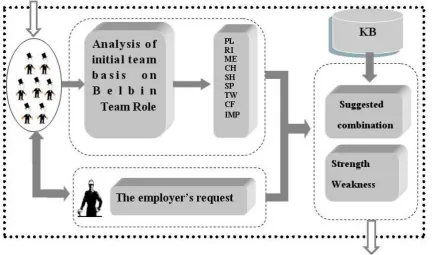
The proposed model has 4 main modules (Figure 1):
Module of Analysis the initial team: At, the beginning the employer selects some individuals for making an initial team.Inthis team the role of each person is recognized by using SPI questionnaire. In this stage the employee registers the type existing roles in the team and the number of each role (first entry).
Module of the Employer’s demands: At this module, some questions are asked from the employer on the basis of the above-said seven factors affecting the team efficiency. In fact, the employ’s answers to the questions determine the manner of performed and the kind of team formation (second entry).
Here the most important question is about determining a proper combination for each team that is related to the kind of project being performed by the above team. Each project has one of the three situations:
Downright design
Downright Implementation Variety
Based on the three situations the system takes different methods to consideration for team member’s analysis. If the project is downright design or downright implementation some of Belbin’s nine roles will be omitted. It doesn’t mean that the omitted roles have no effect on team efficiency. Considering the type of the employer’s demands, other roles are more capable of performing the task. In addition to this, the system tries to prevent from employing inessential members to deduce expense.
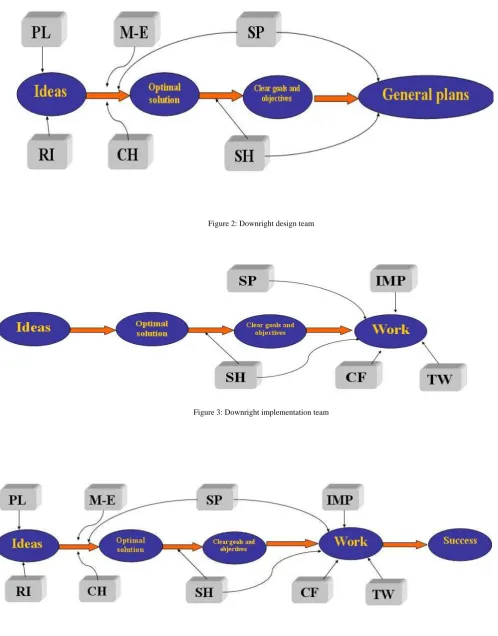
If the project state is downright design, some creative individuals who have the ability of proposing solutions for the problem are required. Among the above roles ME, SP, PL as thinking roles are the most important ones (Figure 2).
Figure 1: Proposed Model
If the project is a combination of design and execution, all nine roles are required. In this case, the team’s thinking and executing must be efficient (Figure 4).
In this part the system recognized the kind of the project and asked some questions, from the employers, which were related to the project.
Module of Analysis the existing team: Based on employer’s entries, the existing roles and information on the system’s knowledge base the team is analyzed. The manner of analysis is based on information previously inserted to the knowledge base. Some examples of these analyses are presented below:
Spearman coefficient for SH is negative [4], it means by the increasing of SH number in the team, the team efficiency doesn’t increase. The reason of negative sign is conflict among SH’s in the team formation. If their number are more than one, it is noted to the employer that there are some conflicts in the team, and solving this problem some of the SH(s) should be omitted.
If the number of PL(s) are superabundant in the team, we can hope that the power of suggesting ideas for the team is high since PL (s) are introvert some problem may occur due to not existence of extrovert individuals. If number of individuals with SP(s) roles increase in the team, there would be some individuals who are not able to perform different tasks. Noticing a coefficient equal to, 0.01 which, is very close to zero, we can conclude that we didn’t waste any expense and by omitting some of them, the team efficiency can increase.
Module of presenting the proposed Combination: Considering system analysis on the initial team and its strength and weakness, the expert system presents the employer a proper combination of members with their existing roles. In fact, this system compares members in the initial team with ideal team, sends messages to the employer about omitting or adding them and proposes a proper combination.
V.IMPLEMENTATION
In this essay clips software is utilized for implementation of the proposed model. It is a rule base language; the results are obtained on the basis of rule's preconditions. For this purpose, design many rules. The rules can be classified into three parts:
Getting information
Analysis of initial team combination Proposing ideal combination of team
As it was stated before, some questions are asked from the employer to get initial information. One of these questions that indicate the kind of project is as follows:
(deffunction add_char()
(printout t"please enter type of your team : (variety[va]/downright design[dd]/downright implementation[di])" )
(bind ?*a* (read))
(assert (team_type(type ?*a*))))
At this part the employee answers the system, considering the kind of project. For example, di means downright Implementation team. Some other questions are asked in the field of the project. They include first kind rules for example (getting information):
(defrule rule3
(team_type(type va)) (add_detail(add no)) =>
(bind ?*CH1*(+ ?*CH1* 1))
(printout t crlf crlf"Q2:whether your team will be
able to negotiate whit other pepole
:(yes/no)") (bind ?*c* (read))
Figure 2: Downright design team
Figure 3: Downright implementation team
This rule is fired when the kind of team is va and the answer to the add_detail is negative. It suggests the user to add an individual with the role of CH.
The second kind of rules is based on the employer’s initial combination. They analyze the team’s weakness and strength, and present proper messages for helping the employer. One example of these rules is shown below:
(defrule rule32 (team_type(type va)) =>
(if (< (- ?*SP1* ?*SP*) 0 ) Then
(printout t “In your team number of Specialist are enough, you can delete some of it " crlf crlf ) ) )
These rules are executed if the Variety team is integrative, if the SP(s) are additional is fired, then it sends a message of omitting some SP(s).
The tertiary kind of rules present a proper combination for team formation based on the employer’s considered feathery of these and also conditions of the initial team.
The proposed team has the best combination concerning efficiency and expense. An example is an:
(defrule rule90 =>
(if( < (+ ?*RI* ?*SH* ?*TW* ?*PL* ?*CF*
?*ME* ?*IMP* ?*CH* ?*SP*)
(+ ?*RI1* ?*SH1* ?*TW1* ?*PL1* ?*CF1*
?*ME1* ?*IMP1* ?*CH1* ?*SP1*)) then
(printout t "You must add "( - (+ ?*RI1* ?*SH1*
?*TW1* ?*PL1* ?*CF1* ?*ME1* ?*IMP1*
?*CH1* ?*SP1*)
(+ ?*RI* ?*SH* ?*TW* ?*PL* ?*CF* ?*ME* ?*IMP* ?*CH* ?*SP*)) " of your team member")))
The above rules present the required number of roles that by this rule the employer can constitute the ideal team.
VI. CONCLUSION AND FUTURE WORKS
Due to the limitation of time and budget the economic-social system has to be adjusted to this limitation. Some methods should be designed for distribution of their resources and having the highest rate of efficiency. In this respect the group activity has been recognized as one of the most important basis of economic-social systems. If we present methods for optimization of the number of members
deducting the employment expenses, we can reach to our goals to some extent. While considering Belbin management model in team formation at this essay we tried to design and implement an expert system to present a proper team combination based on the employer’s demands, condition of the initial team, expense and time. Because employer’s demands were more reliable than information for initial prelude data base of system, the system was able to exhibit the correct proffers by utilizing this information. And the sequel of system was higher accordance about the employer’s demands, which it will occasion the conflict between employer and team member was indicating the least.
Because the Belbin model peruse the coordination aspect among members of the team, that it not sufficiency for study all station of team. Hence for completion the proposed model, other models and theory must be used, like Tuchman that explains the concept of team formation. An, other model is DISK, which is very practical and helps complete the team formation.
REFERENCES
[1] Belbin Associates, Interplace IV Human Resource Management System User’s Manual, Cambridge, (2004).
[2] Belbin, R. M. Management Teams: Why They Succeed or Fail, Butterworth- Heinemann, Oxford, (1981).
[3] (Basic Book/Monograph Online Sources) Belbin Team Roles online testing and feedback, accreditation training and Team Role games, based on Dr R Meredith Belbin's work on Belbin Team Roles. http://www.belbin.com/
[4] Chong , Eric., Role balance and teadevelopment: A study of team role characteristics underlying high and low performing teams., Victoria University of Wellington, Journal of Behavioral and Applied Management , pp. 202-217 , May (2007).
[5] Gündüz, Hasan Basri., An Evaluation on Belbin’s Team Roles Theory. (The Case of Sakarya Anatol2an Profess2on H2gh School, Vocat2onal H2gh School for Industry);Faculty of Education, Sakarya University, Sakarya/Turkey, world appelied Sciences Journal 4(3): 460-469 ,2008
[6] Martínez-Miranda J., Aldea A. and Bañares-Alcántara R. “Modelling Human Behaviour to Support the Integration of Work Teams” in Proceedings of Workshop on Intelligent Computing, L. Sheremetov and M. Alvarado (Eds.), pp. 91-99 April 2004.
[7] M.Henry, Sallie, K.Todd,Stevens,: Using Belbin’s Leadership Role to Improve Team Effectiveness: An Empirical Investigation. Department of Computer Science Virginia Tech Blacksburg, Journal of Systems and Software, Volume 44, Issue 3, January 1999, Pages 241-250.
[8] Stevens, K. Todd, The Effects of Roles and Personality Characteristics on Software Development Team Effectiveness, Virginia, March 1998 Blacksburg.