Soft Computing Based Controllers
Implementation for
Non-linear Process in Real Time
S.Nithya1, N.Sivakumaran2 , T.K.Radhakrishnan3 and N.Anantharaman4
ABSTRACT
The aim of this paper is to implement controllers based on soft computing techniques in real time for a non-linear process. The process taken up for study is to control the level in a conical tank setup using cost effective data acquisition system. The system identification of this non-linear process is done using black box modeling and found to be First Order Plus Dead Time (FOPDT) model. Then the controller tuning strategy has been applied using Skogestad’s PI tuning method. The soft computing based controllers like Fuzzy Logic Controller (FLC) and Genetic Algorithm (GA) based controller has been implemented and compared with conventional PI tuning method. From the results based on Performance indices like Integral Absolute Error (IAE) and Integral Squared Error (ISE), it is proved the controllers implemented using soft computing techniques out performs well than the conventional controller.
KEYWORDS: Fuzzy Logic, Genetic Algorithm, Non-linear system, PI Controller.
Dept of Electronics and Communication, TRP Engineering College, Tiruchirappalli, India [email protected] ,
Dept. of Instrumentation and Control Engineering,
NITechnology, Tiruchirappalli. India, 620 015, [email protected] Dept .of Chemical Engg, NIT, Tiruchirappalli.,
India, 620 015, [email protected] Dept of Chemical Engg , NIT,
Tiruchirappalli. India, 620 015, [email protected]
1. INTRODUCTION
Since the introduction of the theory of fuzzy sets by Zadeh in 1965 [7] and the industrial application of the first fuzzy controller by E. H. Mamdani in 1974 [8], fuzzy systems have obtained a major role in engineering systems and consumer products in the 1980s and 1990s. Georgescu et al. [9] have demonstrated the application of fuzzy predictive PID controllers to a heating control system, while Kiupel et al. [10] have discussed the fuzzy control for steam turbines. A PI-type fuzzy controller that uses information from the fuzzy regions of a nonlinear process such as a continuously stirred tank reactor for pH titration is proposed by Qin et al. [11]. Optimization is a powerful tool for design of controllers. Recently, the interest in Genetic Algorithm’s [GA] is growing due to their difference from ordinary optimization tools. GA’s are regarded as important mathematical means for nonlinear multi-objective optimization problems. Davis [12] and Goldberg [13] discussed it is a robust search algorithm based on Darwinian survival of the fittest in natural evolution. It has been proved to be an effective optimization mechanism in complex search spaces, which are usually discontinuous, multi-modal and highly nonlinear. By using only a few simple operators, i.e. reproduction, crossover and mutation, the GA is a powerful technique for optimization and machine learning. Wang and Kwok [14] discussed about the optimal design based PID controller for a pH process using genetic algorithm. They proved that GA’s are found to be very suitable for such a nonlinear optimization problem. Dionisio et al. [15] have described the genetic algorithm based system identification and PID tuning for optimum adaptive control. Nithya et al. [16] implemented GA based controller for a spherical tank in real time. They
[image:2.595.76.247.580.746.2]
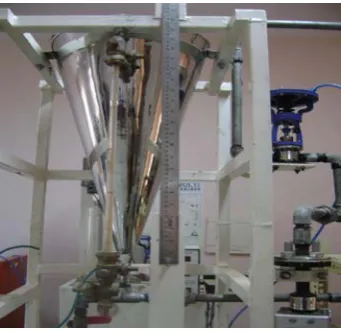
Fig 1: Real experimental setup of the conical tank process
proved that soft computing based controller outperforms the conventional PI controller.
2.EXPERIMENTAL SETUP
The laboratory set up for this system consists of a conical tank, a water reservoir, pump, rotameter, a differential pressure transmitter, an electro pneumatic converter (I/P converter), a pneumatic control valve, an interfacing ADAM’s module and a Personal Computer (PC). The differential pressure transmitter output is interfaced with computer using ADAM’s 5000 Advantech module in the RS-232 port of the PC. This module supports 8 analog input and 4 analog output channels with the voltage range of ±10 volt. The sampling rate of the module is 18 samples per sec and baud rate is 9600 bytes per sec with 16-bit resolution. The programs written in script code using MATLAB software is then linked via this ADAM’s module with the sampling time of 60 milliseconds. Fig 1 shows the real time experimental setup of the process. Table I shows the technical specifications of the setup.
Table I: Technical specifications of setup
3.SYSTEM IDENTIFICATION 3.1 Mathematical Modeling
The conical tank system shown in Fig 1 is essentially a system with nonlinear dynamics.
Its nonlinear dynamics described by the first - order differential equation.
Part Name Details Conical tank Stainless Steel
Height - 49.3 cm, Top Diameter - 33.74 cm, Bottom Diameter - 0.8 cm, α - 30’
Differential Pressure Transmitter
Type Capacitance, Range (2.5 - 250)mbar, Output , (4 - 20)mA,Siemens make
Pump Centrifugal 0.5 HP
Control valve Size ¼“ Pneumatic actuated, Type: Air to close
Input (3 - 15) psi Rotameter Range (0 - 18) lpm
Air regulator Size 1/4" BSP Range (0 - 2.2 ) bar E/P converter Input (4-20) mA
Output (0.2 - 1) bar Pressure gauge Range (0 - 30) psi
(1)
Where V is the Volume of the tank, F 1 is the Inlet flow rate
and F 2 is the outlet flow rate.
(2)
Where h is the total height of the tank in cm and r is the radius of the tank in cm. Applying the steady state values, and solving the equations (1) and (2), for linearzing the non - linearity in the conical tank,
(3)
Where and
3.2 Black Box Modeling
Here in real time implementation, system identification of this non-linear process is done using black box modeling. For fixed input water flow rate and output water flow rate of the spherical tank, the tank is allowed to fill with water from (0-45) cm. At each sample time the data from differential pressure transmitter i.e. between (4-20) mA is being collected and fed to the system through the serial port RS-232 using ADAM’s interfacing module. Thereby the data is scaled up in terms of level (in cm).Using the open loop method, for a given change in the input variable; the output response for the system is recorded. Ziegler and Nichols [1] have obtained the time constant and time delay of a FOPDT model by constructing a tangent to the experimental open loop Sundaresan and Krishnaswamy [16] have obtained the parameters of FOPDT transfer function model by letting the response of the actual system and that of the model to meet at two points which describe the two parameters τ and θ. The proposed times
t
1 andt
2, are estimated from a stepresponse curve. This time corresponds to the 35.3% and 85.3% response times. The time constant and time delay are calculated as follows.
)
(
67
.
0
t
2
t
1
(4)t
t
D
1
.
3
1
0
.
29
2
(5) At a fixed inlet flow rate, outlet flow rate, the system isallowed to reach the steady state. After that a step increment in the input flow rate is given, and various readings are noted till the process becomes stable in the spherical tank. The experimental data are approximated to be a FOPDT model and the model parameters are given as
1
6
.
53
e
12
)
(
2.05
s
s
G
s (6)4. DESIGN OF PI CONTROLLER
After deriving the transfer function model the controller has to be designed for maintaining the system to the optimal set point. This can be achieved by properly selecting the tuning
parameters
K
P and
I for a PI controller. Consider thestandard FOPDT model.
( )
1
sKe
G s
s
(7)According to the method proposed by Skogestad’s [17], the PI controller settings are
1
C PK
K
,
I
(8)The PI controller was to run for the different set points 7, 15, 18 and 27 cm. Then load disturbances at different intervals were given in the conical tank system for 32 cm. The variation in the level was recorded in both the cases.
5. DESIGN OF FUZZY CONTROLLER
Fuzzy logic enables control engineers to easily implement control strategies used by human operators. To implement FLC for a non-linear conical tank system in real time, level and level error are taken as the two inputs and controller as output by changing the position of valve opening. Here triangular membership functions are chosen for FLC. The universes of discourse for these parameters are scaled from 0 to 45, -45 to +45 and (4-20) mA for the two input variable and one output respectively. The rule base developed in order to bring the optimum response in designing fuzzy logic controller. Then after implementing FLC, in the conical tank setup, in order have good control in the non-linear regions, we have divided the whole set up into different zones and designed Fuzzy PI controller. According to this, the rule base is increased in the Fuzzy PI controller to get optimum response compared to the Fuzzy Controller.
6. APPLICATION OF GENETIC ALGORTHIM FOR TUNING
GA, population of chromosomes is formed, each representing a possible solution to the problem. The population will then undergo operations similar to genetic evolution, namely reproduction, crossover and mutation. The components of genetic algorithm are fitness function and genetic operator’s fitness function is nothing but an objective function which is to be minimized or maximized. Selection, selects the fittest chromosomes for the next generation based on their fitness values and crossover pairs and crossover point are selected randomly and strings are swapped beyond the crossover point. Mutation of a bit involves flipping that is changing a 0 to 1 or vice versa if binary coding is used. Then again the new generation is subjected to these operations till the problem is optimized. Here, in this work, the optimized tuned values are applied in real time for different set points and load change as carried in PI.
7. RESULTS AND DISCUSSIONS
The soft computing technique is applied to a real time control of a conical tank system using ADAM’s module. The performance of the soft computing based controllers is compared to Skogestad’s based PI controller tuning settings. The performance is compared for different set points like 7, 15, 18 and 27 cm. For the conventional controller, set point tracking performance is characterized by lack of smooth transition as well it has more oscillations. Also it takes much time to reach the set point. The soft computing based controller tracks the set point faster with fewer oscillations as shown in Fig 2. From Fig 3 it is clear that the soft computing controllers reach the set point faster and maintains the steady state .This is also validated from the Table II. Suddenly 10 % of load disturbance is introduced in the level tank setup for different controllers as shown in Fig 4. In that case also, the soft computing based controllers track the load disturbances and settles in faster time.
8. CONCLUSION
It was found for a level control in conical tank process for all set point and load changes, the performance of the soft computing based controller was much superior to the conventional control. The response of all the soft computing based controllers was proved satisfactory when compared with conventional PI controller. It was able to keep the process parameters in the optimum range whenever the set point and load disturbance occurred. It is concluded that for a nonlinear system the controllers implemented using soft computing techniques outperforms the conventional controller in real time using cost effective data acquisition system.
REFERENCES
[1].Ziegler, G. and Nichols, N. B,.Optimum settings for automatic controllers, Trans. ASME, 64, 1942 , pp. 759-768.
[2] M. Ge, M.-S. Chiu, Q.-G. Wang, Robust PID
controller design via LMI approach, J. Process Contr. 1 (12), 2002. pp. 3–13.
[3] Antonio Visioli, A new design plus for a feedforward controller, J.Process.Contr. 14, 2004, pp. 457-463. [4] Astrom, K., and Hagglund,T., ,” Revisiting the Ziegler–Nichols step response method for PID control,” J. Process Control, 14 , 2004,pp. 635-650. [5] Toscano, R, A simple PI/PID controller design method via numerical optimization approach,” J. Process Control, 15, 2005, pp. 81- 88.
[6] Nithya ,S, Sivakumaran, N, Balasubramanian ,T, and Anantharaman, N, 2008, IMC based controller design for a spherical tank process in real time , National conference in Advanced Techniques in
Instrumentation Control and Communication Engineering , 2008, pp.173 -178.
[7].Mamdani EH, Application of fuzzy algorithm for control of simple dynamic plant, Proc IEE, 121, 1974, pp.1585-1588.
[8].Zadeh LA, Fuzzy sets,Information and Control, 8(3), 1965 , pp. 339-353.
[9].C. Georgescu, A. Afshari and G. Bornard, Fuzzy predictive PID controllers, A heating control application “, Proc. of 2nd IEEE Conf. on Fuzzy
Systems, 1993, pp.1091-1098.
[10].N. Kiupel, P. M. Frank and O. Bux, Fuzzy control of steam turbines, Fuzzy Sets and Systems, 63, 1994, pp.319-327.
[11].S. J. Qin and G. Borders, A multi region fuzzy logic controller for nonlinear process control”, IEEE Trans. on Fuzzy Systems, 2, 1994 ,pp.74-81 . [12].Davis, L.,. Handbook of Genetic Algorithms. Van Nostrand Reinhold, 1991, New York.
[13].Goldberg, D.E, Genetic Algorithm Search, Optimization, and Machine Learning, Addison- Wesley, 1989, Reading.
[14]P. Wang and D.P. Kwok, Optimal design of PID process controllers based on genetic algorthims, Control Engg . Practice, 2 (4), 1994, pp.641-648. [15].Dionisio, S, Pereria and Joao O.P.Pinto , ,Genetic Algorithm based system identification and PID tuning for optimum adaptive control, IEEE International conference on advanced intelligent Mechnotronics. 2005.
[16].S.Nithya , Abhay Singh Gour , N.Sivakumaran, T.Balasubramanian and N.AnanthaRaman, Optimal design of controllers based on soft computing, National Conference on coFRACCCE -08, 2008,pp. 34-38.
[17].Sundaresan,K.R.;Krishnaswamy,R.R.,Estimation of time delay,Time constant parameters in Time, Frequency and Laplace Domains, Can.J.Chem.Eng,, 56, 1978,pp. 257.
Fig 2: Servo response for 7 and 18 cm
Fig 3: Servo response for 15 and 27cm
Fig 4: Regulatory response for 32 cm