Mixed Membership Markov Models
for Unsupervised Conversation Modeling
Michael J. Paul
Center for Language and Speech Processing Johns Hopkins University
Baltimore, MD 21218, USA [email protected]
Abstract
Recent work has explored the use of hidden Markov models for unsupervised discourse and conversation modeling, where each seg-ment or block of text such as a message in a conversation is associated with a hidden state in a sequence. We extend this approach to al-low each block of text to be a mixture of mul-tiple classes. Under our model, the probability of a class in a text block is a log-linear func-tion of the classes in the previous block. We show that this model performs well at predic-tive tasks on two conversation data sets, im-proving thread reconstruction accuracy by up to 15 percentage points over a standard HMM. Additionally, we show quantitatively that the induced word clusters correspond to speech acts more closely than baseline models.
1 Introduction
The proliferation of social media in recent years has lead to an increased use of informal Web data in the language processing community. With this ris-ing interest in social domains, it is natural to sider models which explicitly incorporate the con-versational patterns of social text. Compared to the naive approach of treating conversations as flat doc-uments, models which include conversation struc-ture have been shown to improve tasks such as fo-rum search (Elsas and Carbonell, 2009; Seo et al., 2009), question answering and expert finding (Xu et al., 2008; Wang et al., 2011a), and interpersonal re-lationship identification (Diehl et al., 2007).
While conversational features may be important, Web-derived corpora are not always annotated with
this information, and the nature of conversations on the Web can vary wildly across domains and venues. Addressing these concerns, there has been recent work with unsupervised models of Web conversa-tions based on hidden Markov models (Ritter et al., 2010), where each state corresponds to a conversa-tional class or “act.” Unlike more tradiconversa-tional uses of HMMs in which a single token is emitted per time step, HMM emissions in conversations correspond to entire blocks of text, such that an entire message is generated at each step. Because each time step is associated with a block of variables, we refer to this type of HMM as ablock HMM(Fig. 1a).
While block HMMs offer a concise model of inter-message structure, they have the limitation that each text block (message) belongs to exactly one class. Many modern generative models of text, in contrast, allow documents to contain many latent classes. For example, topic models such as Latent Dirichlet Allocation (LDA) (Blei et al., 2003) as-sume each document has its own distribution over multiple classes (often called “topics”). For many predictive tasks, topic models outperform single-class generative models such as Naive Bayes. These properties could similarly be desirable in conversa-tion modeling. An email might contain a request, a question, and an answer to a previous question – three distinct dialog acts within a single message. This motivates the desire to allow a message to be a
mixtureof classes.
In this paper, we introduce a new type of model which combines the functionality of topic models, which posit latent class assignments to each individ-ual token, with Markovian sequence models, which
α
π
z1 z2 z3 . . .
w1 w2 w3 . . .
N N N
(a) Block HMM
α
θ1 θ2 θ3 . . .
z1 z2 z3 . . .
w1 w2 w3 . . .
N N N
(b) LDA
λ
π1 π2 π3 . . .
z1 z2 z3 . . .
w1 w2 w3 . . .
N N N
[image:2.612.89.528.57.188.2](c) M4
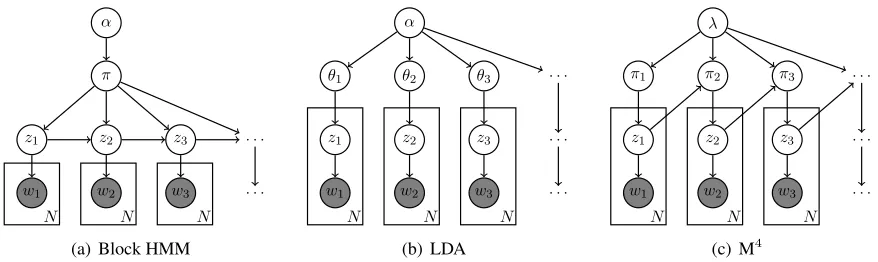
Figure 1: The graphical models for the block HMM (left) where each block of tokens depends on exactly one latent class, LDA (center) where each token individually depends on a latent class, and M4 (right) where the class
distri-butions are dependent across blocks. Some parameters are omitted for simplicity. This figure depicts the Bayesian variant of the block HMM (Ritter et al., 2010) where the transition distributionsπdepend on a Dirichlet(α) prior.
govern the transitions between text blocks in a se-quence. We generalize the block HMM approach so that there is no longer a one-to-one correspondence between states in the Markov chain and latent dis-course classes. Instead, we allow a state in the HMM to correspond to a mixture of many classes: we re-fer to this family of models asmixed membership Markov models (M4). Instead of defining explicit transition probabilities from one class to another as in a traditional HMM, we define the distribution over classes as a function of the entire histogram of class assignments of the previous text segment. We define our model using the same number of parameters as a standard HMM (§2), and we present a straightfor-ward approximate inference algorithm (§3).
While we introduce a general model, we will fo-cus on the task of unsupervised conversation model-ing. Specifically, we build off the Bayesian block HMMs used by Ritter et al. (2010) for modeling Twitter conversations, which will be our primary baseline. After discussing related work (§4), we present experimental results on a set of Twitter con-versations as well as a set of threads from CNET discussion forums (§5). We show that M4increases thread reconstruction accuracy by up to 15% com-pared to the HMM of Ritter et al. (2010), and we reduce variation of information against speech act annotations by an average of 18% from HMM and LDA baselines. To the best of our knowledge, this work is the first attempt to quantitatively compare unsupervised models against gold standard speech act annotations.
2 M4: Mixed Membership Markov Models
In this section, we extend the block HMM by intro-ducing mixed membership Markov models (M4).
Under the block HMM, as utilized by Ritter et al. (2010), messages in a conversation flow according to a Markov process, where the words of messages are generated according to language models associated with a state in a hidden Markov model. The intu-ition is that HMM states should correspond to some notion of a conversation “act” such asQUESTIONor ANSWER. The intuition is the same under M4, but now each token in a message is given its own class assignment, according to a class distribution for that particular message. A message’s class distribution depends on the class assignments of the previous message, yielding a model that retains sequential de-pendencies between messages, while allowing for finer grained class allocation than the block HMM. Modeling messages (or more generally, text blocks) as a mixture of multiple classes rather than a single class gives rise to the “mixed membership” property. In the subsections below, we formalize and ana-lyze this new model.
2.1 Structure Assumptions
Thus, a textblockis a set of tokens, while a doc-umentconsists of the discourse graph and all blocks associated with it. In the context of modeling con-versation threads, which will be the focus of our ex-periments later, we will assume a block corresponds to a single message in a thread. The parent of a mes-sagem is the message to which it is a response; if a message is not in response to anything in particu-lar, then it has no parent. Any replies to the message
m are the children ofm. The thread as a whole is called a document.
The discourse graph should be acyclic. A directed acyclic graph (DAG) offers a flexible representation of discourse (Ros´e et al., 1995), but for simplic-ity, we will restrict this and assume that each sub-graph is a tree; i.e. no message has multiple parents. The graph as a whole may be a forest: for example, someone could write a new message in a conversa-tion that is not directly in reply to any previous mes-sage, so this message would not have any parents, and would form the root of a new tree in the forest.
2.2 Generative Story
Extending the block HMM, latent classes in M4are now associated with each individual token, rather than one class for an entire block. The key differ-ence between the generative process behind M4 and the block HMM is that the transition distributions are defined with a log-linear model, which uses class assignments in a block as features to define the dis-tribution over classes for the children of that block. Put another way, a state in M4corresponds to a class histogram, and transitions between states are func-tions of the log-linear parameters.
Given a blockb, we will use the notationbto de-note the block’s feature vector, which consists of the histogram of latent class assignments for the tokens ofb.1There areKclasses. Additionally, we assume each feature vector has an extra cell containing an indicator denoting whether the block has no parent – this allows us to learn transitions from a “start” state. We also include a bias feature that is always 1, to learn a default weight for each class. There
1
One could also use other functions of the class histograms rather than the raw counts themselves. For example, we experi-mented with binary indicator features (i.e. “does classkappear anywhere in blockb?”), but this performed consistently worse in early experiments, and we do not consider this further.
are thus K + 2 features which are used to predict the probability of each of theK classes. The fea-tures are weighted by transition parameters, denoted
λ. The random variablezdenotes a latent class, and
φz is a discrete distribution over word types – that
is, each class is associated with a unigram language model. The transition distribution over classes is de-notedπ, which is given in terms ofλand the feature vector of the parent block.
Under this model, a corpusDis generated by:
1. For each(j, k)in the transition matrixΛK×K+2:
(a) Draw transition weightλjk∼ N(0,σ2).
2. For each classj:
(a) Draw word distributionφj∼Dirichlet(ω).
3. For each blockbof each documentdinD:
(a) Set class probabilityπbj =
exp(λT
ja) P
j0exp(λTj0a)
for all classesj, whereais the feature vec-tor for blocka, the parent ofb.
(b) For each tokennin blockb: i. Sample classz(b,n)∼πb.
ii. Sample wordw(b,n)∼φz.
For each block of text in a document (e.g. each message in a conversation), the distribution over classes π is computed as a function of the feature vector of the block’s parent and the transition pa-rameters (feature weights)Λ. Eachλjk has an
intu-itive interpretation: a posintu-itive value means that the occurrence of classkin a parent block increases the probability thatjwill appear in the next block, while a negative value reduces this probability.
The observed words of each block are generated by repeatedly sampling classes from the block’s dis-tribution π, and for each sampled class z, a single word is sampled from the class-specific distribution over wordsφz. In contrast, under the block HMM, a
classzis sampled once from the transition distribu-tion, and words are repeatedly sampled fromφz.
We place a symmetric Dirichlet prior on each φ
shows how M4 combines the sequential dependen-cies of the block HMM with the token-specific class assignments of LDA.
2.3 Discussion
Like the block HMM, M4is a type of HMM. A latent sequence under M4forms a Markov chain in which a state corresponds to a histogram of classes. (For simplicity, we are ignoring the extra features of the start state indicator and bias in this discussion.) If we assumea priorithat the length of a block is un-bounded, then this state space isNK where0 ∈ N. The probability of transitioning from a statebto an-other stateb˜ ∈NKis:
P(b→b)˜ ∝ζNMultinomial(˜b|π(b), N) (1)
where N = P
kb˜k, ζN is the probability that a
block hasN tokens,2andπ(b)is the transition dis-tribution given a vector b. This follows from the generative story defined above, with an additional step of generating the number of tokensN from the distributionζ.
We currently define a blockb’s distributionπb in
terms of the discrete feature vector a given by its parent a. We could have instead made πb a
func-tion of the parent’s distribufunc-tionπa– this would lead
to a model that assumes a dynamical system over a continuous space rather than a Markov chain. How-ever, as a generative story we believe it makes more sense for a block’s distribution to depend on the ac-tual class values which are emitted by the parent. Similar arguments are made by Blei and Mcauliffe (2007) when designing supervised topic models.
Under a block HMM with one class per block, there are K states corresponding to theK classes, requiringK×K parameters to define the transition matrix. Under M4, there is a countably infinite num-ber of states, but the transitions are still defined by
K×Kparameters (ignoring extra features). M4thus utilizes a larger state space without increasing the number of free parameters.
3 Inference and Parameter Estimation
We must infer the values of the hidden variables z
as well as the parameters for the word distributions
2
The distribution over the number of tokens can be arbitrary, as this is observed and does not affect inference. In topic mod-els, this is sometimes assumed to be Poisson (Blei et al., 2003).
Φ and transition weights Λ. Standard HMM dy-namic programming algorithms cannot straightfor-wardly be used for M4 because of the unboundedly large state space. We instead turn to Markov chain Monte Carlo (MCMC) methods as a tool for approx-imate inference. We derive a stochastic EM algo-rithm in which we alternate between sampling class assignments for the word tokens and optimizing the transition parameters, outlined in the following two subsections.
3.1 Latent Class Sampling
To explore the posterior distribution over latent classes, we use a collapsed Gibbs sampler such that we marginalize out each word multinomial φ and only need to sample the token assignments z con-ditioned on each other. Given the current state of the sampler, we sample a token’s class according to:
P(z(b,n)=k|z−(b,n),w, λ, ω)∝ (2)
exp(λTka)
P
k0exp(λTk0a)
nwk +ω nk+W ω
Y
c∈C
Y
j
exp(λTjb)
P
j0exp(λTj0b) !njc
The notation nwk indicates the number of tokens with word typewthat have been assigned to topick.
W is the vocabulary size. ais the parent block ofb, andCis the set ofb’s children.bis the feature vector corresponding to block b (i.e. the class histogram plus the bias feature), where the histogram includes the incremented count of the candidate classk.
This sampling distribution is very similar to that of LDA (Griffiths and Steyvers, 2004), but the distri-bution over “topics” is now a function of the previ-ous block, which gives the leftmost term. The right-most term is a result of the dependency of the child blocks (C) on the class assignments ofb.
3.2 Transition Parameter Optimization
Differentiating the corpus likelihood with respect to
Λyields the standard equation for log-linear models:
∂` ∂λzk
=X b
ak
nzb−nb
exp(λT za)
P
z0exp(λTz0a)
−λzk
σ2
(3) whereais the parent of blockb,ais the feature vec-tor associated witha,nz
bis the number of times class zoccurs in blockbandnb is the total number of
to-kens in blockb.
Standard optimization methods can be used to learn these parameters. In our experiments, we find that we obtain good results by simply performing a single iteration of gradient ascent after each sam-pling iterationt,3with the following update:
λ(zkt+1) =λ(zkt)+η(t) ∂` ∂λzk
(4)
whereηis a step size function.
4 Related Work
Hidden Markov models have a recent history as sim-ple models of document structure. Stolcke et al. (2000) used HMMs as a general model of discourse with an application to speech acts (or dialog acts) in conversations. Barzilay and Lee (2004) applied HMMs as anunsupervisedmodel of discourse. This work used HMMs to model the progression of sen-tences in articles, and was shown to be useful for or-dering sentences and generating summaries of news articles. More recently, Wang et al. (2011b) exper-imented with similar tasks using a related HMM-based model called the Structural Topic Model.
Unsupervised HMMs were applied to conversa-tional data by Ritter et al. (2010) who experimented with Twitter conversations. The authors also experi-mented with incorporating a topic model on top of the HMM to distinguish speech acts from topical clusters, with mixed results. Joty et al. (2011) ex-tended this work by enriching the emission distribu-tions and using additional features such as speaker and position information. An approach to unsuper-vised discourse modeling that does not use HMMs is
3
Incremental updates are justified under the generalized EM algorithm (Dempster et al., 1977). Each gradient step with re-spect toλcorresponds to a generalized M-step, while each sam-pling iteration corresponds to a stochastic E-step.
the latent permutation model of Chen et al. (2009). This model assumes each segment (e.g. paragraph) in a document is associated with a latent class or topic, and the ordering of topics within a document is modeled as a deviation from some canonical or-dering.
Extensions to the block HMM have incorpo-rated mixed membership properties within blocks, notably the Markov Clustering Topic Model (Hospedales et al., 2009), which allows each HMM state to be associated with its own distribution over topics in a topic model. Like the block HMM, this still assumes a relatively small number of HMM states, but with an extra layer of latent variables be-fore the observations are emitted. This is more re-strictive than the unbounded state space of M4.
Decoupling HMM states from latent classes was considered by Beal et al. (1997) with the Factorial HMM, which uses factorized state representations. The Factorial HMM is most often used to model in-dependent Markov chains, whereas M4 has a dense graphical model topology: the probability of each of the latent classes depends on the counts of all of the classes in the previous block. The trick in M4 is to define the transition matrix via a function of a limited number of parameters, allowing tractable inference in a model with arbitrarily many states.
In topic models, log-linear formulations of la-tent class distributions4 are utilized in correlated topic models (Blei and Lafferty, 2007) as a means of incorporating covariance structure among topic probabilities. Applying log-linear regression to po-tentially many features was combined with LDA by Mimno and McCallum (2008), who model the Dirichlet prior over topics as a function of document features. In M4, such features would correspond to the class histograms of previous blocks, introducing additional dependencies between documents.
One topic model that imposes sequential depen-dencies between documents is Sequential LDA (Du et al., 2010), which models a document as a se-quence of segments (such as paragraphs) governed by a Pitman-Yor process, in which the latent topic distribution of one segment serves as the base dis-tribution for the next segment. This is in the spirit
4This formulation corresponds to the
of our work, where the latent classes in a segment depend on the class distribution of the previous seg-ment. By using the Pitman-Yor process, however, this work assumes topics are positively correlated, i.e. the occurrence of a topic in one segment makes it likely to appear in the next. In contrast, we wish to learn arbitrary transitions, both positive and neg-ative, between the latent classes.
5 Experiments with Conversation Data
We experiment with two corpora of text-based asyn-chronous conversations on the Web. One of these is annotated with speech act labels, against which we compare our unsupervised clusters. We measure the predictive capabilities of the model via perplexity experiments and the task of thread reconstruction.
5.1 Data Sets
First, we use a corpus of discussion threads from CNET forums (Kim et al., 2010), which are mostly technical discussion and support. This corpus in-cludes 321 threads and a total of 1309 messages, with an average message length of 78 tokens after preprocessing.5 Second, we use the Twitter data set created by Ritter et al. (2010). We consider 36K con-versation threads for a total of 100K messages with average length 13.4 tokens.
Both data sets are already annotated with the re-ply structure, so the discourse graph is given. We preprocess the data by treating contiguous blocks of punctuation as tokens, and we remove infrequent words. The Twitter corpus has some additional pre-processing, such as converting URLs to a single word type.
5.2 Baseline Models
Our work is motivated by the Bayesian HMM ap-proach of Ritter et al. (2010) – the model we re-fer to as the block HMM (BHMM) – and we con-sider this our primary baseline. (See also (Goldwa-ter and Griffiths, 2007) for more details on Bayesian HMMs with Dirichlet priors.) We also compare against LDA, which makes latent assignments at the token-level, but blocks of text are independent of
5
Three messages in this corpus have multiple parents. For the sake of conciseness, we simply remove these threads rather than introducing a method to model multiple parents.
each other. In other words, BHMM models sequen-tial dependencies but allows only single-class mem-bership, whereas LDA uses no sequence information but has a mixed membership property. M4combines these two properties.
We use standard Gibbs samplers for both baseline models, and we optimize the Dirichlet hyperparam-eters (for the transition and topic distributions) using Minka’s fixed-point iterations (2003).
5.3 Incorporating Background Distributions
In our experiments, we find that the intrusion of common stop words can make the results difficult to interpret, but we do not want to perform simple stop word removal because common function words often play important roles in the latent classes (i.e. speech acts) of the conversation data we consider here. We instead handle this by extending our model to include a “background” distribution over words which is independent of the latent classes in a docu-ment; this was also done by Wang et al. (2011b).
The idea is to introduce a binary switching vari-able x into the model which determines whether a word is generated from the general background dis-tribution or from the disdis-tribution specific to a latent class z. Loosely, if the marginal probability of a word was given by p(w) = P
zp(w|z)p(z), the
introduction of a background distribution gives the marginal probability p(w) = p(x = 0)p(w|B) + p(x = 1)P
zp(w|z). This is common practice and
we will not go into detail; see (Chemudugunta et al., 2006) for a general example on sampling switching variables. We augment all three models with a back-ground distribution in exactly the same way, so that the comparison is fair. We use a Beta(10.0,10.0)
prior over the switching distribution.
5.4 Experimental Setup
All of our results are averaged across four randomly initialized chains which are run for 5000 iterations, with five samples collected during the final 500 it-erations. We take small gradient steps of decreasing size withη(t) = 0.1/(1000 +t).
We set σ2 = 10.0 as the variance of the λ
5 10 15 20 25 CNET
Unigram 63.07 63.07 63.07 63.07 63.07 LDA 57.16 54.35 52.88 51.63 50.50 BHMM 61.26 61.06 60.92 60.86 60.85 M4 60.38 59.58 59.26 59.21 59.25
Unigram 93.00 93.00 93.00 93.00 93.00 LDA 83.70 78.40 74.01 70.91 70.16 BHMM 90.51 89.94 89.68 89.59 89.38 M4 88.44 86.17 85.50 85.55 86.31
Table 1: Average perplexity of held-out data for various numbers of latent classes.
Metropolis-Hastings proposals: we add Gaussian-distributed noise to the log of the current ω, then exponentiate this to yield the proposedω(new). This log-space proposal ensures thatωis always positive. When computing the transition distributions for M4, we normalize the class histograms so that the counts to sum to 1. This helps with numeric sta-bility because the input vectors stay within a small bounded range.6
5.5 Experimental Results
5.5.1 Perplexity
We begin with standard measures of the perplex-ity of held-out data. For these experiments, we train on 75% of the data, and test on the remaining 25%. We run the sampler for 500 iterations using the word distributions and transition parameters learned during training; we compute the average perplexity from the final ten sampling iterations.
Results for different numbers of classes are shown in Table 1. These results demonstrate the advan-tage of models with the mixed membership property. Although LDA outperforms both sequence models, this is be expected. Each block’s topic distribution is stochastically generated with LDA, whereas in the two sequence models, the distribution over classes is simply a deterministic function of the previous block. This allows LDA to infer parameters that fit the data more tightly. Comparing only the two se-quence models, we find that M4 does significantly better than BHMM in all cases withp <0.05.
6Implementations of both M4and the block HMM will be
available athttp://cs.jhu.edu/˜mpaul
BHMM
M
40.25 0.30 0.35 0.40 0.45 0.50 0.55
Thread Reconstruction Accuracy
CNET
BHMM
M
40.35 0.36 0.37 0.38 0.39 0.40 0.41
[image:7.612.74.301.61.195.2]0.42
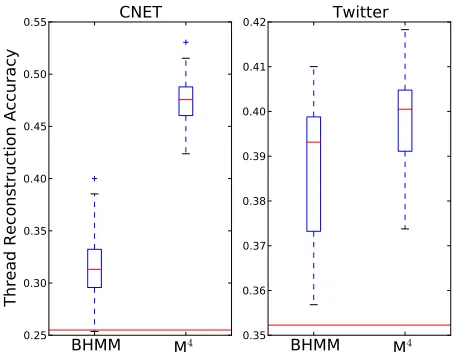
Figure 2: Accuracy at the task of thread reconstruction. The horizontal bar indicates a random baseline.
If capturing sequence information is not impor-tant, then LDA may provide a better fit to a corpus than sequence models. In the next two subsections, we will consider tasks where the sequential structure is important, thus LDA is not an appropriate choice.
5.5.2 Thread Reconstruction
A natural predictive task of the sequence models is to reconstruct the discourse graph of a document where the structure is unknown. In the conversa-tion domain, this corresponds to the task ofthread reconstruction(Yeh and Harnly, 2006; Wang et al., 2011c). Given only a flat structure, can we recover the reply structure of messages in the conversation? Previous work with BHMM found the optimal structure by computing the likelihood of all permu-tations of a thread or sequence (Ritter et al., 2010; Wang et al., 2011b). We take a more practical ap-proach and find the optimal structure as part of our inference procedure. We do this by treating the par-ent of each block as a hidden variable to be inferred. The parent of blockbis the random variablerb, and
we alternate between sampling values of the latent classes z and the parents r. The sampling distri-butions are annealed, as a search technique to find the best configuration of assignments (Finkel et al., 2005). At temperatureτ, we sample a block’s parent according to:
P(rb =a|z, λ)∝
Y
j
exp(λTja)
P
j0exp(λTj0a) !n
j b/τ
For each conversation thread, any message is a candidate for the parent of blockb (exceptbitself) including the dummy “start” block.
As before, we train on 75% of the data, and run this experiment on the remaining 25%. We run the sampler for 500 iterations, cooling τ by 1% after each iteration, whereτ(0) = 1. We measure accu-racy as the percentage of blocks whose assignment for rb matches the true parent. For each fold, we
run this estimation procedure from five random ini-tializations and average the results. Like Ritter et al. (2010), we do not enforce temporal constraints in the thread structure for this experiment. We are purely evaluating the predictive abilities of the model rather than its performance in a full-fledged reconstruction setup, which would require richer features beyond the scope of this paper.
Figure 2 shows results comparing M4 against BHMM. Because all blocks are independent under LDA, it cannot be used in this experiment; using LDA would amount to a random baseline.
We plot the distribution of results from vari-ous samples and varivari-ous numbers of classes in
{5, . . . ,25}. Most of the variance is across folds and samples; we find that there is not a strong trend in accuracy as a function of the number of classes. This suggests that most of the sequence predictions are carried by a small subset of the classes.
On average, M4 outperforms BHMM by more than 15 points on the CNET corpus. M4 is also bet-ter on the Twitbet-ter corpus, but the difference is not so stark. This seems to confirm our intuition that the advantage of M4 over BHMM is greater when the blocks are longer; tweets may be short enough that the single-class assumption is not as limiting.
5.5.3 Speech Act Discovery
Thus far, we have investigated the predictive power of the model, but we would also like to deter-mine if the inferred clusters correspond to human-interpretible classes. In the case of conversation data, our hope is that some of the latent classes representspeech actsor dialog acts (Searle, 1975). While there is a body of work in supervised speech act classification (Cohen et al., 2004; Bangalore et al., 2006; Surendran and Levow, 2006; Qadir and Riloff, 2011), the variety of conversation domains on the Web motivates the use of unsupervised
ap-5 10 15 20 25
Number of classes
2.0 2.5 3.0 3.5 4.0 4.5 5.0
Variation of Information (VI)
Speech Act Clustering (CNET)
[image:8.612.314.539.56.242.2]Random LDA BHMM M4
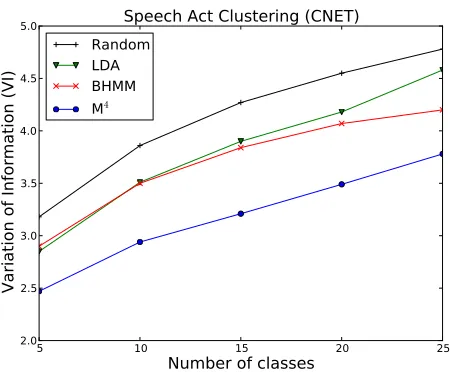
Figure 3: The variation of information between the human-created speech act annotations of the CNET cor-pus and the latent class assignments by various models.
proaches.
The CNET corpus is annotated with twelve speech act classes: QUESTIONandANSWER, which are both broken down into multiple sub-classes, as well asRESOLUTION,REPRODUCTION, andOTHER (Kim et al., 2010). We would like to quantitatively measure how closely the latent states induced by our model match these annotations.7
We can measure this with variation of informa-tion (Meila, 2003), which has been used in recent years for unsupervised evaluation, e.g. in part-of-speech clustering (Goldwater and Griffiths, 2007). Given two sets of variable assignmentszandz0, the variation of information is defined as H(Z|Z0) + H(Z0|Z). In other words, given one clustering, how much uncertainty do we have about the other? Re-sults are shown in Figure 3: a lower value corre-sponds to higher similarity.
On the CNET corpus, M4outperforms both base-lines in all cases by a very significant margin. Qual-itatively, we see clusters and transition parameters that make sense. For example, the class with top words {i, my, have, computer, am,?, tried, help}
is most likely to begin a thread (with λ = +1.94) and appears to describe questions or requests for
7
! you ? :) u your good !! thanks
. i , it you but that im lol its
to in ! . im ? the at
be going
! * :d lol haha :p ? .. me !! :o
” he . is the him his that was like . the of , ?
a in is to for that
-url- rt just # today anyone people
−
+
− +
+
−
+
+
+
+
+
+ −
+
+
+
−
+
+
−
+
−
−
+
+
+
−+
−
−
+
+
−
+
−
[image:9.612.100.524.63.254.2]+
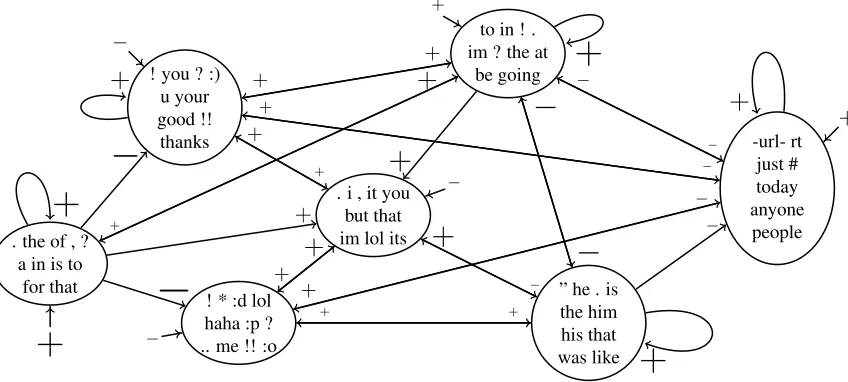
Figure 4: Example output from a model trained on the Twitter corpus with 15 classes (7 shown). Each node corre-sponds to a class learned by the model, and the most probable words are shown for each class. The symbols+and
−on the directed edges denote the sign of theλassociated with transitioning from one class to another, and the size of the symbols is scaled by the magnitude ofλ. Non-edge arrows going into a node represent the weight of starting a conversation with that class. Low-magnitude weights are not shown, and some edges are omitted to avoid clutter.
help. The class is not likely to be followed by itself (λ=−0.32) but is likely to be followed by the class with words {you, your, /, com, ., http, windows}
(withλ= +1.38).
The Twitter corpus does not have speech act an-notations, so we offer example output in Figure 4. We again see patterns that we might expect to find in social media conversations, and some classes appear to correspond to speech acts such a declarations, per-sonal questions, and replies. For example, the class in the center of the figure has words likeyouandbut
which suggests it is used in reply to other messages, and indeed we see that it has a positive weight of following almost every class, but a negative weight for actually starting a thread. Conversely, the class containing URLs (which corresponds to the act of sharing news or media) is likely to begin a thread, but is not likely to follow other classes except itself.
How well unsupervised models can truly capture speech acts is an open question. Much as LDA “topics” do not always correspond to what humans would judge to be semantic classes (Chang et al., 2009), the conversation classes inferred by unsu-pervised sequence models are similarly unlikely to be a perfect fit to human-assigned classes. Never-theless, these results suggest M4 is a step forward.
Our model provides a framework for defining inter-message transitions as functions of multiple classes, which will be a desirable property for many corpora.
6 Conclusion
We have presented mixed membership Markov models (M4), which extend the simple HMM ap-proach to discourse modeling by positing class as-signments at the level of individual tokens. This al-lows blocks of text to belong to potentially multiple classes, a property that relates M4 to topic models. This type of model can be viewed as an HMM with an expanded state space, but because the transition probabilities are a function of a small number of pa-rameters, the output remains human-interpretible.
messages (e.g. into sentences) and constraint each segment to belong to one class or speech act; modi-fications along these lines have been applied to topic models as well (Gruber et al., 2007). While we have focused on conversation modeling, M4 is a general probabilistic model that could be applied to other discourse applications, for example modeling sen-tences or paragraphs in articles rather than messages in conversations; it could also be applied to data be-yond text.
Compared to a Bayesian block HMM, M4 per-forms much better at a variety of tasks. A draw-back is that the time complexity of inference as pre-sented here is quadratic in the number of classes rather than linear. Improving this may be the subject of future research. Another potential avenue of fu-ture work is to model transitions such that a Dirichlet prior for the class distribution of a block, rather than the class distribution itself, depends on the previous class assignments. This would yield a model that more closely resembles LDA, but with topic priors that encode sequence information.
Acknowledgements
Thanks to Matt Gormley, Mark Dredze, Jason Eis-ner, the members of my lab and the anonymous re-viewers for helpful feedback and discussions. This material is based upon work supported by a National Science Foundation Graduate Research Fellowship under Grant No. DGE-0707427 and a Dean’s Fel-lowship from the Johns Hopkins University Whiting School of Engineering.
References
Srinivas Bangalore, Giuseppe Di Fabbrizio, and Amanda Stent. 2006. Learning the structure of task-driven human-human dialogs. InProceedings of the 21st In-ternational Conference on Computational Linguistics and the 44th annual meeting of the Association for Computational Linguistics, ACL-44, pages 201–208.
Regina Barzilay and Lillian Lee. 2004. Catching the drift: Probabilistic content models, with applications to generation and summarization. In HLT-NAACL 2004: Main Proceedings, pages 113–120, Boston, Massachusetts, USA, May 2 - May 7. Association for Computational Linguistics.
M. J. Beal, Z. Ghahramani, and C. E. Rasmussen. 1997.
Factorial hidden markov models. InMachine Learn-ing, volume 29, pages 29–245.
D. Blei and J. Lafferty. 2007. A correlated topic model of science.Annals of Applied Statistics, 1(1):17–35. David M. Blei and Jon D. Mcauliffe. 2007. Supervised
topic models. InAdvances in Neural Information Pro-cessing Systems 21.
David Blei, Andrew Ng, and Michael Jordan. 2003. La-tent dirichlet allocation. Journal of Machine Learning Research, 3.
Jonathan Chang, Jordan Boyd-Graber, Sean Gerrish, Chong Wang, and David Blei. 2009. Reading Tea Leaves: How Humans Interpret Topic Models. In Neu-ral Information Processing Systems (NIPS).
Chaitanya Chemudugunta, Padhraic Smyth, and Mark Steyvers. 2006. Modeling general and specific as-pects of documents with a probabilistic topic model. InNIPS, pages 241–248.
Harr Chen, S. R. K. Branavan, Regina Barzilay, and David R. Karger. 2009. Global models of document structure using latent permutations. In Proceedings of Human Language Technologies: The 2009 Annual Conference of the North American Chapter of the As-sociation for Computational Linguistics, NAACL ’09, pages 371–379.
William W. Cohen, Vitor R. Carvalho, and Tom M. Mitchell. 2004. Learning to classify email into “speech acts”. In Proceedings of EMNLP 2004, pages 309–316, Barcelona, Spain, July. Association for Computational Linguistics.
A. P. Dempster, N. M. Laird, and D. B. Rubin. 1977. Maximum likelihood from incomplete data via the em algorithm.Journal of the Royal Statistical Society. Se-ries B (Methodological), 39(1):1–38.
Christopher P. Diehl, Galileo Namata, and Lise Getoor. 2007. Relationship identication for social network dis-covery. InAAAI’07.
Lan Du, Wray Buntine, and Huidong Jin. 2010. Se-quential latent dirichlet allocation: Discover underly-ing topic structures within a document. 2010 IEEE International Conference on Data Mining, pages 148– 157.
Jonathan L. Elsas and Jaime Carbonell. 2009. It pays to be picky: An evaluation of thread retrieval in online fo-rums. In32nd Annual International ACM SIGIR Con-ference on Research and Development on Information Retrieval(SIGIR 2009).
Jenny Rose Finkel, Trond Grenager, and Christopher D. Manning. 2005. Incorporating non-local information into information extraction systems by gibbs sampling. InACL.
the Association of Computational Linguistics, pages 744–751, Prague, Czech Republic, June. Association for Computational Linguistics.
Tom Griffiths and Mark Steyvers. 2004. Finding scien-tific topics. InProceedings of the National Academy of Sciences of the United States of America.
Amit Gruber, Michal Rosen-Zvi, and Yair Weiss. 2007. Hidden topic markov models. InArtificial Intelligence and Statistics (AISTATS), San Juan, Puerto Rico. Timothy Hospedales, Shaogang Gong, and Tao Xiang.
2009. A markov clustering topic model for mining behaviour in video. In International Conference on Computer Vision (ICCV).
Shafiq R. Joty, Giuseppe Carenini, and Chin-Yew Lin. 2011. Unsupervised modeling of dialog acts in asyn-chronous conversations. InIJCAI, pages 1807–1813. Su Nam Kim, Li Wang, and Timothy Baldwin. 2010.
Tagging and linking web forum posts. InProceedings of the Fourteenth Conference on Computational Natu-ral Language Learning, CoNLL ’10, pages 192–202. Marina Meila. 2003. Comparing clusterings by the
vari-ation of informvari-ation. Learning Theory and Kernel Ma-chines, pages 173–187.
D. Mimno and A. McCallum. 2008. Topic models condi-tioned on arbitrary features with dirichlet-multinomial regression. InUAI.
Tom Minka. 2003. Estimating a dirichlet distribution. Ashequl Qadir and Ellen Riloff. 2011. Classifying
sen-tences as speech acts in message board posts. In Pro-ceedings of the 2011 Conference on Empirical Meth-ods in Natural Language Processing, pages 748–758, Edinburgh, Scotland, UK., July. Association for Com-putational Linguistics.
Alan Ritter, Colin Cherry, and Bill Dolan. 2010. Unsu-pervised modeling of twitter conversations. InHuman Language Technologies: The 2010 Annual Conference of the North American Chapter of the Association for Computational Linguistics, HLT ’10, pages 172–180. Carolyn Penstein Ros´e, Barbara Di Eugenio, Lori S.
Levin, and Carol Van Ess-Dykema. 1995. Discourse processing of dialogues with multiple threads. In Pro-ceedings of the 33rd annual meeting on Association for Computational Linguistics, ACL ’95, pages 31–38. John Searle, 1975. A taxonomy of illocutionary acts.
University of Minnesota Press, Minneapolis.
Jangwon Seo, W. Bruce Croft, and David A. Smith. 2009. Online community search using thread struc-ture. InACM Conference on Information and Knowl-edge Management (CIKM 2009), pages 1907–1910. Andreas Stolcke, Noah Coccaro, Rebecca Bates, Paul
Taylor, Carol Van Ess-Dykema, Klaus Ries, Eliza-beth Shriberg, Daniel Jurafsky, Rachel Martin, and Marie Meteer. 2000. Dialogue act modeling for
automatic tagging and recognition of conversational speech. Computational Linguistics, 26(3):339–373, September.
Dinoj Surendran and Gina-Anne Levow. 2006. Dialog act tagging with support vector machines and hidden markov models. InInterspeech.
Hanna M. Wallach, David Mimno, and Andrew McCal-lum. 2009. Rethinking LDA: Why priors matter. In
NIPS.
H.M. Wallach. 2006. Topic modeling: beyond bag-of-words. InICML ’06: Proceedings of the 23rd inter-national conference on Machine learning, pages 977– 984.
Hongning Wang, Chi Wang, ChengXiang Zhai, and Ji-awei Han. 2011a. Learning online discussion struc-tures by conditional random fields. In 34th Annual International ACM SIGIR Conference on Research and Development in Information Retrieval (SIGIR’11), pages 435–444.
Hongning Wang, Duo Zhang, and ChengXiang Zhai. 2011b. Structural topic model for latent topical struc-ture analysis. InACL, pages 1526–1535. The Associ-ation for Computer Linguistics.
Li Wang, Marco Lui, Su Nam Kim, Joakim Nivre, and Timothy Baldwin. 2011c. Predicting thread discourse structure over technical web forums. InProceedings of EMNLP 2011, pages 13–25.
Gu Xu, Hang Li, and Wei-Ying Ma. 2008. Fora: Lever-aging the power of internet communities for question answering. In1st International Workshop on Question Answering on the Web (QAWeb08).