Deep Recurrent Generative Decoder for Abstractive Text Summarization
∗Piji Li† Wai Lam† Lidong Bing‡ Zihao Wang†
†Key Laboratory on High Confidence Software Technologies (Sub-Lab, CUHK),
Ministry of Education, China
†Department of Systems Engineering and Engineering Management,
The Chinese University of Hong Kong
‡AI Lab, Tencent Inc., Shenzhen, China
†{pjli, wlam, zhwang}@se.cuhk.edu.hk, ‡[email protected]
Abstract
We propose a new framework for ab-stractive text summarization based on a sequence-to-sequence oriented encoder-decoder model equipped with a deep re-current generative decoder (DRGN). La-tent structure information implied in the target summaries is learned based on a re-current latent random model for improv-ing the summarization quality. Neural variational inference is employed to ad-dress the intractable posterior inference for the recurrent latent variables. Abstractive summaries are generated based on both the generative latent variables and the dis-criminative deterministic states. Extensive experiments on some benchmark datasets in different languages show that DRGN achieves improvements over the state-of-the-art methods.
1 Introduction
Automatic summarization is the process of auto-matically generating a summary that retains the most important content of the original text doc-ument (Edmundson, 1969;Luhn,1958;Nenkova and McKeown,2012). Different from the common extraction-based and compression-based methods, abstraction-based methods aim at constructing new sentences as summaries, thus they require a deeper understanding of the text and the capabil-ity of generating new sentences, which provide an obvious advantage in improving the focus of a summary, reducing the redundancy, and keeping a good compression rate (Bing et al.,2015;Rush et al.,2015;Nallapati et al.,2016).
∗The work described in this paper is supported by a grant from the Grant Council of the Hong Kong Special Adminis-trative Region, China (Project Code: 14203414).
Apple sues Qualcomm for nearly $1 billion
Twitter fixes botched @POTUS account transfer
Track Trump’s 100-day promises, Silicon Valley-style
The emergence of the ‘cyber cold war’
Tesla Autopilot not defective in fatal crash
Twitter mostly meets modest diversity goals
Uber to pay $20 million for misleading drivers
[image:1.595.323.512.225.371.2]top stories_
Figure 1: Headlines of the top stories from the channel “Technology” of CNN.
Some previous research works show that human-written summaries are more abstractive (Jing and McKeown, 2000). Moreover, our in-vestigation reveals that people may naturally fol-low some inherent structures when they write the abstractive summaries. To illustrate this observa-tion, we show some examples in Figure1, which are some top story summaries or headlines from the channel “Technology” of CNN. After analyz-ing the summaries carefully, we can find some common structures from them, such as “What”, “What-Happened” , “Who Action What”, etc. For example, the summary “Apple sues Qual-comm for nearly $1 billion” can be structural-ized as “Who (Apple) Action (sues) What (Qual-comm)”. Similarly, the summaries “[Twitter] [fixes] [botched @POTUS account transfer]”, “[Uber] [to pay] [$20 million] for misleading drivers”, and “[Bipartisan bill] aims to [reform] [H-1B visa system]” also follow the structure of “Who Action What”. The summary “The emer-gence of the ‘cyber cold war”’ matches with the structure of “What”, and the summary “St. Louis’ public library computers hacked” follows
the structure of “What-Happened”.
Intuitively, if we can incorporate the latent structure information of summaries into the ab-stractive summarization model, it will improve the quality of the generated summaries. How-ever, very few existing works specifically consider the latent structure information of summaries in their summarization models. Although a very pop-ular neural network based sequence-to-sequence (seq2seq) framework has been proposed to tackle the abstractive summarization problem (Lopyrev, 2015;Rush et al.,2015;Nallapati et al.,2016), the calculation of the internal decoding states is en-tirely deterministic. The deterministic transforma-tions in these discriminative models lead to lim-itations on the representation ability of the latent structure information. Miao and Blunsom (2016) extended the seq2seq framework and proposed a generative model to capture the latent summary in-formation, but they did not consider the recurrent dependencies in their generative model leading to limited representation ability.
To tackle the above mentioned problems, we design a new framework based on sequence-to-sequence oriented encoder-decoder model equipped with a latent structure modeling com-ponent. We employ Variational Auto-Encoders (VAEs) (Kingma and Welling, 2013; Rezende et al., 2014) as the base model for our genera-tive framework which can handle the inference problem associated with complex generative modeling. However, the standard framework of VAEs is not designed for sequence modeling related tasks. Inspired by (Chung et al., 2015), we add historical dependencies on the latent variables of VAEs and propose a deep recurrent generative decoder (DRGD) for latent structure modeling. Then the standard discriminative deterministic decoder and the recurrent generative decoder are integrated into a unified decoding framework. The target summaries will be decoded based on both the discriminative deterministic variables and the generative latent structural information. All the neural parameters are learned by back-propagation in an end-to-end training paradigm.
The main contributions of our framework are summarized as follows: (1) We propose a sequence-to-sequence oriented encoder-decoder model equipped with a deep recurrent generative decoder (DRGD) to model and learn the latent
structure information implied in the target sum-maries of the training data. Neural variational in-ference is employed to address the intractable pos-terior inference for the recurrent latent variables. (2) Both the generative latent structural informa-tion and the discriminative deterministic variables are jointly considered in the generation process of the abstractive summaries. (3) Experimental re-sults on some benchmark datasets in different lan-guages show that our framework achieves better performance than the state-of-the-art models.
2 Related Works
Automatic summarization is the process of auto-matically generating a summary that retains the most important content of the original text doc-ument (Nenkova and McKeown, 2012). Tradi-tionally, the summarization methods can be classi-fied into three categories: extraction-based meth-ods (Erkan and Radev, 2004; Goldstein et al., 2000;Wan et al., 2007; Min et al., 2012; Nalla-pati et al., 2017; Cheng and Lapata, 2016; Cao et al.,2016;Song et al.,2017), compression-based methods (Li et al., 2013; Wang et al., 2013; Li et al., 2015, 2017), and abstraction-based meth-ods. In fact, previous investigations show that human-written summaries are more abstractive (Barzilay and McKeown,2005;Bing et al.,2015). Abstraction-based approaches can generate new sentences based on the facts from different source sentences. Barzilay and McKeown (2005) em-ployed sentence fusion to generate a new sentence. Bing et al. (2015) proposed a more fine-grained fusion framework, where new sentences are gen-erated by selecting and merging salient phrases. These methods can be regarded as a kind of in-direct abstractive summarization, and complicated constraints are used to guarantee the linguistic quality.
segments, but also distracts them in the decoding step in order to better grasp the overall meaning of input documents. Nallapati et al. (2016) utilized a trick to control the vocabulary size to improve the training efficiency. The calculations in these methods are all deterministic and the representa-tion ability is limited. Miao and Blunsom (2016) extended the seq2seq framework and proposed a generative model to capture the latent summary in-formation, but they do not consider the recurrent dependencies in their generative model leading to limited representation ability.
Some research works employ topic models to capture the latent information from source docu-ments or sentences. Wang et al.(2009) proposed a new Bayesian sentence-based topic model by making use of both the document and term-sentence associations to improve the performance of sentence selection. Celikyilmaz and Hakkani-Tur (2010) estimated scores for sentences based on their latent characteristics using a hierarchical topic model, and trained a regression model to ex-tract sentences. However, they only use the latent topic information to conduct the sentence salience estimation for extractive summarization. In con-trast, our purpose is to model and learn the latent structure information from the target summaries and use it to enhance the performance of abstrac-tive summarization.
3 Framework Description 3.1 Overview
As shown in Figure 2, the basic framework of our approach is a neural network based encoder-decoder framework for sequence-to-sequence learning. The input is a variable-length sequence
X = {x1,x2, . . . ,xm} representing the source
text. The word embedding xt is initialized
ran-domly and learned during the optimization pro-cess. The output is also a sequence Y =
{y1,y2, . . . ,yn}, which represents the generated
abstractive summaries. Gated Recurrent Unit (GRU) (Cho et al., 2014) is employed as the ba-sic sequence modeling component for the encoder and the decoder. For latent structure modeling, we add historical dependencies on the latent variables of Variational Auto-Encoders (VAEs) and propose a deep recurrent generative decoder (DRGD) to distill the complex latent structures implied in the target summaries of the training data. Finally, the abstractive summaries will be decoded out based
on both the discriminative deterministic variables
Hand the generative latent structural information
Z.
3.2 Recurrent Generative Decoder
Assume that we have obtained the source text rep-resentationhe∈Rkh. The purpose of the decoder is to translate this source code he into a series
of hidden states{hd
1,hd2, . . . ,hdn}, and then revert
these hidden states to an actual word sequence and generate the summary.
For standard recurrent decoders, at each time stept, the hidden statehd
t ∈Rkhis calculated
us-ing the dependent input symbolyt−1 ∈ Rkw and
the previous hidden statehd t−1:
hdt =f(yt−1,hdt−1) (1)
where f(·) is a recurrent neural network such as vanilla RNN, Long Short-Term Memory (LSTM) (Hochreiter and Schmidhuber, 1997), and Gated Recurrent Unit (GRU) (Cho et al.,2014). No mat-ter which one we use forf(·), the common trans-formation operation is as follows:
hd
t =g(Wdyhyt−1+Wdhhhdt−1+bdh) (2)
whereWd
yh ∈ Rkh×kw and Wdhh ∈ Rkh×kh are
the linear transformation matrices. bd
h is the bias.
khis the dimension of the hidden layers, andkwis
the dimension of the word embeddings.g(·)is the non-linear activation function. From Equation2, we can see that all the transformations are deter-ministic, which leads to a deterministic recurrent hidden statehd
t. From our investigations, we find
that the representational power of such determin-istic variables are limited. Some more complex latent structures in the target summaries, such as the high-level syntactic features and latent topics, cannot be modeled effectively by the deterministic operations and variables.
<eos>
1
y y2
1
y y2
ߝ 2
logV ߤ
ܰሺͲǡ ܫሻ ݄ ݄ௗ
2
[ (, ) || (0,)] KL
D N uV N I
1
x x2 x3
Attention
input output
z 1
z z2 z3
Encoder Decoder Variational Auto-Encoders
<eos>
4 x
[image:4.595.90.514.64.203.2]variational-encoder variational-decoder
Figure 2: Our deep recurrent generative decoder (DRGD) for latent structure modeling.
introducing the historical latent variable depen-dencies to make it be capable of modeling se-quence data. Our proposed latent structure mod-eling framework can be viewed as a sequence generative model which can be divided into two parts: inference (variational-encoder) and gener-ation (varigener-ational-decoder). As shown in the de-coder component of Figure2, the input of the orig-inal VAEs only contains the observed variableyt,
and the variational-encoder can map it to a latent variablez∈Rkz, which can be used to reconstruct the original input. For the task of summarization, in the sequence decoder component, the previous latent structure information needs to be considered for constructing more effective representations for the generation of the next state.
For the inference stage, the variational-encoder can map the observed variable y<t and the
pre-vious latent structure informationz<t to the
pos-terior probability distribution of the latent struc-ture variable pθ(zt|y<t,z<t). It is obvious that
this is a recurrent inference process in which zt
contains the historical dynamic latent structure in-formation. Compared with the variational infer-ence processpθ(zt|yt)of the typical VAEs model,
the recurrent framework can extract more complex and effective latent structure features implied in the sequence data.
For the generation process, based on the la-tent structure variablezt, the target wordytat the
time steptis drawn from a conditional probabil-ity distribution pθ(yt|zt). The target is to
maxi-mize the probability of each generated summary
y = {y1,y2, . . . ,yT} based on the generation
process according to:
pθ(y) = T Y
t=1 Z
pθ(yt|zt)pθ(zt)dzt (3)
For the purpose of solving the intractable integral of the marginal likelihood as shown in Equation3, a recognition modelqφ(zt|y<t,z<t)is introduced
as an approximation to the intractable true poste-rior pθ(zt|y<t,z<t). The recognition model
pa-rameters φ and the generative model parameters
θ can be learned jointly. The aim is to reduce the Kulllback-Leibler divergence (KL) between
qφ(zt|y<t,z<t)andpθ(zt|y<t,z<t):
DKL[qφ(zt|y<t,z<t)kpθ(zt|y<t,z<t)]
= Z
zqφ(zt|y<t,z<t) log
qφ(zt|y<t,z<t)
pθ(zt|y<t,z<t)dz =Eqφ(zt|y<t,z<t)[logqφ(zt|·)−logpθ(zt|·)] where·denotes the conditional variablesy<t and
z<t. Bayes rule is applied to pθ(zt|y<t,z<t),
and we can extractlogpθ(z)from the expectation,
transfer the expectation termEqφ(zt|y<t,z<t) back to KL-divergence, and rearrange all the terms. Consequently the following holds:
logpθ(y<t) =
DKL[qφ(zt|y<t,z<t)kpθ(zt|y<t,z<t)] +Eqφ(zt|y<t,z<t)[logpθ(y<t|zt)] −DKL[qφ(zt|y<t,z<t)kpθ(zt)]
(4)
LetL(θ, φ;y)represent the last two terms from the right part of Equation4:
L(θ, ϕ;y) =
Eqφ(zt|y<t,z<t) XT
t=1logpθ(yt|zt)
−DKL[qφ(zt|y<t,z<t)kpθ(zt)]
(5)
Since the first KL-divergence term of Equation4 is non-negative, we havelogpθ(y<t)≥ L(θ, φ;y)
lower bound L(θ, φ;y), following the core idea of VAEs, we use a neural network framework for the probabilistic encoder qφ(zt|y<t,z<t) for
bet-ter approximation.
3.3 Abstractive Summary Generation
We also design a neural network based frame-work to conduct the variational inference and gen-eration for the recurrent generative decoder com-ponent similar to some design in previous works (Kingma and Welling,2013;Rezende et al.,2014; Gregor et al.,2015). The encoder component and the decoder component are integrated into a uni-fied abstractive summarization framework. Con-sidering that GRU has comparable performance but with less parameters and more efficient com-putation, we employ GRU as the basic recurrent model which updates the variables according to the following operations:
rt=σ(Wxrxt+Whrht−1+br)
zt=σ(Wxzxt+Whzht−1+bz)
gt= tanh(Wxhxt+Whh(rtht−1) +bh)
ht=ztht−1+ (1−zt)gt
wherertis the reset gate,ztis the update gate.
denotes the element-wise multiplication. tanhis the hyperbolic tangent activation function.
As shown in the left block of Figure2, the en-coder is designed based on bidirectional recurrent neural networks. Let xt be the word embedding
vector of the t-th word in the source sequence. GRU mapsxtand the previous hidden stateht−1
to the current hidden stateht in feed-forward
di-rection and back-forward didi-rection respectively:
*
ht=GRU(xt,
*
ht−1)
(
ht=GRU(xt,(ht−1)
(6)
Then the final hidden statehe
t ∈R2khis
concate-nated using the hidden states from the two direc-tions: he
t =
*
ht||
(
h. As shown in the middle block of Figure 2, the decoder consists of two compo-nents: discriminative deterministic decoding and generative latent structure modeling.
The discriminative deterministic decoding is an improved attention modeling based recurrent se-quence decoder. The first hidden state hd
1 is
ini-tialized using the average of all the source input states:hd
1 = T1e
Te
P t=1h
e
t, wherehet is the source
in-put hidden state. Teis the input sequence length.
The deterministic decoder hidden state hd t is
cal-culated using two layers of GRUs. On the first layer, the hidden state is calculated only using the current input word embeddingyt−1and the
previ-ous hidden statehd1 t−1:
hd1
t =GRU1(yt−1,hdt−11) (7)
where the superscriptd1 denotes the first decoder
GRU layer. Then the attention weights at the time step tare calculated based on the relationship of
hd1
t and all the source hidden states{het}. Letai,j
be the attention weight betweenhd1
i andhej, which
can be calculated using the following formulation:
ai,j = PTexp(e ei,j)
j0=1exp(ei,j0)
ei,j =vTtanh(Wdhhhid1 +Wehhhej+ba)
whereWd
hh ∈ Rkh×kh, Whhe ∈ Rkh×2kh,ba ∈
Rkh, and v ∈ Rkh. The attention context is ob-tained by the weighted linear combination of all the source hidden states:
ct=
XTe
j0=1at,j0hej0 (8)
The final deterministic hidden state hd2 t is the
output of the second decoder GRU layer, jointly considering the word yt−1, the previous hidden
statehd2
t−1, and the attention contextct:
hd2
t =GRU2(yt−1,hdt−21,ct) (9)
For the component of recurrent generative model, inspired by some ideas in previous works (Kingma and Welling,2013;Rezende et al.,2014; Gregor et al.,2015), we assume that both the prior and posterior of the latent variables are Gaussian, i.e., pθ(zt) = N(0,I) and qφ(zt|y<t,z<t) =
N(zt;µ,σ2I), where µ andσ denote the
varia-tional mean and standard deviation respectively, which can be calculated via a multilayer percep-tron. Precisely, given the word embedding yt−1,
the previous latent structure variablezt−1, and the
previous deterministic hidden statehd
t−1, we first
project it to a new hidden space:
hez
t =g(Wyhezyt−1+Wezhzzt−1+Whhezhtd−1+behz)
whereWez
yh ∈ Rkh×kw,Wezhz ∈ Rkh×kz,Whhez ∈
Rkh×kh, and bez
h ∈ Rkh. g is the sigmoid
Gaussian parametersµt ∈Rkz andσt ∈Rkz can be obtained via a linear transformation based on
hez
t :
µt=Wez
hµhetz +beµz log(σ2t) =Whσhetz +beσz
(10)
The latent structure variablezt ∈Rkz can be
cal-culated using the reparameterization trick:
ε∼ N(0,I), zt=µt+σt⊗ε (11)
whereε∈Rkz is an auxiliary noise variable. The process of inference for findingztbased on neural
networks can be teated as a variational encoding process.
To generate summaries precisely, we first in-tegrate the recurrent generative decoding compo-nent with the discriminative deterministic decod-ing component, and map the latent structure vari-ableztand the deterministic decoding hidden state
hd2
t to a new hidden variable:
hdy
t =tanh(Wdzhyzt+Whhdzhdt2 +bdhy) (12)
Given the combined decoding state hdy
t at the
time t, the probability of generating any target wordytis given as follows:
yt=ς(Whyd htdy+bdhy) (13)
whereWd
hy ∈Rky×khandbhyd ∈Rky. ς(·)is the
softmax function. Finally, we use a beam search algorithm (Koehn,2004) for decoding and gener-ating the best summary.
3.4 Learning
Although the proposed model contains a recurrent generative decoder, the whole framework is fully differentiable. As shown in Section3.3, both the recurrent deterministic decoder and the recurrent generative decoder are designed based on neural networks. Therefore, all the parameters in our model can be optimized in an end-to-end paradigm using back-propagation. We use{X}N and{Y}N
to denote the training source and target sequence. Generally, the objective of our framework con-sists of two terms. One term is the negative log-likelihood of the generated summaries, and the other one is the variational lower boundL(θ, φ;Y)
mentioned in Equation 5. Since the variational lower boundL(θ, φ;Y)also contains a likelihood term, we can merge it with the likelihood term of summaries. The final objective function, which
needs to be minimized, is formulated as follows:
J = 1N
N
X
n=1
T
X
t=1
(
−log
p(y(tn)|y<t(n), X(n))
+DKL
qφ(z(tn)|y(<tn),z(<tn))kpθ(z(tn))
) (14)
4 Experimental Setup 4.1 Datesets
We train and evaluate our framework on three pop-ular datasets. Gigawords is an English sentence summarization dataset prepared based on Anno-tated Gigawords1 by extracting the first sentence from articles with the headline to form a source-summary pair. We directly download the prepared dataset used in (Rush et al.,2015). It roughly con-tains 3.8M training pairs, 190K validation pairs, and 2,000 test pairs. DUC-20042 is another En-glish dataset only used for testing in our experi-ments. It contains 500 docuexperi-ments. Each document contains 4 model summaries written by experts. The length of the summary is limited to 75 bytes. LCSTSis a large-scale Chinese short text summa-rization dataset, consisting of pairs of (short text, summary) collected from Sina Weibo3 (Hu et al., 2015). We take Part-I as the training set, Part-II as the development set, and Part-III as the test set. There is a score in range1 ∼5labeled by human to indicate how relevant an article and its summary is. We only reserve those pairs with scores no less than 3. The size of the three sets are 2.4M, 8.7k, and 725 respectively. In our experiments, we only take Chinese character sequence as input, without performing word segmentation.
4.2 Evaluation Metrics
We use ROUGE score (Lin,2004) as our evalua-tion metric with standard opevalua-tions. The basic idea of ROUGE is to count the number of overlapping units between generated summaries and the ref-erence summaries, such as overlapped n-grams, word sequences, and word pairs. F-measures of ROUGE-1 1), ROUGE-2 2), ROUGE-L (R-L) and ROUGE-SU4 (R-SU4) are reported. 4.3 Comparative Methods
We compare our model with some baselines and state-of-the-art methods. Because the datasets are
1https://catalog.ldc.upenn.edu/ldc2012t21 2http://duc.nist.gov/duc2004
quite standard, so we just extract the results from their papers. Therefore the baseline methods on different datasets may be slightly different.
• TOPIARY(Zajic et al.,2004) is the best on DUC2004 Task-1 for compressive text sum-marization. It combines a system using lin-guistic based transformations and an unsu-pervised topic detection algorithm for com-pressive text summarization.
• MOSES+(Rush et al.,2015) uses a phrase-based statistical machine translation system trained on Gigaword to produce summaries. It also augments the phrase table with “dele-tion” rulesto improve the baseline perfor-mance, and MERT is also used to improve the quality of generated summaries.
• ABSandABS+(Rush et al.,2015) are both the neural network based models with local attention modeling for abstractive sentence summarization. ABS+ is trained on the Gi-gaword corpus, but combined with an ad-ditional log-linear extractive summarization model with handcrafted features.
• RNNandRNN-context(Hu et al.,2015) are two seq2seq architectures. RNN-context in-tegrates attention mechanism to model the context.
• CopyNet (Gu et al., 2016) integrates a copying mechanism into the sequence-to-sequence framework.
• RNN-distract(Chen et al.,2016) uses a new attention mechanism by distracting the his-torical attention in the decoding steps.
• RAS-LSTMandRAS-Elman(Chopra et al., 2016) both consider words and word po-sitions as input and use convolutional en-coders to handle the source information. For the attention based sequence decoding pro-cess, RAS-Elman selects Elman RNN ( El-man,1990) as decoder, and RAS-LSTM se-lects Long Short-Term Memory architecture (Hochreiter and Schmidhuber,1997).
• LenEmb(Kikuchi et al.,2016) uses a mech-anism to control the summary length by con-sidering the length embedding vector as the input.
• ASC+FSC1(Miao and Blunsom,2016) uses
a generative model with attention mechanism to conduct the sentence compression prob-lem. The model first draws a latent summary sentence from a background language model, and then subsequently draws the observed sentence conditioned on this latent summary. • lvt2k-1sentandlvt5k-1sent(Nallapati et al., 2016) utilize a trick to control the vocabulary size to improve the training efficiency.
4.4 Experimental Settings
For the experiments on the English dataset Giga-words, we set the dimension of word embeddings to 300, and the dimension of hidden states and la-tent variables to 500. The maximum length of doc-uments and summaries is 100 and 50 respectively. The batch size of mini-batch training is 256. For DUC-2004, the maximum length of summaries is 75 bytes. For the dataset of LCSTS, the dimen-sion of word embeddings is 350. We also set the dimension of hidden states and latent variables to 500. The maximum length of documents and sum-maries is 120 and 25 respectively, and the batch size is also 256. The beam size of the decoder was set to be 10. Adadelta (Schmidhuber,2015) with hyperparameterρ = 0.95 and = 1e−6
is used for gradient based optimization. Our neu-ral network based framework is implemented us-ing Theano (Theano Development Team,2016).
5 Results and Discussions 5.1 ROUGE Evaluation
Table 1: ROUGE-F1 on validation sets
Dataset System R-1 R-2 R-L GIGA StanD 32.69 15.29 30.60
DRGD 36.25 17.61 33.55 LCSTS StanD 33.88 21.49 31.05 DRGD 36.71 24.00 34.10
Table 2: ROUGE-F1 on Gigawords
System R-1 R-2 R-L
ABS 29.55 11.32 26.42
ABS+ 29.78 11.89 26.97
RAS-LSTM 32.55 14.70 30.03 RAS-Elman 33.78 15.97 31.15 ASC + FSC1 34.17 15.94 31.92
[image:8.595.83.279.247.398.2]lvt2k-1sent 32.67 15.59 30.64 lvt5k-1sent 35.30 16.64 32.62 DRGD 36.27 17.57 33.62
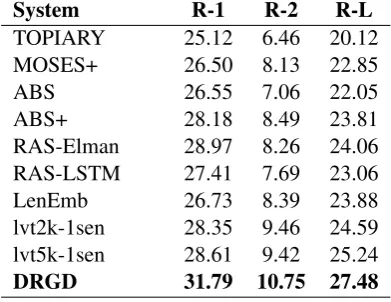
Table 3: ROUGE-Recall on DUC2004
System R-1 R-2 R-L
TOPIARY 25.12 6.46 20.12 MOSES+ 26.50 8.13 22.85
ABS 26.55 7.06 22.05
ABS+ 28.18 8.49 23.81
RAS-Elman 28.97 8.26 24.06 RAS-LSTM 27.41 7.69 23.06 LenEmb 26.73 8.39 23.88 lvt2k-1sen 28.35 9.46 24.59 lvt5k-1sen 28.61 9.42 25.24 DRGD 31.79 10.75 27.48
Table 4: ROUGE-F1 on LCSTS
System R-1 R-2 R-L
RNN 21.50 8.90 18.60
RNN-context 29.90 17.40 27.20 CopyNet 34.40 21.60 31.30 RNN-distract 35.20 22.60 32.50 DRGD 36.99 24.15 34.21
decoders is similar with those mentioned popular baseline methods.
The results on the English datasets of Giga-words and DUC-2004 are shown in Table 2 and Table3respectively. Our model DRGD achieves the best summarization performance on all the ROUGE metrics. Although ASC+FSC1 also uses
a generative method to model the latent summary variables, the representation ability is limited and it cannot bring in noticeable improvements. It is worth noting that the methods lvt2k-1sent and lvt5k-1sent (Nallapati et al.,2016) utilize linguis-tic features such as parts-of-speech tags, named-entity tags, and TF and IDF statistics of the words as part of the document representation. In fact, extracting all such features is a time consuming work, especially on large-scale datasets such as
Gigawords. lvt2k and lvt5k are not end-to-end style models and are more complicated than our model in practical applications.
The results on the Chinese dataset LCSTS are shown in Table4. Our model DRGD also achieves the best performance. Although CopyNet employs a copying mechanism to improve the summary quality and RNN-distract considers attention in-formation diversity in their decoders, our model is still better than those two methods demonstrating that the latent structure information learned from target summaries indeed plays a role in abstractive summarization. We also believe that integrating the copying mechanism and coverage diversity in our framework will further improve the summa-rization performance.
5.2 Summary Case Analysis
In order to analyze the reasons of improving the performance, we compare the generated sum-maries by DRGD and the standard decoders StanD used in some other works such as (Chopra et al., 2016). The source texts, golden summaries, and the generated summaries are shown in Table 5. From the cases we can observe that DRGD can in-deed capture some latent structures which are con-sistent with the golden summaries. For example, our result for S(1) “Wuhan wins men’s soccer ti-tle at Chinese city games” matches the “Who Ac-tion What” structure. However, the standard de-coder StanD ignores the latent structures and gen-erates some loose sentences, such as the results for S(1) “Results of men’s volleyball at Chinese city games” does not catch the main points. The reason is that the recurrent variational auto-encoders used in our framework have better representation ability and can capture more effective and complicated la-tent structures from the sequence data. Therefore, the summaries generated by DRGD have consis-tent laconsis-tent structures with the ground truth, leading to a better ROUGE evaluation.
6 Conclusions
Table 5: Examples of the generated summaries.
S(1): hosts wuhan won the men ’s soccer title by beating beijing shunyi #-# here at the #th chinese city games on friday.
Golden: hosts wuhan wins men ’s soccer title at chinese city games.
StanD: results of men ’s volleyball at chinese city games.
DRGD: wuhan wins men ’s soccer title at chinese city games.
S(2): UNK and the china meteorological administration tuesday signed an agreement here on long - and short-term cooperation in projects involving meteorological satellites and satellite meteorology.
Golden: UNK china to cooperate in meteorol-ogy.
StanD: weather forecast for major chinese cities.
DRGD:china to cooperate in meteorological satellites.
S(3): the rand gained ground against the dollar at the opening here wednesday , to #.# to the greenback from #.# at the close tuesday. Golden: rand gains ground.
StanD: rand slightly higher against dollar. DRGD:rand gains ground against dollar. S(4): new zealand women are having more children and the country ’s birth rate reached its highest level in ## years , statistics new zealand said on wednesday.
Golden: new zealand birth rate reaches ##-year high.
StanD: new zealand women are having more children birth rate hits highest level in ## years. DRGD: new zealand ’s birth rate hits ##-year high.
datasets show that DRGD achieves improvements over the state-of-the-art methods.
References
Regina Barzilay and Kathleen R McKeown. 2005. Sentence fusion for multidocument news
summa-rization. Computational Linguistics, 31(3):297–
328.
Lidong Bing, Piji Li, Yi Liao, Wai Lam, Weiwei Guo, and Rebecca Passonneau. 2015. Abstractive multi-document summarization via phrase selection and
merging. InACL, pages 1587–1597.
Samuel R Bowman, Luke Vilnis, Oriol Vinyals, An-drew M Dai, Rafal Jozefowicz, and Samy Ben-gio. 2016. Generating sentences from a continuous
space. CoNLL, pages 10–21.
Ziqiang Cao, Wenjie Li, Sujian Li, Furu Wei, and Yan-ran Li. 2016. Attsum: Joint learning of focusing
and summarization with neural attention. COLING,
pages 547–556.
Asli Celikyilmaz and Dilek Hakkani-Tur. 2010. A hy-brid hierarchical model for multi-document
summa-rization. InACL, pages 815–824.
Qian Chen, Xiaodan Zhu, Zhenhua Ling, Si Wei, and Hui Jiang. 2016. Distraction-based neural
net-works for document summarization. InIJCAI, pages
2754–2760.
Jianpeng Cheng and Mirella Lapata. 2016. Neural summarization by extracting sentences and words.
InACL, pages 484–494.
Kyunghyun Cho, Bart Van Merri¨enboer, Caglar Gul-cehre, Dzmitry Bahdanau, Fethi Bougares, Holger Schwenk, and Yoshua Bengio. 2014. Learning phrase representations using rnn encoder-decoder
for statistical machine translation. InEMNLP, pages
1724–1734.
Sumit Chopra, Michael Auli, Alexander M Rush, and SEAS Harvard. 2016. Abstractive sentence sum-marization with attentive recurrent neural networks.
NAACL-HLT, pages 93–98.
Junyoung Chung, Kyle Kastner, Laurent Dinh, Kratarth Goel, Aaron C Courville, and Yoshua Bengio. 2015. A recurrent latent variable model for sequential data.
InNIPS, pages 2980–2988.
Harold P Edmundson. 1969. New methods in
au-tomatic extracting. Journal of the ACM (JACM),
16(2):264–285.
Jeffrey L Elman. 1990. Finding structure in time.
Cog-nitive science, 14(2):179–211.
G¨unes Erkan and Dragomir R Radev. 2004. Lexrank: Graph-based lexical centrality as salience in text
summarization. Journal of Artificial Intelligence
Research, 22:457–479.
Jade Goldstein, Vibhu Mittal, Jaime Carbonell, and
Mark Kantrowitz. 2000. Multi-document
sum-marization by sentence extraction. In
NAACL-ANLPWorkshop, pages 40–48.
Karol Gregor, Ivo Danihelka, Alex Graves, Danilo Rezende, and Daan Wierstra. 2015. Draw: A
recur-rent neural network for image generation. InICML,
pages 1462–1471.
Jiatao Gu, Zhengdong Lu, Hang Li, and Victor OK Li. 2016. Incorporating copying mechanism in
sequence-to-sequence learning. In ACL, pages
Sepp Hochreiter and J¨urgen Schmidhuber. 1997.
Long short-term memory. Neural computation,
9(8):1735–1780.
Baotian Hu, Qingcai Chen, and Fangze Zhu. 2015. Lc-sts: A large scale chinese short text summarization
dataset. InEMNLP, pages 1962–1972.
Hongyan Jing and Kathleen R McKeown. 2000. Cut
and paste based text summarization. In NAACL,
pages 178–185.
Yuta Kikuchi, Graham Neubig, Ryohei Sasano, Hiroya Takamura, and Manabu Okumura. 2016. Control-ling output length in neural encoder-decoders. In
EMNLP, pages 1328–1338.
Diederik P Kingma and Max Welling. 2013.
Auto-encoding variational bayes. arXiv preprint
arXiv:1312.6114.
Philipp Koehn. 2004. Pharaoh: a beam search de-coder for phrase-based statistical machine
transla-tion models. InConference of the Association for
Machine Translation in the Americas, pages 115– 124. Springer.
Chen Li, Fei Liu, Fuliang Weng, and Yang Liu. 2013. Document summarization via guided sentence
com-pression. InEMNLP, pages 490–500.
Piji Li, Lidong Bing, Wai Lam, Hang Li, and Yi Liao. 2015. Reader-aware multi-document
summariza-tion via sparse coding. InIJCAI, pages 1270–1276.
Piji Li, Zihao Wang, Wai Lam, Zhaochun Ren, and Lidong Bing. 2017. Salience estimation via vari-ational auto-encoders for multi-document
summa-rization. InAAAI, pages 3497–3503.
Chin-Yew Lin. 2004. Rouge: A package for
auto-matic evaluation of summaries. InText
summariza-tion branches out: Proceedings of the ACL-04
work-shop, volume 8.
Konstantin Lopyrev. 2015. Generating news
head-lines with recurrent neural networks. arXiv preprint
arXiv:1512.01712.
Hans Peter Luhn. 1958. The automatic creation of
lit-erature abstracts. IBM Journal of research and
de-velopment, 2(2):159–165.
Yishu Miao and Phil Blunsom. 2016. Language as a latent variable: Discrete generative models for
sen-tence compression. InEMNLP, pages 319–328.
Ziheng Lin Min, Yen Kan Chew, and Lim Tan. 2012. Exploiting category-specific information for
multi-document summarization. COLING, pages 2903–
2108.
Ramesh Nallapati, Feifei Zhai, and Bowen Zhou. 2017. Summarunner: A recurrent neural network based se-quence model for extractive summarization of
docu-ments. InAAAI, pages 3075–3081.
Ramesh Nallapati, Bowen Zhou, Caglar Gulcehre, Bing Xiang, et al. 2016. Abstractive text summa-rization using sequence-to-sequence rnns and
be-yond.arXiv preprint arXiv:1602.06023.
Ani Nenkova and Kathleen McKeown. 2012. A survey
of text summarization techniques. In Mining Text
Data, pages 43–76. Springer.
Danilo Jimenez Rezende, Shakir Mohamed, and Daan Wierstra. 2014. Stochastic backpropagation and ap-proximate inference in deep generative models. In
ICML, pages 1278–1286.
Alexander M Rush, Sumit Chopra, and Jason Weston. 2015. A neural attention model for abstractive
sen-tence summarization. InEMNLP, pages 379–389.
J¨urgen Schmidhuber. 2015. Deep learning in neural
networks: An overview. Neural Networks, 61:85–
117.
Hongya Song, Zhaochun Ren, Piji Li, Shangsong Liang, Jun Ma, and Maarten de Rijke. 2017. Summarizing answers in non-factoid community
question-answering. InWSDM, pages 405–414.
Theano Development Team. 2016. Theano: A Python
framework for fast computation of mathematical ex-pressions.arXiv e-prints, abs/1605.02688.
Xiaojun Wan, Jianwu Yang, and Jianguo Xiao. 2007. Manifold-ranking based topic-focused
multi-document summarization. In IJCAI, volume 7,
pages 2903–2908.
Dingding Wang, Shenghuo Zhu, Tao Li, and Yihong Gong. 2009. Multi-document summarization
us-ing sentence-based topic models. InACL-IJCNLP,
pages 297–300.
Lu Wang, Hema Raghavan, Vittorio Castelli, Radu Flo-rian, and Claire Cardie. 2013. A sentence com-pression based framework to query-focused
multi-document summarization. In ACL, pages 1384–
1394.
David Zajic, Bonnie Dorr, and Richard Schwartz. 2004.
Bbn/umd at duc-2004: Topiary. In HLT-NAACL,