Proceedings of the 15th SIGMORPHON Workshop on Computational Research in Phonetics, Phonology, and Morphology, pages 78–83
78
Automatically Tailoring Unsupervised Morphological Segmentation to the
Language
Ramy Eskander† Owen Rambow] Smaranda Muresan†‡
†Department of Computer Science, Columbia University
‡Data Science Institute, Columbia University
{rnd2110,smara}@columbia.edu
]Elemental Cognition, Inc.[email protected]
Abstract
Morphological segmentation is beneficial for several natural language processing tasks dealing with large vocabularies. Unsuper-vised methods for morphological segmen-tation are essential for handling a diverse set of languages, including low-resource languages. Eskander et al. (2016) intro-duced a Language Independent Morpholog-ical Segmenter (LIMS) using Adaptor Gram-mars (AG) based on the best-on-average per-forming AG configuration. However, while LIMS worked best on average and outper-forms other state-of-the-art unsupervised morphological segmentation approaches, it did not provide the optimal AG configura-tion for five out of the six languages. We propose two language-independent classi-fiers that enable the selection of the opti-mal or nearly-optiopti-mal configuration for the morphological segmentation of unseen lan-guages.
1 Introduction
As natural language processing becomes more interested in many languages, including low-resource languages, unsupervised morphologi-cal segmentation remains an important area of study. For most of the languages of the world, we do not have morphologically annotated re-sources. However, many human language tech-nologies profit from morphological segmenta-tion, for example machine translation (Nguyen et al., 2010; Ataman et al., 2017) and speech recognition (Narasimhan et al.,2014).
In this paper, we build on previous work on unsupervised morphological segmentation us-ing Adaptor Grammars (AGs) (Johnson, 2008;
Sirts and Goldwater,2013;Eskander et al.,2016), a type of nonparametric Bayesian models that generalize probabilistic context-free grammars (PCFGs) (Johnson et al.,2007), where the PCFG is typically a morphological grammar that
spec-ifies the word structure. Specifically, we ex-tend the research proposed by Eskander et al.
(2016), who investigate a large space of param-eters when using Adaptor Grammars related to (i) the underlying context-free grammar and (ii) the use of a “Cascaded” system in which one grammar chooses affixes to be seeded into an-other in order to simulate the situation where scholar-knowledge is available. Their results on a development set of 6 languages (English, German, Finish, Turkish, Estonian and Zulu) show that the best performing AG-based con-figuration (grammar and learning setup) differ from language to language. For processing un-seen languages,Eskander et al.(2016) proposed the Language-Independent Morphological Seg-menter (LIMS) based on the best-on-average performing configuration when running leave-one-out cross validation on the development languages.
However, while LIMS works best on average and has been shown to outperform other state-of-the-art unsupervised morphological segmen-tation systems (Eskander et al., 2016), it is not the optimal configuration for any of the devel-opment languages except Zulu. Thus, in this paper we propose an approach to automatically select the optimal or nearly-optimal language-independent configuration for the morphologi-cal segmentation of unseen languages. We train two classifiers on the development languages used byEskander et al.(2016) to make choices for unseen languages (Section3). We show that we can choose the best parameter settings for the six development languages in a leave-one-out cross validation, and also on an unseen test language (Arabic).
2 Problem Definition and Dataset
seg-Grammar Main Representation Compound Morph SubMorph Segmentation Level
Morph+SM Morph+ No Yes Yes Morph
[image:2.595.91.506.63.163.2]Simple Prefix?+Stem+Suffix? No No No Prefix-Stem-Suffix Simple+SM Prefix?+Stem+Suffix? No No Yes Prefix-Stem-Suffix PrStSu Prefix+Stem+Suffix No Yes No Prefix-Stem-Suffix PrStSu+SM Prefix+Stem+Suffix No Yes Yes Prefix-Stem-Suffix PrStSu+Co+SM Prefix+Stem+Suffix Yes Yes Yes Prefix-Stem-Suffix PrStSu2a+SM Prefix?+(Stem+Suffix) No Yes Yes Prefix-Stem-Suffix PrStSu2b+SM (Prefix-Stem)+Suffix? No Yes Yes Prefix-Stem-Suffix PrStSu2b++Co+SM (Prefix-Stem)+Suffix? Yes Yes Yes Prefix-Stem-Suffix
Table 1: Grammar Representations. Compound = Upper level representation of the word as a sequence of compounds; Morph = Affix/Morph representation as a sequence of morphs. SubMorph (SM) = Lower level representation of characters as a sequence of sub-morphs. “+" denotesone or moreand “?" denotesoptional.
mentation (Johnson,2008;Sirts and Goldwater,
2013;Eskander et al.,2016), which is the task of breaking down words in a language into a se-quence of morphs. An AG model typically has two main components: a PCFG and an adap-tor that adapts the probabilities assigned to in-dividual subtrees in the grammar. For the task of morphological segmentation, a PCFG is typ-ically a morphological grammar that specifies word structure. Given a list of input strings, AGs can learn latent tree structures.
Eskander et al. (2016) developed several AG models based on different underlying context-free grammars and learning settings, which we briefly introduce below.
Grammars. Eskander et al.(2016) introduce a set of 9 grammars (see Table1) designed based on three dimensions: 1) how the grammar gen-erates the prefix, stem and suffix (morph vs. tripartite), 2) the levels which are represented in nonterminals (e.g., compounds, morphs and sub-morphs) and 3) the levels at which the seg-mentation into output morphs is produced. For example, in the PrStSu+SM grammar a word is modeled as a prefix, a stem and a suffix, where the prefix and suffix are sequences of zero or more morphs, while a morph is a se-quence of sub-morphs, and the segmentation is based on the prefix, suffix and stem level. The PrStSu2a+SM grammar is similar, but a word is modeled as a prefix and stem-suffix sequence, where the prefix is optional, and stem-suffix is either a stem or a stem and a suffix (see Eskan-der et al.(2016) for more details). Figure1shows the trees for segmenting the wordreplayings us-ing the PrStSu+SM and PrStSu2a+SM grammars.
Learning Settings. Eskander et al.(2016) con-sider three learning settings: Standard (Std), Scholar-Seeded Knowledge (Sch) and Cascaded (Casc). In the Standard setting, no scholar knowledge is introduced in the grammars, while
in the Scholar-Seeded Knowledge setting the grammars are augmented with scholar knowl-edge in the form of information about affixes gathered from grammar books (before learning happens). The Cascaded setting approximates the effect of scholar-seeded knowledge by first using a high-precision AG to derive a set of af-fixes and then insert those afaf-fixes into the gram-mars used in a second learning step.
Eskander et al.(2016) show that the segmenta-tion performance differs significantly across the different grammars, learning settings and lan-guages. For instance, the best performance for German is obtained by running the Standard PrStSu+SM configuration, while the Cascaded PrStSu2a+SM configuration produces the best segmentation for Finnish. That means, there is no setup that yields the optimal segmenta-tion for all languages. For the processing of an unseen language (i.e., not part of the develop-ment),Eskander et al.(2016) recommend using the Cascaded PrStSu+SM configuration (referred to as LIMS: Language-Independent Morpholog-ical Segmenter), as it is the best-on-average per-forming one when running leave-one-out cross validation on the development languages.
Problem definition. While LIMS works best on average, it is not the optimal configura-tion for any of the development languages ex-cept Zulu. Thus, in this paper, we address the problem of automatically selecting the optimal or nearly-optimal language-independent (Stan-dard or Cascaded) configuration for the mor-phological segmentation of unseen languages.
We use the 6 development languages used by
Eskander et al.(2016) as well as Arabic as a fully unseen language. The data for English, German, Finnish, Turkish and Estonian is from Morpho Challenge1, and the data for Zulu is from the Uk-wabelana corpus (Spiegler et al.,2010). For the
Figure 1: Grammar trees for the wordreplayings: (a) PrStSu+SM, (b) PrStSu2a+SM
[image:3.595.75.287.291.413.2]Lang. Source TRAIN DEV TEST English Morpho Challenge 50,046 1,212 – German Morpho Challenge 50,086 540 – Finnish Morpho Challenge 49,909 1,494 – Turkish Morpho Challenge 49,765 1,531 – Estonian Morpho Challenge 49,909 1,500 – Zulu Ukwabelana 50,000 1,000 – Arabic PATB 50,000 – 1,000
Table 2: Data source and size information. TRAIN = training corpus, DEV = development corpus and TEST = test corpus.
unseen language we choose Arabic as it belongs to the Semitic family, while none of the develop-ment languages does. We obtain the Arabic data by randomly selecting 50K words from the PATB corpus (Maamourio et al.,2004). Table2lists the sources and sizes of our corpora.
3 Method
Since we have nine grammars to choose from (see Table 1) with two possible learning set-ting (Standard and Cascaded), for a total of 18 possible configurations, we restrict our pool of selection to the four configurations that yield the best-on-average performance across the development languages, namely Cascaded PrStSu+SM, Cascaded PrStSu2a+SM, Standard PrStSu+SM and Standard PrStSu2a+SM, with av-erage EMMA F-scores (Spiegler and Monson,
2010) of 0.720, 0.695, 0.684 and 0.683, respec-tively (see Section 2 and Table 1 for grammar descriptions). EMMA stands for the Evaluation Metric for Morphological Analysis (Spiegler and
Monson, 2010), and is a metric that has been shown to be particularly adequate for evaluating unsupervised methods for morphological seg-mentation and superior to the metric used in the Morpho Challenge competition series.
We use a supervised machine learning ap-proach to select the best configuration. Since we only have six development languages, we split the classification task into two binary classifi-cation ones: Approach Classificlassifi-cation (Standard (Std) vs. Cascaded (Casc)) and Grammar Classi-fication (PrStSu+SM vs. PrStSu2a+SM), and run leave-one-out cross validation on the develop-ment languages for both tasks. Table3lists the best configurations and the gold class labels (for both Approach and Grammar) for the six devel-opment languages.
Language
Best Configuration
Approach class
Grammar class
English Std PrStSu+SM Std PrStSu+SM German Std PrStSu+SM Std PrStSu+SM Finnish Casc PrStSu2a+SM Casc PrStSu2a+SM Turkish Std PrStSu+SM Std PrStSu+SM Estonian Casc PrStSu2a+SM Casc PrStSu2a+SM
Zulu Casc PrStSu+SM Casc PrStSu+SM
Table 3: The best configurations and the gold class labels for both the Approach classification and Grammar classifi-cation for the six development languages.
3.1 Feature Generation
[image:3.595.309.524.523.614.2]Feature ID Description
[image:4.595.72.290.62.220.2]F01 Average no. of simple affixes per word F02 Average no. of simple prefixes per word F03 Average no. of simple suffixes per word F04 Average no. of characters per affix F05 No. of distinct simple affixes F06 No. of distinct simple prefixes F07 No. of distinct simple suffixes F08 Average no. of complex affixes per word F09 Average no. of complex prefixes per word F10 Average no. of complex suffixes per word F11 Average no. of characters per affix F12 No. of distinct complex affixes F13 No. of distinct complex prefixes F14 No. of distinct complex suffixes
Table 4:Classification features
Language KNN NB RF
English Std PrStSu+SM Std PrStSu+SM Std PrStSu+SM
German Std PrStSu+SM Std PrStSu+SM Casc PrStSu+SM
Finnish Casc PrStSu2a+SM Casc PrStSu+SM (x) Casc PrStSu2a+SM
Turkish Std PrStSu+SM Std PrStSu+SM Std PrStSu+SM
EstonianCasc PrStSu2a+SM Casc PrStSu+SM (x) Std PrStSu2a+SM (x)
Zulu Casc PrStSu+SM Casc PrStSu+SM Casc PrStSu+SM
[image:4.595.74.290.243.328.2]Accuracy 100.0% 66.7% 88.3%
Table 5: Overall system output. KNN = K-Nearest Neigh-bors, NB = Naive Bayes and RF = Random Forest. Wrong predictions are denoted by (x).
reported by Eskander et al.(2016)), as the pur-pose is to quickly generate morphological clues that help the classification rather than to ob-tain highly optimized segmentation. We choose this particular configuration due to its high effi-ciency across all languages in addition to its rela-tively small execution time. Upon generating the initial segmentation, we extract 14 morpholog-ical features for classification. The features are listed in Table4. We only consider affixes that appear more than 10 times in the segmentation output, where a simple affix contains only one morpheme, while a complex affix contains one or more simple affixes.
3.2 Classification
We experiment with three classification meth-ods; K-Nearest Neighbors (KNN), Naive Bayes (NB) and Random Forest (RF) for both the Ap-proach (Std vs. Casc) and Grammar (PrStSu+SM vs. PrStSu2a+SM) classification tasks. We con-duct the two classification tasks separately, and then we combine the outcome to obtain the best configuration.
In the training phase, we perform leave-one-out cross validation on the six development lan-guages. In each of the six folds of the cross validation, we choose one language in turn as the test language. We use the training and
de-velopment corpora listed in table2for training the models and evaluating the classifiers, respec-tively.
Table 5 shows the final system output af-ter combining the outcomes from the Approach classification and Grammar Classification. KNN predicts the right configuration consistently, while NB picks the wrong grammars for Finnish and Estonian, and RF predicts the wrong ap-proach and grammar for Estonian. Thus, the overall accuracies of KNN, NB and RF are 100%, 66.7% and 88.3%, respectively, which suggests using KNN for classification. So for an unseen language, we first run the Standard PrTuSu+SM configuration for 50 optimization iterations to obtain the morphological features. We then run the KNN classifier on those features in order to obtain the final AG configuration.
Studying the correlation between the mor-phological features and the output shows that features F14, F07, F11 and F03 in table 4, are the most significant ones for the selection of the best configuration. This illustrates the high re-liance on information about suffixes as three out of the four features, namely F14, F07 and F03, are suffix-related.
4 Evaluation
We report results using the EMMA F-measure score (Spiegler and Monson,2010).
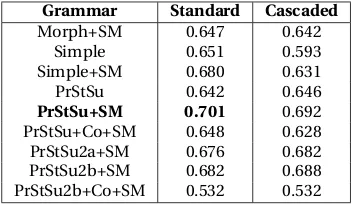
Results on an unseen language. We evaluate our system on Arabic, a language that is not part of the development of the system. Ara-bic also belongs to the Semitic family, where none of the development languages does. For an unseen language, we first run the Standard PrStSu+SM configuration for 50 optimization it-erations to obtain the morphological features. We then run the KNN classifier on those features in order to obtain the final AG configuration. Ta-ble6lists the EMMA F-scores for Arabic for all grammars in both the Standard and Cascaded setups. Our KNN classifier picks the Standard PrStSu+SM configuration, which yields the best segmentation among all the configurations with an EMMA F-score of 0.701.
Grammar Standard Cascaded
Morph+SM 0.647 0.642 Simple 0.651 0.593 Simple+SM 0.680 0.631 PrStSu 0.642 0.646
[image:5.595.93.269.62.164.2]PrStSu+SM 0.701 0.692 PrStSu+Co+SM 0.648 0.628 PrStSu2a+SM 0.676 0.682 PrStSu2b+SM 0.682 0.688 PrStSu2b+Co+SM 0.532 0.532
Table 6:Adaptor-grammar results (Emma F-scores) for the Standard and Cascaded setups for Arabic. Boldface indi-cates the best configuration and the choice of our system.
Grammar Morfessor MorphoChain LIMS Ours Best
English 0.805 0.746 0.809 0.821 0.826 German 0.740 0.625 0.777 0.790 0.790 Finnish 0.675 0.621 0.727 0.733 0.733 Turkish 0.551 0.551 0.591 0.647 0.647 Zulu 0.414 0.390 0.611 0.611 0.611 Estonian 0.779 0.679 0.805 0.828 0.847 Arabic 0.779 0.751 0.682 0.701 0.701 Avg. 0.678 0.623 0.715 0.733 0.736
Table 7:The performance of our system (Ours) compared to Morfessor, MorphoChain, LIMS and an upper-bound system (Best), using EMMA F-scores.
chosen). Our system has EMMA F-score error re-ductions of 17.1%, 29.2% and 6.3% over Morfes-sor, MorphoChain2 and LIMS, respectively, on average across the development languages and Arabic. It is also only 0.003 of average EMMA F-score behind an oracle system, where the best configuration is always selected (indicated as
Best). We are not able to compare versus the sys-tem presented byWang et al.(2016) as neither their system nor their data is currently available.
5 Related Work
The first work that utilizes AGs for unsupervised morphological segmentation is introduced by
Johnson(2008), whileSirts and Goldwater(2013) propose minimally supervised AG models of dif-ferent tree structures for morphological segmen-tation. The most recent work on using AGs for morphological segmentation is proposed by Es-kander et al.(2016), where they experiment with several AG models based on different underly-ing grammars and learnunderly-ing settunderly-ings. They also research the use of scholar knowledge seeded in the grammar trees. This knowledge could be gathered from grammar books or automatically generated via bootstrapping. This paper extends their work by proposing a machine learning
ap-2Since MorphoChain expects large corpora in order to
learn the morphological chains, it does not perform well on the small corpora we use in our setup, where we experi-ment with real conditions of low-resource languages.
proach to select the best language-independent model for each language.
In addition to the use of AGs, several mod-els have been successfully used for unsupervised morphological segmentation such as genera-tive probabilistic models (utilized by Morfessor (Creutz and Lagus,2007)), and log-linear models using contextual and global features (Poon et al.,
2009).Narasimhan et al.(2015) use a discrimina-tive model for unsupervised morphological seg-mentation that integrates orthographic and se-mantic properties of words. The model learns morphological chains, where a chain extends a base form available in the lexicon.
Another recent notable work is introduced by
Wang et al.(2016), who use neural networks for unsupervised segmentation, where they build LSTM (Hochreiter and Schmidhuber, 1997) ar-chitectures to learn word structures in order to predict morphological boundaries. Another variation of the this approach is presented by
Yang et al.(2017), where they use partial-word information as character bigram embeddings and evaluate their work on Chinese.
6 Conclusion and Future Work
We have shown that our language-independent classifiers improve the state-of-the-art unsuper-vised morphological segmentation proposed by
Eskander et al.(2016) by making choices that op-timize for a given language, rather than choosing parameters for all languages based on averages on the development languages.
In future work, we plan to conduct an extrinsic evaluation on tasks that could benefit from mor-phological segmentation such as machine trans-lation, information retrieval and summarization. We also plan to optimize the segmentation mod-els for those specific tasks.
Acknowledgements
References
Duygu Ataman, Matteo Negri, Marco Turchi, and Marcello Federico. 2017. Linguistically mo-tivated vocabulary reduction for neural ma-chine translation from turkish to english. 108.
Mathias Creutz and Krista Lagus. 2007. Unsu-pervised models for morpheme segmentation and morphology learning. ACM Trans. Speech Lang. Process., 4(1):3:1–3:34.
Ramy Eskander, Owen Rambow, and Tianchun Yang. 2016. Extending the use of adap-tor grammars for unsupervised morphologi-cal segmentation of unseen languages. In Pro-ceedings of he Twenty-Sixth International Con-ference on Computational Linguistics (COL-ING), Osaka, Japan.
Sepp Hochreiter and Jürgen Schmidhuber. 1997. Long short-term memory. Neural computa-tion, 9(8):1735–1780.
Mark Johnson. 2008. Unsupervised word seg-mentation for Sesotho using adaptor gram-mars. In Proceedings of the Tenth Meeting of ACL Special Interest Group on Computa-tional Morphology and Phonology, pages 20– 27, Columbus, Ohio. Association for Compu-tational Linguistics.
Mark Johnson, Thomas L. Griffiths, and Sharon Goldwater. 2007. Adaptor grammars: a frame-work for specifying compositional nonpara-metric bayesian models. InAdvances in Neu-ral Information Processing Systems 19, pages 641–648, Cambridge, MA. MIT Press.
Mohamed Maamourio, Ann Bies, Tim Buckwal-ter, and Wigdan Mekki. 2004. Arabic treebank: Building a large-scale annotated arabic cor-pus. In Proceedings of the NEMLAR Confer-ence on Arabic Language Resources and Tools, Cairo, Egypt.
Karthik Narasimhan, Regina Barzilay, and Tommi Jaakkola. 2015. An unsupervised method for uncovering morphological chains.
In Twelfth AAAI Conference on Artificial
Intelligence.
Karthik Narasimhan, Damianos Karakos, Richard M. Schwartz, Stavros Tsakalidis, and Regina Barzilay. 2014. Morphologi-cal segmentation for keyword spotting. In
EMNLP.
ThuyLinh Nguyen, Stephan Vogel, and Noah A. Smith. 2010. Nonparametric word segmenta-tion for machine translasegmenta-tion. InProceedings of the 23rd International Conference on Compu-tational Linguistics, COLING ’10, pages 815– 823, Stroudsburg, PA, USA. Association for Computational Linguistics.
Hoifung Poon, Colin Cherry, and Kristina Toutanova. 2009. Unsupervised morpholog-ical segmentation with log-linear models.
In Proceedings of Human Language
Tech-nologies: The 2009 Annual Conference of
the North American Chapter of the Associ-ation for ComputAssoci-ational Linguistics, pages 209–217, Boulder, Colorado. Association for Computational Linguistics.
Kairit Sirts and Sharon Goldwater. 2013. Minimally-supervised morphological seg-mentation using adaptor grammars. Trans-actions of the Association for Computational Linguistics, 1(May):231–242.
Sebastian Spiegler and Christian Monson. 2010. Emma: A novel evaluation metric for morpho-logical analysis. InProceedings of the 23rd In-ternational Conference on Computational Lin-guistics (Coling 2010), pages 1029–1037, Bei-jing, China. Coling 2010 Organizing Commit-tee.
Sebastian Spiegler, Andrew van der Spuy, and Pe-ter A. Flach. 2010. Ukwabelana - an open-source morphological zulu corpus. In Pro-ceedings of the 23rd International Conference on Computational Linguistics (Coling 2010), pages 1020–1028, Beijing, China. Coling 2010 Organizing Committee.
Linlin Wang, Zhu Cao, Yu Xia, and Gerard de Melo. 2016. Morphological segmentation with window LSTM neural networks. In Thir-tieth AAAI Conference on Artificial Intelligence.