Original Article
Tagging functional SNPs rs191876689 in MTHFR
decrease risk of ischemic stroke
Shengnian Zhong1, Su Li1, Chunjian Ma1, Haitao Wu1, Haijun Ma1, Dehua Ma1, Ming Hou1, Fenge Li1,2 1Emergency Center, Qinghai Province Affiliated Hospital of Qinghai University, Qinghai, China; 2Huffington Center
On Aging, Baylor College of Medicine, Houston TX, USA
Received July 18, 2017; Accepted December 13, 2017; Epub February 15, 2018; Published February 28, 2018
Abstract:Objective: Functional polymorphisms located in MTHFR have been identified to be highly associated with the risk of ischemic stroke (IS). In this study, we mainly focused on the miRNA associated MTHFR polymorphisms and function of which in the development of IS. Methods: The hospital based case-control study was conducted with 350 patients diagnosed with IS and 350 healthy volunteers as control enrolled. The genotype was conducted by using Taqman probe. The binding site between miR-22 and MTHFR was predicted by bioinformatical analysis. The relative expression of MTHFR was detected by qRT-PCR. Further confirmation was determined by dual-luciferase assay. Results: The potential function polymorphism rs191876689 located in the 3’ untranslated region of MTHFR was predicted by bioinformatical analysis with highly interaction with miR-22. The genotype assay further indicated polymorphism rs191876689 were significantly associated with decreased risk of ischemic stroke compared with the wild genotype. According to the bioinformatical analysis and further confirmed by luciferase assay, the polymor-phism rs191876689 could attenuate the binding of miR-22, resulting in the accumulation of MTHFR. Conclusion:
This study demonstrated that the MTHFR rs191876689 is associated with decreased risk of IS and might be a biomarker for early intervention for IS patients.
Keywords: MTHFR, polymorphism, Taqman, miR-22
Introduction
As the major cause of mortality in elder popula-tion and a common cause of long-term disabili-ty in the world, stroke burden continues to increase, especially in developing countries like China [1, 2]. Accordingly, stroke can be divided into ischemic and hemorrhagic stroke [3, 4]. Ischemic stroke is usually caused by blockage of a blood vessel, whereas hemorrhagic stroke is caused by rupture of a vessel leading to bleeding in the brain. Increasing evidence revealed that the environmental factor and genetic factor might be responsible for the occurrence of IS [5-7].
Methylene tetrahydrofolate reductase (MTHFR) is the key enzyme for the metabolism of circu-lating homocysteine (tHcy) [8, 9]. tHcy is a crucial intermediate in methionine metabolism and causes excessive production of reactive oxygen species (ROS) [10, 11]. The accumula-tion of tHcy could evaluate the ROC levels by
activating the MAPK signaling, resulting in the cell apoptosis [11, 12]. As reported, the func-tional polymorphism located in the exon region of MTHFR has been proved highly associated with the pathogenesis of IS. For example, the polymorphism rs1801133 could cause appro- ximately 70% and 35% reductions of normal MTHFR enzymatic activity in TT and CT geno-type carriers, respectively, and finally causing the increasing level of tHcy which predicting the poor prognosis of IS [13, 14].
con-tribution of miR-22 in the inhibition of MTHFR gene expression during 2-AAF-induced rat he- patocarcinogenesis [18].
In this study, according to the direct binding between miR-22 and MTHFR, we aimed to sc- reen the potential polymorphisms which may associate with miR-22 by bioinformatical an- alysis.
Materials and methods
Study subjects
Total 350 patients diagnosed with ischemic stroke and 350 healthy controls were enroll- ed. Diagnosis of patients with ischemic stroke was established clinically and confirmed by us- ing X-ray computed tomography and/or mag-netic resonance imaging scans of the brain. All control individuals visited our hospital for an- nual health check-ups and were free of isch-emic stroke. Diabetes mellitus was defined as a fasting glucose level ≥ 7.0 mmol/L and/or ≥ 11.1 mmol/L 2 h after oral glucose challenge, or receiving anti-diabetic medication. Subjects
who had smoked more than 10 cigarettes dai- ly for 5 years were considered as smokers. Subjects who drank more than 50 ml of alco-holic beverages daily for 5 years were consid-ered as alcohol drinkers. This study was ap- proved by the Ethics Committee of Qinghai University and the study was conducted in accordance with the Helsinki Declaration. Genomic DNA extraction and genotyping
Blood samples were collected after a 12 h over-night fasting period and then separated into serum, red blood cells, and buffy coat. Geno- mic DNA from peripheral whole blood of every validation subject was extracted by using QI- Aamp DNA blood mini kits (Qiagen, Hilden, Germany) according to the manufacturer’s in- structions. Briefly, genomic DNA samples of 10 ng each were amplified using PCR in a to- tal volume of 5 μL containing TaqMan Univer- sal Master Mix, 80x SNP Genotyping Assay- Mix, DNase-free water and 10-ng DNA. The PCR conditions were 50°C for 2 min and then 95°C for 10 min, followed by 40 cycles of 95°C for 15 s and 60°C for 1 min in a 384-well ABI 7900HT Real Time PCR System.
Bioinformatics analysis
Bioinformatics software (http://bioinfo.life.hu- st.edu.cn/miRNASNP2/index.php) was used to detect the candidate SNPs which was associ-ated with miR-22.
Cell transfection
The 293T cells were obtained from the Chine- se Academy of Sciences Cell Bank (Shanghai, China) and cultured in RPMI-1640 (Gibco, Gai- thersburg, MD, USA) supplemented with 10% fetal bovine serum (Invitrogen, Carlsbad, CA, USA) in a humidified incubator with 5% CO2 at 37°C. The miR-22 mimics and control were ob- tained from Genepharma (Shanghai, China) and transfected into 293T cells using Lipo- fectamine 2000 (Invitrogen) according to the manufacturer’s protocol.
Luciferase reporter assay
MTHFR 3’-UTR fragments containing either G or C alleles were amplified using PCR from genomic DNA and cloned into pGL3-promoter-Table 1. Clinical characteristics of ischemic
stroke patients and healthy controls enrolled in this study
Characteristics (n = 350)Cases (n = 350)Control p valuea
Age >0.05
>60 299 301
<60 51 49
Gender >0.05
Male 256 239
Female 94 111
Smoking exposure <0.001
Yes 279 202
No 71 148
Drinking exposure <0.001
Yes 244 122
No 106 228
Diabetes 0.007
Yes 228 109
No 122 241
Hypertension <0.001
Yes 281 111
No 69 239
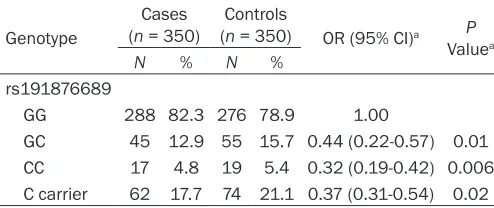
[image:2.612.91.288.108.372.2]Table 2. Genotype frequencies of the MTHFR rs191876689 in IS patients and healthy controls
Genotype
Cases
(n = 350) (Controls n = 350) OR (95% CI)a P
Valuea
N % N %
rs191876689
GG 288 82.3 276 78.9 1.00
GC 45 12.9 55 15.7 0.44 (0.22-0.57) 0.01 CC 17 4.8 19 5.4 0.32 (0.19-0.42) 0.006 C carrier 62 17.7 74 21.1 0.37 (0.31-0.54) 0.02
aThe ORs, 95% CIs and P value were calculated after adjusting for age,
gender, smoking, drinking and other characteristics listed in Table 1.
less luciferase-based plasmids (Promega, Ma- dison, WI, USA) multiple cloning sites. MTHFR 3’-UTR fragments potentially binding to miR-NAs, predicted by bioinformatical analysis or a mutated sequence with the predicted target sites, were cloned using PCR from genomic DNA and inserted into the pGL3 promoter ve- ctor (Genscript, Nanjing, China). The cloned plasmids were amplified and verified by DNA sequencing.
For the dual-luciferase reporter assay, 293T cells were plated onto 24-well plates and trans-fected with 100 ng of pGL3-MTHFR wild, pGL- 3-MTHFR mutant, and miRNA mimics, respec-tively, using Lipofectamine 2000 (Invitrogen). A Renilla luciferase vector pRL-SV40 (5 ng) was also co-transfected as a normalization and transfection efficiency control. Each expe- riment was performed in triplicate and lucifer-ase activity was assessed 48 h after transfec-tion using the dual-luciferase reporter assay system (Promega). Firefly luciferase activity was normalized to Renilla luciferase activity. Statistical analysis
The association between different genetic vari-ants and ischemic stroke risk was evaluated by calculation of the odds ratios (ORs) and 95% confidence intervals (CIs) using univariate and multivariate logistic regression analysis. Student t test was applied to analyze the dif- ferent between the expression of MTHFR in IS patients and controls. All statistical analyses were two-sided and P<0.05 was considered statistically significant using SPSS 13.0 (SPSS, Chicago, IL, USA) or SAS software (version 9.1.3; SAS Institute, Cary, NC, USA).
brovascular diseases including total cholester-ol, HDL-C and LDL-C were also associated with the occurrence of IS.
MTHFR polymorphism rs191876689 acting as a protective factor in IS
As predicted by bioinformatical analysis, the polymorphism rs191876689 located in the 3’UTR of MTHFR presented highly association with the binding of miR-22. As presented in Table 2, among the 350 IS patients, we found that polymorphism rs191876689 indicated a different distribution comparing with the con-trol group. The logistic regression analysis revealed that MTHFR rs191876689 GC and CC genotypes significantly associated with de- creased risk of developing of ischemic stroke compared with the GG genotype (OR = 0.44; 95% CI = 0.22-0.57 for GC genotype, while OR = 0.32; 95% CI = 0.19-0.42 for AA genotype; Table 2). A higher number of C-alleles were al- so associated with an increased risk of isch-emic stroke (OR = 0.37; 95% CI = 0.31-0.54). The miR-22 binding was attenuated by func-tion SNP
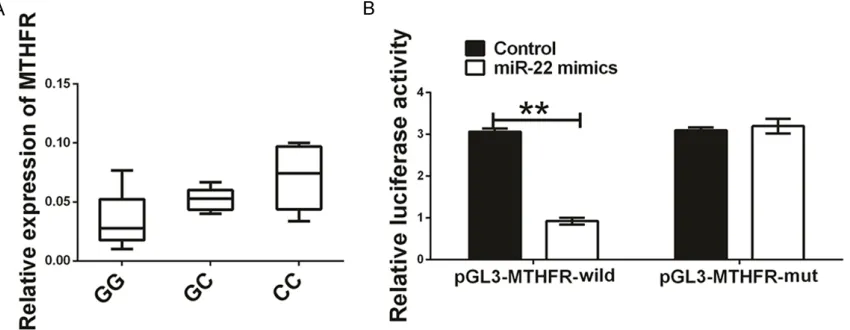
As confirmed, functional SNP could cause an abnormal binding of miRNA and target genes. The expression of MTHFR with different geno-type was detected by RT-PCR in plasma mRNA. As presented in Figure 1A, the expression of MTHFR was increased with the patients har-bored the C allele indicating the SNP located in the 3’UTR of MTHFR might causing an abnor-mal expression. We next clone the miR-22 mim-ics and transfected with either wild type or mutant type of MTHFR in cells. The luciferase assay to confirm such binding and found that
Results
Clinical characteristics analysis
cere-luciferase activity of G-allele-specific pGL3 construct was significantly suppressed by miR-22 (Figure 1B).
Discussion
ROS generation is enhanced and can lead to damage to various types of cells, including brain endothelial cells, leading to formation of thrombosis and loss of brain function. Among the ROS signaling, MTHFR is an important enzyme especially for the degradation of tHcy [19]. There is accumulating evidence demon-strating that SNPs localized at miRNA binding sites (miRSNPs) could affect the binding of miR-NAs to the target genes and in turn result in reduction or increase in translation of the tar-get mRNA and altered susceptibility to cancer [20]. For example, previous studies showed that the rs2910164 polymorphism harboring the sequence for miR-146a could influence susceptibility to gastric cancer in a Chinese population, while rs4143815 and rs4819388 SNPs in the 3’-UTR of B7-H1 and B7-H2 genes, respectively, associated with development of gastric cancer [21].
In this study, we focused on the functional SNP located in MTHFR which might associated with miR-22, a reported regulator of MTHFR. As pre-dicted by bioinformatical analysis, we reveal that rs191876689 might decrease the risk of ischemic stroke. Besides, the binding ability of miR-22 in MTHFR could also attenuated by the
functional SNP causing a increasing level of MTHFR. Consistent with previous report, MT- HFR rs868014 TC or CC genotypes were also associated with increased serum tHcy and a poor ischemic stroke outcome.
In summary, our current study demonstrated MTHFR rs191876689 is associated with de- creased risk of IS and might be a short-term outcome biomarker for IS patients.
Disclosure of conflict of interest
None.
Address correspondence to: Dr. Ming Hou, Emer- gency Center, Qinghai Province Affiliated Hospital of Qinghai University, Qinghai, China. Tel: +86-971-6162711; Fax: +86-971-+86-971-6162711; E-mail: [email protected]; Dr. Fenge Li, Huffington Center On Aging, Baylor College of Medicine, Houston TX 77030, USA. E-mail: [email protected]
References
[1] Asakawa T, Zong L, Wang L, Xia Y and Namba H. Unmet challenges for rehabilitation after stroke in China. Lancet 2017; 390: 121-122. [2] Zhang Y, Chen S and Tang W. Two-year
out-come after endovascular treatment for stroke. N Engl J Med 2017; 376: 2597.
[image:4.612.97.522.74.239.2][3] Li H, Wu J, Shen H, Yao X, Liu C, Pianta S, Han J, Borlongan CV and Chen G. Autophagy in hemorrhagic stroke: mechanisms and clinical implications. Prog Neurobiol 2017; [Epub ahead of print].
[4] Lopes RD, Guimaraes PO, Kolls BJ, Wojdyla DM, Bushnell CD, Hanna M, Easton JD, Thom-as L, Wallentin L, Al-Khatib SM, Held C, Gabriel Melo de Barros E Silva P, Alexander JH, Grang-er CB and DienGrang-er HC. Intracranial hemorrhage in patients with atrial fibrillation receiving anti-coagulation therapy. Blood 2017; 129: 2980-2987.
[5] Xu H, Cao Y, Yang X, Cai P, Kang L, Zhu X, Luo H, Lu L, Wei L, Bai X, Zhu Y, Zhao BQ and Fan W. ADAMTS13 controls vascular remodeling by modifying VWF reactivity during stroke recov-ery. Blood 2017; 130: 11-22.
[6] Anadure R, Christopher R, Nagaraja D and Na-rayanan C. A genetic study of Factor V Leiden (G1691A) mutation in young ischemic strokes with large vessel disease in a South Indian population. J Clin Neurosci 2017; 44: 346-352.
[7] Chen Z, Qi Y and Gao C. Cardiac myocyte-pro-tective effect of microRNA-22 during ischemia and reperfusion through disrupting the caveo-lin-3/eNOS signaling. Int J Clin Exp Pathol 2015; 8: 4614-4626.
[8] Lv C, Bai Z, Liu Z, Luo P and Zhang J. Renal cell carcinoma risk is associated with the interac-tions of APOE, VHL and MTHFR gene polymor-phisms. Int J Clin Exp Pathol 2015; 8: 5781-5786.
[9] Zhu L, Yu J, Jia B, Zhao F, Tang M, Hu L and Lin F. Effect of losartan with folic acid on plasma homocysteine and vascular ultrastructural changes in spontaneously hypertensive rats. Int J Clin Exp Pathol 2015; 8: 12908-12914. [10] Rallidis LS, Gialeraki A, Triantafyllis AS,
Tsire-bolos G, Liakos G, Moutsatsou P and Iliodromi-tis E. Characteristics and Long-Term Prognosis of Patients </=35 years of age with ST seg-ment elevation myocardial infarction and “nor-mal or near nor“nor-mal” coronary arteries. Am J Cardiol 2017; 120: 740-746.
[11] Kovalska M, Kovalska L, Tothova B, Mahmood S, Adamkov M and Lehotsky J. Combination of hyperhomocysteinemia and ischemic toler-ance in experimental model of global ischemia in rats. J Physiol Pharmacol 2015; 66: 887-897.
[12] Kim JH, Lee JO, Lee SK, Moon JW, You GY, Kim SJ, Park SH, Park JM, Lim SY, Suh PG, Uhm KO, Song MS and Kim HS. The glutamate agonist homocysteine sulfinic acid stimulates glucose uptake through the calcium-dependent AMPK-p38 MAPK-protein kinase C zeta pathway in skeletal muscle cells. J Biol Chem 2011; 286: 7567-7576.
[13] Haerian MS, Haerian BS, Molanaei S, Kosari F, Sabeti S, Bidari-Zerehpoosh F and Abdolali E. MTRR rs1801394 and its interaction with MTHFR rs1801133 in colorectal cancer: a case-control study and meta-analysis. Pharma-cogenomics 2017; 18: 1075-1084.
[14] Yuan Y, Yu X, Niu F and Lu N. Genetic polymor-phism of methylenetetrahydrofolate reductase as a potential risk factor for congenital heart disease: a meta-analysis in Chinese pediatric population. Medicine (Baltimore) 2017; 96: e7057.
[15] Yao XL, Lu XL, Yan CY, Wan QL, Cheng GC and Li YM. Circulating miR-122-5p as a potential novel biomarker for diagnosis of acute myocar-dial infarction. Int J Clin Exp Pathol 2015; 8: 16014-16019.
[16] He R, Yang L, Lin X, Chen X, Lin X, Wei F, Liang X, Luo Y, Wu Y, Gan T, Dang Y and Chen G. MiR-30a-5p suppresses cell growth and enhances apoptosis of hepatocellular carcinoma cells via targeting AEG-1. Int J Clin Exp Pathol 2015; 8: 15632-15641.
[17] Li C, Ni J, Liu YX, Wang H, Liang ZQ and Wang X. Response of 22-3p and MiRNA-149-5p to folate deficiency and the differential regulation of MTHFR expression in normal and cancerous human hepatocytes. PLoS One 2017; 12: e0168049.
[18] Koturbash I, Melnyk S, James SJ, Beland FA and Pogribny IP. Role of epigenetic and miR-22 and miR-29b alterations in the downregulation of Mat1a and Mthfr genes in early preneoplas-tic livers in rats induced by 2-acetylaminofluo-rene. Mol Carcinog 2013; 52: 318-327. [19] Goncalves RO, Fraga LR, Santos WV, Carvalho
AF, Veloso Cerqueira BA, Sarno M, Toralles MB, Vieira MJ, Dutra CG, Schuler-Faccini L, Sanse-verino MT, Goncalves MS, Vianna FS and Costa OL. Association between the thrombophilic polymorphisms MTHFR C677T, Factor V Leiden, and prothrombin G20210A and recur-rent miscarriage in Brazilian women. Genet Mol Res 2016; 15: 1.
[20] Liu B, Wei J, Li M, Jiang J, Zhang H, Yang L, Wu H and Zhou Q. Association of common genetic variants in VEGFA with biliary atresia suscepti-bility in Northwestern Han Chinese. Gene 2017; 628: 87-92.