Proceedings of EACL '99
Japanese D e p e n d e n c y Structure Analysis
B a s e d on M a x i m u m E n t r o p y M o d e l s
K i y o t a k a U c h i m o t o t S a t o s h i S e k i n e $ H i t o s h i I s a h a r a t t C o m m u n i c a t i o n s R e s e a r c h L a b o r a t o r y
M i n i s t r y of P o s t s a n d T e l e c o m m u n i c a t i o n s 588-2, Iwaoka, I w a o k a - c h o , Nishi-ku
K o b e , H y o g o , 651-2401, J a p a n
[uchimot o i
isahara] ©crl. go. j
p
SNew York U n i v e r s i t y 715 B r o a d w a y , 7 t h floor New York, N Y 10003, U S A
sekine~cs, nyu. edu
A b s t r a c t
This paper describes a dependency structure analysis of Japanese sentences based on the maximum entropy mod- els. Our model is created by learning the weights of some features from a train- ing corpus to predict the dependency be- tween bunsetsus or phrasal units. The dependency accuracy of our system is 87.2% using the Kyoto University cor- pus. We discuss the contribution of each feature set and the relationship between the number of training data and the ac- curacy.
1 I n t r o d u c t i o n
Dependency structure analysis is one of the ba- sic techniques in Japanese sentence analysis. The Japanese dependency structure is usually repre- sented by the relationship between phrasal units called 'bunsetsu.' The analysis has two concep- tual steps. In the first step, a dependency matrix is prepared. Each element of the matrix repre- sents how likely one bunsetsu is to depend on the other. In the second step, an optimal set of de- pendencies for the entire sentence is found. In this paper, we will mainly discuss the first step, a model for estimating dependency likelihood.
So far there have been two different approaches to estimating the dependency likelihood, One is the rule-based approach, in which the rules are created by experts and likelihoods are calculated by some means, including semiautomatic corpus- based methods but also by manual assignment of scores for rules. However, hand-crafted rules have the following problems.
• They have a problem with their coverage. Be- cause there are many features to find correct
dependencies, it is difficult to find them man- ually.
• They also have a problem with their consis- tency, since many of the features compete with each other and humans cannot create consistent rules or assign consistent scores. • As syntactic characteristics differ across dif-
ferent domains, the rules have to be changed when the target domain changes. It is costly to create a new hand-made rule for each do- main.
Proceedings of EACL '99
Now, we briefly describe the algorithm of de- pendency analysis. It is said that Japanese de- pendencies have the following characteristics.
(1) Dependencies are directed from left to right (2) Dependencies do not cross
(3) A bunsetsu, except for the rightmost one, de- pends on only one bunsetsu
(4) In many cases, the left context is not neces- sary to determine a dependency 1
T h e analysis method proposed in this paper is de- signed to utilize these features. Based on these properties, we detect the dependencies in a sen- tence by analyzing it backwards (from right to left). In the past, such a backward algorithm has been used with rule-based parsers (e.g., (Fujita, 1988)). We applied it to our statistically based approach. Because of the statistical property, we can incorporate a beam search, an effective way of limiting the search space in a backward analysis. 2 T h e P r o b a b i l i t y M o d e l
Given a tokenization of a test corpus, the prob- lem of dependency structure analysis in Japanese can be reduced to the problem of assigning one of two tags to each relationship which consists of two bunsetsus. A relationship could be tagged as
"0" or "1" to indicate whether or not there is a dependency between the bunsetsus, respectively. The two tags form the space of "futures" for a maximum entropy formulation of our dependency problem between bunsetsus. A maximum entropy solution to this, or any other similar problem al- lows the computation of P ( f [ h ) for any f from the space of possible futures, F, for every h from the space of possible histories, H. A "history" in max- imum entropy is all of the conditioning data which enables you to make a decision among the space of futures. In the dependency problem, we could reformulate this in terms of finding the probabil- ity of f associated with the relationship at index t in the test corpus as:
P ( f ] h t ) = P ( f l Information derivable from the test corpus related to relationship t) The computation of P ( f ] h ) in M.E. is depen- dent on a set of '`features" which, hopefully, are helpful in making a prediction about the future. Like most current M.E. modeling efforts in com- putational linguistics, we restrict ourselves to fea- tures which are binary functions of the history and aAssumption (4) has not been discussed very much, but our investigation with humans showed that it is true in more than 90% of cases.
future. For instance, one of our features is g 1 :
g ( h , f ) =
t
0 :Here "has(h,z)" is a binary function which re- turns true if the history h has an attribute x. We focus on attributes on a bunsetsu itself and those between bunsetsus. Section 3 will mention these attributes.
Given a set of features and some training data, the maximum entropy estimation process pro- duces a model in which every feature gi has as- sociated with it a parameter ai. This allows us to compute the conditional probability as follows (Berger et al., 1996):
P ( f l h ) - Y I i a [
z~(h)
'(n'l)(2)
~,i • (3)
I i
T h e maximum entropy estimation technique guarantees that for every feature gi, the expected value of gi according to the M.E. model will equal the empirical expectation of gi in the training cor- pus. In other words:
y]~ P(h, f). g,(h, f)
h,!
=
y-~P(h).y~P~(Slh)-g,(h,1).
(41
h !
Here /3 is an empirical probability and PME is the probability assigned by the M.E. model.
We assume that dependencies in a sentence are independent of each other and the overall depen- dencies in a sentence can be determined based on the product of probability of all dependencies in the sentence.
if has(h, x) = ture, = " P o s t e r i o r - H e a d -
P O S ( M a j o r ) : ~[J'~(verb)" (1)
& f = l
otherwise.
3 E x p e r i m e n t s a n d D i s c u s s i o n
Proceedings of EACL '99
tools, for example, can achieve 97% for morpho- logical analysis (Kitauchi et al., 1998) and 99% for bunsetsu identification (Murata et al., 1998).
We employed the Maximum Entropy tool made by Ristad (Ristad, 1998), which requires one to specify the number of iterations for learning. We set this number to 400 in all our experiments.
In the following sections, we show the features used in our experiments and the results. Then we describe some interesting statistics t h a t we found in our experiments. Finally, we compare our work with some related systems.
3.1 R e s u l t s o f E x p e r i m e n t s
The features used in our experiments are listed in Tables 1 and 2. Each row in Table 1 contains a feature type, feature values, and an experimental result that will be explained later. Each feature consists of a type and a value. The features are basically some attributes of a bunsetsu itself or those between bunsetsus. We call them 'basic fea- tures.' The list is expanded from tIaruno's list (Haruno et al., 1998). The features in the list are classified into five categories that are related to the "Head" part of the anterior bunsetsu (cate- gory "a"), the '~rype" part of the anterior bun- setsu (category "b"), the "Head" part of the pos- terior bunsetsu (category "c"), the '~l~ype " part of the posterior bunsetsu (category "d"), and the features between bunsetsus (category "e") respec- tively. The term "Head" basically means a right- most content word in a bunsetsu, and the term "Type" basically means a function word following a "Head" word or an inflection type of a "Head" word. The terms are defined in the following para- graph. The features in Table 2 are combinations of basic features ('combined features'). They are represented by the corresponding category name of basic features, and each feature set is repre- sented by the feature numbers of the correspond- ing basic features. They are classified into nine categories we constructed manually. For exam- ple, twin features are combinations of the features related to the categories %" and "c." Triplet, quadruplet and quintuplet features basically con- sist of the twin features plus the features of the remainder categories "a," "d" and "e." The to- tal number of features is about 600,000. Among them, 40,893 were observed in the training corpus, and we used them in our experiment.
The terms used in the table are the following: A n t e r i o r : left bunsetsu of the dependency P o s t e r i o r : right bunsetsu of the dependency H e a d : the rightmost word in a bunsetsu other
than those whose major part-of-speech 2 cat- egory is " ~ (special marks)," " 1 ~ (post- positional particles)," or " ~ (suffix)" 2Part-of-speech categories follow those of JU- MAN(Kurohashi and Nagao, 1998).
H e a d - L e x : the fundamental form (uninflected form) of the head word. Only words with a frequency of three or more are used. H e a d - I n f : the inflection type of a head
Type:
the rightmost word other than those whose major part-of-speech category is " ~(special marks)." If the major category of the word is neither
"IIJJ~-~-]
(post-positional par- ticles)" nor"~[~:~.
(suffix)," and the word is inflectable 3, then the type is represented by the inflection type.J O S t i I l : the rightmost post-positional particle in the bunsetsu
J O S t t I 2 : the second rightmost post-positional particle in the bunsetsu if there are two or more post-positional particles in the bunsetsu T O U T E N , W A : T O U T E N means if a comma (Touten) exists in the bunsetsu. WA means if the word WA (a topic marker) exists in the bunsetsu
B W : BW means "between bunsetsus"
B W - D i s t a n c e : the distance between the bunset- sus
B W - T O U T E N : if TOUTEN exists between bunsetsus
B W - I D t o - A n t e r i o r - T y p e :
BW-IDto-Anterior-Type means if there is a bunsetsu whose type is identical to that of the anterior bunsetsu between bunsetsus B W - I D t o - A n t e r i o r - T y p e - H e a d - P OS: the
part-of-speech category of the head word of the bunsetsu of "BW-IDto-Anterior-Type" B W - I D t o - P o s t e r i o r - H e a d : if there is between
bunsetsus a bunsetsu whose head is identical to that of the posterior bunsetsu
B W - I D t o - P o s t e r i o r - H e a d - T y p e ( S t r i n g ) : the lexical information of the bunsetsu "BW- IDto-Posterior-Head"
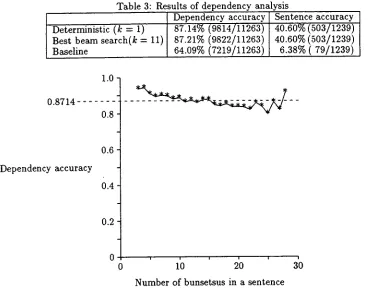
The results of our experiment are listed in Ta- ble 3. The dependency accuracy means the per- centage of correct dependencies out of all depen- dencies. The sentence accuracy means the per- centage of sentences in which all dependencies were analyzed correctly. We used input sentences t h a t had already been morphologically analyzed and for which bunsetsus had been identified. The first line in Table 3 (deterministic) shows the ac- curacy achieved when the test sentences were an- alyzed deterministically (beam width k = 1). The second line in Table 3 (best beam search) shows the best accuracy among the experiments when changing the beam breadth k from 1 to 20. The best accuracy was achieved when k = 11, although the variation in accuracy was very small. This re- sult supports assumption (4) in Chapter 1 because
P r o c e e d i n g s o f E A C L '99
C a t e g o r y ] F e a t u r e n u m b e r [ F e a t u r e t y p e
T a b l e 1: F e a t u r e s ( b a s i c f e a t u r e s )
B a s i c f e a t u r e s (5 c a t e g o r i e s , 4 3 t y p e s ) [
• F e a t u r e values . . . ( N u m b e r of v a l u e s ) A c c u r a c y w i t h o u t
I
e a c h f e a t u r e 1
2
a 3
4 5 6 7 8 9
b 10
11 12 13 14 15 16 17 18 19 20 21 22 23 24 25 26 27 28 29 30 31 32 33 34 35 36 37 38 39 40 41 42 43
A n t e r i o r - H e a d - L e x A n t e r i o r - H e a d - P O S ( M a j o r ) A n t e r i o r - H e a d - P O S ( M i n o r ) A n t e r i o r - H e a d - l n f ( M a j o r ) A n t e r i o r - H e a d - I n f ( M i n o r ) A n t e r i o r - T y p e ( S t r i n g ) A n t e r i o r - T y p e ( M a j o r ) A n t e r i o r - T y p e ( M i n o r )
A n t e r i o r - J O S H l l ( S t r i n g ) A n t e r i o r - J O S H I 1 / M i n o r ) A n t e r i o r - J O S H I 2 ( S t r i n g ) A n t e r i o r - J O S H I 2 ( M i n o r ) A n t e r i o r - p u n c t u a t i o n A n t e r i o r - b r a c k e t - o p e n A n t e r i o r - b r a c k e t - c l o s e
(2204)
(verb), ~I#~-] (adjective), ~ (noun) .... (117
~ 1 ~ ~] ( c o m m o n noun), ~ ( q u a n t i f i e r ) . . . . (24)
~ j [ t ] ~ (vowel verb) . . . . (307
~ ( s t e m ) , ~ r ~ (fundamental form) . . . . (6O)
~ , ~ a, ~c L-C, ~ , &, tO, t . . . . (73)
( p o s t - p o s i t i o n a l p a r t i c l e ) , (43) :~]]J3~ (case m a r k e r ) , ~ . z x . ~ ( i m p e r a t i v e form)
. . . . (lO2)
~ b , ~'~*, a)Jk, ~, ~t~., ... (63) [nil], ; ~ J ~ (case marker) .... (5)
YJ'~:', ~ , A e', ,];:, ~*, . . . (63)
;~gJJ~ (case marker) .... (4)
[ml], c o m m a , pemod (3)
nil ,[nil]'
/ < , , , >,
111 ,
::
Posterior-Head-Lex Post erior- Head- P O S (Maj or) Posterior-Head-POS (Minor) Posterior-Head-Inf(Maj or 7 Post erior-Head-Inf(Minor) Posterior-Type(String) Posterior-Type(Major)
P o s t e r i o r - T y p e ( M i n o r ~ P o s t e r i o r - J O S H l l ( S t r m g ) P o s t e r i o r - J O S H I l ( M i n o r ) P o s t e r i o r - J OS HI2( St r i n g ) Posterior- J O S H I 2 ( M i n o r )
Posterior- punct Uatlon Post erior-bracket- open Posterior-bracket-close BW-Dist ance
BW-TOU'I'EIN B W - W A BW-brackets
BW-IDt o-Ant erior-Type B W - IDto-Anterior-Type- Head-POS(Major) B W - IDt o-Ant erior-Type-
Head-POS(Minor) B W - IDto-Ant erior-Type-
Head-lnf(Major) B W - IDtc-Ant erior-Type-
Head-lnf(Minor) BW-IDto-Posterior-Head B W - IDto-Posterior- Head-
Type(String) B W - IDt o- Posterior-Head-
T y p e ( M a j o r ) BW- I D t o - P o s t e r i o r - H e a d -
T y p e ( M i n o r )
T h e s a m e values as t h o s e of f e a t u r e n u m b e r 1. T h e s a m e v a l u e s as t h o s e of f e a t u r e n u m b e r 2. T h e s a m e v a l u e s as t h o s e of f e a t u r e n u m b e r 3. T h e s a m e values as t h o s e of f e a t u r e n u m b e r 4. T h e s a m e values as t h o s e of f e a t u r e n u m b e r 5. T h e s a m e values as t h o s e of f e a t u r e n u m b e r 6. T h e s a m e values as those of f e a t u r e n u m b e r 7. T h e s a m e values as those of f e a t u r e n u m b e r 8. T h e s a m e values as t h o s e of f e a t u r e n u m b e r 9. T h e s a m e values as t h o s e of f e a t u r e n u m b e r 10. T h e s a m e v a l u e s as t h o s e of f e a t u r e n u m b e r 11. T h e s a m e values as t h o s e of f e a t u r e n u m b e r 12. T h e s a m e values as t h o s e of f e a t u r e n u m b e r 13. T h e s a m e values as t h o s e of f e a t u r e n u m b e r 14. T h e s a m e values as t h o s e of f e a t u r e n u m b e r 15.
A(1), B~2 ~ 5), C(6 or more) (3)
[nil], [extstJ (2~
[hill, [exist] (27
[nil], close, open, open-close (4)
[nil], [existJ (2)
T h e s a m e v a l u e s as t h o s e of f e a t u r e n u m b e r 2.
T h e s a m e v a l u e s as t h o s e of f e a t u r e n u m b e r 3.
T h e s a m e v a l u e s as t h o s e of f e a t u r e n u m b e r 4.
T h e s a m e values as t h o s e of f e a t u r e n u m b e r 5.
[nilJ, [exist] (2)
The same values as those of feature number 6.
The same values as those of feature number 7.
The same values as those of feature number 8.
86.96% (-0.16%)
86.43% (--0.71%)
87.14% (4-0%)
69.73% (--17.41%)
87.11% (-0.03%)
87.08% (-0.06%)
8 5 . 4 7 ~ (-- 1.67v£ 87.12% ~--0.02% 87.10% (--0.04% 86.31% ( - 0 . 8 3 % 7 6 . 1 5 ~ (--10.99%)
87.14% (4---0% 7
86.06% ( - 1.08%)
87.16% ( + 0 . 0 2 % 7
87.11% ( - 0 . 0 3 % )
s4.62~ (-2.52%) s6.s7z ~-o.27~'o) 66.85% (-0.29%) 84.64% (-2.50%)
66.81% (-0.33%)
86.96% (--0.18,%)
86.08% ~-- 1.06%)
86.99% (--0.15%)
86.75% (-o.39%)
C o m b i n a t i o n t y p e
T w i n f e a t u r e s :
related to t h e "Type" p a r t of the a n t e r i o r b u n s e t s u and t h e "Head" p a r t of the p o s t e r i o r bunsetsu.
T r i p l e t f e a t u r e s : basically c o n s i s t of t h e t w i n features plus t h e features between b u n s e t s u s . Q u a d r u p l e t f e a t u r e s : basically c o n s i s t of t h e t w i n features plus t h e features related t o t h e "Head" p a r t of the a n t e r i o r b u n s e t s u , and t h e "Type" p a r t of t h e p o s t e r i o r bunsetsu.
T a b l e 2: F e a t u r e s ( c o m b i n e d f e a t u r e s )
C o m b i n e d features (9 categories, 134 types)
C o m b i n a t i o n s C a t e g o r y
(b, c)
(bx, b2, c)
(b, c, e)
( d l , d2, e) ( b l , b2, c, d)
(b, c, el, e2)
(a, b, c, d)
F e a t u r e set
b = {6, 7, 8}, c = {16, 17, 18}
( b l , b2) = {(9, 1 1 ) , ( 1 0 , 12)}, c = {17, 18}
b = {6, 7, 8}, c = {17, lS},
e = {31, 32, 33, 34, 35, 36, 37, 38, 39, 40, 41, 42, 43}
(dl, d,, e) = (29, 30, 34)
b I = {6, 7, 8}, c = {17, 1 8 } , ( b 2 , d) = (13, 28) b = {6, 7, 8 ) , c = {17, 1 8 } , ( e l , e 2 ) = (35, 40) (a, c) = {(1, 16), (2, 17), (3, 18)},
(b, d) = {(6, 21), (7, 22), (8, 23)}
A c c u r a c y w i t h o u t t h e f e a t u r e
86.99% (-o.15%)
66.47%(-0.67%)
85.65% ( - 1 . 4 9 % )
Q u i n t u p l e t f e a t u r e s : (a, b l , b2, c, d) (a, c) = {(2, 17), (3, 18)}, 86.96% ( - 0 . 1 8 % )
basically c o n s i s t of t h e ( b l , b2) = {(9, 11), ( I 0 , 12)}, d = {21,22,23}
q u a d r u p l e t f e a t u r e s plus t h e (a, b, c, d, e) (a, c) = {(1, 16), (2, 17), (3, 18)},
[image:4.596.71.516.60.728.2]Proceedings of E A C L '99
Table 3: Results of dependency analysis Deterministic (k = 1)
Best b e a m search(k = 11) Baseline
Dependency accuracy 87.14%(9814/11263) 87.21%(9822/11263) 64.09%(7219/11263)
Sentence accuracy 40.60% (503/1239) 40.60% (503/1239) 6.38% ( 7 9 / 1 2 3 9 )
1.0 0.8714 . . .
0.8
Dependency accuracy 0.6
0.4
0.2
- - ~ -
-, , i i I i
10 20 30
Number of bunsetsus in a sentence
Figure 1: Relationship between the number of bunsetsus in a sentence and dependency accuracy.
it shows that the previous context has almost no effect on the accuracy. The last line in Table 3 rep- resents the accuracy when we assumed t h a t every bunsetsu depended on the next one (baseline).
Figure 1 shows the relationship between the sentence length (the number of bunsetsus) and the dependency accuracy. The d a t a for sentences longer than 28 segments are not shown, because there was at most one sentence of each length. Figure 1 shows t h a t the accuracy degradation due to increasing sentence length is not significant. For the entire test corpus the average running time on a SUN Sparc Station 20 was 0.08 seconds per sentence.
3.2 F e a t u r e s a n d A c c u r a c y
This section describes how much each feature set contributes to improve the accuracy.
T h e rightmost column in Tables 1 and 2 shows the performance of the analysis without each fea- ture set. In parenthesis, the percentage of im- provement or degradation to the formal experi- m e n t is shown. In the experiments, when a basic feature was deleted, the combined features t h a t included the basic feature were also deleted.
We also conducted some experiments in which several types of features were deleted together. T h e results are shown in Table 4. All of the results in the experiments were carried out deterministi- cally ( b e a m width k = 1).
T h e results shown in Table 1 were very close to our expectation. T h e m o s t useful features are the type of the anterior bunsetsu and the part- of-speech tag of the head word on the posterior bunsetsu. Next i m p o r t a n t features are the dis- tance between bunsetsus, the existence of punctu- ation in the bunsetsu, and the existence of brack- ets. These results indicate preferential rules with respect to the features.
The accuracy obtained with the lexical fea- tures of the head word was better t h a n that without them. In the e x p e r i m e n t with the fea- tures, we found m a n y idiomatic expressions, for example, "~,, 15-C (oujile, according t o ) - - b}~b
(kimeru,
decide)" and " ~ ' ~ " (katachi_de, in the form o f ) - - ~ b ~(okonawareru, be held)." We
would expect to collect more of such expressions if we use more training data.T h e experiments without some combined fea- tures are reported in Tables 2 and 4. As can be seen from the results, the combined features are very useful to improve the accuracy. We used these combined features in addition to the basic features because we thought t h a t the basic fea- tures were actually related to each other. With- out the combined features, the features are inde- pendent of each other in the m a x i m u m entropy framework.
[image:5.596.86.462.74.363.2]Proceedings of EACL '99
Table 4: Accuracy without several types of features Features
Without features 1 and 16 (lexical information about the head word) Without features 35 to 43
Without quadruplet and quintuplet features
Without triplet, quadruplet, and quintuplet features Without all combinations
Accuracy 86.30% (-0.84%) 86.83% (-0.31%) 84.27% (-2.87%)
81.28% (-5.86%)
68.83% (-18.31%)nations, the number of combined features would have been very large, and the training would not have been completed on the available ma- chine. Furthermore, we found that the accuracy decreased when several new features were added in our preliminary experiments. So, we should not use all combinations of the basic features. We selected the combined features based on our intu- ition.
In our future work, we believe some methods for automatic feature selection should be studied. One of the simplest ways of selecting features is to select features according to their frequencies in the training corpus. But using this method in our current experiments, the accuracy decreased in all of the experiments. Other methods that have been proposed are one based on using the gain (Berger et al., 1996) and an approximate method for se- lecting informative features (Shirai et al., 1998a), and several criteria for feature selection were pro- posed and compared with other criteria (Berger and Printz, 1998). We would like to try these methods.
Investigating the sentences which could not be analyzed correctly, we found that many of those sentences included coordinate structures. We be- lieve that coordinate structures can be detected to a certain extent by considering new features which take a wide range of information into account. 3.3 N u m b e r o f T r a i n i n g D a t a a n d
A c c u r a c y
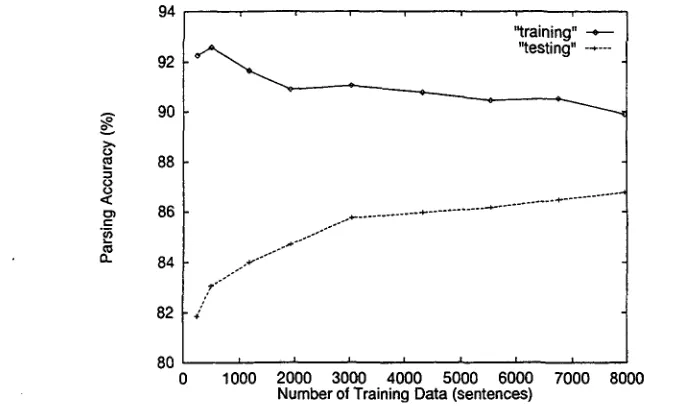
Figure 2 shows the relationship between the num- ber of training data (the number of sentences) and the accuracy. This figure shows dependency accu- racies for the training corpus and the test corpus. Accuracy of 81.84% was achieved even with a very small training set (250 sentences). We believe that this is due to the strong characteristic of the max- imum entropy framework to the data sparseness problem. From the learning curve, we can expect a certain amount of improvement if we have more training data.
3.4 C o m p a r i s o n w i t h R e l a t e d W o r k s This section compares our work with related statistical dependency structure analyses in Japanese.
Comparison with
Shirai's work (Shirai et al., 1998b) Shirai proposed a framework of statistical lan- guage modeling using several corpora: the EDR corpus, RWC corpus, and Kyoto University cor- pus. He combines a parser based on a hand-made CFG and a probabilistic dependency model. He also used the maximum entropy model to estimate the dependency probabilities between two or three post-positional particles and a verb. Accuracy of 84.34% was achieved using 500 test sentences of length 7 to 9 bunsetsus. In both his and our ex- periments, the input sentences were morphologi- cally analyzed and their bunsetsus were identified. The comparison of the results cannot strictly be done because the conditions were different. How- ever, it should be noted that the accuracy achieved by our model using sentences of the same length was about 3% higher than that of Shirai's model, although we used a much smaller set of training data. We believe that it is because his approach is based on a hand-made CFG.
Comparison with Ehara's work (Ehara, 1998) Ehara also used the Maximum Entropy model, and a set of similar kinds of features to ours. How- ever, there is a big difference in the number of fea- tures between Ehara's model and ours. Besides the difference in the number of basic features, Ehara uses only the combination of two features, but we also use triplet, quadruplet, and quintuplet features. As shown in Section 3.2, the accuracy in- creased more than 5% using triplet or larger com- binations. We believe that the difference in the combination features between Ehara's model and ours may have led to the difference in the accuracy. The accuracy of his system was about 10% lower than ours. Note that Ehara used T V news articles for training and testing, which are different from our corpus. The average sentence length in those articles was 17.8, much longer than that (average: 10.0) in the Kyoto University text corpus. Comparison with
[image:6.596.86.493.75.153.2]Proceedings of EACL '99
A
0
<
O , .
94
92
90
88
86
84
82
80 0
'2raining" - - * - "testing .. . .
. . . . ,+. . . ~ . . . .+- . . .
/ 4
I I I I I I I
1000 2000 3000 4000 6000 6000 7000 8000 Number o! Training Data (sentences)
Figure 2: Relationship between the number of training d a t a and the parsing accuracy. (beam breadth k = l )
models and a boosting method. It is difficult to directly compare these models with ours because they use a different corpus, the E D R corpus which is ten times as large as our corpus, for training and testing, and the way of collecting test data is also different. But they reported an accuracy of around 85%, which is slightly worse than our model.
We carried out two experiments using almost the same attributes as those used in their exper- iments. The results are shown in Table 5, where the lines "Feature set(l)" and "Feature set(2)" show the accuracies achieved by using Fujio's attributes and Haruno's attributes respectively. Considering that both results are around 85% to 86%, which is about the same as ours. From these experiments, we believe that the important factor in the statistical approaches is not the model, i.e. Maximum Entropy, Maximum Likelihood, or De- cision Tree, but the feature selection. However, it may be interesting to compare these models in terms of the number of training data, as we can imagine that some models are better at cop- ing with the data sparseness problem than others. This is our future work.
4 C o n c l u s i o n
This paper described a Japanese dependency structure analysis based on the maximum en- tropy model. Our model is created by learning the weights of some features from a training cor- pus to predict the dependency between bunset- sus or phrasal units. The probabilities of depen- dencies between bunsetsus are estimated by this model. The dependency accuracy of our system was 87.2% using the Kyoto University corpus.
In our experiments without the feature sets shown in Tables 1 and 2, we found that some basic and combined features strongly contribute to im- prove the accuracy. Investigating the relationship between the number of training d a t a and the accu- racy, we found that good accuracy can be achieved even with a very small set of training data. We believe that the maximum entropy framework has suitable characteristics for overcoming the d a t a sparseness problem.
T h e r e are several future directions. In particu- lar, we are interested in how to deal with coordi- nate structures, since that seems to be the largest problem at the moment.
R e f e r e n c e s
Adam Berger and Harry Printz. 1998. A com- parison of criteria for maximum entropy / min- imum divergence feature selection. Proceedings of Third Conference on Empirical Methods in Natural Language Processing, pages 97-106. Adam L. Berger, Stephen A. Della Pietra, and
Vincent J. Della Pietra. 1996. A maximum en- tropy approach to natural language processing.
Computational Linguistics, 22(1):39-71. Michael Collins. 1996. A new statistical parser
based on bigram lexical dependencies. Proceed- ings of the 34th Annual Meeting of the Asso- ciation for Computational Linguistics (ACL),
pages 184-191.
[image:7.596.109.450.68.271.2]Proceedings of EACL '99
Table 5: Simulation of Fujio's and Haruno's experiments Feature set
Feature set (1)
(Without features 4, 5, 9--12, 14, 15, 19, 20, 24--27, 29, 30, 34--43.) Feature set (2)
(Without features 4, 5, 9--12, 19, 20, 24--27, 34-43.)
Accuracy 85.71% (-1.43%)
86.47% (-0.67%)
Meeting of The Association for Natural Lan- guage Processing, pages 382-385. (in Japanese). Masakazu Fujio and Yuuji Matsumoto. 1998.
Japanese dependency structure analysis based on lexicalized statistics. Proceedings of Third Conference on Empirical Methods in Natural Language Processing, pages 87-96.
Katsuhiko Fujita. 1988. A deterministic parser based on karari-uke grammar, pages 399-402. Masahiko Haruno, Satoshi Shiral, and Yoshifumi
Ooyama. 1998. Using decision trees to con- struct a practical parser. Proceedings of the
COLING-ACL '98.
Akira Kitauchi, Takehito Utsuro, and Yuji Mat- sumoto. 1998. Error-driven model learning of Japanese morphological analysis. IPSJ-
WGNL, NL124-6:41--48. (in Japanese).
Sadao Kurohashi and Makoto Nagao. 1997. Ky- oto university text corpus project, pages 115- 118. (in Japanese).
Sadao Kurohashi and Makoto Nagao, 1998.
Japanese Morphological Analysis System JU- MAN version 3.5. Department of Informatics, Kyoto University.
Masaki Murata, Kiyotaka Uchimoto, Qing Ma, and Hitoshi Isahara. 1998. Machine learning approach to bunsetsu identification - - compar- ison of decision tree, maximum entropy model, example-based approach, and a new method us- ing category-exclusive rules --. IPSJ-WGNL,
NL128-4:23-30. (in Japanese).
Adwait Ratnaparkhi. 1997. A linear observed time statistical parser based on maximum en- tropy models. Conference on Empirical Meth- ods in Natural Language Processing.
Eric Sven Ristad. 1998. Maximum en- tropy modeling toolkit, release 1.6 beta. http ://www.mnemonic.com/software/memt. Kiyoaki Shirai, Kentaro Inui, Takenobu Toku-
naga, and I-Iozumi Tanaka. 1998a. Learning dependencies between case frames using max- imum entropy method, pages 356-359. (in Japanese).
Kiyoaki Shirai, Kentaro Inui, Takenobu Toku- naga, and Hozumi Tanaka. 1998b. A frame- work of integrating syntactic and lexical statis- tics in statistical parsing. Journal of Nat-
ural Language Processing, 5(3):85-106. Japanese).
[image:8.596.76.510.81.148.2]