Abstract—In this paper we illustrate total structure of swarm systems and their impacts on net-centric computing environments. The paper presents a comprehensive look on swarm applications and its potential to solve complex problems in related areas. The effects of emergent externalities of swarm behavior through its basic elements such as groups/clusters, individuals/agents and inner/outer communications are also studied to explain the role of swarming in improving the performance of net-centric systems. Self-organization, robustness, flexibility and handling unpredicted situations are introduced as results of such collective and cooperating strategies. The paper also takes a look at the role of existing technologies and related challenges towards implementing real swarm systems.
Index Terms—Swarm intelligence, self-organization, robustness, flexibility, multi-agent systems.
I. INTRODUCTION
For thousands of years of evolution, people have been learning too many things from the nature. Autonomic systems [1], artificial neural networks [2], modern diagnostic methods, sophisticated management systems, genetic algorithms [3] and many other achievements are taught from this knowledgeable teacher [4]. One of the most interesting capabilities of the nature is handling a huge amount of complexity through special self-managing and self-organizing strategies in a converging way. Swarm intelligence is such a strategy, found in various natural colonies of social insects, which use groups of simple individuals to solve complex problems through only simple and sometimes even binary interactions [5]. This kind of cooperative behavior is a useful solution to handle unpredicted situations in our today interwoven computing systems.
Increasing complexity of computing environments introduced new challenges in different areas. Some of these challenges are: complicated system management [6], overall system scalability [7], system flexibility and consistency, system dependability [8], financial parameters and many
Manuscript received August 17, 2007. This work was supported in part by the Islamic Azad University of IRAN.
P. Lalbakhsh is with the Computer engineering faculty of Islamic Azad University of Boroujerd, Lorestan, IRAN (e-mail: [email protected]). M. N. Fesharaki is with the computer engineering faculty of Islamic Azad University, Science & Research Campus, Hesarak, Tehran, IRAN (e-mail: [email protected]).
other related challenges. Although various approaches are proposed to answer the above problems, none of them can fulfill the main requirements of this complexity. Some of these approaches like autonomic computing and its related projects seem to be efficient, but very difficult to implement [8]. On the other hand, such complex implementations may increase the overall system complexity [9].
The considerable advantage of swarm behavior is its simplicity. For millions of years, natural swarms have been presenting good levels of scalability, robustness and flexibility using their simple organs. On the other hand, the distributed nature of swarm groups maximizes the overall system dependability by removing critical challenges such as single point(s) of failure, bottlenecks and unbalanced traffics.
The mentioned advantages of this efficient behavior persuaded us to study swarm applications and map their characteristics on network centric foundation using the existing technologies to improve the quality of system results.
The paper is organized as follows:
The next section reviews the main concepts of swarm intelligence together with swarm structure and its sub-systems such as groups, agents and communication systems. Swarm related projects and evaluation methods of system externalities are also studied in this section. Afterwards, the roles of swarm intelligence in network centric systems and the improvement of system results are reviewed. After introducing basic concepts, swarm capabilities such as flexibility, self-organization and robustness in distributed environments are explained. The paper also introduces existing technologies to form an appropriate infrastructure for implementing swarm projects. Finally the paper ends by taking a look at future of swarm intelligence together with its integration with other areas of science following by a conclusion section.
II. SWARM INTELLIGENCE:BASIC CONCEPTS AND RELATED WORKS
A. Swarm Definition
Although several definitions of swarm intelligence are presented, all of them involve some basic terms in common. In this section we use these common concepts to define swarm behavior.
Swarm intelligence is the emergent collective intelligence of groups of simple agents. Each agent can interact with its
Basic Concepts and Anatomy of Swarm
Intelligence and Its Roles in Today and Future
Network Centric Environments
local environment and other agents, but acts independently from all other agents. Some authors indicate that these agents are autonomic agents and some others believe that the agents are not necessarily autonomic. Word swarm describes a certain family of social processing integrated by simpler units. It typically refers to a cluster of things such as insects, animals or artificial agents, in which individuals move in apparently random directions, but the group stays together as a whole [10]. Using emergent behavior, simple processes and self-organization, swarm intelligence can lead to complex results. Marvel ventilated termite mounds [11], ant shortest path routing [12], optimized labor allocation in bee colonies, swimming fish flocks [13] and complex human swarms [14] are some instances of natural swarm abilities.
B. Emergent Intelligence of Swarm Behavior
As mentioned above, the most amazing aspect of swarm systems are their emergent externalities. The emergent intelligence of a swarm system depends on some particular factors that illustrated bellow:
• Intelligence levels of system agents.
• The kind of interactions and communications between system agents.
• The size of each swarm group.
According to the above factors, a level of intelligence results by each swarm system. Since swarm systems are network based systems and interconnections have an important role in such environments, we refer to some proposed methods, presented to evaluate network externalities. Although these works only regard the number of network nodes, they can be good origins to study the emergent value of swarm systems.
R. Metcalf believes that the emergent value of a network is proportional to the square of the size of the network (number of network elements) [15].
D. Reed states that regarding various groups that can be formed by network nodes, the value of the network by n
participants grows like 2n [16].
A. Odlyzko struggles the above opinions and states that the value of a communication network of size n grows like
nlog(n) [17].
The emergent intelligence of a swarm system is much more complicated than the above formulas. In a swarm system the emergent behavior depends on four factors which are illustrated bellow:
1. Number of participants in a swarm system. 2. Intelligence level of each participant. 3. Type of interactions and communications. 4. Duration of the behavior.
Regarding the three mentioned formulas, it is evident that increasing the number of swarm agents improves the system generated value (or intelligence). Intelligence level of each agent is an important factor that can boost the value during the operational phase of system life cycle. These improvements can be achieved using learning capabilities or benefiting from previous system experiences. Some other swarm systems use much simpler organs, but generate such intelligence through the environment using distributed indirect strategies such as stigmergy. Fig. 1 illustrates the
[image:2.595.320.534.88.432.2]emergent value regarding agent intelligence levels and time duration. In this figure the agent population is supposed to be identical.
[image:2.595.323.536.98.227.2]Fig. 1 Emergent system value for different levels of agent intelligence
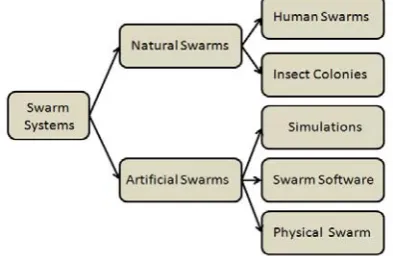
Fig. 2 A taxonomy of swarm systems
Preparing appropriate conditions for the above factors, natural swarms appear to be successful swarm systems during thousands or even millions of years. Ant colonies, wasps, bees, humans and many other social creatures are instances of such successful swarms. The power and simplicity of these social colonies encouraged the researchers to simulate swarm behaviors in different artificial projects. The next part presents a basic taxonomy of swarm systems and discusses about their benefits and drawbacks.
C. Taxonomy of swarm systems
Fig. 2 presents a basic taxonomy of swarm systems with two main domains: natural and artificial swarms. The artificial domain is classified in three following sub-domains:
1. Physical cooperative system swarms. 2. Sophisticated swarm software. 3. Swarm simulations.
Physical cooperative swarm systems can be discussed in several sub-domains such as swarm robots [18] and sensor swarms [19]. Unmanned vehicle swarm projects for military purposes [20], swarm rescue robots [21] and many other similar projects are instances of physical swarms.
[image:2.595.333.530.262.390.2]cooperative software agents and many other related projects are accomplished in this domain.
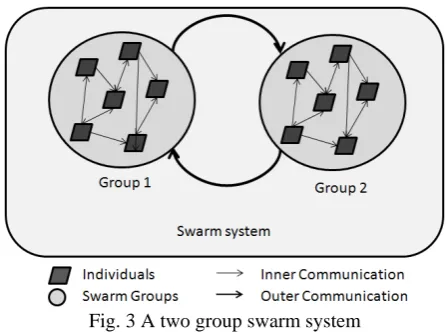
Fig. 3 A two group swarm system
Building physical swarm is expensive, time-consuming and restricted to small swarms. This approach is also confronted with numerous real-world problems such as mobility, environmental sensing, power consumption and communication. Thus, although these projects may seem to provide appropriate solutions, these kinds of projects can not completely act as real natural swarms because of their implementation restrictions.
Swarm simulations are useful tools to study and experience the swarm behavior. There are various platforms to simulate swarm systems [25]. Some researches even use natural colonies to simulate swarm algorithms. For example Palmer and his colleagues prefer using a collection of humans as an execution testbed for swarm algorithms. They believe that human is the best kind of agent to simulate swarm behavior because of his/her sophisticated sensors, effectors and communication capabilities [14].
According to the artificial swarm projects, it is evident that there is still a long way to achieve the overall benefits of natural swarms in such artificial projects. The most challenging aspect is balancing the mentioned four factors in artificial swarm projects. None of the proposed approaches present a comprehensive architecture to handle these factors and balance their trade offs.
D. Swarm Anatomy
Each swarm system involves three main concepts: 1. Clusters or groups.
2. Individuals or agents.
3. Interactions and communications.
Groups or clusters play an important role in a swarm system. A tightly packed collection of agents with a surrounding empty buffer zone is easily recognized as a group [12]. Although a system may contain more than one group, each group acts independently from the others. Each swarm group has two characteristics:
1. Group size. 2. Group constraints.
Group size refers to the number of valid agents in a swarm group. Number of agents affects the quality and accuracy of the system results. All the participant agents should accept the group constraints to be a member of the group. Group constraints may be implemented as special attractant or repellent algorithms to protect the scale and size of a swarm
group to avoid collisions or disruptions [23]. In the other words, group constraints are responsible for swarm coherency. Grouping swarm agents involves some implementation challenges such as:
• Determining agent groups. • Consolidating groups. • Avoiding other groups.
Group characteristics are determined according to the system responsibilities. The kind of swarm mission and mission environment affects the basic implementation factors. For example in cooperative unmanned vehicles different communication channels for each group can be used to avoid group collisions. Fig. 3 shows a two group swarm system and its related communication links. It should be mentioned that a swarm system may have more than two groups [26].
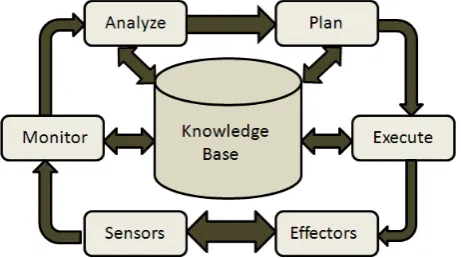
Swarm agents are the atomic functional elements of each swarm system. As mentioned above, there is not an agreement on the nature of the agents. Some authors believe that these individuals should be autonomic and others discuss them as much simpler agents. Fig. 4 diagrammatically shows an autonomic system closed control loop introduced by IBM [1]. According to this diagram, each autonomic system has six specific engines and a knowledge base. In a swarm system, agents can even be implemented as reactive agents. Various swarm projects are accomplished using such simple agents [23].
We believe that swarm agents are not necessarily autonomic. In some simple projects they only need to have sensors, a simple analyzer and the required effectors as shown in Fig. 5. These simple agents can be more empowered using more sophisticated knowledge bases. The agents can be designed as simple as your application requires. Using the knowledge base is optional and depends on the project functionality and the system mission.
Since swarm intelligence is a cooperative process and it is based on local knowledge and local decisions, agents should be able to communicate to each other. On the other hand, in multi group swarm projects like the system presented in Fig. 3 another interconnection is required between swarm groups. So in a swarm system, we may have two communication domains [10]:
1. Agent communication or inner communication links.
2. Group communication or outer communication links.
Each of these communication domains may use direct communication or stigmergy.
Direct communication is a direct strategy to communicate between two or more individuals in a swarm group. For more than two individual communications or more than two groups, a specific interconnection topology should be applied regarding the application characteristics. Each individual may have more than one communication channel or technology.
Fig. 4 Closed control loop of an autonomic system
III. SWARM INTELLIGENCE AND NET-CENTRIC ENVIRONMENTS
The dawning of the information age defined new concepts in computing system domain. Network centric applications are the most important concepts of the new age. Because of their great efficiency, many new areas of work appeared around net-centric computing systems. Like the other new technologies, network centric applications defined new challenges in their implementation, functionality and maintenance. Some of these challenges are overall consistency [27], network traffic management, network security, etc. On the other hand; other distributed technologies around these environments such as distributed data bases, worsen the system complexity. To improve these challenges, new technologies such as multi-agent systems was introduced in the domain. Using different kinds of agents in a networked environment could decrease the overall traffic and simplify the overall system management. Swarm intelligence was the next technology that could help the net-centric environments together with multi-agent strategy. Multi-agent technology could prepare the required granularity and swarm intelligence could lead this granular colony to a desired destination. Many successful projects are accomplished through this hybrid strategy, particularly in network routing algorithms [28]. The resulted agility and flexibility of this hybrid strategy, led scientists to apply this technology in highly critical environments such as network centric warfare or some enterprise architectures [29].
A. Swarm advantages in net-centric environments
Swarm capability can improve the system performance using the following three main advantages:
1. Flexibility:
Because of the distributed and granular feature of this strategy, the system can easily adopt to dynamic changing environments. This feature is a vital ability for critical systems such as battlefield environments. 2. Robustness:
Swarm externalities are emerged from swarm groups not directly from its agents. Therefore, individual agent failures in limited domains will not affect the total system functionality. So the system can still satisfy its responsibilities having some failed agents.
Fig. 5 A simple swarm agent structure 3. Self-organization:
In such systems, activities are neither centrally controlled, nor locally supervised. According to self-organization, the behavior of the group emerges from the collective interactions of all individuals. Therefore, swarm works well in unpredicted and complex situations.
Although a net-centric system with the above features will overcome many of the mentioned challenges, implementing such a swarm system is still a challenge itself. On the other hand; the extensive experiments and projects in swarm intelligence and the appearance of new technologies such as service oriented architecture or SOA [30] show a straight path to implement real full featured swarm systems in network centric environments.
B. Existing technologies towards implementing swarm in net-centric environments
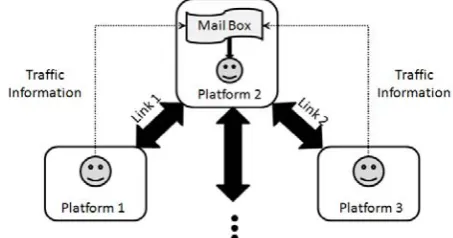
According to the swarm multi-agent systems capabilities, their comprehensive implementation using the existing technologies in net centric environments would be a great revolution in the network area. Fortunately, most of the needed tools are available because of the networked nature of these systems. On the other hand; the extensive researches on multi-agent systems, have prepared a good infrastructure for implementing swarm multi-agent systems. Agents in multi-agent systems may be physical (robots, sensors) or logical (software agents). A swarm system is a multi-agent system that involves a layer of goal based communications. These goal based communications can be implemented as direct, indirect, synchronous or asynchronous communication links to provide a common agreement among group agents. In physical swarms, the communication of swarm agents are mostly mobile communication links because of the floating nature of swarm agents. In virtual swarm systems like multi-agent network management strategies, service oriented architecture can be used as an appropriate infrastructure because of its high level of consistency and flexibility. Sensor technology is also an important part of a swarm system. Sensors should be selected according to the mission environment. Fig. 6 illustrates three network management agents communicating together using a common mail box as a kind of stigmergic communication. Agents on platforms 1 and 3 sense the network parameters and traffic information using their predefined algorithms and put the results into the mail box. The third agent makes use of this information to accomplish the required tasks such as network routing.
will direct the group towards the common goal, and increase the system scalability and robustness.
Fig. 6 indirect communication for network management According to the above review, we can implement swarm systems as an integration of three main technologies, namely: sensor technology, communication technology and knowledge acquisition technology. Because of the rapid advancement of these technologies, swarm systems have powerful infrastructure for implementation in physical and artificial worlds.
IV. FUTURE OF SWARM INTELLIGENCE
Since swarm intelligence is an integrated technology, future advancements of software and hardware technologies will greatly affect its performance and efficiency. Studying more complicated swarm colonies such as wasps, bees and humans will open up new areas of application in swarm intelligence. On the other hand, modern infrastructures such as nanotechnology will have important roles in the future of swarm intelligence. Integrating nano-sensors and nano-robot technologies can produce nano-swarm systems with incredible efficiency particularly in military and medical domains [31]. It goes without saying that many great challenges of today interwoven systems will be faced by swarm capabilities in future.
V. CONCLUSION
Although swarm intelligence is not a new concept, its application in computing domain is totally a new paradigm. In this paper we present the most important aspects of this strategy and its relations with the other technologies to explain the integrated nature of artificial swarm systems in computing environments. By studying swarm anatomy and mapping its characteristics on existing infrastructures, we believe that, sophisticated swarm projects can be implemented by the proper integration of existing technologies such as multi-agent strategy, service oriented architecture, information communication technology and knowledge acquisition algorithms. Our future work is defining a comprehensive architecture to implement swarm systems using the mentioned technologies in net-centric environments.
REFERENCES
[1] A. Ganik, T. Corbi, “The dawning of the autonomic era”, IBM System Journal, vol.42 (1), 2003, pp. 5–18.
[2] M.B. Menhaj, Computational intelligence, fundamentals of neural networks, 2nd ed., Tehran: Iran, Amir kabir university of technology 2001, ch. 1.
[3] M. Mitchell, An introduction to genetic algorithms, MIT press, 1996. ch. 1.
[4] H. Z. Chavez, (2004, May). Artificial intelligence profits from biological lessons, IEEE distributed systems. [Online]. 5(5).Available:
http://dsonline.computer.org
[5] G. Theraulaz, J. L. Deneubourg, “Swarm intelligence in social insects and the emergence of cultural swarm patterns”, Proc. NATO ASI, Series
D: Behavioral and social sciences, vol. 78, 1994, pp. 107-123.
[6] M. Amin, “Towards self-healing infrastructure systems”, IEEE
Computer Magazine, vol. 33(8), 2000, pp. 199-220.
[7] A. Avozienis, J. C. Laprie, B. Randell, , C. Landwehr, “Basic concepts and taxonomy of dependable and secure computing”, IEEE Trans.
Dependable and Secure Computing, vol. 1(1), 2004, pp.11-33.
[8] P. Lalbakhsh, M. N. Fesharaki, “Towards autonomic computing using goal-based translation strategy in heterogeneous distributed environments”, Proc. 9th WSEAS International Conf. Autonomic
Control, Modeling & Simulation, Istanbul, 2007, pp. 65-71.
[9] K. Hermann, G. Muhl, K. Geihs, (2005, January). Self management: the solution to complexity or just another problem, IEEE Sistributed
systems [Online]. 6(1), pp. 5-18, Available:
http://dsonline.computer.org
[10] M. EI-Abd, M. Kamel, “Factors governing the behavior of multiple cooperating swarms”, Proc. Genetic and Evolutionary Computation
Conf. Washington DC, 2005, pp. 269-270.
[11] J. Korb, K. E. Linsenmair, “Ventilation of termitemounds: new results require a new model”, Behavioral Ecology Journal, vol. 11(5), 2000, pp. 486-494.
[12] E. Bonabeau, C. Meyer, (2001, May). Swarm intelligence: a whole new way to think about business, Harvard Business Review. [Online]. pp. 106-114. Available: http://harvardbusinessonline.hbsp.harvard.edu
[13] C. Reylonds, “Flocks, herds and schools: a distributed behavioral model”, Computer Graph Journal, vol. 21(4), 1987, pp. 25-34. [14] D. Palmer, et al. , “Using a collection of humans as an execution testbed
for swarm algorithms”, Proc. IEEE swarm intelligence symposium,
Indiana, 2003, pp. 58-64.
[15] R. Metcalfe, “Metcalfe’s law: a network becomes more valuable as it reaches more users”, InfoWorld, vol. 17(40), 1995.
[16] D. P. Reed, “Weapon of math destruction: a simple formula explains why the internet is wreaking Havoc on business models”, Context
magazine, spring1999.
[17] A. Odlyzko, B. Tilly, “A refutation on Metcalfe’s law and a better estimate for the value of networks and network interconnections”,
Digital Technology Center, University of Minnesota, 2005.
[18] F. Steel, G. Thomas, “Directed stigmergy based control for multi-robot systems”, Proc. ACM International Conf. Human-robot Interactions,
2007, pp. 223-230.
[19] M. Gerla, Y. Yi, “Team communication among autonomous sensor swarms”, SIGMOD Record Journal, vol. 33(1), 2004, pp. 20-25. [20] P. Svenson, C. Martenson, H. Sidenbladh, M. Malm, “Swarm
intelligence for logistics: background”, Swedish Defence Research
Agency, 2004.
[21] R. R. Murphy, “Rescue robotics for homeland security”,
Communication of the ACM, vol. 47(3), 2004, pp. 66-68.
[22] E. Curran, Swarm: cooperative reinforcement learning for routing in
Ad-hoc networks, M.Sc. Thesis, Dept. Computer Science, Trinity
College, Dublin: Ireland, 2003.
[23] J. S. Yoon, M. L. Maher, “A swarm algorithm for wayfinding in dynamic virtual worlds, Proc. ACM Symposium on Virtual Reality
Software and Technology, Naval Postgraduate School, Monterey,
USA, 2005, pp. 113-116.
[24] P. Vincent, I. Rubin, “A framework and analysis for cooperative search using UAV swarms, Proc. ACM Symposium on Applied Computing,
Nicosia, 2004, pp. 79-86.
[25] N. Minar, R. Burkhart, C. Langton, M. Askenazi, “The swarm simulation system: a toolkit for building multi-agent simulations”, Santafe University Projects, 1996.
[26] A. Yang, N. J. Curtis, H. A. Abbass, R. Sarker, “Evolving agents for network centric warfare”, Proc. Genetic and Evolutionary
[27] T. Gruber, “A translation approach to portable ontology specifications”, Knowledge Acquisition, vol. 5(2), 1993, pp. 199-220. [28] G. D. Caro, M. Dorigo, “AntNet: distributed stigmergic control for
communications networks, Journal of Artificial Intelligence Research,
vol. 9, 1998, pp. 317-365.
[29] NCW Roadmap, Defence Publishing Center, Department of Defence,
Canberra, ACT, 2005.
[30] M. P. Papazoglou, W. J. Heuvel, “Service oriented architectures: approaches, technologies and research issues”, The International
Journal on Very Large Data Bases, vol. 16(3), 2007, pp. 389-415.