On Generating Characteristic-rich Question Sets for QA Evaluation
Yu Su1, Huan Sun2, Brian Sadler3, Mudhakar Srivatsa4
Izzeddin G¨ur1, Zenghui Yan1and Xifeng Yan1
1University of California, Santa Barbara, Department of Computer Science
2The Ohio State University, Department of Computer Science and Engineering
3U.S. Army Research Lab,4IBM Research
{ysu,izzeddingur,zyan,xyan}@cs.ucsb.edu, [email protected] [email protected], [email protected]
Abstract
We present a semi-automated framework for constructing factoid question answering (QA) datasets, where an array of question character-istics are formalized, including structure com-plexity, function, commonness, answer cardi-nality, and paraphrasing. Instead of collecting questions and manually characterizing them, we employ a reverse procedure, first generat-ing a kind of graph-structured logical forms from a knowledge base, and then converting them into questions. Our work is the first to generate questions with explicitly specified characteristics for QA evaluation. We con-struct a new QA dataset with over 5,000 log-ical form-question pairs, associated with an-swers from the knowledge base, and show that datasets constructed in this way enable fine-grained analyses of QA systems. The dataset can be found inhttps://github.com/
ysu1989/GraphQuestions.
1 Introduction
Factoid question answering (QA) has gained great attention recently, owing to the fast growth of large knowledge bases (KBs) such as DBpedia (Lehmann et al., 2014) and Freebase (Bollacker et al., 2008), which avail QA systems of comprehensive and pre-cise knowledge of encyclopedic scope (Yahya et al., 2012; Berant et al., 2013; Cai and Yates, 2013; Kwiatkowski et al., 2013; Berant and Liang, 2014; Fader et al., 2014; Reddy et al., 2014; Bao et al., 2014; Zou et al., 2014; Yao and Van Durme, 2014; Yih et al., 2015; Sun et al., 2015; Dong et al., 2015; Yao, 2015; Berant and Liang, 2015). With the blos-soming of QA systems, evaluation is becoming an
increasingly important problem. QA datasets, con-sisting of a set of questions with ground-truth an-swers, are critical for both comparing existing sys-tems and gaining insights to develop new syssys-tems.
Questions have rich characteristics, constituting dimensions along which question difficulty varies. Some questions are difficult due to their com-plex semantic structure (“Who was the coach when Michael Jordan stopped playing for the Chicago Bulls?”), while some others may be difficult because they require a precise quantitative analysis over the answer space (“What is the best-selling smartphone in 2015?”). Many other characteristics shall be con-sidered too, e.g., what topic a question is about (questions about common topics may be easier to answer) and how many answers there are (it is harder to achieve a high recall in case of multiple answers). Worse still, due to the flexibility of natural language, different people often describe the same question in different ways, i.e., paraphrasing. It is important for a QA system to be robust to paraphrasing.
A QA dataset explicitly specifying such ques-tion characteristics allows for fine-grained inspec-tion of system performance. However, to the best of our knowledge, none of the existing QA datasets (Voorhees and Tice, 2000; Berant et al., 2013; Cai and Yates, 2013; Lopez et al., 2013; Bor-des et al., 2015; Serban et al., 2016) proviBor-des ques-tion characteristics. In this work, we make the first attempt to generate questions with explicitly speci-fied characteristics, and examine the impact of vari-ous question characteristics in QA.
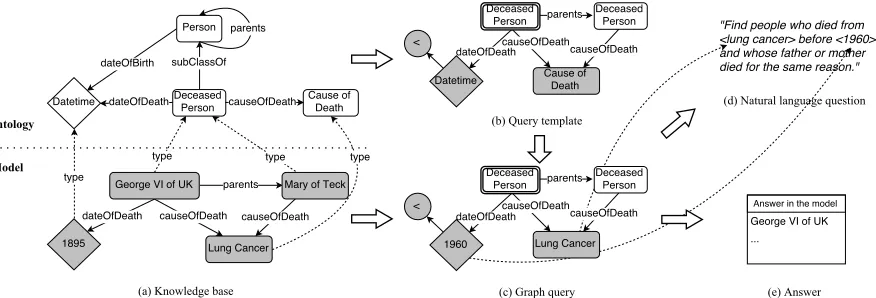
We present a semi-automated framework (Fig-ure 1) to construct QA datasets with characteristic
Figure 1: Running example of our framework. Graph queries are first generated from a knowledge base. After refinement (not shown), graph queries are sent to human annotators and converted into natural language questions. Answers are collected from the knowledge base.
specification from a knowledge base. The frame-work revolves around an intermediate graph query
representation, which helps to formalize question characteristics and collect answers. We first auto-matically generate graph queries from a knowledge base, and then employ human annotators to convert graph queries into questions.
Automating graph query generation brings with it the challenge of assessing the quality of graph queries and filtering out bad ones. Our framework tackles the challenge by combining structured mation in the knowledge base and statistical infor-mation from the Web. First, we identify redundant componentsin a graph query and develop techniques to remove them. Furthermore, based on the fre-quency of entities, classes, and relations mined from the Web, we quantify the commonness of a graph query and filter out too rare ones.
We employ a semi-automated approach for the conversion from graph query to natural language question, which provides two levels of paraphras-ing: Common lexical forms of an entity (e.g., “Queen Elizabeth” and “Her Majesty the Queen” for ElizabethII) mined from the Web are used
as entity paraphrases, and the remaining parts of a question are paraphrased by annotators. As a result, dozens of paraphrased questions can be produced for a single graph query.
To demonstrate the usefulness of question char-acteristics in QA evaluation, we construct a new dataset with over 5,000 questions based on Freebase using the proposed framework, and extensively
eval-uate several QA systems. A couple of new find-ings about system performance and question diffi-culty are discussed. For example, different from the results based on previous QA datasets (Yao et al., 2014), we find that semantic parsing in gen-eral works better than information extraction on our dataset. Information extraction based QA systems have trouble dealing with questions requiring aggre-gation or with multiple answers. A holistic under-standing of the whole question is often needed for hard questions. The experiments point out an array of issues that future QA systems may need to solve.
2 Related Work
Early QA research has extensively studied problems like question taxonomy, answer type, and knowl-edge sources (Burger et al., 2001; Hirschman and Gaizauskas, 2001; Voorhees and Tice, 2000). This work mainly targets factoid questions with one or more answers that are guaranteed to exist in a KB.
A few KB-based QA datasets have been pro-posed recently. QALD (Lopez et al., 2013) and FREE917 (Cai and Yates, 2013) contain hundreds
of hand-crafted questions. QALD also indicates whether a question requires aggregation. Both based on single Freebase triples, SIMPLEQUES -TIONS (Bordes et al., 2015) employ human
ques-tions involving multiple triples and various func-tions. Wang et al. (2015) generate question-answer pairs for closed domains like basketball. They also first generate logical forms (λ-DCS
formu-lae (Liang, 2013) in their case), and then convert log-ical forms into questions via crowdsourcing. Logi-cal forms are first converted into canoniLogi-cal questions to help crowdsourcing workers. Different from pre-vious works, we put a particular focus on generating questions with diversified characteristics in a sys-tematic way, and examining the impact of different question characteristics in QA.
Another attractive way for QA dataset construc-tion is to collect quesconstruc-tions from search engine logs (Bendersky and Croft, 2009). For exam-ple, WEBQUESTIONS(Berant et al., 2013) contains
thousands of popular questions from Google search, and Yih et al. (2016) have manually annotated these questions with logical forms. However, automatic characterization of questions is hard, while man-ual characterization is costly and requires exper-tise. Moreover, users’ search behavior is shaped by search engines (Aula et al., 2010). Due to the inade-quacy of current search engines to answer advanced questions, users may adapt themselves accordingly and mostly ask simple questions. Thus questions collected in this way, to some extent, may still not well reflect the true distribution of user information needs, nor does it fully exploit the potential of KB-based QA. Collecting answers is yet another chal-lenge for this approach. Yih et al. (2016) show that only 66%of the WEBQUESTIONSanswers, which
were collected via crowdsourcing, are completely correct. On the other hand, although questions gen-erated from a KB may not follow the distribution of user information needs, it has the advantage of ex-plicit question characteristics, and enables program-matic configuration of question generation. Also, answer collecting is automated without involving human labor and errors.
3 Background 3.1 Knowledge Base
In this work, we mainly concern knowledge bases storing knowledge about entities and relations in the form of triples (simplyknowledge bases hereafter). SupposeEis a set of entities,La set of literals (I=
E ∪ Lis also calledindividuals),Ca set of classes, andRa set of directed relations, a knowledge base Kconsists of two parts: anontologyO ⊆ C × R × C and amodelM ⊆ E × R ×(C ∪ E ∪ L). In other words, an ontology specifies classes and relations between classes, and a model consists offactsabout individuals. Such knowledge bases can be naturally represented as a directed graph, e.g., Figure 1(a). Literal classes such asDatetimeare represented as
diamonds, and other classes are rounded rectangles. Individuals are shaded. We assume relations are typed, i.e., each relation is associated with a set of
domainandrangeclasses. Facts of a relation must be compatible with its domain and range constraints. Without loss of generality, we use Freebase (June 2013 version) in this work for compatibility with the to-be-tested QA systems. It has 24K classes, 65K relations, 41M entities, and 596M facts.
3.2 Graph Query
Motivated by the graph-structured nature of knowl-edge bases, we adopt a graph-centric approach. We hinge on a formal representation namedgraph query
(e.g., Figure 1(c)), developed on the basis of Yih et al. (2015) and influenced byλ-DCS (Liang, 2013). Syntax. A graph query q is a connected directed
graph built on a given knowledge baseK. It com-prises three kinds of nodes: (1)Question node (dou-ble rounded rectangle), a free varia(dou-ble. (2) Un-grounded node(rounded rectangle or diamond), an existentially quantified variable. (3)Grounded node
(shaded rounded rectangle or diamond), an individ-ual. In addition, there arefunctions(shaded circle) such as<andcountapplied on a node. Nodes are
typed, each associated with a class. Nodes are con-nected by directed edges representing relations. En-tities on the grounded nodes are calledtopic entities.
Semantics. Graph query is a strict subset of λ -calculus. For example, the graph query in Fig-ure 1(c) can be written inλ-calculus (an existentially
quantified variable is imposed by<):
λx.∃y.∃z.type(x,DeceasedPerson)
∧type(y,DeceasedPerson)
∧type(z,Datetime)∧parents(x, y)
∧causeOfDeath(x,LungCancer)
∧causeOfDeath(y,LungCancer)
Theanswer of a graph queryq, denoted asJqKK,
can be easily obtained fromK. For example, ifK is stored in a RDF triplestore, then q can be
au-tomatically converted into a SPARQL query and run against K to get the answer. Compared with Yih et al. (2015), graph queries are not constrained to be tree-structured, which grants us a higher ex-pressivity. For example, linguistic phenomena like anaphora (e.g., Figure 1(d)) become easier to model.
4 Automatic Graph Query Generation
Our framework proceeds as follows: (1) Generate
query templates from a knowledge base, ground the templates to generate graph queries, and col-lect answers (this section). (2) Refine graph queries to retain high-quality ones (Section 5). (3) Con-vert graph queries into questions via crowdsourcing (Section 6).
We now describe an algorithm to generate the query template shown in Figure 1(b) (excluding the function for now). For simplicity, we will focus on the case of a single question node. Nevertheless, the proposed framework can be extended to generate graph queries with multiple question nodes. The al-gorithm takes as input an ontology (Figure 1(a)) and the desired number of edges. All the operations are conducted in a random manner to avoid systematic biases in query generation. TheDeceasedPerson
class is first selected as the question node. We then iteratively grow it by adding neighboring nodes and edges in the ontology. In each iteration, an exist-ing node is selected, and a new edge, which might introduce a new node, is appended to it. For exam-ple, the relationcauseOfDeath, whose domain
in-cludes DeceasedPerson, is first appended to the
question node, and then one of its range classes,
CauseOfDeath, is added as a new node. When a
node with the classCauseOfDeathalready exists,
it is possible to add an edge without introducing a new node. The same relation or class can be added multiple times, e.g., “parent of parent”.
Topic entities like LungCancer play an
impor-tant role in a question. A query template contains some template nodes that can be grounded with different topic entities to generate different graph queries. We randomly choose a few nodes as tem-plate. It may cause problems. For example,
ground-Figure 2: Mutual exclusivity example. Entities on different nodes should be different.
ing one node may make some others redundant. We conduct a formal study on this in Section 5.1.
Functions such as counting and comparatives are pervasive in real-life questions, e.g., “how many”, “the most recent”, and “people older than”, but are scarce in existing QA datasets. We incorpo-rate functions as an important question characteris-tic, and consider nine common functions, grouped into three categories: counting (count), superlative
(max,min,argmax,argmin), and comparative (>, ≥, <, ≤). More functions can be incorporated in the future. See Appendix A for examples. We ran-domly add functions to compatible nodes in query templates. In the running example, the<function
imposes the constraint that only people who passed away before a certain date should be considered. Each query will have at most one function.
We then ground the template nodes with indi-viduals to generate graph queries. A grounding is valid if the individuals conform with the class of the corresponding template nodes, and the resulted answer is not empty. For example, by grounding
CauseOfDeathwithLungCancerandDatetime
with1960, we get the graph query in Figure 1(c). A
query template can render multiple groundings. Finally, we convert a graph query into a SPARQL query and execute it using Virtuoso Open-Source 7 to collect answers. We further imposemutual exclu-sivityin SPARQL queries, that is, the entities on any two nodes in a graph query should be different. Con-sider the example in Figure 2, which is asking for the siblings of Natasha Obama. Wihout mutual ex-clusivity, however, Natash Obama herself will also be included as an answer, which is not desired.
5 Query Refinement
Figure 3:Query minimization example: (a) Graph query with redundant components. (b) Graph query after minimization.
Figure 4: Uncommon query example. It is uncommon to ask for somebody’s great-great-grandparents.
5.1 Query Redundancy and Minimization
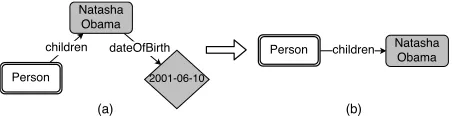
Some components (nodes and edges) in a graph query may not effectively impose any constraint on the answer. The query in Figure 3(a) is to “find the US president whose child is Natasha Obama,
and Natasha Obama was born on 2001-06-10”. Intuitively, the bold-faced clause does not change the answer of the question. Correspondingly, the
dateOfBirth edge and the date node are
redun-dant. As a comparison, removing any component from the query in Figures 3(b) will change the an-swer. Formally, given a knowledge baseK, a com-ponent in a graph queryqisredundantiff. removing
it does not change the answerJqKK.
Redundancy can be desired or not. In a question, redundant information may be inserted to reduce ambiguity. In Figure 3(a), if one uses “Natasha” to refer toNatashaObama, there comes ambiguity
since it may be matched with many other entities. The additional information “who was born on 2001-06-10” then helps. Next we describe an algorithm to remove redundancy from queries. One can choose to either only generate queries with no redundant com-ponent, or intentionally generate redundant queries and test QA systems in presence of redundancy.
We manage to generate minimal queries, for which there exists no sub-query having the same an-swer. An important theorem, as we prove in Ap-pendix B, is the equivalency of minimality and non-redundancy: A query is minimaliff.it has no redun-dant component. This renders a simple algorithm for query minimization, which directly detects and removes the redundant components in a query. We first examine every edge (in an arbitrary order), and remove an edge if it is redundant. Redundant nodes
will then become disconnected to the question node and are thus eliminated. It is easy to prove that the produced query (e.g., Figure 3(b)) is minimal, and has the same answer as the original query.
5.2 Commonness Checking
We now quantify thecommonnessof graph queries. The benefits of this study are two-fold. First, it pro-vides a refinement mechanism to reduce too rare queries. Second, commonness is itself an important question characteristic. It is interesting to examine its impact on question difficulty. Consider the ex-ample in Figure 4, which asks for “the great-great-grandparents of Ernest Solvay”. It is minimal and logically plausible. Few users, however, are likely to come up with it. Ernest Solvay is famous for the Solvay Conferences, but few people outside the sci-ence community may know him. AlthoughPerson
and parents are common, asking for the
great-great-grandparents is quite uncommon.
A query is more common if users would more likely come up with it. We define the commonness of a queryq as itsprobabilityp(q)of being picked among all possible queries from a knowledge base. The problem then boils down to estimating p(q).
It is hard, if not impossible, to exhaust the whole query space. We thus make the following simplifica-tion. We break down query commonness by compo-nents, assuming mutual independence between com-ponents, and omit functions:
p(q) = Q
i∈Iq
p(i)× Q
c∈Cq
p(c)× Q
r∈Rq
p(r), (1)
whereIq,Cq,Rqare themulti-setof the individuals,
classes, and relations in q, respectively. Repeating
components are thus accumulated (c.f. Figure 4). We propose a data-driven method, using statisti-cal information from the Web, to estimatep(i),p(c),
and p(r). Other methods like domain-knowledge
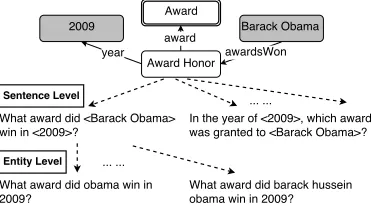
re-Figure 5:Question generation and paraphrasing.
spectively. Suppose entityehasn(e)mentions, then
p(e) = P n(e)
e0∈En(e0).For a class c, probability p(c)
is higher if it has more frequently mentioned enti-ties. If we usee ∈ cto indicateeis an instance of c, thenp(c) =
P e∈cn(e) P
c0∈C P
e∈c0n(e). Estimatingp(r)
re-quires relation extraction from texts, which is hard. We make the following simplification: If(e1, r, e2)
is a fact in the knowledge base, we increasen(r)by 1 ife1 ande2 co-occur in a document. This suffices
to distinguish common relations from uncommon ones. We then define p(r) = P n(r)
r0∈Rn(r0). Finally,
we use frequency information from the knowledge base to smooth the probabilities, e.g., to avoid zero probabilities. The probability of literals are solely determined by the frequency information from the knowledge base. Refer to Appendix C for the re-sulted probability distributions.
6 Natural Language Conversion
In order to ensure naturalness and diversity, we em-ploy human annotators to manually convert graph queries into natural language questions. We man-age to provide two levels of paraphrasing (Fig-ure 5). Each query is sent to multiple annotators for sentence-level paraphrasing. In addition, we use dif-ferent lexical forms of an entity mined from FACC1 for entity-level paraphrasing. We provide a ranked list of common lexical forms and the corresponding frequency for each topic entity. For example, the lexical form list for UnitedStatesOfAmericais
“us” (108M), “united states” (44M), “usa” (22M), etc. Finally, graph queries are automatically trans-lated into SPARQL queries to collect answers.
Natural language generation (NLG) (Wen et al., 2015; Serban et al., 2016; Duˇsek and Jurˇc´ıˇcek, 2015) would be a good complement to our framework, the combination of which can lead to a fully-automated
pipeline to generate QA datasets. For example, Serban et al. (2016) automatically convert Free-base triples into questions with a neural network. More sophisticated NLG techniques able to handle graph queries involving multiple relations and vari-ous functions are an interesting future direction.
7 Experiments
We have constructed a new QA dataset, named GRAPHQUESTIONS, using the proposed
frame-work, and tested several QA systems to show that it enables fine-grained inspection of QA systems.
7.1 Dataset Construction
We first randomly generated a set of minimal graph queries, and removed the ones whose common-ness is below a certain threshold. The remaining graph queries were then screened by graduate stu-dents, and a canonicalquestion was generated for each query, with each being verified by at least two students. We recruited 160 crowdsourcing work-ers from Amazon MTurk to generate sentence-level paraphrases of the canonical questions. Trivial para-phrases (e.g., “which city” vs. “what city”) were manually removed to retain a high diversity in para-phrasing. At most 3 entity-level paraphrases were used for each sentence-level paraphrase.
7.2 Dataset Analysis
GRAPHQUESTIONS contains 500 graph queries,
2,460 sentence-level paraphrases, and 5,166 ques-tions2. The dataset presents a high diversity and
covers a wide range of domains includingPeople, Astronomy, Medicine, etc. Specifically, it
con-tains 148, 506, 596, 376 and 3,026 distinct domains, classes, relations, topic entities, and words, respec-tively. We evenly split GRAPHQUESTIONS into a
training set and a testing set. All the paraphrases of the same graph query are in the same set.
While there are other question characteristics derivable from graph query, we will focus on the following ones:structure complexity,function, com-monness,paraphrasing, andanswer cardinality. We
2For each query template, we only generate one graph query,
[image:6.612.93.279.59.162.2]# of edges Function log10(p(q)) |A|
1 2 3 none count super. comp. [−40,30) [−30,20) [−20,10) [−10,0) 1 >1
# of graph queries 321 144 35 350 61 42 47 60 135 283 22 332 168
[image:7.612.80.524.57.106.2]# of questions 3094 1648 424 3855 710 332 269 653 1477 2766 270 3487 1679
Table 1:Characteristic statistics.|A|is answer cardinality. Refer to Appendix D for paraphrase and other fine-grained distributions.
Question Domain Answer # of edges Function log10(p(q)) |A| Find terrorist organizations involved in
September 11 attacks.
TheSeptember 11 attackswere carried out with
the involvement of what terrorist organizations? Terrorism alQaeda 1 none -16.67 1 Who didnine eleven?
How many children ofEddard Starkwere born inWinterfell?
Winterfellis the home of how many ofEddard
Stark’s children? FictionalUniverse 3 2 count -23.34 1 What’s the number ofNed Stark’s children
whose birthplace isWinterfell? In which month does the average rainfall ofNew
York Cityexceed86mm?
Rainfall averages more than86mm inNew York
Cityduring which months? Travel March, August. . . 3 comp. -37.84 7 List the calendar months whenNYCaverages in
[image:7.612.85.514.115.321.2]excess of86millimeters of rain?
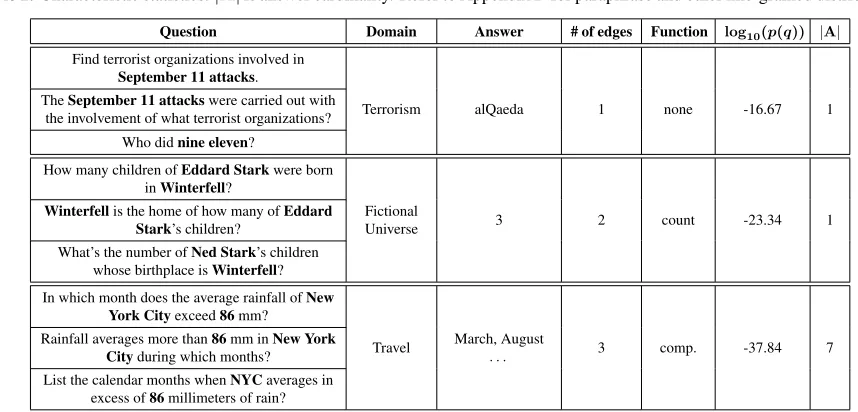
Table 2: Example questions and characteristics. Three sentence-level paraphrases are shown for each graph query, with the last one also involving entity-level paraphrasing. Topic entities are bold-faced. More examples can be found in Appendix D.
use the number of edges to quantify structure com-plexity, and limit it to at most 3. Commonness is limited to log10(p(q)) ≥ −40 (c.f. Eq. 1). As shown in Section 7.4.2, such questions are already very hard for existing QA systems. Nevertheless, the proposed framework can be used to generate questions with different characteristic distributions. Some statistics are shown in Table 1 and more fine-grained statistics can be found in Appendix D.
Several example questions are shown in Ta-ble 2. Sentence-level paraphrasing requires to han-dle both commands (the first example) and “Wh” questions, light verbs (“Who did nine eleven?”), and changes of syntactic structure (“The Septem-ber 11 attacks were carried out with the involve-ment of what terrorist organizations?”). Entity-level paraphrasing tests the capability of QA systems on abbreviation (“NYC” for New York City),
world knowledge (“Her Majesty the Queen” for
ElizabethII), or even common typos (“ Shaks-peare” forWilliamShakespeare). Numbers and
dates are also common, e.g., “Which computer oper-ating system was released on Sept. the 20th, 2008?” We compare several QA datasets constructed from Freebase, shown in Table 3. Datasets focus-ing on sfocus-ingle-relation questions are of a larger scale,
but are also of a significant lack in question charac-teristics. Overall GRAPHQUESTIONS presents the
highest diversity in question characteristics.
7.3 Setup
We evaluate three QA systems whose source code is publicly available: SEMPRE(Berant et al., 2013),
PARASEMPRE (Berant and Liang, 2014), and JA -CANA (Yao and Van Durme, 2014). SEMPRE
and PARASEMPRE follow the semantic parsing
paradigm. SEMPRE conducts a bottom-up
beam-based parsing on questions to find the best logical form. PARASEMPRE, in a reverse manner,
enumer-ates a set of logical forms, generenumer-ates a canonical utterance for each logical form, and ranks logical forms according to how well the canonical utter-ance paraphrases the input question. In contrast, JA -CANAfollows the information extraction paradigm,
and builds a classifier to directly predict whether an individual is the answer. They all use Freebase.
Dataset # of Questions # of Multi-relation Function (count/super./comp.) Commonness Paraphrase Multi-answer
GRAPHQUESTIONS(this work) 5166 2072 710 / 332 / 269 + + +
WEBQUESTIONSSP (Yih et al., 2016)1 4737 2075 2 / 168 / 334 - - +
FREE917 (Cai and Yates, 2013) 917 229 185 / 0 / 0 - - +
Serban et al. (2016) 30M 0 0 / 0 / 0 - -
-SIMPLEQUESTIONS(Bordes et al., 2015) 108K 0 0 / 0 / 0 - -
-Table 3:Comparison of QA datasets constructed from Freebase. GRAPHQUESTIONSis the richest in question characteristics.
System F1 Time/s
SEMPRE 10.80 56.19
PARASEMPRE 12.79 18.43
[image:8.612.68.540.58.128.2]JACANA 5.08 2.01
Table 4:Overall performance on GRAPHQUESTIONS.
precision is 1, recall is 0, and F1 is 0. Average run-time is used for efficiency. Results are shown in per-centage. Systems are trained on the training set us-ing the suggested configurations (Appendix E). We use student’s t test atp= 0.05for significance test.
7.4 Results
7.4.1 Overall Evaluation
Compared with the scores on WEBQUESTIONS
(30%-40%), the scores on GRAPHQUESTIONS are
lower (Table 4). This is because GRAPHQUES -TIONS contains questions over a broader range of
difficulty levels. For example, it is more diverse in topics (Appendix D); also the scores become much closer when excluding paraphrasing (Section 7.4.2). JACANA achieves a comparable F1 score with
SEMPRE and PARASEMPRE on WEBQUES -TIONS (Yao et al., 2014). On GRAPHQUESTIONS,
however, SEMPRE and PARASEMPRE significantly
outperform JACANA (both p < 0.0001). The
following experiments will give more insights about where the performance difference comes from. On the other hand, JACANA is much faster,
showing an advantage of information extraction. The semantic parsing systems spend a lot of time on executing SPARQL queries. Bypassing SPARQL and directly working on the knowledge base may be a promising way to speed up semantic parsing on large knowledge bases (Yih et al., 2015).
2WEBQUESTIONSSP is WEBQUESTIONS with manually
annotated logical forms. Only those with a full logical form are included (4737 / 5810).
7.4.2 Fine-grained Evaluation
With explicitly specified question characteristics, we are able to further inspect QA systems.
Structure Complexity. We first break down system performance by structure. Answer quality is in gen-eral sensitive to the complexity of question struc-ture: As the number of edges increases, F1 score decreases (Figure 6(a)). The tested systems often fail to take into account auxiliary constraints in a question. For example, for “How many children of Ned Stark were born in Winterfell?” SEMPRE
fails to identify the constraint “born in Winterfell”, so it also considers Ned Stark’s bastard son, Jon Snow, as an answer, who was not born in Winter-fell. Answering questions involving multiple rela-tions using large knowledge bases remain an open problem. The large size of knowledge bases pro-hibits exhaustive search, so smarter algorithms are needed to efficiently prune the answer space. Be-rant and Liang (2015) point out an interesting direc-tion, leveraging agenda-based parsing with imitation learning for efficient search in the answer space.
Function. In terms of functions, while SEMPREand
PARASEMPREperform well oncountquestions, all
the tested systems perform poorly on questions with superlatives or comparatives (Figure 6(b)). JACANA
has trouble dealing with functions because it does not conduct quantitative analysis over the answer space. SEMPREand PARASEMPREdo not generate
logical forms with superlatives and comparatives, so they cannot answer such questions well.
Commonness. Not surprisingly, more common questions are in general easier to answer (Fig-ure 6(c)). An interesting observation is that SEM -PRE’s performance gets worse on the most common
questions. The cause is likely rooted in how the QA systems construct their candidate answer sets. PARASEMPRE and JACANA exhaustively construct
candidate sets, while SEMPREemploys a bottom-up
[image:8.612.121.247.148.205.2]1 2 3 0
0.05 0.1 0.15 0.2
(a) # of edges
Average F1
SEMPRE PARASEMPRE JACANA
none count super. comp. 0
0.05 0.1 0.15 0.2
(b) Function
Average F1
SEMPRE PARASEMPRE JACANA
−35 −25 −15 −5 0
0.05 0.1 0.15 0.2 0.25
(c) commonness
Average F1
SEMPRE PARASEMPRE JACANA
1 3 5 7 9 11 13 15 17
0 0.05 0.1 0.15 0.2 0.25 0.3 0.35
(d) Rank of paraphrases
Average F1
[image:9.612.76.535.58.147.2]SEMPRE PARASEMPRE JACANA
Figure 6:Performance breakdown by (a) structure complexity, (b) function, (c) commonness, and (d) paraphrase. Note that in (c)
x=−5indicates the commonness range−10≤log10(p(q))<0.
the candidate answer space. Common entities like
UnitedStatesOfAmerica are often featured by
a high degree in knowledge bases (e.g., 1 million neighboring entities), which dramatically increases the size of the candidate answer space. During SEM -PRE’s iterative beam search, many correct logical
forms may have fallen off beam before getting into the final candidate set. We checked the percentage of questions for which the correct logical form is in the final candidate set, and found that it decreased from 19.8% to 16.7% when commonness increased from -15 to -5, providing an evidence for the intuition.
Paraphrasing. It is critical for a system to toler-ate the wording varieties of users. We make the first effort to evaluate QA systems on paraphras-ing. For each system, we rank, in descending or-der, all the paraphrases derived from the same graph query by their F1 score achieved by the system, and then compute the average F1 score of each rank. In Figure 6(d), the decreasing rate of a curve thus de-scribes a system’s robustness to paraphrasing; the higher, the less robust. All the systems achieve a reasonable score on the top-1 paraphrases, i.e., when a system can choose the paraphrase it can best an-swer. The F1 scores drop quickly in general. On the fourth-ranked paraphrases, the F1 score of SEM -PRE, PARASEMPRE, and JACANA are respectively
only 37.65%, 53.2%, and 36.2% of their score on the top-1 paraphrases. Leveraging paraphrasing in its model, PARASEMPREdoes seem to be more
ro-bust. The results show that how to handle para-phrased questions is still a challenging problem.
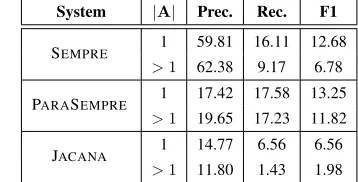
Answer Cardinality. SEMPRE and JACANA get a
significantly lower F1 score (both p < 0.0001)
on multi-answer questions (Table 5), mainly com-ing from a decrease on recall. The decrease of PARASEMPREis not significant (p=0.29). The
par-ticularly significant decrease of JACANA
demon-System |A| Prec. Rec. F1
SEMPRE 1 59.81 16.11 12.68
>1 62.38 9.17 6.78
PARASEMPRE 1 17.42 17.58 13.25
>1 19.65 17.23 11.82
JACANA 1 14.77 6.56 6.56
[image:9.612.331.510.185.276.2]>1 11.80 1.43 1.98
Table 5:Performance breakdown by answer cardinality|A|.
strates the difficulty of training a classifier that can predict all of the answers correctly; semantic pars-ing is more robust in this case. The precision of SEMPREis high because it generates no response for
many questions. Note that under the current defini-tion, the average F1 score is not the harmonic mean of the average precision and recall (c.f. Section 7.3).
8 Conclusion
We proposed a framework to generate characteristic-rich questions for question answering (QA) evalua-tion. Using the proposed framework, we constructed a new and challenging QA dataset, and extensively evaluated several QA systems. The findings point out an array of issues that future QA research may need to solve.
9 Acknowledgements
References
Anne Aula, Rehan M. Khan, and Zhiwei Guan. 2010. How does search behavior change as search becomes more difficult? InProceedings of CHI.
Junwei Bao, Nan Duan, Ming Zhou, and Tiejun Zhao. 2014. Knowledge-based question answering as ma-chine translation. InProceedings of ACL.
Michael Bendersky and W. Bruce Croft. 2009. Analysis of long queries in a large scale search log. In Proceed-ings of the 2009 workshop on Web Search Click Data. Jonathan Berant and Percy Liang. 2014. Semantic
pars-ing via paraphraspars-ing. InProceedings of ACL.
Jonathan Berant and Percy Liang. 2015. Imitation learn-ing of agenda-based semantic parsers. Transactions of the Association for Computational Linguistics, 3:545– 558.
Jonathan Berant, Andrew Chou, Roy Frostig, and Percy Liang. 2013. Semantic parsing on Freebase from question-answer pairs. InProceedings of EMNLP. Kurt Bollacker, Colin Evans, Praveen Paritosh, Tim
Sturge, and Jamie Taylor. 2008. Freebase: A collabo-ratively created graph database for structuring human knowledge. InProceedings of SIGMOD.
Antoine Bordes, Nicolas Usunier, Sumit Chopra, and Jason Weston. 2015. Large-scale simple question answering with memory networks. arXiv preprint arXiv:1506.02075.
John Burger, Claire Cardie, Vinay Chaudhri, Robert Gaizauskas, Sanda Harabagiu, David Israel, Christian Jacquemin, Chin-Yew Lin, Steve Maiorano, George Miller, et al. 2001. Issues, tasks and program structures to roadmap research in question & answer-ing (q&a). In Document Understanding Conferences Roadmapping Documents, pages 1–35.
Qingqing Cai and Alexander Yates. 2013. Large-scale semantic parsing via schema matching and lexicon ex-tension. InProceedings of ACL.
Li Dong, Furu Wei, Ming Zhou, and Ke Xu. 2015. Ques-tion answering over Freebase with multi-column con-volutional neural networks. InProceedings of ACL. Ondˇrej Duˇsek and Filip Jurˇc´ıˇcek. 2015. Training a
nat-ural language generator from unaligned data. In Pro-ceedings of ACL.
Anthony Fader, Luke Zettlemoyer, and Oren Etzioni. 2014. Open question answering over curated and ex-tracted knowledge bases. InProceedings of KDD. Evgeniy Gabrilovich, Michael Ringgaard, and Amarnag
Subramanya. 2013. FACC1: Freebase annotation of ClueWeb corpora, version 1 (release date 2013-06-26, format version 1, correction level 0). http://
lemurproject.org/clueweb09/ and http:
//lemurproject.org/clueweb12/.
Lynette Hirschman and Robert Gaizauskas. 2001. Natu-ral language question answering: the view from here.
natural language engineering, 7(4):275–300.
Tom Kwiatkowski, Eunsol Choi, Yoav Artzi, and Luke Zettlemoyer. 2013. Scaling semantic parsers with on-the-fly ontology matching. InProceedings of EMNLP. Jens Lehmann, Robert Isele, Max Jakob, Anja Jentzsch, Dimitris Kontokostas, Pablo N Mendes, Sebastian Hellmann, Mohamed Morsey, Patrick van Kleef, S¨oren Auer, et al. 2014. DBpedia - a large-scale, mul-tilingual knowledge base extracted from wikipedia.
Semantic Web Journal, 6(2):167–195.
Percy Liang. 2013. Lambda dependency-based compo-sitional semantics. arXiv preprint arXiv:1309.4408. Vanessa Lopez, Christina Unger, Philipp Cimiano, and
Enrico Motta. 2013. Evaluating question answering over linked data. Web Semantics: Science, Services and Agents on the World Wide Web, 21:3–13.
Siva Reddy, Mirella Lapata, and Mark Steedman. 2014. Large-scale semantic parsing without question-answer pairs. Transactions of the Association for Computa-tional Linguistics, 2:377–392.
Iulian Vlad Serban, Alberto Garc´ıa-Dur´an, Caglar Gul-cehre, Sungjin Ahn, Sarath Chandar, Aaron Courville, and Yoshua Bengio. 2016. Generating factoid ques-tions with recurrent neural networks: The 30m factoid question-answer corpus. InProceedings of ACL. Huan Sun, Hao Ma, Wen-tau Yih, Chen-Tse Tsai,
Jingjing Liu, and Ming-Wei Chang. 2015. Open do-main question answering via semantic enrichment. In
Proceedings of WWW.
Ellen M Voorhees and Dawn M Tice. 2000. Building a question answering test collection. InProceedings of SIGIR.
Yushi Wang, Jonathan Berant, and Percy Liang. 2015. Building a semantic parser overnight. InProceedings of ACL.
Tsung-Hsien Wen, Milica Gaˇsi´c, Nikola Mrkˇsi´c, Pei-Hao Su, David Vandyke, and Steve Young. 2015. Semanti-cally conditioned LSTM-based natural language gen-eration for spoken dialogue systems. InProceedings of EMNLP.
Mohamed Yahya, Klaus Berberich, Shady Elbassuoni, Maya Ramanath, Volker Tresp, and Gerhard Weikum. 2012. Deep answers for naturally asked questions on the web of data. InProceedings of WWW.
Xuchen Yao and Benjamin Van Durme. 2014. Informa-tion extracInforma-tion over structured data: QuesInforma-tion answer-ing with Freebase. InProceedings of ACL.
Xuchen Yao, Jonathan Berant, and Benjamin Van Durme. 2014. Freebase QA: Information extraction or seman-tic parsing? InProceedings of ACL.
Wen-tau Yih, Ming-Wei Chang, Xiaodong He, and Jian-feng Gao. 2015. Semantic parsing via staged query graph generation: Question answering with knowl-edge base. InProceedings of ACL.
Wen-tau Yih, Matthew Richardson, Christopher Meek, Ming-Wei Chang, and Jina Suh. 2016. The value of
semantic parse labeling for knowledge base question answering. InProceedings of ACL.