Learning to Recognize Discontiguous Entities
Aldrian Obaja Muis Wei Lu
Singapore University of Technology and Design {aldrian muis,luwei}@sutd.edu.sg
Abstract
This paper focuses on the study of recognizing discontiguous entities. Motivated by a previ-ous work, we propose to use a novel hyper-graph representation to jointly encode discon-tiguous entities of unbounded length, which can overlap with one another. To compare with existing approaches, we first formally in-troduce the notion ofmodel ambiguity, which defines the difficulty level of interpreting the outputs of a model, and then formally analyze the theoretical advantages of our model over previous existing approaches based on linear-chain CRFs. Our empirical results also show that our model is able to achieve significantly better results when evaluated on standard data with many discontiguous entities.
1 Introduction
Building effective automatic named entity recogni-tion (NER) systems that is capable of extracting useful semantic shallow information from texts has been one of the most important tasks in the field of natural language processing. An effective NER sys-tem can typically play an important role in certain downstream NLP tasks such as relation extraction, event extraction, and knowledge base construction (Hasegawa et al., 2004; Al-Rfou and Skiena, 2012). Most traditional NER systems are capable of ex-tracting entities1 as short spans of texts. Two ba-sic assumptions are typically made when extract-1Or sometimes mentions are considered, which can be named, nominal or pronominal references to entities (Florian et al., 2004). In this paper we use “mentions” and “entities” interchangeably.
EGD showed [hiatal hernia]1and vertical [laceration]2 in distal [esophagus]2with [blood in[stomach]4]3and overlying [lac]4.
Figure 1: Discontiguous entities in a medical domain. Words annotated with the same index are part of the same entity. Note that entity 3 and entity 4 overlap with one another.
ing entities: 1) entities do not overlap with one an-other, and 2) each entity consists of a contiguous se-quence of words. These assumptions allow the task to be modeled as a sequence labeling task, for which many existing models are readily available, such as linear-chain CRFs (McCallum and Li, 2003).
While the above two assumptions are valid for most cases, they are not always true. For example, in the entityUniversity of New Hampshire of type ORGthere exists another entityNew Hampshireof typeLOC. This violates the first assumption above, yet it is crucial to extract both entities for subsequent tasks such as relation extraction and knowledge base construction. Researchers therefore have proposed to tackle the above issues in NER using more so-phisticated models (Finkel and Manning, 2009; Lu and Roth, 2015). Such efforts still largely rely on the second assumption.
Unfortunately, the second assumption is also not always true in practice. There are also cases where the entities are composed of multiple discontiguous sequences of words, such as in disorder mention recognition in clinical texts (Pradhan et al., 2014b), where the entities (disorder mentions in this case) may be discontiguous. Consider the example shown in Figure 1. In this example there are four
ties, the first one, hiatal hernia, is a conventional contiguous entity. The second one, laceration ... esophagus, is a discontiguous entity, consisting of two parts. The third and fourth ones,blood in stom-ach andstomach ... lac (for stomach laceration), are overlapping with each other, with the fourth be-ing discontiguous at the same time.
For such discontiguous entities which can poten-tially overlap with other entities in complex man-ners, existing approaches such as those based on simple sequence tagging models have difficulties handling them accurately. This stems from the fact that there is a very large number of possible entity combinations in a sentence when the entities can be discontiguous and overlapping.
Motivated by this, in this paper we propose a novel model that can better represent both contigu-ous and discontigucontigu-ous entities which can overlap with one another. Our major contributions can be summarized as follows:
• We propose a novel model that is able to
repre-sent both contiguous and discontiguous entities.
• Theoretically, we introduce the notion ofmodel ambiguityfor quantifying the ambiguity of dif-ferent NER models that can handle discontigu-ous entities. We present a study and make com-parisons about different models’ ambiguity un-der this theoretical framework.
• Empirically, we demonstrate that our model can significantly outperform conventional ap-proaches designed for handling discontiguous entities on data which contains many discontigu-ous entities.
2 Related Work
Learning to recognize named entities is a popular task in the field of natural language processing. A survey by Nadeau (2007) lists several approaches in NER, including Hidden Markov Models (HMM) (Bikel et al., 1997), Decision Trees (Sekine, 1998), Maximum Entropy Models (Borthwick and Sterling, 1998), Support Vector Machines (SVM) (Asahara and Matsumoto, 2003), and also semi-supervised and unsupervised approaches. Ratinov (2009) uti-lizes averaged perceptron to solve this problem and also focused on four key design decisions, achiev-ing state-of-the-art in MUC-7 dataset. These
ap-proaches work on standard texts, such as news ar-ticles, and the entities to be recognized are defined to be contiguous and non-overlapping.
Noticing that many named entities contain other named entities inside them, Finkel and Manning (2009) proposed a model that is capable of extract-ing nested named entities by representextract-ing the sen-tence as a constituency parse tree, with named enti-ties as phrases. As a parsing-based model, the ap-proach has a time complexity that is cubic in the number of words in the sentence.
Recently, Lu and Roth (2015) proposed a model that can represent overlapping entities. In addition to supporting nested entities, theoretically this model can also represent overlapping entities where nei-ther is nested in anonei-ther. The model represents each sentence as a hypergraph with nodes indicating en-tity types and boundaries. Compared to the previ-ous model, this model has a lower time complexity, which is linear in the number of words in the sen-tence.
All the above models focus on NER in convtional texts, where the assumption of contiguous en-tities is valid. In the past few years, there is a grow-ing body of works on recognizgrow-ing disorder mentions in clinical text. These disorder mentions may be discontiguous and also overlapping. To tackle such an issue, a research group from University of Texas Health Science Center at Houston (Tang et al., 2013; Zhang et al., 2014; Xu et al., 2015) first utilized a conventional linear-chain CRF to recognize disorder mention parts by extending the standard BIO (Begin, Inside, Outside) format, and next did some postpro-cessing to combine different components. Though effective, as we will see later, such a model comes with some drawbacks. Nevertheless, their work mo-tivated us to perform further analysis on this issue and propose a novel model specifically designed for discontiguous entity extraction.
3 Models
3.1 Linear-chain CRF Model
EGD showedhiatal[B]hernia[I]and verticallaceration[BD]
in distalesophagus[BD]withblood[B]in[I]stomach[BH]and
overlyinglac[BD].
Infarctions[BH]eitherwater[BD]shed[ID]orembolic[BD]
Figure 2:Entity encoding in the linear-chain model. Top: for the example in Fig 1.Bottom: for the second example in Fig 4. TheOlabels are not shown.
that we will make comparison with in later sections. The problem is regarded as a sequence prediction task, where each word is assigned a label similar to BIO format often used for NER. We used the en-coding used by Tang et al. (2013), which uses 7 tags to handle entities that can be discontiguous and overlapping. Specifically, we usedB,I,O,BD,ID, BH, andIHto denoteBeginning of entity,Inside en-tity, Outside of entity, Beginning of Discontiguous entity,Inside ofDiscontiguous entity,Beginning of Head, and Inside of Head. To encode a sentence in this format, first we identify the contiguous word sequences which are parts of multiple entities. We call thesehead componentsand we label each word inside each component withBH(for the first word ineach component) orIH. Then we find contiguous word sequences which are parts of a discontiguous entity, which we call thebody components. Words inside those components which have not been la-beled are lala-beled withBD(for the first word ineach component) orID. Finally, words that are parts of a contiguous entity are calledcontiguous component, and, if they have not been labeled, are labeled asB (for the first word ineach component) orI.
This encoding is lossy, since the information on which parts constitute the same entity is lost. The top example in Figure 2 is the encoding of the example shown in Figure 1. During decod-ing, based on the labels only it is not entirely clear whether “laceration” should be combined with “esophagus” or with “stomach” to form a single mention. For the bottom example, we cannot deduce that “Infarctions” alone is a mention, since there is no difference in the encoding of a sentence with only two mentions {“Infarctions . . . water shed”, “Infarctions . . . embolic”}or having three mentions with “Infarctions” as another mention, since in both cases, the word “Infarctions” is labeled withBH.
Also, it should be noted that some of the label se-quences are not valid. For example, a sentence in which there is only one word labeled as BDis in-valid, since a discontiguous entity requires at least two words to be labeled asBDorBH. This is, how-ever, a possible output from the linear CRF model, due to the Markov assumption inherent in linear CRF models. Later we see that our models do not have this problem.
3.2 Our Model
Linear-chain CRF models are limited in their repre-sentational power when handling complex entities, especially when they can be discontiguous and can overlap with one another. While recent models have been proposed to effectively handle overlapping tities, how to effectively handle discontiguous en-tities remains a research question to be answered. Motivated by previous efforts on handling overlap-ping entities (Lu and Roth, 2015), in this work we propose a model based on hypergraphs that can bet-ter represent entities that can be discontiguous and at the same time be overlapping with each other.
Unlike the previous work (Lu and Roth, 2015), we establish a novel theoretical framework to formally quantify the ambiguity of our hypergraph-based models and justify their effectiveness by making comparisons with the linear-chain CRF approach.
Now let us introduce our novel hypergraph rep-resentation. A hypergraph can be used to represent entities of different types and their combinations in a given sentence. Specifically, a hypergraph is con-structed as follows. For the word at positionk, we
have the following nodes:
• Ak: this node represents all entities that begin with the current or a future word (to the right of the current word).
• Ek: this node represents all entities that begin with the current word.
• Tk
t: this node represents entities of certain spe-cific type t that begin with the current word.
There is oneTkt for each different type.
• Bkt,i: this node indicates that the current word is part of thei-th component of an entity of typet. • Okt,i: this node indicates that the current word appears in between(i-1)-th andi-th components
There is also a special leaf node, X-node, which indicates the end (i.e., right boundary) of an entity.
The nodes are connected by directed hyperedges, which for the purpose of explaining our models are defined as those edges that connect one node, called the parent node, to one or more child nodes. For ease of notation, in the rest of this paper we useedgeto refer to directed hyperedge.
The edges EachAk is a parent toEk andAk+1,
encoding the fact that the set of all entities at position
kis the union of the set of entities startingexactly at
current position (Ek) with the set of entities starting at orafter positionk+ 1(Ak+1).
EachEk is a parent toTk
1,. . .,TkT , whereT is the total number of possible types that we consider. EachTkt has two edges where it serves as a parent, within one it is parent toBk
t,0and within another it is
toX. These edges encode the fact that at positionk, either there is an entity of typetthat begins with the
current word (toBkt,0), or there is no entity of typet
that begins with the current word (toX).
In the full hypergraph, each Bkt,i is a parent to Bkt,i+1 (encoding the fact that the next word also be-longs to the same component of the same entity), to Okt,i+1+1 (encoding the fact that this word is part of a discontiguous entity, and the next word is the first word separating current component and the next component), and to X(representing that the entity ends at this word). Also there are edges with all pos-sible combinations of Bkt,i+1, Okt,i+1+1, and X as the child nodes, representing overlapping entities. For example, the edgeBk
t,i → (Bkt,i+1,X )denotes that there is an entity which continues to the next word (the edge toBkt,i+1), while there is another entity end-ing atk-th word (the edge toX). In total there are 7 edges in whichBkt,iis a parent, which are:
• Bkt,i→(X)
• Bkt,i→(Okt,i+1+1)
• Bk
t,i→(Okt,i+1+1,X)
• Bkt,i→(Bkt,i+1)
• Bk
t,i→(Bkt,i+1,X)
• Bkt,i→(Bt,ik+1,Okt,i+1+1)
• Bkt,i→(Bt,ik+1,Okt,i+1+1,X)
Analogously,Ok
t,i has three edges that connect to
A A A A A A
E E E E E E
T T T T T T
B0
O1 O1 O1 O1
B1 B1 B1
X X X X X
X
X X
[image:4.612.323.539.57.232.2][[[Infarctions]1]2]3either [water shed]2 or [embolic]3
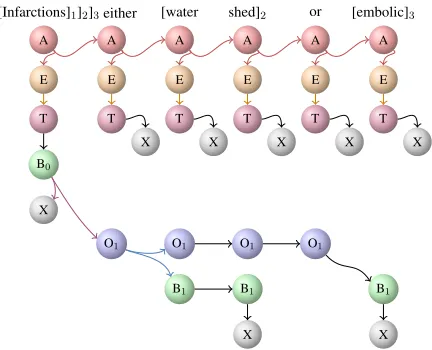
Figure 3: The hypergraph for SHAREDmodel for the second example in Figure 4. The type information inT, B, andO -nodes is not shown. TheX-node is drawn multiple times for better visualization.
Okt,i+1,Bkt,i+1+1, and both. Note thatOkt,i is not a par-ent toXby definition.
During testing, the model will predict asubgraph which will result in the predicted entities after de-coding. We call this subgraph representing certain entity combinationentity-encoded hypergraph.
For example, Figure 3 shows the entity-encoded hypergraph of our model encoding the three men-tions in the second example in Figure 4. The edge from theT-node for the first word to theB-node for the first word shows that there is at least one entity starting with this word. The three places where an X-node is connected to a B-node show the end of the three entities. Note that this hypergraph clearly shows the presence of the three mentions without ambiguity, unlike a linear-chain encoding of this ex-ample where it cannot be inferred that “Infarctions” alone is a mention, as discussed previously. In this paper, we set the maximum number of components to be 3 since the dataset does not contain any men-tion with more than 3 components.
Also note that this model supports discontiguous and overlapping mentions of different types since each type has its own set ofO-nodes andB-nodes, unlike the linear-chain model, which supports only overlapping mentions of the same type.
We also experimented with a variant of this model, where we split the T-nodes, B-nodes, and O-nodes further according to the number of com-ponents. We splitBk
1. . .3which represents that the word is part of the i-th component of a mention with total j
compo-nents. Similarly we splitOkt,iintoOkt,i,jandTkt into Tk
t,j. We call the original version SHARED model, and this variant SPLIT model. The motivation for
this variant is that the majority of overlaps in the data are between discontiguous and contiguous enti-ties, and so splitting the two cases – one component (contiguous) and more (discontiguous) – will reduce ambiguity for those cases.
These models are still ambiguous to some degree, for example when anO-node has two child nodes and two parents, we cannot decide which of the par-ent node is paired with which child node. However, in this paper we argue that:
• This model is less ambiguous compared to the linear-chain model, as we will show later theo-retically and empirically.
• Every output of our model is a valid prediction,
unlike the linear-chain model since this model will always produce a valid path fromT-nodes to theX-nodes representing some entities. We will also show through experiments that our models can encode the entities more accurately.
3.3 Interpreting Output Structures
Both the linear-chain CRF model and our models are still ambiguous to some degree, so we need to handle the ambiguity in interpreting the output structures into entities. For all models, we define two gen-eral heuristics: ENOUGH and ALL. The ENOUGH
heuristic handles ambiguity by trying to produce a minimal set of entities which encodes to the one pro-duced by the model, while ALL heuristic handles
ambiguity by producing the union of all possible en-tity combinations that encode to the one produced by the model. For more details on how these heuris-tics are implemented for each model, please refer to the supplementary material.
3.4 Training
For both models, the training follows a log-linear formulation, by maximizing the loglikelihood of the training dataD:
L(D) =X (x,y)∈D
X
e∈E(x,y)
wTf(e)−logZw(x)
−λ||w||2
Here (x,y) is a training instance consisting of
the sentence x and the entity-encoded hypergraph y ∈ Y whereY is the set of all possible mention-encoded hypergraphs. The vectorwconsists of fea-ture weights, which are the model parameters to be learned. The setE(x,y)consists of all edges present
in the entity-encoded hypergraphyfor inputx. The function f(e) returns the features defined over the
edgee,Zw(x)is the normalization term which gives
the sum of scores over all possible entity-encoded hypergraphs inYthat is relevant to the inputx, and finallyλis the`2-regularization parameter.
4 Model Ambiguity
The main aim of this paper is to assess how well each model can represent the discontiguous entities, even in the presence of overlapping entities.
In this section, we will theoretically compare the models’ ambiguity, which is defined as the aver-age number of mention combinations that map to the same encoding in a model. Now, to compare two models, instead of calculating the ambiguity di-rectly, we can calculate the relative ambiguity be-tween the two models directly by comparing the number ofcanonical encodingsin the two models.
A canonical encoding is a fixed, selected repre-sentation of a particular set of mentions in a sen-tence, among (possibly) several alternative represen-tations. Several alternatives may be present due to the ambiguity of the encoding-decoding process and also since the output of the model is not restricted to a specific rule. For example, for the text “John Smith”, a model trained in BIO format might output “B-PER I-PER” or “I-PER I-PER”, and both will still mean that “John Smith” is a person, although the “correct” encoding would of course be “B-PER I-PER”, which is selected as the canonical encoding. Intuitively, a canonical encoding is a formal way to say that we only consider the “correct” encodings.
A model with larger number of canonical encod-ings will, on average, have less ambiguity compared to the one with smaller number of canonical encod-ings. Subsequently, a model with less ambiguity will be more precise in predicting entities.
LetMLI(n),MSH(n),MSP(n)denote the
sen-tence with n words. Then we formally define the
relative ambiguity of model M1 over model M2,
Ar(M1, M2), as follows:
Ar(M1, M2) = lim
n→∞
logPni=1MM2(i)
logPni=1MM1(i) (1)
Ar(M1, M2) > 1means modelM1 is more
am-biguous thanM2. Now, we claim the following:
Theorem 4.1. Ar(LI,SH)>1
We provide a proof sketch below. Due to space limitation, we cannot provide the full dynamic pro-gramming calculation. We refer the reader to the supplementary material for the details.
Proof Sketch The number of canonical encodings in the linear-chain model is less than7nsince there are 7 possible tags for each of thenwords and not
all of the7ntag sequences are canonical encodings.
So we have MLI(n) < 7n and thus we can derive logPni=1MLI(i)<3nlog 2.
For our models, by employing some dynamic pro-gramming adapted from the inside algorithm (Baker, 1979), we can calculate the growth order of the num-ber of canonical encodings for SHAREDmodel to
ar-rive at a conclusion that∀n > n0, Pni=1MSH(i)> C·210nfor some constantsn
0, C. Then we have:
Ar(LI,SH)≥ lim n→∞
logC+10nlog 2
3nlog 2 =
10
3 >1 (2)
Theorem 4.1 says that the linear-chain model is more ambiguous compared to our SHARED model.
Similarly, we can also establish Ar(SH,SP) > 1. Later we also see this empirically from experiments.
5 Experiments
5.1 Data
To allow us to conduct experiments to empirically assess different models’ capability in handling en-tities that can be discontiguous and can potentially overlap with one another, we need a text corpus an-notated with entities which can be discontiguous and overlapping with other entities. We found the largest of such corpus to be the dataset from the task to recognize disorder mentions in clinical text, initially organized by ShARe/CLEF eHealth Evaluation Lab (SHEL) in 2013 (Suominen et al., 2013) and contin-ued in SemEval-2014 (Pradhan et al., 2014a).
The definition of the task is to recognize men-tions of concepts that belong to the Unified Medi-cal Language System (UMLS) semantic group dis-ordersfrom a set of clinical texts. Each text has been annotated with a list of disorder mentions by two professional coders trained for this task, followed by an open adjudication step (Suominen et al., 2013).
Unfortunately, even in this dataset, only 8.95% of the mentions are discontiguous. Working directly on such data would prevent us from understanding the true effectiveness of different models when han-dling entities which can be discontiguous and over-lapping. In order to truly understand how different models behave on data with discontiguous entities, we consider a subset of the data where we consider those sentences which contain at least one discon-tiguous entity. We call the resulting subset the “Dis-contiguous” subset of the “Original” dataset. Later we will also still use the training data of the “Origi-nal” dataset in the experiments.
Note that this “Discontiguous” subset still con-tains contiguous entities since a sentence usually contains more than one entity. The subset is a bal-anced dataset with 53.61% of the entities being dis-contiguous and the rest dis-contiguous. We then split this dataset into training, development, and test set, according to the split given in SemEval 2014 setting (henceforth LARGE dataset). To see the impact of
dataset size, we also experiment on a subset of the
LARGE dataset, following the SHEL 2013 setting,
with the development set in theLARGEdataset used
as test set (henceforthSMALLdataset). The training
and development set of the SMALL dataset comes
from a random 80% (Tr80) and 20% (Tr20) split of the training set inLARGEdataset.
The statistics of the datasets, including the num-ber of overlaps between the entities in the “All” col-umn, are shown in Table 1.
Split #Sentences Number of mentions #Overlaps 1 part 2 parts 3 parts Total All Diff Train 534 544 607 44 1,195 205 58 - Tr80 416 448 476 33 957 164 48
- Tr20 118 96 131 11 238 41 10
Dev 303 357 421 18 796 240 28
[image:7.612.74.295.59.149.2]Test 430 584 610 16 1,210 327 61
Table 1:The statistics of the data. Tr80 and Tr20 refers to the 80% and 20% partitions of the full training data.
having no semantic category information2. See the supplementary material for more details. The num-ber of overlaps between different types is shown in the “Diff” column in Table 1. Except for a handful overlaps in development set, all overlaps involve at least one discontiguous entity. Our main result will still be based on the dataset with one type of entity.
The patient had blood in his mouth and on his tongue, pupils were pinpoint and reactive.
-blood in his mouth -blood . . . on his tongue -pupils . . . pinpoint
Infarctions either water shed or embolic -Infarctions
-Infarctions . . . water shed -Infarctions . . . embolic
You see blood or dark/black material when you vomit or have a bowel movement.
-blood . . . vomit
-blood . . . bowel movement -dark . . . material . . . vomit -dark . . . bowel movement -black material . . . vomit
[image:7.612.74.302.289.528.2]-black material . . . bowel movement
Figure 4: Examples of discontiguous and overlapping men-tions, taken from the dataset.
Figure 4 shows some examples of the mentions. The first example shows two discontiguous men-tions that do not overlap. The second example shows a typical discontiguous and overlapping case. The last example shows a very hard case of overlapping
2It is tempting to just ignore these entities since theNtype does not convey any specific information about the entities in it. However, due to the dataset size, excluding this type will lead to very small number of interactions between types. So we decided to keep this type
and discontiguous mentions, as each of the compo-nents in{blood,dark,black material}is paired with each of the word in{vomit,bowel movement}, re-sulting in six mentions in total, with one having three components (dark . . . material . . . vomit).
5.2 Features
Motivated by the features used by Zhang et al. (2014), for both the linear-chain CRF model and our models we use the following features: neigh-bouring words with relative position information (we consider previous and next k words, where
k=1,2,3), neighbouring words with relative
posi-tion informaposi-tion paired with the current word, word
n-grams containing the current word (n=2,3), POS tag for the current word, POS tag n-grams
con-taining the current word (n=2,3), orthographic
fea-tures (prefix, suffix, capitalization, lemma), note type (discharge summary, echo report, radiology, and ECG report), section name (e.g. Medications, Past Medical History)3, Brown cluster, and word-level semantic category information4. We used Stan-ford POS tagger (Toutanova et al., 2003) for POS tagging, and NLP4J package5 for lemmatization. For Brown cluster features, following Tang et al. (2013), we used 1,000 clusters from the combina-tion of training, development, and test set, and used all the subpaths of the cluster IDs as features.
5.3 Experimental Setup
We evaluated the three models on theSMALLdataset
and theLARGEdataset.
Note that in both the SMALLandLARGEdataset,
about half of all mentions are discontiguous, both in training and test set. We also want to see whether training on a set where the majority of the mentions are contiguous will affect the performance on rec-ognizing discontiguous mentions. So we also per-formed another experiment where we trained each model on the original training set where the major-ity of the entities are contiguous. We refer to this original dataset as “Train-Orig” (it contains 10,405 sentences, including those with no entities) and the 3Section names were determined by some heuristics, refer to the supplementary material for more information
4This is standard information that can be extracted from UMLS. See (Zhang et al., 2014) for more details.
SMALL LARGE
Train-Disc Train-Orig Train-Disc Train-Orig
P R F1 P R F1 P R F1 P R F1
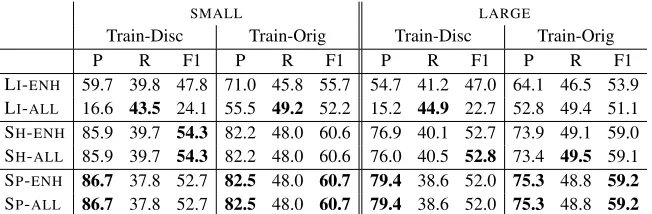
LI-ENH 59.7 39.8 47.8 71.0 45.8 55.7 54.7 41.2 47.0 64.1 46.5 53.9 LI-ALL 16.6 43.5 24.1 55.5 49.2 52.2 15.2 44.9 22.7 52.8 49.4 51.1 SH-ENH 85.9 39.7 54.3 82.2 48.0 60.6 76.9 40.1 52.7 73.9 49.1 59.0 SH-ALL 85.9 39.7 54.3 82.2 48.0 60.6 76.0 40.5 52.8 73.4 49.5 59.1 SP-ENH 86.7 37.8 52.7 82.5 48.0 60.7 79.4 38.6 52.0 75.3 48.8 59.2
[image:8.612.143.469.57.164.2]SP-ALL 86.7 37.8 52.7 82.5 48.0 60.7 79.4 38.6 52.0 75.3 48.8 59.2
Table 2:Results on the two datasets and two different training data after optimizing regularization hyperparameterλin development set. The -ENHand -ALLsuffixes refer to the ENOUGHand ALLheuristics. The best result in each column is put in boldface.
earlier one as “Train-Disc”.
First we trained each model on the training set, varying the regularization hyperparameter λ,6 then
theλwith best result in the development set using
the respective ENOUGH heuristic for each model is
chosen for final result in the test set.
For each experiment setting, we show precision (P), recall (R) and F1 measure. Precision is the percentage of the mentions predicted by the model which are correct, recall is the percentage of men-tions in the dataset correctly discovered by the model, and F1 measure is the harmonic mean of pre-cision and recall.
5.4 Results and Discussions
The full results are recorded in Table 2.
We see that in general our models have higher pre-cision compared to the linear-chain baseline. This is expected, since our models have less ambiguity, which means that from a given output structure it is easier in our model to get the correct interpretation. We will explore this more in Section 5.5.
The ALLheuristic, as expected, results in higher
recall, and this is more pronounced in the linear-chain model, with up to 4% increase from the ENOUGH heuristic, achieving the highest recall in
three out of four settings. The high recall of the ALL
heuristic in the linear-chain model can be explained by the high level of ambiguity the model has. Since it has more ambiguity compared to our models, one label sequence predicted by the model produces a lot of entities, and so it is more likely to overlap with the gold entities. But this has the drawback of very low precision as we can see in the result.
We see switching from one heuristic to the other
6Taken from the set{0.125, 0.25, 0.5, 1.0, 2.0}
does not affect the results of our models much. Looking at the output of our models, they tend to produce output structures with less ambiguity, which causes little difference in the two heuristics.
One example where the baseline made a mis-take is the sentence: “Ethanol Intoxication and withdrawal”. The gold mentions are “Ethanol Intoxication” and “Ethanol withdrawal”. But the linear-chain model labeled it as “[Ethanol][B]
[Intoxication][I] and [withdrawal][BD]”, which is
in-consistent since there is only one discontiguous component. Our models do not have this issue be-cause in our models every subgraph that may be pre-dicted translates to valid mention combinations, as discussed in Section 3.2.
In the “Train-Orig” column, we see that all mod-els can recognize discontiguous entities better when given more data, even though the majority of the en-tities in “Train-Orig” are contiguous.
5.5 Experiments on Ambiguity
To see the ambiguity of each model empirically, we run the decoding process for each model given the gold output structure, which is the true label sequence for the linear-chain model and the true mention-encoded hypergraph for our models.
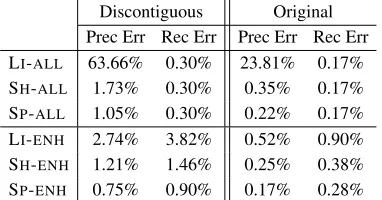
We used the entities from the training and devel-opment sets for this experiment, and we compare the “Original” datasets with the “Discontiguous” subset to see that the ambiguity is more pronounced when there are more discontiguous entities. Then we show the precision and recall errors (defined as1−Pand 1−R, respectively) in Table 3.
Since the ALL heuristics generates all possible
can-Discontiguous Original Prec Err Rec Err Prec Err Rec Err LI-ALL 63.66% 0.30% 23.81% 0.17% SH-ALL 1.73% 0.30% 0.35% 0.17% SP-ALL 1.05% 0.30% 0.22% 0.17% LI-ENH 2.74% 3.82% 0.52% 0.90% SH-ENH 1.21% 1.46% 0.25% 0.38% SP-ENH 0.75% 0.90% 0.17% 0.28%
Table 3: Precision and recall errors (%) of each model in the “Discontiguous” and “Original” datasets when given the gold output structure (label sequence in linear-chain model, hyper-graph in our models). Lower numbers are better.
Type #Ent Linear-chain SHARED SPLIT
P R F P R F P R F
A 289 69.8 59.9 64.4 79.4 56.1 65.7 81.0 56.1 66.3
B 418 50.0 34.0 40.5 56.8 29.0 38.4 58.2 28.0 37.8
[image:9.612.89.280.58.158.2]N 503 62.1 37.8 47.0 84.8 43.3 57.4 84.9 42.4 56.5 Total 1210 60.3 41.7 49.3 74.3 41.4 53.2 75.5 40.7 52.9
Table 4: Results on theLARGEdataset when entities are split into three types:A,B, andN. #Ent is the number of entities
not be properly encoded in the models7. Removing these errors results in perfect recall (0% recall er-ror). This means that all models are complete: they can encode any mention combinations.
We see however, a very huge difference on the precision error between the linear-chain model and our models, even more when most of the entities are discontiguous. For the discontiguous subset with the ALLheuristic, the linear-chain model produced
5,463 entities, while the SHAREDand SPLITmodel
produced 2,020 and 2,006 entities, respectively. The total number of gold entities is 1,991. This means one encoding in the linear-chain model produces much more distinct mention combinations compared to our model, which again shows that the linear-chain model has more ambiguity. Similarly, we can deduce that the SHARED model has slightly more
ambiguity compared to the SPLITmodel. This
con-firms our theoretical result presented previously. It is also worth noting that in the ENOUGH
heuris-tic our models have smaller errors compared to the linear-chain model, showing that when both mod-els can predict the true output structure (the correct
7There are 19 errors in the original dataset, and 6 in the dis-contiguous subset, which include duplicate mentions and men-tions with incorrect boundaries
label sequence for the baseline model and mention-encoded hypergraph for our models), it is easier in our models to get the desired mention combinations.
5.6 Experiments on Multiple Entity Types We used the LARGE dataset with the multiple-type
entities for this experiment. We ran our two models and the linear-chain CRF model with the ENOUGH
heuristic on this multi-type dataset, in the same set-ting as Train-Orig in previous experiments, and the result is shown in Table 4. We used the best lambda from the main experiment for this experiment.
There is a performance drop compared to the
LARGE-Train-Orig results in Table 2, which is
ex-pected since the presence of multiple types make the task harder. But in general we still see that our mod-els are still better than the baseline, especially the SPLIT model, which shows that in the presence of
multiple types, our models can still work better than the baseline model.
6 Conclusions and Future Work
In this paper we proposed new models that can bet-ter represent discontiguous entities that can be over-lapping at the same time. We validated our claims through theoretical analysis and empirical analysis on the models’ ambiguity, as well as their perfor-mances on the task of recognizing disorder men-tions on datasets with a substantial number of dis-contiguous entities. When the true output structure is given, which is still ambiguous in all models, our models show that it is easier to produce the desired mention combinations compared to the linear-chain CRF model with reasonable heuristics. We note that an extension similar to Markov or weak semi-Markov (Muis and Lu, 2016) is possible for our models. We leave this for future investigations.
The supplementary material and our implementa-tions for the models are available at:
http://statnlp.org/research/ie
Acknowledgments
References
Rami Al-Rfou and Steven Skiena. 2012. SpeedRead: A Fast Named Entity Recognition Pipeline. Proceedings of COLING 2012, pages 51–66.
Masayuki Asahara and Yuji Matsumoto. 2003. Japanese Named Entity Extraction with Redundant Morpholog-ical Analysis. InProceedings of HLT-NAACL ’03, vol-ume 1, pages 8–15.
James K Baker. 1979. Trainable Grammars for Speech Recognition. Journal of the Acoustical Society of America, 65(S1):S132.
Daniel M. Bikel, Scott Miller, Richard M. Schwartz, and Ralph Weischedel. 1997. Nymble: a high-performance learning name-finder. Proceedings of the fifth conference on Applied Natural Language Pro-cessing (ANLP ’97), pages 194–201.
Andrew Borthwick and John Sterling. 1998. NYU: De-scription of the MENE named entity system as used in MUC-7. InProceedings of the 7th Message Under-standing Conference (MUC-7).
Jenny Rose Finkel and Christopher D. Manning. 2009. Nested named entity recognition. In Proceedings of the 2009 Conference on Empirical Methods in Natural Language Processing (EMNLP ’09), volume 1, pages 141–150.
Radu Florian, Hany Hassan, Abraham Ittycheriah, Hongyan Jing, Nanda Kambhatla, Xiaoqiang Luo, H Nicolov, and Salim Roukos. 2004. A statistical model for multilingual entity detection and tracking. InProceedings of HLT-NAACL ’04, pages 1–8. Takaaki Hasegawa, Satoshi Sekine, and Ralph Grishman.
2004. Discovering Relations Among Named Entities from Large Corpora. Proceedings of the 42nd An-nual Meeting on Association for Computational Lin-guistics, pages 415–422.
John Lafferty, Andrew McCallum, and Fernando CN Pereira. 2001. Conditional random fields: Proba-bilistic models for segmenting and labeling sequence data. InProceedings of International Conference on Machine Learning (ICML ’01), pages 282–289. Wei Lu and Dan Roth. 2015. Joint Mention Extraction
and Classification with Mention Hypergraphs. In Pro-ceedings of the 2015 Conference on Empirical Meth-ods in Natural Language Processing (EMNLP ’15), pages 857–867.
Andrew McCallum and Wei Li. 2003. Early results for named entity recognition with conditional random fields, feature induction and web-enhanced lexicons. In Proceedings of HLT-NAACL ’03, volume 4, pages 188–191.
Aldrian Obaja Muis and Wei Lu. 2016. Weak Semi-Markov CRFs for Noun Phrase Chunking in Informal
Text. InProceedings of HLT-NAACL ’16, pages 714– 719.
David Nadeau and Satoshi Sekine. 2007. A survey of named entity recognition and classification. Lingvisti-cae Investigationes, 30(1):3–26.
Sameer Pradhan, No´emie Elhadad, Wendy W. Chapman, Suresh Manandhar, and Guergana Savova. 2014a. SemEval-2014 Task 7: Analysis of Clinical Text. In Proceedings of the 8th International Workshop on Se-mantic Evaluation (SemEval 2014), pages 54–62. Sameer Pradhan, No´emie Elhadad, Brett R. South, David
Martinez, Lee Christensen, Amy Vogel, Hanna Suomi-nen, Wendy W. Chapman, and Guergana Savova. 2014b. Evaluating the state of the art in disorder recognition and normalization of the clinical narrative. Journal of the American Medical Informatics Associa-tion : JAMIA, 22(1):143–54.
Lev Ratinov and Dan Roth. 2009. Design Challenges and Misconceptions in Named Entity Recognition. In Proceedings of the Thirteenth Conference on Com-putational Natural Language Learning (CoNLL ’09), pages 147–155.
Satoshi Sekine. 1998. NYU: Description of the Japanese NE system used for MET-2. InProceedings of the 7th Message Understanding Conference (MUC-7). Hanna Suominen, Sanna Salanter¨a, Sumithra Velupillai,
Wendy W. Chapman, Guergana Savova, Noemie El-hadad, Sameer Pradhan, Brett R. South, Danielle L. Mowery, Gareth J. F. Jones, Johannes Leveling, Liadh Kelly, Lorraine Goeuriot, David Martinez, and Guido Zuccon, 2013. Overview of the ShARe/CLEF eHealth Evaluation Lab 2013, pages 212–231. Springer Berlin Heidelberg, Berlin, Heidelberg.
Buzhou Tang, Hongxin Cao, Yonghui Wu, Min Jiang, and Hua Xu. 2013. Recognizing clinical entities in hospital discharge summaries using Structural Sup-port Vector Machines with word representation fea-tures.BMC medical informatics and decision making, 13 Suppl 1(Suppl 1):S1.
Kristina Toutanova, Dan Klein, and Christopher D Man-ning. 2003. Feature-rich part-of-speech tagging with a cyclic dependency network. InProceedings of HLT-NAACL ’03, volume 1, pages 252–259.
Jun Xu, Yaoyun Zhang, Jingqi Wang, Yonghui Wu, and Min Jiang. 2015. UTH-CCB : The Participation of the SemEval 2015 Challenge Task 14. InProceedings of the 9th International Workshop on Semantic Evalua-tion (SemEval 2015), pages 311–314.