Proceedings of the 2011 Conference on Empirical Methods in Natural Language Processing, pages 869–879,
Statistical Machine Translation with Local Language Models
Christof Monz
Informatics Institute, University of Amsterdam P.O. Box 94323, 1090 GH Amsterdam, The Netherlands
Abstract
Part-of-speech language modeling is com-monly used as a component in statistical ma-chine translation systems, but there is mixed evidence that its usage leads to significant im-provements. We argue that its limited effec-tiveness is due to the lack of lexicalization. We introduce a new approach that builds a separate local language model for each word and part-of-speech pair. The resulting mod-els lead to more context-sensitive probabil-ity distributions and we also exploit the fact that different local models are used to esti-mate the language model probability of each word during decoding. Our approach is evalu-ated for Arabic- and Chinese-to-English trans-lation. We show that it leads to statistically significant improvements for multiple test sets and also across different genres, when com-pared against a competitive baseline and a sys-tem using a part-of-speech model.
1 Introduction
Language models are an important component of current statistical machine translation systems. They affect the selection of phrase translation candidates and reordering choices by estimating the probability that an application of a phrase translation is a flu-ent continuation of the currflu-ent translation hypoth-esis. The size and domain of the language model can have a significant impact on translation quality. Brants et al. (2007) have shown that each doubling of the training data from the news domain (used to build the language model), leads to improvements of approximately 0.5 BLEU points. On the other hand,
each doubling using general web data leads to im-provements of approximately 0.15 BLEU points.
While large n-gram language models do lead to improved translation quality, they still lack any generalization beyond the surface forms (Schwenk, 2007). Consider example (1), which is a short sen-tence fragment from the MT09 Arabic-English test set, with the corresponding machine translation out-put (1.b), from a phrase-based statistical machine translation system, and reference translation (1.c). (1) a.
ÈYj.ÊË
èQJÓ éJ ¯Am HAm'Qå éJ ®Ê g
......
éË ÑêÓAîE@ð
b. ... the background of press statements of
controversial and accused him ...
c. ... the background of controversial press
statements and accused him ...
Clearly, the adjective “controversial” should pre-cede the nouns “press statement”, but since the AFP and Xinhua portions of the Gigaword corpus, used to build the language model for the translation sys-tem, do not contain this surface n-gram, translations with obviously ungrammatical constructions such as (1.b) can result. For unseen n-grams, one would like to model adjectives as being likely to precede nouns in English, for example.
with surface models. Under constrained data condi-tions, this can lead to improvements. But once larger amounts of training data are used, the gains obtained from adding POS language models decline substan-tially. This raises the question of why POS language models are not more effective. We argue that one of the short-comings of previous approaches to using POS language models is that these models are es-timated globally, not lexically anchored, and hence rather context insensitive.
In this paper, we introduce a novel approach that builds and uses individual, local POS language mod-els for each word in the vocabulary. Our experiments show that it leads to statistically significant improve-ments over a competitive baseline, using lexical-ized reordering and a sizable 5-gram word language model, as well as a standard 7-gram POS language model approach.
2 Part-of-Speech Language Models
2.1 Background
Typically, POS language models are used like word-based language models. N-grams are extracted from a POS-tagged corpus and an n-gram language model is built from that. While word-based models esti-mate the probability of a string ofmwords by Equa-tion 2, POS-based models estimate the probability of
string ofmPOS tags by Equation 3.
p(wm1 )∝ m Y
i=1
p(wi|wii−1−n+1) (2)
p(tm1 )∝
m Y
i=1
p(ti|tii−−1n+1) (3)
where,nis the order of the language model, andwij refers to the sub-sequence of words (or tags) from positionsitoj.
Word language models can be built directly from large text corpora, such as LDC’s Gigaword corpus, but POS models require texts that are annotated with POS tags. Ideally, one would use manually anno-tated corpora such as the Penn Treebank (Marcus et al., 1993), but since those tend to be small, most ap-proaches rely on larger corpora which have been au-tomatically annotated by a POS tagger or a parser (Koehn et al., 2008). Though automated annotation
inevitably contains errors, it is assumed that this is ameliorated by the increased size of annotated data. The event space of a language models is of size
|V|n, whereV is the vocabulary, andnis the order of the language model. The vocabulary of POS mod-els, (typically ranging between 40 and 100 tags), is much smaller than the vocabulary of a word model, which can easily approach a million words. Nev-ertheless, most POS language modeling approaches apply some form of smoothing to account for unseen events (Bonneau-Maynard et al., 2007).
To deploy POS language models in machine translation, translation candidates need to be anno-tated with POS tags. Each target phrasee¯in a phrase pair( ¯f ,e¯) can be associated with a number of POS tag sequencest¯e¯. Heeman (1998) shows that using the joint probability leads to improved perplexity for POS models. For machine translation one can sum over all possible tag sequences, as in Equation 4.
p(e|f) = arg maxeX
t
p(e,t|f) (4)
Summing over all possible tag sequences has the dis-advantage that it requires one to keep this informa-tion during decoding. Below, we opt for an approxi-mate solution, where each target phrase is annotated with the most likely POS tag sequence given the source and target phrase:¯t¯e= arg max¯
tp(¯t|e,¯ f¯).
2.2 Effectiveness of POS Language Models
Reported results on the effectiveness of POS lan-guage models for machine translation are mixed, in particular when translating into languages that are not morphologically rich, such as English. While they rarely seem to hurt translation quality, there does not seem to be a clear consensus that they sig-nificantly improve quality either.
only. Once the baseline incorporates lexicalized dis-tortion (Tillmann, 2004; Koehn et al., 2005), these improvements disappear. Factored language mod-els have not resulted in significant improvements ei-ther. Kirchhoff and Yang (2005) report slight im-provements when re-ranking the n-best lists of their decoder, which word tri-grams. But these improve-ments are less than those gained by re-ranking the n-best lists with a 4-gram word language model.
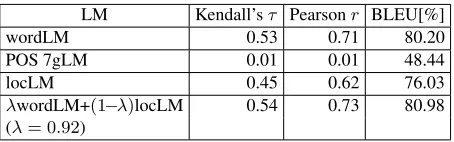
The impact of POS language models depends among other things on the size of the parallel cor-pus, the size and order of the word language model, and whether lexicalized distortion models are used. To gauge the potential effectiveness of POS lan-guage models without taking into consideration all these factors, we isolate the contribution of the lan-guage model by simulating machine translation out-put using English data only (Al-Onaizan and Pap-ineni, 2006; Post and Gildea, 2008). Taking a set of POS-tagged reference translations of the MT04 Arabic-to-English test set, each English sentence is randomly chunked into n-grams of average length three. The chunks of each sentence, with their cor-responding POS tags, are randomly reordered. This is repeated 500 times for each sentence in the test set. The smoothed sentence BLEU score (ignor-ing brevity penalty) is computed for each reordered sentence with respect to all reference translations. The higher the BLEU score, the more well-formed the reordering is. As each reordered sentence only contains words from at least one of the reference translations, the uni-gram precision is always 1.0. The language model probability is then computed for each reordering. Table 1 shows the average cor-relations between language model probabilities and BLEU scores.
We can see that the surface language model corre-lates moderately well with BLEU, explaining about 49% (r2= 0.49) of the variation, whereas the POS language model does not correlate with BLEU at all.1 On the other hand, local language models alone
(as introduced in Section 3) correlate with BLEU only slightly worse than surface models. The high-est correlation is seen when they are interpolated with word models. The BLEU scores in Table 1
1Interpolating both models does not lead to further
correla-tion improvements.
LM Kendall’sτ Pearsonr BLEU[%]
wordLM 0.53 0.71 80.20
POS 7gLM 0.01 0.01 48.44
locLM 0.45 0.62 76.03
[image:3.612.314.541.70.141.2]λwordLM+(1−λ)locLM 0.54 0.73 80.98 (λ= 0.92)
Table 1: Correlation between randomly permuted English reference translations and BLEU.
are computed using the 1-best sentences after re-ranking. These system-agnostic correlation results look promising for our local models and the end-to-end translation results in Section 5 confirm these initial findings.
3 Local Language Models
In this section, we introduce a novel approach to lan-guage modeling that is more context-sensitive than standard POS language models. Instead of using one global POS language model that is built by using all of a mono-lingual corpus in the target language, we build individual models, or local models, for each word-POS pair using the POS tags surrounding each occurrence of that pair. This adds an aspect of lex-icalization that is entirely absent in previous POS language models. The effect is that the resulting n-gram probability distributions of each local model are more biased towards the contextual constraints of each individual word-POS pair. This is similar to the idea of cached language models (Kuhn, 1988), but more fine-grained and with a tighter integration of POS and lexical information.
3.1 Definition of Local Language Models
Each conditional probability of order n in a local
model for the word-POS pairw:tis of the form:
pw:t(tn, pn|t1:p1, . . . , tn−1:pn−1)
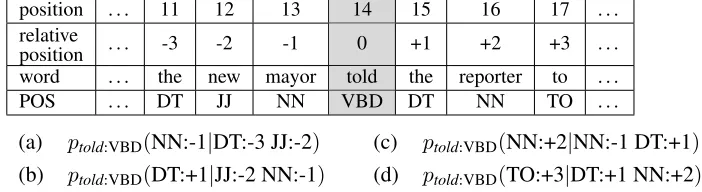
whereti refers to POS tags andpi to positions rel-ative to an occurrence of the pair (w:t). For ex-ample, consider the sentence fragment in Figure 1. The conditional local n-gram probabilities (a–d) are
generated from the occurrence of the wordtoldwith
position . . . 11 12 13 14 15 16 17 . . . relative
position . . . -3 -2 -1 0 +1 +2 +3 . . .
word . . . the new mayor told the reporter to . . .
POS . . . DT JJ NN VBD DT NN TO . . .
(a) ptold:VBD(NN:-1|DT:-3 JJ:-2) (c) ptold:VBD(NN:+2|NN:-1 DT:+1)
[image:4.612.139.490.73.169.2](b) ptold:VBD(DT:+1|JJ:-2 NN:-1) (d) ptold:VBD(TO:+3|DT:+1 NN:+2)
Figure 1: Sentence fragment with the tri-gram probabilities (a–d) linked totold.
For each local model we use a sliding window con-sidering all n-grams of lengthnstartingnwords to the left and endingnwords to the right of an occur-rence of the word-POS pair of the model at hand.
All local model probabilities are smoothed
us-ing Witten-Bell smoothus-ing and interpolation.2 POS
tags are annotated with positional information to distinguish between lower-order estimates such as ptold:VBD(NN+2) and ptold:VBD(NN+3) both of
which can arise when backing off during smooth-ing. Without positional information,ptold:VBD(NN)
only estimates the probability of the tag NN occur-ring within the proximity oftold.3
A local model of orderncontains the conditional
probabilities for words occurring at relative posi-tions -1, +1, . . . +n. Therefore the probability of a word occurrence is estimated by all local mod-els covering this word’s position. Figure 2 shows schematically how overlapping n-gram probabilities interact. E.g., the probability of wordwi+2 is based
on the probability of the local model for wi+1,wi, wi−1, andwi−2 (the last two are not shown in
Fig-ure 2 for space reasons). Formally, the conditional probability of a word-POS pair, given its word and POS tag history is defined in Equation 5.
p(wi, ti|wii−−n1+1, tii−−1n+1) =
pwi:ti(ti−1:-1| hti−n:-n, . . . , ti−2:-2i)
·
nY−1
j=0
pwi−n+j:ti−n+j(ti:n−j|Hi,n[j,·]) (5)
2The smaller event space of local models often leads to
in-complete counts-of-counts, preventing the use of Kneser-Ney smoothing (Chen and Goodman, 1999).
3Despite the notational similarities, our approach should not
be confused with projected POS models, which use source side POS tags to model reordering (Och et al., 2004).
. . .
. . .
...
w1 wi-3wi-2wi-1 wi wi+1wi+2wi+3 ... wm
[image:4.612.317.530.215.335.2]n-gram history predicted word position of current local model
Figure 2: Schema of overlapping local language model applications.
whereHi,nis ann×nmatrix specifying the history
of the word at position i. Each row j ofHi,n
rep-resents the history of the conditional probability be-longing to the local model associated with position i−n+j. Each entryHi,n[j, k]is defined as follows:
Hi,n[j, k] = (
ti−n+k:k−j ifj6=k
otherwise
whereti−n+k is the POS tag at positioni−n+k andk−jis the relative position with respect to the diagonal ofHi,n, i.e., the position of the local lan-guage model corresponding to rowj.Hi,n[j,·]is the jth row vector from which thejth entry (the empty element) has been removed. For instance, given the example in Figure 1,H14,3is
H14,3 =
JJ:+1 NN:+2
DT:-1 NN:+1
DT:-2 JJ:-1
position 0 1 2 3 4 5 6
token <s> cuba frees more dissidents . </s>
POS tag <s> NNP VBZ JJR NNS . </s>
p(cuba, NNP|w0
0, t00) = pcuba:NNP(<s>:-1)·p<s>:<s>(NNP:+1) p(frees, VBZ|w1
0, t10) = pfrees:VBZ(NNP:-1|<s>:-2)·p<s>:<s>(VBZ:+2|NNP:+1)
·pcuba:NNP(VBZ:+1|<s>:-1)
p(more, JJR|w2
0, t20) = pmore:JJR(VBZ:-1|NNP:-3 VBZ:-2)·p<s>:<s>(JJR:+3|NNP:+1 VBZ:+2)
·pcuba:NNP(JJR:+2|<s>:-1 VBZ:+1)·pfrees:VBZ(JJR:+1|<s>:-2 NNP:-1)
p(dissidents, NNS|w3
1, t31) = pdissidents:NNS(JJR:-1|NNP:-3 VBZ:-2)·pcuba:NNP(NNS:+3|VBZ:+1 JJR:+2)
·pfrees:VBZ(NNS:+2|NNP:-1 JJR:+1)·pmore:JJR(NNS:+1|NNP:-2 VBZ:-1)
p(. , .|w4
2, t42) = p.:.(NNS:-1|VBZ:-3 JJR:-2)·pfrees:VBZ(.:+3|JJR:+1 NNS:+2)
·pmore:JJR(.:+2|VBZ:-1 NNS:+1)·pdissidents:NNS(.:+1|VBZ:-2 JJR:-1)
p(</s>,</s>|w5
3, t53) = p</s>:</s>(.:-1|JJR:-3 NNS:-2)·pmore:JJR(</s>:+3|NNS:+1 .:+2)
[image:5.612.84.525.69.271.2]·pdissidents:NNS(</s>:+2|JJR:-1 .:+1)·p.:.(</s>:+1|JJR:-2 NNS:-1)
Figure 3: Language model probability computation for the sentence “Cuba frees more dissidents.” using our local language modeling approach.
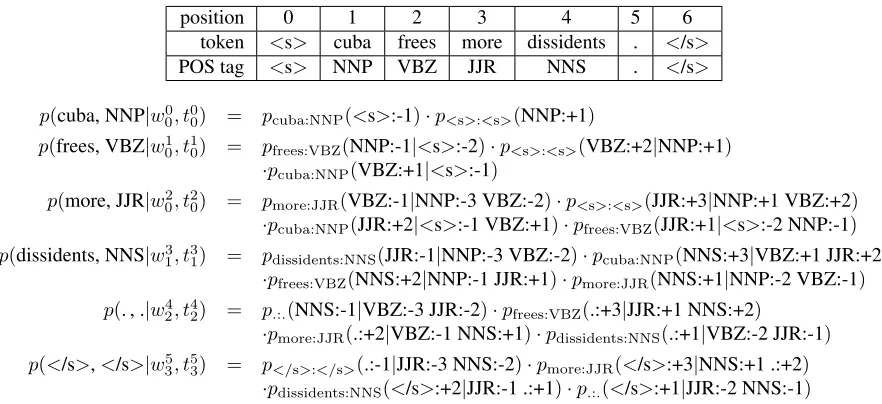
The example in Figure 3 shows word-by-word how tri-gram local language models are used to compute the probability of a whole sentence.
Our local language model approach also bears some resemblance to statistical approaches to mod-eling subcategorization frames (Manning, 1993). While our approach is more general by considering all words and not just focusing on verbal subcatego-rization frames, it is also more shallow in the sense that only part-of-speech categories are considered which does not model any contextual relationships on the phrase level.
3.2 Building Local Language Models
To build the local language models, we use the SRILM toolkit (Stolcke, 2002), which is commonly applied in speech recognition and statistical machine translation. While SRILM collects n-gram statistics from all n-grams occurring in a corpus to build a single global language model, we build a language model for each word-POS pair only using the n-grams within the proximity of occurrences for that word-POS pair in a POS-tagged corpus. This results in separate n-gram count files, which are then pro-cessed by SRILM to build the individual language models.4 Charniak’s parser (Charniak, 2000) is used
to POS tag the corpus.
4The pre-processing scripts are available athttp://www.
science.uva.nl/˜christof/locLM/.
3.3 Decoder Integration
Several approaches that integrate POS language models have focused on n-best list re-ranking only (Hasan et al., 2006; Wang et al., 2007). Often this is due to the computational (and implementational) complexities of integrating more complex language models with the decoder, although it is expected that a tighter integration with the decoder itself leads to better improvements than n-best list re-ranking.
Integrating our local language modeling approach with a decoder is straightforward. Our baseline decoder already uses SRILM’s API for computing word language model probabilities. Since SRILM supports arbitrarily many language models, local language models can be added using the same func-tionalities of SRILM’s API. For the experiments dis-cussed in Section 4, we add about 150,000 local language models to the word model. All local lan-guage model probabilities are coupled with the same feature weight. Potentially, improvements could be gained from using separate weights for individual local models, but this would require an optimiza-tion procedure such as MIRA (Chiang et al., 2009), which can handle a larger number of features.
4 Experimental Setup
Three approaches are compared in our experiments: the baseline system is a phrase-based statistical ma-chine translation system (Koehn et al., 2003), very similar to Moses (Koehn et al., 2007), using a word-based 5-gram language model. The second approach extends the baseline by including a 7-gram POS-based language model. The third approach repre-sents the work described in this paper, extending the baseline by including 4-gram local language models. Translation quality is evaluated for two language pairs: Arabic-to-English and Chinese-to-English. NIST’s MT-Eval test sets are used for both pairs. Only resources allowed under NIST’s constrained data conditions are used to train the language, trans-lation, and lexicalized distortion models.
To see whether our local language models result in improvements over a competitive baseline, we designed the baseline to use a large 5-gram word language model and lexicalized distortion model-ing, both of which are known to cancel-out improve-ments gained from POS language models (Birch et al., 2007; Kirchhoff and Yang, 2005). The 5-gram word language model is trained on the Xinhua and AFP sections of the Gigaword corpus (3rd edition, LDC2007T40) and the target side of the bitext. We removed from the training data all documents re-leased during the periods that overlap with the pub-lication dates of the documents included in our de-velopment or test data sets. In total, 630 million to-kens were used to build the word language model. The language model was trained using SRILM with modified Kneser-Ney smoothing and interpolation (Chen and Goodman, 1999). It is common practice not to include higher-order n-grams that occur fewer than a predefined number of times. Here, we applied rather conservative cut-offs, by ignoring 3-, 4-, and 5-grams that occurred only once. The 7-gram POS and 4-gram local language models were both trained on the POS tagged English side of the bitext and 10M sentences from Gigaword’s Xinhua and AFP sections.
The data for building the translation models were primarily drawn from the parallel news re-sources distributed by the Linguistic Data
Consor-tium (LDC).5 The Arabic-English bitext consists
5LDC catalog numbers for Arabic-English: LDC2004E72,
of 11.4M source and 12.6M target tokens, and the Chinese-English bitext of 10.6M source and 12.3M target tokens. Word alignment was performed run-ning GIZA++ in both directions and generating the symmetric alignments using the ‘grow-diag-final-and’ heuristics.
All three approaches, including the baseline, use lexicalized distortion, distinguishing between mono-tone, swap, and discontinuous reordering, all with respect to the previous and next phrase (Koehn et al., 2005). The distortion limit is set to 5 for Arabic-to-English, and 6 for Chinese-to-English. For each source phrase the top 30 translations are considered. For tuning and testing we use NIST’s official MT-Eval test sets. MT04 was used as the development set for both language pairs. Testing was carried out on MT05 to MT09 for Arabic-English and MT05 to MT08 for Chinese-English. NIST did not re-lease a new Chinese-English test set for MT-Eval 2009. Parameter tuning of the decoder was done with minimum error rate training (MERT) (Och, 2003), adapted to BLEU maximization.
As evaluation metrics we used NIST’s adapta-tion of BLEU-4 (Papineni et al., 2001), version 13a, where the brevity penalty is based on the reference translation with the closest length, and translation error rate (TER) version 0.7.25 (Snover et al., 2006). All results reported here are case-insensitive. TER scores are shown as 1-TER.
To see whether the differences between the ap-proaches we compared in our experiments are sta-tistically significant, we apply approximate random-ization (Noreen, 1989); Riezler and Maxwell (2005) have shown that approximate randomization is less sensitive to Type-I errors, i.e., less likely to falsely reject the null hypothesis, than bootstrap resampling (Koehn, 2004) in the context of machine translation. 5 Results and Analysis
systems and MT04 MT05 MT06 MT08 MT09 MT05–09
improvements tune NW NW WB ALL NW WB ALL NW WB ALL NW WB ALL
BLEU[%]
1a wordLM 51.90 53.83 46.76 34.69 43.41 48.77 33.26 42.37 52.97 34.25 44.34 50.51 34.00 45.63 2a +posLM 51.92 54.29 47.02 34.44 43.51 48.81 33.30 42.31 53.52 34.04 44.36 50.89 33.87 45.70 3a >wordLM +0.02 +0.46N+0.26 −0.25 +0.10 +0.04 +0.04 −0.06 +0.55N −0.21 +0.02 +0.38N −0.13 +0.07
4a +locLM 52.65 55.08 47.24 35.17 43.88 49.61 33.67 42.92 54.39 34.40 44.82 51.57 34.33 46.22
5a >wordLM +0.75N +1.25N+0.48N+0.48M+0.47N+0.84N+0.41 +0.55N+1.42N +0.15 +0.48N +1.06N+0.33M+0.59N
6a >+posLM +0.73N +0.79N+0.22 +0.73N+0.37M+0.80N+0.37 +0.61N+0.87N +0.36 +0.46N +0.68N+0.46N+0.52N 1-TER[%]
1b wordLM 58.32 59.04 54.27 45.62 51.68 55.59 44.41 50.69 59.90 46.43 53.03 56.94 45.49 53.13 2b +posLM 58.54 59.72 54.90 45.67 52.14 55.75 44.64 50.89 60.49 46.72 53.47 57.46 45.70 53.55 3b >wordLM +0.22M +0.68N+0.63N+0.05 +0.46N+0.16 +0.23 +0.20M+0.59N+0.29M+0.44N +0.52N+0.21N+0.42N
4b +locLM 58.95 60.06 54.88 45.62 52.11 56.42 44.91 51.38 60.91 46.84 53.74 57.79 45.83 53.81
5b >wordLM +0.63N +1.02N+0.61N+0.00 +0.43N+0.83N+0.50N+0.69N+1.01N+0.41M+0.71N +0.85N+0.34N+0.68N 6b >+posLM +0.41N +0.34M−0.02 −0.05 −0.03 +0.67N+0.27 +0.49N+0.42M +0.12 +0.27M +0.33N +0.13 +0.26N
# segments 1,353 1,056 1,033 764 1,797 813 547 1,360 586 727 1,313 3,488 2,038 5,526
Table 2: Results for Arabic-to-English translation. Comparison of our approach (+locLM, rows 4a/b) to the baseline
using a word language model (wordLM, rows 1a/b) and a competing approach using a POS-based language model
(+posLM, rows 2a/b). Results are presented using BLEU[%] (rows 1a–6a) and 1-TER[%] (rows 1b–6b) and broken
down by genre: NW=newswire, WB=web, and ALL=NW∪WB. Rows 3a/b, 5a/b, and 6a/b show the relative
improve-ments over the system mentioned to the right of the>sign. Statistically significant improvements/declines (using
approximate randomization) at thep < .01level are markedN/HandM/Oat thep < .05level.
tains the genres ‘broadcast news’ and ‘newsgroup’. In both tables, the former has been classified under ‘newswire’ and the latter under ‘web’.
The first approach is the baseline system ‘wordLM’ (rows 1a/b in Tables 2 and 3), which uses a 5-gram word-based language model. The next ap-proach ‘+posLM’ extends the baseline by adding a 7-gram POS language model (rows 2a/b in both ta-bles). Rows 3a/b show the relative improvements over the baseline. The third approach ‘+locLM’ (rows 4a/b) uses local language models in addition to the baseline’s word-based model. Note that +lo-cLM does not use the 7-gram POS language model as well. Rows 5a/b show the relative improvements of the local modeling approach over the baseline and rows 6a/b the improvements over the approach using a POS language model.
Let us first take a closer look at the Arabic-to-English results in Table 2. The approach using a POS language model results in statistically signifi-cant improvements for only one test set (MT05) and the newswire documents of MT09. The average im-provements across all sets and genres are negligible (+0.07 BLEU). Our local language modeling ap-proach achieves the highest BLEU scores for all test
sets and across all genres. In particular, the improve-ments of +1.06 BLEU for newswire docuimprove-ments are substantial. With the exception of MT08-WB and MT09-WB all BLEU improvements over the base-line are statistically significant.
When evaluating with 1-TER, local language modeling also achieves the best results, with the ex-ception of MT06, where the POS language model approach performs slightly better.
Turning to the Chinese-English results in Table 3, we see similar improvements in BLEU. The im-provements of using a POS language model are
neg-ligible (+0.04BLEU). Here as well, local language
modeling leads to the best results, with substantial improvements of +0.88 BLEU for web documents.
The major difference between Arabic-English and Chinese-English is the discrepancy between BLEU score improvements and decreases in 1-TER. While we cannot explain this discrepancy, it is worth not-ing that similar discrepancies between BLEU and TER and Arabic-to-English and Chinese-to-English translation can be found in the literature. The results described in Shen et al. (2009) show a strong
cor-relation between BLEU and 1-TER improvements6
systems and MT04 MT05 MT06 MT08 MT05–08
improvements tune NW NW WB ALL NW WB ALL NW WB ALL
BLEU[%]
1a wordLM 37.32 32.55 33.33 23.40 31.16 28.67 17.57 24.03 31.93 19.82 29.30 2a +posLM 37.32 32.47 33.13 23.67 31.06 28.63 18.46 24.35 31.82 20.46 29.34 3a >wordLM +0.00 −0.08 −0.20 +0.27 −0.10 −0.04 +0.89N +0.32 −0.11 +0.64N +0.04
4a +locLM 38.15 33.05 33.33 24.62 31.42 29.52 18.24 24.79 32.36 20.70 29.82
5a >wordLM +0.83N +0.50M+0.00 +1.22N +0.26 +0.85N+0.67M+0.76N +0.43N +0.88N+0.52N
6a >+posLM +0.83N +0.58N+0.20 +0.95N+0.36M +0.89N −0.22 +0.44M +0.54N +0.24 +0.48N
1-TER[%]
1b wordLM 42.81 40.73 42.99 39.42 42.15 40.42 36.77 38.78 41.53 37.77 40.63
2b +posLM 42.50 40.60 42.75 38.87 41.84 39.76 36.75 38.41 41.23 37.55 40.34 3b >wordLM −0.31O −0.13 −0.24 −0.55 −0.31O−0.66H −0.02 −0.37O −0.30H −0.22 −0.29H
4b +locLM 42.77 40.49 42.62 39.40 41.86 40.00 36.11 38.26 41.20 37.35 40.27 5b >wordLM −0.04 −0.24 −0.37 −0.02 −0.29 −0.42 −0.66H−0.52H −0.33O−0.42O−0.36H
6b >posLM +0.27 −0.11 −0.13 +0.53 +0.02 +0.24 −0.64H −0.15 −0.03 −0.20 −0.07
[image:8.612.107.500.69.271.2]# segments 1,788 1,082 1,181 483 1,664 691 666 1,357 2,954 1,149 4,103
Table 3: Comparison of our system for Chinese-to-English translation. See Table 2 for details on notation.
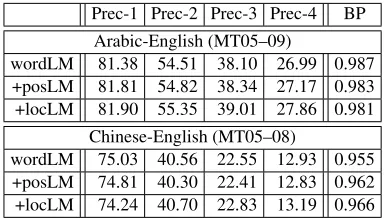
for Arabic-to-English on the MT06 and MT08 sets, but for Chinese-to-English the correlation seems to be much weaker and BLEU improvements of +0.75 can correspond to decreases of up to -0.80 in 1-TER. One of the motivations of using POS language models in general, and local language models in our case, is to improve the fluency of translations, which should be reflected in increased precision for higher-order n-grams. Table 4 shows that this is the case when comparing local modeling to both word and POS language models for Arabic-to-English trans-lation. The same trend, but to a somewhat weaker degree can be observed for Chinese-to-English.
Prec-1 Prec-2 Prec-3 Prec-4 BP Arabic-English (MT05–09)
wordLM 81.38 54.51 38.10 26.99 0.987 +posLM 81.81 54.82 38.34 27.17 0.983 +locLM 81.90 55.35 39.01 27.86 0.981
Chinese-English (MT05–08)
wordLM 75.03 40.56 22.55 12.93 0.955 +posLM 74.81 40.30 22.41 12.83 0.962 +locLM 74.24 40.70 22.83 13.19 0.966
Table 4: BLEU n-gram precision (1≤n≤4) and Brevity
Penalty (BP) scores over all test sets.
The effectiveness of a POS language model of-ten diminishes with improved translation quality of the base system to which it is added. Naturally, we are interested in the extent that this diminish-ing effect also holds for our local language
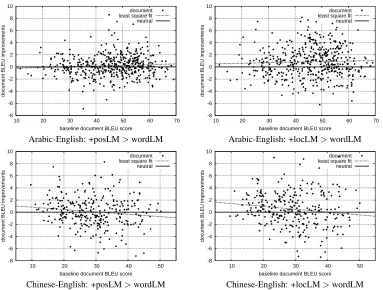
mod-els. A full experimental setup, varying all relevant factors, such as language, translation, and distor-tion model size, and the various meta-parameters, is beyond the scope of this paper. Nevertheless, we can gauge this by taking a closer look at the distribution of improvements within our experi-ments. Figure 4 shows performance improvements in document-level BLEU for both language pairs. The document-level BLEU score for the baseline system is plotted on the x-axis and improvements are plotted on the y-axis. The dotted line is the linear fit (using least square regression). If the effective-ness of either added model (POS or local) dimin-ishes with increasing translation quality, we would expect a declining regression line. This is not the case for Arabic-to-English translation. Relative im-provements for both added models increase as the translation quality of the baseline increases. The slope of both regression fits is almost identical, but the y-intercept is larger for our local modeling ap-proach. Note that the small slope is also due to dif-ference in scale between full BLEU scores and rel-ative improvements. We can observe the opposite for Chinese-to-English translation, where the slope is negative. Both models seem to help more for documents with lower baseline translation quality. For the POS model, the regression line intersects
with the neutral line (±0 improvement) at around
[image:8.612.88.280.498.607.2]Ta--8 -6 -4 -2 0 2 4 6 8 10
10 20 30 40 50 60 70
document BLEU improvements
baseline document BLEU score document least square fit neutral
-8 -6 -4 -2 0 2 4 6 8 10
10 20 30 40 50 60 70
document BLEU improvements
baseline document BLEU score document least square fit neutral
Arabic-English: +posLM>wordLM Arabic-English: +locLM>wordLM
-8 -6 -4 -2 0 2 4 6 8 10
10 20 30 40 50
document BLEU improvements
baseline document BLEU score document least square fit neutral
-8 -6 -4 -2 0 2 4 6 8 10
10 20 30 40 50
document BLEU improvements
baseline document BLEU score document least square fit neutral
[image:9.612.114.497.72.362.2]Chinese-English: +posLM>wordLM Chinese-English: +locLM>wordLM
Figure 4: Correlation between baseline BLEU scores for individual documents and the relative, absolute improvements achieved by +posLM (left) and +locLM (right). BLEU scores (and improvements) are computed at the document level.
ble 3). For the local language model, the regres-sion line intersects with the neutral line at about 40 BLEU, suggesting that until translation quality improves substantially, local language models could still have a positive impact.
6 Related Work
The main goal of this paper is to show that by tying POS language models to lexical items, we get more accurate distributions for specific words. The work on factored language models (Bilmes and Kirchhoff, 2003) is related to our work to the extent that it also mixes POS tags with lexical information, albeit in a very different manner. Factored language models use more general representations, such as POS tags or stems, only during back-off. Kirchhoff and Yang (2005) applied factored language models to machine translation but the improvements were negligible.
Collins et al. (2005) proposed a discriminative language modeling approach that uses mixtures of POS and surface information and showed that it leads to a reduction in speech recognition word
er-ror rates. On the other hand, their approach seems more suited for n-best list re-ranking and it is not clear whether those improvements carry over to ma-chine translation. Li and Khudanpur (2008) adapted this discriminative approach to machine translation re-ranking but used surface forms only.
Wang et al. (2007) and Zheng et al. (2008) use elaborately enriched representations, called su-per abstract role values (Wang and Harper, 2002), which capture contextual dependencies using lexi-cal categories, role labels, and dependency grammar structures. So far their approach has been limited to re-ranking n-best lists only.
7 Conclusion
ad-vantage of the language model probability of each word being based on all surrounding local models. The evaluations for Arabic- and Chinese-to-English show that local models lead to statistically signifi-cant improvements across different test sets and gen-res. Correlating the translation quality of the base-line with the improvements that result from adding local models, further suggests that these improve-ments are sustainable and should carry over to im-proved baseline systems.
Acknowledgments
This research was funded in part by the European Commission through the CoSyne project FP7-ICT-4-248531, the European Commission’s ICT Pol-icy Support Program as part of the Competitive-ness and Innovation Framework Program, CIP ICT-PSP under grant agreement nr. 250430, and the PROMISE Network of Excellence co-funded by the 7th Framework Programme of the European Com-mission, grant agreement no. 258191.
References
Yaser Al-Onaizan and Kishore Papineni. 2006.
Distor-tion models for statistical machine translaDistor-tion. In
Pro-ceedings of the 21st International Conference on Com-putational Linguistics and the 44th annual meeting of the Association for Computational Linguistics, pages 529–536.
Jeff A. Bilmes and Katrin Kirchhoff. 2003. Factored language models and generalized parallel backoff. In
Proceedings of the the North American Chapter of the Association for Computational Linguistics on Human Language Technology, pages 4–6.
Alexandra Birch, Miles Osborne, and Philipp Koehn. 2007. CCG supertags in factored statistical machine
translation. InProceedings of the Second Workshop
on Statistical Machine Translation, pages 9–16. H´el`ene Bonneau-Maynard, Alexandre Allauzen, Daniel
D´echelotte, and Holger Schwenk. 2007. Combining morphosyntactic enriched representation with n-best
reranking in statistical translation. InProceedings of
the NAACL-HLT Workshop on Syntax and Structure in Statistical Translation, pages 65–71.
Thorsten Brants, Ashok C. Popat, Peng Xu, Franz J. Och, and Jeffrey Dean. 2007. Large language models in
machine translation. InProceedings of the 2007 Joint
Conference on Empirical Methods in Natural guage Processing and Computational Natural Lan-guage Learning (EMNLP-CoNLL), pages 858–867.
Eugene Charniak. 2000. A maximum-entropy-inspired
parser. In Proceedings of the 1st North American
chapter of the Association for Computational Linguis-tics conference, pages 132–139.
Stanley F. Chen and Joshua Goodman. 1999. An empiri-cal study of smoothing techniques for language model-ing.Computer Speech and Language, 13(4):359–393. David Chiang, Kevin Knight, and Wei Wang. 2009. 11,001 new features for statistical machine
transla-tion. InProceedings of the North American Chapter of
the Association for Computational Linguistics, pages 218–226.
Michael Collins, Brian Roark, and Murat Saraclar. 2005. Discriminative syntactic language modeling for
speech recognition. InProceedings of the 43rd
An-nual Meeting on Association for Computational Lin-guistics, pages 507–514.
Saˇsa Hasan, Oliver Bender, and Hermann Ney. 2006. Reranking translation hypotheses using structural
properties. InProceedings of the EACL Workshop on
Learning Structured Information in Natural Language Applications, pages 41–48.
Peter Heeman. 1998. POS tagging versus classes in
lan-guage modeling. In Proceedings of the Sixth
Work-shop on Very Large Corpora, pages 179–187.
Katrin Kirchhoff and Mei Yang. 2005. Improved lan-guage modeling for statistical machine translation. In
Proceedings of the ACL Workshop on Building and Us-ing Parallel Texts, pages 125–128.
Philipp Koehn and Hieu Hoang. 2007. Factored
transla-tion models. InProceedings of the 2007 Joint
Confer-ence on Empirical Methods in Natural Language Pro-cessing and Computational Natural Language Learn-ing (EMNLP-CoNLL), pages 868–876.
Philipp Koehn, Franz Josef Och, and Daniel Marcu.
2003. Statistical phrase-based translation. In
Pro-ceedings of the 2003 Conference of the North Ameri-can Chapter of the Association for Computational Lin-guistics on Human Language Technology, pages 48– 54.
Philipp Koehn, Amittai Axelrod, Alexandra Birch Mayne, Chris Callison-Burch, Miles Osborne, and David Talbot. 2005. Edinburgh system description for the 2005 IWSLT speech translation evaluation. In
Proceedings of the International Workshop on Spoken Language Translation.
Philipp Koehn, Hieu Hoang, Alexandra Birch, Chris Callison-Burch, Marcello Federico, Nicola Bertoldi, Brooke Cowan, Wade Shen, Christine Moran, Richard Zens, Chris Dyer, Ondˇrej Bojar, Alexandra Con-stantin, and Evan Herbst. 2007. Moses: open source
toolkit for statistical machine translation. In
Inter-active Poster and Demonstration Sessions, pages 177– 180.
Philipp Koehn, Abhishek Arun, and Hieu Hoang. 2008. Towards better machine translation quality for the
german–english language pairs. InProceedings of the
Third Workshop on Statistical Machine Translation, pages 139–142.
Philipp Koehn. 2004. Statistical significance tests for
machine translation evaluation. InProceedings of the
2004 Conference on Empirical Methods in Natural Language Processing, pages 388–395.
Roland Kuhn. 1988. Speech recognition and the fre-quency of recently used words: a modified Markov
model for natural language. InProceedings of the 12th
conference on Computational Linguistics, pages 348– 350.
Zhifei Li and Sanjeev Khudanpur. 2008. Large-scale discriminative n-gram language models for statisti- cal
machine translation. InProceedings of AMTA, pages
133–142.
Christopher D. Manning. 1993. Automatic acquisition of a large subcategorization dictionary from corpora. In
Proceedings of the 31st Annual Meeting of the Associ-ation for ComputAssoci-ational Linguistics, pages 235–242. Mitchell P. Marcus, Mary Ann Marcinkiewicz, and
Beat-rice Santorini. 1993. Building a large annotated
cor-pus of english: the penn treebank.Computational
Lin-guistics, 19:313–330.
Eric W. Noreen. 1989. Computer Intensive
Meth-ods for Testing Hypotheses. An Introduction. Wiley-Interscience.
Franz Josef Och, Daniel Gildea, Sanjeev Khudanpur, Anoop Sarkar, Kenji Yamada, ALex Fraser, Shankar Kumar, Libin Shen, David Smith, Katherine Eng, Viren Jain, Zhen Jin, and Dragomir Radev. 2004. A smorgasbord of features for statistical machine
trans-lation. In Proceedings of the 2004 Meeting of the
North American chapter of the Association for Com-putational Linguistics, pages 161–168.
Franz-Josef Och. 2003. Minimum error rate training in
statistical machine translation. InProceedings of the
41st Annual Meeting of the Association for Computa-tional Linguistics (ACL), pages 160–167.
Kishore Papineni, Salim Roukos, Todd Ward, and Wei-Jing Zhu. 2001. BLEU: A method for automatic
evaluation of machine translation. InProceedings of
the 40th Annual Meeting on Association for Computa-tional Linguistics (ACL 2001), pages 311–318. Matt Post and Daniel Gildea. 2008. Parsers as language
models for statistical machine translation. In
Proceed-ings of the Eighth Conference of the Association for Machine Translation in the Americas, pages 172–181.
Stefan Riezler and John T. Maxwell. 2005. On some pitfalls in automatic evaluation and significance
test-ing for MT. InProceedings of the ACL Workshop on
Intrinsic and Extrinsic Evaluation Measures for Ma-chine Translation and/or Summarization, pages 57– 64.
Holger Schwenk. 2007. Continuous space language
models. Computer Speech and Language, 21:492–
518.
Libin Shen, Jinxi Xu, Bing Zhang, Spyros Matsoukas, and Ralph Weischedel. 2009. Effective use of linguis-tic and contextual information for statislinguis-tical machine
translation. InProceedings of Empirical Methods in
Natural Language Processing, pages 72–80.
Matthew Snover, Bonnie Dorr, Richard Schwartz, Lin-nea Micciulla, and John Makhoul. 2006. A study of translation edit rate with targeted human annotation. InProceedings of Association for Machine Translation in the Americas, pages 223–231.
Andreas Stolcke. 2002. SRILM—an extensible
lan-guage modeling toolkit. InProceedings of the
Inter-national Conference on Spoken Language Processing, pages 901–904.
Christoph Tillmann. 2004. A unigram orientation model
for statistical machine translation. InProceedings of
the Human Language Technology and North American Association for Computational Linguistics Conference (HLT/NAACL-04), pages 101–104.
Wen Wang and Mary P. Harper. 2002. The Super-ARV language model: investigating the effectiveness of tightly integrating multiple knowledge sources. In
Proceedings of Empirical Methods in Natural Lan-guage Processing, pages 238–247.
Wen Wang, Andreas Stolcke, and Jing Zheng. 2007. Reranking machine translation hypotheses with
struc-tured and web-based language models. InIEEE
Work-shop on Automatic Speech Recognition &
Understand-ing, pages 159–164.
Jing Zheng, Necip Fazil Ayan, Wen Wang, Dimitra Ver-gyri, Nicolas Scheffer, and Andreas Stolcke. 2008.
SRI systems in the NIST MT08 Evaluation. In