Cascaded G r a m m a t i c a l R e l a t i o n A s s i g n m e n t
S a b i n e B u c h h o l z and J o r n V e e n s t r a and W a l t e r D a e l e m a n s ILK, C o m p u t a t i o n a l Linguistics, T i l b u r g University
P O box 90153, 5000 LE Tilburg, T h e N e t h e r l a n d s [ b u c h h o l z , v e e n s t r a , dae l e m a n s ] 0kub. n l
A b s t r a c t
In this paper we discuss cascaded Memory- Based grammatical relations assignment. In the first stages of the cascade, we find chunks of sev- eral types (NP,VP,ADJP,ADVP,PP) and label them with their adverbial function (e.g. local, temporal). In the last stage, we assign gram- matical relations to pairs of chunks. We stud- ied the effect of adding several levels to this cas- caded classifier and we found that even the less performing chunkers enhanced the performance of the relation finder.
1 I n t r o d u c t i o n
When dealing with large amounts of text, find- ing structure in sentences is often a useful pre- processing step. Traditionally, full parsing is used to find structure in sentences. However, full parsing is a complex task and often pro- vides us with more information then we need. For many tasks detecting only shallow struc- tures in a sentence in a fast and reliable way is to be preferred over full parsing. For example, in information retrieval it can be enough to find only simple NPs and VPs in a sentence, for in- formation extraction we might also want to find relations between constituents as for example the subject and object of a verb.
In this paper we discuss some Memory-Based (MB) shallow parsing techniques to find labeled chunks and grammatical relations in a sentence. Several MB modules have been developed in previous work, such as: a POS tagger (Daele- mans et al., 1996), a chunker (Veenstra, 1998; Tjong Kim Sang and Veenstra, 1999) and a grammatical relation (GR) assigner (Buchholz, 1998). The questions we will answer in this pa- per are: Can we reuse these modules in a cas- cade of classifiers? What is the effect of cascad- ing? Will errors at a lower level percolate to
higher modules?
Recently, many people have looked at cas- caded and/or shallow parsing and GR assign- ment. Abney (1991) is one of the first who pro- posed to split up parsing into several cascades. He suggests to first find the chunks and then the dependecies between these chunks. Grefen- stette (1996) describes a cascade of finite-state transducers, which first finds noun and verb groups, then their heads, and finally syntactic functions. Brants and Skut (1998) describe a partially automated annotation tool which con- structs a complete parse of a sentence by recur- sively adding levels to the tree. (Collins, 1997; Ratnaparkhi, 1997) use cascaded processing for full parsing with good results. Argamon et al. (1998) applied Memory-Based Sequence Learn- ing (MBSL) to NP chunking and subject/object identification. However, their subject and ob- ject finders are independent of their chunker
(i.e. not cascaded).
Drawing from this previous work we will explicitly study the effect of adding steps to the grammatical relations assignment cascade. Through experiments with cascading several classifiers, we will show that even using im- perfect classifiers can improve overall perfor- mance of the cascaded classifier. We illustrate this claim on the task of finding grammati- cal relations (e.g. subject, object, locative) to verbs in text. The GR assigner uses several sources of information step by step such as sev- eral types of XP chunks (NP, VP, PP, ADJP and ADVP), and adverbial functions assigned to these chunks (e.g. temporal, local). Since not all of these entities are predicted reliably, it is the question whether each source leads to an improvement of the overall GR assignment.
In the rest of this paper we will first briefly de- scribe Memory-Based Learning in Section 2. In
Section 3.1, we discuss the chunking classifiers that we later use as steps in the cascade. Sec- tion 3.2 describes the basic G R classifier. Sec- tion 3.3 presents the architecture and results of the cascaded G R assignment experiments. We discuss the results in Section 4 and conclude with Section 5.
2 M e m o r y - B a s e d L e a r n i n g
M e m o r y - B a s e d Learning (MBL) keeps all train- ing d a t a in m e m o r y and only abstracts at clas- sification time by extrapolating a class from the most similar item(s) in memory. In recent work Daelemans et al. (1999b) have shown that for typical n a t u r a l language processing tasks, this approach is at an advantage because it also "remembers" exceptional, low-frequency cases which are useful to e x t r a p o l a t e from. More- over, a u t o m a t i c feature weighting in the similar- ity metric of an MB learner makes the approach well-suited for domains with large numbers of features from heterogeneous sources, as it em- bodies a smoothing-by-similarity m e t h o d when d a t a is sparse (Zavrel and Daelemans, 1997). We have used the following M B L algorithms1:
I B 1 : A variant of the k-nearest neighbor (k- NN) algorithm. The distance between a test item and each m e m o r y item is defined as the n u m b e r of features for which they have a different value (overlap metric).
I B i - I G : IB1 with information gain (an information-theoretic notion measuring the reduction of uncertainty a b o u t the class to be p r e d i c t e d when knowing the value of a feature) to weight the cost of a feature value m i s m a t c h during comparison.
I G T r e e : In.this variant, a decision tree is cre- ated with features as tests, and ordered ac- cording to the information gain of the fea- tures, as a heuristic approximation of the c o m p u t a t i o n a l l y more expensive IB1 vari- ants.
For more references and information a b o u t these algorithms we refer to (Daelemans et al., 1998; Daelemans et al., 1999b). For other
1For the experiments described in this paper we have used TiMBL, an MBL software package developed in the ILK-group (Daelemans et al., 1998), TiMBL is available from: h t t p : / / i l k . k u b . n l / .
m e m o r y - b a s e d approaches to parsing, see (Bod, 1992) and (Sekine, 1998).
3 M e t h o d s a n d R e s u l t s
In this section we describe the stages of the cas- cade. The very first stage consists of a Memory- Based Part-of-Speech Tagger ( M B T ) for which we refer to (Daelemans et al., 1996). The next three stages involve determining b o u n d - aries and labels of chunks. Chunks are non- recursive, non-overlapping constituent parts of sentences (see (Abney, 1991)). First, we si- multaneously chunk sentences into: NP-, V P - , Prep-, A D J P - and A P V P - c h u n k s . As these chunks are non-overlapping, no words can be- long to more t h a n one chunk, and thus no con- flicts can arise. Prep-chunks are the preposi- tional part of P P s , thus excluding the nominal part. T h e n we join a Prep-chunk and one - - or more coordinated - - NP-chunks into a P P - chunk. Finally, we assign adverbial function ( A D V F U N C ) labels (e.g. locative or temporal) to all chunks.
In the last stage of the cascade, we label several types of grammatical relations between pairs of words in the sentence.
The d a t a for all our experiments was ex- tracted from the P e n n Treebank II Wall Street Journal (WSJ) corpus (Marcus et al., 1993). For all experiments, we used sections 00-19 as training material and 20-24 as test material. See Section 4 for results on other t r a i n / t e s t set splittings.
For evaluation of our results we use the pre- cision and recall measures. Precision is the per- centage of predicted chunks/relations t h a t are actually correct, recall is the percentage of cor- rect chunks/relations that are actually found. For convenient comparisons of only one value, we also list the FZ=i value (C.J.van Rijsbergen, 1979): (Z2+l)'prec'rec /~2.prec+rec , with/~ = 1
3.1 C h u n k i n g
In the first experiment described in this section, the task is to segment the sentence into chunks and to assign labels to these chunks. This pro- cess of chunking and labeling is carried out by assigning a tag to each word in a sentence left- to-right. R a m s h a w and Marcus (1995) first as- signed a chunk tag to each word in the sentence: I for inside a chunk, O for outside a chunk, and
type precision B tbr inside a chunk, b u t tile preceding word is
in another chunk. As we want to find more than one kind of chunk, we have to [hrther differen- tiate tile IOB tags as to which kind of chunk (NP, VP, Prep, A D J P or ADVP) the word is ill. W i t h the extended IOB tag set at hand we can tag the sentence:
But/CO [NP the/DT dollar/NN NP] [ADVP later/KB ADVP]
[VP rebounded/VBD VP] ,/, [VP finishing/VBG VP]
[ADJP slightly/KB higher/RBK ADJP] [Prep against/IN Prep] [NP the/DT yen/NNS NP] [ADJP although/IN ADJP]
[ADJP slightly/RB lower/J JR ADJP] [Prep against/IN Prep] [NP the/DT mark/NN NP] ./.
as:
But/CCo the/DTi_NP dollar/NNi_Np
later/KBi-ADVP rebounded/VBDi_vP ,/,0
f inishing/VBGi_vP slightly/KBi-ADVP
higher/RBRi_ADVP against/INi_Prep
the/DTl_Np yen/NNSi_NP
although/INi_ADJP slightly/KBB_ADJP
lower/JJKl_ADJP against/IN[_Prep
the/DTf_Np mark/NNi_Np ./.o
After having found Prep-, NP- and other
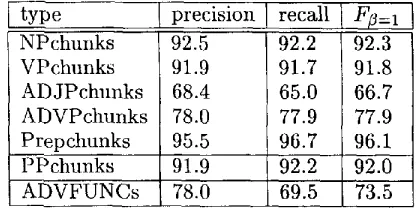
chlmks, we collapse Preps and N P s to P P s in a second step. While the G R assigner finds re- lations between V P s and other chunks (cf. Sec- tion 3.2), the P P chunker finds relations be- tween prepositions and N P s 2 in a way sim- ilar to G R assignment (see Section 3.2). In the last chunking/labeling step, we assign ad- verbial functions to chunks. The classes are the adverbial function labels from the treebank: LOC (locative), T M P (temporal), D I R (direc- tional), P R P (purpose and reason), M N R (man- ner), E X T (extension) or "-" for none of the fornmr. Table 1 gives an overview of the results of the chunking-labeling experiments, using the following algorithms, determined by validation on the train set: I B i - I G for XP-chunking and IGTree for P P - c h u n k i n g and A D V F U N C s as- signment.
3.2 G r a m m a t i c a l R e l a t i o n A s s i g n m e n t
In grammatical relation assignment we assign a G R to pairs of words in a sentence. In our
2pPs containing anything else than NPs (e.g. without bringing his wife) are not searched for.
NPchunks VPchunks A D J P c h u n k s ADVPchunks Prepchunks
92.5 91.9 68.4 78.0 95.5 P P c h u n k s 91.9 A D V F U N C s 78.0
recall 92.2 91.7 65.0 77.9 96.7 92.2 69.5
•fl=l
92.3 91.8 66.7 77.9 96.1 92.0 73.5
Table h Results of chunking-labeling experi- ments. NP-,VP-, A D J P - , A D V P - and Prep- chunks are found sinmltaneously, b u t for con- venience, precision and recall values are given separately for each type of chunk.
experiments, one of these words is always a verb, since this yields the most i m p o r t a n t GRs. The other word is the head of the phrase which is a n n o t a t e d with this grammatical relation in the treebank. A preposition is the head of a PP, a noun of an N P and so on. Defining relations to hold between heads means t h a t the algorithm can, for example, find a subject relation between a noun and a verb without necessarily having to make decisions a b o u t the precise b o u n d a r i e s of the subject NP.
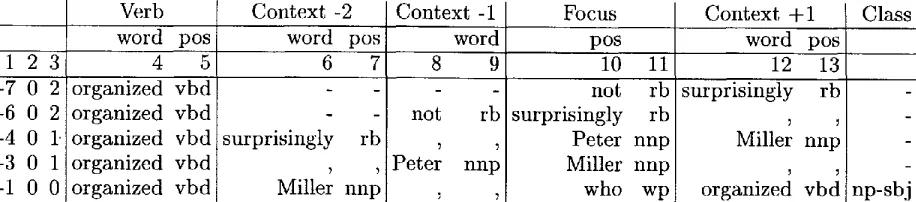
Suppose we had the P O S - t a g g e d sentence shown in Figure 1 and we wanted the algorithm to decide whether, and if so how, Miller (hence- forth: the focus) is related to the first verb or- ganized. We then construct an instance for this pair of words by extracting a set of feature val- ues from the sentence. The instance contains information a b o u t the v e r b and the f o c u s : a feature for the word form and a feature for the P O S of both. It also has similar features for the local c o n t e x t of the focus. Experiments on the training d a t a suggest an optimal context w i d t h of two elements to the left and one to the right. In the present case, elements are words or punc- t u a t i o n signs. In addition to the lexical and the local context information, we include superficial information a b o u t clause s t r u c t u r e : The first feature indicates the distance from the verb to the focus, counted in elements. A negative dis- tance means that the focus is to the left of the verb. The second feature contains the n u m b e r of other verbs between the verb and the focus. The third feature is the n u m b e r of intervening commas. The features were chosen by manual
[image:3.612.308.517.65.170.2]Not/RB surprisingly/RB ,/, Peter/NNP Miller/NNP ,/, who/WP organized/VBD the/DT con-
ference/NN in~IN New/NNP York/NNP ,/, does/VBZ not/RB want/VB to~TO come/VB to~IN
Paris /NNP without~IN bringing /VBG his /P RP$ wife /NN .
Figure 1: An example sentence a n n o t a t e d with POS.
Verb Context -2 Context -1 word pos word posl word
1 2 3 4 5 6 7 8 9
- 7 0 2 - 6 0 2 - 4 0 1 . - 3 0 1 - 1 0 0
surprisingly rb
Miller n n p organized v b d
organized v b d organized v b d organized v b d organized v b d
not rb
Peter nnp
Focus Context +1
pos word pos
10 11 12 13
not rb surprisingly rb Peter nnp Miller nnp who wp
surprisingly rb
Millet nnp
organized v b d
Class
np-sbj
Table 2: The first five instances for the sentence in Figure 1. Features 1-3 are the Features for distance and intervening V P s and commas. Features 4 and 5 show the verb and its P O S . Features 6-7, 8-9 and 12-13 describe the context words, Features 10-11 the focus word. E m p t y contexts are indicated by the value "-" for all features.
"feature engineering". Table 2 shows the com- plete instance for
Miller-organized
in row 5, to- gether with the other first four instances for the sentence. The class is mostly "-", to indicate that the word does not have a direct grammati- cal relation toorganized.
Other possible classes are those from a list of more than 100 different labels found in the treebank. These are combi- nations of a syntactic category and zero, one or more functions, e.g. NP-SBJ for subject, NP-PRD for predicative object, NP for (in)direct object 3, PP-LOC for locative P P adjunct, PP-LOC-CLR for subcategorised locative PP, etcetera. Accord- ing to their information gain values, features are ordered with decreasing importance as follows: 11, 13, 10, 1, 2, 8, 12, 9, 6 , 4 , 7 , 3 , 5. In- tuitively,, this ordering makes sense. The most i m p o r t a n t feature is the P O S of the focus, be- cause this determines whether it can have a G R to a verb at all (15unctuation cannot) and what kind of relation is possible. The P O S of the fol- lowing word is important, because e.g. a noun followed by a noun is p r o b a b l y not the head of an N P and will therefore not have a direct G R to the verb. The word itself may be important if it is e.g. a preposition, a pronoun or a clearly t e m p o r a l / l o c a l adverb. Features 1 and 2 give some indication of the complexity of the struc- ture intervening between the focus and the verb.aDirect and indirect object NPs have the same label in the treebank annotation. They can be differentiated by their position.
The more complex this structure, the lower the probability that the focus and the verb are re- lated. Context further away is less i m p o r t a n t t h a n near context.
To test the effects of the chunking steps from Section 3.1 on this task, we will now construct instances based on more s t r u c t u r e d input text, like that in Figure 2. This time, the focus is de- scribed by five features instead of two, for the additional information: which t y p e of chunk it is in, what the preposition is if it is in a P P chunk, and what the adverbial function is, if any. We still have a context of two elements left, one right, b u t elements are now defined to be either chunks, or words outside any chunk, or punctuation. Each chunk in the context is represented by its last word (which is the se- mantically most i m p o r t a n t word in most cases), by the P O S of the last word, and by the t y p e of chunk. The distance feature is a d a p t e d to the new definition of element, too, and instead of counting intervening verbs, we now count in- tervening V P chunks. Figure 3 shows the first five instances for the sentence in Figure 2. Class value"-" again means "the focus is not directly related to the verb" (but to some other verb or a non-verbal element). According to their in- formation gain values, features are ordered in decreasing importance as follows: 16, 15, 12, 14, 11, 2, 1, 19, 10, 9, 13, 18, 6, 17, 8, 4, 7, 3, 5. Comparing this to the earlier feature order- ing, we see that most of the new features are
[image:4.612.93.551.135.236.2][ A D V P
Not/RB suwri,singly/1RB
A D V P ] ,/, [ N PPeter/NNP Miller/NNP
N P ] ,/, [ N Pwho/WP
N P ] [ V Porganized/VBD
V P ] [ N Pthe/DT conference/NN
N P ] { P P - L O C [ P r e pin~IN
P r e p ] [ N P N e w / N N PYork/NNP
N P ] P P - L O C } ,/, [ V Pdoes/VBZ not/RB want/VB
to~TO eome/VB
V P ] { P P - D I R [ P r e pto~IN
P r e p ] [ N PParis/NNP
N P ] P P - D I R } [ P r e p.,~ithout/IN
P r e p ] [ V Pbringing/VBG
V P ] [ N Phis/PRP$ wife/NN
N P ] .Figure 2: An example sentence annotated with P O S (after the slash), ctmnks (with square and curly brackets) and adverbial functions (after the dash).
Stru(:t. Verb Context -2 Context -1 Focus Context +1
word pos cat word pos cat pr word pos cat adv word pos cat 1 2 3 4 5 6 7 8 9 10 11 12 13 14 15 16 17 18 19
org. vbd vp conf. nn np
surpris, rb advp Miller nnp np
who wp np - - conf. nn np in York nnp pp loc
org. vbd vp i York nnp pp org. vbd
org. vbd org. vbd org. vbd org. vbd - 5 0 2
- 3 0 1 - 1 0 0 1 0 0 2 0 0
surpris, rb advp Miller nnp np who wp np org. vbd vp
Class
np-sbj np
Table 3: The first five instances for the sentence in Figure 2. Features 1-3 are the features for distance and intervening V P s and commas. Features 4 and 5 show the verb and its P O S . Features 6-8, 9-11 and 17 19 describe the context words/chunks, Features 12-16 the focus chunk. E m p t y contexts are indicated by the "-" for all features.
very important, thereby justifying their intro- duction. Relative to the other "old" features, the structural features 1 and 2 have gained im- portance, p r o b a b l y because more structure is available in the input to represent.
In principle, we would have to construct one instance tbr each possible pair of a verb and a focus word in the sentence. However, we re- strict instances to those where there is at most one other v e r b / V P chunk between the verb and the focus, in case the focus precedes the verb, and no other verb in case the verb precedes the focus. This restriction allows, for example, for a relative clause on the subject (as in our example sentence). In the training data, 97.9% of the re- lated pairs fulfill this condition (when counting V P chunks). Experiments on the training d a t a showed that increasing the a d m i t t e d number of intervening V P chunks slightly increases recall, at the cost of precision. Having constructed all instances from the test d a t a and from a training set with the same level of partial structure, we first train the IG'IYee algorithm, and then let it classify the test instances. Then, for each test instance that was classified with a grammatical relation, we check whether the same verb-focus- pair appears with the same relation in the G R list e x t r a c t e d directly from the treebank. This gives us the precision of the classifier. Checking the treebank list versus the classified list yields
recall.
3.3 Cascaded E x p e r i m e n t s
We have already seen from the example that the level of structure in the input text can influence the composition of the instances. We are inter- ested in the effects of different sorts of partial structure in the input d a t a on the classification performance of the final classifier.
Therefore, we ran a series of experiments. The classification task was always t h a t of find- ing grammatical relations to verbs and perfor- mance was always measured by precision and recall on those relations (the test set contained 45825 relations). The a m o u n t of s t r u c t u r e in the input d a t a varied. Table 4 shows the results of the experiments. In the first experiment, only P O S tagged input is used. Then, N P chunks are added. Other sorts of chunks are inserted at each subsequent step. Finally, the adverbial function labels are added. We can see t h a t the more structure we add, the b e t t e r precision and recall of the grammatical relations get: preci- sion increases from 60.7% to 74.8%, recall from 41.3% to 67.9%. This in spite of the fact that the added information is not always correct, be- cause it was predicted for the test material on the basis of the training material by the classi- tiers described in Section 3.1. As we have seen in Table 1, especially A D J P and A D V P chunks
[image:5.612.64.520.173.263.2]and adverbial function labels did not have very high precision and recall.
4 D i s c u s s i o n
There are three ways how two cascaded modules can interact.
The first m o d u l e can add information on which the later module can (partially) base its decisions. This is the case between the adverbial functions finder and the relations finder. The former adds an extra informa- tive feature to the instances of the latter (Feature 16 in Table 3). Cf. column two of Table 4.
The first m o d u l e can restrict the num- ber of decisions to be made by the sec- ond one. This is the case in the combina- tion of the chunking steps and the relations finder. W i t h o u t the chunker, the relations finder would have to decide for every word, whether it is the head of a constituent that bears a relation to the verb. W i t h the chun- ker., the relations finder has to make this decision for fewer words, namely only for those which are the last word in a chunk resp. the preposition of a P P chunk. Prac- tically, this reduction of the n u m b e r of de- cisions (which translates into a reduction of instances) as can be seen in the third column of Table 4.
• T h e first m o d u l e can reduce the number of elements used for the instances by count- ing one chunk as just one context element. We can see the effect in the feature that indicates the distance in elements between the focus and the verb. The more chunks are used, the smaller the average absolute distance (see column four Table 4).
All three effects interact in the cascade we describe. The P P chunker reduces the number of decisions for the relations finder (instead of one instance for the preposition and one for the N P chunk, we get only one instance for the P P chunk), introduces an extra feature (Feature 12 in Table 3), and changes the context (instead of a preposition and an NP, context may now be one P P ) .
As we already noted above, precision and re- call are monotonically increasing when adding
more structure. However, we note large dif- ferences, such as N P chunks which increase FZ=i by more than 10%, and V P chunks which add another 6.8%, whereas A D V P s and A D J P s yield hardly any improvement. This m a y par- tially be explained by the fact t h a t these chunks are less frequent t h a n the former two. Preps, on the other hand, while hardly reducing the av- erage distance or the n u m b e r of instances, im- prove F~=i by nearly 1%. P P s yield another 1.1%. W h a t may come as a surprise is t h a t ad- verbial functions again increase FZ=i by nearly 2%, despite the fact that FZ=i for this ADV- F U N C assignment step was not very high. This result shows that cascaded modules need not be perfect to be useful.
Up to now, we only looked at the overall re- sults. Table 4 also shows individual FZ=i val- ues for four selected c o m m o n g r a m m a t i c a l re- lations: subject NP, (in)direct object NP, loca- tive P P adjunct and t e m p o r a l P P adjunct. Note that the steps have different effects on the dif- ferent relations: Adding N P s increases FZ=i by 11.3% for subjects resp. 16.2% for objects, b u t only 3.9% resp. 3.7% for locatives and t e m p o - rals. Adverbial functions are more i m p o r t a n t for the two adjuncts (+6.3% resp. +15%) than for the two complements (+0.2% resp. +0.7%).
Argamon et al. (1998) report FZ=i for sub- ject and object identification of respectively 86.5% and 83.0%, compared to 81.8% and 81.0% in this paper. Note however that Arg- amon et al. (1998) do not identify the head of subjects, subjects in e m b e d d e d clauses, or subjects and objects related to the verb only through a trace, which makes their task eas- ier. For a detailed comparison of the two meth- ods on the same task see (Daelemans et al., 1999a). T h a t paper also shows that the chunk- ing m e t h o d proposed here performs a b o u t as well as other methods, and that the influence of tagging errors on (NP) chunking is less than
1%.
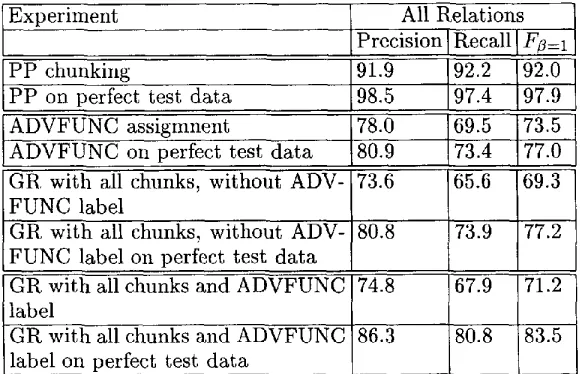
To s t u d y the effect of the errors in the lower modules other than the tagger, we used "per- fect" test d a t a in a last experiment, i.e. d a t a an- notated with partial information taken directly from the treebank. The results are shown in Table 5. We see that later modules suffer from errors of earlier modules (as could be expected): Ff~=l of P P chunking is 92% b u t could have
Structure in input words and POS only + N P chunks
+ V P chunks
+ A D V P and ADJP chunks
+ P r e p chunks + P P chunks +ADVFUNCs
I All Subj. Obj. Loc. Temp.
¢p Feat. i # Inst. A Prec a e c FZ=i FZ=i FZ=i FZ=i FZ=t 1 3 350091 6.1 60.7 41.3 49.1 52.8 49.4 34.0 38.4 17 227995 4.2 65.9 55.7 60.4 6 4 . 1 75.6 37.9 42.1 17 186364 4.5 72.1 62.9 67.2 78.6 75.6 40.8 46.8 17 185005 4.4 72.1 63.0 67.3 78.8 75.8'40.41 46.5
17 184455 4.4 72.5 64.3 68.2 81.2 75.7 40.4! 47.1 18 149341,3.6 73.6 65.6 69.3 81.6 80.3 40.6 48.3 19 149341 3.6 74.8 67.9 71.2 i 81.8 81.0 46.9 63.3
Table 4: Results of grammatical relation assignment with more and more structure in the test data added by earlier modules in the cascade. Columns show the number of features in the instances, the mlmber of instances constructed front the test input, the average distance between the verb and the tbcus element, precision, recall and FZ=i over all relations, and F¢~=i over some selected relations.
Experiment
P P chunking
P P on perfect test data ADVFUNC assigmnent
ADVFUNC on perfect test data
All Relations Precision I Recalll F~=i
91.9 92.2 92.0
98.5 97.4 97.9 78.0 q)9.5 73.5 r3.4 77.0 65.6 69.3
80.8 73.9 77.2
74.8 67.9
86.3 80.8 83.5 80.9
GR with all chunks, without ADV- 73.6 FUNC label
GR with all chunks, without ADV-I FUNC label on perfect test data GR with all chunks and ADVFUNC I label
GR with all chunks and ADVFUNC label on perfect test data
71.2
Table 5: Comparison of performance of several modules on realistic input structurally enriched by previous modules in the cascade) vs. on "perfect" input (enriched with partial treebank annotation). For PPs, this means perfect POS tags and chunk labels/boundaries, for ADVFUNC additionally perfect P P chunks, for GR assignment also perfect ADVFUNC labels.
been 97.9% if all previous chunks would have been correct (+5.9%). For adverbial functions, the difference is 3.5%. For grammatical rela- tion assignment, the last module in the cascade, the difference is, not surprisingly, the largest: 7.9% for chunks only, 12.3% for chunks and AD- VFUNCs. The latter percentage shows what could maximally be gained by further improving the chunker and ADVFUNCs finder. 'On realis- tic data, a realistic ADVFUNCs finder improves GR assigment by 1.9%. On perfect data, a per- fect ADVFUNCs finder increases performance
by 6.3%.
5 C o n c l u s i o n a n d F u t u r e R e s e a r c h
In this paper we studied cascaded grammatical relations assignment. We showed that even the use of imperfect modules improves the overall result of the cascade.
In future research we plan to also train our classifiers on imperfectly chunked material. This enables the classifier to better cope with systematic errors in train and test material. We expect that especially an improvement of the
[image:7.612.85.516.67.199.2] [image:7.612.156.446.285.472.2]adverbial function assignment will lead to bet- ter GR assignment.
Finally, since cascading proved effective for GR assignment we intend to study the effect of cascading different types of XP chunkers on chunking performance. We might e.g. first find A D J P chunks, then use that chunker's o u t p u t as additional input for the NP chunker, then use the combined o u t p u t as input to the VP chunker and so on. Other chunker orderings are possible, too. Likewise, it might be better to find differ- ent grammatical relations subsequently, instead of simultaneously.
R e f e r e n c e s
S. Abney. 1991. Parsing by chunks. In Principle-Based Parsing, pages 257-278. Kluwer Academic Publishers, Dordrecht. S. Argamon, I. Dagan, and Y. Krymolowski.
1998. A memory-based approach to learning shallow natural language patterns. In Proc. of 36th annual meeting of the A CL, pages 67- 73, Montreal.
R. Bod. 1992. A computational model of language performance: Data oriented pars- ing. In Proceedings of the l~th Interna- tional Conference on Computational Linguis- tics, COLING-92, Nantes, France, pages 855-859.
Thorsten, Brants and Wojciech Skut. 1998. Au- tomation of treebank annotation. In Proceed- ings of the Conference on New Methods in Language Processing (NeMLaP-3), Australia. Sabine Buchholz. 1998. Distinguishing com-
plements from adjuncts using memory-based learning. In Proceedings of the ESSLLI-98 Workshop on Automated Acquisition of Syn- tax and Parsing, Saarbriicken, Germany. C.J.van Rijsbergen. 1979. Information Re-
trieval. Buttersworth, London.
M. Collins. 1997. Three generative, lexicalised models for statistical parsing. In Proceedings of the 35th A CL and the 8th EA CL, Madrid, Spain~ July.
W. Daelemans, J. Zavrel, P. Berck, and S. Gillis. 1996. M B T : A memory-based part of speech
tagger generator. In E. Ejerhed and I. Dagan, editors, Proc. of Fourth Workshop on Very Large Corpora, pages 14-27. ACL SIGDAT. W. Daelemans, J. Zavrel, K. Van der Sloot, and
A. Van den Bosch. 1998. TiMBL: Tilburg
Memory Based Learner, version 1.0, reference manual. Technical Report ILK-9803, ILK, Tilburg University.
W. Daelemans, S. Buchholz, and J. Veenstra. 1999a. Memory-based shallow parsing. In Proceedings of CoNLL, Bergen, Norway. W. Daelemans, A. Van den Bosch, and J. Za-
vrel. 1999b. Forgetting exceptions is harm- ful in language learning. Machine Learning, Special issue on Natural Language Learning, 34:11-41.
Gregory Grefenstette. 1996. Light parsing as finite-state filtering. In Wolfgang Wahlster, editor, Workshop on Extended Finite State Models of Language, ECAI'96, Budapest, Hungary. John Wiley & Sons, Ltd.
M. Marcus, B. Santorini, and M . A . Marcinkiewicz. 1993. Building a large anno- tared corpus of english: T h e p e n n treebank.
Computational Linguistics, 19(2):313-330. L.A. Ramshaw and M.P. Marcus. 1995. Text
chunking using transformation-based learn- ing. In Proceedings of the 3rd ACL/SIGDAT Workshop on Very Large Corpora, Cam- bridge, Massachusetts, USA, pages 82-94. A. Ratnaparkhi. 1997. A linear observed time
statistical parser based on m a x i m u m en- tropy models. In Proceedings of the Second Conference on Empirical Methods in Natural Language Processing, EMNLP-2, Providence, Rhode Island, pages 1-10.
Satoshi Sekine. 1998. Corpus-Based Parsing and Sublanguage Studies. Ph.D. thesis, New York University.
E. Tjong Kim Sang and J.B. Veenstra. 1999. Representing text chunks. In Proceedings of the EA CL, Bergen, N.
J. B. Veenstra. 1998. Fast np chunking using memory-based learning techniques. In Pro- ceedings of BENELEARN'98, pages 71-78, Wageningen, The Netherlands.
J. Zavrel and W. Daelemans. 1997. Memory- based learning: Using similarity for smooth- ing. In Proc. of 35th annual meeting of the A CL, Madrid.