Unsupervised Parse Selection for HPSG
Rebecca Dridan and Timothy Baldwin Dept. of Computer Science and Software Engineering
University of Melbourne, Australia
[email protected], [email protected]
Abstract
Parser disambiguation with precision gram-mars generally takes place via statistical rank-ing of the parse yield of the grammar usrank-ing a supervised parse selection model. In the standard process, the parse selection model is trained over a hand-disambiguated treebank, meaning that without a significant investment of effort to produce the treebank, parse selec-tion is not possible. Furthermore, as treebank-ing is generally streamlined with parse selec-tion models, creating the initial treebank with-out a model requires more resources than sub-sequent treebanks. In this work, we show that, by taking advantage of the constrained nature of these HPSG grammars, we can learn a dis-criminative parse selection model from raw text in a purely unsupervised fashion. This al-lows us to bootstrap the treebanking process and provide better parsers faster, and with less resources.
1 Introduction
Parsing with precision grammars is generally a two-stage process: (1) the full parse yield of the preci-sion grammar is calculated for a given item, often in the form of a packed forest for efficiency (Oepen and Carroll, 2000; Zhang et al., 2007); and (2) the individual analyses in the parse forest are ranked us-ing a statistical model (“parse selection”). In the do-main of treebank parsing, the Charniak and Johnson (2005) reranking parser adopts an analogous strat-egy, except that ranking and pruning are incorpo-rated into the first stage, and the second stage is based on only the top-ranked parses from the first
stage. For both styles of parsing, however, parse se-lection is based on a statistical model learned from a pre-existing treebank associated with the grammar. Our interest in this paper is in completely remov-ing this requirement of parse selection on explicitly treebanked data, ie the development of fully unsu-pervised parse selection models.
The particular style of precision grammar we ex-periment with in this paper is HPSG (Pollard and Sag, 1994), in the form of the DELPH-IN suite of grammars (http://www.delph-in.net/). One of the main focuses of the DELPH-IN collab-oration effort is multilinguality. To this end, the Grammar Matrix project (Bender et al., 2002) has been developed which, through a set of question-naires, allows grammar engineers to quickly pro-duce a core grammar for a language of their choice. Bender (2008) showed that by using and expanding on this core grammar, she was able to produce a broad-coverage precision grammar of Wambaya in a very short amount of time. However, the Gram-mar Matrix can only help with the first stage of pars-ing. The statistical model used in the second stage of parsing (ie parse selection) requires a treebank to learn the features, but as we explain in Section 2, the treebanks are created by parsing, preferablywith a statistical model. In this work, we look at methods for bootstrapping the production of these statistical models without having an annotated treebank. Since many of the languages that people are building new grammars for are under-resourced, we can’t depend on having any external information or NLP tools, and so the methods we examine are purely unsuper-vised, using nothing more than the grammars
selves and raw text. We find that, not only can we produce models that are suitable for kick-starting the treebanking process, but the accuracy of these mod-els is comparable to parsers trained on gold standard data (Clark and Curran, 2007b; Miyao and Tsujii, 2008), which have been successfully used in appli-cations (Miyao et al., 2008).
2 The problem
The current method of training a parse selection model uses the [incr tsdb()] treebanking mechanism (Oepen, 2001) and works well for updating models for mature grammars, although even for these gram-mars, building a new model for a different domain requires a time-consuming initial treebanking effort. The treebanks used with DELPH-IN grammars are dynamic treebanks (Oepen et al., 2004) created by parsing text and having an annotator select the cor-rect analysis (or discard all of them). The annotation process involves making binary decisions based on so-called parse discriminants (Carter, 1997). When-ever the grammar is changed, the treebank can be quickly updated by re-parsing and re-applying the old annotation decisions. This treebanking process not only produces gold standard trees, but also a set of non-gold trees which provides the negative train-ing data necessary for a discriminative maximum en-tropy model.
The standard process for creating a parse selection model is:
1. parse the training set, recording up to 500 highest-ranking parses for each sentence;
2. treebank the training set;
3. extract features from the gold and non-gold parses;
4. learn feature weights using the TADM toolkit.1 (Malouf, 2002)
The useful training data from this process is the parses from those sentences for which: more than one parse was found; and at least one parse has been annotated as correct. That is, there needs to be both gold and non-gold trees for any sentence to be used in training the discriminative model.
1http://tadm.sourceforge.net/
There are two issues with this process for new grammars. Firstly, treebanking takes many person-hours, and is hence both time-consuming and ex-pensive. Complicating that is the second issue: N -best parsing requires a statistical model. While it is possible to parse exhaustively with no model, pars-ing is much slower, since the unpackpars-ing of results is time-consuming. Selective unpacking (Zhang et al., 2007) speeds this up a great deal, but requires a parse selection model. Treebanking is also much slower when the parser must be run exhaustively, since there are usually many more analyses to man-ually discard.
This work hopes to alleviate both problems. By producing a statistical model without requiring hu-man treebanking, we can have a working and effi-cient parser with less human effort. Even if the top-1 parses this parser produces are not as accurate as those trained on gold standard data, this model can be used to produce theN-best analyses for the tree-banker. Since our models are much better than ran-dom selection, we can afford to reduceN and still have a reasonable likelihood that the correct parse is in that top N, making the job of the treebanker much faster, and potentially leading to even better parse selection accuracy based on semi-supervised or fully-supervised parse selection.
3 Data and evaluation
Our ultimate goal is to use these methods for under-resourced languages but, since there are no pre-existing treebanks for these languages, we have no means to measure which method produces the best results. Hence, in this work, we experiment with languages and grammars where we have gold stan-dard data, in order to be able to evaluate the qual-ity of the parse selection models. Since we have gold-standard trained models to compare with, this enables us to fully explore how these unsupervised methods work, and show which methods are worth trying in the more time-consuming and resource-intensive future experiments on other languages. It is worth reinforcing that the gold-standard data is used for evaluation only, except in calculating the supervised parse selection accuracy as an upper-bound.
Language Sentences Average Average words parses
[image:3.612.87.287.55.104.2]Japanese 6769 10.5 49.6 English 4855 9.0 59.5
Table 1: Initial model training data, showing the average word length per sentence, and also the ambiguity mea-sured as the average number of parses found per sentence.
Flickinger (2002)) is an HPSG-based grammar of English that has been under development for many person years. In order to examine the cross-lingual applicability of our methods, we also use Jacy, an HPSG-based grammar of Japanese (Siegel and Bender, 2002). In both cases, we use grammar versions from the “Barcelona” release, from mid-2009.
3.1 Training Data
Both of our grammars come with statistical models, and the parsed data and gold standard annotations used to create these models are freely available. As we are trying to simulate a fully unsupervised setup, we didn’t want any influence from these earlier mod-els. Hence, in our experiments we used the parsed data from those sentences that received less than 500 parses and ignored any ranking, thus annulling the effects of the statistical model. This led to a re-duced data set, both in the number of sentences, and in the fact that the more ambiguous sentences were discarded, but it allows clean comparison between different methods, without incorporating external in-formation. The details of our training sets are shown in Table 1,2indicating that the sentence lengths are relatively short, and hence the ambiguity (measured as average parses per sentence) is low for both our grammars. The ambiguity figures also suggest that the Japanese grammar is more constrained (less am-biguous) than the English grammar, since there are, on average, more parses per sentence for English, even with a lower average sentence length.
3.2 Test Data
The test data sets used throughout our experiments are described in Table 2. Thetc-006data set is from
2Any sentences that do not have both gold and non-gold
analyses (ie, had no correct parse, only one parse, or none) are not included in these figures.
Test Set Language Sentences Average Average words parses
tc-006 Japanese 904 10.7 383.9
jhpstgt English 748 12.8 4115.1
[image:3.612.317.539.57.115.2]catb English 534 17.6 9427.3
Table 2: Test data, showing the average word length per sentence, and also the ambiguity measured as the average number of parses found per sentence. Note that the ambi-guity figures for the English test sets are under-estimates, since some of the longer sentences timed out before giv-ing an analysis count.
the same Tanaka Corpus (Tanaka, 2001) which was used for the Japanese training data. There is a wider variety of treebanked data available for the English grammar than for the Japanese. We use the jhp-stgtdata set, which consists of text from Norwegian
tourism brochures, from the same LOGON corpus as the English training data (Oepen et al., 2004). In order to have some idea of domain effects, we also use thecatb data set, the text of an essay on open-source development.3We see here that the sentences are longer, particularly for the English data. Also, since we are not artificially limiting the parse am-biguity by ignoring those with 500 or more parses, the ambiguity is much higher. This ambiguity figure gives some indication of the difficulty of the parse selection task. Again we see that the English sen-tences are more ambiguous, much more in this case, making the parse selection task difficult. In fact, the English ambiguity figures are an under-estimate, since some of the longer sentences timed out before producing a parse count. This ambiguity can be a function of the sentence length or the language it-self, but also of the grammar. A more detailed and informative grammar makes more distinctions, not all of which are relevant for every analysis.
3.3 Evaluation
The exact match metric is the most common accu-racy metric used in work with the DELPH-IN tool set, and refers to the percentage of sentences for which the top parse matched the gold parse in every way. This is akin to the sentence accuracy that is oc-casionally reported in the parsing literature, except
3The Cathedral and the Bazaar, by Eric Raymond.
that it also includes fine-grained syntactico-semantic features that are not often present in other parsing frameworks. Exact match is a useful metric for parse selection evaluation, but it is very blunt-edged, and gives no way of evaluatinghow closethe top parse was to the gold standard. Since these are very de-tailed analyses, it is possible to get one detail wrong and still have a useful analysis. Hence, in addition to exact match, we also use the EDMN A
evalua-tion defined by Dridan (2009). This is a predicate– argument style evaluation, based on the semantic output of the parser (MRS: Minimal Recursion Se-mantics (Copestake et al., 2005)). This metric is broadly comparable to the predicate–argument de-pendencies of CCGBank (Hockenmaier and Steed-man, 2007) or of the ENJU grammar (Miyao and Tsujii, 2008), and also somewhat similar to the grammatical relations (GR) of the Briscoe and Car-roll (2006) version of DepBank. The EDMN A
met-ric matches triples consisting of predicate names and the argument type that connects them.4
4 Initial Experiments
All of our experiments are based on the same basic process: (1) for each sentence in the training data described in Section 3.1, label a subset of analyses as correct and the remainder as incorrect; (2) train a model using the same features and learner as in the standard process of Section 2; (3) parse the test data using that model; and (4) evaluate the accuracy of the top analyses. The differences lay in how the ‘correct’ analyses are selected each time. Each of the following sections detail different methods for nominating which of the (up to 500) analyses from the training data should be considered pseudo-gold for training the parse selection model.
4.1 Upperbound and baseline models
As a first step we evaluated each data set using an upperbound and a baseline model. The upperbound model in this case is the model trained with gold standard annotations. These accuracy figures are slightly lower than others found in the literature for this data, since, to allow for comparison, we lim-ited the training data to the sets described in Table 1.
4The full EDM metric also includes features such as tense
and aspect, but this is less comparable to the other metrics men-tioned.
Test Set Exact EDM
Match Precision Recall F-score
tc-006 72.90 0.961 0.957 0.959
jhpstgt 48.07 0.912 0.908 0.910
[image:4.612.319.537.53.115.2]catb 22.29 0.838 0.839 0.839
Table 3: Accuracy of the gold standard-based parse se-lection model.
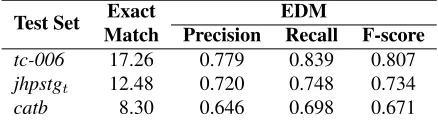
Test Set Exact EDM
Match Precision Recall F-score
tc-006 17.26 0.779 0.839 0.807
jhpstgt 12.48 0.720 0.748 0.734
catb 8.30 0.646 0.698 0.671
Table 4: Accuracy of the baseline model, trained on ran-domly selected pseudo-gold analyses.
By throwing out those sentences with more than 500 parses, we exclude much of the data that is used in the standard model and so our exact match figures are slightly lower than might be expected.
For the baseline model, we used random selection to select our gold analyses. For this experiment, we randomly assigned one parse from each sentence in the training data to be correct (and the remainder of analyses as incorrect), and then used that ‘gold stan-dard’ to train the model. Results for the upperbound and baseline models are shown in Tables 3 and 4.
As expected, the results for Japanese are much higher, since the lower ambiguity makes this an eas-ier task. The catb test set results suffer, not only from being longer, more ambiguous sentences, but also because it is completely out of the domain of the training data.
The exact match results from the random baseline are approximately what one might expect, given the respective ambiguity levels in Table 2. The EDM figures are perhaps higher than might be expected given random selection from the entire parse forest. This results from using a precision grammar, with an inbuilt notion of grammaticality, hence constrain-ing the parser to only produce somewhat reasonable parses, and creating a reasonably high baseline for our parse selection experiments.
[image:4.612.317.536.158.218.2]which may be due to the learner giving weight to features that are common across the training data, but the differences weren’t significant. Recall was significantly lower when using random selection di-rectly, due to the time outs caused by running with-out a model. For this reason, we use the random selection-based model results as our baseline for the other unsupervised parse selection models, noting that correctly identifying approximately three quar-ters of the dependencies in thejhpstgtset, and over
80% when using the Japanese grammar, is a fairly high baseline.
4.2 First attempts
As a first approach to unsupervised parse selection, we looked at two heuristics to designate some num-ber of the analyses as ‘gold’ for training. Both of these heuristics looked independently at the parses of each sentence, rather than calculating any num-bers across the whole training set.
The first method builds on the observation from the random selection-based model baseline exper-iment that just giving weight to common features could improve parser accuracy. In this case, we looked at the edges of the parsing chart. For each sentence, we counted the number of times an edge was present in an analysis, and used that number (normalised by the total number of times any edge was used) as the edge weight. We then calculated an analysis score by summing the edge weights of all the edges in that analysis, and dividing by the number of edges, to give an average edge weight for an analysis. All analyses that had the best analysis score for a sentence were designated ‘gold’. Since it was possible for multiple analyses to have the same score, there could be multiple gold analyses for any one sentence. If all the analyses had the same score, this sentence could not be used as part of the train-ing data. This method has the effect of selecttrain-ing the parse(s) most like all the others, by some definitions thecentroidof the parse forest. This has some rela-tionship to the partial training method described by Clark and Curran (2006), where the most frequent dependencies where used to train a model for the C&C CCG parser. In that case, however, the de-pendencies were extracted only from analyses that matched the gold standard supertag sequence, rather than the whole parse forest.
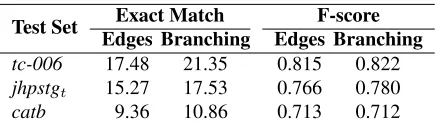
Test Set Exact Match F-score
Edges Branching Edges Branching
tc-006 17.48 21.35 0.815 0.822
jhpstgt 15.27 17.53 0.766 0.780
[image:5.612.318.537.53.116.2]catb 9.36 10.86 0.713 0.712
Table 5: Accuracy for each test set, measured both as per-centage of sentences that exactly matched the gold stan-dard, and f-score over elementary dependencies.
The second heuristic we tried is one often used as a baseline method: degree of right (or left) branch-ing. In this instance, we calculated the degree of branching as the number of right branches in a parse divided by the number of left branches (and vice versa for Japanese, a predominantly left-branching language). In the same way as above, we designated all parses with the best branching score as ‘gold’. Again, this is not fully discriminatory, and it was common to get multiple gold trees for a given sen-tence.
Table 5 shows the results for these two methods. All the results show an improvement over the base-line, with all but the F-score for the Edges method oftc-006being at a level of statistical significance.5 The only statistically significant difference between the Edges and Branching methods is over the jhp-stgt data set. While improvement over random is
encouraging, the results were still uninspiring and so we moved on to slightly more complex methods, described in the next section.
5 Supertagging Experiments
The termsupertagswas first used by Bangalore and Joshi (1999) to describe fine-grained part of speech tags which include some structural or dependency information. In that original work, the supertags were LTAG (Schabes and Joshi, 1991) elementary trees, and they were used for the purpose of speed-ing up parsspeed-ing by restrictspeed-ing the allowable leaf types. Subsequent work involving supertags has mostly fo-cussed on this efficiency goal, but they can also be used to inform parse selection. Dalrymple (2006) and Blunsom (2007) both look at how discrimina-tory a tag sequence is in filtering a parse forest. This
5All statistical significance tests in these experiments use the
work has shown that tag sequences can be success-fully used to restrict the set of parses produced, but generally are not discriminatory enough to distin-guish a single best parse. Toutanova et al. (2002) present a similar exploration but also go on to in-clude probabilities from a HMM model into the parse selection model as features. There has also been some work on using lexical probabilities for domain adaptation of a model (Hara et al., 2007; Rimell and Clark, 2008). In Dridan (2009), tag se-quences from a supertagger are used together with other factors to re-rank the top 500 parses from the same parser and English grammar we use in this re-search, and achieve some improvement in the rank-ing where tagger accuracy is sufficiently high. We use a similar method, one level removed, in that we use the tag sequences to select the ‘gold’ parse(s) that are then used to train a model, as in the previous sections.
5.1 Gold Supertags
In order to test the viability of this method, we first experimented using gold standard tags, extracted from the gold standard parses. Supertags come in many forms, depending on both the grammar for-malism and the implementation. For this work, we use HPSG lexical types (lextypes), the native word classes in the grammars. These lextypes encode part of speech and subcategorisation information, as well as some more idiosyncratic features of words, such as restrictions on preposition forms, mass/count dis-tinctions and comparative versus superlative forms of adjectives. As a few examples from the En-glish grammar, v np lerepresents a basic transi-tive verb, whilen pp c-of lerepresents a count noun that optionally takes a prepositional phrase complement headed byof. The full definition of a lextype consists of a many-featured AVM (attribute value matrix), but the type names have been de-liberately chosen to represent the main features of each type. In the Dridan (2009) work, parse ranking showed some improvement when morphological in-formation was added to the tags. Hence, we also look at more fine-grained tags constructed by con-catenating appropriate morphological rules onto the lextypes, as inv np le:past verb orule(ie a simple transitive verb with past tense).
We used these tags by extracting the tag sequence
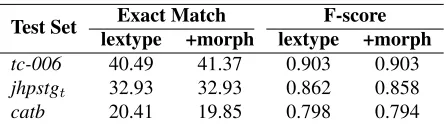
Test Set Exact Match F-score
lextype +morph lextype +morph
tc-006 40.49 41.37 0.903 0.903
jhpstgt 32.93 32.93 0.862 0.858
[image:6.612.316.539.53.116.2]catb 20.41 19.85 0.798 0.794
Table 6: Accuracy using gold tag sequence compatibility to select the ‘gold’ parse(s).
from the leaf types of all the parses in the forest, marking as ‘gold’ any parse that had the same se-quence as the gold standard parse and then training the models as before. Table 6 shows the results from parsing with models based on both the basic lextype and the lextype with morphology. The results are promising. They still fall well below training purely on gold standard data (at least for the in-domain sets), since the tag sequences are not fully discrimi-natory and hence noise can creep in, but accuracy is significantly better than the heuristic methods tried earlier. This suggested that, at least with a reason-ably accurate tagger, this was a viable strategy for training a model. With no significant difference be-tween the basic and +morph versions of the tag set, we decided to use the basic lextypes as tags, since a smaller tag set should be easier to tag with. How-ever, we first had to train a tagger, without using any gold standard data.
5.2 Unsupervised Supertagging
Research into unsupervised part-of-speech tagging with a tag dictionary (sometimes called weakly su-pervised POS tagging) has been going on for many years (cf Merialdo (1994), Brill (1995)), but gener-ally using a fairly small tag set. The only work we know of on unsupervised tagging for the more com-plexsupertags is from Baldridge (2008), and more recently, Ravi et al. (2010a). In this work, the con-straining nature of the (CCG) grammar is used to mitigate the problem of having a much more am-biguous tag set. Our method has a similar under-lying idea, but the implementation differs both in the way we extract the word-to-tag mappings, and also how we extract and use the information from the grammar to initialise the tagger model.
implemen-tation of Dekang Lin,6 which re-estimates probabil-ities, given an initial model, using the Baum-Welch variant of the Expectation-Maximisation (EM) algo-rithm. One possibility for an initial model was to ex-tract the word-to-lextype mappings from the gram-mar lexicon as Baldridge does, and make all starting probabilities uniform. However, our lexicon maps between lextypes andlemmas, rather than inflected word forms, which is what we’d be tagging. That is to say, from the lexicon we could learn that the lemmawalk can be tagged asv pp* dir le, but we could not directly extract the fact that therefore walked should also receive that tag.7 For this rea-son, we decided it would be simplest to initialise our probability estimates using the output of the parser, feeding in only those tag sequences which are compatible with analyses in the parse forest for that item. This method takes advantage of the fact that, because the grammars are heavily constrained, the parse forest only contains viable tag sequences. Since parsing without a model is slow, we restricted the training set to those sentences shorter than a specific word length (12 for English and 15 for Japanese, since that was the less ambiguous gram-mar and hence faster).
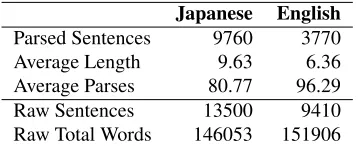
Table 7 shows how much parsed data this gave us. From this parsed data we extracted tag-to-word and tag-to-tag frequency counts from all parses for all sentences, and used these frequencies to produce the emission and transition probabilities, respectively. The emission probabilities were taken directly from the normalised frequency counts, but for the tran-sition probabilities we allow for all possible transi-tions, and add one to all counts before normalising. This model we call our initial counts model. The EM trainedmodel is then produced by starting with this initial model and running the Baum-Welch al-gorithm using raw text sentences from the training corpus.
5.3 Supertagging-based parse selection models
We use both the initial counts and EM trained models to tag the training data from Table 1 and then compared this with the extracted tag sequences
6
Available from http://webdocs.cs.ualberta. ca/˜lindek/hmm.htm
7
Morphological processing occurs before lexicon lookup in the PET parser.
Japanese English
[image:7.612.338.517.54.128.2]Parsed Sentences 9760 3770 Average Length 9.63 6.36 Average Parses 80.77 96.29 Raw Sentences 13500 9410 Raw Total Words 146053 151906
Table 7: Training data for the HMM tagger (both the parsed data from which the initial probabilities were de-rived, and the raw data which was used to estimated the
EM trainedmodels).
Test Set
Exact Match F-score
Initial EM Initial EM
counts trained counts trained
tc-006 32.85 40.38 0.888 0.898
jhpstgt 26.29 24.04 0.831 0.827
catb 14.61 14.42 0.782 0.783
Table 8: Accuracy using tag sequences from a HMM tag-ger to select the ‘correct’ parse(s). The initial counts
model was based on using counts from a parse forest to approximate the emission and transition probabilities.
TheEM trainedmodel used the Baum Welch algorithm to
estimate the probabilities, starting from the initial counts state.
used in the gold tag experiment. Since we could no longer assume that our tag sequence would be present within the extracted tag sequences, we used the percentage of tokens from a parse whose lextype matched our tagged sequence as the parse score. Again, we marked as ‘gold’ any parse that had the best parse score for each sentence, and trained a new parse selection model.
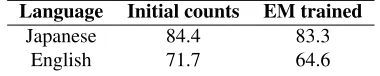
Table 8 shows the results of parsing with these models. The results are impressive, significantly higher than all our previous unsupervised methods.
Language Initial counts EM trained
[image:8.612.314.554.54.125.2]Japanese 84.4 83.3 English 71.7 64.6
Table 9: Tagger accuracy over the training data, using both theinitial countsand theEM trainedmodels.
There is much potential for further work in this direction, experimenting with more training data or more estimation iterations, or even looking at dif-ferent estimators as suggested in Johnson (2007) and Ravi et al. (2010b). There is also the issue of whether tag accuracy is the best measure for indicat-ing potential parse accuracy. The Japanese parsindicat-ing results are already equivalent to those achieved us-ing gold standard tags. It is possible that parsus-ing ac-curacy is reasonably insensitive to tagger acac-curacy, but it is also possible that there is a better metric to look at, such as tag accuracy over frequently con-fused tags.
6 Discussion
The results of Table 8 show that, using no human annotated data, we can get exact match results that are almost half way between our random baseline and our gold-standard-trained upperbound. EDM F-scores of 90% and 83% over in-domain data com-pare well with dependency-based scores from other parsers, although a direct comparison is very diffi-cult to do (Clark and Curran, 2007a; Miyao et al., 2007). It still remains to see whether this level of ac-curacy is good enough to be useful. The main aim of this work is to bootstrap the treebanking process for new grammars, but to conclusively show the efficacy of our methods in that situation requires a long-term experiment that we are now starting, based on the results we have here. Another possible use for these methods was alluded to in Section 2: producing a new model for a new domain.
Results at every stage have been much worse for thecatbdata set, compared to the otherjhpstgt
En-glish data set. While sentence length plays some part, the major reason for this discrepancy was do-main mismatch between the training and test data. One method that has been successfully used for do-main adaption in parsing is self-training (McClosky et al., 2006). In this process, data from the new main is parsed with the parser trained on the old
do-Source of ‘Gold’ Data Exact Match F-score
Random Selection 8.30 0.671 Supertags (initial counts) 14.61 0.782
Gold Standard 22.29 0.839
[image:8.612.90.280.55.93.2]Self-training 15.92 0.791
Table 10: Accuracy results over the out-of-domaincatb
data set, using theinitial countsunsupervised model to produce in-domain training data in a self-training set up. The previous results are shown for easy comparison.
main, and then the top analyses of the parsed new domain data are added to the training data, and the parser is re-trained. This is generally considered a semi-supervised method, since the original parser is trained on gold standard data. In our case, we wanted to test whether parsing data from the new do-main using ourunsupervisedparse selection model was accurate enough to still get an improvement us-ing self-trainus-ing for domain adaptation.
It is not immediately clear what one might con-sider to be the ‘domain’ of thecatbtest set, since do-main is generally very vaguely defined. In this case, there was a limited amount of text available from other essays by the same author.8 While the topics of these essays vary, they all relate to the social side of technical communities, and so we used this to rep-resent in-domain data for thecatbtest set. It is, how-ever, a fairly small amount of data for self-training, being only around 1000 sentences. We added the re-sults of parsing this data to the training set we used to create theinitial countsmodel and again retrained and parsed. Table 10 shows the results. Previous re-sults for thecatbdata set are given for comparison.
The results show that the completely unsuper-vised parse selection method produces a top parse that is at least accurate enough to be used in self-training, providing a cheap means of domain adapta-tion. In future work, we hope to explore this avenue of research further.
7 Conclusions and Further Work
Comparing Tables 8 and 4, we can see that for both English and Japanese, we are able to achieve parse selection accuracy well above our baseline of a
ran-8
dom selection-based model using only the informa-tion available in the grammar and raw text. This was in part because it is possible to extract a rea-sonable tagging model from uncorrected parse data, due to the constrained nature of these grammars. These models will hopefully allow grammar engi-neers to more easily build statistical models for new languages, using nothing more than their new gram-mar and raw text.
Since fully evaluating the potential for building models for new languages is a long-term ongoing experiment, we looked at a more short-term eval-uation of our unsupervised parse selection meth-ods: building models for new domains. A pre-liminary self-training experiment, using our initial counts tagger trained model as the starting point, showed promising results for domain adaptation.
There are plenty of directions for further work arising from these results. The issues surrounding what makes a good tagger for this purpose, and how can we best learn one without gold training data, would be one possibly fruitful avenue for further exploration. Another interesting slant would be to investigate domain effects of the tagger. Previous work has already found that training just a lexical model on a new domain can improve parsing results. Since the optimal tagger ‘training’ we saw here (for English) was merely to read off frequency counts for parsed data, it would be easy to retrain the tagger on different domains. Alternatively, it would be inter-esting so see how much difference it makes to train the tagger on one set of data, and use that to tag a model training set from a different domain. Other methods of incorporating the tagger output could also be investigated. Finally, a user study involv-ing a grammar engineer workinvolv-ing on a new language would be useful to validate the results we found here and confirm whether they are indeed helpful in boot-strapping a new grammar.
Acknowledgements
This research was supported by Australian Research Council grant no. DP0988242 and Microsoft Re-search Asia.
References
Jason Baldridge. 2008. Weakly supervised supertagging with grammar-informed initialization. InProceedings of the 22nd International Conference on
Computa-tional Linguistics (Coling 2008), pages 57–64,
Manch-ester, UK.
Srinivas Bangalore and Aravind K. Joshi. 1999. Su-pertagging: an approach to almost parsing.
Compu-tational Linguistics, 25(2):237–265.
Emily M. Bender, Dan Flickinger, and Stephan Oepen. 2002. The grammar matrix: An open-source starter-kit for the rapid development of cross-linguistically consistent broad-coverage precision grammars. In
Proceedings of the Workshop on Grammar Engineer-ing and Evaluation at the 19th International
Con-ference on Computational Linguistics, pages 8–14,
Taipei, Taiwan.
Emily M. Bender. 2008. Evaluating a crosslinguistic grammar resource: A case study of Wambaya. In
Pro-ceedings of the 46th Annual Meeting of the ACL, pages
977–985, Columbus, USA.
Philip Blunsom. 2007. Structured Classification for
Multilingual Natural Language Processing. Ph.D.
thesis, Department of Computer Science and Software Engineering, the University of Melbourne.
Eric Brill. 1995. Unsupervised learning of disambigua-tion rules for part of speech tagging. InProceedings
of the Third Workshop on Very Large Corpora, pages
1–13, Cambridge, USA.
Ted Briscoe and John Carroll. 2006. Evaluating the accuracy of an unlexicalised statistical parser on the PARC DepBank. InProceedings of the 44th Annual Meeting of the ACL and the 21st International
Confer-ence on Computational Linguistics, pages 41–48,
Syd-ney, Australia.
David Carter. 1997. The treebanker: a tool for super-vised training of parsed corpora. InProceedings of a Workshop on Computational Environments for
Gram-mar Development and Linguistic Engineering, pages
9–15, Madrid, Spain.
Eugene Charniak and Mark Johnson. 2005. Coarse-to-fine n-best parsing and maxent discriminative rerank-ing. InProceedings of the 43rd Annual Meeting of the ACL, pages 173–180, Ann Arbor, USA.
Stephen Clark and James R. Curran. 2006. Partial train-ing for a lexicalized-grammar parser. InProceedings of the Human Language Technology Conference of the
North American Chapter of the ACL (NAACL), pages
144–151, New York City, USA.
Stephen Clark and James R. Curran. 2007a. Formalism-independent parser evaluation with CCG and Dep-Bank. InProceedings of the 45th Annual Meeting of
Stephen Clark and James R. Curran. 2007b. Wide-coverage efficient statistical parsing with CCG and log-linear models. Computational Linguistics, 33(4):493–552.
Ann Copestake, Dan Flickinger, Ivan A. Sag, and Carl Pollard. 2005. Minimal recursion semantics: An in-troduction. Research on Language and Computation, vol 3(no 4):pp 281–332.
Mary Dalrymple. 2006. How much can part-of-speech tagging help parsing? Natural Language Engineering, 12(4):373–389.
Rebecca Dridan. 2009. Using lexical statistics to
im-prove HPSG parsing. Ph.D. thesis, Saarland
Univer-sity.
Dan Flickinger. 2002. On building a more efficient grammar by exploiting types. In Stephan Oepen, Dan Flickinger, Jun’ichi Tsujii, and Hans Uszkoreit, edi-tors, Collaborative Language Engineering, pages 1– 17. Stanford: CSLI Publications.
Tadayoshi Hara, Yusuke Miyao, and Jun’ichi Tsujii. 2007. Evaluating impact of re-training a lexical dis-ambiguation model on domain adaptation of an HPSG parser. InProceedings of the 10th International
Con-ference on Parsing Technology (IWPT 2007), pages
11–22, Prague, Czech Republic.
Julia Hockenmaier and Mark Steedman. 2007. CCG-bank: A corpus of CCG derivations and dependency structures extracted from the Penn Treebank.
Compu-tational Linguistics, 33(3):355–396, September.
Mark Johnson. 2007. Why doesnt EM find good HMM POS-taggers? In Proceedings of the 2007 Joint Conference on Empirical Methods in Natural guage Processing and Computational Natural
Lan-guage Learning (EMNLP-CoNLL), pages 296–305,
Prague, Czech Republic.
Robert Malouf. 2002. A comparison of algorithms for maximum entropy parameter estimation. In Pro-ceedings of the 6th Conference on Natural Language
Learning, Taipei, Taiwan.
David McClosky, Eugene Charniak, and Mark Johnson. 2006. Effective self-training for parsing. In Proceed-ings of the Human Language Technology Conference
of the NAACL, pages 152–159, New York City, USA.
Bernard Merialdo. 1994. Tagging english text with a probabilistic model. Computational Linguistics, 20(2):155–171.
Yusuke Miyao and Jun’ichi Tsujii. 2008. Feature for-est models for probabilistic HPSG parsing.
Computa-tional Linguistics, 34(1):35–80.
Yusuke Miyao, Kenji Sagae, and Jun’ichi Tsujii. 2007. Towards framework-independent evaluation of deep linguistic parsers. InProceedings of the GEAF 2007
Workshop, Palo Alto, California.
Yusuke Miyao, Rune Sætre, Kenji Sagae, Takuya Mat-suzaki, and Jun’ichi Tsujii. 2008. Task-oriented eval-uation of syntactic parsers and their representations. In
Proceedings of the 46th Annual Meeting of the ACL,
pages 46–54, Columbus, USA.
Stephan Oepen and John Carroll. 2000. Ambiguity pack-ing in constraint-based parspack-ing - practical results. In
Proceedings of the 1st Conference of the North Ameri-can Chapter of the Association for Computational
Lin-guistics, pages 162–169, Seattle, USA.
Stephan Oepen, Dan Flickinger, Kristina Toutanova, and Christopher D. Manning. 2004. LinGO redwoods. a rich and dynamic treebank for HPSG. Journal of
Re-search in Language and Computation, 2(4):575–596.
Stephan Oepen. 2001. [incr tsdb()] – competence and performance laboratory. User manual, Computational Linguistics, Saarland University, Saarbr¨ucken, Ger-many.
Carl Pollard and Ivan A. Sag. 1994.Head-Driven Phrase
Structure Grammar. University of Chicago Press,
Chicago, USA.
Sujith Ravi, Jason Baldridge, and Kevin Knight. 2010a. Minimized models and grammar-informed initializa-tion for supertagging with highly ambiguous lexicons.
InProceedings of the 48th Annual Meeting of the
Asso-ciation for Computational Linguistics, pages 495–503,
Uppsala, Sweden.
Sujith Ravi, Ashish Vaswani, Kevin Knight, and David Chiang. 2010b. Fast, greedy model minimization for unsupervised tagging. InProceedings of the 23rd In-ternational Conference on Computational Linguistics
(Coling 2010), pages 940–948, Beijing, China.
Laura Rimell and Stephen Clark. 2008. Adapting a lexicalized-grammar parser to contrasting domains.
In Proceedings of the 2008 Conference on Empirical
Methods in Natural Language Processing (EMNLP
2008), pages 475–484, Honolulu, USA.
Yves Schabes and Aravind K. Joshi. 1991. Parsing with lexicalized tree adjoining grammar. In Masaru Tomita, editor, Current Issues in Parsing Technology, chap-ter 3, pages 25–48. Kluwer.
Melanie Siegel and Emily M. Bender. 2002. Efficient deep processing of japanese. InProceedings of the 3rd Workshop on Asian Language Resources and Interna-tional Standardization. Coling 2002 Post-Conference
Workshop., Taipei, Taiwan.
Yasuhito Tanaka. 2001. Compilation of a multilingual parallel corpus. In Proceedings of PACLING 2001, pages 265–268, Kitakyushu, Japan.
Kristina Toutanova, Chistopher D. Manning, Stuart M. Shieber, Dan Flickinger, and Stephan Oepen. 2002. Parse disambiguation for a rich HPSG grammar. In
First Workshop on Treebanks and Linguistic Theories
Alexander Yeh. 2000. More accurate tests for the sta-tistical significance of result differences. In Proceed-ings of the 18th International Conference on
Compu-tational Linguistics (COLING 2000), pages 947–953,
Saarbrcken, Germany.
Yi Zhang, Stephan Oepen, and John Carroll. 2007. Ef-ficiency in unification-based n-best parsing. In Pro-ceedings of the 10th international conference on
pars-ing technologies (IWPT 2007), pages 48–59, Prague,