http://www.jite.org/documents/Vol14/JITEv14IIPp063-083Sullivan0919.pdf
Learning Circles: A Collaborative
Technology-Mediated Peer-Teaching Workshop
Kevin Sullivan
Bridge21, Trinity College Dublin,
Ireland
[email protected]
Kevin Marshall
Microsoft Ireland
[email protected]
Brendan Tangney
CRITE, Trinity College Dublin, Ireland
[email protected]
Abstract
This research study explores peer teaching and learning without a domain expert teacher, within the context of an activity where teams of second level students (~16 years old) are required to create a learning experience for their peers. The study looks at how participants would like to be taught and how they would teach their peers if given the opportunity and examines the support they require, their motivation levels, and if they actually learn curriculum content using this ap-proach.
An exploratory case study methodology was used, and the findings suggest that students want varied learning experiences that include many of the elements which would fall under the heading of 21st century learning, that with some support and encouragement they can create innovative learning experiences for their peers, and that they can learn curriculum content from the process.
Keywords: Collaborative Learning, Technology, Teamwork, Peer learning, Peer teaching, Pro-ject-based, Bridge21.
Introduction
In a world in which vast amounts of information are easily available, (c.f. Wikipedia, YouTube, the Khan Academy, etc.) the notion of a teacher being a gate-keeper to content is meaningless, and the usefulness of a purely didactic approach to teaching and, indeed, the role of teaching itself need to be re-examined. The emergence of the “flipped classroom” (Gerstein, 2011) and
experi-ments by Mitra and Dangwal (2010) on teaching without a teacher are just two examples of the type of innovation which is taking place.
In Ireland, secondary school education is divided into two main cycles. Stu-dents spend three years preparing for a state examination called the Junior Cer-tificate and then a further two year “Sen-ior Cycle” leading to the final secondary Material published as part of this publication, either on-line or
school exams, the Leaving Certificate. Students sitting the Junior Certificate are typically 15 years old. Many schools offer an additional year between the two cycles. This “Transition Year” is an in-school gap year where students often get the chance to study subjects outside the regular curriculum, to take part in community or professional work placements, and to participate in ex-tra-curricular projects both in and out of school. The participants in this study were Transition Year students (~16 years of age) from seven schools in Dublin. For each workshop within the study, a mixed group of around 20 students, from four or five different schools, would work to-gether for four days
This research study looks at learning without a domain expert teacher and peer learning by exam-ining an activity where teams of students are required to create a learning experience for their peers, who were students of a similar age and year group.
Working in a purpose-designed learning space in the authors’ university, and using a particular model of technology-mediated collaborative learning (Lawlor, Conneely, & Tangney, 2010), teams of Transition Year students were each given a topic from the Irish Second Level Senior Cycle curriculum, asked to learn it, then prompted to prepare a learning experience, on that topic for their peers. Adult mentors were present to support the process but were not subject experts in the topics being taught.
Four workshops took place, each of four days in duration. A total of 82 students participated in the study, and they worked on seven different curriculum topics across a range of subjects from biology to history. Following an exploratory case study methodology, data was collected from (1) student questionnaires, (2) student focus group interviews, (3) mentor interviews, and (4) analysis of the learning experiences created by the participants.
The study looks at how participants said they wanted to learn and how they would teach their peers and investigates the support they required to do this. The students motivation levels and if they actually learned any curriculum content using this approach were also examined. By explor-ing these questions, the authors sought to investigate the potential for this type of learnexplor-ing to be used in more formal educational settings.
Background
Awareness of different learning styles can be valuable to both teachers and students. Students will better understand why certain approaches are being used and how they can benefit from them, and, in turn, teachers should recognise the mix of learning styles among their students and tailor their teaching style to account for this (Kovacic, 2004). If a student’s preferred learning style is compatible with the teaching style of his teacher, he is likely to retain more information, achieve higher grades, and maintain a higher level of interest in a given subject (Felder, 1993). That is not to suggest that students should only be exposed to a single pedagogical approach but that some understanding of their preferred learning styles would be worthwhile in any lesson planning pro-cess.
work at their own pace, to repeat lessons if necessary and to take part in active learning during class time.
A prominent theme running through current research on technology-mediated learning is that the modern technology-rich classroom should include elements of constructivism, collaboration, problem solving, creativity, active learning, team teaching, and the creation of personally mean-ingful artefacts (Blatchford, Kutnick, Baines, & Galton, 2003; Galton, Hargreaves, & Pell, 2009; Johnson & Johnson, 1987; Jonassen, Peck, & Wilson 1999; Lou, Abrami, Spence, Poulsen, Chambers, & D’Apollonia, 1996; Harel & Papert, 1991; Poindexter, 2003). Constructivism fo-cuses on the learner, rather than the teacher, and includes active learning, learning by “doing” and discovery-based learning - or in the words of Abbott and Ryan (2000), the focus is upon
“knowledge construction and not knowledge absorption”. Social constructivism emphasises the importance of interaction with others in the learning process, and Vygotsky’s (1978) idea of the “more able other” is central to the approach.
A technique which explicitly addresses peers as “more able others” is peer teaching, in which students take on the role of teacher and students learn from each other (Goodlad & Hirst, 1990). It relies upon and strengthens the relationships between learners and can be, if properly structured, a powerful learning technique. In a peer teaching pedagogy, the role of the teacher is quite different from the more traditional model (King, 1993) and the term “orchestration” is used by Dillenbourg and Fischer (2007) to describe the teacher when acting as a facilitator conducting collaborative learning activities. The benefits to students of this approach are not just academic but also per-sonal and social (Leung, Marsh, & Craven, 2009). P. A. Cohen, Kulik, and Kulik (1982) found that students who used peer tutoring performed better in examinations than control groups who had not used peer tutoring. Beasley (1997) claimed that a collaborative, student-centred, peer tu-toring programme helped students who were “passive, teacher dependent, uncritical recipients of information” become more “engaged, questioning and autonomous learners”. He also found that the benefits to the tutors included increased confidence, self-worth, and improved communication skills. Ng (2008) states that students involved in a peer learning project found the experience to be valuable and efficient. Goldschmid and Goldschmid (1976) argue that peer tutoring can benefit both the student “teacher” and the student “learner” by encouraging participation, cooperation, and social interaction. Knobe et al. (2010) claim that the benefits of a project involving self-teaching and peer self-teaching lie mostly with the student “teachers”. Benware and Deci (1984) claim that learning for teaching creates high levels of motivation and that learning by teaching leads to excellent levels of retention.
Mitra and Dangwal (2010) took this idea much further and conducted studies into what children, working together but with no expert help, could learn using the internet as their primary source of information. They argue that children can learn what they want to learn, even without a specialist teacher, if given access to the information and encouragement to explore and work things out for themselves. This work reinforces the view that the traditional role of the teacher as the primary source of information for learners is changing and that how teachers work with their students may also have to change.
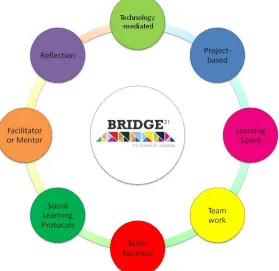
The Bridge21 Learning Model
• “A structured team-based pedagogy influenced by the Patrol System learning method of the World Organisation of the Scout Movement (WOSM).
• A physical learning space designed and configured to support team-based learning.
• Adult support that seeks to guide and mentor, with teachers orchestrating and scaffold-ing team activities.
• Delivery of content through student-led projects.
• Technology used as an integral tool in the process.
• Incorporation of team and individual reflection as a regular part of the learning.
[image:4.612.170.449.248.519.2]• Cross-curricular thematic learning.” (Lawlor et al., 2010)
Figure 1: The Bridge21 Learning Model – (Conneely, Lawlor &Tangney, 2015)
heav-ily team-based approach facilitates the transfer of responsibility for the learning to the learner. The model has been used with over 8000 students both within and outside the formal classroom and research to date suggests that it is very effective for promoting intrinsic student motivation, developing teamwork and twenty-first century (21C) skills (Conneely et al., 2015).
Research Focus
The study focused on how students would like to be taught and how they would teach their peers if given the opportunity and examines the support they require, their motivation levels, and if they actually learn curriculum content using this approach. Specifically the following questions were addressed.
• What did students say about how they would like to learn?
• How did students teach each other?
• What support did students require in learning and teaching without a domain ex-pert teacher?
• Were the students creating, delivering and attending peer learning sessions en-gaged and motivated to learn?
• Did students learn without a domain expert teacher?
Research Design and Method
An exploratory case study methodology was used to explore a number of questions, as outlined in the introduction, centered on the idea of students as teachers and the use of peer teaching in a context in which access to digital content is freely available. The majority of the data collected for this study was qualitative, and this was supported by quantitative data collected by a pre- and post-experience attitudinal survey. The details of the workshops and the data collection instru-ments are outlined below.
The Learning Circles Workshops
Four Learning Circles workshops, the central focus of the data collection, were carried out over a five week period using the Bridge21 model of learning. Each was 4 days in duration. There were roughly 20 students in each workshop (82 participants in total) and they were arranged into 4 or 5 teams (17 teams in total) – see Table 1. The students were randomly assigned across the four workshops and the teams were picked randomly, with the exceptions of trying to create teams that were neither single-gender nor full of students from one school. This is standard practice for a Bridge21 workshop.
Table 1 Participants, Schools and Teams per workshop Workshop Students Schools Teams
1 20 5 4
2 22 4 5
3 20 5 4
4 20 4 4
The workshops took place on the main campus of the authors’ institution and each ran for 5 hours per day over 4 consecutive days. The 82 participants were typically 15-16 years of age, and they came from 7 different schools, 5 of which are designated as “disadvantaged” in terms of socio-economic background and third level progression rates. There was a gender balance of approxi-mately 50-50.
The participants in this study all had previous experience of working with Bridge21. This in-volved four-day workshops earlier in the same school year. The previous workshop focused on multimedia projects rather than any specific curriculum content. There was no explicit peer teach-ing element to that workshop but they did gain experience workteach-ing in a structured team environ-ment and using the technical resources in the Bridge21 learning space.
Initially, each team was asked to make a presentation on how they like to learn. This served three purposes. Firstly, it acted as both an ice-breaker and group formation exercise. Secondly, the presentations from each group give insights as to how such students would like to be taught. Fi-nally, it was envisaged that this in turn would influence the main activity in the workshop. The central project for each team was to take an assigned topic from their school curriculum, which they had not previously covered, to learn it for themselves, using the internet or other re-sources, and then prepare a 30 minute lesson on that topic. The workshop concluded with each team delivering their lesson to one other team, i.e., each team took a turn at being “teachers” and “students”.
The physical learning space available consisted of 2 large rooms, one with team pods and the oth-er a flat space equipped with a single PC, projector and large screen. Students worked in teams of 4 and, in keeping with the Bridge21 model of structured collaboration, each team was assigned a pod with two computers. There was no additional technology specifically introduced for the pur-poses of this project. Access to the internet as a primary source of subject information and the student’s ability to use a range of software to assemble and present their ideas and information, and indeed to quickly learn how to use additional software, were the key technological compo-nents of this workshop.
Adult mentors were present in each workshop, 8 in total over the four workshops, typically 2-3 at any time, but none had any particular subject expertise in the topics that were assigned to teams to cover. The mentors were there to support and encourage the students, to help the teams to plan and make decisions together, and to help solve any problems that arose, whether these involved technology or personal issues within the teams. The topics were suggested by current second lev-el teachers and were taken from the 5th and 6th year (Senior Cycle) of the national secondary school curriculum. They included mathematics (probability), history (the space race and the 1969 moon landing, Nazi propaganda), biology (the digestive system), physics (reflection and refrac-tion of light), and geography (Brazil). To really stretch the model, the final subject covered was Mandarin which none of the participants, mentors, or researchers had any knowledge of. The top-ics were randomly assigned to the teams each week by the facilitator.
Data collection instruments
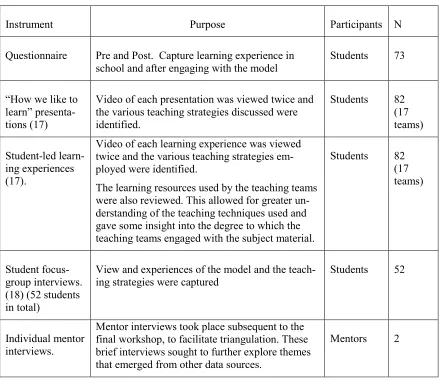
Quantitative data was collected using closed questions on pre and post questionnaires, while qual-itative data collection instruments included open questions on the pre and post questionnaires, semi-structured interviews with both the student participants and the mentors. Additionally, ob-servation data, analysis of the student presentations, and lesson delivery was used. The complete list of instruments and the amount of data collected with each one is itemised in Table 2.
questionnaire included questions about which subjects the students preferred and why. There were also Likert scale questions including statements such as “I am bored in class”, “We work in groups” or “I work things out for myself”. A similar Likert scale appears in the post questionnaire to allow for a comparison of student experience in school and during the workshop. The post questionnaire also asked which parts of the workshop the students found the most difficult and whether knowing they would have to teach their peers was a motivating factor for them. The ma-jority of the questions were taken or adapted from questionnaires used in previous Bridge21 workshops with some questions on student motivation added based on the work of Benware and Deci (1984). The student focus groups took place after the questionnaires and allowed the partici-pants to further discuss their experience during the workshop. There were between two and four participants in each group, and in all but two of the focus groups the participants were from the same team. Questions about whether the participants believed they had learned by teaching, whether they believed they had taught their peers effectively, whether they had learned from their peers, and whether a peer teaching approach could be used in formal education were among the topics discussed.
Table 2 Instrument used and participants in the study
Instrument Purpose Participants N
Questionnaire Pre and Post. Capture learning experience in
school and after engaging with the model Students 73
“How we like to learn” presenta-tions (17)
Video of each presentation was viewed twice and the various teaching strategies discussed were identified.
Students 82 (17 teams)
Student-led learn-ing experiences (17).
Video of each learning experience was viewed twice and the various teaching strategies em-ployed were identified.
The learning resources used by the teaching teams were also reviewed. This allowed for greater un-derstanding of the teaching techniques used and gave some insight into the degree to which the teaching teams engaged with the subject material.
Students 82 (17 teams)
Student focus-group interviews. (18) (52 students in total)
View and experiences of the model and the
teach-ing strategies were captured Students 52
Individual mentor interviews.
Mentor interviews took place subsequent to the final workshop, to facilitate triangulation. These brief interviews sought to further explore themes that emerged from other data sources.
Mentors 2
Data analysis
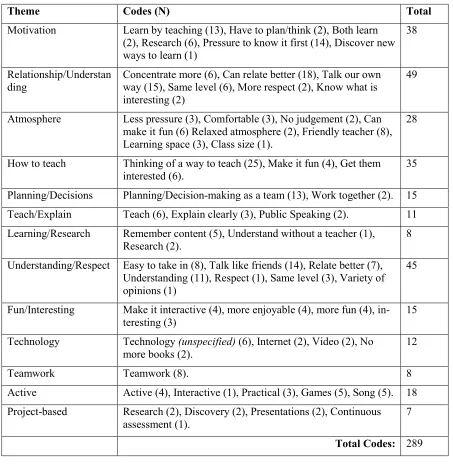
lead author based on a process of generation and reduction of codes. The various answers given or ideas mentioned by students in response to a particular question or when discussing a specific topic were coded and counted. Recurring codes were counted and finally a subset of themes rele-vant to the research questions emerged (Creswell, 2003). The list of themes and codes are pre-sented in Table 3.
Table 3 Summary of Key Themes
Theme Codes (N) Total
Motivation Learn by teaching (13), Have to plan/think (2), Both learn (2), Research (6), Pressure to know it first (14), Discover new ways to learn (1)
38
Relationship/Understan
ding Concentrate more (6), Can relate better (18), Talk our own way (15), Same level (6), More respect (2), Know what is interesting (2)
49
Atmosphere Less pressure (3), Comfortable (3), No judgement (2), Can make it fun (6) Relaxed atmosphere (2), Friendly teacher (8), Learning space (3), Class size (1).
28
How to teach Thinking of a way to teach (25), Make it fun (4), Get them
interested (6). 35
Planning/Decisions Planning/Decision-making as a team (13), Work together (2). 15 Teach/Explain Teach (6), Explain clearly (3), Public Speaking (2). 11 Learning/Research Remember content (5), Understand without a teacher (1),
Research (2). 8
Understanding/Respect Easy to take in (8), Talk like friends (14), Relate better (7), Understanding (11), Respect (1), Same level (3), Variety of opinions (1)
45
Fun/Interesting Make it interactive (4), more enjoyable (4), more fun (4),
in-teresting (3) 15
Technology Technology (unspecified) (6), Internet (2), Video (2), No
more books (2). 12
Teamwork Teamwork (8). 8
Active Active (4), Interactive (1), Practical (3), Games (5), Song (5). 18 Project-based Research (2), Discovery (2), Presentations (2), Continuous
assessment (1). 7
Total Codes: 289
Results
Overall Impact
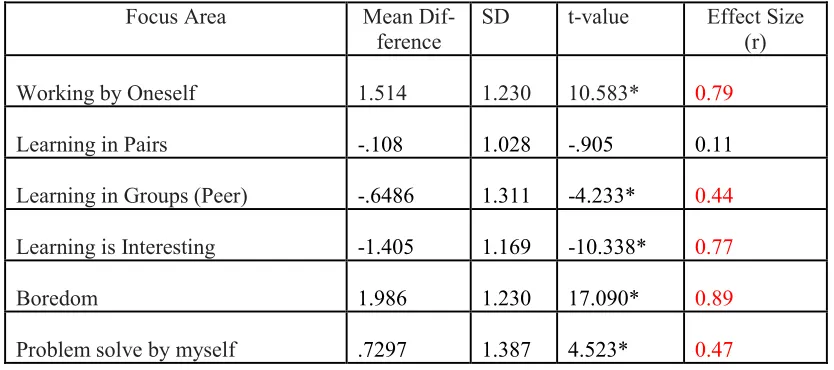
In order to understand the overall student experience at a macro-level, the data from the pre and post implementation surveys were analysed, and Table 4 summarises the results showing average gains across all but one of the variables. For example, pre-implementation the mean response across items measuring the extent to which students found learning boring was 3.35 (Likert scale) post implementation, this had reduced to 1.76, a mean difference of 1.986 as indicated in the third column of the table. A paired t-test of this difference resulted in at t of 17.1 at a significance level of .001, suggesting that the difference is not likely to be an artefact of the sample and can be con-sidered statistically significant. Expressing the mean difference as a standard deviation unit, the effect size of .89 was estimated. Within the framework suggested by L. Cohen, Manion, and Morrison (2011), this represents a substantial effect.
[image:9.612.116.533.336.521.2]Significant differences were found for four other variables: independent learning, working by oneself, problem solving, and learning in groups. For example, data suggest that students who worked in groups in the workshop reported a much better experience as compared to their school experience; the mean response across this item post implementation was 1.84 as compared to 3.35 before the workshop began ( t = -4.233, df =74, p<.001, r=.44). Similarly, students also reported the workshop experience more “interesting” compared to their school experience (t=-10.338, df =74, p<.001). The effect size of .77 would be considered a substantial effect.
Table 4 Pre-Post intervention differences and effect sizes
Focus Area Mean
Dif-ference SD t-value Effect Size (r)
Working by Oneself 1.514 1.230 10.583* 0.79
Learning in Pairs -.108 1.028 -.905 0.11
Learning in Groups (Peer) -.6486 1.311 -4.233* 0.44
Learning is Interesting -1.405 1.169 -10.338* 0.77
Boredom 1.986 1.230 17.090* 0.89
Problem solve by myself .7297 1.387 4.523* 0.47
*P <.001
The students’ feedback on their experience in the Learning Circles workshop was extremely posi-tive. This is based on the post questionnaires, the focus groups, and the mentor interviews. They found this style of learning to be both enjoyable and effective. They described constructivist and constructionist styles of learning when asked to describe how they like to learn and attempted to implement these approaches in their teaching projects. They found it challenging to move beyond the traditional approaches to teaching and learning they usually experience in their own schools but, with some encouragement and support, most teams created innovative, active learning expe-riences for their peers.
How Would Students Like to Learn
re-vealed 18 separate codes, from which five main themes emerged. The students’ ideas on this top-ic focused on technology, teamwork, a project-based approach to learning, being active and a positive atmosphere (see Table 3).
During their presentations many of the students said that they believed these ideas would make for enjoyable and effective learning scenarios. The ideas which were mentioned most often (teamwork, technology, active learning, research) are in keeping with constructivist and construc-tionist theories of education and were typical of many descriptions of 21C learning (Voogt & Pelgrum, 2005). They included teams of students, solving problems, learning through research and discovery, using modern technology, and presenting their work to their peers. A comfortable, modern learning space designed for team-based project work was mentioned by three teams, and a friendly and encouraging facilitator or mentors were proposed by eight teams. One notable fea-ture of the analysis of how the students like to learn is that almost every theme that emerged was an element of the Bridge21 learning model.
Eight teams presented a negative view of schooling characterised by strict teachers and boring books in a “normal” classroom and then contrasted this with a more relaxed atmosphere in a modern, technology-rich learning space with a more informal facilitator leading the class. Team-work, technology, and the atmosphere in the classroom were the most common issues mentioned, along with a desire for an active, project-based approach to learning. Learning through song and continuous assessment, as opposed to one final exam, were also specifically mentioned as ideas favoured by the students.
How Did the Students Teach Each Other?
All of the teams engaged with the process and attempted to develop interesting learning experi-ences. During the first two workshops, eight teams out of nine used PowerPoint presentations as the main element of their learning experience.
In those two workshops, as it became obvious that most of the teams were relying heavily on PowerPoint, they were encouraged to include something more in keeping with their “How we like to learn” presentations to accompany the slides. When challenged, every team came up with at least one learning activity or experience to accompany their presentation and most came up with two or more. One team got their students to complete an online word-search, which, from a learn-ing perspective, was little more than a time-filler, but most teams got their students engaged in some kind of productive work or at least a quiz-style activity to check for understanding/learning. PowerPoint allowed the students to copy and paste material without really engaging with it and then deliver traditional presentations. As one student commented,
“PowerPoint is the easiest way for the teacher, not the best way [for the students to learn]”.
In the final two weeks, in order to avoid this over dependence on PowerPoint, teams were explic-itly told they should not use it as the basis of the learning experience they created.
Adolf Hitler. A lesson about Brazil included Samba lessons for all of the students and the facili-tator!
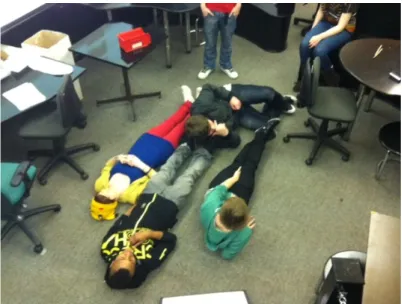
[image:11.612.345.546.210.362.2]A particularly innovative, and kinaesthetic, approach to learning was taken by one team teaching the digestive system. They asked their students to lie on the ground, one at a time, with each one performing the role of a different section of the digestive system. First, someone lay down straight, as the oesophagus. Next, someone curled in a ball at his feet, as the stomach, and so on. A “cheese-burger” made of Play-Doh was then passed through the system, from the oesophagus into the stomach etc. with the person at each stage explaining what their component of the system was doing, e.g., churn up the burger or extract the nutrients (green Play-Doh) from the burger – see Figure 3.
Figure 2: Facebook page for
Neil Armstrong Figure 3: Modelling the digestive system
Limitations of students as teachers
There were a number of factors which reduced the effectiveness of some of the learning experi-ences created. In particular, a lack of presentation skills among some of the students was noted. A few students who had prepared slides turned their backs on their audience or just read aloud from their notes. The students, in general, had very little experience of public speaking and sever-al were obviously nervous, even in speaking to a smsever-all audience of their peers. As students were, at times, at the limit of their knowledge of the subject they were teaching, there were a few factu-al errors in their work, e.g., one group had John F. Kennedy congratulating Neil Armstrong on reaching the moon. This was corrected by one of the “students” in the group. Two teaching teams made small errors: one in describing a slide on Probability, another discussing the physics of light. These were not picked up by the students. On a couple of occasions, the “teachers” attempt-ed to bluff answers to their students’ questions. In these situations, the facilitator encouragattempt-ed them to admit that they didn’t know, or to go and find out, rather than pretend otherwise. A few teams, who had excellent ideas for how their students could learn, did not clearly explain the con-text of a particular item or activity and, as a result, learners did not fully understand what was happening. For example, when a team teaching about Nazi propaganda wanted their students to create a piece of propaganda of their own they asked the learners to make a poster about anything they wanted without any direction about a subject for their poster or how the exercise was to help them understand the nature of propaganda.
[image:11.612.112.325.213.378.2]inter-esting and effective, in the opinion of their peers. To varying degrees, they achieved this goal - particularly when the option to use PowerPoint was taken away.
Support Required
Over fifty-percent of the students stated that the biggest challenge teams faced was finding ways to make the material interesting or fun for their peers. Completing the task on time was men-tioned by four students and general issues in relation to team work, such as working together and making decisions, were also mentioned. Remembering the material was mentioned by five stu-dents with just one student saying she struggled to understand the material without a teacher to explain it. In general, it seems that the students felt that learning the material without a teacher was quite achievable but having to teach it in a fun, interesting way was much harder.
The students’ responses suggest that they enjoyed the workshops and found them both engaging and challenging. They were very positive about the idea of learning by teaching and positive, al-beit less so, about the idea of learning from their peers.
The students were asked what the most challenging part of the whole process was and one over-whelming theme emerged. “Learning by doing” was highly rated in the “How we like to learn” presentations but implementing it, and the other innovative ideas that emerged, was a real chal-lenge for the students. There was unanimous agreement that trying to think up interesting ways to teach the material or find ways to make the material interesting was much more difficult than they had envisaged and that they struggled with “finding a way to make it fun” and “coming up with different ideas to make it interesting”. Two teams mentioned issues with managing the project within their own team as being a problem, and one team mentioned public speaking as being a challenge – although in practice a number of groups struggled with this aspect of the exercise. Interestingly, only one team mentioned learning the material for themselves as a problem.
Mentors
The mentors stated that the students displayed “very high retention of [technical] skills” from previous participation in Bridge21 workshops and that “they were certainly able to learn it [the curriculum content] on their own”. The biggest area where the students needed help was in plan-ning how they would teach. The mentors said that finding “interesting ways to cover it” and “to do it beyond just presentation was the hard bit”. They mentioned that in some cases they needed to pitch in an idea or two to get things moving but once they did that, most of the teams were able to come up with several options.
Student Motivation and Engagement
The students found this style of learning to be interesting and enjoyable, and they were highly motivated throughout the workshops. On a five point scale with 1 representing “Excellent” and 5 representing “Poor”, the 80 students who completed the questionnaire were very positive about the experience, giving an average rating of 1.25. When asked to give reasons for their choice they mentioned the fact that it was fun, that it was interesting, that they felt that they had learned something, that they met and got along with new people, and that they liked being part of a team among other things.
“It was incredibly fun ... also very productive, I learned so many things ... also im-proved my communications skills.”
“We got great work done as well as having fun.”
than the mean of the whole group but still falls between “Average” and “Good” on the scale pro-vided.
One lone student said he was “used to school and didn’t like the sudden learning change”. Most students said that the workshops were “Never” boring and “Always” interesting. This is in contrast with their opinions on their time in school, during which they are bored more often and describe it as “interesting” less often. The workshop experience was considerably more engaging than school.
The students were asked if they would like to take part in further workshops like this one and if they felt that learning a topic in preparation for teaching their peers created a higher level of mo-tivation than learning it for an exam. In both cases, a 99% positive response represents an en-dorsement of the model of learning employed.
Student Learning
The students were assigned a topic to learn, asked to teach their peers that topic, and asked to learn other topics from their peers, all without a domain expert teacher.
Learning without a teacher
In general, the students were very positive about learning in this way. All of the teams said that “it was easy enough to find info” and a few said that while “there were bits we didn’t understand, most of it was okay”. Two teams (both teaching physics) mentioned reaching a limit of what they could understand without any adult help. One team mentioned having to “skim” lots of websites to find the necessary information, some teams divided their topic into sections and each member took a section, while others discussed the topic amongst themselves and “kind of explained it to each other as well, as we understood it.” The students’ ability to filter through large amounts of online information is in keeping with Prensky’s (2001) ideas about “Digital Natives”.
When asked how did they learn the topic they were assigned to teach, 97% replied that they ob-tained the necessary material from the internet. They were not asked explicitly which websites they used but fourteen students mentioned YouTube or other online video sites and four men-tioned playing online games related to their subject. Discussing the topic with their team-mates, attempting to “translate” ideas expressed in, what the students considered to be, “difficult” lan-guage into simpler terms, and creating and revising summary notes in preparation for their learn-ing experiences were also mentioned. The mentors were rarely asked for help with this part of the project and there were only two teams who encountered topics that they could not understand. It should be pointed out that the teams had some flexibility with which parts of their topic they wanted to cover and that some of the students had a level of prior knowledge of the topics they were assigned and may have tended to “play it safe” in terms of what they would teach. That said, based on facilitator and mentor observation, the teams were generally very engaged with this part of the project and almost every student said they had learned about the subject their team was teaching.
Learning by teaching
The “digestive system” activity shown in Figure 3 lasted 5-6 minutes. In that time, the teaching team described the roles of the four types of teeth, saliva, the oesophagus, peristalsis, the liver, the stomach, bile, the small intestine, and the large intestine as they got their students to model the system themselves with the Play-Doh “food”. Three members of the team took turns explain-ing the various elements and this was all done without reference to any slides or notes.
Another team, teaching about probability, introduced their students to terminology such as “chance”,”unlikely”,”probable” and “number of possible outcomes”. They next described the probabilities involved in events such as a coin-flip, rolling a die, or choosing a specific colour of marble from a mixed bag. Finally, they explained the Fundamental Principle of Counting using various examples.
In running these activities, the students demonstrated a clear understanding of the material they had been asked to learn and teach. Their comments in the focus groups reinforce this finding.
“I could (now) write a page about the digestive system whereas before I could write a paragraph.”
“I didn’t understand it before but I know all about it now” “I’ll remember it, I really will.”
When asked why they had learned so well, they mentioned feeling under pressure to learn the material to teach it and that working through the process of creating and delivering a learning ex-perience really forced them to engage with their topic. Many teams mentioned having to think about the material so they could simplify it and put it into their own words. The students reported that peer relationships and a shared level of language were advantageous in teaching each other. They also reported that the atmosphere created by peer teachers was comfortable, fun, and al-lowed them to ask questions, with less fear of judgement than in a normal classroom setting. A small number of students disagreed, citing a lack of discipline without a teacher to maintain order as being a problem. One student pointed out that not all students are at the same level and that it is difficult for a “weaker” student to try and teach a “smarter” student. Overall though, most students felt that creating and delivering lessons for their peers was an effective way to learn.
Learning from your peers
The students were positive about the experience of being taught by their peers, but not as strongly as with learning by teaching. 83% said that learning from their peers was a good way to learn. When asked, in team interviews, if they had learned from their peers, two main ideas emerged. 50% of the teams said “Yes”, while the other 50% gave more reserved, “Yeah, a bit”, or a close variation of same. The teams who said “Yes” felt that they learned what the other team tried to teach them. The “partial learning” answers were from teams who felt they only understood some of what was presented to them.
Most students were very positive about peer learning in general, stating that “you understand more” and “you don’t have to use ‘big language’” but a few (N < 10) felt that they “didn’t learn much” and that “there was a lot of information to take in.” It was mentioned that the teaching dents “need to prep well” and that they could explain well “if they know” the material. Other stu-dents mentioned “lack of experience” or discipline issues as potential problems.
Discussion
This research study set out to explore peer teaching and learning without a subject expert teacher by examining an activity where teams of second level students are required to create a learning experience for their peers, who were students of a similar age and year group.
The following research questions were addressed.
• What did students say about how they would like to learn?
• How did students teach each other?
• What support did students require in learning and teaching without a domain ex-pert teacher?
• Were the students creating, delivering and attending peer learning sessions en-gaged and motivated to learn?
• Did students learn without a domain expert teacher?
By exploring these questions, the authors sought to investigate the potential for this type of learn-ing to be used in more formal educational settlearn-ings.
The findings suggest that students would like to learn in a collaborative and constructivist man-ner. In describing how they learn in school, students reflected McGarr’s (2009) claims about the limited impact that modern ICT has made in the classroom, and when given the chance to discuss how modern classrooms could be, they included many of the ideas frequently found in the litera-ture as part of a 21C pedagogy, such as teamwork, technology, project work, and problem solving (Voogt & Pelgrum, 2005). A “how we like to learn” activity could be valuable with various dent groups both in helping students and teachers understand one another and in encouraging stu-dents to think about their own learning.
The study suggests that, despite an initial tendency to “teach as they have been taught”, students are capable, with some encouragement, of creating innovative 21C learning experiences for their peers. In the process, they created artefacts, both digital and physical, and developed new learning activities. Encouragement to go beyond the familiar ground of lecture-style presenting of infor-mation was vital in helping the teams to develop the varied learning experiences they created. The students needed help and support at various points in this project. The facilitator and mentors were on hand throughout to offer encouragement and to help the teams make decisions and stay focussed. This is typical of all Bridge21 student workshops.
There were two areas in which the students needed particular help during these workshops. The first was in coming up with interesting ways to cover the material. The teams said that this was the hardest part of the whole project. Whether trying to take a subject that they did not find inter-esting and make it so for their peers or just trying to avoid giving one long presentation, this was the area where the teams felt the most thought and effort was required. The mentors also com-mented that it was at this stage that they felt the teams required the most help, whether that in-volved encouragement or offering an idea or two to get the teams started. It was a challenge for the teams but it was one they engaged with and were, in most cases, able to overcome. The three sets of data supported each other in these findings and the triangulation allows some confidence in the conclusions drawn. As the students technical skills increase, there may be less help re-quired with the “creating” portion of a project but in the “planning” phase (or phases) more help was needed. Once the students are comfortable with “How” to complete their project, or at least confident that they can work it out, the focus can shift to “What” and “Why” they want to say or create.
trained teacher and as a result some of the learners were confused at times as to what they were supposed to do or why they were supposed to do it. This lack of experience as teachers and lack of confidence in making a presentation are common attributes in learners of this age group and are issues which are not usually addressed in the classroom. Further exposure to learning experi-ences as described here would, however, directly help to develop these skills.
This study took place in Bridge21. The facilities available and the style of learning employed were key factors in being able to run this activity. Physical resources, such as whiteboards, com-puters with internet access for research and creating digital artefacts, and the flexible design of the learning space that allowed for the teams to work as they saw fit, were all necessary elements of this workshop. The students had all previously experienced working in this environment and some referred to “knowing how to work in a team” as an important prerequisite to this activity. Students who were unable to make decisions together, take responsibility for their work, trust each other, and work to a deadline would struggle with this style of learning but, as with the communication skills mentioned previously, this style of learning would help develop those col-laborative skills.
The students were, in general, highly motivated and engaged during this project. This was indi-cated by several complimentary data sources which suggests a good level of reliability. Student responses on the questionnaire and in the interviews show that they enjoyed the technology-mediated team-based project work they have done in Bridge21 in general, and the challenge of these workshop in particular. They rated the work they were doing as “Interesting” most of the time and very many students (N= 67) said they were never bored during the workshops. Over-whelmingly, they said they would like to take part in further workshops, like this one, if the op-portunity arose and that knowing they would have to teach their peers was a big factor in motivat-ing them to learn their topic for themselves.
The participants in this study believed they were able to learn without an expert teacher to teach them. They said they were able to find relevant information online and learn it whether working alone or with their teammates. Standardised tests may have provided a more quantifiable measure of the students’ learning but were deemed beyond the scope of this study. Only one team said that understanding the content was a problem, and the mentors agreed that most teams were able to find and understand the relevant information without any help. The structured team-based ap-proach used in Bridge21, in combination with learning for and by teaching, allows students to take ownership of their own learning and help develop the motivation required to learn. This is in keeping with the findings of Mitra and Dangwal (2010) about what motivated students can learn, even without a domain expert to teach them.
The findings support the idea that students can learn by teaching their peers. The students found that both the preparation and delivery of lessons was an effective way to learn both in terms of motivation and engagement with the material. This is in keeping with the work of Leung, Marsh, and Craven (2009), who claimed that peer teaching was an effective learning technique with ben-efits for both “teachers” and “students”, and Benware and Deci (1984), who found that students were more motivated to learn for teaching than for an examination. This is not to suggest that col-laborative self-teaching and peer teaching should replace domain expert teachers but that these teaching methods could form part of a varied teaching strategy.
that peers would have a good sense of what would be fun or interesting for each other. This is in keeping with the findings of Leung et al. (2009). When asked about the possibility of teaching their peers in school, four students mentioned that a teacher would still be needed to maintain or-der and one suggested that some students might struggle to teach a student they perceived as “smarter” than themselves.
It seems that learning for teaching and learning by teaching are very effective. Learning from peers was less successful in this study, but it is clear that it has an important role to play in this context, as it motivates the peer teachers to learn their subject and this learning is reinforced by preparing and delivering the learning experience.
The students found this workshop to be an effective and enjoyable way to learn. Their feedback was very positive in the interviews, questionnaires, and informal discussions with the mentors. They were highly motivated, felt they had learned well, and were keen to take part in further workshops if they could.
Finally, this study supports research which argues for the potential for learning without a teacher using peer teaching, technology, and teamwork. As the students said:
“....before you teach you have to double make sure you know what you’re talking about....”
“....when you’re teaching someone something, you tend to learn yourself.”
Conclusions
Globally, our education systems are at an inflection point; the rapidly changing economic and social environment in which we live and, more importantly, in which our children will live and work demands different skills and knowledge of productive citizens. Furthermore, a dominant feature of the emerging world our children will inhabit is the role and use of technology in the broadest sense of its meaning. Technology is, and will continue to be, omnipresent and ubiqui-tous. If the last five years is used as a benchmark we can only begin to imagine the extent that technology will impact on our lives over the next five years (Hallisey & Marshall, 2015). In this context, there is a need to equip students, teachers, and schools for a rapidly changing world driv-en by emerging technologies. Moreover, we need to challdriv-enge our assumption about the nature of knowledge. As Bransford noted, it is easy to fall into the trap of assuming that all schools should teach what we learned when we grew up (Bransford, Darling-Hammond, & LePage, 2000). Furthermore, assessment of student learning remains one of the greatest challenges underlying the transformation of our education systems. If we are to explore new models of learning, then we must explore alternative models of assessment which in turn incorporate technology, teamwork, and peer learning (assessment). Only then will we build balanced learning environments that in-corporate a wide range of learning experiences for students.
Limits of this Study and Further Work
The study took place in an out-of-school context with students from several schools. This allowed the students to start with a “clean slate” in terms of their perceptions and expectations of their teammates and of their relationship with the facilitator and mentors at Bridge21. In a more formal environment, student attitudes may be affected by their relationships with teachers, the school environment in general, and their relationships with their classmates. These factors may affect the success of an exercise like this in such an environment.
outside the scope of this study. This was due to time constraints and the fact that, to make the tests meaningful, it would have been necessary to be very specific about the content the students should cover. Also, pre and post testing may have influenced how the students would try to teach each other. Instead, the students’ opinions on the effectiveness of the learning experiences were the primary source of data used. Centra and Gaubatz (2005) state that “when a student rates over-all instruction as effective, there is a correspondingly high perception of learning, as well as ‘ac-tual’ learning as measured by course exams (Centra, 1977; P. A. Cohen, 1981; Feldman, 1989; Frey, 1978; Marsh, 1987)”. The topics assigned to some of the teams in this case were quite broad. While this allowed students some freedom to choose which areas they would teach, it may have allowed them to avoid more difficult areas. A more detailed brief may have challenged the students to learn all aspects of the subject and allow for more meaningful measurement of their learning.
This study has focused on the overall cohort as a single case but there may be value in focusing on the experience of a single team or teams taking part in future workshops.
Finally it is worth noting that the exposure of participants to different models of learning was lim-ited to their experience in school and partaking in Bridge21 workshops. All the schools attended by the students would be categorised as mainstream, focussing on traditional models of learning. The Bridge21 workshops, in contrast, take place in an out-of-school environment and are not leading to any formal examination or assessment. The participants were partly self-selecting for this workshop as they were voluntarily returning for a Bridge21 workshop and hence were fa-vourably disposed to the model. From the cohort of over 200 that completed the original Bridge21 workshop, a small number of students were ruled out due to discipline or attendance problems in school. From this group, the 82 participants were randomly chosen, while maintain-ing an even gender balance and a fair distribution of places among the various participatmaintain-ing schools. The students had the option not to attend but all available students that were offered a place chose to take it.
This research is part of a larger project which is investigating the use of the Bridge21 model in mainstream classrooms for teaching the standard curriculum. The findings from this study cor-roborate the view that team work (supported by technology) is an under-utilised approach in schools and, along with the pedagogy and process discussed in this paper, have much to offer.
References
Abbott, J., & Ryan, T. (2000). The unfinished revolution. Network Educational Press.
Beasley, C. (1997). Students as teachers: The benefits of peer tutoring. In R. Pospisil & L. Willcoxson (Eds.), Learning Through Teaching. Proceedings of the 6th Annual Teaching Learning Forum, 21-30. Murdoch University, February 1997. Perth: Murdoch University.
Bénard, D. (2002). A method of non-formal education for young people from 11 to 15. In G. González (Ed.), Handbook for leaders of the Scout section. Geneva, Switzerland: World Scout Bureau. Benware, C., & Deci, E. L. (1984). Quality of learning with an active versus passive motivational set.
American Educational Research Journal, 21, 755–765.
Bergmann, J., & Sams, A. (2012). Flip your classroom: Talk to every student in every class every day. In-ternational Society for Technology in Education
Blatchford, P., Kutnick, P., Baines, E., & Galton, M. (2003). Toward a social pedagogy of classroom group work. International Journal of Educational Research, 39, 153-172.
Centra, J. A. (1977). Student ratings of instruction and their relationship to student learning. American Ed-ucational Research Journal, 14(1), 17-24.
Centra, J. A., & Gaubatz, N. B. (2005). Student perceptions of learning and instructional effectiveness in college courses. Retrieved from http://www.ets.org/Media/Products/perceptions.pdf.
Cohen, L., Manion, L., & Morrison, K. (2011). Research methods in education. Routledge.
Cohen, P. A. (1981). Student ratings of instruction and student achievement: A meta-analysis of multisec-tion validity studies. Review of Educational Research, 51(3), 281-309.
Cohen, P. A., Kulik, J. A., & Kulik, C. C. (1982). Education outcomes of tutoring: A meta-analysis of find-ings. American Educational Research Journal, 19, 237-248.
Conneely C., Lawlor J., & Tangney B. (2015). Technology, teamwork and 21st Century skills in the Irish classroom. In D. Butler, K. Marshall, & M. Leahy (Eds.), Shaping the future: How technology can lead to educational transformation. The Liffey Press.
Creswell, J. W. (2003). Research design: Qualitative, quantitative, and mixed methods approaches (2nd ed.). Thousand Oaks, CA: Sage Publications.
Dillenbourg, P., & Fischer, F. (2007). Basics of computer-supported collaborative learning. Zeitschrift für Berufs- und Wirtschaftspädagogik, 21, 111-130.
Felder, R. M. (1993). Reaching the second tier – Learning and teaching styles in college science education.
Journal of College Science Teaching, 78(7), 674-681.
Feldman, K. A. (1989). The association between student ratings of specific instructional dimensions and student achievement: Refining and extending the synthesis of data from multisection validity studies.
Research in Higher Education, 30, 583-645.
Frey, P. W. (1978). A two-dimensional analysis of student ratings of instruction. Research in Higher Edu-cation, 9, 69-91.
Galton, M., Hargreaves, L., & Pell, T. (2009). Group work and whole-class teaching with 11- to 14-year-olds compared. Cambridge Journal of Education, 39(1), 119-140.
Gerstein, J. (2011). The flipped classroom model: A full picture. Retrieved from
http://usergeneratededucation .wordpress.com/2011/06/13/the-flipped-classroom-model-a-full-picture/ Goldschmid, B., & Goldschmid, M. L. (1976). Peer teaching in higher education: A review. Higher
Educa-tion, 5(1), 9-33.
Goodlad, S. & Hirst, B. (Eds.). (1990). Explorations in peer tutoring. Blackwell Education, Oxford. Hallisey, M, & Marshall, K. (2015). A time for reflection, perspective and celebration? In D. Butler, K.
Marshall, & M. Leahy (Eds.), Shaping the future: How technology can lead to educational transfor-mation. The Liffey Press.
Harel, I. E., & Papert, S. E. (1991). Constructionism. Ablex Publishing
Johnson, D., & Johnson, R. (1987). Learning together and alone. Englewood Cliffs, NJ: Prentice-Hall. Jonassen, D. H., Peck, K. L., & Wilson, B. G. (1999). Learning with technology: A constructivist
perspec-tive. Upper Saddle River, NJ: Merrill/Prentice Hall.
King, A. (1993). From sage on the stage to guide on the side. College Teaching, 41(1), 30-35. Retrieved from http://www.jstor.org/stable/27558571
Knobe, M., Münker, R., Sellei, R. M., Holschen, M., Mooij, S. C., Schmidt‐Rohlfing, B., ... & Pape, H. C. (2010). Peer teaching: A randomised controlled trial using student‐teachers to teach musculoskeletal ultrasound. Medical Education, 44(2), 148-155.
Kovacic, Z. (2004). A comparison of learning and teaching styles - Self-perception of IT students. Issues
Lawlor, J., Conneely, C., & Tangney, B. (2010). Towards a pragmatic model for group-based, technology mediated, project oriented learning - An overview of the B2C model. Paper presented at the TechEduca Conference, Athens, 2010. Retrieved from http://www.bridge21.ie/wp-content/uploads/2011/04/B21-Model.pdf.
Leung, K. C., Marsh, H. W., & Craven, R. G. (2009). Are peer tutoring programs effective in promoting academic achievement and self-concept in educational settings: A meta-analytical review. SELF Re-search Centre, University of Western Sydney, Australia
Lou, Y., Abrami, P. C., Spence, J. C., Poulsen, C., Chambers, B., & D’Apollonia, S. (1996). Within-class groupings: A meta-analysis. Review of Educational Research, 66(4), 423-458.
Marsh, H. W. (1987). Students’ evaluations of university teaching: Research findings, methodological is-sues, and directions for future research. International Journal of Educational Research, 11(3), 253-388.
McGarr, O. (2009). The development of ICT across the curriculum in Irish schools: A historical perspec-tive. British Journal of Educational Technology, 40(6), 1094-1108.
Mitra, S., & Dangwal, R. (2010). Limits to self-organising systems of learning—The Kalikuppam experi-ment. British Journal of Educational Technology, 41(5), 672-688.
Ng, E. M. W. (2008). Engaging student teachers in peer learning via a blended learning environment. Jour-nal of Issues in Informing Science and Information Technology, 5, 326–334.
Harel, I. E., & Papert, S. E. (1991). Constructionism. Ablex Publishing.
Poindexter, S. (2003). Assessing active alternatives for teaching programming. Journal of Information Technology Education, 2, 257-266. Retrieved from http://www.jite.org/documents/Vol2/v2p257-265-25.pdf
Prensky, M. (2001). Digital natives, digital immigrants Part 1. On the Horizon, 9(5), 1-6.
Prensky, M. (2011). A huge leap for the classroom: True peer-to-peer learning, enhanced by technology.
Retrieved from http://marcprensky.com/writing/Prensky-EDTECH-LearningCatalytics-Nov-Dec-2011-FINAL.pdf
Strauss, A., & Corbin, J. (1998). Basics of qualitative research: Techniques and procedures for developing grounded theory. Thousand Oaks, CA: Sage.
Tangney, B., E. Oldham, Conneely, C., Barrett, S., & Lawlor, J. (2009). Pedagogy and processes for a computer engineering outreach workshop – the B2C model. IEEE Transactions on Education 2010, 53(1), 53-60.
Tucker, B. (2012). The flipped classroom. Retrieved from http://educationnext.org/files/ednext_20121_BTucker.pdf
Biographies
Kevin Sullivan is Development Manager at Bridge21, an education research project based in the Centre for Research in IT in Education
Centre for Research in IT in Education (CRITE) - a joint initiative be-tween the School of Education and the School of Computer Science & Statistics) - in Trinity College Dublin. He holds a B.Sc. in Applied Science (Computer Science and Software Engineering) from the Dub-lin Institute of Technology and M.Sc. in Technology & Learning from the University of Dublin (Trinity College).
Dr. Kevin Marshall is the Head of Education, Microsoft Ireland. He is a Visiting Research Fellow in Centre for Research in IT in Educa-tion. He has represented industry on a number of Irish education com-mittees such as the Teaching Council and the National Council of Cur-riculum Assessment (NCCA). He serves on a number of boards in-cluding: the Rehab Group, Marino Institute of Education and the Lear-novate Research Centre based in in Trinity College Dublin. Prior to working in Ireland, he worked in Boston Public Schools in the Office of Research, Assessment and Evaluation where he ran a number re-search projects focusing on developing new performance assessment and statistical models to enhance student performance. He has a BA in Psychology from the National University of Ireland, an M.Sc. from the University of Hull and a Ph.D. from Boston College.