Do we need bigram alignment models? On the effect of alignment quality
on transduction accuracy in G2P
Steffen Eger Text Technology Lab
Goethe University Frankfurt am Main [email protected]
Abstract
We investigate the need forbigram align-ment models and the benefit of super-vised alignment techniques in grapheme-to-phoneme (G2P) conversion. Moreover, we quantitatively estimate the relation-ship between alignment quality and over-all G2P system performance. We find that, in English, bigram alignment models do perform better than unigram alignment models on the G2P task. Moreover, we find that supervised alignment techniques may perform considerably better than their unsupervised brethren and that few manu-ally aligned training pairs suffice for them to do so. Finally, we estimate a highly significant impact of alignment quality on overall G2P transcription performance and that this relationship is linear in nature. 1 Introduction
Grapheme-to-phoneme (G2P) conversion is the problem of converting a string of letters into a string of phonetic symbols. Closely related to G2P are other string transduction problems in nat-ural language processing (NLP) such as transliter-ation (Sherif and Kondrak, 2007), lemmatiztransliter-ation (Dreyer et al., 2008), and spelling error correc-tion (Brill and Moore, 2000). The classical learn-ing paradigm in each of these settlearn-ings is to train a model on pairs of strings {(x,y)} and then to evaluate model performance on test data. While there are exceptions (e.g., (Rao et al., 2015)), most state-of-the-art modelings (e.g., (Jiampojamarn et al., 2007; Bisani and Ney, 2008; Jiampojamarn et al., 2008; Jiampojamarn et al., 2010; Novak et al., 2012)) view string transduction as a two-stage process in which string pairs (x,y) in the train-ing data are first aligned, and then a subsequent (e.g., sequence labeling) module is learned on the aligned data.
ph oe n i x
f i n I ks
Table 1: Sample monotone many-to-many align-ment betweenx= phoenix andy=finIks.
State-of-the-art alignments in G2P are charac-terized by the following properties:
(i) Alignments aremonotonein that the ordering of characters in input and output sequences is preserved by the alignments. Furthermore, they aremany-to-manyin the sense that sev-eralx sequence characters may be matched up with severaly sequence characters as il-lustrated in Table 1.
(ii) The alignment is alatent variableand learnt in an unsupervised manner from pairs of strings in the training data.
(iii) The unsupervised alignment models are un-igram alignmentmodels insofar as the over-all score that the alignment model assigns an alignment is the same for all orderings of the matched-up subsequences (context indepen-dence).
To illustrate point (iii), consider, in the field of lemmatization, the case of aligning an inflected word form with the extended infinitive in German, such asabsagt (‘rejects’) withabzusagen(‘to re-ject’). Critically, the insertion-zu- appears in in-fixal position and a plausible alignment might be as in Table 2. Then, correctly aligning certain
a b s a g t
a b zu s a g en
Table 2: Alignment between absagen and
abzusagen. Empty string denoted by.
analogous forms such as zusagt (‘accepts’) with
their corresponding extended infinitivezuzusagen
(‘to accept’) is beyond the scope of a unigram alignment model since this cannot distinguish the linguistically correct alignment from the following linguistically incorrect alignment
z u s a g t
zu z u s a g en precisely because it has no notion of context.
In this work, we firstly address bigram align-ment models in G2P. We investigate whether there are phenomena in G2P that require bigram align-ment models and, more generally, whether bigram alignment models produce better alignments — with respect to a human gold standard — than un-igram alignment models within the G2P setting. We do so,secondly, in asupervisedsetting where the model learns from gold-standard alignments. While this may seem an odd scenario at first sight, modern alignment toolkits in the related field of machine translation typically include the possibil-ity to learn both in a supervised and unsupervised manner (Liu et al., 2010; Liu and Sun, 2015). The rationale behind supervised learning models may be that they perform better than unsupervised models, and if alignment quality has a large impact upon subsequent string translation performance, then a supervised model may be a suitable alterna-tive.Thirdly, we investigate how alignment qual-ity affects overall G2P performance. This allows us to address whether it is worthwhile to work on better alignment models, which bigram and supervised alignment models promise to be. To our knowledge, all three outlined aspects of align-ments — bigram models, supervised learning, and
systematicallyestimating the relationship between alignment quality and overall string transduction performance — are novel in the G2P setting and its related fields as outlined; however, see also the related work section.
This work is structured as follows. Section 2 presents definitions and algorithms for uni- and bi-gram alignment models. Section 3 surveys related work. Section 4 presents our data and Section 5 our experiments. We conclude in Section 6. 2 Uni- and bigram alignment models We first formally define the problem of aligning two strings xandy over arbitrary alphabets in a
monotone and many-to-many manner. Let `x = |x| and`y = |y|denote the lengths ofx andy, respectively. LetN = {0,1,2, . . .}, and letS ⊆
N2\{(0,0)}be a set defining the valid match-up operations betweenxcharacters andycharacters. In other words, when(s, t) ∈ S, then this means we allow matches of subsequences ofxof length sand subsequences ofyof lengtht.1
It is convenient to define a monotone many-to-many alignment ofxandyas a2×k(fork≥1 ar-bitrary) nonnegative integer matrixAx,y ∈ N2×k satisfying Ax,y1k =
`x `y
, i.e., the two rows of Ax,y sum up to the lengths of the respective strings,2 and where each column ofAx,y lies in
S. For any such alignment, we let(x1, . . . ,xk)be the corresponding induced segmentation ofxand
(y1, . . . ,yk) be the corresponding induced seg-mentation ofy.
Example. For any S ⊇ {(1,1),(1,2),(2,1)}, the alignment of x = phoenix and y = finIks shown in Table 1 may be represented by the ma-trixAx,y=
2 2 1 1 1 1 1 1 1 2
. The correspond-ing induced segmentations are (ph,oe,n,i,x) and (f,i,n,I,ks).
LetAS(x,y)denote the class of all alignments ofxandy. We call a functionf :AS(x,y)→R analignment model. We call an alignment model f aunigram alignment modeliff takes the form, for anyAx,y∈ AS(x,y),
f(Ax,y) = k X
i=1
sim1(xi,yi) (1)
where sim1 is an arbitrary (real-valued) similar-ity function measuring similarsimilar-ity of two subse-quences. We call an alignment modelf abigram alignment modeliff takes the form
f(Ax,y) = k X
i=1
sim2
(xi,yi),(xi−1,yi−1)
(2) wheresim2is an arbitrary (real-valued) similarity function measuring similarity of successive pairs of subsequences.
Example. Letsim1(u,v)be equal to|u| · |v|and let funi(Ax,y) be as in Eq. (1). Then, funi is a
unigram alignment model that assigns the score
1This is sometimes denoted in the mannerM-N(e.g.,3
-2, 1-0), indicating thatM characters of one string may be matched up withN characters of the other string. Analo-gously, we could write heres-trather than(s, t).
1 + 1 + 0 + 1 + 1 + 1 + 2 = 7to the alignment given in Table 2.
Example. Let sim2 (u,v),(u0,v0) = (|u| · |v|)|v0|
if|u| = |u0| −1 oru = vand −2
oth-erwise. Letfbi(Ax,y)be as in Eq. (2). Then,fbi
is a bigram alignment model assigning the score
(1·1)0+ (1·1)1+ (0·2)1+ (1·1)2+ (1·1)1+
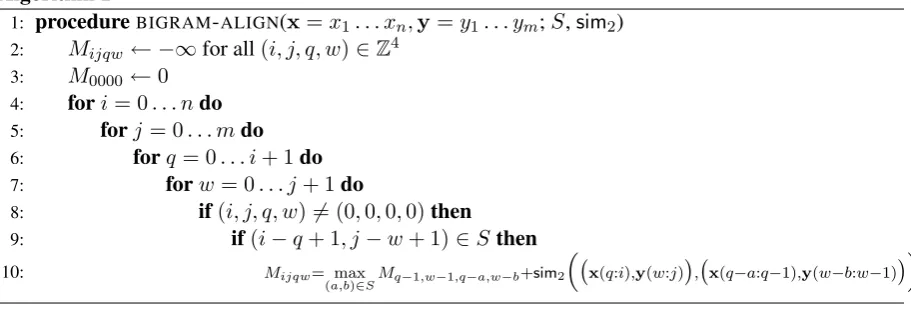
(1·1)1−2 = 3to the alignment in Table 2. In statistical alignment modeling, the task is to find an optimal alignment (i.e., one with maxi-mal score) given strings x and y and given the alignment modelf. Whenf is a unigram model, this can be solved efficiently via dynamic pro-gramming (DP). When f is a bigram alignment model, then finding the optimal alignment can still be solved via DP, by introducing a variable Mijqw denoting the score of the best alignment ofx(1 : i) andy(1 : j) that ends in the match-up of x(q : i) with y(w : j).3 The variable
Mijqw satisfies a recurrence leading to a DP al-gorithm, shown in Algorithm 1. The actual align-ment can be found by storing pointers to the maxi-mizing steps taken. Running time of the algorithm isO(`2
x`2y|S|). Note also that the sketched algo-rithm is supervised insofar as it assumes that the similarity valuessim2(·,·) are known. Typically, such alignment algorithms can be converted into unsupervised algorithms in which similarity mea-suressimare learnt iteratively, e.g., in an EM-like fashion (cf., e.g., Eger (2012), Eger (2013)); how-ever, in this paper, we only investigate the super-vised base version as indicated.
3 Related work
Monotone alignments have a long tradition in NLP. The classical Needleman-Wunsch algo-rithm (Needleman and Wunsch, 1970) computes the optimal alignment between two sequences when only single character matches, mismatches, and skips are allowed. It is a special case of the unigram model (1) for which S =
{(1,0),(0,1),(1,1)} and sim1 takes on values from {0,−1}, depending on whether compared subsequences match or not. As is well-known, this alignment specification is equivalent to the edit distance problem (Levenshtein, 1966) in which the minimal number of insertions, deletions and substitutions is sought that transforms one string
3We denote byx(a : b)the substringx
axa+1· · ·xbof
the stringx1x2· · ·xt.
into another. Substring-to-substring edit oper-ations — or equivalently, (monotone) many-to-many alignments — have appeared in the NLP context, e.g., in Deligne et al. (1995), Brill and Moore (2000), Jiampojamarn et al. (2007), Bisani and Ney (2008), Jiampojamarn et al. (2010), or, significantly earlier, in Ukkonen (1985), V´eronis (1988). Learning edit distance/monotone align-ments in an unsupervised manner has been the topic of, e.g., Ristad and Yianilos (1998), Cot-terell et al. (2014), besides the works already men-tioned. All of these approaches are special cases of our unigram model — i.e., they consider particular S (most prominently,S = {(1,0),(0,1),(1,1)}) and sim1.4 Eger (2015b), Yao and Kondrak
(2015), and Eger (2015a) generalize to alignments of multiple strings, but likewise only consider un-igram alignment models in their experiments.
Probably the most closely related work to ours is Jiampojamarn and Kondrak (2010). There, older and specialized alignment techniques such as ALINE (Kondrak, 2000) (as well as partly heuristic/semi-automatic alignment methods) are compared with variants of the M2M alignment algorithm, which we also survey. This work does not consider supervised alignments or bigram alignments, as we do. Moreover, Jiampojamarn and Kondrak (2010) also evaluate the impact of alignment quality on overall G2P system accuracy by running a few experiments, finding that better alignment quality does not always translate into better G2P accuracy, but that there is a “strong correlation” between the two. We more thorougly investigate this question, using, arguably, more heterogeneous aligners, and many more experi-ments. We also quantitatively estimate how align-ment quality influences G2P system accuracy on two different languages via linear regression.
Goldwater et al. (2006) study the effect of context in (unsupervised) word/sequence seg-mentation, which may be considered the one-dimensional specialization of sequence alignment, using a Bayesian method. They find that bigram models greatly outperform unigram models for their task.
Of course, our study is also related to the field of machine translation and its studies on the
rela-4In Cotterell et al. (2014), context influences alignments,
Algorithm 1
1: procedureBIGRAM-ALIGN(x=x1. . . xn,y=y1. . . ym;S,sim2) 2: Mijqw ← −∞for all(i, j, q, w)∈Z4
3: M0000 ←0 4: fori= 0. . . ndo 5: forj = 0. . . mdo
6: forq= 0. . . i+ 1do 7: forw= 0. . . j+ 1do
8: if(i, j, q, w)6= (0,0,0,0)then
9: if(i−q+ 1, j−w+ 1)∈Sthen
10: Mijqw= max
(a,b)∈SMq−1,w−1,q−a,w−b+sim2
x(q:i),y(w:j), x(q−a:q−1),y(w−b:w−1)
tionship between alignment quality and translation performance (Ganchev et al., 2008). In machine translation, the monotonicity assumption of string transduction does typically not hold, however, ren-dering alignment and translation techniques differ-ent and more heuristic in nature.
4 Data and systems
4.1 Data
For English, we conduct experiments on the Gen-eral American (GA) variant of the Combilex data set (Richmond et al., 2009). This contains about 128 000 grapheme-phoneme pairs as exemplified in Table 3. Importantly, Combilex provides gold-standard alignments, which we will make use of for the supervised alignment models as well as for measuring alignment quality. For German, we
ran-Grapheme string Phoneme string g-e-n-e-r-a-l dZ-E-n-@-r-@-l p-r-o-b-a-t-ion-a-r-y p-r-@U-b-eI-S-n=-E-r-i
w-oo-d-e-d w-U-d-@-d
[image:4.595.73.529.73.228.2]M-u-r-m-a-n-s-k m-U@-r-m-A-n-s-k
Table 3: Sample grapheme-phoneme string pairs in Combilex, using Combilex notation for the phoneme strings. Gold-standard alignments indi-cated in an intuitive manner.
domly extract 3 000 G2P string pairs from CELEX (Baayen et al., 1995). We had a native speaker manually align them so that gold standard align-ments are available here, too. Both data sets con-tain quite complex match-ups of character subse-quences such as (2,3) as in Englishs-oi-r-ee-s /s-wOA-r-P-z or (4,1) as in w-eigh-t/w-P-t but the majority of match-ups are of type (1,1), (2,1), and, to a lesser degree, (1,2) and (3,1).
4.2 Alignment toolkits/models
The M2M aligner (Jiampojamarn et al., 2007), which is based on EM maximum likelihood es-timation of alignment parameters, is the classi-cal unsupervised unigram many-to-many aligner in G2P. As has been pointed out (Kubo et al., 2011), M2M greatly overfits the data.5 This
means that when the M2M aligner is given the freedom to align two sequences without restric-tions, it matches them up as a whole. The rea-son is that a (probabilistic) unigram alignment model adds log-probabilities of matched-up sub-sequences, which, if not appropriately corrected for, makes alignments with few match-ups a pri-ori more likely than alignments with many match-ups, when probabilities of individual match-ups are uniformly or randomly initialized (as is typi-cally the case for EM maximum likelihood esti-mation in unsupervised models). To address this, M2M must artifically restrain, in our language, the setS to be{(1,1),(1,2),(2,1)}. In contrast, the
Mpaligner(Kubo et al., 2011) introduces a prior (or penalty) in the alignment model which favors ‘short’ matches(s, t)over ‘long’ ones. Finally, the
Phonetisaurusaligner (Novak et al., 2012) mod-ifies the M2M aligner by adding additional soft constraints.
Our own alignment model is, as indicated, su-pervised. We implement a unigram alignment model where we specifysim1(u,v)as
α·logp((u,v)) +β·logp((|u|,|v|)) +γ·logp(u) +δ·logp(v).
Here, logp(z)denotes the log-probability — esti-mated from the training data — of observing the
5See also the discussion in (Goldwater et al., 2006) for the
objectz, andα,β, γ andδ are parameters. This specification says that the subsequencesu andv
are similar insofar as (i)uandvhave been paired frequently in the training data, (ii) the length ofu
and the length ofv have been paired frequently, (iii)/(iv) u/v by itself is likely. We refer to this unigram alignment model as uniα,β,γ,δ. We also implement a bigramalignment model where we specifysim2 (u,v),(u0,v0)as
α·logp (u,v)|(u0,v0) +β·logp (|u|,|v|)|(|u0|,|v0|) +γ·logp u|u0+δ·logp v|v0.
Here, logp(z|z0)denotes the logarithm of the
con-ditional probability of observing the objectz fol-lowing the objectz0. We refer to this bigram
align-ment model asbiα,β,γ,δ.
4.3 Transduction systems
We use two string transduction systems for our ex-periments. The first one is DirecTL+ (Jiampo-jamarn et al., 2010), a discriminative string-to-string translation system incorporating joint n-gram features. DirecTL+ is an extension of the model presented in Jiampojamarn et al. (2008) which treats string transduction as a source se-quence segmentation and subsequent sese-quence la-beling task. In addition, we use Phonetisaurus
(Novak et al., 2012), a weighted finite state-based joint n-gram model employing recurrent neural network language model N-best rescoring in de-coding. Both systems take aligned pairs of strings as input and from this construct a monotone trans-lation model.6
4.4 Measuring alignment quality
We employ two measures of alignment quality. First, we useword accuracy, defined as the frac-tion of correctly aligned sequence pairs in a test sample. This is a very strict measure that penalizes even tiny deviations from the gold standard. Addi-tionally, we measure theedit distancebetween the true alignment Ax,y and the predicted alignment
ˆ
Ax,y. To implement this, we view the two induced segmentations that constitute an alignment — e.g., (ph,oe,n,i,x) and (f,i,n,I,ks) — as strings includ-ing splittinclud-ing signs. Thus, we can compute the edit distance between the gold-standard segmentedx
6We run both systems with parameters determined by
some manual tuning, without trying to systematically opti-mize their individual performances, however.
string and the predicted segmentation, and analo-gously for the y sequence. Then, we define the edit distance between Ax,y andAˆx,y as thesum of these two string edit distances. For a test sam-ple, we indicate so-definedaverageedit distance, averaged over all pairs in the sample.
5 Experiments
5.1 Alignment quality
To measure alignment quality for the different sys-tems, for English, we run experiments on sets of size x+5 000, where x = 1 000, 2 000, 5 000, 10 000, and 20 000. For the supervised models, we consider x as the training data and the 5 000 additional string pairs as test data.7 To quantify
effects when training data is very little, we let x also range over 100 and 500 string pairs for the supervised models. For the unsupervised models, we simply take allx+5 000 string pairs as data to learn from (but evaluate performance only on the 5 000 string pairs, for comparability).
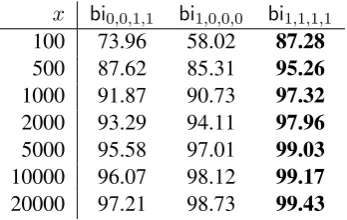
Results are shown in Tables 4, 5, and 6. We first note (Table 4) that the unsupervised mod-els perform decently, obtaining accuracy rates of 80% and beyond under appropriate parametriza-tions. We also observe the M2M aligner’s terioration in performance as we increase its de-grees of freedom (allowing it to match subse-quences of larger length), confirming our previous remarks. The Mpaligner does not suffer from this problem as it penalizes large matches. Phoneti-saurus suffers from the same problems as M2M, but to a lesser degree. Overall, we find that, under optimal parametrizations, Phonetisaurus produces best alignments, followed by Mpalign and M2M. However, peak performances of all three unsu-pervised aligners are close. Unsurprisingly, the
supervised alignment models perform better than the unsupervised ones (Tables 5 and 6). Surpris-ingly, however, they do so with very little train-ing data; fewer than 100 aligned strtrain-ing pairs suf-fice to outperform the unsupervised models under good calibrations. When there is sufficient train-ing data, the supervised models perform splen-didly, with a peak accuracy of 99.43% for the bi-gram alignment model that includes appropriate features (scoring lengths of aligned subsequences,
7For all our below experiments involving the supervised
etc.). We also note that the bigram alignment model is almost consistently better than the uni-gram alignment model, with a surplus of about 1% point, depending on specific parametrizations.
We performed an analogous analysis for the German data. Results are quite similar except that unigram and bigram alignment model have indis-tinguishable performance on the German data, in-dicating (the known fact) that G2P is a more com-plex task in English, apparently not requiring bi-gram alignment models.
x uni0,0,1,1 uni1,0,0,0 uni1,1,1,1
100 70.34 58.13 87.22
500 81.94 84.64 95.60
1000 84.56 90.38 96.17
2000 85.41 93.47 97.13
5000 86.56 96.11 97.72
10000 86.13 97.07 98.14
[image:6.595.86.277.223.333.2]20000 86.60 97.90 98.34
Table 5: Unigram model and its alignment accura-cies in % for various training sizes.
x bi0,0,1,1 bi1,0,0,0 bi1,1,1,1
100 73.96 58.02 87.28
500 87.62 85.31 95.26
1000 91.87 90.73 97.32
2000 93.29 94.11 97.96
5000 95.58 97.01 99.03
10000 96.07 98.12 99.17
20000 97.21 98.73 99.43
Table 6: Bigram model and its alignment accura-cies in % for various training sizes.
Error analysisConcerning errors that the uni-gram model commits and the biuni-gram model does not, the majority of errors (roughly 80%) involve match-ups of ed/d and d. For example, the uni-gram model aligns as in
t w i n k le d
t w I N k @l d while the gold-standard alignment is
t w i n k l ed
t w I N k @l d
While all match-ups in both alignments are plau-sible, the bigram model assigns here higher proba-bility to the corrected/dmatch-up in terminal po-sition (consistently favored in the data set), which
has a particular meaning there, namely, that of a suffix marker for past tense.8,9 In the German
data, there is a single instance where the unigram and bigram alignment model disagree, namely, in the alignment ofs-t-o-ff-f-l-a-sch-e /S-t-O-f-f-l-&-S-@, which the unigram model falsely aligns as
s-t-o-f-ff-l-a-sch-e/S-t-O-f-f-l-&-S-@; note that in the correct alignment f must follow ff, not vice versa, which depends on context information, e.g., that o/O signifies a short vowel which is followed by a double consonant, not a single consonant.
All remaining errors that the bigram align-ment models commits are, for the best considered parametrization and training set size, typically due to match-up types not seen in the training data, and thus mostly concern foreign names or writings (e.g.,Bh-u-tt-o/b-u-t-F, falsely aligned as B-hu-tt-o/b-u-t-F). A few other errors might be corrected when the feature coefficientsα, β, γ, δ were opti-mized on a development set rather than set manu-ally. We find no indication that our G2P data, ei-ther for English or German, would furei-ther benefit fromn-gram alignment models of ordern >2.
5.2 Alignment quality vs. overall G2P performance
Next, we estimate the relationship between align-ment quality and overall G2P performance (tran-scription accuracy). To this end, for the English data, we use the 5 000 aligned string pairs from the previous experiment on alignment quality and feed them in — as training data — to either Di-recTL+ or Phonetisaurus as outlined in Section 4. We then evaluate G2P performance — in terms of
word accuracy (fraction of correctly transcribed strings) — on a distinct test set of size 10 000. Figure 1 shows a plot of overall G2P accuracy vs.training set size for the aligner (ranging over thexvalues in the last section); and a second plot that sketches G2P accuracy as a function of corre-sponding alignment accuracy. We first note that, as the supervised aligner receives more training
8Similar cases are, e.g., alignments of the type
f-ee-d-b-a-ck/f-i-d-b-a-k, which the unigram model falsely aligns as f-e-ed-b-a-ck/f-i-d-b-a-k. Here, too, the unigram is unable to account for the almost exclusive terminal position of theed/d match-up in the data.
9Other errors involve ‘unusual/foreign’
[image:6.595.95.269.396.506.2]x Mpalign M2M2,2 M2M3,3 M2M6,6 Phon2,2 Phon3,3 Phon6,6
1000 76.48 77.87 34.59 18.96 78.27 78.15 11.70
2000 78.05 78.03 34.45 18.87 79.24 77.07 12.43
5000 76.68 77.93 35.09 19.72 79.77 80.47 17.63
10000 78.86 77.97 35.03 21.35 79.60 81.30 23.57
[image:7.595.113.484.62.146.2]20000 79.87 78.60 37.09 22.90 80.09 83.37 34.61
Table 4: Unsupervised aligners and their alignment accuracies in % for various data sizes as described in the text. Subscriptsa, bdenote restrictions on maximal lengths of subsequences allowed in match-ups (a/bcorresponds tox/ysubsequences).
0.38 0.42 0.46 0.50 0.54 0.58
2K 10K 20K
Transduction
Accurac
y
Training size aligner 0.38
0.42 0.46 0.50 0.54 0.58
2K 10K 20K
Transduction
Accurac
y
Training size aligner Phonetisaurus
DirecTL Phonetisaurus
DirecTL 0.38
0.42 0.46 0.50 0.54 0.58
0.60 0.70 0.80 0.90 1.00
Transduction
Accurac
y
Alignment quality (accuracy) Phonetisaurus
[image:7.595.86.511.215.380.2]DirecTL
Figure 1: Left: Overall G2P accuracy as a function of training set size of supervised aligneruni1,0,0,0. Right: G2P accuracy as a function of alignment quality (measured in accuracy).
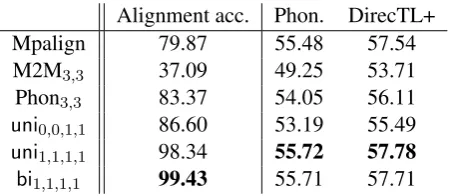
data from which to align the 5 000 string pairs, the overall G2P accuracy of both DirecTL+ and Phonetisaurus increase substantially (and as a con-vex function of training set size). Apparently, the better alignments produced by more training data for the particular supervised aligner considered di-rectly translate into better overall G2P accuracy. The other plot in the figure shows that, indeed, there seems to be a linear trend coupling align-ment quality with overall G2P performance. Table 7 pairs G2P accuracy with alignment accuracy of selected systems, all run in the x = 20 000 set-ting. While, in the table, better alignments do not necessarily imply better overall G2P performance, the two best alignments also lead to the two best overall G2P performances (although, in this case, the second best alignment is paired with the best overall G2P performance); conversely, the worst alignment quality is coupled with the worst over-all G2P performance.
Overall, we ran 249 experiments (including the German data) in which we trained DirecTL+ or Phonetisaurus with alignments of specific
quali-Alignment acc. Phon. DirecTL+
Mpalign 79.87 55.48 57.54
M2M3,3 37.09 49.25 53.71
Phon3,3 83.37 54.05 56.11
uni0,0,1,1 86.60 53.19 55.49
uni1,1,1,1 98.34 55.72 57.78
bi1,1,1,1 99.43 55.71 57.71
Table 7: Systems, alignment accuracies of corre-sponding produced alignments and transcription accuracy of Phonetisaurus and DirecTL+ when trained with the respective alignments.
[image:7.595.308.533.442.540.2]0.15 0.25 0.35 0.45 0.55
0.1 0.2 0.3 0.4 0.5 0.6 0.7 0.8 0.9 1
Transduction
Accurac
y
Alignment quality (accuracy) Phonetisaurus
DirecTL 0.15
0.25 0.35 0.45 0.55
0 1 2 3 4 5 6 7 8 9
Transduction
Accurac
y
Alignment quality (edit distance) Phonetisaurus
[image:8.595.90.502.69.234.2]DirecTL
Figure 2: Overall G2P accuracy vs. alignment quality. Left: Alignment quality measured in accuracy. Right: Alignment quality measured in edit distance. English data only.
this, we regress overall G2P system performance (measured in word accuracy) on edit distance and other variables.10 This yielded the coefficients as
given in Table 8; in each case, the goodness-of-fit of the linear model was quite large, with R2 values above 90% for the English data and about 84% for the German data. Also, the coefficients on alignment quality were highly significantly dif-ferent from zero. The table shows that the co-efficients are on the order of about −3.80% to −4.70%, meaning that, all else being equal, in-creasing alignment quality by 1 edit distance to the gold-standard alignment increases overall G2P by about 3.80 to 4.70%.
DirecTL+ Phonetisaurus English −3.80∗∗∗ −4.14∗∗∗
[image:8.595.309.518.473.595.2]German - −4.68∗∗∗
Table 8: Coefficients on edit distance in the regres-sion of G2P accuracy on edit distance and further variables. For German, DirecTL+ is omitted due to its long run times.
So far, we have estimated the effects of align-ment quality on overall G2P system performance for a fixed size of training data, namely, 5 000 aligned string pairs. To see whether this relation-ship changes when we vary the amount of train-ing data, we run several more experiments. In these, we align training sets of sizes 100, 500,
10These include binary dummy variables for the specific
systems as well as alignment consistency and its square — measured in conditional entropyH(Y|X) (Pervouchine et al., 2009) — in the regression.
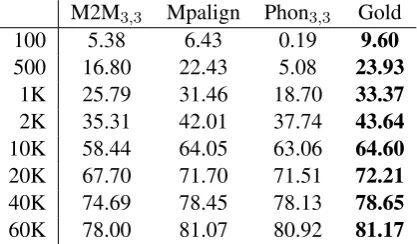
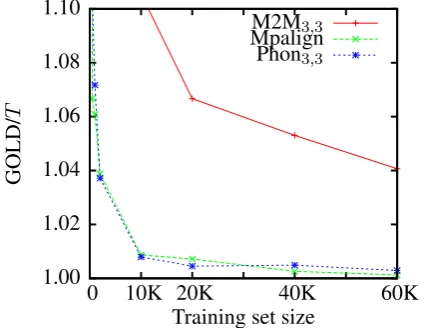
1 000, 2 000, 10 000, 20 000, 40 000 and 60 000 via our several alignment systems. Then we feed the aligned data to the Phonetisaurus system (we omit DirecTL+ here because of its long run times) and compute overall G2P accuracy on a disjoint test set of size 28 000 approximately. This time, we only use the unsupervised aligners and the gold-standard alignments directly, omitting results for our various supervised aligners. Note, how-ever, that these aligners could, in principle, imi-tate the gold-standard alignments with a very high degree of precision, as previously seen. Table 9
M2M3,3 Mpalign Phon3,3 Gold
100 5.38 6.43 0.19 9.60
500 16.80 22.43 5.08 23.93
1K 25.79 31.46 18.70 33.37
2K 35.31 42.01 37.74 43.64
10K 58.44 64.05 63.06 64.60
20K 67.70 71.70 71.51 72.21
40K 74.69 78.45 78.13 78.65
60K 78.00 81.07 80.92 81.17
Table 9: Overall G2P accuracy in % as a function training size of aligned data and alignment system.
[image:8.595.90.271.497.539.2]boot-strapped from larger data sets (cf. Table 4). Ad-ditionally, the effect of alignment quality on over-all G2P system performance may simply vanish as training set sizes become large enough because the translation modules can better accomodate ‘noisy’ data as long as its size is sufficiently large. Figure
1.00 1.02 1.04 1.06 1.08 1.10
0 10K 20K 40K 60K
GOLD/
T
[image:9.595.71.285.162.326.2]Training set size M2M3,3 Mpalign Phon3,3
Figure 3: Ratio of transcription accuracy when us-ing gold standard alignments (GOLD) and when using alignments generated by T = M2M3,3, Mpalign, and Phon3,3, respectively, as a function of size of aligned training set.
3 sketches the decreasing influence of alignment system on overall G2P system performance as size of the aligned data increases.
6 Conclusion
We have investigated the need for bigram align-ment models and the benefit of supervised align-ment techniques in G2P. We have also quantita-tively estimated the relationship between align-ment quality and overall G2P system performance. We have found that, in English, bigram alignment models do perform better than unigram alignment models on the G2P task (we find almost no dif-ferences between unigram and bigram models for the German sample of G2P data we considered). Moreover, we have found that supervised align-ment techniques may perform considerably better than their unsupervised brethren and that few man-ually aligned training pairs suffice for them to do so. Finally, we have estimated a highly significant impact of alignment quality on overall G2P tran-scription performance and that this relationship is linear in nature. At a particular training size, a linear regression model has estimated that improv-ing alignment quality by 1 edit distance toward the
gold standard alignments leads to an 3.80-4.70% increase in G2P transcription accuracy. However, we have also found that the importance of good alignments on G2P accuracy appears to dimish as data set size increases, possibly because the trans-lation modules can accomodate more ‘noisy’ data in this scenario.
As a ‘policy’ implication, we recommend the use of supervised alignment techniques particu-larly when the size of the G2P corpus is small or when high quality alignments, as an end in them-selves, are required. In this case, constructing a few dozen or few hundred alignments in an unsu-pervised manner and correcting them by hand (to serve as an input for a supervised technique) may be highly beneficial.
In future work, it may be worthwhile to study the impact of alignment techniques on overall sys-tem performance in other string transduction prob-lems such as transliteration, lemmatization, and spelling error correction.
Our supervised uni- and bigram aligners are available via https://github.com/ SteffenEger/.
Acknowledgments
I thank three anonymous reviewers and Tim vor der Br¨uck for valuable suggestions.
References
H. Baayen, R. Piepenbrock, and L. Gulikers. 1995. The CELEX2 lexical database. ldc96l14.
Maximilian Bisani and Hermann Ney. 2008. Joint-sequence models for grapheme-to-phoneme conver-sion.Speech Communication, 50(5):434–451.
Eric Brill and Robert C. Moore. 2000. An improved error model for noisy channel spelling correction. In Proceedings of the 38th Annual Meeting on As-sociation for Computational Linguistics, ACL ’00, pages 286–293, Stroudsburg, PA, USA. Association for Computational Linguistics.
Ryan Cotterell, Nanyun Peng, and Jason Eisner. 2014. Stochastic contextual edit distance and probabilis-tic FSTs. InProceedings of the 52nd Annual Meet-ing of the Association for Computational LMeet-inguistics (ACL), pages 625–630, Baltimore, June.
Markus Dreyer, Jason Smith, and Jason Eisner. 2008. Latent-variable modeling of string transductions with finite-state methods. InEMNLP, pages 1080– 1089. ACL.
Steffen Eger. 2012. S-restricted monotone alignments: Algorithm, search space, and applications. In COL-ING’12, pages 781–798.
Steffen Eger. 2013. Sequence alignment with arbitrary steps and further generalizations, with applications to alignments in linguistics. Inf. Sci., 237:287–304. Steffen Eger. 2015a. Improving g2p from wiktionary
and other (web) resources. InProceedings of Inter-speech. accepted.
Steffen Eger. 2015b. Multiple many-to-many se-quence alignment for combining string-valued vari-ables: A G2P experiment. In Proceedings of the 53rd Annual Meeting of the Association for Compu-tational Linguistics and the 7th International Joint Conference on Natural Language Processing of the Asian Federation of Natural Language Processing, ACL 2015, July 26-31, 2015, Beijing, China, Volume 1: Long Papers, pages 909–919.
Kuzman Ganchev, Joo Graa, and Ben Taskar. 2008. Better alignments = better translations? In Kath-leen McKeown, Johanna D. Moore, Simone Teufel, James Allan, and Sadaoki Furui, editors,ACL, pages 986–993. The Association for Computational Lin-guistics.
Sharon Goldwater, Thomas L. Griffiths, and Mark Johnson. 2006. Contextual dependencies in un-supervised word segmentation. In Proceedings of the 21st International Conference on Computational Linguistics and 44th Annual Meeting of the Associa-tion for ComputaAssocia-tional Linguistics, pages 673–680, Sydney, Australia, July. Association for Computa-tional Linguistics.
Sittichai Jiampojamarn and Grzegorz Kondrak. 2010. Letter-phoneme alignment: An exploration. In Jan Hajic, Sandra Carberry, and Stephen Clark, editors, ACL, pages 780–788. The Association for Compu-tational Linguistics.
Sittichai Jiampojamarn, Grzegorz Kondrak, and Tarek Sherif. 2007. Applying many-to-many alignments and hidden markov models to letter-to-phoneme conversion. In Human Language Technologies 2007: The Conference of the North American Chap-ter of the Association for Computational Linguistics; Proceedings of the Main Conference, pages 372– 379, Rochester, New York, April. Association for Computational Linguistics.
Sittichai Jiampojamarn, Colin Cherry, and Grzegorz Kondrak. 2008. Joint processing and discriminative training for letter-to-phoneme conversion. In Pro-ceedings of ACL-08: HLT, pages 905–913, Colum-bus, Ohio, June. Association for Computational Lin-guistics.
Sittichai Jiampojamarn, Colin Cherry, and Grzegorz Kondrak. 2010. Integrating joint n-gram features into a discriminative training framework. In HLT-NAACL, pages 697–700. The Association for Com-putational Linguistics.
Grzegorz Kondrak. 2000. A new algorithm for the alignment of phonetic sequences. InProceedings of the 1st North American Chapter of the Association for Computational Linguistics Conference, NAACL 2000, pages 288–295, Stroudsburg, PA, USA. Asso-ciation for Computational Linguistics.
Keigo Kubo, Hiromichi Kawanami, Hiroshi Saruwatari, and Kiyohiro Shikano. 2011. Un-constrained many-to-many alignment for automatic pronunciation annotation. In Proceedings of Asia-Pacific Signal and Information Processing Association Annual Summit and Conference 2011 (APSIPA2011), October.
VI Levenshtein. 1966. Binary Codes Capable of Cor-recting Deletions, Insertions and Reversals. Soviet Physics Doklady, 10:707.
Yang Liu and Maosong Sun. 2015. Contrastive unsu-pervised word alignment with non-local features. In Proceedings of AAAI 2015.
Yang Liu, Qun Liu, and Shouxun Lin. 2010. Discrim-inative word alignment by linear modeling. Compu-tational Linguistics, pages 303–339.
Saul B. Needleman and Christian D. Wunsch. 1970. A general method applicable to the search for sim-ilarities in the amino acid sequence of two pro-teins. Journal of Molecular Biology, 48(3):443– 453, March.
Josef R. Novak, Nobuaki Minematsu, and Keikichi Hi-rose. 2012. WFST-based grapheme-to-phoneme conversion: Open source tools for alignment, model-building and decoding. InProceedings of the 10th International Workshop on Finite State Meth-ods and Natural Language Processing, pages 45–49, Donostia–San Sebastin, July. Association for Com-putational Linguistics.
Vladimir Pervouchine, Haizhou Li, and Bo Lin. 2009. Transliteration alignment. In Proceedings of the Joint Conference of the 47th Annual Meeting of the ACL and the 4th International Joint Conference on Natural Language Processing of the AFNLP: Volume 1 - Volume 1, ACL ’09, pages 136–144, Stroudsburg, PA, USA. Association for Computa-tional Linguistics.
Kanishka Rao, Fuchun Peng, Hasim Sak, and Franoise Beaufays. 2015. Grapheme-to-phoneme conversion using long short-term memory recurrent neural net-works. InICASSP 2015.
Eric Sven Ristad and Peter N. Yianilos. 1998. Learn-ing strLearn-ing-edit distance. IEEE Trans. Pattern Anal. Mach. Intell., 20(5):522–532.
Tarek Sherif and Grzegorz Kondrak. 2007. Substring-based transliteration. In John A. Carroll, Antal van den Bosch, and Annie Zaenen, editors, ACL. The Association for Computational Linguistics. Esko Ukkonen. 1985. Algorithms for approximate
string matching. Information and Control, 64:100– 118.
Jean V´eronis. 1988. Computerized correction of phonographic errors. Computers and the Humani-ties, 22(1):43–56.