Filling the Gap:
Semi-Supervised Learning for Opinion Detection Across Domains
Ning Yu
Indiana University [email protected]
Sandra K ¨ubler
Indiana University [email protected]
Abstract
We investigate the use of Semi-Supervised Learning (SSL) in opinion detection both in sparse data situations and for domain adapta-tion. We show that co-training reaches the best results in an in-domain setting with small la-beled data sets, with a maximum absolute gain of 33.5%. For domain transfer, we show that self-training gains an absolute improvement in labeling accuracy for blog data of 16% over the supervised approach with target domain training data.
1 Introduction
Rich and free opinions published electronically and, more recently, on the WWW offer ample opportuni-ties to discover individual’s attitudes towards certain topics, products, or services. To capitalize on this enormous body of opinions, researchers have been working in the area of opinion mining since the late 1990s. Opinion detection seeks to automatically de-termine the presence or absence of opinions in a text, and it is therefore a fundamental task for opinion mining.
In order to capture subtle and creative opinions, opinion detection systems generally assume that a large body of opinion-labeled data are available. However, collections of opinion-labeled data are of-ten limited, especially at the granularity level of sen-tences; and manual annotation is tedious, expensive and error-prone. The shortage of opinion-labeled data is less challenging in some data domains (e.g., reviews) than in others (e.g., blog posts). A sim-ple method for improving accuracies in challenging domains would be to borrow opinion-labeled data
from a non-target data domain; but this approach often fails because opinion detection strategies de-signed for one data domain generally do not perform well in another domain. One reason for failure of the simple transfer approach is that the information used for opinion detection is typically lexical, and lexical means of expressing opinions may vary not only from domain to domain, but also from register to register. For example, while the word ”awesome” is a good indicator of an opinion in blogs, it is less likely to occur in the same role in newspaper texts.
While it is difficult to obtain opinion-labeled data, one can easily collect almost infinite unlabeled user-generated data that contain opinions. The use of Semi-Supervised Learning (SSL), motivated by lim-ited labeled data and plentiful unlabeled data in the real world, has achieved promising results in vari-ous NLP studies (e.g., (F¨urstenau and Lapata, 2009; Talukdar and Pereira, 2010)), yet it has not been fully investigated for use in opinion detection. Al-though studies have shown that simple SSL meth-ods are promising for extracting opinion features or patterns using limited opinion-labeled data (e.g., (Wiebe and Riloff, 2005)), few efforts have been made either to apply SSL directly to opinion detec-tion or to examine more sophisticated SSL methods. This research is intended to fill the gap regarding ap-plication of SSL in opinion detection. We investi-gate a range of SSL algorithms with a focus on self-training and co-self-training in three types of electronic documents: edited news articles, semi-structured movie reviews, and the informal and unstructured content of the blogosphere. We conclude that SSL is a successful method for handling the shortage of opinion labeled data and the domain transfer prob-lem.
2 Background and Related Work
There is a wide range of literature on opinion detec-tion. We concentrate here on supervised and semi-supervised approaches.
2.1 Supervised Learning for Opinion Detection
Supervised learning algorithms that can automati-cally learn important opinion-bearing features from an annotated corpus have been adopted and inves-tigated for opinion detection and yielded satisfying results (Wiebe et al., 2004; Yu and Hatzivassiloglou, 2003; Zhang and Yu, 2007). With no classifica-tion techniques developed specifically for opinion detection, state-of-the-art topical supervised classifi-cation algorithms can achieve performance compa-rable to complex linguistic approaches when using binary values (i.e., presence or absence) and incor-porating different types of features. Commonly used opinion-bearing features include bag-of-words, POS tags, ngrams, low frequency words or unique words (Wiebe et al., 2004; Yang et al., 2007), semantically oriented adjectives (e.g., “great”, “poor”) and more complex linguistic patterns. Both the scale and qual-ity of the annotated corpus play an important role in the supervised learning approach.
2.2 SSL for Opinion Detection
In contrast to supervised learning, SSL learns from both labeled and unlabeled data. SSL assumes that, although unlabeled data hold no information about classes (e.g., “opinion” or “non-opinion”), they do contain information about joint distribution over classification features. Therefore, when a limited set of labeled data is available in the target domain, us-ing SSL with unlabeled data is expected to achieve an improvement over supervised learning.
Self-training Self-training is the simplest and most commonly adopted form of SSL for opinion detection. Self-training was originally used to fa-cilitate automatic identification of opinion-bearing features. For example, Riloff and Wiebe (2003) pro-posed a bootstrapping process to automatically iden-tify subjective patterns. Self-training has also been applied directly for identifying subjective sentences by following a standard self-training procedure: (1) train an initial supervised classifier on the labeled data; (2) apply this classifier to unlabeled data and
select the most confidently labeled data, as deter-mined by the classifier, to augment the labeled data set; and (3) re-train the classifier by restarting the whole process. Wiebe and Riloff (2005) used a self-trained Na¨ıve Bayes classifier for classifying subjec-tive sentences and achieved better recall with modest precision over several rule-based classifiers.
One shortcoming of self-training is that the result-ing data may be biased: That is, the final labeled data may consist of examples that are easiest for this par-ticular opinion detector to identify.
Co-training The core idea of co-training is to use two classifiers and trade additional examples be-tween them, assuming that the resulting union of classified examples is more balanced than examples resulting from using either classifier alone. When labeling new examples, a final decision is made by combining the predictions of the two updated learn-ers. The original co-training algorithm assumes re-dundancy in the training data and thus more than one view can be used to represent and classify each example independently and successfully (Blum and Mitchell, 1998). For example, an image can be nat-urally represented by its text description or by its visual attributes. Even when a natural split in the feature set is not available, studies have shown that the key to co-training is the existence of two largely different initial learners, regardless of whether they are built by using two feature sets or two learning algorithms (Wang and Zhou, 2007).
When there are different views for the target ex-amples, co-training is conceptually clearer than self-training, which simply mixes features. Since co-training uses each labeled example twice, it requires less labeled data and converges faster than self-training. However, the lack of natural feature splits has kept researchers from exploring co-training for opinion detection. To the best of our knowledge, the only co-training application for opinion detec-tion was reported by Jin et al. (2009), who created disjoint training sets for building two initial classi-fiers and successfully identified opinion sentences in camera reviews by selecting auto-labeled sentences agreed upon by both classifiers.
incomplete data. Nigam et al. (1999) combined EM with a Na¨ıve Bayes classifier to resolve the problem of topical classification, where unlabeled data were treated as incomplete data. The EM-NB SSL algorithm yielded better performance than ei-ther an unsupervised lexicon-based approach or a supervised approach for sentiment classification in different data domains, including blog data (Aue and Gamon, 2005; Takamura et al., 2006). No opinion detection applications of EM-based SSL have been reported in the literature.
S3VMs Semi-Supervised Support Vector Ma-chines (S3VMs) are a natural extension of SVMs in the semi-supervised spectrum. They are designed to find the maximal margin decision boundary in a vec-tor space containing both labeled and unlabeled ex-amples. Although SVMs are the most favored super-vised learning method for opinion detection, S3VMs have not been used in opinion detection. Graph-based SSL learning has been successfully applied to opinion detection (Pang and Lee, 2004) but is not appropriate for dealing with large scale data sets.
2.3 Domain Adaptation for Opinion Detection
When there are few opinion-labeled data in the target domain and/or when the characteristics of the target domain make it challenging to detect opinions, opinion detection systems usually borrow opinion-labeled data from other data domains. This is especially common in opinion detection in the bl-ogosphere (Chesley et al., 2006). To evaluate this shallow approach, Aue and Gamon (2005) com-pared four strategies for utilizing opinion-labeled data from one or more non-target domains and con-cluded that using non-targeted labeled data without an adaptation strategy is less efficient than using la-beled data from the target domain, even when the majority of labels are assigned automatically by a self-training algorithm.
Blitzer et al. (2007) and Tan et al. (2009) imple-mented domain adaptation strategies for sentiment analysis. Although promising, their domain adapta-tion strategies involved sophisticated and computa-tionally expensive methods for selecting general fea-tures to link target and non-target domains.
3 Motivation and Objective
While SSL is especially attractive for opinion de-tection because it only requires a small number of labeled examples, the studies described in the previ-ous section have concentrated on simple SSL meth-ods. We intend to fill this research gap by comparing the feasibility and effectiveness of a range of SSL approaches for opinion detection. Specifically, we aim to achieve the following goals:
First, to gain a more comprehensive understand-ing of the utility of SSL in opinion detection. We examine four major SSL methods: self-training, co-training, EM-NB, and S3VM. We focus on self-training and co-self-training because they are both wrap-per approaches that can be easily adopted by any ex-isting opinion detection system.
Second, to design and evaluate co-training strate-gies for opinion detection. Since recent work has shown that co-training is not restricted by the orig-inal multi-view assumption for target data and that it is more robust than self-training, we evaluate new co-training strategies for opinion detection.
Third, to approach domain transfer using SSL, assuming that SSL can overcome the problem of domain-specific features by gradually introducing targeted data and thus diminishing bias from the non-target data set.
4 SSL Experiments
Our research treats opinion detection as a binary classification problem with two categories: subjec-tive sentences and objecsubjec-tive sentences. It is evalu-ated in terms of classification accuracy.
Since a document is normally a mixture of facts and opinions (Wiebe et al., 2001), sub-document level opinion detection is more useful and meaning-ful than document-level opinion detection. Thus, we conduct all experiments on the sentence level.
The remainder of this section explains the data sets and tools used in this study and presents the ex-perimental design and parameter settings.
4.1 Data Sets
terms of structure, text genre (e.g., level of formal-ity), and proportion of opinions found therein. We selected a data set from each type in order to inves-tigate the robustness and adaptability of SSL algo-rithms for opinion detection and to test the feasibil-ity of SSL for domain adaptation.
Movie Review One of the standard data sets in opinion detection is the movie review data set cre-ated by Pang and Lee (2004). It contains 5,000 sub-jective sentences or snippets from the Rotten Toma-toes pages and 5,000 objective sentences or snip-pets from IMDB plot summaries, all in lowercase. Sentences containing less than 10 tokens were ex-cluded and the data set was labeled automatically by assuming opinion inheritance: every sentence in an opinion-bearing document expresses an opinion, and every sentence in a factual document is factual. Although this assumption appears to be acceptable for movie review data, it is generally unreliable for other domains.
News Article The Wall Street Journal part of the Penn Treebank III has been manually augmented with opinion related annotations. This set is widely used as a gold-standard corpus in opinion detection research. According to the coding manual (Wiebe et al., 1999), subjective sentences are those express-ing evaluations, opinions, emotions, and specula-tions. For our research, 5,174 objective sentences and 5,297 subjective sentences were selected based on the absence or presence of manually labeled sub-jective expressions.
JDPA Blog Post The JDPA corpus (Kessler et al., 2010) is a new opinion corpus released in 2010. It consists of blog posts that express opinions about automobile and digital cameras with named entities and sentiments expressed about them manually an-notated. For our purpose, we extracted all sentences containing sentiment-bearing expressions as subjec-tive sentences and manually chose objecsubjec-tive tences from the rest by eliminating subjective sen-tences that were not targeted to any labeled entities. After this process, we had approximately 10,000 subjective sentences and 4,348 objective sentences. To balance the number of subjective and objective sentences, we used 4,348 sentences from each cate-gory.
4.2 Data Preparation
We removed a small number of stop words. No stemming was conducted since the literature shows no clear gain from stemming in opinion detection. One reason for this may be that stemming actually erases subtle opinion cues such as past tense verbs. All words were converted to lowercase and numbers were replaced by a placeholder #. Both unigrams and bigrams were generated for each sentence.
Each data set was randomly split into three por-tions: 5% of the sentences were selected as the eval-uation set and were not available during SSL and supervised learning (SL) runs; 90% were treated as unlabeled data (U) for SSL runs and i% (1≤i≤5) as labeled data (L) for both SL and SSL runs. For each SSL run, a baseline SL run was designed with the same number of labeled sentences (i%) and a full SL run was designed with all available sentences (90% + i%). If effective, an SSL run would signifi-cantly outperform its corresponding baseline SL run and approach the performance of a full SL run.
4.3 Experimental Design
We conducted three groups of experiments: 1) to in-vestigate the effectiveness of the SSL approach for opinion detection; 2) to explore different co-training strategies; and 3) to evaluate the applicability of SSL for domain adaptation.
4.3.1 General Settings for SSL
The Na¨ıve Bayes classifier was selected as the initial classifier for self-training because of its abil-ity to produce prediction scores and to work well with small labeled data sets. We used binary values for unigram and bigram features, motivated by the brevity of the text unit at the sentence level as well as by the characteristics of opinion detection, where occurrence frequency has proven to be less influen-tial. We implemented two feature selection options: Chi square and Information Gain.
Parameters for SSL included: (1) Thresholdkfor number of iterations. Ifk is set to 0, the stopping criterion is convergence; (2) Number of unlabeled sentences available in each iteration u (u << U); (3) Number of opinion and non-opinion sentences,
pandn, to augment L during each iteration; and (4) Weighting parameterλfor auto-labeled data. When
equally; when λ is set to 1, feature values in an auto-labeled sentence are multiplied by the predic-tion score assigned to the sentence.
We used the WEKA data mining software (Hall et al., 2009) for data processing and classifica-tion of the self-training and co-training experi-ments. EM implemented in LingPipe (Alias-i, 2008) was used for the EM-NB runs. S3VMs imple-mented in SVMlight (Joachims, 1999) and based on local search were adopted for the S3VM runs. Since hyper-parameter optimization for EM-NB and S3VM is not the focus of this research and prelim-inary explorations on parameter settings suggested no significant benefit, default settings were applied for EM-NB and S3VM.
4.3.2 Co-Training Strategies
For co-training, we investigated five strategies for creating two initial classifiers following the criteria that these two classifiers either capture different fea-tures or based on different learning assumptions.
Two initial classifiers were generated: (1) Us-ing unigrams and bigrams respectively to create two classifiers based on the assumption that low-order
n-grams and high-ordern-grams contain redundant information and represent different views of an ex-ample: content and context; (2) Randomly splitting feature set into two; (3) Randomly splitting train-ing set into two; (4) Applytrain-ing two different learn-ing algorithms (i.e., Na¨ıve Bayes and SVM) with different biases; and (5) Applying a character-based language model (CLM) and a bag-of-words (BOW) model where the former takes into consideration the sequence of words while the latter does not. In prac-tice, for strategy (1), bigrams were used in combina-tion with unigrams because bigrams alone are weak features when extracted from limited labeled data at sentence level.
Auto-labeled sentences were selected if they were assigned a label that both classifiers agreed on with highest confidence. Because our initial classifiers vi-olated the original co-training assumptions, forcing agreement between confident predictions improved the maintenance of high precision.
4.3.3 Self-Training for Domain Adaptation
Based on the literature and our preliminary re-sults (Yu and K¨ubler, 2010), movie reviews achieve
# Labeled Examples
Type 100 200 300 400 500 all
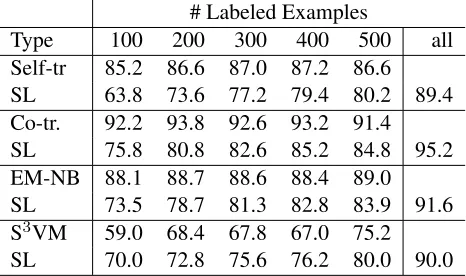
[image:5.612.314.547.55.193.2]Self-tr 85.2 86.6 87.0 87.2 86.6 SL 63.8 73.6 77.2 79.4 80.2 89.4 Co-tr. 92.2 93.8 92.6 93.2 91.4 SL 75.8 80.8 82.6 85.2 84.8 95.2 EM-NB 88.1 88.7 88.6 88.4 89.0 SL 73.5 78.7 81.3 82.8 83.9 91.6 S3VM 59.0 68.4 67.8 67.0 75.2 SL 70.0 72.8 75.6 76.2 80.0 90.0
Table 1: Classification accuracy(%) of SSL and SL on movie reviews
the highest accuracy while news articles and blog reviews are considerably more challenging. Thus, we decided to use movie reviews as source data and news articles and blog posts as target data do-mains. While the data split for the target domain re-mains the same as in section 4.2, all sentences in the source domain, except for the 5% evaluation data, were treated as labeled data. For example, in order to identify opinion-bearing sentences from the blog data set, all 9,500 movie review sentences and i% of blog sentences were used as labeled data, 90% of blog sentences were used as unlabeled data, and 5% as evaluation data. We also applied a parameter to gradually decrease the weight of the source domain data, similar to the work done by Tan et al. (2009).
5 Results and Evaluation
Overall, our results suggest that SSL improves ac-curacy for opinion detection although the contribu-tion of SSL varies across data domains and different strategies need to be applied to achieve optimized performance. For the movie review data set, almost all SSL runs outperformed their corresponding base-line SL runs and approached full SL runs; for the news article data set, SSL performance followed a similar trend but with only a small rate of increase; for the blog post data set, SSL runs using only blog data showed no benefits over the SL baseline, but with labeled movie review data, SSL runs produced results comparable with full SL result.
5.1 SSL vs. SL
of initial labeled sentences. Both the self- and co-training runs reported here used the same parame-ter settings: k=0, u=20, p=2, n=2, λ=0, with no feature selection. The co-training results in Table 1 used a CLM and a BOW model (see section 5.2). SL runs for co-training classified sentences based on the highest score generated by two classifiers; SL runs for S3VM applied the default SVM setting in SVMlight; and SL runs for EM-NB used the Na¨ıve Bayes classifier in the EM-NB implementation in LingPipe.
Table 1 shows that, except for S3VM, SSL al-ways outperforms the corresponding SL baseline on movie reviews: When SSL converges, it achieves improvement in the range of 8% to 34% over the SL baseline. The fewer initial labeled data, the more benefits an SSL run gained from using unlabeled data. For example, using 100 labeled sentences, self-training achieved a classification accuracy of 85.2% and outperformed the baseline SL by 33.5%. Al-though this SSL run was surpassed by 4.9% by the full SL run using all labeled data, a great amount of effort was saved by labeling only 100 sentences rather than 9,500. Co-training produced the best SSL results. For example, with only 200 labeled sentences, co-training yielded accuracy as high as 93.8%. Overall, SSL for opinion detection on movie reviews shows similar trends to SSL for traditional topical classification (Nigam and Ghani, 2000).
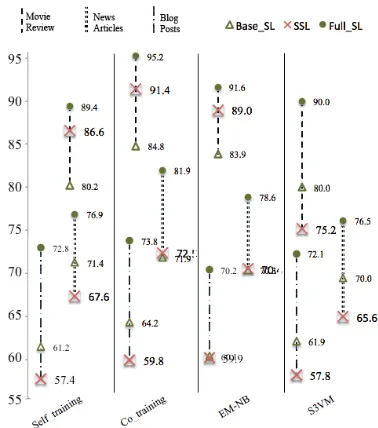
[image:6.612.332.521.55.269.2]However, the advantages of SSL were not as sig-nificant in other data domains. Figure 1 demon-strates the performance of four types of SSL runs relative to corresponding baseline and full SL runs for all three data sets. All SSL runs reported here used 5% data as labeled data. Lines with different patterns indicate different data sets, green triangles mark baseline SL runs, green dots mark full SL runs, and red crosses mark SSL runs. Numbers next to symbols indicate classification accuracy. For each line, if the red cross is located above the triangle, it indicates that the SSL run improved over the SL baseline; and, the closer the red cross to the upper dot, the more effective was the SSL run. Figure 1 shows that S3VM degrades in performance for all three data sets and we exclude it from the follow-ing discussion. From movie reviews to news articles to blog posts, the classification accuracy of baseline SL runs as well as the improvement gained by SSL
Figure 1: Classification accuracy(%) of SSL and SL on three data sets (i=5)
runs decreased: With greater than 80% baseline ac-curacy on movie reviews, SSL runs were most effec-tive; with slightly above 70% baseline accuracy on news articles, self-training actually decreased per-formance of the corresponding SL baseline while co-training and EM-NB outperformed the SL base-line only slightly; and with 60% or so basebase-line accu-racy on blog posts, none of the SSL methods showed improvement. We assume that the lower the baseline accuracy, the worse the quality of auto-labeled data, and, therefore, the less advantages is application of SSL. We also found that the average sentence length in blog posts (17 words) is shorter than the average sentence length in either movie reviews (23.5 words) or news articles (22.5 words), which posed an addi-tional challenge because there is less information for the classifier in terms of numbers of features.
prob-Figure 2: Performance of four co-training strategies on movie review data
lem space of opinion detection may be successfully described by the mixture model assumption of EM. As for blog posts, since the performance of the base-line classifiers was only slightly better than chance (50%), we needed to improve the baseline accuracy in order for SSL to work. One solution was to intro-duce high quality features. We augmented feature set with domain independent opinion lexicons that have been suggested as effective in creating high precision opinion classifier, but improvement was only minimal. An alternative solution was to bor-row more labeled data from non-blog domains(s). Section 5.3 discusses dealing with a ‘difficult’ data domain using data from an ‘easy’ domain.
The preliminary exploration of different parame-ter settings for both self- and co-training showed no significant benefit gained by setting the weight pa-rameter λor applying feature selection; and using a larger number of unlabeled sentences u available for each iteration did not improve results. Further investigation is needed for an in-depth explanation.
5.2 Co-training
The best co-training runs reported in Table 1 and Figure 1 used an 8-grams CLM to train one clas-sifier and a BOW model to train the other clasclas-sifier.
These two classifiers differ both in feature represen-tation (i.e., character vs. word) and in learning al-gorithm (language model vs. pure statistical model). To investigate whether the two different classifiers improve each other’s performance during iterations, we analyzed the CLM and BOW classifiers individ-ually. When comparing the BOW classifier during co-training iterations to the performance of corre-sponding SL runs based on BOW, the former us-ing both CLM and BOW classifiers always outper-formed the latter, indicating that the BOW fier learned from CLM. Similarly, the CLM classi-fier also gained from the BOW classiclassi-fier during co-training.
[image:7.612.131.477.59.307.2]not improve accuracy and is not discussed here. An observation of the performance of self-training and co-self-training over iterations confirmed that co-training used labeled data more effectively for opinion detection than self-training, as sug-gested for traditional topical classification. We found that, overall, co-training produces better formance than self-training and reaches optimal per-formance faster. For instance, with 500 labeled sen-tences, a self-training run reached an optimal classi-fication accuracy of 88.2% after adding 4,828 auto-matically annotated sentences for training, while the co-training run reached an optimal performance of 89.4% after adding only 2,588 sentences.
5.3 Domain Transfer
Even without any explicit domain adaptation meth-ods, results indicate that simple self-training alone is promising for tackling domain transfer between the source domain movie reviews and the target do-mains news articles and blog posts.
Target domain news articles We used 9,500 la-beled movie review sentences to train a Na¨ıve Bayes classifier for news articles. Although this classi-fier produced a fairly good classification accuracy of 89.2% on movie review data, its accuracy was poor (64.1%) on news data (i.e., domain-transfer SL), demonstrating the severity of the domain trans-fer problem. Self-training with Na¨ıve Bayes using unlabeled data from the news domain (i.e., domain-transfer SSL run) improved the situation somewhat: it achieved a classification accuracy of 75.1% sur-passing the domain-transfer SL run by more than 17%. To finvestigate how well SSL handles the do-main transfer problem, a full in-dodo-main SL run that used all labeled news sentences was also performed. This full SL run achieved 76.9% classification accu-racy, only 1.8% higher than the domain-transfer SSL run, which did not use any labeled news data.
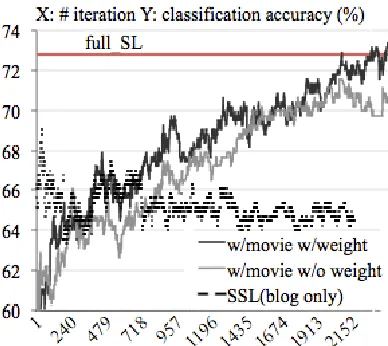
[image:8.612.330.524.54.227.2]Target domain blog posts Because blog data are more challenging than news data, we kept 5% blog data as labeled data. Both SSL runs with and without out-of-domain data are depicted in Figure 3. Self-training using only blog data decreases SL baseline performance (dashed black line). Keeping the same settings, we added additional labeled data from the movie reviews, and self-training (gray line) came
Figure 3: Self-training for domain transfer between movie reviews (source domain) and blogs (target domain)
closer to the performance of the full SL run (red line), which used 90% of the labeled blog data. We then added a control factor that reduced the impact of movie review data gradually (i.e., a decrease of 0.001 in each iteration). Using this control, the self-training run (solid black line) reached and occasion-ally exceeded the performance of the full SL run.
6 Conclusion and Future Work
We investigated major SSL methods for identify-ing opinionated sentences in three domains. For movie review data, SSL methods attained state-of-the-art results with a small number of labeled sen-tences. Even without a natural feature split, dif-ferent co-training strategies increased the baseline SL performance and outperformed other SSL meth-ods. Due to the nature of the movie review data, we suspect that opinion detection on movie reviews is an ‘easy’ problem because it relies, strictly speak-ing, on distinguishing movie reviews from plot sum-maries, which also involves genre classification. For other manually created data sets that are expected to reflect real opinion characteristics, the SSL ap-proach was impeded by low baseline precision and showed limited improvement. With the addition of out-of-domain labeled data, however, self-training exceeded full SL. This constitutes a successful new approach to domain adaptation.
References
Alias-i. 2008. LingPipe (version 4.0.1). Available from
http://alias-i.com/lingpipe.
Anthony Aue and Michel Gamon. 2005. Customizing sentiment classifiers to new domains: A case study. In
Proceedings of the International Conference on Recent Advances in Natural Language Processing (RANLP), Borovets, Bulgaria.
John Blitzer, Mark Dredze, and Fernando Pereira. 2007. Biographies, Bollywood, boom-boxes and blenders: Domain adaptation for sentiment classification. In
Proceedings of the 45th Annual Meeting of the Associ-ation of ComputAssoci-ational Linguistics (ACL), pages 440– 447, Prague, Czech Republic.
Avrim Blum and Tom Mitchell. 1998. Combining la-beled and unlala-beled data with co-training. In Proceed-ings of the 11th Annual Conference on Computational Learning Theory, pages 92–100, Madison, WI. Paula Chesley, Bruce Vincent, Li Xu, and Rohini K.
Sri-hari. 2006. Using verbs and adjectives to automati-cally classify blog sentiment. InProceedings of AAAI-CAAW-06, the Spring Symposia on Computational Ap-proaches to Analyzing Weblogs, Menlo Park, CA. Hagen F¨urstenau and Mirella Lapata. 2009.
Semi-supervised semantic role labeling. In Proceedings of the 12th Conference of the European Chapter of the ACL (EACL), pages 220–228, Athens, Greece. Mark Hall, Eibe Frank, Geoffrey Holmes, Bernhard
Pfahringer, Peter Reutemann, and Ian H. Witten. 2009. The WEKA data mining software: An update.
SIGKDD Explorations, 11(1).
Wei Jin, Hung Hay Ho, and Rohini K. Srihari. 2009. OpinionMiner: A novel machine learning system for web opinion mining. In Proceedings of the 15th ACM SIGKDD International Conference on Knowl-edge Discovery and Data Mining, Paris, France. Thorsten Joachims. 1999. Making large-scale SVM
learning practical. In B. Sch¨olkopf, C. Burges, and A. Smola, editors,Advances in Kernel Methods - Sup-port Vector Learning. MIT-Press.
Jason S. Kessler, Miriam Eckert, Lyndsie Clark, and Nicolas Nicolov. 2010. The ICWSM 2010 JDPA sen-timent corpus for the automotive domain. In4th Inter-national AAAI Conference on Weblogs and Social Me-dia Data Workshop Challenge (ICWSM-DWC), Wash-ington, D.C.
Kamal Nigam and Rayid Ghani. 2000. Analyzing the effectiveness and applicability of co-training. In Pro-ceedings of the Ninth International Conference on In-formation and Knowledge Management, McLean, VA. Kamal Nigam, Andrew Kachites Mccallum, Sebastian Thrun, and Tom Mitchell. 1999. Text classification
from labeled and unlabeled documents using EM. Ma-chine Learning, 39:103–134.
Bo Pang and Lillian Lee. 2004. A sentimental edu-cation: Sentiment analysis using subjectivity summa-rization based on minimum cuts. In Proceedings of the 42nd Annual Meeting on Association for Compu-tational Linguistics, Barcelona, Spain.
Ellen Riloff and Janyce Wiebe. 2003. Learning extrac-tion patterns for subjective expressions. In Proceed-ings of the Conference on Empirical Methods in Natu-ral Language Processing (EMNLP), Sapporo, Japan. Hiroya Takamura, Takashi Inui, and Manabu Okumura.
2006. Latent variable models for semantic orientations of phrases. InProceedings of the 11th Conference of the European Chapter of the Association for Compu-tational Linguistics (EACL), Trento, Italy.
Partha Pratim Talukdar and Fernando Pereira. 2010. Experiments in graph-based semi-supervised learning methods for class-instance acquisition. In Proceed-ings of the 48th Annual Meeting of the Association for Computational Linguistics (ACL), pages 1473–1481, Uppsala, Sweden.
Songbo Tan, Xueqi Cheng, Yufen Wang, and Hongbo Xu. 2009. Adapting naive Bayes to domain adaptation for sentiment analysis. In Proceedings of the 31st Eu-ropean Conference on Information Retrieval (ECIR), Toulouse, France.
Wei Wang and Zhi-Hua Zhou. 2007. Analyzing co-training style algorithms. InProceedings of the 18th European Conference on Machine Learning, Warsaw, Poland.
Janyce Wiebe and Ellen Riloff. 2005. Creating sub-jective and obsub-jective sentence classifiers from unan-notated texts. InProceedings of the 6th International Conference on Intelligent Text Processing and Compu-tational Linguistics (CICLing), Mexico City, Mexico. Janyce Wiebe, Rebecca Bruce, and Thomas O’Hara.
1999. Development and use of a gold standard data set for subjectivity classifications. InProceedings of the 37th Annual Meeting of the Association for Com-putational Linguistics (ACL), College Park, MD. Janyce Wiebe, Rebecca Bruce, Matthew Bell, Melanie
Martin, and Theresa Wilson. 2001. A corpus study of evaluative and speculative language. InProceedings of the 2nd ACL SIGdial Workshop on Discourse and Dialogue, Aalborg, Denmark.
Hong Yu and Vasileios Hatzivassiloglou. 2003. Towards answering opinion questions: Separating facts from opinions and identifying the polarity of opinion sen-tences. InProceedings of the Conference on Empirical Methods in Natural Language Processing (EMNLP), Sapporo, Japan.
Ning Yu and Sandra K¨ubler. 2010. Semi-supervised learning for opinion detection. InProceedings of the IEEE/WIC/ACM International Conference on Web In-telligence and Intelligent Agent Technology, volume 3, pages 249–252, Toronto, Canada.