Modelling metaphor with attribute-based semantics
Luana Bulat Computer Laboratory University of Cambridge
Stephen Clark Computer Laboratory University of Cambridge
Ekaterina Shutova Computer Laboratory University of Cambridge
Abstract
One of the key problems in computational metaphor modelling is finding the optimal level of abstraction of semantic represen-tations, such that these are able to cap-ture and generalise metaphorical mecha-nisms. In this paper we present the first metaphor identification method that uses representations constructed from property norms. Such norms have been previously shown to provide a cognitively plausible representation of concepts in terms of se-mantic properties. Our results demon-strate that such property-based semantic representations provide a suitable model of cross-domain knowledge projection in metaphors, outperforming standard distri-butional models on a metaphor identifica-tion task.
1 Introduction
According to the Conceptual Metaphor Theory (Lakoff and Johnson, 1980), metaphors are not merely a linguistic, but also a cognitive phe-nomenon. They arise when one concept (or con-ceptual domain) can be understood in terms of the properties of another. For example, we interpret the metaphorical expression “He shot down my ar-gument” by projecting our knowledge about bat-tles(the source domain) onto our reasoning about arguments(the target domain).
Multiple studies have established the prevalence of metaphor in language (Cameron, 2003; Shutova and Teufel, 2010) and confirmed the key role that it plays in human reasoning (Thibodeau and Boroditsky, 2011). These findings make com-putational processing of metaphor essential for any NLP application that is focused on seman-tics, from machine translation (Shutova, 2011) to
recognising textual entailment (Agerri, 2008). Nu-merous approaches to metaphor processing have been proposed, modelling generalisations over source and target domains using hand-constructed lexical resources (e.g. WordNet) (Tsvetkov et al., 2014), distributional clustering (Shutova et al., 2010), LDA topic modelling (Heintz et al., 2013) and, more recently, multimodal word embeddings (Shutova et al., 2016). While these works have es-tablished that it is possible to generalise metaphor-ical mappings using the above techniques, one im-portant question remains unanswered – that of the optimal level of abstraction of semantic represen-tations needed to capture and generalise metaphor-ical mechanisms. On the one hand, such represen-tations need to be sufficiently informative for the task, and on the other hand generalise well enough as to obtain a broad coverage of metaphorical lan-guage.
Much work in cognitive science suggests that human concept representation relies on salient at-tributesorproperties1(Tyler et al., 2000; Randall
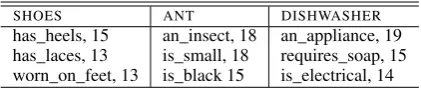
et al., 2004). Property norm datasets (McRae et al., 2005; Devereux et al., 2013) are constructed by asking human participants to identify the most important attributes of a concept (see Table 1) and are widely used to test models of conceptual repre-sentation (McRae et al., 1997; Randall et al., 2004; Cree et al., 2006; Tyler et al., 2000; Grondin et al., 2009). Yet, to the best of our knowledge, such property norms have not been investigated in the context of metaphor processing.
Recent studies (Fagarasan et al., 2015; Bu-lat et al., 2016) have shown that wide-coverage property-norm based semantic representations can be automatically constructed using cross-modal maps and that these perform comparably to dense semantic representations (Mikolov et al., 2013)
1Throughout the paper we will be using the terms
proper-tiesandattributesinterchangeably.
SHOES ANT DISHWASHER
[image:2.595.76.287.62.107.2]has_heels, 15 an_insect, 18 an_appliance, 19 has_laces, 13 is_small, 18 requires_soap, 15 worn_on_feet, 13 is_black 15 is_electrical, 14
Table 1: Examples of properties from McRae et al. (2005) together with their production frequencies on standard word similarity tasks. In this pa-per we hypothesise that such attribute-based rep-resentations provide a suitable means for gener-alisation over the source and target domains in metaphorical language and test this hypothesis. Our results show that these property-based repre-sentations can perform better than dense predicting (Mikolov et al., 2013) and context-counting (Turney and Pantel, 2010) vectors in a metaphor classification task, thus providing a suit-able model of cross-domain property projection in metaphorical language.
2 Related work
Much previous research on metaphor processing casts the problem as classification of linguistic ex-pressions as metaphorical or literal. Gedigian et al. (2006) classified verbs using a maximum en-tropy classifier and the verbs’ nominal arguments and their semantic roles as features. Dunn (2013) used a logistic regression classifier and high-level properties of concepts extracted from the SUMO ontology, including domain types (ABSTRACT, PHYSICAL, SOCIAL, MENTAL) and event status
(PROCESS, STATE, OBJECT). Tsvetkov et al.
(2013) also used logistic regression and coarse se-mantic features, such as concreteness, animate-ness, named entity types and WordNet super-senses. They have shown that the model learned with such coarse semantic features is portable across languages. The work of Hovy et al. (2013) is notable as they focused on compositional fea-tures. They trained an SVM with dependency-tree kernels to capture compositional information, us-ing lexical, part-of-speech tag and WordNet su-persense representations of parse trees. Mohler et al. (2013) derived semantic signatures of texts as sets of highly-related and interlinked WordNet synsets. The semantic signatures served as fea-tures to train a set of classifiers (maximum en-tropy, decision trees, SVM, random forest) that map new metaphors to the semantic signatures of the known ones.
Turney et al. (2011) hypothesized that meta-phor is commonly used to describe abstract
con-cepts in terms of more concrete or physical experi-ences. They developed a method to automatically measure concreteness of words and applied it to identify verbal and adjectival metaphors. Shutova et al. (2010) pointed out that the metaphorical uses of words constitute a large portion of the de-pendency features extracted for abstract concepts from corpora. As a result, distributional cluster-ing of abstract nouns with such features identifies groups of diverse concepts metaphorically associ-ated with the same source domain. Shutova et al. (2010) exploit this property of co-occurrence vec-tors to identify new metaphorical mappings start-ing from a set of examples. Shutova and Sun (2013) used hierarchical clustering to derive a net-work of concepts in which metaphorical associa-tions are learned in an unsupervised way.
3 Method
3.1 Learning dense linguistic representations We construct two types of linguistic representa-tions: context-predicting – based on the skip-gram model of Mikolov et al. (2013) – and context-counting.
EMBED We employ 100-dimensional word
em-beddings constructed by Shutova et al. (2016) from Wikipedia using the standard log-linear skip-gram model with negative sampling of Mikolov et al. (2013). The embeddings were trained using a symmetric window of 5 words either side of the target word, 10 negative samples per word-context pair and number of epochs set to 3.
SVD We use Wikipedia to build count-based distributional vectors, using the top 10K most fre-quent lemmatised words (excluding stopwords) as contexts. Context windows are defined as sen-tence boundaries and counts are re-weighted us-ing positive pointwise mutual information (PPMI). We obtain 100-dimensional dense semantic repre-sentations by applying singular value decomposi-tion (SVD) (Deerwester et al., 1990) to the sparse 10K-dimensional PPMI weighted vectors.
3.2 Learning attribute-based vectors through cross-modal mapping
is_loud has_keys requires_air is_long
ACCORDION 6 17 11 0
CLARINET 0 9 0 8
[image:3.595.347.486.62.137.2]CROCODILE 0 0 0 6
Table 2: A subspace of the property-norm seman-tic space (PROPERTY)
concepts annotated with properties and produc-tion frequencies (i.e. the number of participants that produced that property). Examples of con-cepts and properties can be found in Table 1. Each concept was shown to 30 participants and only features listed by more than 5 annotators were recorded. The published dataset contains a total of 2526 properties, with a mean of 13.7 features per concept. The McRae et al. (2005) property-norm dataset can be used to obtain distributed repre-sentations of concepts over attributes (henceforth
PROPERTY). We can view it as a bag of 2526
prop-erties, with the standard co-occurrence counts be-ing replaced by the production frequencies. Table 2 shows a subspace of such a property-norm se-mantic space.
Cross-modal maps Even though MCRAE only
contains annotations for 541 concepts, cross-modal maps can be used to induce property-based representations for words outside of this dataset. Fagarasan et al. (2015) propose a method for ob-taining such representations for any concept from its distributional behaviour and Bulat et al. (2016) show that these can be also inferred from images. Cross-modal maps represent a formalisation of the reference problem. For example, by inducing a cross-modal map between linguistic representa-tions and property-based representarepresenta-tions, we can learn to predict properties for new (unseen) con-cepts (Figure 1).
Property-based vectors Following Fagarasan et al. (2015), we obtain property-based vectors by using partial least squares regression2 (PLSR) to
learn a cross-modal mapping function between the dense linguistic representations (SVDandEMBED)
and the property-norm semantic space (PROP -ERTY), using the 541 concepts inMCRAEas
train-ing data. We learn two different maps, hence two different attribute-based representations: one from
SVDtoPROPERTY(ATTR-SVD) and one fromEM -BEDtoPROPERTY(ATTR-EMBED).
2We set the number of latent variables in the cross-modal
PLSR map to 100.
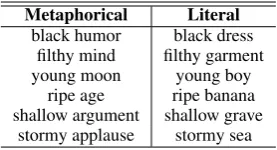
Metaphorical Literal black humor black dress
filthy mind filthy garment young moon young boy
ripe age ripe banana shallow argument shallow grave
stormy applause stormy sea
Table 3: Annotated adjective–noun pairs from
TSV-TEST
3.3 Metaphor classification
We compare the performance of the aforemen-tioned semantic representations (SVD, EMBED, ATTR-SVD and ATTR-EMBED) on a metaphor
classification task, in order to test our hypoth-esis as to whether attribute-based semantic rep-resentations provide better concept generalisa-tions for metaphor modelling than the widely-used dense linguistic representations. We use an SVM (Joachims, 1998) to perform the classification3.
4 Experiments 4.1 Experimental data
We evaluate our method using the dataset of adjective–noun pairs manually annotated for metaphoricity, created by Tsvetkov et al. (2014). This corpus was created by extracting the nouns that co-occur with a list of 1000 frequent adjectives in the TenTen Web Corpus4 using
SketchEngine and in collections of metaphor on the Web. The data is divided into a training set (TSV-TRAIN) and test set (TSV-TEST).TSV-TRAIN
contains 884 literal and 884 metaphorical pairs an-notated for metaphoricity.TSV-TESTcontains 100
literal and 100 metaphorical pairs, annotated by 5 annotators with an inter-annotator agreement of
κ = 0.76. Table 3 shows a portion of the test set. Metaphorical phrases that depend on wider context for their interpretation (e.g. drowning stu-dents) were removed.
This dataset is well-suited to our task since it in-cludes examples of the same adjective used in both metaphorical and literal phrases (e.g. “hot topic” and “hot chocolate”). This is important since we want our model to be able to discriminate between different word senses, as opposed to selecting the most frequent class for any given word.
3Experiments were performed using the sklearn.svm
toolkit.
4
[image:3.595.75.307.64.109.2]DOG CAT
furry
pet
run
CAT
has_fur
a_pet
an_animal
f
DOG
Linguistic
Attribute
[image:4.595.103.497.67.230.2]TIGER
Figure 1: Example of cross-modal mapping: learn f using aligned representations (linguistic and at-tribute) forDOGandCAT, then predict attribute representation forTIGERasf(TIGER_linguistic)
4.2 Experimental setup and results
We obtain four types of semantic vectors (SVD, EMBED, ATTR-SVD, ATTR-EMBED) for all nouns
and adjectives in Tsvetkov et al. (2014) as de-scribed in Section 3. It is important to note that up to now, attribute-based representations as those described in Section 3.2 have only been used for nouns. To our knowledge, this is also the first work that uses cross-modal maps learned on nouns to predict attribute-based representations for other parts of speech.
The input to our SVM classifier is the concate-nation of the L2-normalised adjective and noun vectors. We use the phrases in TSV-TRAIN and TSV-TEST to train and test our system,
respec-tively. We evaluated the performance of our clas-sifier on TSV-TEST in terms of precision, recall
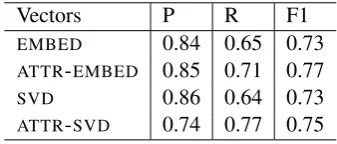
and F-score; the results are presented in Table 4. Both types of attribute-based vectors outperform their dense counterparts, which lends support to our hypothesis that property norms offer a suitable level of generalisation of the source and target do-mains. The best performance is achieved when us-ing the attribute-based representation learned from the embedding space (ATTR-EMBED), with an
im-provement of 4% in F1 score overEMBED.
5 Qualitative analysis and discussion The results in Table 4 show that the systems are able to reliably distinguish between metaphori-cal and literal expressions both when using dense and attribute-based semantic representations. This is an effect of modelling word meanings as dis-tributed representations over semantic primitives.
Vectors P R F1
EMBED 0.84 0.65 0.73
ATTR-EMBED 0.85 0.71 0.77
SVD 0.86 0.64 0.73
ATTR-SVD 0.74 0.77 0.75
Table 4: System performance on Tsvetkov et al. test set (TSV-TEST) in terms of precision (P), re-call (R) and F-score (F1)
Intuitively, one may expect the noun and the ad-jective in a metaphorical expression to share fewer properties than in the case of literal language, due to a semantic distinction between its source and target domains. And it is likely that all of our models capture this effect, by implicitly learning some notion of similarity between the semantic domains in the literal and metaphorical phrases. Our hypothesis is that attribute-based methods outperform theEMBEDandSVDbaselines because
the attribute-based dimensions are cognitively-motivated and represent cognitively salient prop-erties for concept distinctiveness. As such, they provide a more suitable means of generalisation in the metaphor identification task, as inferred from our results.
Another advantage of using attribute-based vec-tors (ATTR-EMBED, ATTR-SVD) in the metaphor
identification task is that they are interpretable, i.e. every dimension in the space has a fixed interpretation (is_round, a_bird etc.) as op-posed to the abstract dimensions of SVD and EMBED. We can thus identify the most salient
[image:4.595.331.500.286.358.2]in-sights into how the attributes of metaphorical ex-pressions differ from those of the literal ones. For example, in the metaphorical expression “woolly liberal”, the highest weighted attributes for woolly (AN_ANIMAL, A_FRUIT, IS_SMALL, A_MAMMAL, IS_BROWN, IS_LONG) are ranked
low for liberal and vice-versa. When we look at a literal expression using the same adjective, “woolly mammoth”, we observe many overlap-ping features among the top 200 highest-weighted ones, with 48% of these attributes being shared (e.g. AN_ANIMAL, IS_SMALL, IS_BROWN, HAS_4_LEGS, A_MAMMAL, IS_LARGE). The
same trend was observed for the majority of the AN pairs in TSV-TEST5, demonstrating that
the components of literal expressions share many more features than the components of the metaphorical ones.
6 Conclusion
We presented the first method that uses large-scale attribute-based semantic representations for meta-phor identification. Our results demonstrate that these provide a suitable level of generalisation for capturing metaphorical mechanisms. Our experi-ments also suggest interesting future research av-enues in the investigation of the attribute-based representations of abstract concepts, more gener-ally. For instance, we have observed that many of the highly-weighted attributes for abstract con-cepts are metaphorical in nature (e.g.A_BIRD for
“liberal”). This echoes previous research in cogni-tive science, which has shown that while concrete concepts are well represented through their inter-nal properties and relation to similar concepts, ab-stract concepts tend to be represented through as-sociations with many diverse concepts (Crutch and Warrington, 2005). We believe that our methods provide a framework for a data-driven investiga-tion of this issue in the future.
7 Acknowledgments
LB is supported by an EPSRC Doctoral Training Grant. SC is supported by ERC Starting Grant DisCoTex (306920) and ERC Proof of Concept Grant GroundForce (693579). ES is supported by the Leverhulme Trust Early Career Fellowship. We are grateful to Jean Maillard for providing help
5ATTR-EMBEDwas used for this analysis as it performs
best in the metaphor classification task.
with the embeddings and thank the anonymous re-viewers for their helpful comments.
References
Rodrigo Agerri. 2008. Metaphor in textual entailment. In COLING 2008: Companion volume: Posters, pages 3–6, Manchester, UK, August.
Luana Bulat, Douwe Kiela, and Stephen Clark. 2016. Vision and feature norms: Improving automatic fea-ture norm learning through cross-modal maps. In
Proceedings of the 2016 Conference of the North American Chapter of the Association for Computa-tional Linguistics: Human Language Technologies, pages 579–588, San Diego, California, June. Asso-ciation for Computational Linguistics.
Lynne Cameron. 2003. Metaphor in Educational Dis-course. Continuum, London.
George S. Cree, Chris McNorgan, and Ken McRae. 2006. Distinctive features hold a privileged status in the computation of word meaning: Implications for theories of semantic memory. Journal of Experi-mental Psychology: Learning, Memory, and Cogni-tion, 32(4):643.
Sebastian J. Crutch and Elizabeth K. Warrington. 2005. Abstract and concrete concepts have structurally different representational frameworks.
Brain, 128(3):615–627.
Scott Deerwester, Susan T. Dumais, George W Fur-nas, Thomas K Landauer, and Richard Harshman. 1990. Indexing by latent semantic analysis. Jour-nal of the American Society for Information Science, 41(6):391.
Barry J. Devereux, Lorraine K. Tyler, Jeroen Geertzen, and Billi Randall. 2013. The centre for speech, language and the brain (CSLB) concept property norms. Behavior Research Methods, pages 1–9. Jonathan Dunn. 2013. Evaluating the premises and
results of four metaphor identification systems. In
Proceedings of CICLing’13, pages 471–486, Samos, Greece.
Luana Fagarasan, Eva Maria Vecchi, and Stephen Clark. 2015. From distributional semantics to fea-ture norms: grounding semantic models in human perceptual data. InProceedings of the 11th Inter-national Conference on Computational Semantics (IWCS’15), pages 52–57, London, UK, April. As-sociation for Computational Linguistics.
Matt Gedigian, John Bryant, Srini Narayanan, and Bra-nimir Ciric. 2006. Catching metaphors. InIn Pro-ceedings of the 3rd Workshop on Scalable Natural Language Understanding, pages 41–48, New York. Ray Grondin, Stephen J. Lupker, and Ken McRae.
Ilana Heintz, Ryan Gabbard, Mahesh Srivastava, Dave Barner, Donald Black, Majorie Friedman, and Ralph Weischedel. 2013. Automatic extraction of linguis-tic metaphors with lda topic modeling. In Proceed-ings of the First Workshop on Metaphor in NLP, pages 58–66, Atlanta, Georgia.
Dirk Hovy, Shashank Shrivastava, Sujay Kumar Jauhar, Mrinmaya Sachan, Kartik Goyal, Huying Li, Whit-ney Sanders, and Eduard Hovy. 2013. Identifying metaphorical word use with tree kernels. In Pro-ceedings of the First Workshop on Metaphor in NLP, pages 52–57, Atlanta, Georgia.
Thorsten Joachims. 1998. Text categorization with support vector machines: Learning with many rel-evant features. InEuropean Conference on Machine Learning (ECML), Berlin.
George Lakoff and Mark Johnson. 1980. Metaphors We Live By. University of Chicago Press, Chicago. Ken McRae, Virginia R. de Sa, and Mark S.
Seiden-berg. 1997. On the nature and scope of featural representations of word meaning. Journal of Exper-imental Psychology: General, 126(2):99.
Ken McRae, George S. Cree, Mark S. Seidenberg, and Chris McNorgan. 2005. Semantic feature pro-duction norms for a large set of living and nonliv-ing thnonliv-ings. Behavior Research Methods, 37(4):547– 559.
Tomas Mikolov, Kai Chen, Greg Corrado, and Jeffrey Dean. 2013. Efficient estimation of word represen-tations in vector space.ICLR workshop.
Michael Mohler, David Bracewell, Marc Tomlinson, and David Hinote. 2013. Semantic signatures for example-based linguistic metaphor detection. In
Proceedings of the First Workshop on Metaphor in NLP, pages 27–35, Atlanta, Georgia.
Billi Randall, Helen E. Moss, Jennifer M. Rodd, Mike Greer, and Lorraine K. Tyler. 2004. Distinctiveness and correlation in conceptual structure: behavioral and computational studies. Journal of Experimen-tal Psychology: Learning, Memory, and Cognition, 30(2):393.
Ekaterina Shutova and Lin Sun. 2013. Unsupervised metaphor identification using hierarchical graph fac-torization clustering. In Proceedings of the 2013 Conference of the North American Chapter of the Association for Computational Linguistics: Human Language Technologies, pages 978–988, Atlanta, Georgia, June. Association for Computational Lin-guistics.
Ekaterina Shutova and Simone Teufel. 2010. Meta-phor corpus annotated for source - target domain mappings. In Nicoletta Calzolari (Conference Chair), Khalid Choukri, Bente Maegaard, Joseph Mariani, Jan Odijk, Stelios Piperidis, Mike Ros-ner, and Daniel Tapias, editors,Proceedings of the
Seventh conference on International Language Re-sources and Evaluation (LREC’10), Valletta, Malta, May. European Language Resources Association (ELRA).
Ekaterina Shutova, Lin Sun, and Anna Korhonen. 2010. Metaphor identification using verb and noun clustering. InProceedings of the 23rd International Conference on Computational Linguistics (Coling 2010), pages 1002–1010, Beijing, China, August. Coling 2010 Organizing Committee.
Ekaterina Shutova, Douwe Kiela, and Jean Maillard. 2016. Black holes and white rabbits: Metaphor identification with visual features. InProceedings of the 2016 Conference of the North American Chap-ter of the Association for Computational Linguis-tics: Human Language Technologies, pages 160– 170, San Diego, California, June. Association for Computational Linguistics.
Ekaterina Shutova. 2011. Computational Approaches to Figurative Language. Ph.D. thesis, University of Cambridge, UK.
Paul H. Thibodeau and Lera Boroditsky. 2011. Meta-phors we think with: The role of metaphor in rea-soning.PLoS ONE, 6(2):e16782, 02.
Yulia Tsvetkov, Elena Mukomel, and Anatole Gersh-man. 2013. Cross-lingual metaphor detection using common semantic features. InProceedings of the First Workshop on Metaphor in NLP, pages 45–51, Atlanta, Georgia.
Yulia Tsvetkov, Leonid Boytsov, Anatole Gershman, Eric Nyberg, and Chris Dyer. 2014. Metaphor de-tection with cross-lingual model transfer. In Pro-ceedings of the 52nd Annual Meeting of the Asso-ciation for Computational Linguistics (Volume 1: Long Papers), pages 248–258, Baltimore, Maryland, June. Association for Computational Linguistics. Peter D Turney and Patrick Pantel. 2010. From
fre-quency to meaning: Vector space models of se-mantics. Journal of Artificial Intelligence Research, 37(1):141–188.
Peter Turney, Yair Neuman, Dan Assaf, and Yohai Co-hen. 2011. Literal and metaphorical sense identifi-cation through concrete and abstract context. In Pro-ceedings of the 2011 Conference on Empirical Meth-ods in Natural Language Processing, pages 680– 690, Edinburgh, Scotland, UK., July. Association for Computational Linguistics.