Abstract— The existence of selfish nodes, who do not cooperate in routing and forwarding, menaces the applicability of mobile ad hoc networks (MANETs). In this paper, we propose a novel price-based method for stimulating cooperation among the nodes of a MANET. This method utilizes the game-theoretic notion of core to distribute the earnings of a cooperation coalition among its members in an optimal manner. In this way, a stable cost-efficient route is established between communicating parties.
Index Terms— Cooperation stimulation, cost-efficient routing, game theory, mobile ad hoc networks
I. INTRODUCTION
he use of mobile devices has been proliferated in recent years. The advent of mobile ad hoc networks (MANETs) is a direct result of such proliferation in which a set of mobile nodes are connected without any pre-established infrastructure. In such networks, there is no specific-purpose router, and any node may undertake the responsibilities of a router. Therefore, cooperation among the nodes of a MANET is vital for network functionality. Such cooperation is an un-derlying assumption of a large number of routing protocols proposed so far. This assumption is only valid for the applica-tions in which all the nodes belong to a single authority, e.g., military or emergency applications where the nodes share a common mission.
If nodes belong to different authorities, a node may not co-operate in network functions. This is because he prefers to save his limited resources, such as the battery power and bandwidth, for his own needs. Such a misbehaving node is said to be a selfish node. The existence of selfish nodes causes a MANET to be broken into pieces so that the network cannot provide services, such as route establishment and packet for-warding, for legitimate users. In this sense, the behavior of selfish nodes causes a passive denial-of-service in MANETs.
It has been shown that the presence of selfish nodes de-creases the throughput of an ad hoc network [1]. It has also been proven that the probability of cooperation among nodes
This work was supported in part by the Iran Telecommunication Research Center.
A. Omrani is an M.S. student in the department of IT and computer engi-neering, Amirkabir University of Technology, Tehran, Iran. Email: [email protected].
M. S. Fallah is with the department of IT and Computer Engineering, Amirkabir University of Technology, Tehran, Iran. Email: [email protected]
is very low where there is no specific mechanism for coopera-tion stimulacoopera-tion [2]. Hence, enforcing cooperation among nodes requires some encouraging mechanism in which coop-eration is more beneficial than egocentric behavior.
There are two principal classes of encouraging mechanisms, reputation-based mechanisms and price-based mechanisms. In a reputation-based mechanism, the neighbors of a node con-tinually log the actions taken by that node [2], [3], [4]. In this way, every node would have a record of his neighbors’ reputa-tions. More cooperative a node is, he gains better reputation, and consequently, he will be better served. Notorious nodes, on the other hand, will be isolated from the network. Although the reputation-based mechanisms can be easily implemented, they suffer from the false detection of misbehaving nodes, an issue that is very likely in mobile environments [5].
In price-based mechanisms, what a cooperative node loses due to his cooperative behavior is compensated by some kind of virtual money [6], [7], [8], [9]. In [6] and [7], if a node re-lays a packet, he receives one unit of credit from the sender. The correctness of credit exchange is preserved by putting tamper-proof hardware in any node or deploying a specific-purpose secure exchange protocol. In the latter, a Credit Clearance Service (CCS) makes payments in forwarding stage, when intermediate nodes have actually relayed the packets [8].
The price of relaying a packet may be different in the nodes. Therefore, an effective price-based mechanism should be sup-plemented by a technique which determines these prices accu-rately. In [9], a node calculates the price of a service accord-ing to the cost he incurs in providaccord-ing that service. Then, he announces this price. In this approach, it is implicitly assumed that the nodes aretruthful and announce their prices honestly. The source node calculates the flow rate on the basis of these prices and his own willingness-to-pay.
In ad hoc VCG, a routing protocol proposed in [10], the destination sets prices in such a way that dishonesty has no profit for the nodes, and therefore, they declare their costs truthfully. In doing so, it employs the idea stated in VCG (Vickrey-Clarke-Groves) that is an auction mechanism known well for its efficient outcomes and incentives it provides for bidders to reveal their true valuation of the presented service. Nevertheless, the collusion problem in which selfish nodes cooperate with each other to gain better payoffs is not consid-ered in ad hoc VCG. The presence of such collusions threat-ens the stability of established route.
Stimulating Cooperation in MANETs Using
Game Theory
Azadeh Omrani and Mehran S. Fallah
In this paper, we propose a price-based routing mechanism which is very similar to ad hoc VCG but without the short-coming stated above. In doing do, we employ game theory.
Several non-cooperative games have already been proposed to model the cooperation problem in ad hoc networks [2], [8], [10], [11], [12], [13]. In a non-cooperative game, players pick their actions according to their own interests. However, selfish players may achieve better payoffs if they cooperate with each other, i.e., if they make a collusion. This issue cannot be mod-eled using non-cooperative games.
The routing protocol proposed in [14] uses coalitional game theory to analyze how a coalition of redirecting nodes is formed. It then distributes the earnings of the coalition, which is the frugality of energy consumption, among cooperating nodes in a fair manner. We show that such a fair distribution does not necessarily preserve the stability of an established route.
We propose a payment scheme which pursues cost-efficiency, individual profitability, and stability of an estab-lished route as its main objectives. To do so, we define a cost function, and then deploy the notion of core in coalitional games to find a stable payment scheme. It is shown that the overpayment of our mechanism is less than the one in ad hoc VCG.
This paper is organized as follows. Section 2 provides some basic definitions of coalitional game theory. Section 3 states the problem of cooperation stimulation in details. Section 4 explains our payment scheme. Section 5 shows simulation results. Section 6 outlines future works and concludes the pa-per.
II. COALITIONAL GAME THEORY
This section introduces those concepts of coalitional game theory used in our payment scheme.
The coalitional game theory [15] is a framework for finding the players’ optimum strategies when they make coalitions for a common goal. The players in a coalition can do joint actions leading to possibly different payoffs for those players. Thus, the set of outcomes for a coalition is the set of all feasible payoffs for the coalition members. In transferable payoff games, an outcome is a distribution of total gain, obtained from cooperation, among the members with respect to the relative power or value of each member in the coalition.
Let N be a finite set of players. A transferable payoff coali-tional game is modeled by the pair ( , )N v , where v is the characteristic function v: 2N →\ that maps any non-empty subset of N to a real number. The value of v S( ) shows the maximum worth the members of S can make together.
A characteristic function is said to be super-additive if for all coalitionsAand B with A B∩ = ∅, v A B( ∪ )≥v A( )+
( )
v B . In supper-additive coalitional games, the grand coali-tion is necessarily formed.
Any payoff vector x S( ) ( )= xi i S∈ is called an S-feasible
outcome if
∑
i S∈ xi=v S( ). An N-feasible outcome is called afeasible outcome. In super-additive games, we say that a fea-sible outcome x N( ) is in the core if and only if every coali-tion receives a total payoff greater than or equal to what it is worth, i.e., v S( )≤∑i S∈ xi for any S N⊆ .
The core is informally defined as the set of allocations for cooperative players in the grand coalition (N) which cannot be blocked by any other coalition. A coalition may block an allocation if it provides more payoffs for all of its members than the grand coalition can offer them. If the core is non-empty, there exists at least one stable outcome that makes it uninterested for any set of players to deviate from the grand coalition.
According to Bondareva-Shapley theorem, a transferable payoff coalitional game has a non-empty core if and only if it is balanced. A game ( , )N v is balanced if ∑S N⊆ λSv S( )≤
( )
v N for every collection of weights ∑S N⊆ λS=1.
III. PROBLEM STATEMENT
An ad hoc network is modeled as a directed graph
=( , )
G V E , where V and E are the set of nodes and the set of directed links respectively. When nj is in the transmission range of ni, the edge eij∈E represents the directed link from
i
n to nj (n ni, j∈V). A route in the network is represented by a path in this graph, where its source and destination are denoted by ns and nd. If esd∉E, nd is not in the transmis-sion range of ns and the communication may be possible through a number of intermediate nodes realizing a path from
s
n to nd in the corresponding graph. In such a case, the co-operation among intermediate nodes, the nodes on the path except for the source and destination, is required for relaying data. A node ni∈V incurs a cost to send/forward a packet
j
n that is in his transmission range (nj is called a neighbor of
i
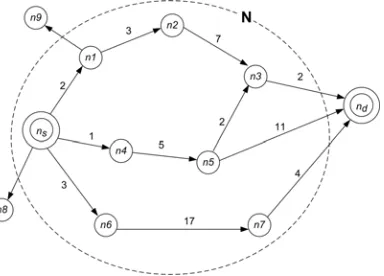
n ). Therefore, we assign a label cij to the link from ni to nj as the cost ni incurs to communicate with nj. Fig. 1 shows the model of an example ad hoc network.
The cost cij is calculated as the multiplication of the value of ni’s battery energy unit, which depends on the current bat-tery level, and the amount of energy needed for transmission [16]. We assume that every node can adjust the level of his transmission power. In such a case, the minimum power re-quired for transmission from ni to nj, Pminij , is proportional to dijα, where 2≤ ≤α 6, and dij is the distance between ni and nj. The parameter α depends on the environment cir-cumstances [17].
des-tination collects all the suggested routes and selects the least costly one.
In order to encourage the selfish intermediate nodes to co-operate in data transmission in a route R, the costs they incur as well as an extra benefit should be returned to them. As with the earlier price-based schemes for cooperation stimulation, our method considers a virtual account for any node. The source ns has to pay the nodes on the cost-efficient route. This payment is withdrawn from ns’s account. As proposed in [8], such a money transfer is done in data transmission phase, i.e., the phase after establishing a route between sender and receiver. We stipulate that the remained money in an ac-count should be nonnegative. Moreover, it is assumed that every node has a positive initial amount of money in his ac-count.
The source node ns is willing to pay a specific amount
( )
W s of money to set up a route to the destination node nd. Clearly, this amount of money has to be less than what ns owns in his account. The payment pi to an intermediate node
i
n should be greater than his cost to encourage him to coop-erate with the nodes in the route R from ns to nd. Therefore, the payoff function for a node i with respect to a possible route R is defined by
( ) , if
( , ) , if and is on
0, otherwise
j i j R
i i
W i p c i s
u i R p c i s i R
∈
− − =
⎧ ⎪
=⎨ − ≠
⎪ ⎩
∑
. (1)
[image:3.612.85.277.472.610.2]It is more preferable for the source to pay less money com-pared to the value he considers for the route. Each intermedi-ate node, on the other hand, is interested in the additional money he gains from cooperation. If a node does not cooper-ate, he gains and loses nothing.
Fig. 1. The graph of an example ad hoc network. A label on the edge leaving a node is the cost that node should incur in data forwarding.
We assume that the nodes can negotiate with each other on the price of services they provide (pi). In the presence of such negotiation, an established route may not be stable because the sender may receive better suggestions from the nodes are not in the current route. A new suggestion may lead to a cost-inefficient route. A cost-cost-inefficient route results in a poor
en-ergy consumption pattern which threatens network survivabil-ity.
By the following example, we show that negotiation among nodes may lead to an inefficient route in ad hoc VCG scheme [10]. As shown in Fig. 1, the set of possible routes from ns to
d
n is ℜ = 〈{n n n1, 2, 3〉 〈, n n n4, ,5 3〉, 〈n n6, 7〉} where the cost-efficient route is Rbest = 〈n n n4, ,5 3〉 with the total cost of 10. If we assume W s( ) 35= , every node on Rbest will receive a payoff equal to his marginal contribution ui =cost R( best−i )
−cost R( best), where Rbest−i is the cost-efficient route from ns to nd when ni does not contribute in routing. Note that the above equality is a result of truthfulness under which any node in the route announces the actual cost he incurs. For the network represented by Fig.1, we have
u1=u2= u6=u7=0, u4 =u5 =14 10 4− = , u3 =17 10 7− = , and
{ }
( ) ( )
35 10 15 10. best
best best
s i R i s
i i
i R s i R
u W s p c
W s c u
∈
∈ ∪ ∈
= − −
= − −
= − − =
∑
∑ ∑
On the other hand, another possible route from ns to nd is
R= 〈n n n1, ,2 3〉 with the total cost of 14. Assume that
nego-tiation among the nodes in R results in the payoffs u1′ =1, 1, 8 u2′ = u′3 = and us′ =35 14 10 11.− − = Thus, the nodes ns and n3 will secede from Rbestand form R together with n1and n2, though R is not a cost-efficient route.
Another problem with the ad hoc VCG is its high ratio of overpayment. As stated in [10], the overpayment ratio is de-fined by
( )
best
s i R i
best
c p
cost R
∈
+
∑
,
in which pi= +ci ui. This ratio has an upper bound that is a constant multiple of 2α+1 and can be very large in actual im-plementations. A payment scheme with a less overpayment ratio is more desirable.
In the next section, we propose a routing protocol including a novel payment scheme. This protocol finds a cost-efficient route and provides incentives for cooperating entities in such a way that the established route remains stable. We examine the overpayment problem as well.
IV. PAYMENT SCHEME
A typical on-demand routing protocol contains two phases; route discovery and data transmission. Our proposed protocol computes the value of payment to a node in route discovery phase and pays it in data transmission phase.
coali-tional game theory. It is also shown that the overpayment ratio of our scheme is less than the one in ad hoc VCG.
A. Route discovery and coalition formation
An on-demand routing protocol is proposed which deploys flooding of route request packets in its route discovery phase. The interaction between the source and any intermediate node in this phase is modeled as a non-cooperative game.
The source node ns and all the nodes on a possible route from ns to nd form the set of players N. The action space for ns is {send not send, − }. These actions represent source’s decision on sending route discovery packets. For an interme-diate node, the action space is {forward drop, }.
We assume that the cost of sending control packets is neg-ligible because they are small in size and the routing operation is not very frequent.
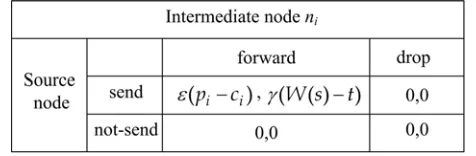
The motivation for dispatching rout request packets is that the intermediate nodes hope to gain non-zero payoffs in data transmission phase. If the probability of being located on the selected route is ε for an intermediate node ni, he gains the payoff ε(p ci− i) according to (1). The source gains the corre-sponding payoff in (1) multiplied by γ that is the probability of finding at least one route from source to destination. The bimatrix of the single-shot game between the source and an intermediate node is shown in Fig. 2.
If W s( )≥t and pi≥ci, the strategy profile (send, forward) is a Nash equilibrium in the sense that deviation from this strategy has no profit for the deviator. The payment scheme leading to the Nash equilibrium above is called indi-vidually profitable. The players that adhere to the Nash pre-scription form a cooperating coalition.
Fig 2. The bimatrix of the game between the source and an intermediate nodni, where t=
∑
i R∈ pi+cs.Now we describe the route discovery protocol. The source
s
n broadcasts a route request packet by a predetermined level of transmission power that is known by any node in the net-work. This level of transmission power is the highest one a node can access. The reason for using the highest possible level of transmission power in the route discovery process is that all possible routes are discovered in this way. As will be seen, this is an important issue in solving the collusion prob-lem.
The route request packet includes a route ID, IDs d− , as well as the source and destination ID’s, ns and nd. It also contains a payment offer W s( ) signed by the source, and the cost of
one unit of energy in the source es. Each nodenj, receiving
this request from his previous node ni, senses the received signal strength. He then calculates the minimum transmission power Pminij needed for ni to reach nj (as formulated in [10]). The node nj calculates the cost ci by multiplying min
ij P and i
e together, the declared cost of one unit of energy in ni. He then proceeds by substituting ci for ei, and appending min
ij P ,
j
n ’s ID, and ej as the cost of one unit of energy in nj. Fi-nally, nj broadcasts the route request packet. The messages exchanged in the route discovery phase are as follows.
min
: , , , , W( ), ,
for any in 's neighborhood,
: , , , , W( ), ..., , , , , ,
for any pair of adjacent nodes
s i s d s d s
i s
ij
j k s d s d i i j j
j
n n RREQ ID n n s e
n n
n n RREQ ID n n s n c P n e
n
−
−
→ 〈 〉
→ 〈 〉
and , andnk
min min
: , , , , ..., , , ij , , , jd
d s s d s d i i j j
n →n 〈RREP ID− n n n p P n p P 〉.
During a stable time slot, for every route that could be found from ns to nd, the destination node receives a route request packet offering that route. For each offered route R, the destination node calculates CR =
∑
i R∈ ci and chooses the route with minimum CR as the cost-efficient route. He also determines payments with respect to W s( ) and nodes’ costs. Then, a route reply packet is unicasted from nd to ns along the reverse of the selected route. This route reply packet con-tains those minimum transmission power levels the nodes on the selected route should know for data transmission. He also contains the payments, pi, that should be made by the source in data transmission phase.Note that, we assume the nodes declare the values W s( ) and ei truthfully and adhere to the integrity of ci. In what follows, the values pi are calculated using the concept of core in a coalitional game.
B. Coalitional Stability
A coalition of cooperating nodes is formed as a result of route discovery process. More specifically, a subset of the grand coalition is determined as the cost-efficient route be-tween the source and destination. In this section, a payment scheme is proposed that guarantees the stability of the cost-efficient route. In doing so, we use the notion of core in coali-tional game theory, where the characteristic function reflects the benefit of different subsets of the grand coalition when they cooperate with each other.
The payment scheme is to satisfy the following properties. 1.It compensates the cost a node incurs in data
transmis-sion (individual profitability).
2.The payment distribution prevents any deviation from the solution (stability).
3.It makes as less payment as possible.
[image:4.612.54.292.463.541.2]source node pays less than his willingness to pay. For the sec-ond property we utilize the solution concept of coalitional game theory. The third property is investigated in the next section.
Consider a TU coalitional game ( ,N vG). As shown in Fig. 1, the set of players N includes the source node ns and the intermediate nodes on the routes from ns to nd. For a subset S of N, we define SG as the set of all possible paths from
s
n to nd in G whose nodes (except for nd) are in S. The characteristic function vG designates the total benefit the members of a coalition can make when they cooperate. This function is defined by
( ) min { }, and
( )
0,G otherwise
R S i R i s s G
G W s c c n S S
v S = ⎨⎧ − ∈ ∈ + ∈ ≠ ∅
⎩
∑ .
(2) The payment to the members of a coalition is the responsi-bility of the source, and is only possible for the coalitions the node ns belongs to. Moreover, if no route exists in S, the coalition S can gain nothing. A coalition S including ns and some intermediate nodes which can build some route to nd gain the difference between the total money ns is willing to pay and the total costs expended on the cheapest route in S. This is because every coalition tends to maximizev SG( ). In this way, the cost-efficient route is selected among all possible routes. Note that W s( ) is determined at the beginning of route discovery process, and does not change later.
As seen in Section 3, the distribution of the value produced by a cost-efficient route has an important role in the stability of that route. By using the core allocation rule, the stability of an outcome is guaranteed. This requires the core to be non-empty.
Theorem 1. The core of the game ( ,N vG) is non-empty. Proof. For any disjoint subsets A and B of N, if ns is not in A or B, v AG( )=v BG( )=v A BG( ∪ ) 0= . If ns is in A but not in B, v BG( ) 0= and v AG( )≤v A BG( ∪ ). This is be-cause the set A B∪ contains the routes in A together with some new routes through which attaining a route of less cost is possible. A similar argument holds for remaining cases. Therefore, the game is super-additive, and the grand coalition is formed. From (2), it is evident that v SG( )≤v NG( ) for any
S N⊆ . Now, consider a balanced collection of weights
1
S S N⊆ λ =
∑ . This is immediate that ∑S N⊆ λSv SG( )≤v NG( ).
Hence, the game ( ,N vG) is balanced with a non-empty core.
Consider the example network in Fig. 1. We have
G s G
s G
s G
v n n n n v n n n n v n n n v N
1 2 3 4 5 3 6 7
({ , , , }) 35 14 21, ({ , , , }) 35 10 25, ({ , , }) 35 24 11, ( ) 25.
= − = = − = = − = =
A stable payoff allocation( )x by the use of the core solution is
x1=x2 =x6=x7=0,
s
s
s x x
x
x x x x
3
4 5 3
21, 11 25,
25.
+ ≥
≤ ≤
+ + + =
As seen in Section 3, the payoff allocation of ad hoc VCG lies outside the core, and therefore, the cost-efficient route is in-stable. This is because the selfish nodes are in collusion for more benefits. The allocations made by the core of ( ,N vG)
would prevent such collusion if all possible routes were known before solving the system of core. In other words, de-spite using the payments prescribed by the core, an unconsid-ered route may still compromise the stability of the cost-efficient route. In order to have all possible routes before solv-ing the core inequalities, it is sufficient to use the highest level of transmission power in broadcasting route request packets. Moreover, no route request of the same route ID has to be discarded unless it contains data seen before.
In the route discovery process presented in the previous sec-tion, the destination node acquires several route offers in a stable time slot. We assume the duration of stable time slot to be more than the time the destination needs to discover the complete graph. This holds if the length of a route is bounded above by L. Under such an assumption, none of the source or destination nodes is interested in routes longer than L, since it leads to unacceptable delays. Thus, all possible routes are dis-covered in a limited time.
After collecting all possible routes, the destination node solves the system of linear inequalities to determine the nodes’ payoffs. If there are n nodes in the network, the system has
−2
2n inequalities of n−2 unknowns in the worst case. Thus, this problem is of exponential order.
Nevertheless, this system can be reduced to (4) where the number of inequalities is noticeably decreased. In the system of (4), ℜis the set of discovered routes and Rbest∈ℜ is the cost-efficient one.
1.
∑
i N∈ xi =v NG( ),2.xs+
∑
i R∈ bestxi≥v NG( ),3.xs≥maxS∈ℜ′{ ( )}v SG with
ℜ =′ { |R R∈ℜ,R R∩ best= ∅},
4.xs+
∑
i S∈ xi≥v SG( ) for any S∈ℜ′′, wherepoint method and considering ε-exact solutions, we have
3
y= anda log(= 1/ )ε .
On the other hand, it has been shown that in a directed graph of n vertices and m edges, solving the VCG problem requires Ω( (n nlogn m+ )) computations [21]. However, in practical settings of ad hoc VCG routing, the problem is in
L
O n( +1). This is because for each of the nodes (there are n
nodes in the worst case) on the best route, the minimum-cost route excluding that node has to be determined. A search for such a route takes nL computations in the worst case.
Therefore, the problem of payment assignment is of the same complexity, O n( L+1), in both methods. However, as will be shown in simulations results, our method (the core) takes more time than ad hoc VCG in actual examples. This is owing to the hidden multiplicative constants in the asymptotic notations stated above.
C. Overpayment ratio
The overpayment ratio is defined as the ratio of total pay-ment to total cost in a paypay-ment scheme. Evidently, a scheme with less overpayment ratio is more desirable. In this section, we compare the overpayment ratio in the core with that in ad hoc VCG.
Let C be the cost of the cost-efficient route Rbest. Further, assume there exists a route having the following properties: it shares no node with Rbest, its cost is greater than C, say
τ
+
(1 )
C , and it is the least costly route in the absence of
best
R . We compare the core with ad hoc VCG when such an assumption holds.
In ad hoc VCG, each node on Rbest earns, C(1+τ)
τ
− =C C . Thus, if there are k nodes on Rbest, the overpay-ment ratio is (kCτ+C C k)/ = τ+1. In the core, we have
τ
≥ ( )− (1+ )
s
x W s C . This means that the maximum payment occurs when xs=W s C( )− (1+τ). According to (4), in the
case of maximum payment, we have W s C( )− (1+ +τ)
best i i R∈ x
∑
=W s C( )− . This implies that∑
i R∈ bestxi =Cτ , and therefore, the maximum overpayment ratio isC C C
( τ+ )/ = +τ 1.
Hence, under the assumption stated above, the overpayment ratio in the core is less than the one in ad hoc VCG. In this sense, it enjoys a better performance. The simulation results confirm this, even in the cases the above assumption does not hold.
V. SIMULATION RESULTS
This section presents MATLAB simulations which help compare ad hoc VCG and the core payment schemes. In these simulations, arouting protocol based on DSR [19] is adopted which is very similar to the cost-aware routing protocol used in [10]. The number of nodes is 40, and they are randomly located on a 50m×50m terrain. This is repeated 50 times (each results in a random topology), and in each topology, 30 pairs of source-destination nodes are selected randomly. The
rout-ing protocol is applied to these pairs and the results are then averaged. In addition, it is assumed that α =4, and the maximum length of a route equals the square root of the number of nodes, i.e., L= 40.
In order to solve the system of core, the function linprog.m with the large-scale model is employed. This function uses the LIPSOL algorithm [22] as a polynomial time algorithm based on the primal-dual interior point method.
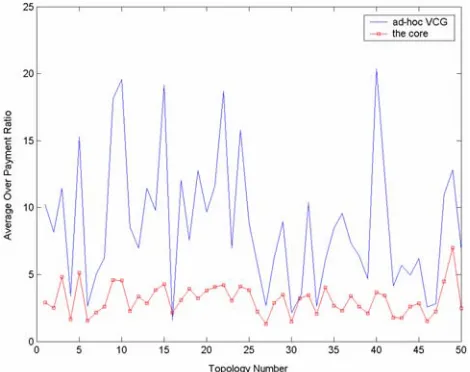
The resultant overpayment ratios in ad hoc VCG and the core are shown in Fig. 3. As seen, average overpayment ratios in the core lie below the ones in ad hoc VCG.
Fig 3.The average overpayment ratios in the core and in ad hoc VCG.
As we mentioned in Subsection B of Section 4, both VCG and the core payment computations are done in polynomial time. Fig. 4 compares the time needed for computations in the two methods. As seen, the time taken by the core is more than the one taken by ad hoc VCG. This is because the core per-forms extra computations to find stable payments. This intro-duces a tradeoff between the execution time and the overpay-ment. The less overpayment one intends, the more computa-tions he should perform. A question arises here: Are these extra computations economic? In order to answer this ques-tion, we should have an effective method to compare the cost of extra computations with the benefits produced by low over-payments.
We denote the difference between total payments in the core and ad hoc VCG by Fs. This is the amount of money a source node can save when he uses the core in lieu of ad hoc VCG. Similarly, Dt is the extra time a destination node spends when he uses the core instead of ad hoc VCG. Assume that in a unit of time the destination node consumes one unit of energy. As the cost of one unit of energy is ed in the desti-nation, the amount of money he should expend for the extra computations equals Md =D et d. Therefore, the actual benefit produced by the core, in comparison to ad hoc VCG, is
s d
[image:6.612.322.557.206.392.2]spent for extra computations. Hence, the core is more benefi-cial than ad hoc VCG.
Fig 4. The time taken by the core in comparison to the one taken by ad hoc VCG.
Fig 5.The average of Q F= s−Md as the actual benefit produced by the core.
VI. CONCLUSION
In this paper, we focused on providing incentives for selfish nodes in a MANET to participate in routing and forwarding. In doing so, we deployed coalitional game theory to propose an optimal price-based scheme aimed at energy-efficiency, individual profitability, and stability. As its distinctive feature, it was shown that the proposed scheme preserves the stability of the cost-efficient route. In addition, it has a better perform-ance than ad hoc VCG.
In our scheme, it is assumed that the nodes declare their costs truthfully. This is not necessarily valid and deserves fur-ther studies.
REFERENCES
[1] S. Marti, T.J. Giuli, K. Lai, and M. Baker, “Mitigating routing misbehavior in mobile ad hoc networks,” in Proc. 6th Annu. Int. Conf.
Mobile Computing and Networking, Boston, MA, 2000, pp. 255-265.
[2] M. Félegyházi, J.-P. Hubaux, L. Buttyán, “Nash equilibria of packet forwarding strategies in wireless ad hoc networks,” IEEE Trans. Mobile
Computing, vol. 5, no. 5, May 2006, pp. 463-476.
[3] S. Buchegger and J.-Y. Le Boudec. “Performance analysis of the CONFIDANT protocol: cooperation of nodes fairness in dynamic ad-hocnetworks,” in Proc. IEEE/ACM Symp. Mobile Ad Hoc Networking
and Computing, Lausanne, CH, 2002, pp. 226-236.
[4] P. Michiardi, R. Molva, “Core: a collaborative reputation mechanism to enforce node cooperation in mobile ad hoc networks,” in Proc. 6th
IFIP-Communication and Multimedia Security Conf., Portoroz, Slovenia,
2002 ,pp. 107-121.
[5] R. Carruthers, I. Nikolaidis, “Certain limitations of reputation-based schemes in mobile environments,” in Proc. 8th Int. Symp. Modeling
Analysis and Simulation of Wireless and Mobile Systems, Montreal,
Canada, 2005, pp. 2-11.
[6] L. Buttyán and J.-P. Hubaux, “Stimulating cooperation in self-organizing mobile ad hoc networks,” ACM J. Mobile Networks and Applications, vol. 8, no. 5, Oct. 2003, pp. 579-592.
[7] L. Blazevic, L. Buttyán, S. Capkun, S. Giordano, J.-P. Hubaux, and J.-Y. Le Boudec, “Self-organization in mobile ad hoc networks: the approach of Terminodes,” IEEE Communications Magazine, vol. 39, no. 6, Jun. 2001, pp. 166-174.
[8] S. Zhong, J. Chen, and Y. R. Yang, “Sprite: a simple, cheat-proof, credit-based system for mobile ad hoc networks,” in Proc. 22nd Annu.
Joint Conf. IEEE Computer and Communications Societies, San
Franciso, CA, 2003, pp. 1987-1997.
[9] J. Crowcroft, R. Gibbens, F. Kelly, and S. Östring, “Modelling incentives for collaboration in mobile ad hoc networks,” Performance
Evaluation, vol. 57, no. 4, Aug. 2004, pp. 427-439.
[10] L. Anderegg and S. Eidenbenz. "Ad hoc-VCG: a truthful and cost-effcient routing protocol for mobile ad hoc networks with selfsh agents,"
in Proc. 9th Int. Conf. Mobile Computing and Networking, San Diego,
CA, 2003, pp. 245-259.
[11] S. Zhong, L. Liy, Y. G. Liu, Y. R. Yang, “On designing incentive-compatible routing and forwarding protocols in wireless ad-hoc networks: an integrated approach using game theoretical and cryptographic techniques,” in Proc. 11th Annu. Int. Conf. Mobile
Computing and Networking, Cologne, Germany, 2005, pp. 117-131.
[12] A. Urpi, M. Bonuccelli and S. Giordano, “Modeling cooperation in mobile ad hoc networks: a formal description of selfishness,” presented at the 1st Int. Symp. Modeling and Optimization in Mobile, Ad-Hoc and
Wireless Networks, Sophia-Antipolis, France, 2003.
[13] V. Srinivasan, P. Nuggehalli, C.-F. Chiasserini, and R. R. Rao, “Cooperation in wireless ad hoc networks,” in Proc. 22nd Annu. Joint
Conf. IEEE Computer and Communications Societies, San Franciso,
CA, 2003, pp. 808-817.
[14] J. Cai, U. Pooch, “Allocate fair payoff for cooperation in wireless ad hoc networks using Shapley value,” Int. Workshop on Algorithms for
Wireless, Mobile, Ad Hoc and Sensor Networks, Santa Fe, NM, 2004.
[15] M. J. Osborne and A. Rubinstein, A course in game theory, MIT press, 1994, pp. 255-263.
[16] S. Singh, M. Woo, and C.S. Raghavendra, “Power-aware routing in mobile ad hoc networks,” in Proc. 4th Annual ACM/IEEE Int. Conf.
Mobile computing and Networking, Dallas, TX, 1998,pp. 181-190.
[17] S. Basagni, M. Conti, S. Giordano, I. Stojmenovic, Mobile Ad hoc networking. New York: IEEE Press and John Wiley and Sons Inc. , 2004, pp. 301-327.
[18] J. Gomez, A. T. Campbell, M. Naghshineh and C. Bisdikian, “Conserving transmission power in wireless ad hoc networks”,in Proc.
9th Int. Conf. Network Protocols, Riverside, CA, 2001, pp. 24-34.
[19] D. Johnson, Y.-C. Hu, and D. Maltz, “The dynamic source routing protocol (DSR) for mobile ad hoc networks for IPv4,” RFC 4728, Feb. 2007.
[20] K. Ross, T. Terlaky and J.-P. Vial, Theory and Algorithms for Linear
Optimization An Interior Point Approach, John Wiley & Sons Wiley –
Interscience Series in Discrete Mathematics and Optimization Chichester, 1997.
[21] J.Hershberger, S. Suri and A. Bhosle, “On the difficulty of some shortest path problems,” ACM Trans. Algorithms, vol. 3, no.1, Feb 2007. [22] Y. Zhang, “Solving large-scale linear programs by interior-point
[image:7.612.49.291.80.267.2] [image:7.612.52.293.301.490.2]