Incremental Parsing Models for Dialog Task Structure
Srinivas Bangalore and Amanda J. Stent AT&T Labs – Research, Inc., 180 Park Avenue,
Florham Park, NJ 07932, USA
{srini,stent}@research.att.com
Abstract
In this paper, we present an integrated model of the two central tasks of dialog management: interpreting user actions and generating system actions. We model the interpretation task as a classication prob-lem and the generation task as a predic-tion problem. These two tasks are inter-leaved in an incremental parsing-based di-alog model. We compare three alterna-tive parsing methods for this dialog model using a corpus of human-human spoken dialog from a catalog ordering domain that has been annotated for dialog acts and task/subtask information. We contrast the amount of context provided by each method and its impact on performance.
1 Introduction
Corpora of spoken dialog are now widely avail-able, and frequently come with annotations for tasks/games, dialog acts, named entities and ele-ments of syntactic structure. These types of infor-mation provide rich clues for building dialog mod-els (Grosz and Sidner, 1986). Dialog modmod-els can be built ofine (for dialog mining and summariza-tion), or online (for dialog management).
A dialog manager is the component of a dia-log system that is responsible for interpreting user actions in the dialog context, and for generating system actions. Needless to say, a dialog manager operates incrementally as the dialog progresses. In typical commercial dialog systems, the interpre-tation and generation processes operate indepen-dently of each other, with only a small amount of shared context. By contrast, in this paper we de-scribe a dialog model that (1) tightly integrates in-terpretation and generation, (2) makes explicit the type and amount of shared context, (3) includes the task structure of the dialog in the context, (4) can be trained from dialog data, and (5) runs crementally, parsing the dialog as it occurs and in-terleaving generation and interpretation.
At the core of our model is a parser that in-crementally builds the dialog task structure as the
dialog progresses. In this paper, we experiment with three different incremental tree-based parsing methods. We compare these methods using a cor-pus of human-human spoken dialogs in a catalog ordering domain that has been annotated for dialog acts and task/subtask information. We show that all these methods outperform a baseline method for recovering the dialog structure.
The rest of this paper is structured as follows: In Section 2, we review related work. In Sec-tion 3, we present our view of the structure of task-oriented human-human dialogs. In Section 4, we present the parsing approaches included in our ex-periments. In Section 5, we describe our data and experiments. Finally, in Section 6, we present con-clusions and describe our current and future work.
2 Related Work
There are two threads of research that are relevant to our work: work on parsing (written and spoken) discourse, and work on plan-based dialog models.
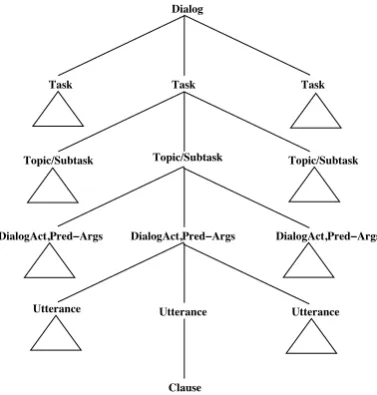
Dialog
Task
Topic/Subtask Topic/Subtask
Task Task
Clause
Utterance Utterance
Utterance
Topic/Subtask
[image:2.595.85.274.61.259.2]DialogAct,Pred!Args DialogAct,Pred!Args DialogAct,Pred!Args
Figure 1: A schema of a shared plan tree for a dialog.
not incremental; it used global features such as the number of turn changes. Also, it focused strictly in interpretation of input utterances; it could not predict actions by either dialog partner.
In contrast to other work on discourse parsing, we wish to use the parsing process directly for di-alog management (rather than for information ex-traction or summarization). This inuences our approach to dialog modeling in two ways. First, the subtask tree we build represents the functional task structure of the dialog (rather than the rhetor-ical structure of the dialog). Second, our dialog parser must be entirely incremental.
Plan-Based Dialog Models Plan-based ap-proaches to dialog modeling, like ours, operate di-rectly on the dialog’s task structure. The process of task-oriented dialog is treated as a special case of AI-style plan recognition (Sidner, 1985; Litman and Allen, 1987; Rich and Sidner, 1997; Carberry, 2001; Bohus and Rudnicky, 2003; Lochbaum, 1998). Plan-based dialog models are used for both interpretation of user utterances and prediction of agent actions. In addition to the hand-crafted mod-els listed above, researchers have built stochastic plan recognition models for interaction, includ-ing ones based on Hidden Markov Models (Bui, 2003; Blaylock and Allen, 2006) and on proba-bilistic context-free grammars (Alexandersson and Reithinger, 1997; Pynadath and Wellman, 2000).
In this area, the work most closely related to ours is that of Barrett and Weld (Barrett and Weld, 1994), who build an incremental bottom-up parser
Opening
Order Placement
Contact Info
Delivery Info Shipping Info
Closing Summary
[image:2.595.309.536.63.137.2]Payment Info Order Item
Figure 2: Sample output (subtask tree) from a parse-based model for the catalog ordering do-main.
to parse plans. Their parser, however, was not probabilistic or targeted at dialog processing.
3 Dialog Structure
We consider a task-oriented dialog to be the re-sult of incremental creation of a shared plan by the participants (Lochbaum, 1998). The shared plan is represented as a single treeTthat incorpo-rates the task/subtask structure, dialog acts, syn-tactic structure and lexical content of the dialog, as shown in Figure 1. A task is a sequence of sub-tasksST ∈ S. A subtask is a sequence of dialog actsDA∈D. Each dialog act corresponds to one clause spoken by one speaker, customer (cu) or agent (ca) (for which we may have acoustic, lexi-cal, syntactic and semantic representations).
Figure 2 shows the subtask tree for a sample di-alog in our domain (catdi-alog ordering). An order placement task is typically composed of the se-quence of subtasks opening, contact-information, order-item, related-offers, summary. Subtasks can be nested; the nesting can be as deep asve lev-els in our data. Most often the nesting is at the leftmost or rightmost frontier of the subtask tree.
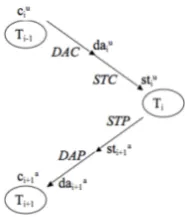
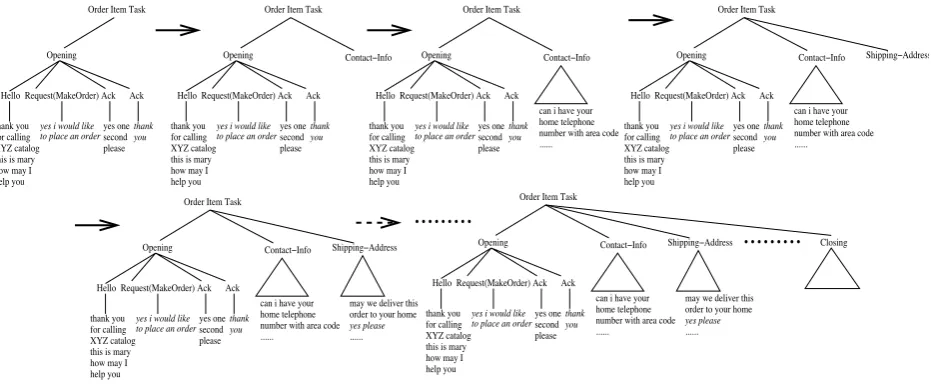
As the dialog proceeds, an utterance from a par-ticipant is accommodated into the subtask tree in an incremental manner, much like an incremen-tal syntactic parser accommodates the next word into a partial parse tree (Alexandersson and Rei-thinger, 1997). An illustration of the incremental evolution of dialog structure is shown in Figure 4. However, while a syntactic parser processes in-put from a single source, our dialog parser parses user-systemexchanges: user utterances are inter-preted, while system utterances are generated. So the steps taken by our dialog parser to incorpo-rate an utterance into the subtask tree depend on whether the utterance was produced by theagent
or theuser(as shown in Figure 3).
Interpretation of a user’s utterance:
DAC:daui =argmax du∈D P(d
u
|cui, STii−−k1, DA i−1 i−k, c
i−1 i−k) (1)
ST C:stui =argmax su∈S P(s
u
|daui, cui, STii−−k1, DA i−1 i−k, c
i−1 i−k) (2)
Generation of an agent’s utterance:
ST P :stai =argmax sa∈S P(s
a
|STii−−k1, DAii−−1k, cii−−1k) (3)
DAP:daai =argmax da∈D P(d
a
|stai, STii−−k1, DAii−−1k, cii−−1k) (4)
Table 1: Equations used for modeling dialog act and sub-task labeling of agent and user utterances. cui/cai = the words, syntactic information and named entities associated with the ith utterance of the dialog, spoken by user/agent
u/a. dau
i/daai = the dialog act of theithutterance, spoken by user/agentu/a.stu
i/stai = the subtask label of theith ut-terance, spoken by user/agentu/a. DAii−−1k represents the dialog act tags for utterancesi−1toi−k.
and labeled with named entities1. Interpretation of the clause (cui) involves assigning a dialog act la-bel (dau
i) and a subtask label (stui). We useSTii−−k1,
DAii−−1k, andcii−−1kto represent the sequence of pre-ceeding k subtask labels, dialog act labels and clauses respectively. The dialog act label daui is determined from information about the clause and (a kthorder approximation of) the subtask tree so far (Ti−1 = (STii−−k1, DAii−−1k, cii−−1k)), as shown in
Equation 1 (Table 1). The subtask labelstui is de-termined from information about the clause, its di-alog act and the subtask tree so far, as shown in Equation 2. Then, the clause is incorporated into the subtask tree.
Agent utterances In contrast, a dialog sys-tem starts planning an agent utterance by iden-tifying the subtask to contribute to next, sta
i, based on the subtask tree so far (Ti−1 =
(STi−1
i−k, DA i−1
i−k, c i−1
i−k)), as shown in Equation 3 (Table 1) . Then, it chooses the dialog act of the utterance,daai, based on the subtask tree so far and the chosen subtask for the utterance, as shown in Equation 4. Finally, it generates an utterance,ca
i, to realize its communicative intent (represented as a subtask and dialog act pair, with associated named entities)2.
Note that the current clause cui is used in the
1This results in a syntactic parse of the clause and could
be done incrementally as well.
[image:3.595.369.462.61.170.2]2We do not address utterance realization in this paper.
Figure 3: Dialog management process
conditioning context of the interpretation model (for user utterances), but the corresponding clause for the agent utterance cai is to be predicted and hence is not part of conditioning context in the generation model.
4 Dialog Parsing
A dialog parser can produce a “shallow” or “deep” tree structure. A shallow parse is one in which utterances are grouped together into subtasks, but the dominance relations among subtasks are not tracked. We call this model a chunk-based dia-log model (Bangalore et al., 2006). The chunk-based model has limitations. For example, dom-inance relations among subtasks are important for dialog processes such as anaphora resolu-tion (Grosz and Sidner, 1986). Also, the chunk-based model is representationally inadequate for center-embedded nestings of subtasks, which do occur in our domain, although less frequently than the more prevalent “tail-recursive” structures.
... Order Item Task
Opening
Hello Request(MakeOrder) Ack
number with area code second
please Ack
Contact!Info
can i have your home telephone thank you
please Ack
Contact!Info
thank you to place an ordersecond for calling
XYZ catalog this is mary how may I help you yes one yes one thank you for calling XYZ catalog this is mary how may I help you
Ack Order Item Task
Opening
Hello Request(MakeOrder)
yes i would like
Opening
Hello Request(MakeOrder) Ack
thank you for calling
Order Item Task
yes please
Shipping!Address
can i have your home telephone number with area code ... XYZ catalog
Contact!Info
to place an order yes i would like
[image:4.595.75.541.60.252.2]you thank
...
Ack
this is mary how may I help you yes one second please ... Request(MakeOrder) Ack thank you for calling XYZ catalog this is mary
Hello
you thank to place an order yes i would like
Order Item Task
Opening
how may I
you thank
Closing
...
may we deliver this order to your home
yes i would like
help you
yes one second please
Ack
to place an order yes i would liketo place an order youthank
help you
yes one second please
Ack
Contact!Info
may we deliver this order to your home
...
yes please
how may I
Shipping!Address
Request(MakeOrder) Ack
thank you for calling XYZ catalog this is mary
Hello
can i have your home telephone number with area code ... Order Item Task
Opening
Shipping!Address
Request(MakeOrder) Ack
thank you for calling XYZ catalog this is mary
Hello
can i have your home telephone number with area code ... Order Item Task
Opening
how may I
you thank yes i would like
help you
yes one second please
Ack
Contact!Info
to place an order
Figure 4: An illustration of incremental evolution of dialog structure
a feature vector containing contextual information for the parsing action (see Section 5.1). These fea-ture vectors and the associated parser actions are used to train maximum entropy models (Berger et al., 1996). These models are then used to incre-mentally incorporate the utterances for a new di-alog into that didi-alog’s subtask tree as the didi-alog progresses, as shown in Figure 3.
4.1 Shift-Reduce Method
In this method, the subtask tree is recovered through a right-branching shift-reduce parsing process (Hall et al., 2006; Sagae and Lavie, 2006). The parser shifts each utterance on to the stack. It then inspects the stack and decides whether to do one or more reduce actions that result in the cre-ation of subtrees in the subtask tree. The parser maintains two data structures – a stack and a tree. The actions of the parser change the contents of the stack and create nodes in the dialog tree struc-ture. The actions for the parser include unary-reduce-X, binary-reduce-X andshift, where X is each of the non-terminals (subtask labels) in the tree. Shift pushes a token representing the utter-ance onto the stack;binary-reduce-Xpops two to-kens off the stack and pushes the non-terminal X; andunary-reduce-X pops one token off the stack and pushes the non-terminal X. Each type of re-duce action creates a constituent X in the dialog tree and the tree(s) associated with the reduced el-ements as subtree(s) ofX. At the end of the dialog, the output is a binary branching subtask tree.
Consider the example subdialogA: would you like a free magazine? U: no. The
process-ing of this dialog usprocess-ing our shift-reduce dialog parser would proceed as follows: the STP model predicts shift for sta; the DAP model predicts
YNP(Promotions) for daa; the generator outputs
would you like a free magazine?; and the parser shifts a token representing this utterance onto the stack. Then, the customer says no. The DAC model classiesdau asNo; the STC model clas-siesstuasshiftandbinary-reduce-special-offer; and the parser shifts a token representing the ut-terance onto the stack, before popping the top two elements off the stack and adding the subtree for
special-orderinto the dialog’s subtask tree.
4.2 Start-Complete Method
In the shift-reduce method, the dialog tree is con-structed as a side effect of the actions performed on the stack: each reduce action on the stack in-troduces a non-terminal in the tree. By contrast, in the start-complete method the instructions to build the tree are directly encoded in the parser ac-tions. A stack is used to maintain the global parse state. The actions the parser can take are similar to those described in (Ratnaparkhi, 1997). The parser must decide whether to join each new termi-nal onto the existing left-hand edge of the tree, or start a new subtree. The actions for the parser in-clude start-X,n-start-X, complete-X, u-complete-Xandb-complete-X, where X is each of the non-terminals (subtask labels) in the tree. Start-X
pops the top two tokens off the stack and pushes the non-terminal X;u-complete-Xpops the top to-ken off the stack and pushes the non-terminal X; andb-complete-Xpops the top two tokens off the stack and pushes the non-terminal X. This method produces a dialog subtask tree directly, rather than producing an equivalent binary-branching tree.
Consider the same subdialog as before, A: would you like a free magazine? U: no. The processing of this dialog using our start-complete dialog parser would proceed as follows: the STP model predictsstart-special-offerforsta; the DAP model predictsYNP(Promotions)fordaa; the gen-erator outputs would you like a free magazine?; and the parser shifts a token representing this ut-terance onto the stack. Then, the customer says
no. The DAC model classiesdauasNo; the STC model classiesstuascomplete-special-offer; and the parser shifts a token representing the utter-ance onto the stack, before popping the top two elements off the stack and adding the subtree for
special-orderinto the dialog’s subtask tree.
4.3 Connection Path Method
In contrast to the shift-reduce and the start-complete methods described above, the connec-tion path method does not use a stack to track the global state of the parse. Instead, the parser di-rectly predicts theconnection path(path from the root to the terminal) for each utterance. The col-lection of connection paths for all the utterances in a dialog denes the parse tree. This encoding was previously used for incremental sentence parsing by (Costa et al., 2001). With this method, there are many more choices of decision for the parser (195 decisions for our data) compared to the shift-reduce (32) and start-complete (82) methods.
Consider the same subdialog as before, A: would you like a free magazine? U: no. The pro-cessing of this dialog using our connection path dialog parser would proceed as follows. First, the STP model predicts S-special-offer for sta; the DAP model predicts YNP(Promotions) for daa; the generator outputs would you like a free mag-azine?; and the parser adds a subtree rooted at
special-offer, with one terminal for the current ut-terance, into the top of the subtask tree. Then, the customer says no. The DAC model
classi-es dau asNo and the STC model classiesstu asS-special-offer. Since the right frontier of the subtask tree has a subtree matching this path, the
Type Task/subtask labels
Call-level call-forward, closing, misc-other, open-ing, out-of-domain, sub-call
[image:5.595.309.526.132.340.2]Task-level check-availability, contact-info, delivery-info, discount, order-change, order-item, order-problem, payment-info, related-offer, shipping-address, special-offer, summary
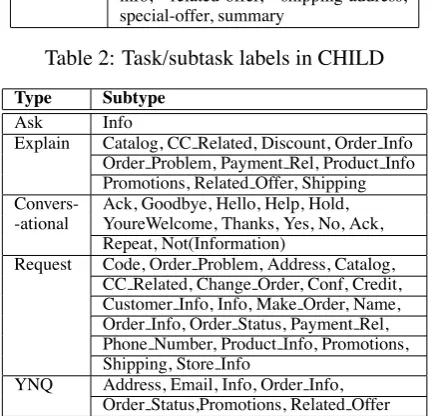
Table 2: Task/subtask labels in CHILD
Type Subtype
Ask Info
Explain Catalog, CC Related, Discount, Order Info Order Problem, Payment Rel, Product Info Promotions, Related Offer, Shipping Convers- Ack, Goodbye, Hello, Help, Hold, -ational YoureWelcome, Thanks, Yes, No, Ack,
Repeat, Not(Information)
Request Code, Order Problem, Address, Catalog, CC Related, Change Order, Conf, Credit, Customer Info, Info, Make Order, Name, Order Info, Order Status, Payment Rel, Phone Number, Product Info, Promotions, Shipping, Store Info
YNQ Address, Email, Info, Order Info, Order Status,Promotions, Related Offer
Table 3: Dialog act labels in CHILD
parser simply incorporates the current utterance as a terminal of thespecial-offersubtree.
5 Data and Experiments
To evaluate our parse-based dialog model, we used 817 two-party dialogs from the CHILD corpus of telephone-based dialogs in a catalog-purchasing domain. Each dialog was transcribed by hand; all numbers (telephone, credit card, etc.) were removed for privacy reasons. The average di-alog in this data set had 60 turns. The di-alogs were automatically segmented into utter-ances and automatically annotated with part-of-speech tag and supertag information and named entities. They were annotated by hand for dia-log acts and tasks/subtasks. The diadia-log act and task/subtask labels are given in Tables 2 and 3.
5.1 Features
(deter-mined by the parser). Each input feature vector for agent subtask prediction has these features for up to three utterances of left-hand context (see Equa-tion 3). Each input feature vector for dialog act prediction has the same features as for agent task prediction, plus the actual or predicted sub-task label (see Equation 4). Each input feature vector for dialog act interpretation has features a-h for up to ta-hree utterances of left-a-hand context, plus the current utterance (see Equation 1). Each input feature vector for user subtask classication has the same features as for user dialog act inter-pretation, plus the actual or classied dialog act (see Equation 2).
The label for each input feature vector is the parsing action (for subtask classication and pre-diction) or the dialog act label (for dialog act clas-sication and prediction). If more than one pars-ing action takes place on a particular utterance (e.g. a shift and then a reduce), the feature vec-tor is repeated twice with different stack contents.
5.2 Training Method
We randomly selected roughly 90% of the dialogs for training, and used the remainder for testing.
We separately trained models for: user dia-log act classication (DAC, Equation 1); user task/subtask classication (STC, Equation 2); agent task/subtask prediction (STP, Equation 3); and agent dialog act prediction (DAP, Equation 4). In order to estimate the conditional distributions shown in Table 1, we use the general technique of choosing the MaxEnt distribution that properly es-timates the average of each feature over the train-ing data (Berger et al., 1996). We use the machine learning toolkit LLAMA (Haffner, 2006), which encodes multiclass classication problems using binary MaxEnt classiers to increase the speed of training and to scale the method to large data sets.
5.3 Decoding Method
The decoding process for the three parsing meth-ods is illustrated in Figure 3 and has four stages: STP, DAP, DAC, and STC. As already explained, each of these steps in the decoding process is mod-eled as either a prediction task or a classi ca-tion task. The decoder constructs an input feature vector depending on the amount of context being used. This feature vector is used to query the ap-propriate classier model to obtain a vector of la-bels with weights. The parser action lala-bels (STP and STC) are used to extend the subtask tree. For
example, in the shift-reduce method, shift results in a push action on the stack, while reduce-X re-sults in popping the top two elements off the stack and pushing Xon to the stack. The dialog act la-bels (DAP and DAC) are used to label the leaves of the subtask tree (the utterances).
The decoder can use n-best results from the classier to enlarge the search space. In order to manage the search space effectively, the de-coder uses a beam pruning strategy. The decod-ing process proceeds until the end of the dialog is reached. In this paper, we assume that the end of the dialog is given to the decoder3.
Given that the classiers are error-prone in their assignment of labels, the parsing step of the de-coder needs to be robust to these errors. We ex-ploit the state of the stack in the different meth-ods to rule out incompatible parser actions (e.g. a
reduce-X action when the stack has one element, ashiftaction on an already shifted utterance). We also use n-best results to alleviate the impact of classication errors. Finally, at the end of the di-alog, if there are unattached constituents on the stack, the decoder attaches them as sibling con-stituents to produce a rooted tree structure. These constraints contribute to robustness, but cannot be used with the connection path method, since any connection path (parsing action) suggested by the classier can be incorporated into the incremental parse tree. Consequently, in the connection path method there are fewer opportunities to correct the errors made by the classiers.
5.4 Evaluation Metrics
We evaluate dialog act classication and predic-tion by comparing the automatically assigned di-alog act tags to the reference didi-alog act tags. For these tasks we report accuracy. We evaluate subtask classication and prediction by compar-ing the subtask trees output by the different pars-ing methods to the reference subtask tree. We use the labeled crossing bracket metric (typically used in the syntactic parsing literature (Harrison et al., 1991)), which computes recall, precision and crossing brackets for the constituents (subtrees) in a hypothesized parse tree given the reference parse tree. We report F-measure, which is a combination of recall and precision.
For each task, performance is reported for 1, 3,
3This is an unrealistic assumption if the decoder is to
5, and 10-best dynamic decoding as well as oracle (Or) and for 0, 1 and 3 utterances of context.
5.5 Results
0 1 1
3 0 1 3
3 0 1 5
3 0 1 10
3 0 1 Or
3 0
20 40 60 80 100
Number utterances history Nbest
F
[image:7.595.72.288.124.304.2]start!complete connection!paths shift!reduce
Figure 5: Performance of parse-based methods for subtask tree building
Figure 5 shows the performance of the different methods for determining the subtask tree of the di-alog. Wider beam widths do not lead to improved performance for any method. One utterance of context is best for shift-reduce and start-join; three is best for the connection path method. The shift-reduce method performs the best. With 1 utter-ance of context, its 1-best f-score is 47.86, as com-pared with 34.91 for start-complete, 25.13 for the connection path method, and 21.32 for the chunk-based baseline. These performance differences are statistically signicant at p<.001. However, the best performance for the shift-reduce method is still signicantly worse than oracle.
All of the methods are subject to some ‘stick-iness’, a certain preference to stay within the current subtask rather than starting a new one. Also, all of the methods tended to perform poorly on parsing subtasks that occur rarely (e.g. call-forward, order-change) or that occur at many dif-ferent locations in the dialog (e.g. out-of-domain, order-problem, check-availability). For example, the shift-reduce method did not make manyshift
errors but did frequently b-reduce on an incor-rect non-terminal (indicating trouble identifying subtask boundaries). Some non-terminals most likely to be labeled incorrectly by this method (for both agent and user) are:call-forward, order-change, summary, order-problem, opening and
out-of-domain.
Similarly, the start-complete method frequently mislabeled a non-terminal in a complete action, e.g. misc-other, check-availability, summary or
contact-info. It also quite frequently mislabeled nonterminals in n-start actions, e.g. order-item, contact-infoorsummary. Both of these errors in-dicate trouble identifying subtask boundaries.
It is harder to analyze the output from the con-nection path method. This method is more likely to mislabel tree-internal nodes than those imme-diately above the leaves. However, the same non-terminals show up as error-prone for this method as for the others: out-of-domain, check-availability, order-problemandsummary.
0 1 1
3 0 1 3
3 0 1 5
3 0 1 10
3 0 1 Or
3 0.0
0.2 0.4 0.6 0.8 1.0
Number utterances history Nbest
Accuracy
[image:7.595.310.524.264.440.2]start!complete connection!paths shift!reduce
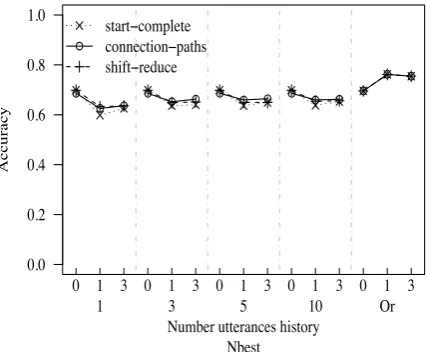
Figure 6: Performance of dialog act assignment to user’s utterances.
Figure 6 shows accuracy for classication of user dialog acts. Wider beam widths do not lead to signcantly improved performance for any method. Zero utterances of context gives the high-est accuracy for all methods. All methods per-form fairly well, but no method signicantly out-performs any other: with 0 utterances of context, 1-best accuracy is .681 for the connection path method, .698 for the start-complete method and .698 for the shift-reduce method. We note that these results are competitive with those reported in the literature (e.g. (Poesio and Mikheev, 1998; Seran and Eugenio, 2004)), although the dialog corpus and the label sets are different.
The most common errors in dialog act classi -cation occur with dialog acts that occur 40 times or fewer in the testing data (out of 3610 testing utterances), and withNot(Information).
Speaker Utterance Shift-Reduce Start-Complete Connection Path
A This is Sally shift,Hello start-opening,Hello opening S,Hello
A How may I help you shift, binary-reduce-out-of-domain,Hello
complete-opening,
Hello
opening S,Hello
B Yes Not(Information), shift,
binary-reduce-out-of-domain
Not(Information), complete-opening
Not(Information), open-ing S
B Um I would like to place an order please
Rquest(Make-Order), shift, binary-reduce-opening
Rquest(Make-Order), complete-opening, n-start-S
Rquest(Make-Order), opening S
A May I have your
tele-phone number with the area code
shift,Acknowledge start-contact-info, Ac-knowledge
contact-info S,
Request(Phone-Number)
[image:8.595.74.538.61.216.2] [image:8.595.74.288.257.436.2]B Uh the phone number is [number]
Explain(Phone-Number), shift, binary-reduce-contact-info
Explain(Phone-Number), complete-contact-info
Explain(Phone-Number), contact-info S
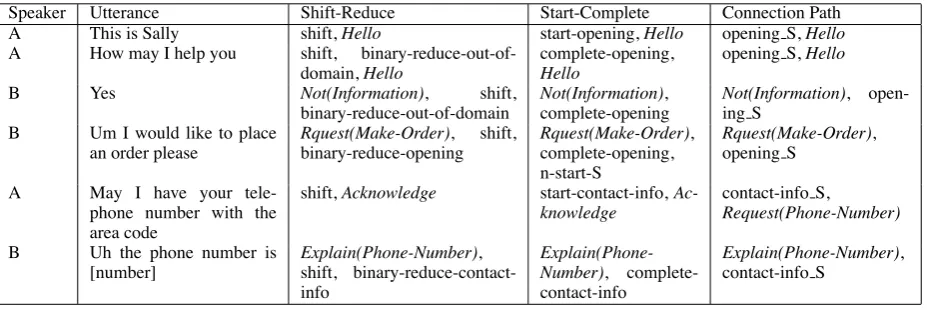
Table 4: Dialog extract with subtask tree building actions for three parsing methods
0 1 1
3 0 1 3
3 0 1 5
3 0 1 10
3 0 1 Or
3 0.0
0.2 0.4 0.6 0.8 1.0
Number utterances history Nbest
Accuracy
start!complete connection!paths shift!reduce
Figure 7: Performance of dialog act prediction used to generate agent utterances.
that for dialog act classication because this is a prediction task. Wider beam widths do not gener-ally lead to improved performance for any method. Three utterances of context generally gives the best performance. The shift-reduce method per-forms signicantly better than the connection path method with a beam width of 1 (p<.01), but not at larger beam widths; there are no other signi -cant performance differences between methods at 3 utterances of context. With 3 utterances of con-text, 1-best accuracies are .286 for the connection path method, .329 for the start-complete method and .356 for the shift-reduce method.
The most common errors in dialog act predic-tion occur with rare dialog acts,Not(Information), and the prediction ofAcknowledgeat the start of a turn (we did not remove grounding acts from the data). With the shift-reduce method, some YNQ
acts are commonly mislabeled. With all methods,
dialog acts pertaining to Order-Infoand Product-Info acts are commonly mislabeled, which could potentially indicate that these labels require a sub-tle distinction between information pertaining to an order and information pertaining to a product.
Table 4 shows the parsing actions performed by each of our methods on the dialog snippet pre-sented in Figure 4. For this example, the connec-tion path method’s output is correct in all cases.
6 Conclusions and Future Work
References
J. Alexandersson and N. Reithinger. 1997. Learning dialogue structures from a corpus. InProceedings of Eurospeech.
J. Baldridge and A. Lascarides. 2005. Probabilistic head-driven parsing for discourse. InProceedings of CoNLL.
S. Bangalore, G. Di Fabbrizio, and A. Stent. 2006. Learning the structure of task-driven human-human dialogs. InProceedings of COLING/ACL.
A. Barrett and D. Weld. 1994. Task-decomposition via plan parsing. InProceedings of AAAI.
A. Berger, S.D. Pietra, and V.D. Pietra. 1996. A Max-imum Entropy Approach to Natural Language Pro-cessing.Computational Linguistics, 22(1):39–71.
N. Blaylock and J. F. Allen. 2006. Hierarchical instan-tiated goal recognition. InProceedings of the AAAI Workshop on Modeling Others from Observations.
D. Bohus and A. Rudnicky. 2003. RavenClaw: Dialog management using hierarchical task decomposition and an expectation agenda. InProceedings of Eu-rospeech.
H.H. Bui. 2003. A general model for online probabal-istic plan recognition. InProceedings of IJCAI.
S. Carberry. 2001. Techniques for plan recogni-tion. User Modeling and User-Adapted Interaction, 11(1–2):31–48.
M. Collins. 2003. Head-driven statistical models for natural language parsing. Computational Linguis-tics, 29(4):589–638.
F. Costa, V. Lombardo, P. Frasconi, and G. Soda. 2001. Wide coverage incremental parsing by learning at-tachment preferences. InProceedings of the Con-ference of the Italian Association for Artificial Intel-ligence (AIIA).
D. Cristea. 2000. An incremental discourse parser ar-chitecture. InProceedings of the 2nd International Conference on Natural Language Processing.
K. Forbes, E. Miltsakaki, R. Prasad, A. Sarkar, A. Joshi, and B. Webber. 2003. D-LTAG system: Discourse parsing with a lexicalized tree-adjoining grammar.Journal of Logic, Language and Informa-tion, 12(3):261–279.
B.J. Grosz and C.L. Sidner. 1986. Attention, inten-tions and the structure of discourse. Computational Linguistics, 12(3):175–204.
P. Haffner. 2006. Scaling large margin classiers for spoken language understanding. Speech Communi-cation, 48(3–4):239–261.
J. Hall, J. Nivre, and J. Nilsson. 2006. Discriminative classiers for deterministic dependency parsing. In Proceedings of COLING/ACL.
P. Harrison, S. Abney, D. Fleckenger, C. Gdaniec, R. Grishman, D. Hindle, B. Ingria, M. Marcus, B. Santorini, and T. Strzalkowski. 1991. Evaluating syntax performance of parser/grammars of English. InProceedings of the Workshop on Evaluating Nat-ural Language Processing Systems, ACL.
H. LeThanh, G. Abeysinghe, and C. Huyck. 2004. Generating discourse structures for written texts. In Proceedings of COLING.
D. Litman and J. Allen. 1987. A plan recognition model for subdialogs in conversations. Cognitive Science, 11(2):163–200.
K. Lochbaum. 1998. A collaborative planning model of intentional structure. Computational Linguistics, 24(4):525–572.
M. Poesio and A. Mikheev. 1998. The predictive power of game structure in dialogue act recognition: experimental results using maximum entropy esti-mation. InProceedings of ICSLP.
L. Polanyi, C. Culy, M. van den Berg, G. L. Thione, and D. Ahn. 2004. A rule based approach to discourse parsing. InProceedings of SIGdial.
D.V. Pynadath and M.P. Wellman. 2000. Probabilistic state-dependent grammars for plan recognition. In Proceedings of UAI.
A. Ratnaparkhi. 1997. A linear observed time statis-tical parser based on maximum entropy models. In Proceedings of EMNLP.
C. Rich and C.L. Sidner. 1997. COLLAGEN: When agents collaborate with people. InProceedings of the First International Conference on Autonomous Agents.
K. Sagae and A. Lavie. 2006. A best-rst proba-bilistic shift-reduce parser. InProceedings of COL-ING/ACL.
R. Seran and B. Di Eugenio. 2004. FLSA: Extending latent semantic analysis with features for dialogue act classication. InProceedings of ACL.
C.L. Sidner. 1985. Plan parsing for intended re-sponse recognition in discourse. Computational In-telligence, 1(1):1–10.
R. Soricut and D. Marcu. 2003. Sentence level dis-course parsing using syntactic and lexical informa-tion. InProceedings of NAACL/HLT.