Regular Expression Learning for Information Extraction
Yunyao Li, Rajasekar Krishnamurthy, Sriram Raghavan, Shivakumar Vaithyanathan
IBM Almaden Research Center San Jose, CA 95120
{yunyaoli, rajase, rsriram}@us.ibm.com, [email protected]
H. V. Jagadish∗
Department of EECS University of Michigan
Ann Arbor, MI 48109 [email protected]
Abstract
Regular expressions have served as the dom-inant workhorse of practical information ex-traction for several years. However, there has been little work on reducing the manual ef-fort involved in building high-quality, com-plex regular expressions for information ex-traction tasks. In this paper, we propose Re-LIE, a novel transformation-based algorithm for learning such complex regular expressions. We evaluate the performance of our algorithm on multiple datasets and compare it against the CRF algorithm. We show that ReLIE, in ad-dition to being an order of magnitude faster, outperforms CRF under conditions of limited training data and cross-domain data. Finally, we show how the accuracy of CRF can be im-proved by using features extracted by ReLIE.
1 Introduction
A large class of entity extraction tasks can be ac-complished by the use of carefully constructed reg-ular expressions (regexes). Examples of entities amenable to such extractions include email ad-dressesandsoftware names(web collections),credit card numbers and social security numbers (email compliance), andgene and protein names (bioinfor-matics), etc. These entities share the characteristic that their key representative patterns (features) are expressible in standard constructs of regular expres-sions. At first glance, it may seem that constructing
∗
Supported in part by NSF 0438909 and NIH 1-U54-DA021519.
a regex to extract such entities is fairly straightfor-ward. In reality, robust extraction requires the use of rather complex expressions, as illustrated by the following example.
Example 1 (Phone number extraction). An obvious pattern for identifying phone numbers is “blocks of digits separated by hyphens” represented as R1 =
(\d+\-)+\d+.1 WhileR1matches valid phone numbers
like 800-865-1125 and 725-1234, it suffers from both “precision” and “recall” problems. Not only doesR1
produce incorrect matches (e.g., social security numbers like 123-45-6789), it also fails to identify valid phone numbers such as800.865.1125, and(800)865-CARE. An improved regex that addresses these problems is R2 =
(\d{3}[-.\ ()]){1,2}[\dA-Z]{4}.
While multiple machine learning approaches have been proposed for information extraction in recent years (McCallum et al., 2000; Cohen and McCal-lum, 2003; Klein et al., 2003; Krishnan and Man-ning, 2006), manually created regexes remain a widely adopted practical solution for information extraction (Appelt and Onyshkevych, 1998; Fukuda et al., 1998; Cunningham, 1999; Tanabe and Wilbur, 2002; Li et al., 2006; DeRose et al., 2007; Zhu et al., 2007). Yet, with a few notable exceptions, which we discuss later in Section 1.1, there has been very little work in reducing this human effort through the use of automatic learning techniques. In this paper, we propose a novel formulation of the problem of
learn-1Throughout this paper, we use the syntax of the standard Java regex engine (Java, 2008).
ing regexes for information extraction tasks. We demonstrate that high quality regex extractors can be learned with significantly reduced manual effort. To motivate our approach, we first discuss prior work in the area of learning regexes and describe some of the limitations of these techniques.
1.1 Learning Regular Expressions
The problem of inducing regular languages from positive and negative examples has been studied in the past, even outside the context of information extraction (Alquezar and Sanfeliu, 1994; Dupont, 1996; Firoiu et al., 1998; Garofalakis et al., 2000; Denis, 2001; Denis et al., 2004; Fernau, 2005; Galassi and Giordana, 2005; Bex et al., 2006). Much of this work assumes that the target regex is small and compact thereby allowing the learn-ing algorithm to exploit this information. Consider, for example, the learning of patterns motivated by DNA sequencing applications (Galassi and Gior-dana, 2005). Here the input sequence is viewed as multiple atomic events separated by gaps. Since each atomic event is easily described by a small and compact regex, the problem reduces to one of learn-ing simple regexes. Similarly, in XML DTD infer-ence (Garofalakis et al., 2000; Bex et al., 2006), it is possible to exploit the fact that the XML docu-ments of interest are often described using simple DTDs. E.g., in an online books store, each book has a title, one or more authors and price. This in-formation can be described in a DTD ashbooki ← htitleihauthori+hpricei. However, as shown in Ex-ample 1, regexes for information extraction rely on more complex constructs.
In the context of information extraction, prior work has concentrated primarily on learning regexes over relatively small alphabet sizes. A common theme in (Soderland, 1999; Ciravegna, 2001; Wu and Pottenger, 2005; Feldman et al., 2006) is the problem of learning regexes over tagged tokens produced by other text-processing steps such as POS tagging, morphological analysis, and gazetteer matching. Thus, the alphabet is defined by the space of possible tags output by these analysis steps. A similar approach has been proposed in (Brill, 2000) for POS disambiguation. In contrast, our paper ad-dresses extraction tasks that require “fine-grained” control to accurately capture the structural features
of the entity of interest. Consequently, the domain of interest consists ofall charactersthereby dramat-ically increasing the size of the alphabet. To enable this scale-up, the techniques presented in this paper exploit advanced syntactic constructs (such as char-acter classes and quantifiers) supported by modern regex languages.
Finally, we note that almost all of the above de-scribed work define the learning problem over a restricted class of regexes. Typically, the restric-tions involve either disallowing or limiting the use of Kleene disclosure and disjunction operations. How-ever, our work imposes no such restrictions.
1.2 Contributions
In a key departure from prior formulations, the learning algorithm presented in this work takes as input not just labeled examples but also an initial regular expression. The use of an initial regex has two major advantages. First, this expression pro-vides a natural mechanism for a domain expert to provide domain knowledge about the structure of the entity being extracted. Second, as we show in Sec-tion 2, the space of output regular expressions un-der consiun-deration can be meaningfully restricted by appropriately defining their relationship to the input expression. Such a principled approach to restrict the search space permits the learning algorithm to consider complex regexes in a tractable manner. In contrast, prior work defined a tractable search space by placing restrictions on the target class of regular expressions. Our specific contributions are:
• A novel regex learning problem consisting of learn-ing an “improved” regex given an initial regex and labeled examples
• Formulation of this learning task as an optimization problem over a search space of regexes
• ReLIE, a regex learning algorithm that employs transformations to navigate the search space • Extensive experimental results over multiple
datasets to show the effectiveness of ReLIE and a comparison study with the Conditional Random Field (CRF) algorithm
2 The Regex Learning Problem
Consider the task of identifying instances of some entityE. LetR0 denote the input regex provided by the user and letM(R0,D)denote the set of matches obtained by evaluating R0 over a document col-lection D. Let Mp(R0,D) = {x ∈ M(R0,D) : xinstance ofE}and Mn(R0,D) = {x ∈ M(R0,D) : xnot an instance ofE}denote the set of positive and negative matches forR0. Note that a match is pos-itive if it corresponds to an instance of the entity of interest and is negative otherwise. The goal of our learning task is to produce a regex that is “better” thanR0 at identifying instances ofE.
Given a candidate regexR, we need a mechanism to judge whetherR is indeed a better extractor for E thanR0. To make this judgment even for just the original document collectionD, we must be able to label each instance matched byR(i.e., each element of M(R,D)) as positive or negative. Clearly, this can be accomplished if the set of matches produced byRare contained within the set of available labeled examples, i.e., ifM(R,D) ⊆M(R0,D). Based on this observation, we make the following assumption:
Assumption 1. Given an input regexR0 over some al-phabetΣ, any other regexRoverΣis a candidate for our learning algorithm only ifL(R)⊆L(R0). (L(R) denotes the language accepted byR).
Even with this assumption, we are left with a po-tentially infinite set of candidate regexes from which our learning algorithm must choose one. To explore this set in a principled fashion, we need a mecha-nism to move from one element in this space to an-other, i.e., from one candidate regex to another. In addition, we need an objective function to judge the extraction quality of each candidate regex. We ad-dress these two issues below.
Regex Transformations To systematically ex-plore the search space, we introduce the concept of
regex transformations.
Definition 1(Regex Transformation). LetRΣdenote
the set of all regular expressions over some alphabetΣ. A regex transformation is a functionT :RΣ→2RΣ such
that∀R0∈T(R),L(R0)⊆L(R).
For example, by replacing different occurrences of the quantifier + in R1 from Example 1 with
specific ranges (such as {1,2} or {3}), we obtain expressions such as R3 = (\d+\-){1,2}\d+ and
R4 = (\d{3}\-)+\d+. The operation of replacing quantifiers with restricted ranges is an example of a particular class of transformations that we describe further in Section 3. For the present, it is sufficient to view a transformation as a function applied to a regexRthat produces, as output, a set of regexes that accept sublanguages ofL(R). We now define the search space of our learning algorithm as follows:
Definition 2(Search Space). Given an input regexR0
and a set of transformationsT, the search space of our learning algorithm isT(R0), the set of all regexes
ob-tained by (repeatedly) applying the transformations inT
toR0.
For instance, if the operation of restricting quanti-fiers that we described above is part of the transfor-mation set, thenR3 andR4 are in the search space
of our algorithm, givenR1 as input.
Objective Function We now define an objective function, based on the well known F-measure, to compare the extraction quality of different candidate regexes in our search space. UsingMp(R,D)(resp.
Mn(R,D)) to denote the set of positive (resp. nega-tive) matches of a regexR, we define
precision(R,D) = Mp(R,D) Mp(R,D) + Mn(R,D)
recall(R,D) = Mp(R,D) Mp(R0,D)
F(R,D) =2·precision(R,D)·recall(R,D) precision(R,D) + recall(R,D)
The regex learning task addressed in this paper can now be formally stated as the following opti-mization problem:
Definition 3 (Regex Learning Problem). Given an input regex R0, a document collection D, labeled
sets of positive and negative examples Mp(R0,D) and
Mn(R0,D), and a set of transformationsT, compute the
output regexRf = argmaxR∈T(R0)F(R,D).
3 Instantiating Regex Transformations
In this section, we describe how transformations can be implemented by exploiting the syntactic con-structs of modern regex engines. To help with our description, we introduce the following task:
When applied to a collection of University web pages, we discovered thatR5 identified correct
in-stances such as Netscape 2.0, Windows 2000 and
Installation Designer v1.1. However, R5 also
ex-tracted incorrect instances such as course numbers (e.g. ENGLISH 317), room numbers (e.g. Room 330), and section headings (e.g. Chapter 2.2). To eliminate spurious matches such as ENGLISH 317, let us enforce the condition that “each word is a single upper-case letter followed by one or more lower-case letters”. To accomplish this, we focus on the sub-expression ofR5 that identifies
capital-ized words, R51 =([A-Z]\w*\s*)+, and replace it
withR51a =([A-Z][a-z]*\s*)+. The regex
result-ing fromR5 by replacingR51 withR51a will avoid
matches such asENGLISH 317.
An alternate way to improve R5 is by explicitly
disallowing matches against strings likeENGLISH,
Room and Chapter. To accomplish this, we can exploit the negative lookahead operator supported in modern regex engines. Lookaheads are special constructs that allow a sequence of characters to be checked for matches against a regex with-out the characters themselves being part of the match. As an example, (?!Ra)Rb (“?!” being
the negative lookahead operator) returns matches of regex Rb but only if they do not match Ra. Thus, by replacing R51 in our original regex with
R51b =(?! ENGLISH|Room|Chapter)[A-Z]\w*\s*,
we produce an improved regex for software names. The above examples illustrate the general prin-ciple of our transformation technique. In essence, we isolate a sub-expression of a given regex R and modify it such that the resulting regex accepts a sub-language of R. We consider two kinds of modifica-tions – disjunct and include-intersect. In drop-disjunct, we operate on a sub-expression that corre-sponds to a disjunct and drop one or more operands of that disjunct. In include-intersect, we restrict the chosen sub-expression by intersecting it with some other regex. Formally,
Definition 4 (Drop-disjunct Transformation). Let R ∈ RΣ be a regex of the form R = Raρ(X)Rb,
where ρ(X) denotes the disjunction R1|R2|. . .|Rn of
any non-empty set of regexesX = {R1, R2, . . . , Rn}.
The drop-disjunct transformationDD(R, X, Y)for some Y ⊂X, Y 6=∅results in the new regexRaρ(Y)Rb.
Definition 5(Include-Intersect Transformation). Let
.
[image:4.612.361.476.62.134.2]\W \s \w
[a-zA-Z] \d|[0-9] _
[a-z] [A-Z]
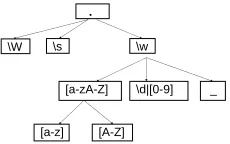
Figure 1: Sample Character Classes in Regex
R ∈ RΣbe a regex of the formR =RaXRb for some
X ∈ RΣ, X 6=∅. The include-intersect transformation
II(R, X, Y)for someY ∈ RΣ, Y 6=∅results in the new
regexRa(X∩Y)Rb.
We state the following proposition (proof omit-ted in the interest of space) that guarantees that both drop-disjunct and include-intersect restrict the lan-guage of the resulting regex, and therefore are valid transformations according to Definition 1.
Proposition 1. Given regexes R, X1, Y1, X2 and Y2
from RΣ such that DD(R, X1, Y1) and II(R, X2, Y2)
are applicable, L(DD(R, X1, Y1)) ⊆ L(R) and
L(II(R, X2, Y2))⊆L(R).
We now proceed to describe how we use differ-ent syntactic constructs to apply drop-disjunct and include-intersect transformations.
Character Class Restrictions Character
classes are short-hand notations for denoting the disjunction of a set of characters (\d is equivalent to (0|1...|9); \w is equivalent to (a|. . .|z|A|. . .|Z|0|1. . .|9| ); etc.).2 Figure 1 illustrates a character class hierarchy in which each node is a stricter class than its parent (e.g., \d is stricter than \w). A replacement of any of these character classes by one of its descendants is an instance of the drop-disjunct transformation. Notice that in Example 2, when replacingR51 with
R51a, we were in effect applying a character class
restriction.
Quantifier Restrictions Quantifiers are used to define the range of valid counts of a repetitive se-quence. For instance,a{m,n} looks for a sequence of a’s of length at least m and at most n. Since quantifiers are also disjuncts (e.g.,a{1,3}is equiv-alent to a|aa|aaa), the replacement of an expres-sionR{m, n}with an expressionR{m1, n1}(m≤
m1 ≤ n1 ≤ n) is an instance of the drop-disjunct
transformation. For example, given a subexpres-sion of the form a{1,3}, we can replace it with
2
one ofa{1,1},a{1,2},a{2,2},a{2,3}, ora{3,3}. Note that, before applying this transformation, wild-card expressions such asa+anda* are replaced by a{0,maxCount} and a{1,maxCount} respectively, where maxCount is a user configured maximum length for the entity being extracted.
Negative Dictionaries Observe that the include-intersect transformation (Definition 5) is applicable for every possible sub-expression of a given regex
R. Note that a valid sub-expression in R is any portion ofRwhere a capturing group can be intro-duced.3 Consider a regexR = RaXRb with a sub-expression X; the application of include-intersect
requires another regexY to yieldRa(X∩Y)Rb. We would like to constructY such thatRa(X∩Y)Rbis “better” thanRfor the task at hand. Therefore, we constructY as¬Y0whereY0 is a regex constructed from negative matches ofR. Specifically, we look at each negative match ofRand identify the substring of the match that corresponds toX. We then apply a greedy heuristic (see below) to these substrings to yield a negative dictionary Y0. Finally, the trans-formed regexRa(X∩¬Y0)Rbis implemented using the negative lookahead expressionRa(?! Y’)XRb. Greedy Heuristic for Negative Dictionaries Im-plementation of the above procedure requires cer-tain judicious choices in the construction of the neg-ative dictionary to ensure tractability of this trans-formation. Let S(X) denote the distinct strings that correspond to the sub-expressionX in the neg-ative matches of R.4 Since any subset of S(X) is a candidate negative dictionary, we are left with an exponential number of possible transformations. In our implementation, we used a greedy heuris-tic to pick a single negative dictionary consisting of all those elements of S(X) that individually
improve the F-measure. For instance, in Exam-ple 2, if the independent substitution of R51 with
(?!ENGLISH)[A-Z]\w*\s*,(?!Room)[A-Z] \w*\s*, and (?!Chapter)[A-Z]\w*\s* each im-proves the F-measure, we produce a nega-tive dictionary consisting of ENGLISH, Room, and Chapter. This is precisely how the disjunct ENGLISH|Room|Chapteris constructed inR51b.
3
For instance, the sub-expressions of ab{1,2}c are a, ab{1,2},ab{1,2}c,b,b{1,2},b{1,2}c, andc.
4S(X) can be obtained automatically by identifying the sub-string corresponding to the groupXin each entry inMn(R,D)
ProcedureReLIE(Mtr,Mval,R0,T) //Mtr:set of labeled matches used as training data //Mval:set of labeled matches used as validation data //R0:user-provided regular expression
//T:set of transformations begin
1. Rnew=R0 2. do{
3. foreach transformationti∈ T
4. Candidatei=ApplyTransformations(Rnew, ti) 5. let Candidates=S
iCandidatei 6. letR0= argmax
R∈CandidatesF(R,Mtr)
7. if(F(R0,Mtr)<=F(Rnew,Mtr))returnRnew 8. if(F(R0,Mval)<F(Rnew,Mval))returnRnew 9. Rnew=R0
[image:5.612.313.533.99.241.2]10. }while(true) end
Figure 2: ReLIE Search Algorithm
4 ReLIE Search Algorithm
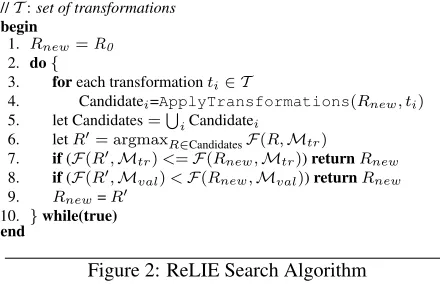
Figure 2 describes the ReLIE algorithm for the Regex Learning Problem (Definition 3) based on the transformations described in Section 3. ReLIEis a greedy hill climbing search procedure that chooses, at every iteration, the regex with the highest F-measure. An iteration inReLIEconsists of:
• Applying every transformation on the current regex
Rnewto obtain a set of candidate regexes
• From the candidates, choosing the regexR0whose F-measure over the training dataset is maximum To avoid overfitting, ReLIE terminates when either of the following conditions is true: (i) there is no improvement in F-measure over the training set; (ii) there is a drop in F-measure when applyingR0
on the validation set.
The following proposition provides an upper bound for the running time of theReLIEalgorithm.
Proposition 2. Given any valid set of inputs Mtr,
Mval,R0, andT, the ReLIE algorithm terminates in at most|Mn(R0,Mtr)|iterations. The running time of the
algorithmTT otal(R0,Mtr,Mval)≤ |Mn(R0,Mtr)| ∗ t0, wheret0is the time taken for the first iteration of the
algorithm.
Proof. With reference to Figure 2, in each iteration, the F-measure of the “best” regexR0 is strictly better than
Rnew. SinceL(R0) ⊆ L(Rnew),R0 eliminates at least one additional negative match compared toRnew. Hence,
the maximum number of iterations is|Mn(R0,Mtr)|.
For a regular expressionR, letncc(R)andnq(R) de-note, respectively, the number of character classes and quantifiers inR. The maximum number of possible sub-expressions inR is|R|2, where|R| is the length ofR.
which a single quantifier appearing inRcan be restricted to a smaller range. LetFccdenote the maximum fanout5
of the character class hierarchy. LetTReEval(D)denote the average time taken to evaluate a regex over datasetD. LetRi denote the regex at the beginning of iteration i. The number of candidate regexes obtained by applying the three transformations is
NumRE(Ri,Mtr)≤ncc(Ri)∗Fcc+nq(Ri)∗MaxQ(Ri)+|Ri|2
The time taken to enumerate the character class and quantifier restriction transformations is proportional to the resulting number of candidate regexes. The time taken for the negative dictionaries transformation is given by the running time of the greedy heuristic (Section 3). The total time taken to enumerate all candidate regexes is given by (for some constantc)
TEnum(Ri,Mtr)≤c∗(ncc(Ri)∗Fcc+nq(Ri)∗MaxQ(Ri)
+|Ri|2∗Mn(Ri,Mtr)∗TReEval(Mtr))
Choosing the best transformation involves evaluating each candidate regex over the training and validation cor-pus and the time taken for this step is
TP ickBest(Ri,Mtr,Mval) =NumRE(Ri,Mtr)
∗(TReEval(Mtr) +TReEval(Mval))
The total time taken for an iteration can be written as
TI(Ri,Mtr,Mval) =TEnum(Ri,Mtr)
+TP ickBest(Ri,Mtr,Mval)
It can be shown that the time taken in each iteration decreases monotonically (details omitted in the interest of space). Therefore, the total running time of the algorithm is given by
TT otal(R0,Mtr,Mval) =
X
TI(Ri,Mtr,Mval)
≤ |Mn(R0,Mtr)| ∗t0.
wheret0 = TI(R0,Mtr,Mval)is the running time
of the first iteration of the algorithm.
5 Experiments
In this section, we present an empirical study of theReLIEalgorithm using four extraction tasks over three real-life data sets. The goal of this study is to evaluate the effectiveness ofReLIEin learning com-plex regexes and to investigate how it compares with standard machine learning algorithms.
5.1 Experimental Setup
Data Set The datasets used in our experiments are: • EWeb: A collection of 50,000 web pages crawled
from a corporate intranet.
5Fanout is the number of ways in which a character class may be restricted as defined by the hierarchy (e.g. Figure 1).
• AWeb: A set of 50,000 web pages obtained from the publicly available University of Michigan Web page collection (Li et al., 2006), including a sub-collection of 10,000 pages (AWeb-S).
• Email: A collection of 10,000 emails obtained from the publicly available Enron email collec-tion (Minkov et al., 2005).
Extraction Tasks SoftwareNameTask, CourseNum-berTask and PhoneNumberTask were evaluated on EWeb, AWeb and Email, respectively. Since web pages have large number of URLs, to keep the la-beling task manageable, URLTaskwas evaluated on AWeb-S.
Gold Standard For each task, the gold standard was created by manually labeling all matches for the initial regex. Note that only exact matches with the gold standard are considered correct in our evalua-tions.6
Comparison Study To evaluate ReLIE for entity extraction vis-a-vis existing algorithms, we used the popular conditional random field (CRF). Specifi-cally, we used the MinorThird (Cohen, 2004) imple-mentation of CRF to train models for all four extrac-tion tasks. For training the CRF we provided it with the set of positive and negative matches from the ini-tial regex with a context of 200 characters on either side of each match7. Since it is unlikely that useful features are located far away from the entity, we be-lieve that 200 characters on either side is sufficient context. The CRF used the base features described in (Cohen et al., 2005). To ensure fair compari-son withReLIE, we also included the matches corre-sponding to the input regex as a feature to the CRF. In practice, more complex features (e.g., dictionar-ies, simple regexes) derived by domain experts are often provided to CRFs. However, such features can also be used to refine the initial regex given toReLIE. Hence, with a view to investigating the “raw” learn-ing capability of the two approaches, we chose to run all our experiments without any additional man-ually derived features. In fact, the patterns learned byReLIEthrough transformations are often similar
6
The labeled data will be made publicly available at
http://www.eecs.umich.edu/db/regexLearning/. 7
(a) SoftwareNameTask
0.5 0.6 0.7 0.8 0.9 1
10% 40% 80%
Percentage of Data Used for Training
F
-M
e
a
s
u
re
ReLIE CRF
(b) CourseNumberTask
0.5 0.6 0.7 0.8 0.9 1
10% 40% 80%
Percentage of Data Used for Training
F
-M
e
a
s
u
re
ReLIE CRF
(c) URLTask
0.5 0.6 0.7 0.8 0.9 1
10% 40% 80%
Percentage of Data Used for Training
F
-M
e
a
s
u
re
ReLIE CRF
(d) PhoneNumberTask
0.5 0.6 0.7 0.8 0.9 1
10% 40% 80%
Percentage of Data Used for Training
F
-M
e
a
s
u
re
[image:7.612.121.481.63.308.2]ReLIE CRF
Figure 3: Extraction Qualitya
a
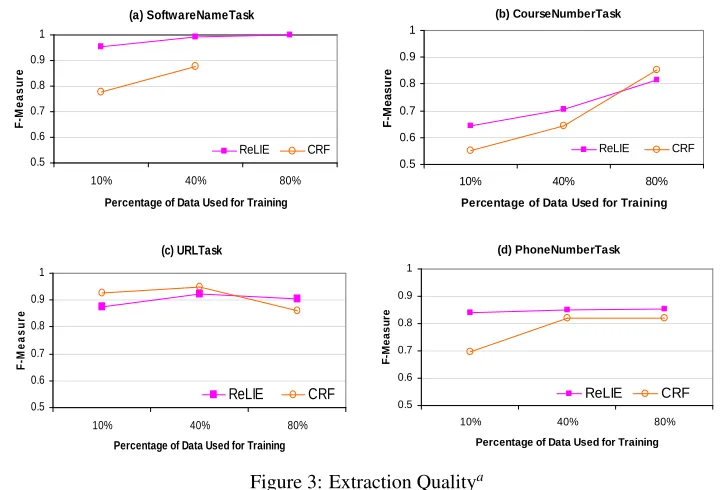
ForSoftwareNameTask, with 80% training data we could not obtain results for CRF as the program failed repeatedly during the training phase.
to the features that domain experts may provide to CRF. We will revisit this issue in Section 5.4.
Evaluation We used the standard F-measure to evaluate the effectiveness of ReLIE and CRF. We di-vided each dataset into 10 equal parts and used X% of the dataset for training (X=10, 40 and 80), 10% for validation, and remaining (90-X)% for testing. All results are reported on the test set.
5.2 Results
Four extraction tasks were chosen to reflect the enti-ties commonly present in the three datasets.
• SoftwareNameTask: Extracting software names such asLotus Notes 8.0, Open Office Suite 2007.
• CourseNumberTask: Extracting university course numbers such asEECS 584, Pharm 101.
• PhoneNumberTask: Extracting phone numbers such as1-800-COMCAST, (425)123 5678.
• URLTask: Extracting URLs such as
http:\\www.abc.comandlsa.umich.edu/ foo/.8
This section summarizes the results of our empir-ical evaluation comparingReLIEand CRF.
8
URLTaskmay appear to be simplistic. However, extracting URLs without the leading protocol definitions (e.g.http) can be challenging.
Raw Extraction Quality The cross-validated re-sults across all four tasks are presented in Figure 3.
• With 10% training data, ReLIE outperforms CRF on three out of four tasks with a difference in F-measure ranging from 0.1 to 0.2.
• As training data increases, both algorithms perform better with the gap between the two reducing for all the four tasks. ForCourseNumberTaskand URL-Task, CRF does slightly better thanReLIEfor larger training dataset. For the other two tasks,ReLIE re-tains its advantage over CRF.9
The above results indicate that ReLIE performs comparably with CRF with a slight edge in condi-tions of limited training data. Indeed, the capability to learn high-quality extractors using a small train-ing set is important because labeled data is often ex-pensive to obtain. For precisely this same reason, we would ideally like to learn the extractors once and then apply them to other datasets as needed. Since these other datasets may be from a different domain, we next performed a cross-domain test (i.e., training
9
and testing on different domains).
Task(Training, Testing)
Data for Training 10% 40% 80%
ReLIE CRF ReLIECRF ReLIE CRF SoftwareNameTask(EWeb,AWeb) 0.9200.2970.9770.5030.971 N/A URLTask(AWeb-S,Email) 0.6900.2090.7840.3800.8010.507 PhoneNumberTask(Email,AWeb)0.3570.1300.4750.1250.5130.120
Table 1: Cross Domain Test (F-measure).
TechniqueSoftwareNameTask CourseNumberTask URLTask PhoneNumberTask training testing training testing training testing training testing
ReLIE 511.7 20.6 69.3 18.4 73.8 7.7 39.4 1.1
CRF 7597.0 2315.8 482.5 75.4 438.7 53.8 434.8 57.7
t(ReLIE)
t(CRF) 0.067 0.009 0.144 0.244 0.168 0.143 0.091 0.019
Table 2: Average Training/Testing Time (sec)(with 40% data for training)
Task(Extra Feature)
Data for Training 10% 40% 80%
CRF C+RL CRF C+RL CRF C+RL CourseNumberTask(Negative Dictionary) 0.5530.624 0.6440.764 0.8540.845
[image:8.612.234.534.62.273.2]PhoneNumberTask(Quantifier) 0.6950.893 0.8200.937 0.8210.964
Table 3: ReLIE as Feature Extractor (C+RL is CRF enhanced with features learned by ReLIE).
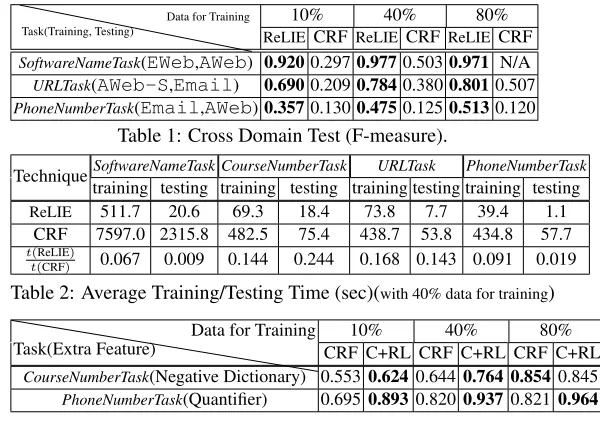
Cross-domain EvaluationTable 1 summarizes the results of training the algorithms on one data set and testing on another. The scenarios chosen are: (i) SoftwareNameTask
trained on EWeb and tested on AWeb, (ii)URLTasktrained onAWeb and tested onEmail, and (iii) Pho-neNumberTask trained on Email and tested on AWeb.10 We can see that ReLIE significantly out-performs CRF for all three tasks, even when provided with a large training dataset. Compared to test-ing on the same dataset, there is a reduction in F-measure (less than 0.1 in many cases) when the regex learned byReLIEis applied to a dif-ferent dataset, while the drop for
CRF is much more significant (over 0.5 in many cases).11
Training Time Another issue of practical consid-eration is the efficiency of the learning algorithm. Table 2 reports the average training and testing time for both algorithms on the four tasks. On average Re-LIEisan order of magnitude fasterthan CRF in both building the model and applying the learnt model.
Robustness to Variations in Input Regexes The transformations done by ReLIE are based on the structure of the input regex. Therefore given differ-ent input regexes, the final regexes learned byReLIE
will be different. To evaluate the impact of the struc-ture of the input regex on the quality of the regex learned byReLIE, we started with different regexes12 for the same task. We found thatReLIEis robust to variations in input regexes. For instance, on Soft-wareNameTask, the standard deviation in F-measure
10
We do not report results forCourseNumberTaskas course numbers are specific to academic webpages and do not appear in the other two domains
11Similar cross-domain performance deterioration for a ma-chine learning approach has been observed by (Guo et al., 2006).
12
Recall that the search space ofReLIEis limited byL(R0)
(Assumption 1). Thus to ensure meaningful comparison, for the same task any two given input regexesR0andR00are
cho-sen in such a way that although their structures are different, Mp(R0,D) = Mp(R00,D)andMn(R0,D) = Mn(R00,D).
of the final regexes generated from six different in-put regexes was less than 0.05. Further details of this experiment are omitted in the interest of space.
5.3 Discussion
The results of our comparison study (Figure 3) in-dicates that for raw extraction qualityReLIE has a slight edge over CRF for small training data. How-ever, in cross-domain performance (Table 1)ReLIE
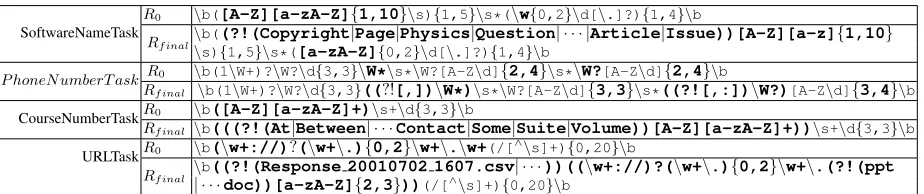
SoftwareNameTask
R0 \b([A-Z][a-zA-Z]{1,10}\s){1,5}\s*(\w{0,2}\d[\.]?){1,4}\b
Rf inal
\b((?!(Copyright|Page|Physics|Question| · · · |Article|Issue))[A-Z][a-z]{1,10}
\s){1,5}\s*([a-zA-Z]{0,2}\d[\.]?){1,4}\b
P honeN umberT ask R0 \b(1\W+)?\W?\d{3,3}\W*\s*\W?[A-Z\d]{2,4}\s*\W?[A-Z\d]{2,4}\b
Rf inal \b(1\W+)?\W?\d{3,3}((?![,])\W*)\s*\W?[A-Z\d]{3,3}\s*((?![,:])\W?)[A-Z\d]{3,4}\b
CourseNumberTaskR0 \b([A-Z][a-zA-Z]+)\s+\d{3,3}\b
Rf inal \b(((?!(At|Between| · · ·Contact|Some|Suite|Volume))[A-Z][a-zA-Z]+))\s+\d{3,3}\b
URLTaskR0 \b(\w+://)?(\w+\.){0,2}\w+\.\w+(/[
∧\s]+){0,20}\b
Rf inal \
[image:9.612.77.539.48.145.2]b((?!(Response 20010702 1607.csv| · · ·))((\w+://)?(\w+\.){0,2}\w+\.(?!(ppt
| · · ·doc))[a-zA-Z]{2,3}))(/[∧\s]+){0,20}\b
Table 4: Sample Regular Expressions Learned by ReLIE(R0: input regex;Rf inal: final regex learned; the parts ofR0
modified by ReLIE and the corresponding parts inRf inalare highlighted.)
into[A-Z\d]{3,3}).
After examining the features learnt by CRF, it was clear that while CRF could learn features such as the negative dictionary it is unable to learn character-level features. This should not be surprising since our CRF was trained with primarily tokens as fea-tures (cf. Section 5.1). While this limitation was less of a factor in experiments involving data from the same domain (some effects were seen with smaller training data), it does explain the significant differ-ence between the two algorithms in cross-domain tasks where the vocabulary can be significantly dif-ferent. Indeed, in practical usage of CRF, the main challenge is to come up with additional complex fea-tures (often in the form of dictionary and regex pat-terns) that need to be given to the CRF (Minkov et al., 2005). Such complex features are largely hand-crafted and thus expensive to obtain. Since the Re-LIE transformations are operations over characters, a natural question to ask is: “Can the regex learned by ReLIE be used to provide features to CRF?” We answer this question below.
5.4 ReLIEas Feature Extractor for CRF
To understand the effect of incorporating ReLIE -identified features into CRF, we chose the two tasks (CourseNumberTask and PhoneNumberTask) with the least F-measure in our experiments to determine raw extraction quality. We examined the final regex pro-duced by ReLIE and manually extracted portions to serve as features. For example, the negative dictionary learned by ReLIE for the CourseNumber-Task (At|Between| · · · |Volume) was incorporated as a feature into CRF. To help isolate the effects, for each task, we only incorporated features correspond-ing to a scorrespond-ingle transformation: negative dictionar-ies forCourseNumberTask and quantifier restrictions for PhoneNumberTask. The results of these experi-ments are shown in Table 3. The first point worthy of
note is that performance has improved in all but one case. Second, despite the F-measure on CourseNum-berTaskbeing lower thanPhoneNumberTask (presum-ably more potential for improvement), the improve-ments onPhoneNumberTask are significantly higher. This observation is consistent with our conjecture in Section 5.1 that CRF learns token-level features; therefore incorporating negative dictionaries as extra feature provides only limited improvement. Admit-tedly more experiments are needed to understand the full impact of incorporating ReLIE-identified fea-tures into CRF. However, we do believe that this is an exciting direction of future research.
6 Summary and Future Work
We proposed a novel formulation of the problem of learning complex character-level regexes for entity extraction tasks. We introduced the concept of regex transformations and described how these could be realized using the syntactic constructs of modern regex languages. We presented ReLIE, a powerful regex learning algorithm that exploits these ideas. Our experiments demonstrate that ReLIE is very ef-fective for certain classes of entity extraction, partic-ularly under conditions of cross-domain and limited training data. Our preliminary results also indicate the possibility of using ReLIE as a powerful feature extractor for CRF and other machine learning algo-rithms. Further investigation of this aspect of ReLIE presents an interesting avenue of future work.
Acknowledgments
References
R. Alquezar and A. Sanfeliu. 1994. Incremental gram-matical inference from positive and negative data using unbiased finite state automata. InSSPR.
Douglas E. Appelt and Boyan Onyshkevych. 1998. The common pattern specification language. InTIPSTER TEXT PROGRAM.
Geert Jan Bex et al. 2006. Inference of concise DTDs from XML data. InVLDB.
Eric Brill. 2000. Pattern-based disambiguation for natu-ral language processing. InSIGDAT.
William W. Cohen and Andrew McCallum. 2003. Infor-mation Extraction from the World Wide Web. inKDD
William W. Cohen. 2004. Minorthird: Methods for identifying names and ontological relations in text using heuristics for inducing regularities from data. http://minorthird.sourceforge.net.
William W. Cohen et al. 2005. Learning to Understand Web Site Update Requests. InIJCAI.
Fabio Ciravegna. 2001. Adaptive information extraction from text by rule induction and generalization. In IJ-CAI.
H. Cunningham. 1999. JAPE – a java annotation patterns engine.
Francois Denis et al. 2004. Learning regular languages using RFSAs. Theor. Comput. Sci., 313(2):267–294. Francois Denis. 2001. Learning regular languages
from simple positive examples. Machine Learning, 44(1/2):37–66.
Pedro DeRose et al. 2007. DBLife: A Community In-formation Management Platform for the Database Re-search Community InCIDR
Pierre Dupont. 1996. Incremental regular inference. In
ICGI.
Ronen Feldman et all. 2006. Self-supervised Relation Extraction from the Web. InISMIS.
Henning Fernau. 2005. Algorithms for learning regular expressions. InALT.
Laura Firoiu et al. 1998. Learning regular languages from positive evidence. InCogSci.
K. Fukuda et al. 1998. Toward information extraction: identifying protein names from biological papers. Pac Symp Biocomput., 1998:707–718
Ugo Galassi and Attilio Giordana. 2005. Learning regu-lar expressions from noisy sequences. InSARA. Minos Garofalakis et al. 2000. XTRACT: a system for
extracting document type descriptors from XML doc-uments. InSIGMOD.
Hong Lei Guo et al. 2006. Empirical Study on the Performance Stability of Named Entity Recognition Model across Domains InEMNLP.
Java Regular Expressions. 2008. http://java.sun.com
/javase/6/docs/api/java/util/regex/package-summary.html.
Dan Klein et al. 2003. Named Entity Recognition with Character-Level Models. InHLT-NAACL.
Vijay Krishnan and Christopher D. Manning. 2006. An Effective Two-Stage Model for Exploiting Non-Local Dependencies in Named Entity Recognition. InACL. Yunyao Li et al. 2006. Getting work done on the web:
Supporting transactional queries. InSIGIR.
Andrew McCallum et al. 2000. Maximum Entropy Markov Models for Information Extraction and Seg-mentation. InICML.
Einat Minkov et al. 2005. Extracting personal names from emails: Applying named entity recognition to in-formal text. InHLT/EMNLP.
Stephen Soderland. 1999. Learning information extrac-tion rules for semi-structured and free text. Machine Learning, 34:233–272.
Lorraine Tanabe and W. John Wilbur 2002. Tagging gene and protein names in biomedical text. Bioinfor-matics, 18:1124–1132.
Tianhao Wu and William M. Pottenger. 2005. A semi-supervised active learning algorithm for information extraction from textual data.JASIST, 56(3):258–271. Huaiyu Zhu, Alexander Loeser, Sriram Raghavan,