Feature Subsumption for Opinion Analysis
Ellen Riloff and Siddharth Patwardhan
School of Computing University of Utah Salt Lake City, UT 84112
{riloff,sidd}@cs.utah.edu
Janyce Wiebe
Department of Computer Science University of Pittsburgh
Pittsburgh, PA 15260 [email protected]
Abstract
Lexical features are key to many ap-proaches to sentiment analysis and opin-ion detectopin-ion. A variety of representatopin-ions have been used, including single words, multi-word Ngrams, phrases, and lexico-syntactic patterns. In this paper, we use a subsumption hierarchyto formally define different types of lexical features and their relationship to one another, both in terms of representational coverage and perfor-mance. We use the subsumption hierar-chy in two ways: (1) as an analytic tool to automatically identify complex features that outperform simpler features, and (2) to reduce a feature set by removing un-necessary features. We show that reduc-ing the feature set improves performance on three opinion classification tasks, espe-cially when combined with traditional fea-ture selection.
1 Introduction
Sentiment analysis and opinion recognition are ac-tive research areas that have many potential ap-plications, including review mining, product rep-utation analysis, multi-document summarization, and multi-perspective question answering. Lexi-cal features are key to many approaches, and a va-riety of representations have been used, including single words, multi-word Ngrams, phrases, and lexico-syntactic patterns. It is common for dif-ferent features to overlap representationally. For example, the unigram “happy” will match all of the texts that the bigram “very happy” matches. Since both features represent a positive sentiment and the bigram matches fewer contexts than the
unigram, it is probably sufficient just to have the unigram. However, there are many cases where a feature captures a subtlety or non-compositional meaning that a simpler feature does not. For exam-ple, “basket case” is a highly opinionated phrase, but the words “basket” and “case” individually are not. An open question in opinion analysis is how often more complex feature representations are needed, and which types of features are most valuable. Our first goal is to devise a method to automatically identify features that are represen-tationally subsumed by a simpler feature but that are better opinion indicators. These subjective ex-pressions could then be added to a subjectivity lex-icon (Esuli and Sebastiani, 2005), and used to gain understanding about which types of complex fea-tures capture meaningful expressions that are im-portant for opinion recognition.
Many opinion classifiers are created by adopt-ing a “kitchen sink” approach that throws together a variety of features. But in many cases adding new types of features does not improve perfor-mance. For example, Pang et al. (2002) found that unigrams outperformed bigrams, and unigrams outperformed the combination of unigrams plus bigrams. Our second goal is to automatically iden-tify features that are unnecessary because similar features provide equal or better coverage and dis-criminatory value. Our hypothesis is that a re-duced feature set, which selectively combines un-igrams with only the most valuable complex fea-tures, will perform better than a larger feature set that includes the entire “kitchen sink” of features.
In this paper, we explore the use of a subsump-tion hierarchy to formally define the subsump-tion relasubsump-tionships between different types of tex-tual features. We use the subsumption hierarchy in two ways. First, we use subsumption as an
alytic tool to compare features of different com-plexities and automatically identify complex fea-tures that substantially outperform their simpler counterparts. Second, we use the subsumption hi-erarchy to reduce a feature set based on represen-tational overlap and on performance. We conduct experiments with three opinion data sets and show that the reduced feature sets can improve classifi-cation performance.
2 The Subsumption Hierarchy
2.1 Text Representations
We analyze two feature representations that have been used for opinion analysis: Ngrams and Ex-traction Patterns. Information extraction (IE) patterns are lexico-syntactic patterns that rep-resent expressions which identify role relation-ships. For example, the pattern “<subj> ActVP(recommended)” extracts the subject of active-voice instances of the verb “recommended” as the recommender. The pattern “<subj> PassVP(recommended)” extracts the subject of passive-voice instances of “recommended” as the object being recommended.
(Riloff and Wiebe, 2003) explored the idea of using extraction patterns to represent more complex subjective expressions that have non-compositional meanings. For example, the expres-sion“drive (someone) up the wall”expresses the feeling of being annoyed, but the meanings of the words “drive”, “up”, and “wall” have no emotional connotations individually. Furthermore, this ex-pression is not a fixed word sequence that can be adequately modeled by Ngrams. Any noun phrase can appear between the words “drive’ and “up”, so a flexible representation is needed to capture the general pattern“drives<NP>up the wall”.
This example represents a general phenomenon: many expressions allow intervening noun phrases and/or modifying terms. For example:
“stepped on<mods>toes” Ex:stepped on the boss’ toes
“dealt<np> <mods>blow”
Ex:dealt the company a decisive blow
“brought<np>to<mods>knees” Ex:brought the man to his knees
(Riloff and Wiebe, 2003) also showed that syn-tactic variations of the same verb phrase can
be-have very differently. For example, they found that passive-voice constructions of the verb “ask” had a 100% correlation with opinion sentences, but active-voice constructions had only a 63% corre-lation with opinions.
Pattern Type Example Pattern
<subj>PassVP <subj>is satisfied <subj>ActVP <subj>complained <subj>ActVP Dobj <subj>dealt blow <subj>ActInfVP <subj>appear to be <subj>PassInfVP <subj>is meant to be <subj>AuxVP Dobj <subj>has position <subj>AuxVP Adj <subj>is happy ActVP<dobj> endorsed<dobj> InfVP<dobj> to condemn<dobj> ActInfVP<dobj> get to know<dobj> PassInfVP<dobj> is meant to be<dobj> Subj AuxVP<dobj> fact is<dobj>
[image:2.595.309.529.139.387.2]NP Prep<np> opinion on<np> ActVP Prep<np> agrees with<np> PassVP Prep<np> is worried about<np> InfVP Prep<np> to resort to<np> <possessive>NP <noun>’s speech
Figure 1: Extraction Pattern Types
Our goal is to use the subsumption hierarchy to identify Ngram and extraction pattern features that are more strongly associated with opinions than simpler features. We used three types of fea-tures in our research: unigrams, bigrams, and IE patterns. The Ngram features were generated us-ing the Ngram Statistics Package (NSP) (Baner-jee and Pedersen, 2003).1 The extraction
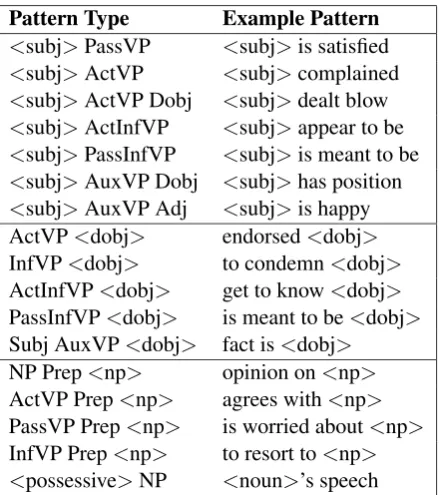
pat-terns (EPs) were automatically generated using the Sundance/AutoSlog software package (Riloff and Phillips, 2004). AutoSlog relies on the Sun-dance shallow parser and can be applied exhaus-tively to a text corpus to generate IE patterns that can extract every noun phrase in the corpus. Au-toSlog has been used to learn IE patterns for the domains of terrorism, joint ventures, and micro-electronics (Riloff, 1996), as well as for opinion analysis (Riloff and Wiebe, 2003). Figure 1 shows the 17 types of extraction patterns that AutoSlog generates. PassVP refers to passive-voice verb phrases (VPs), ActVP refers to active-voice VPs, InfVP refers to infinitive VPs, and AuxVP refers
1NSP is freely available for use under the GPL from
to VPs where the main verb is a form of “to be” or “to have”. Subjects (subj), direct objects (dobj), PP objects (np), and possessives can be extracted by the patterns.2
2.2 The Subsumption Hierarchy
We created a subsumption hierarchythat defines the representational scope of different types of fea-tures. We will say that featureA representation-ally subsumes feature B if the set of text spans that match featureAis a superset of the set of text spans that match featureB. For example, the uni-gram “happy” subsumes the biuni-gram “very happy” because the set of text spans that match “happy” includes the text spans that match “very happy”.
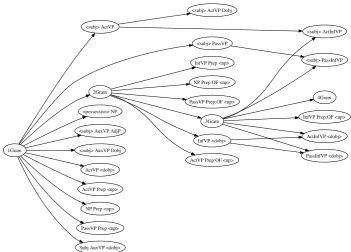
First, we define a hierarchy of valid subsump-tion relasubsump-tionships, shown in Figure 2. The 2Gram node, for example, is a child of the 1Gram node because a 1Gram can subsume a 2Gram. Ngrams may subsume extraction patterns as well. Ev-ery extraction pattern has at least one correspond-ing 1Gram that will subsume it.3. For example,
the 1Gram “recommended” subsumes the pattern “<subj>ActVP(recommended)” because the pat-tern only matches active-voice instances of “rec-ommended”. An extraction pattern may also subsume another extraction pattern. For exam-ple, “<subj> ActVP(recommended)” subsumes “<subj>ActVP(recommended) Dobj(movie)”.
To compare specific features we need to for-mally define the representation of each type of feature in the hierarchy. For example, the hierar-chy dictates that a 2Gram can subsume the pattern “ActInfVP <dobj>”, but this should hold only if the words in the bigram correspond to adjacent words in the pattern. For example, the 2Gram “to fish” subsumes the pattern “ActInfVP(like to fish) <dobj>”. But the 2Gram “like fish” should not subsume it. Similarly, consider the pattern “In-fVP(plan) <dobj>”, which represents the infini-tive “to plan”. This pattern subsumes the pattern “ActInfVP(want to plan) <dobj>”, but it should not subsume the pattern “ActInfVP(plan to start)”. To ensure that different features truly subsume each other representationally, we formally define each type of feature based on words, sequential
2However, the items extracted by the patterns are not
ac-tually used by our opinion classifiers; only the patterns them-selves are matched against the text.
3Because every type of extraction pattern shown in
Fig-ure 1 contains at least one word (not including the extracted phrases, which are not used as part of our feature representa-tion).
dependencies, and syntactic dependencies. A se-quential dependencybetween wordswi andwi+1 means thatwiandwi+1must be adjacent, and that wimust precedewi+1. Figure 3 shows the formal definition of a bigram (2Gram) node. The bigram is defined as two words with a sequential depen-dency indicating that they must be adjacent.
Name =2Gram
Constituent[0] = WORD1 Constituent[1] = WORD2 Dependency = Sequential(0, 1)
Figure 3: 2Gram Definition
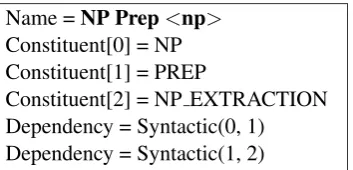
Asyntactic dependencybetween wordswi and wi+1 means thatwi has a specific syntactic rela-tionship towi+1, andwi must precedewi+1. For example, consider the extraction pattern “NP Prep <np>”, in which the object of the preposition at-taches to the NP. Figure 4 shows the definition of this extraction pattern in the hierarchy. The pat-tern itself contains three components: the NP, the attaching preposition, and the object of the prepo-sition (which is the NP that the pattern extracts). The definition also includes two syntactic depen-dencies: the first dependency is between the NP and the preposition (meaning that the preposition syntactically attaches to the NP), while the second dependency is between the preposition and the ex-traction (meaning that the extracted NP is the syn-tactic object of the preposition).
Name =NP Prep<np> Constituent[0] = NP Constituent[1] = PREP
[image:3.595.331.508.506.591.2]Constituent[2] = NP EXTRACTION Dependency = Syntactic(0, 1) Dependency = Syntactic(1, 2)
Figure 4: “NP Prep<np>” Pattern Definition
<subj> ActVP
<subj> ActInfVP <subj> ActVP Dobj
<subj> PassVP
<subj> PassInfVP
InfVP <dobj> ActInfVP <dobj>
PassInfVP <dobj> 1Gram
2Gram
<possessive> NP
<subj> AuxVP AdjP
<subj> AuxVP Dobj
ActVP <dobj>
ActVP Prep <np>
NP Prep <np>
PassVP Prep <np>
Subj AuxVP <dobj>
3Gram
ActVP Prep:OF <np> InfVP Prep <np>
NP Prep:OF <np>
PassVP Prep:OF <np> 4Gram
[image:4.595.117.469.60.312.2]InfVP Prep:OF <np>
Figure 2: The Subsumption Hierarchy
the sentence“He ended the affair with a sense of relief”, but the extraction pattern does not.
Figure 5 shows the definition of another ex-traction pattern, “InfVP<dobj>”, which includes both syntactic and sequential dependencies. This pattern would match the text “to protest high taxes”. The pattern definition has three compo-nents: the infinitive “to”, a verb, and the direct ob-ject of the verb (which is the NP that the pattern extracts). The definition also shows two syntac-tic dependencies. The first dependency indicates that the verb syntactically attaches to the infinitive “to”. The second dependency indicates that the ex-tracted NP syntactically attaches to the verb (i.e., it is the direct object of that particular verb).
The pattern definition also includes a sequen-tial dependency, which specifies that “to” must be adjacent to the verb. Strictly speaking, our parser does not require them to be adjacent. For exam-ple, the parser allows intervening adverbs to split infinitives (e.g.,“to strongly protest high taxes”), and this does happen occasionally. But split in-finitives are relatively rare, so in the vast major-ity of cases the infinitive “to” will be adjacent to the verb. Consequently, we decided that a bigram (e.g.,“to protest”) should representationally sub-sume this extraction pattern because the syntac-tic flexibility afforded by the pattern is negligi-ble. The sequential dependency link represents
this judgment call that the infinitive “to” and the verb are adjacent in most cases.
For all of the node definitions, we used our best judgment to make decisions of this kind. We tried to represent major distinctions between features, without getting caught up in minor differences that were likely to be negligible in practice.
Name =InfVP<dobj>
Constituent[0] = INFINITIVE TO Constituent[1] = VERB
Constituent[2] = DOBJ EXTRACTION Dependency = Syntactic(0, 1)
[image:4.595.324.515.465.564.2]Dependency = Syntactic(1, 2) Dependency = Sequential(0, 1)
Figure 5: “InfVP<dobj>” Pattern Definition
To use the subsumption hierarchy, we assign each feature to its appropriate node in the hierar-chy based on its type. Then we perform a top-down breadth-first traversal. Each feature is com-pared with the features at its ancestor nodes. If a feature’s words and dependencies are a superset of an ancestor’s words and dependencies, then it is subsumed by the (more general) ancestor and discarded.4 When the subsumption process is
fin-ished, a feature remains in the hierarchy only if
4The words that they have in common must also be in the
there are no features above it that subsume it.
2.3 Performance-based Subsumption
Representational subsumption is concerned with whether one feature is more general than another. But the purpose of using the subsumption hier-archy is to identify more complex features that outperform simpler ones. Applying the subsump-tion hierarchy to features without regard to per-formance would simply eliminate all features that have a more general counterpart in the feature set. For example, all bigrams would be discarded if their component unigrams were also present in the hierarchy.
To estimate the quality of a feature, we use In-formation Gain (IG) because that has been shown to work well as a metric for feature selection (For-man, 2003). We will say that feature A be-haviorally subsumes feature B if two criteria are met: (1)Arepresentationally subsumesB, and (2) IG(A)≥IG(B) -δ, whereδis a parameter repre-senting an acceptable margin of performance dif-ference. For example, if δ=0 then condition (2) means that feature A is just as valuable as fea-tureBbecause its information gain is the same or higher. Ifδ>0 then featureAis allowed to be a lit-tle worse than featureB, but within an acceptable margin. For example,δ=.0001 means thatA’s in-formation gain may be up to .0001 lower thanB’s information gain, and that is considered to be an acceptable performance difference (i.e.,Ais good enough that we are comfortable discarding B in favor of the more general featureA).
Note that based on the subsumption hierarchy shown in Figure 2, all 1Grams will always sur-vive the subsumption process because they cannot be subsumed by any other types of features. Our goal is to identify complex features that are worth adding to a set of unigram features.
3 Data Sets
We used three opinion-related data sets for our analyses and experiments: theOP data setcreated by (Wiebe et al., 2004), thePolarity data set5
cre-ated by (Pang and Lee, 2004), and theMPQA data setcreated by (Wiebe et al., 2005).6 The OP and
Polarity data sets involve document-level opinion classification, while the MPQA data set involves
5Version v2.0, which is available at:
http://www.cs.cornell.edu/people/pabo/movie-review-data/
6Available at http://www.cs.pitt.edu/mpqa/databaserelease/
sentence-level classification.
The OP data consists of 2,452 documents from the Penn Treebank (Marcus et al., 1993). Metadata tags assigned by the Wall Street Journal define the opinion/non-opinion classes: the class of any doc-ument labeledEditorial, Letter to the Editor,Arts & Leisure Review, orViewpointby the Wall Street Journal isopinion, and the class of documents in all other categories (such as Business and News) is non-opinion. This data set is highly skewed, with only 9% of the documents belonging to the opinion class. Consequently, a trivial (but useless) opinion classifier that labels all documents as non-opinion articles would achieve 91% accuracy.
The Polarity data consists of 700 positive and 700 negative reviews from the Internet Movie Database (IMDb) archive. The positive and neg-ative classes were derived from author ratings ex-pressed in stars or numerical values. The MPQA data consists of English language versions of ar-ticles from the world press. It contains 9,732 sentences that have been manually annotated for subjective expressions. The opinion/non-opinion classes are derived from the lower-level annota-tions: a sentence is an opinion if it contains a sub-jective expression of medium or higher intensity; otherwise, it is a non-opinion sentence. 55% of the sentences belong to the opinion class.
4 Using the Subsumption Hierarchy for Analysis
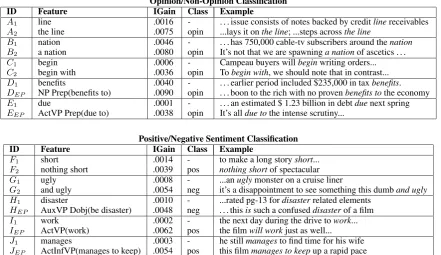
In this section, we illustrate how the subsump-tion hierarchy can be used as an analytic tool to automatically identify features that substantially outperform simpler counterparts. These features represent specialized usages and expressions that would be good candidates for addition to a sub-jectivity lexicon. Figure 6 shows pairs of features, where the first is more general and the second is more specific. These feature pairs were identified by the subsumption hierarchy as being representa-tionally similar but behaviorally different (so the more specific feature was retained). The IGain column shows the information gain values pro-duced from the training set of one cross-validation fold. TheClass column shows the class that the more specific feature is correlated with (the more general feature is usually not strongly correlated with either class).
Opinion/Non-Opinion Classification ID Feature IGain Class Example
A1 line .0016 - . . . issue consists of notes backed by creditlinereceivables A2 the line .0075 opin ...lays it onthe line; ...steps acrossthe line
B1 nation .0046 - . . . has 750,000 cable-tv subscribers around thenation B2 a nation .0080 opin It’s not that we are spawninga nationof ascetics . . . C1 begin .0006 - Campeau buyers willbeginwriting orders... C2 begin with .0036 opin Tobegin with, we should note that in contrast... D1 benefits .0040 - . . . earlier period included $235,000 in taxbenefits. DEP NP Prep(benefits to) .0090 opin . . . boon to the rich with no provenbenefits tothe economy E1 due .0001 - . . . an estimated $ 1.23 billion in debtduenext spring EEP ActVP Prep(due to) .0038 opin It’s alldue tothe intense scrutiny...
Positive/Negative Sentiment Classification ID Feature IGain Class Example
F1 short .0014 - to make a long storyshort... F2 nothing short .0039 pos nothing shortof spectacular G1 ugly .0008 - ...anuglymonster on a cruise liner
G2 and ugly .0054 neg it’s a disappointment to see something this dumband ugly H1 disaster .0010 - ...rated pg-13 fordisasterrelated elements
[image:6.595.80.522.66.321.2]HEP AuxVP Dobj(be disaster) .0048 neg . . . thisissuch a confuseddisasterof a film I1 work .0002 - the next day during the drive towork... IEP ActVP(work) .0062 pos the filmwill workjust as well... J1 manages .0003 - he stillmanagesto find time for his wife JEP ActInfVP(manages to keep) .0054 pos this filmmanages to keepup a rapid pace
Figure 6: Sample features that behave differently, as revealed by the subsumption hierarchy. (1⇒unigram; 2⇒bigram; EP⇒extraction pattern)
the OP data. The more specific features are more strongly correlated with opinion articles. Surpris-ingly, simply adding a determiner can dramatically change behavior. Consider A2. There are many subjective idioms involving “the line” (two are shown in the table; others include“toe the line” and “draw the line”), while objective language about credit lines, phone lines, etc. uses the deter-miner less often. Similarly, considerB2. Adding “a” to“nation”often corresponds to an abstract reference used when making an argument (e.g., “a nation of ascetics”), whereas other instances of “nation” are used more literally (e.g.,“the 6th largest in the nation”). 21% of feature B1’s in-stances appear in opinion articles, while 70% of featureB2’s instances are in opinion articles.
“Begin with” (C2) captures an adverbial phrase used in argumentation (“To begin with...”) but does not match objective usages such as “will begin” an action. The word “benefits” alone (D1) matches phrases like“tax benefits”and “em-ployee benefits”that are not opinion expressions, while DEP typically matches positive senses of the word “benefits”. Interestingly, the bigram “benefits to” is not highly correlated with opin-ions because it matches infinitive phrases such as “tax benefits to provide”and “health benefits to cut”. In this case, the extraction pattern “NP
Prep(benefits to)” is more discriminating than the bigram for opinion classification. The extraction pattern EEP is also highly correlated with opin-ions, while the unigram “due” and the bigram “due to”are not.
These examples illustrate that the subsumption hierarchy can be a powerful tool to better under-stand the behaviors of different kinds of features, and to identify specific features that may be desir-able for inclusion in specialized lexical resources.
5 Using the Subsumption Hierarchy to Reduce Feature Sets
When creating opinion classifiers, people often throw in a variety of features and trust the ma-chine learning algorithm to figure out how to make the best use of them. However, we hypothesized that classifiers may perform better if we can proac-tively eliminate features that are not necesary be-cause they are subsumed by other features. In this section, we present a series of experiments to ex-plore this hypothesis. First, we present the results for an SVM classifier trained using different sets of unigram, bigram, and extraction pattern fea-tures, both before and after subsumption. Next, we evaluate a standard feature selection approach as an alternative to subsumption and then show that combining subsumption with standard feature se-lection produces the best results of all.
5.1 Classification Experiments
To see whether feature subsumption can improve classification performance, we trained an SVM classifier for each of the three opinion data sets. We used the SVMlight (Joachims, 1998) package with a linear kernel. For the Polarity and OP data we discarded all features that have frequency<5, and for the MPQA data we discarded features that have frequency <2 because this data set is sub-stantially smaller. All of our experimental results are averages over 3-fold cross-validation.
First, we created 4 baseline classifiers: a1Gram classifier that uses only the unigram features; a 1+2Gramclassifier that uses unigram and bigram features; a1+EPclassifier that uses unigram and extraction pattern features, and a1+2+EP classi-fier that uses all three types of features. Next, we created analogous 1+2Gram, 1+EP, and 1+2+EP classifiers but applied the subsumption hierar-chy first to eliminate unnecessary features be-fore training the classifier. We experimented with three delta values for the subsumption process: δ=.0005, .001, and .002.
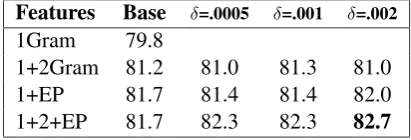
Figures 7, 8, and 9 show the results. The sub-sumption process produced small but consistent improvements on all 3 data sets. For example,
Fig-ure 8 shows the results on the OP data, where all of the accuracy values produced after subsumption (the rightmost 3 columns) are higher than the ac-curacy values produced without subsumption (the Base[line] column). For all three data sets, the best overall accuracy (shown in boldface) was always achieved after subsumption.
Features Base δ=.0005 δ=.001 δ=.002
1Gram 79.8
[image:7.595.313.519.169.239.2]1+2Gram 81.2 81.0 81.3 81.0 1+EP 81.7 81.4 81.4 82.0 1+2+EP 81.7 82.3 82.3 82.7
Figure 7: Accuracies on Polarity Data
Features Base δ=.0005 δ=.001 δ=.002
1Gram 97.5 - -
-1+2Gram 98.0 98.7 98.6 98.7
1+EP 97.2 97.8 97.9 97.9 1+2+EP 97.8 98.6 98.7 98.7
Figure 8: Accuracies on OP Data
Features Base δ=.0005 δ=.001 δ=.002
1Gram 74.8
1+2Gram 74.3 74.9 74.6 74.8 1+EP 74.4 74.6 74.6 74.6 1+2+EP 74.4 74.9 74.7 74.6
Figure 9: Accuracies on MPQA Data
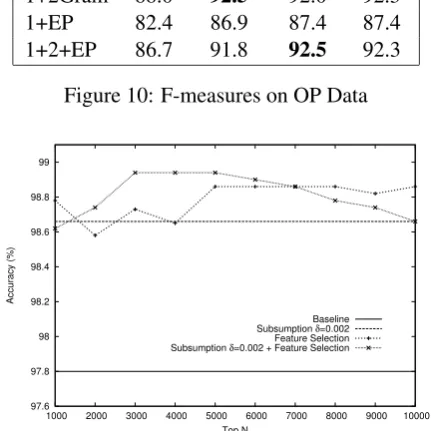
We also observed that subsumption had a dra-matic effect on the F-measure scores on the OP data, which are shown in Figure 10. The OP data set is fundamentally different from the other data sets because it is so highly skewed, with 91% of the documents belonging to the non-opinion class. Without subsumption, the classifier was conser-vative about assigning documents to the opinion class, achieving F-measure scores in the 82-88 range. After subsumption, the overall accuracy improved but the F-measure scores increased more dramatically. These numbers show that the sub-sumption process produced not only a more ac-curate classifier, but a more useful classifier that identifies more documents as being opinion arti-cles.
For the MPQA data, we get a very small im-provement of 0.1% (74.8%→74.9%) using
Features Base δ=.0005 δ=.001 δ=.002
1Gram 84.5
[image:8.595.312.522.65.213.2]1+2Gram 88.0 92.5 92.0 92.3 1+EP 82.4 86.9 87.4 87.4 1+2+EP 86.7 91.8 92.5 92.3
Figure 10: F-measures on OP Data
97.6 97.8 98 98.2 98.4 98.6 98.8 99
1000 2000 3000 4000 5000 6000 7000 8000 9000 10000
Accuracy (%)
Top N
Baseline Subsumption δ=0.002 Feature Selection Subsumption δ=0.002 + Feature Selection
Figure 11: Feature Selection on OP Data
extraction patterns were added! The subsumption process counteracted the negative effect of adding the more complex features.
5.2 Feature Selection Experiments
We conducted a second series of experiments to determine whether a traditional feature selection approach would produce the same, or better, im-provements as subsumption. For each feature, we computed its information gain (IG) and then se-lected the N features with the highest scores.7 We
experimented with values of N ranging from 1,000 to 10,000 in increments of 1,000.
We hypothesized that applying subsumption be-fore traditional feature selection might also help to identify a more diverse set of high-performing fea-tures. In a parallel set of experiments, we explored this hypothesis by first applying subsumption to reduce the size of the feature set, and then select-ing the best N features usselect-ing information gain.
Figures 11, 12, and 13 show the results of these experiments for the 1+2+EP classifiers. Each graph shows four lines. One line corresponds to the baseline classifier with no subsumption, and another line corresponds to the baseline classifier with subsumption using the best δ value for that data set. Each of these two lines corresponds to
7In the case of ties, we included all features with the same
score as the Nth-best as well.
78 78.5 79 79.5 80 80.5 81 81.5 82 82.5 83 83.5
1000 2000 3000 4000 5000 6000 7000 8000 9000 10000
Accuracy (%)
Top N
Baseline Subsumption δ=0.002 Feature Selection Subsumption δ=0.002 + Feature Selection
Figure 12: Feature Selection on Polarity Data
72 72.5 73 73.5 74 74.5 75 75.5
1000 2000 3000 4000 5000 6000 7000 8000 9000 10000
Accuracy (%)
Top N
[image:8.595.73.289.99.315.2]Baseline Subsumption δ=0.0005 Feature Selection Subsumption δ=0.0005 + Feature Selection
Figure 13: Feature Selection on MPQA Data
just a single data point (accuracy value), but we drew that value as a line across the graph for the sake of comparison. The other two lines on the graph correspond to (a) feature selection for dif-ferent values of N (shown on the x-axis), and (b) subsumption followed by feature selection for dif-ferent values of N.
[image:8.595.312.523.258.403.2]statistically significant at the p<0.10 level.
6 Related Work
Many features and classification algorithms have been explored in sentiment analysis and opinion recognition. Lexical cues of differing complexi-ties have been used, including single words and Ngrams (e.g., (Mullen and Collier, 2004; Pang et al., 2002; Turney, 2002; Yu and Hatzivassiloglou, 2003; Wiebe et al., 2004)), as well as phrases and lexico-syntactic patterns (e.g, (Kim and Hovy, 2004; Hu and Liu, 2004; Popescu and Etzioni, 2005; Riloff and Wiebe, 2003; Whitelaw et al., 2005)). While many of these studies investigate combinations of features and feature selection, this is the first work that uses the notion of sub-sumption to compare Ngrams and lexico-syntactic patterns to identify complex features that outper-form simpler counterparts and to reduce a com-bined feature set to improve opinion classification.
7 Conclusions
This paper uses a subsumption hierarchy of feature representations as (1) an analytic tool to compare features of different complexities, and (2) an automatic tool to remove unneces-sary features to improve opinion classification performance. Experiments with three opinion data sets showed that subsumption can improve classification accuracy, especially when combined with feature selection.
Acknowledgments
This research was supported by NSF Grants IIS-0208798 and IIS-0208985, the ARDA AQUAINT Program, and the Institute for Scientific Comput-ing Research and the Center for Applied Scientific Computing within Lawrence Livermore National Laboratory.
References
S. Banerjee and T. Pedersen. 2003. The Design, Imple-mentation, and Use of the Ngram Statistics Package. InProc. Fourth Int’l Conference on Intelligent Text Processing and Computational Linguistics.
A. Esuli and F. Sebastiani. 2005. Determining the se-mantic orientation of terms through gloss analysis. InProc. CIKM-05.
G. Forman. 2003. An Extensive Empirical Study of Feature Selection Metrics for Text Classification. J. Mach. Learn. Res., 3:1289–1305.
M. Hu and B. Liu. 2004. Mining and summarizing customer reviews. InProc. KDD-04.
T. Joachims. 1998. Making Large-Scale Support Vector Machine Learning Practical. In A. Smola B. Sch¨olkopf, C. Burges, editor, Advances in Ker-nel Methods: Support Vector Machines. MIT Press, Cambridge, MA.
S-M. Kim and E. Hovy. 2004. Determining the senti-ment of opinions. InProc. COLING-04.
M. Marcus, B. Santorini, and M. Marcinkiewicz. 1993. Building a Large Annotated Corpus of English: The Penn Treebank. Computational Linguistics, 19(2):313–330.
T. Mullen and N. Collier. 2004. Sentiment Analysis Using Support Vector Machines with Diverse Infor-mation Sources. InProc. EMNLP-04.
B. Pang and L. Lee. 2004. A sentimental education: Sentiment analysis using subjectivity summarization based on minimum cuts. InProc. ACL-04.
B. Pang, L. Lee, and S. Vaithyanathan. 2002. Thumbs up? Sentiment Classification using Machine Learn-ing Techniques. InProc. EMNLP-02.
A-M. Popescu and O. Etzioni. 2005. Extracting prod-uct features and opinions from reviews. In Proc. HLT-EMNLP-05.
E. Riloff and W. Phillips. 2004. An Introduction to the Sundance and AutoSlog Systems. Technical Report UUCS-04-015, School of Computing, University of Utah.
E. Riloff and J. Wiebe. 2003. Learning Extraction Pat-terns for Subjective Expressions. InProc. EMNLP-03.
E. Riloff. 1996. An Empirical Study of Automated Dictionary Construction for Information Extraction in Three Domains. Artificial Intelligence, 85:101– 134.
P. Turney. 2002. Thumbs up or thumbs down? Seman-tic orientation applied to unsupervised classification of reviews. InProc. ACL-02.
C. Whitelaw, N. Garg, and S. Argamon. 2005. Us-ing appraisal groups for sentiment analysis. InProc. CIKM-05.
J. Wiebe, T. Wilson, R. Bruce, M. Bell, and M. Mar-tin. 2004. Learning subjective language. Computa-tional Linguistics, 30(3):277–308.
J. Wiebe, T. Wilson, and C. Cardie. 2005. Annotating expressions of opinions and emotions in language.
Language Resources and Evaluation, 39(2/3). H. Yu and V. Hatzivassiloglou. 2003. Towards