Abstract—Recently, washer-dryer machines with slanted drums have become popular in Japan. We measured and analyzed posture while using such machines with three-dimensional motion capture measuring devices. Subjective Kansei and usability questionnaires were also used. After the measurements, working postures were analyzed with a human kinematic model (3D SSPP). Three types of machines were used for the experiment (European washer. conventional Japanese washer has vertical drum and a new washer-dryer: slanted drum with higher profile). The sum of the estimated %MVC (elbow, hip, knee and ankle) for the new washer-dryer was 116; it was 133 (knee tension was high) for the European washer, and 284 (ankle tension was 110, which exceeds the limit) for the conventional Japanese washer. From subjective evaluations, the new washer-dryer was significantly highly rated (one-way ANOVA) over the European and conventional Japanese washers in terms of subjective fatigue evaluation and general evaluation.
Usability of the control panel of newly developed model of washing machine was also improved. The authors conducted the usability experiments at both planning and preproduction phase of SANYO AWD- AQ3000 prototype, the new model, comparing with the conventional model.
Index Terms—Kansei ergonomics, Body load, Kinematics, Usability, Interface
I. INTRODUCTION A. Kansei Ergonomics
In the early era of Kansei engineering from the 1970s to the mid 1990s, research results were published and presented primarily at several societies of Ergonomics. In Ergonomics, ensuring safety and removing unpleasant items are immediate tasks. Physical traits, such as torque, acceleration, and vibration, and physiological measurements, such as electromyography, are major concerns. Prof.
Manuscript received December 30, 2009.
Shigekazu Ishihara is with the Faculty of Psychological Science, Hiroshima International University, 555-36, Kurose-Gakuendai, Higashi-Hiroshima, Hiroshima 739-2695 Japan (fax: +81-823-70-4852; e-mail: i-shige @he.hirokoku-u.ac.jp).
Keiko Ishihara is with the Faculty of Psychological Science, Hiroshima International University, 555-36, Kurose-Gakuendai, Higashi-Hiroshima, Hiroshima 739-2695 Japan (fax: +81-823-70-4852; e-mail: [email protected]).
Ryo Nakagawa is with the Graduate School of Hiroshima International University, 555-36, Kurose-Gakuendai, Higashi-Hiroshima, Hiroshima 739-2695 Japan (e-mail: [email protected])
Yoshihisa Fujiwara, Hirofumi Sako and Masahiro Naito are with Sanyo Electric, Co. Ltd., 2-5-5, Keihan-Hondoori, Moriguchi, Osaka 570-8677 Japan.
Nagamachi began Kansei engineering, by combining psychological Kansei measurement and analysis methodologies with ergonomics. We have applied Kansei engineering to many product development projects since the 1980s.
Since around the end of the 1990s, we have been involved in the development of many more products, and we have recognized that Kansei engineering and ergonomics are inseparable. Attractive products cannot be made with only ergonomic considerations, and Kansei engineering provides eloquent answers. Thus, we are proclaiming the need for Kansei ergonomics.
B. Washer and Washer-Dryer Machines
Recently, washer-dryer machines with slanted drums have become popular in Japan. Traditionally, Japanese washing machines have had vertical drums, and these types are still common. Users of vertical-drum washers have to bend their backs and stretch their arm to put in and take out laundry. Meanwhile in Europe, horizontal-drum washing machines have long been popular. This type requires a crouching posture for putting in and taking out laundry, because of its lower height.
The washer-dryers have rather different mechanisms to vertical-drum washing machines, and thus require a new and different mechanical design. The new washer-dryers have horizontal or slanted rotational axes of the drum. Thus, the shape of the washing machine was greatly changed; to make loading operations easier, the door position was modified.
In this research, physical loads and usability between the new washer-dryer machine, and the traditional Japanese drum and European washing machines were compared. This comparison was performed using subjective evaluations, 3D motion capture, and estimations of body part loads using a human kinetics computer model.
About 33 % of automatic washing machines sold in Japan in 2007 had built-in dryers [1].The factors such as increase of working parents and pollen allergic measures must raise the sales of automatic washing-drying machines.
The operation has been complex and difficult as the machines have more functions. Manufactures provide more functions on automatic washing machines according to the change of family structures or the people's idea of personal hygiene. For example, futons and blankets, which have rarely been sent to the dry-cleaners, became frequently washable at homes by using the washing courses for heavy-laundry or wool of the washing machines. Residents of apartment houses want to use a quiet-washing course or a time switch.
Development and Improvement of a
Washer-Dryer with Kansei Ergonomics
In addition, Sanyo Electrics add a novel, waterless cleaning course to disinfects and deodorize items with generated ozone. Leather-goods and stuffed toy animals, which have been difficult to be maintained at home can be cleaned with this function.
In this way, as washing machines have more functions, the users require more simple way of using them. The interface has to help variety of users find the function they want in many functions and tune particular settings. We also have re-designed interface panel and operations with ergonomic evaluations and analyises.
II. BODY LOAD EVALUATION METHOD
In the experiment, we requested participants to take out laundry from the machines. As a model laundry load, two towels were placed at the bottom of the drum, and two blankets, each 1.6 kg, were placed on the towels. These items were dry. The participants were asked to open the door, take out the laundry piece-by-piece, put the items into a basket that was placed on the floor, and then close the door. The participants were 12 females, aged 20 to 43. Four subjects were short (148 – 153 cm), five subjects were around the young (age 20 to 29) Japanese female average of 158 cm, and three subjects were taller, around 165 cm.
[image:2.595.315.552.48.224.2]Three laundry machines were used, as shown in Fig. 1: a European box-shaped washing machine (Sanyo AWD-500; referred to below as the “EU type”), a typical Japanese vertical drum washing machine (Sanyo ASW-800; referred to as “vertical drum”), and a slanted-drum, fully-automatic washer-dryer machine (Sanyo AQ-1; referred to as “slanted drum”). The height to the centre of the opening was 47.5 cm for the EU type machine, 90 cm for the vertical-drum machine, and 81 cm for the slanted drum machine. Note that the opening of the vertical-drum machine faced straight up, meaning that laundry had to be lifted higher than the actual height of the door.
Table 1. Questions for Subjective Evaluation
1. How tired does your entire body feel? 2. How tired are your neck and shoulders? 3. How tired are your upper arms? 4. How tired is your back? 5. How tired are your knees?
6. How easy was it to push the door open button? 7. How easy was opening and closing the door? 8. How easy was it to check inside the drum?
9. How easy was it to insert your hand or arm inside the drum? 10. How easy was it to take out laundry?
11. How easy was the machine to use?
Figure 1. Laundry machines: European washer AWD-500, vertical-drum washer ASW-800, and slanted-drum washer-dryer AQ-1 (left to right).
III. SUBJECTIVE EVALUATION RESULTS
A subjective evaluation was carried out by asking the participants a set of questions each time their required task was completed. Of the questions, five were related to fatigue, five to usability, and a final question to the general usability of the washing machine. Table 1 lists the questions asked. Each question was answered on a 5-point scale
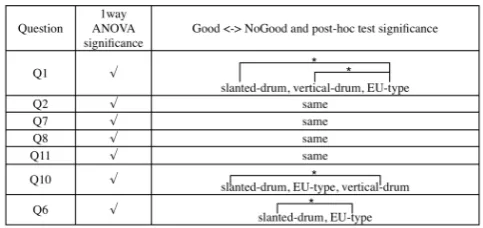
[image:2.595.315.557.449.563.2]We used a one-way analysis of variance (ANOVA) to examine whether differences in the evaluations from one machine to another were significant. For post-hoc pair-wise comparison, we used the Tukey-Kramer honestly significantly different (HSD) test. All of the results are shown in Table 2.
Table 2. 1-way ANOVA and Post-hoc test results
The slanted-drum machine has highest evaluations for all questions. Statistical results shown significance on 7 out of 11 questions and that the EU-type machine was statistically significantly inferior, in terms of fatigue and ease of use. It was also found that the vertical-drum machine, which has been widely used in Japan until recently, was not very good for taking laundry out from the drum (Q10). We next investigated the relationship between these results and working posture as determined by motion capture.
IV. WORKING POSTURE MEASUREMENTS BY MOTION CAPTURE AND ANALYSIS OF JOINT ANGLES
samples/s and the spatial resolution setting during measurements was 5 – 10 mm. Figure 2 shows the posture of a subject with a height of 158 cm (the average for Japanese women) during maximum bending of the body when removing a towel from the drum.
Markers were set at 15 locations on the subject’s body: head, left and right shoulders, left and right elbows, back (dorsal) of each hand, left and right greater trochanter, left and right knees, left and right ankles, and left and right toes (on the subject’s slippers).
Slanted drum Vertical drum
[image:3.595.45.287.169.425.2]EU type
Figure 2: Posture during maximum bending of body (158cm young female) and graph of Angles formed by the knee, greater-trochanter and shoulder for different machines
Using data from the motion capture, we measured and analyzed the angle formed by the knee, greater-trochanter, and shoulder. This angle was 100° (average between subjects) for the slanted drum, 114° for the vertical drum, and 64° for the EU type (Fig. 2). Because standing posture is close to 180°, the larger angle, the better.
One-way ANOVA indicated that differences between machines were significant (F(2,33) = 37.622, p < 0.0001). Results of the HSD test revealed a significant difference between the slanted-drum and EU-type machines, and between the vertical drum and EU-type machines (p < 0.05). The angle formed for the slanted drum was 110/64 = 1.71 times larger than that of the EU type, which can be interpreted as a 70% improvement. For the EU type, the capture screen showed that laundry could not be put in or taken out without squatting completely. This is likely the reason for the poor evaluations given to the EU-type washing machine for the questions “How tired does your entire body feel?”, “How tired are your knees?”, and “How easy was the machine to use?” The vertical drum provided a posture closer to the vertical stance than that of the slanted drum, but since the vertical drum was deep, almost all of the participants had to reach the towel at the bottom of the drum by raising a foot off the ground and stretching inside the drum. This is why the vertical drum was poorly evaluated with respect to the question “How easy was it to take out
laundry?” The relationship between the subjective evaluation and working posture was therefore clarified by measuring body posture through motion capture and calculating the angle of body bending.
We have shown that the vertical drum required an off-balance posture. The entire body load at this time cannot be estimated solely on the basis of coordinates and angle data obtained through motion capture. The load on the lumber vertebra that cannot be directly measured is also an important factor. Accordingly, giving due consideration to the mass of various parts of the body, we attempted to estimate such loads using a kinematic model.
V. STATIC LOAD ESTIMATES USING A KINEMATIC MODEL
We estimated the load on various parts of the body using a kinematic model. To perform these calculations, we used the 3D Static Strength Prediction Program (3D SSPP) developed by a team lead by Prof. Don Chaffin at the University of Michigan. Prof. Chaffin has been researching kinematic models of the human body and applying them to posture analysis of production lines for about 30 years.
As shown in Fig. 3, the Chaffin model features a human body with a basic structure consisting of seven links. These links are the forearm, upper arm, torso (shoulder to lumbar vertebra), sacral vertebra to pelvis, femoral head to knee, shank, and foot.
Figure 3. Body links (entire body) and hip section [2]
The model takes the following values as major
parameters: load, own weight, height, and joint coordinates. The centre of gravity is determined by each part’s size and weight. As an example, a load of 5 kg (49 N) is held in the hand, with the combined weight of the forearm and hand being 15.8 N (Fig. 3). The upper arm, from the elbow up, holds this load with force Relbow in a stationary position.
This can be expressed as –49 N – 15.8 N + Relbow = 0, so
Relbow is 64.8 N in the upward direction.
The rotation moment ME is in equilibrium with the
(centre of gravity of the fore arm ! the weight of the fore arm and hand) + (length from the joint to the grip ! the load). This can be expressed as 17.2 cm (–15.8 N) + 35.5 cm (–49 N) + ME = 0. Thus, ME = 2011.3 Ncm
[image:3.595.324.531.403.546.2]For the upper arm, the upward pulling force at the shoulder can be expressed as RS = WUA + Relbow, where WUA
is the upper arm’s own weight. The torque at the shoulder can be expressed as MS = –(SCMUA) (WUA) – (SE) (Relbow) –
(ME), where SCMUA is the distance from the shoulder to the
centre of gravity of the upper arm, and SE is the length of the
upper arm.
Lowering the upper arm from the horizontal gives a result of cos "(MS). In this way, load and joint moments can
be progressively calculated for various parts of the body (Fig. 4).
Figure 4. Left: forearm and load; right: upper arm and forearm (from [2])
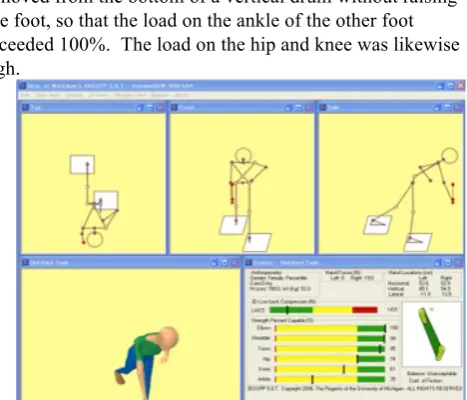
[image:4.595.52.284.156.295.2]Using this model, we estimated the pressure (N) on the disk between the fourth and fifth lumbar vertebra and the maximum voluntary contraction (%MVC) for the muscles involved in the elbow, hip, knee, and ankle joints for the posture corresponding to maximum bending of the body (for a 158-cm, 53-kg participant). The participant’s height and weight were used for the estimation. Referring to Table 3 and Fig. 5, the slanted drum exhibited smaller muscle strengths, except for the hips. For the vertical drum, the pressure on the intervertebral disk was smaller than that of the other two machines, because the back was not bent so much. On the other hand, laundry cannot readily be removed from the bottom of a vertical drum without raising one foot, so that the load on the ankle of the other foot exceeded 100%. The load on the hip and knee was likewise high.
Figure 5. Calculation screen for the vertical drum (158-cm young female)
Table 3. Values estimated by the model (158-cm young female)
Subject: 158 cm / 53 kg
L4/L5
Comp Elbow Hip Knee Ankle Sum (%MVC)
Sum (%MVC) / 400 Slanted
drum 1732 12 54 25 25 116 0.29
EU
type 1801 17 31 59 26 133 0.3325
Vertical
drum 1431 8 75 91 110 284 0.71
Summing individual %MVCs and comparing the
overall %MVC between the different machines revealed that the slanted drum had the smallest value, with a muscle load about 60% less than that of the vertical drum. On
comparing the slanted drum and the EU type, the latter exhibited a smaller load on the hip but 2.36 times the load on the knee, because a squatting posture must be taken. The above results demonstrate that the slanted drum provided improved posture.
VI. USABILITYEXPERIMENTONTHESIMULATORS We attempted to examine the usability of the operation panel of the new model scince it was planed.
A. Settings
The objective operation panels were the current model, SANYO AWD-AQ2000 and the proposed one, AWD-AQ3000 prototype in which a control knob was newly employed in the modified layout. The both panels were implemented as simulator programs with a touch screen.
Seven women aged over 30 years who used to automatic washing machines participated the experiment.
The required tasks were categorized in following seven: turning on the power, switching the wash or wash-dry mode, changing the washing courses, tuning the wash settings, setting the time swich, setting water-saving mode, and setting the “air-washing” function. The instructions given to the participants were, for example, “set to wash the wool sweater and end (do not dry it in succession)” and “deodorize the leather shoes.”
[image:4.595.57.291.469.669.2]They were asked to set the designated washing tasks by using two simulator panels. Time and steps to completion for each task were counted, and irritating measure (5-point rating) was reported by the participants. Each operation steps were recorded on the video tape.
Figure 6. A snapshot of usability experiment on the simulators.
B. Results
The total irritating measure over all participants and tasks was found significantly reduced on the planning model comparing to the conventional one (df = 1, F = 9.0645, p = 0.0032). The completion times had no signifficant difference. Operation steps was reduced by using the control knob. This point was welcome by the participants, because they had not push buttons so many times.
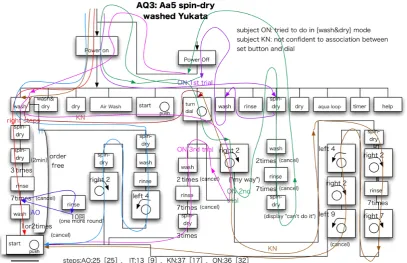
[image:4.595.314.523.497.650.2]hiearchical task analysis [2] to the tasks we conducted. The current choices were layed out horizontally and followed the participants' actual operations vertically. Comparing to the intended operation sequence, we found the errornious point where our participants got lost.
According to those resuls, we adopted the control knob and to isolate the mode-selection buttons from other buttons. The location of the start button and control knob were also changed.
VII. ASSOCIATION
B
ETWEEN CONTROL KNOB AND DISPLAYA.Settings and results
Before starting the usability experiments, we conducted a study of association between operation and display on the control knob. The participants, 120 university students and teachers aged 20-61 were asked which course they expected to be focused in the display when they turn the knob clockwise. They answered their expected course on each of three type of display. The display types and number of responses are shown in Table 4. Display type A had two triangles pointing right and left, similar to station signs of railways. Curved arrows on the Type B also pointed the both side. Curved arrows on the Type C display were associated with rotation. As a result, the most participants agreed on the Type B display then we adopted this.
B. Consideration
The compatibility of the association between rotate control and quantitative display is the one of classical problem [3]. For example, iPod uses association with vertical direction. We used more straight “as is” association, as right turn associated with right arrow.
VIII. USABILITY EXPERIMENT ONTHE TEST MODELS A. Settings
[image:5.595.307.539.185.472.2]Fifteen men and women washing machine users who were 30-61 years old, and 25 users who were around 20 years old participated in the usability experiment. As shown in Figure 6, they were asked to operate to actual devices of the conventional model and the improved test model for the designated six washing tasks as well as the first experiment,
[image:5.595.73.481.491.754.2]Fig. 7 An example diagram of hierarchical task analysis for the task “to spin-dry washed yukata (Japanese summer kimono) for two minutes.” The procedure starts with “turning on power” drawn on the top of the diagram. Choice buttons and control knobs are drawn as connected boxes. The designed procedure and the participant’s actually performed sequences were traced as lines with arrowheads.
Table 4. Compatibility between display and the rotary control knob.
Question given to the participants: The course “標準 (hyoujun; standard washing)” displayed at the center of LCD is now focused. When turning the control knob a division clockwise, which course do you expect to be focused next, “カビガード (kabi-gaado; keeping mold out)” or “おいそぎ (oisogi; quick washing)”?
Control knob Shape of
arrows Display on LCD
Type A N.A.
Number of answers
21
(17.5 %) (80.0 %) 96 3
Type B
N.A. Number
of answers
13 (10.8 %)
105 (87.5 %)
2
Type C N.A.
Number of answers
61
except for using water-saving mode. Time, operation steps and irritating measure were also recorded.
Performance on each measurement for all participants and all tasks are described in Table 5 to 7. Total completion times had no significant difference between two models, while total steps and total irritating measure were significantly reduced for the new model. We tested the difference in the measurements between the models by Wilcoxon matched-pair signed-rank test, because we found all of the distributions were not recognized normal.
Then, we focused on the performance of the participants 30 years or older, because they are similar to our target purchaser. We found that all measurements were significantly reduced for the new model.
Especially, layout change and control knob was found contributed to the task using ‘Air-wash’ function (disinfects and deodorize through using air (ozone) instead of water), whose averaged completion time became 34.5 % of the conventional model.
From the result of hierarchical task analysis for 15 participants aged 30 or more years, there remained a little problems on washing course-selection task on the test model. Six participants missed to set wash/dry mode first, yet it was better than that in case of conventional model.
Some participants near push the power button instead of the start button. The participants who find to rotate the control knob for selecting washing course and settings performed the tasks smoothly.
IX. CONCLUSION
We have shown practical case examples of improvement with Kansei ergonomics, through the commercial product development.
Measurement of working posture showed the evidences of superiority of slanted drum design over the conventional vertical or horizontal drum machines.
On control panel study, small problems found at the experiment were fixed on the final production model. The colored line on the start button was changed so that it should be easily discriminated from the power button. Rounded squares were added in the menu illustration on the operation panel to suggest the user rotating the control knob. The final design is shown in Figure 8. The improved new model AQ-3000 was released on February 2008, and have achieved very good sales (Fig.8).
REFERENCES
[1] Sanyo Electric, Co. Ltd., News release on January 21, 2008. http://www.sanyo.co.jp/koho/hypertext4/0801news-j/0121-1.html [2] Chaffin, D.B., Andersson, G.B.J. & Martin, B.J.: Occupational
Biomechanics (4th edition), Wiley,
[3] Stanton A and Young MS. A Guide to Methodology In Ergonomics, Taylor & Francis: London 1999.
[4] Sanders, MS and McCormick EJ. Human Factors in Engineering and Design Seventh Edition. McGraw-Hill: New York 1993.
(a) Body of the new model.
(b) Improved operation panel and the printings.
[image:6.595.308.522.86.173.2]Fig. 8. Released model of SANYO AQUA AWD-AQ3000. Table 5. Comparison between new and conventional models with average measures over all tasks for all 40 participants.
Measures
Models
Average completion time
Average
steps** Average irritating measure* AQ3000
(new
prototype) 28.3 sec 11.8 1.9 AQ2000
(conventional) 31.1 sec 16.4 2.0
Table 6. Comparison between new and conventional models with average measures over all tasks for 15 participants who were 30-61 years old.
Measures
Models
Average completion time **
Average
steps** Average irritating measure** AQ3000 (new
prototype) 26.3 sec 11.2 1.8 AQ2000
[image:6.595.312.513.337.706.2](conventional) 34.9 sec 18.2 2.2
Table 7. Comparison between new and conventional models on the task of the appealing function “Air-wash.” The measures were averaged over 15 participants who were 30-61 years old.
Measures
Models
Average completion time **
Average steps**
Average irritating measure* AQ3000 (new
prototype) 12.5 sec 3.6 1.3
AQ2000
(conventional) 36.2 sec 11.5 2.3
![Figure 3. Body links (entire body) and hip section [2]](https://thumb-us.123doks.com/thumbv2/123dok_us/1307934.660773/3.595.45.287.169.425/figure-body-links-entire-body-hip-section.webp)