Memory-Based Dependency Parsing
Joakim Nivre, Johan Hall and Jens Nilsson
School of Mathematics and Systems Engineering
V¨axj¨o University
SE-35195 V¨axj¨o
Sweden
[email protected]
Abstract
This paper reports the results of experiments using memory-based learning to guide a de-terministic dependency parser for unrestricted natural language text. Using data from a small treebank of Swedish, memory-based classifiers for predicting the next action of the parser are constructed. The accuracy of a classifier as such is evaluated on held-out data derived from the treebank, and its performance as a parser guide is evaluated by parsing the held-out por-tion of the treebank. The evaluapor-tion shows that memory-based learning gives a signficant im-provement over a previous probabilistic model based on maximum conditional likelihood esti-mation and that the inclusion of lexical features improves the accuracy even further.
1
Introduction
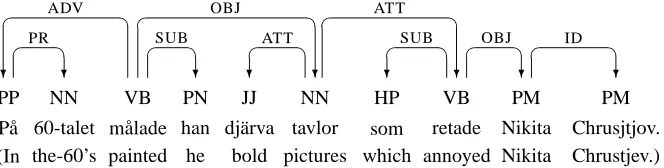
Deterministic dependency parsing has recently been pro-posed as a robust and efficient method for syntactic pars-ing of unrestricted natural language text (Yamada and Matsumoto, 2003; Nivre, 2003). Dependency parsing means that the goal of the parsing process is to construct a dependency graph, of the kind depicted in Figure 1. De-terministic parsing means that we always derive a single analysis for each input string. Moreover, this single anal-ysis is derived in a monotonic fashion with no redundancy or backtracking, which makes it possible to parse natural language sentences in linear time (Nivre, 2003).
In this paper, we report experiments using memory-based learning (Daelemans, 1999) to guide the parser de-scribed in Nivre (2003), using data from a small tree-bank of Swedish (Einarsson, 1976). Unlike most pre-vious work on data-driven dependency parsing (Eisner, 1996; Collins et al., 1999; Yamada and Matsumoto, 2003;
Nivre, 2003), we assume that dependency graphs are la-beled with dependency types, although the evaluation will give results for both labeled and unlabeled represen-tations.
The paper is structured as follows. Section 2 gives the necessary background definitions and introduces the idea of guided parsing as well as memory-based learning. Section 3 describes the data used in the experiments, the evaluation metrics, and the models and algorithms used in the learning process. Results from the experiments are given in section 4, while conclusions and suggestions for further research are presented in section 5.
2
Background
2.1 Dependency Graphs
The linguistic tradition of dependency grammar com-prises a large and fairly diverse family of theories and for-malisms that share certain basic assumptions about syn-tactic structure, in particular the assumption that synsyn-tactic structure consists of lexical nodes linked by binary re-lations called dependencies (see, e.g., Tesni`ere (1959), Sgall (1986), Mel’ˇcuk (1988), Hudson (1990)). Thus, the common formal property of dependency structures, as compared to the representations based on constituency (or phrase structure), is the lack of nonterminal nodes.
In a dependency structure, every word token is depen-dent on at most one other word token, usually called its head or regent, which means that the structure can be represented as a directed graph, with nodes representing word tokens and arcs representing dependency relations. In addition, arcs may be labeled with specific dependency types. Figure 1 shows a labeled dependency graph for a simple Swedish sentence, where each word of the sen-tence is labeled with its part of speech and each arc la-beled with a grammatical function.
PP P˚a (In ? ADV NN 60-talet the-60’s ? PR VB m˚alade painted PN han he ? SUB JJ dj¨arva bold ? ATT NN tavlor pictures ? OBJ HP som which ? ATT VB retade annoyed ? SUB PM Nikita Nikita ? OBJ PM Chrusjtjov. Chrustjev.) ? ID
Figure 1: Dependency graph for Swedish sentence
1. LetR={r1, . . . , rm}be the set of permissible de-pendency types (arc labels).
2. A dependency graph for a string of words W =
w1· · ·wn is a labeled directed graphD = (W, A), where
(a) W is the set of nodes, i.e. word tokens in the input string,
(b) A is a set of labeled arcs (wi, r, wj) (where wi, wj∈W andr∈R).
We writewi < wj to express thatwi precedeswj in the stringW (i.e.,i < j); we writewi →r wj to say that there is an arc fromwitowj labeledr, and wi → wj to say that there is an arc fromwi towj (regardless of the label); we use→∗ to denote the reflexive and transitive closure of the unlabeled arc relation; and we use↔and↔∗for the correspond-ing undirected relations, i.e.wi ↔wj iffwi →wj orwj→wi.
3. A dependency graphD= (W, A)is well-formed iff the five conditions given in Figure 2 are satisfied.
For a more detailed discussion of dependency graphs and well-formedness conditions, the reader is referred to Nivre (2003).
2.2 Parsing Algorithm
The parsing algorithm presented in Nivre (2003) is in many ways similar to the basic shift-reduce algorithm for context-free grammars (Aho et al., 1986), although the parse actions are different given that no nonterminal sym-bols are used. Moreover, unlike the algorithm of Yamada and Matsumoto (2003), the algorithm considered here ac-tually uses a blend of bottom-up and top-down process-ing, constructing left-dependencies bottom-up and right-dependencies top-down, in order to achieve incremental-ity. For a similar but nondeterministic approach to depen-dency parsing, see Obrebski (2003).
Parser configurations are represented by triples
hS, I, Ai, whereSis the stack (represented as a list),Iis the list of (remaining) input tokens, andAis the (current)
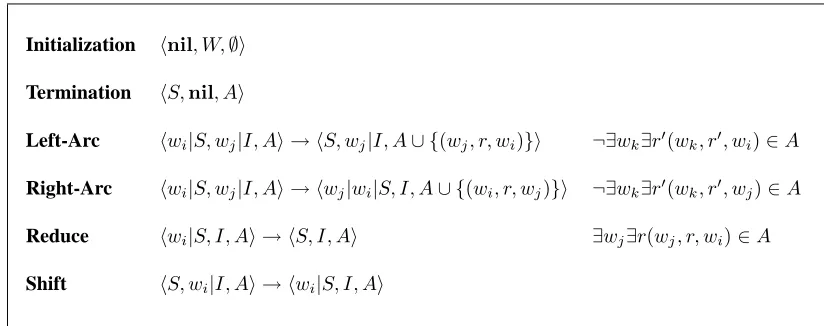
arc relation for the dependency graph. Given an input stringW, the parser is initialized tohnil, W,∅iand termi-nates when it reaches a configurationhS,nil, Ai(for any listSand set of arcsA). The input stringWis accepted if the dependency graphD = (W, A)given at termination is well-formed; otherwiseW is rejected. The behavior of the parser is defined by the transitions defined in Figure 3 (wherewi,wjandwk are arbitrary word tokens, andr andr0are arbitrary dependency relations):
1. The transition Left-Arc (LA) adds an arcwj→r wi from the next input tokenwjto the tokenwion top of the stack and reduces (pops)wifrom the stack.
2. The transition Right-Arc (RA) adds an arcwi→r wj from the tokenwion top of the stack to the next in-put tokenwj, and shifts (pushes)wjonto the stack.
3. The transition Reduce (RE) reduces (pops) the to-kenwion top of the stack.
4. The transition Shift (SH) shifts (pushes) the next in-put tokenwionto the stack.
The transitions Left-Arc and Right-Arc are subject to conditions that ensure that the graph conditions Unique
label and Single head are satisfied. By contrast, the Re-duce transition can only be applied if the token on top of
the stack already has a head. For Shift, the only condition is that the input list is non-empty.
As it stands, this transition system is nondeterminis-tic, since several transitions can often be applied to the same configuration. Thus, in order to get a deterministic parser, we need to introduce a mechanism for resolving transition conflicts. Regardless of which mechanism is used, the parser is guaranteed to terminate after at most
Unique label (wi→r wj ∧ wi→r0wj) ⇒ r=r0
Single head (wi→wj ∧ wk→wj) ⇒ wi=wk
Acyclic ¬(wi→wj ∧ wj→∗wi)
Connected wi↔∗wj
[image:3.612.142.477.73.170.2]Projective (wi↔wk ∧ wi< wj< wk) ⇒ (wi→∗wj ∨ wk→∗wj)
Figure 2: Well-formedness conditions on dependency graphs
Initialization hnil, W,∅i
Termination hS,nil, Ai
Left-Arc hwi|S, wj|I, Ai → hS, wj|I, A∪ {(wj, r, wi)}i ¬∃wk∃r0(wk, r0, wi)∈A
Right-Arc hwi|S, wj|I, Ai → hwj|wi|S, I, A∪ {(wi, r, wj)}i ¬∃wk∃r0(wk, r0, wj)∈A
Reduce hwi|S, I, Ai → hS, I, Ai ∃wj∃r(wj, r, wi)∈A
Shift hS, wi|I, Ai → hwi|S, I, Ai
Figure 3: Parser transitions
2.3 Guided Parsing
One way of turning a nondeterministic parser into a deter-ministic one is to use a guide (or oracle) that can inform the parser at each nondeterministic choice point; cf. Kay (2000), Boullier (2003). Guided parsing is normally used to improve the efficiency of a nondeterministic parser, e.g. by letting a simpler (but more efficient) parser con-struct a first analysis that can be used to guide the choice of the more complex (but less efficient) parser. This is the approach taken, for example, in Boullier (2003).
In our case, we rather want to use the guide to im-prove the accuracy of a deterministic parser, starting from a baseline of randomized choice. One way of doing this is to use a treebank, i.e. a corpus of analyzed sentences, to train a classifier that can predict the next transition (and dependency type) given the current configuration of the parser. However, in order to maintain the efficiency of the parser, the classifier must also be implemented in such a way that each transition can still be performed in constant time.
Previous work in this area includes the use of memory-based learning to guide a standard shift-reduce parser (Veenstra and Daelemans, 2000) and the use of sup-port vector machines to guide a deterministic depen-dency parser (Yamada and Matsumoto, 2003). In the
experiments reported in this paper, we apply memory-based learning within a deterministic dependency parsing framework.
2.4 Memory-Based Learning
Memory-based learning and problem solving is based on two fundamental principles: learning is the simple stor-age of experiences in memory, and solving a new problem is achieved by reusing solutions from similar previously solved problems (Daelemans, 1999). It is inspired by the nearest neighbor approach in statistical pattern recogni-tion and artificial intelligence (Fix and Hodges, 1952), as well as the analogical modeling approach in linguistics (Skousen, 1989; Skousen, 1992). In machine learning terms, it can be characterized as a lazy learning method, since it defers processing of input until needed and pro-cesses input by combining stored data (Aha, 1997).
[image:3.612.98.510.206.369.2]Daelemans (2000).
The main reason for using memory-based learning in the present context is the flexibility offered by similarity-based extrapolation when classifying previously unseen configurations, since previous experiments with a proba-bilistic model has shown that a fixed back-off sequence does not work well in this case (Nivre, 2004). Moreover, the memory-based approach can easily handle multi-class classification, unlike the support vector machines used by Yamada and Matsumoto (2003).
For the experiments reported in this paper, we have used the software package TiMBL (Tilburg Memory Based Learner), which provides a variety of metrics, al-gorithms, and extra functions on top of the classical k nearest neighbor classification kernel, such as value dis-tance metrics and disdis-tance weighted class voting (Daele-mans et al., 2003).
3
Method
3.1 Target Function and Approximation
The function we want to approximate is a mapping f from parser configurations to parser actions, where each action consists of a transition and (unless the transition is
Shift or Reduce) a dependency type:
f:Config→ {LA,RA,RE,SH} ×(R∪ {nil})
HereConfig is the set of all possible parser configura-tions and R is the set of dependency types as before. However, in order to make the problem tractable, we try to learn a functionfˆwhose domain is a finite space of parser states, which are abstractions over configurations. For this purpose we define a number of features that can be used to define different models of parser state. The features used in this study are listed in Table 1.
The first five features (TOP–TOP.RIGHT) deal with properties of the token on top of the stack. In addition to the word form itself (TOP), we consider its part-of-speech (as assigned by an automatic part-of-speech tagger in a preprocessing phase), the dependency type by which it is related to its head (which may or may not be available in a given configuration depending on whether the head is to the left or to the right of the token in question), and the dependency types by which it is related to its leftmost and rightmost dependent, respectively (where the current rightmost dependent may or may not be the rightmost de-pendent in the complete dependency tree).
The following three features (NEXT–NEXT.LEFT) refer to properties of the next input token. In this case, there are no features corresponding to TOP.DEP and TOP.RIGHT, since the relevant dependencies can never be present at decision time. The final feature (LOOK) is a simple looka-head, using the part-of-speech of the next plus one input token.
In the experiments reported below, we have used two different parser state models, one called the lexical model, which includes all nine features, and one called the non-lexical model, where the two lexical features
TOP andNEXTare omitted. For both these models, we have used memory-based learning with different parame-ter settings, as implemented TiMBL.
For comparison, we have included an earlier classifier that uses the same features as the non-lexical model, but where prediction is based on maximum conditional likeli-hood estimation. This classifier always predicts the most probable transition given the state and the most probable dependency type given the transition and the state, with conditional probabilities being estimated by the empiri-cal distribution in the training data. Smoothing is per-formed only for zero frequency events, in which case the classifier backs off to more general models by omitting first the featuresTOP.LEFTandLOOK and then the fea-tures TOP.RIGHT andNEXT.LEFT; if even this does not help, the classifier predicts Reduce if permissible and
Shift otherwise. This model, which we will refer to as the
MCLE model, is described in more detail in Nivre (2004).
3.2 Data
It is standard practice in data-driven approaches to nat-ural language parsing to use treebanks both for training and evaluation. Thus, the Penn Treebank of American English (Marcus et al., 1993) has been used to train and evaluate the best available parsers of unrestricted English text (Collins, 1999; Charniak, 2000). One problem when developing a parser for Swedish is that there is no com-parable large-scale treebank available for Swedish.
For the experiments reported in this paper we have used a manually annotated corpus of written Swedish, created at Lund University in the 1970’s and consisting mainly of informative texts from official sources (Einars-son, 1976). Although the original annotation scheme is an eclectic combination of constituent structure, depen-dency structure, and topological fields (Teleman, 1974), it has proven possible to convert the annotated sentences to dependency graphs with fairly high accuracy.
In the conversion process, we have reduced the orig-inal fine-grained classification of grammatical functions to a more restricted set of 16 dependency types, which are listed in Table 2. We have also replaced the origi-nal (manual) part-of-speech annotation by using the same automatic tagger that is used for preprocessing in the parser. This is a standard probabilistic tagger trained on the Stockholm-Ume˚a Corpus of written Swedish (SUC, 1997) and found to have an accuracy of 95–96% when tested on held-out data.
Feature Description
TOP The token on top of the stack TOP.POS The part-of-speech ofTOP
TOP.DEP The dependency type ofTOP(if any)
TOP.LEFT The dependency type ofTOP’s leftmost dependent (if any)
TOP.RIGHT The dependency type ofTOP’s rightmost dependent (if any)
NEXT The next input token
NEXT.POS The part-of-speech ofNEXT
NEXT.LEFT The dependency type ofNEXT’s leftmost dependent (if any)
LOOK.POS The part-of-speech of the next plus one input token
Table 1: Parser state features
data. Instead, we have to simulate the parser on the tree-bank in order to derive, for each sentence, the transition sequence corresponding to the correct dependency tree. Given the result of this simulation, we can construct a data set consisting of pairshs, ti, wheresis a parser state andtis the correct transition from that state (including a dependency type if applicable). Unlike standard shift-reduce parsing, the simulation of the current algorithm is almost deterministic and is guaranteed to be correct if the input dependency tree is well-formed.
The complete converted treebank contains 6316 tences and 97623 word tokens, which gives a mean sen-tence length of 15.5 words. The treebank has been di-vided into three non-overlapping data sets: 80% for train-ing 10% for development/validation, and 10% for final testing (random samples). The results presented below are all from the validation set. (The final test set has not been used at all in the experiments reported in this paper.) When talking about test and validation data, we make a distinction between the sentence data, which refers to the original annotated sentences in the treebank, and the transition data, which refers to the transitions derived by simulating the parser on these sentences. While the sen-tence data for validation consists of 631 sensen-tences, the corresponding transition data contains 15913 instances. For training, only transition data is relevant and the train-ing data set contains 371977 instances.
3.3 Evaluation
The output of the memory-based learner is a classifier that predicts the next transition (including dependency type), given the current state of the parser. The quality of this classifier has been evaluated with respect to both predic-tion accuracy and parsing accuracy.
Prediction accuracy refers to the quality of the clas-sifier as such, i.e. how well it predicts the next transition given the correct parser state, and is measured by the clas-sification accuracy on unseen transition data (using a 0-1 loss function). We use McNemar’s test for statistical sig-nificance.
Parsing accuracy refers to the quality of the classifier as a guide for the deterministic parser and is measured by the accuracy obtained when parsing unseen sentence data. More precisely, parsing accuracy is measured by the attachment score, which is a standard measure used in studies of dependency parsing (Eisner, 1996; Collins et al., 1999). The attachment score is computed as the proportion of tokens (excluding punctuation) that are as-signed the correct head (or no head if the token is a root). Since parsing is a sentence-level task, we believe that the overall attachment score should be computed as the mean attachment score per sentence, which gives an es-timate of the expected attachment score for an arbitrary sentence. However, since most previous studies instead use the mean attachment score per word (Eisner, 1996; Collins et al., 1999), we will give this measure as well. In order to measure label accuracy, we also define a la-beled attachment score, where both the head and the label must be correct, but which is otherwise computed in the same way as the ordinary (unlabeled) attachment score. For parsing accuracy, we use a pairedt-test for statistical significance.
4
Results
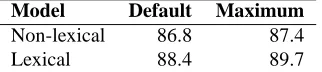
Table 3 shows the prediction accuracy achieved with memory-based learning for the lexical and non-lexical model, with two different parameter settings for the learner. The results in the first column were obtained with the default settings of the TiMBL package, in particular:
• TheIB1 classification algorithm (Aha et al., 1991).
• The overlap distance metric.
• Features weighted by Gain Ratio (Quinlan, 1993).
• k = 1, i.e. classification based on a single nearest neighbor.1
1
In TiMBL, the value ofk in fact refers tok nearest
dis-tances rather thanknearest neighbors, which means that, even
in-Label Dependency Type
ADV Adverbial modifier APP Apposition ATT Attribute
CC Coordination (conjunction or second conjunct) DET Determiner
ID Non-first element of multi-word expression IM Infinitive dependent on infinitive marker IP Punctuation mark dependent on lexical head INF Infinitival complement
OBJ Object
PR Complement of preposition PRD Predicative complement SUB Subject
UK Main verb of subordinate clause dependent on complementizer VC Verb chain (nonfinite verb dependent on other verb)
[image:6.612.157.457.74.279.2]XX Unclassifiable dependent
Table 2: Dependency types in Swedish treebank
Model Default Maximum
Non-lexical 86.8 87.4
Lexical 88.4 89.7
Table 3: Prediction accuracy for MBL models
The second column shows the accuracy for the best pa-rameter settings found in the experiments (averaged over both models), which differ from the default in the follow-ing respects:
• Overlap metric replaced by the modified value dis-tance metric (MVDM) (Stanfill and Waltz, 1986; Cost and Salzberg, 1993).
• No weighting of features.
• k = 5, i.e. classification based on 5 nearest neigh-bors.
• Distance weighted class voting with inverse distance weighting (Dudani, 1976).
For more information about the different parameters and settings, the reader is referred to Daelemans et al. (2003). The results show that the lexical model performs con-sistently better than the non-lexical model, and that the difference increases with the optimization of the learning algorithm (all differences being significant at the .0001 level according to McNemar’s test). This confirms pre-vious results from statistical parsing indicating that lex-ical information is crucial for disambiguation (Collins,
stances that are equally distant to the test instance. This is
dif-ferent from the originalIB1 algorithm, as described in Aha et
al. (1991).
1999; Charniak, 2000). As regards optimization, we may note that although there is a significant improvement for both models, the magnitude of the difference is relatively small.
[image:6.612.226.387.317.353.2]Model Labeled Unlabeled
[image:7.612.209.402.71.121.2]MCLE 74.7 (72.3) 81.5 (79.7) MBL non-lexical 76.5 (74.7) 82.9 (81.7) MBL lexical 81.7 (80.6) 85.7 (84.7)
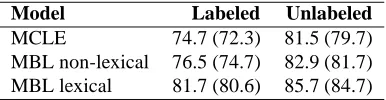
Table 4: Parsing accuracy for MCLE and MBL models, attachment score per sentence (per word in parentheses)
If we compare the results concerning parsing accuracy to those obtained for other languages (given that there are no comparable results available for Swedish), we note that the best unlabeled attachment score is lower than for English, where the best results are above 90% (attach-ment score per word) (Collins et al., 1999; Yamada and Matsumoto, 2003), but higher than for Czech (Collins et al., 1999). This is encouraging, given that the size of the training set in our experiments is fairly small, only about 10% of the standard training set for the Penn Tree-bank. One reason why our results nevertheless compare reasonably well with those obtained with the much larger training set is probably that the conversion to dependency trees is more accurate for the Swedish treebank, given the explicit annotatation of grammatical functions. More-over, the fact that our parser uses labeled dependencies is probably also significant, since the possibility of us-ing information from previously assigned (labeled) de-pendencies during parsing seems to have a positive effect on accuracy (Nivre, 2004).
Finally, it may be interesting to consider the accuracy for individual dependency types. Table 5 gives labeled precision, labeled recall and unlabeled attachment score for four of the most important types with the MBL lex-ical model. The results indicate that subjects have the highest accuracy, especially when labels are taken into account. Objects and predicative complements have com-parable attachment accuracy, but are more often misclas-sified with respect to dependency type. For adverbial modifiers, finally, attachment accuracy is lower than for the other dependency types, which is largely due to the notorious PP-attachment problem.
5
Conclusion
In this paper we have shown that a combination of memory-based learning and deterministic dependency parsing can be used to construct a robust and efficient parser for unrestricted natural language text, achieving a parsing accuracy which is close to the state of the art even with relatively limited amounts of training data. Clas-sifiers based on memory-based learning achieve higher parsing accuracy than previous probabilistic models, and the improvement increases if lexical information is added to the model.
Suggestions for further research includes the further
exploration of alternative models and parameter settings, but also the combination of inductive and analytical learning to impose high-level linguistic constraints, and the development of new parsing methods (e.g. involving multiple passes over the data). In addition, it is important to evaluate the approach with respect to other languages and corpora in order to increase the comparability with other approaches.
Acknowledgements
The work presented in this paper was supported by a grant from the Swedish Research Council (621-2002-4207). The memory-based classifiers used in the experi-ments were constructed using the Tilburg Memory-Based Learner (TiMBL) (Daelemans et al., 2003). We are grate-ful to three anonymous reviewers for constructive com-ments on the preliminary version of the paper.
References
D. W. Aha, D. Kibler and M. Albert. 1991. Instance-based Learning Algorithms. Machine Learning 6, 37– 66.
D. Aha. 1997. Lazy Learning. Dordrecht: Kluwer.
A. V. Aho, R. Sethi and J. D. Ullman. 1986. Compilers: Principles Techniques, and Tools. Addison Wesley.
P. Boullier. 2003. Guided Earley Parsing. In G. van No-ord (ed.) Proceedings of the 8th International Work-shop on Parsing Technologies (IWPT 03), Nancy, France, pp. 43–54.
E. Charniak. 2000. A Maximum-Entropy-Inspired Parser. In Proceedings NAACL-2000.
M. Collins. 1999. Head-Driven Statistical Models for Natural Language Parsing. PhD Thesis, University of Pennsylvania.
M. Collins, J. Hajic, E. Brill, L. Ramshaw and C. Till-mann. 1999. A Statistical Parser of Czech. In Pro-ceedings of 37th ACL Conference, University of Mary-land, College Park, USA, pp. 505–512.
Dependency type Precision Recall Attachment
SUB 84.3 82.7 89.2
OBJ 74.7 78.8 87.0
PRD 75.1 71.4 84.2
ADV 76.2 74.6 78.3
Table 5: Dependency type accuracy, MBL lexical model; labeled precision, labeled recall, unlabeled attachment score
W. Daelemans. 1999. Memory-Based Language Pro-cessing. Introduction to the Special Issue. Journal of Experimental and Theoretical Artificial Intelligence 11(3), 287–292.
W. Daelemans, A. van den Bosch, J. Zavrel. 2002. For-getting Exceptions is Harmful in Language Learning. Machine Learning 34, 11–43.
W. Daelemans, J. Zavrel, K. van der Sloot and A. van den Bosch, . 2003. TiMBL: Tilburg Memory Based Learner, version 5.0, Reference Guide. Techni-cal Report ILK 03-10, Tilburg University.
S. A. Dudani. 1976. The Distance-WeightedK-nearest Neighbor Rule. IEEE Transactions on Systems, Man, and Cybernetics SMC-6, 325–327.
J. Einarsson. 1976. Talbankens skriftsprkskonkordans. Lund University.
J. M. Eisner. 1996. Three New Probabilistic Models for Dependency Parsing: An Exploration. In Proceedings of COLING-96, Copenhagen.
E. Fix and J. Hodges. 1952. Discriminatory Analy-sis: Nonparametric Discrimination: Consistency Prop-erties. Technical Report 21-49-004-11, USAF School of Aviation Medicine, Randolph Field, Texas.
R. A. Hudson. 1990. English Word Grammar. Black-well.
M. Kay. 2000. Guides and Oracles for Linear-Time Pars-ing. In Proceedings of the 6th International Workshop on Parsing Technologies (IWPT 00), Trento, Italy, pp. 6–9.
M. P. Marcus, B. Santorini and M. A. Marcinkiewics. 1993. Building a Large Annotated Corpus of English: The Penn Treebank. Computational Linguistics 19, 313–330.
I. Mel’ˇcuk. 1988. Dependency Syntax: Theory and Practice. State University of New York Press.
J. Nivre. 2003. An Efficient Algorithm for Projective De-pendency Parsing. In G. van Noord (ed.) Proceedings of the 8th International Workshop on Parsing Tech-nologies (IWPT 03), Nancy, France, pp. 149–160.
J. Nivre. 2004. Inductive Dependency Parsing. Techni-cal Report, V¨axj¨o University.
T. Obrebski. 2003. Dependency Parsing Using Depen-dency Graph. In G. van Noord (ed.) Proceedings of the 8th International Workshop on Parsing Technolo-gies (IWPT 03), Nancy, France, pp. 217–218.
J. R. Quinlan. 1993. C4.5: Programs for Machine Learning. San Mateo, CA: Morgan Kaufmann.
P. Sgall, E. Hajicov´a and J. Panevov´a. 1986. The Mean-ing of the Sentence in Its Pragmatic Aspects. Reidel.
R. Skousen. 1989. Analogical Modeling of Language. Dordrecht: Kluwer.
R. Skousen. 1992. Analogy and Structure. Dordrecht: Kluwer.
C. Stanfill and D. Waltz. 1986. Toward Memory-Based Reasoning. Communications of the ACM 29(12), 1213–1228.
SUC 1997. Stockholm Ume˚a Corpus. Version 1.0. Pro-duced by Department of Linguistics, Ume˚a University and Department of Linguistics, Stockholm University.
U. Teleman. 1974. Manual f¨or grammatisk beskrivning av talad och skriven svenska. Studentlitteratur.
L. Tesni`ere. 1959. El´ements de syntaxe structurale. Edi-tions Klincksieck
J. Veenstra and W. Daelemans. 2000. A Memory-Based Alternative for Connectionist Shift-Reduce Parsing. Technical Report ILK-0012, University of Tilburg.