An Integrated Design Support Methodology for
Walking Worker Assembly Lines
Abstract— A traditional assembly system-fixed worker line (FW) designed by assigning one operator to each workstation performing an assembly task at that workstation on the line, has some deficiencies, such as low flexibility, constant demand and difficult balancing. A walking-worker line (WW), with an assembly worker travelling with the work along the line, has several advantages over a traditional line, particularly in flexibility (in terms of product variability) and efficiency (in terms of high productivity). Despite these distinctive advantages of WWs over other type (FWs), the linear WW assembly line is not widely implemented in industrial environments. Although some preliminary works in WW line have been done, there is a lack of developed support methodologies to enhance WWs applications in industry.
This research presents a development methodology based upon the synergistic application of ergonomics analysis, discrete-process simulation, and combinatorial optimization techniques to the problems of determining the optimum design for walking worker assembly line. The methodology intends to identify the levels of process parameters in WW lines which entail the improvements on both productivity and ergonomics.
Index Terms— ergonomics, productivity, manual assembly line, walking worker.
I. INTRODUCTION
The flexibility, efficiency and re-configurability of manufacturing systems are key areas for either manufacturing-based or service-based companies to react to the dramatic changing conditions of the market and the fierce global competition. A significant proportion of manufacturing processes and costs are dedicated to the process of product assembly. In fact, approximately 40% of the product cost is in the assembly stage [1].
Manuscript received December 30, 2009.
Atiya Alzuheri is a PhD student in the School of Advanced Manufacturing and Mechanical Engineering, Division of Information Technology, Engineering and the Environment, University of South Australia, Mawson Lakes, 5095 Australia (e-mail: alyaa002@students. unisa.edu.au).
Professor Lee Luong is a head of the School of Advanced Manufacturing and Mechanical Engineering, Division of Information Technology, Engineering and the Environment, University of South Australia, Mawson Lakes, 5095 Australia (e-mail: [email protected]).
Dr. Ke Xing is a program director in the School of Advanced Manufacturing and Mechanical Engineering, Division of Information Technology, Engineering and the Environment, University of South Australia, Mawson Lakes, 5095 Australia (e-mail: Ke. [email protected]).
Assembly costs could increase when the process is performed manually. From the total cost, 30–50% is allocated to the labour required for completing the manufacturing process of the product [2]. Therefore, manufacturing companies are faced with making the best use of the pertinent available technology and resources that are dedicated to assembly process by changing manual work to automation and robotic cells [3].
Despite this trend towards increasing and implementing automated production systems, there is still a significant and justifiable need for manual assembly [4]. The performance of manual assembly operations could improve by creating a more flexible, highly skilled, and agile workforce. This has had an impact on labour productivity (in parts per hour per person) without significant additional investment in equipment and/or labour, thereby allowing a company to remain cost competitive [5].
II. INDUSTRIAL REQUIREMENTS
The traditional manual assembly line is characterized by one worker at each workstation performing the assembly task at that workstation, while assembled parts are transported from one workstation to another by a handling system. This type of assembly line is called a linear fixed-worker (FW) assembly line, where the assembly worker always remains fixed at the workstation assigned to him to perform a single and often repetitive assembling task along the assembly line [6].
Manual operations are used in the assembly of complex work elements as well as when production demand is unstable or where the use of specialized machines and equipment is unjustifiably expensive. Thus, caution must be exercised, in the design of a manual assembly line, with respect to the volume flexibility with uncertain production demand. To achieve that, this situation requires adjusting the workers number in the line according to the changes in production demand. Hence, a manual assembly line is more flexible than automated machine assembly systems in adapting to the changes in production level [7].
The cooperativeness and willingness of the manual assembly line workers to accept and support the required changing processes which occur as a result to changes in products and market situations make the system adaption quick in responding to these changes.
This motivation from the workers contributes to the flexibility and agility in a manufacturing industry. Characteristics such as high level of flexibility, low investment risk, high level of adaptability and increased productivity can be achieve by utilization of manual
Atiya Alzuheri, Lee Luong, and Ke Xing
assembly lines, prompting small and medium sized companies to adapt this form of assembly process in their manufacturing systems [8].
Despite previous mentioned advantages for this approach of assembly process (fixed worker line), some deficiencies also exist. First, the production rate for the line is determined by the slowest worker and the workstation within longest process time. Second, balancing for this type of assembly line is affected by the any changes in the variables such as the speed and skills of workers, and the process used at each workstation. This may cause disruption in the line or stops it completely. Finally, as the number of workers, equals the number of workstations, there will be a waste in production capacity if the production volume is reduced and the number of workers remains constant. Consequently, these deficiencies influence the following on performance of the assembly line: low efficiency, poor responsiveness, and little flexibility in the system‟s re-configuration to meet the demand changes of the output line [9]. In addition to the foregoing, any variation in speed of working from any worker in the line creates a disparity in utilization of the labour force. To address the problem of balancing the line, the addition of sizable buffers into the production line is a common approach used in this context. However, this procedure increases unnecessary costs and work-in-process (WIP) [5, 9, 10].
Mileham [11], concluded that this type of assembly line has some deficiencies: in addition to difficult balancing particularly if the work elements are relatively large. The deficiencies are has low flexibility (in terms of workers and products), and constant demand.
III. WALKING WORKER ASSEMBLY LINE
With the acknowledgement of the existing deficiencies in the fixed worker type, the traditional approach of manual assembly operations could not fit to the demands of manufacturing enterprises by quickly and economically reacting to unpredictable conditions in a global market place under pressure to produce high-quality products at an economical price. Over the previous last five years, a series of studies from the University of Bath in UK [9], and from Saarland University in Germany [12] have compared the performance of FWs with novel approach from assembly line so-called linear walking worker (WW) have fitters who travel along the line carrying out each assembly task at each workstation. WWs shows a superior performance in terms of flexibility and efficiency.
As a result some of the manufacturing companies with traditional FW assembly approach have either already adopted WWs or are considering its adoption. A layout of linear walking worker assembly line is shown in Figure 1.
Fig.1 Form of the walking worker assembly line
Linear walking-worker (WW) assembly lines differ from the traditional linear FW assembly lines because the workers are cross-trained, so that each one is able to fully assemble the product from beginning to end. This is done through walking of workers from workstation to another along the production line accompanied by the items required to be assembled.
The application of this system in production lines by a number of companies has enabled it to achieve the following [13]: (1) easier in line balancing and contribution to reducing the number of buffers required, (2) greater variations in work time, (3) adjustable number of line workers according to demand requirements, and (4) minimizing the cost of workers/tooling.
Obviously, the linear walking-worker (WW) system attempts to combine some advantages existing in other systems to be collected in this system. These advantages are: high flexibility in terms of product variability in a workbench system or a cellular system, and high efficiency in terms of a higher output in relation to a conventional FW assembly line [13-15].
In A comparison between the two types (FW & WW) shows walking-worker lines have a series of advantages over a traditional line as summarized in Table 1.
IV. MOTIVATION AND ERGONOMICS
However, despite all the many advantages referred to earlier, the linear WW assembly line is not widely implemented in the industrial environment. Part of the reason for the lack of such assembly lines is probably due to the inherent difficulty in the finding much research that can support this approach in applications.
The focus of little studies concerned with this type of assembly line has been to examine details at the early stages of the design phase. In this context, the study of Wang [9] outlined the betters of WW line over fixed workers (FW) in terms of line performance measures. Results from simulation models by using WITNESS software package, indicated that the output of worker per hour in FW line gradually loses efficiency as the scale of the line becomes large while increasing significantly in WW line and the increasing value of efficiency will finally reach a maximum, where n = k+1(n = number of workstations, k = numbers k of workers).
those random variables in the system have been qualified and modelled into this novel approach of assembly process. The study concludes that the implementation of a walking worker line demonstrates the possibility of gaining a low blocking rate due to the effect of system randomness by having a certain number of workers to move along the production line.
Lassalle [5] examined the variable behaviour in-process waiting time that takes place on a linear WW based on two assumptions related workers performance: (1) same performance during a period of production, and (2) variable performance levels during a period of production. The simulation results showed the in-process waiting time of each dynamic walking worker along a linear assembly line is predictable and it adjustable by altering the number of walking workers on the line and the efficiencies of them.
Mileham [17] summarized the advantages and shortcomings of the application of WWs on a short section of a semi-automated automotive engine assembly line. The research has confirmed the possibility of gaining several advantages using the walking worker approach over the conventional fixed worker.
Although WWs have been shown by these studies to be efficient over FWs in terms of flexibility and efficiency, it has also been recognized as a system which puts too much pressure on workers due to the need for highly demanding time period spent on multi-task assembles with repetitive motion movements, as well as increased energy expenditure. Thus, the implementation of WWs effects on worker attitudes may be negative. These attitudes can include: (1) increased in accidents, injuries and illness, and (2) reduced output per worker.
There exists no detailed or comprehensive literature reviews with a more rigorous investigation on the relative performance of WWs especially regarding productivity of labours and ergonomics measures.
To address this need, this research intends to propose a reliable methodology to derive the configuration and
optimisation of the walking-worker line provides a sound basis for maintaining the effective use of workers, workstations, space and providing safety. This layout, in turn, contributes to a firm's efforts on improvement of both productivity and ergonomics measures.
V. RESEARCHAIMS
The aim of this research is to introduce a design methodology intended to conduct ergonomics methods into the early phases of the WW line design to meet the following goals:
(1) Improve ergonomics conditions in assembly lines in order to decrease injury rates and suffering of workers and,
(2) Increase productivity and efficiency of the assembly processs.
The research methodology will be directed toward understanding the behaviour of the WW line by constructing a model of that line and then experimenting by utilizing discrete event simulation. Specifically, the model of the line will be driven with control factors and the corresponding output performance measures are then observed. To determine the optimal settings for the control factors from the process parameters, optimization via a Genetic Algorithm (GA) is considered in conjunction with desirability function. Such a methodology will result in supportive theories and approaches to further implement WW lines in real manufacturing applications.
VI. DESIGN METHODOLOGY SCHEME
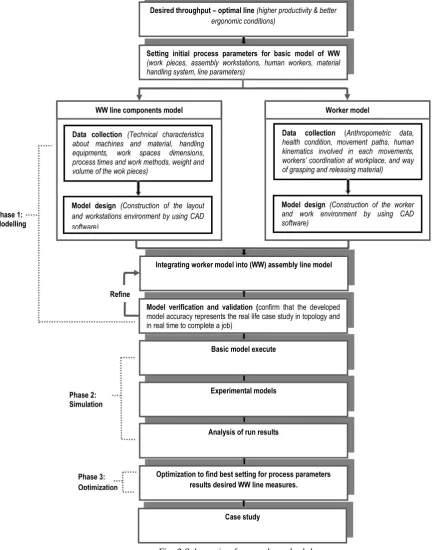
In the following, a scheme of proposed methodology as depicted in Figure 2, aims at improving the overall performance of the WW line at productivity and ergonomics measures. It achieves this through a three- phase and real application with case study to validate it.
Table 1
Summary results of comparison between fixed worker assembly line and walking worker assembly line
Indicator Fixed worker (FWs) type Walking worker (WWs) type
Maximum output of line Number of worker = number of workstations Number of worker < number of workstations Flexibility Fully manned line; limited flexibility in adjusting
staffing levels according to varying production volumes
High flexibility to varying production volumes becomes possible with Individual workers
Labor utilization Low labor utilization and results in high direct labor cost
Maximize when number of workers < number of workstations
Labor skills Low skills Cross-training of workers
Efficiency Higher output and shorter cycle times of this type can be obtained by significant additional investment
A cross-trained worker has the potential to improve the overall system efficiency in the form of higher output and shorter cycle times Blocking rate High level due to fully staffed of workstations Low level by optimizing the number of workers Balancing Poor tolerance to variations in line balance Better tolerance of work time variations Ergonomics conditions Probability of musculoskeletal symptoms increased
where single and repetitive task performed by static worker, and also depended mainly upon workstation design
A. Phase 1: Modeling
The construction of the basic model of a WW assembly line including physical components and workers is considered as a crucial step in this methodology. The detailed explanations of the activities in modelling phase follow closely.
Data collection
There is a constant interplay between the construction of the model and the collection of the needed input data. The data must accurately emulate the realities of the system to the levels of accuracy and detail required. For the assembly line model, it includes:
Technical characteristics about machines and material handling equipments;
Line layout, pictures, sequence of operations, assigned cycle time, production rate;
Work spaces dimensions;
Process times and work methods;
Weight and volume of the work pieces.
Furthermore, to model workers‟ activities it is necessary to know information such as:
Workers anthropometric data (sex, age, weight, height) and health condition;
Identification of the movement paths;
Human kinematics involved in each movements;
Workers‟ coordination at workplace;
[image:4.595.71.509.37.588.2] Way of grasping and releasing materials. Fig. 2 Schematic of research methodology
Worker model
Model design (Construction of the worker and work environment by using CAD software)
Data collection (Anthropometric data, health condition, movement paths, human kinematics involved in each movements, workers’ coordination at workplace, and way of grasping and releasing material) ergonomic conditions)
)
Setting initial process parameters for basic model of WW (work pieces, assembly workstations, human workers, material handling system, line parameters)
WW line components model
Model design (Construction of the layout and workstations environment by using CAD software)
Data collection (Technical characteristics about machines and material, handling equipments, work spaces dimensions, process times and work methods, weight and volume of the wok pieces)
Phase 3: Optimization
Case study
Optimization to find best setting for process parameters results desired WW line measures.
Analysis of run results Experimental models Basic model execute
Model verification and validation (confirm that the developed model accuracy represents the real life case study in topology and in real time to complete a job)
Integrating worker model into (WW) assembly line model
Refine
Phase 2: Simulation Phase 1:
Model design
With all above entities and by using 3D CAD system equipped with discrete events tools for this purpose, the models of WW line configuration and worker can be constructed.
Combined of models
Once all models are constructed and based on the interaction between the line components, they will be combined into one model which serves as the basic model for the WW line.
Consequently, the model has to be evaluated and possibly refined depending upon the result analysis from the first run for the basic model. The process of model refining is called verification and validation.
Model verification and validation
The verification process of the model is to verify that the developed model represents the real life case study and the flow of work pieces in the process go through in the correct way.
The accurate representation of the model to real life case study is determined by the validation process. Validation is usually achieved through comparing the real time (needed to complete a job) and the time obtained (in the same operative conditions) by using the simulation model. The animations play an important role in verification and validation process by identifying the differences between the model and the real life case of line.
B. Phase 2: Simulation
Due to variation of various conditions of manufacturing systems with respect to time [18], often using Discrete Event Simulation (DES) models could provide the possibility of understanding and analysing normally stochastic (or random) behaviour of these systems [19].
Simulation experiments seek the optimal solution of WW line layout which meets between two objectives: higher productivity, and proactively support ergonomics described as follows:
Basic model simulation execute
Model that have been designed have to execute into simulation software.
Experimental models
Application of Experimental Design (ED) over combination of process parameters levels in basic status of WWs model will quantify and predict the influence of their combination at the output performance measures. Simulated experimental models of the WW line will handle several different solutions of WW line layout. The output performance measures in each solution obtained from this set of experiments are controlled by process parameters values.
In the designed methodology, the process parameters for the basic model of WW line can be chosen from real life case or by simulation for models that still do not exists. Generally, these parameters represent a group of those entities mentioned above and should exist in construction of the model line. Two kinds of parameters are used in the construction of the model. The first kind is called the uncontrolled parameter, where values will not
change during the simulation process, while the other type changes in its values and so-called controller factor.
The performance of the WW line in terms of economic and ergonomics measures are monitored with changing in process parameters levels (control factors) and shifts by means of simulation.
Analysis of run results
Experimental models runs are made to provide performance measures on the WW line design. Statistical techniques are used to analyse the output performance measures from the experimental models runs. Typical goals are to construct a confidence interval for performance measures for WW line design. In the proposed methodology, Analysis of Variance (ANOVA) is used for this purpose.
The following, ergonomics and economic measures are used in this methodology which considers the output data performance for the walking worker assembly line layout.
a) Ergonomics measures
The proposed standards ergonomics measures of the workstations belonging to the manual assembly line are:
Lifting limitations, according to the National Institute for Occupational Safety and Health (NIOSH 91), the Lift Index (LI) Index is obtained as ratio between Recommended Weight Limit (RWL) and the object weight in correspondence of two different instant of time (grasps and release), can be accepted if the value is lower than 1 [20].
Metabolic energy consumption according to Garge guidelines, which is a measure to the amount of effort spent on the task (physiological measure) [21].
"OWAS” (Ovako Working posture Analysis System) the worker‟s posture during the task that may indicate risk of injury. This indicator gives information about the physical stress recorded in correspondence of each working posture of shoulders, arms and legs and in relation to the weights handled during the operation [22].
Work area coverage which describes the
proportion of the number of motions of the grasping kind which have to be executed within the area of reach of the smallest person working at this workplace to the total motions which can be executed in a reduced reach area [23].
These ergonomics measures are sensitive to changes in physical structure of workstation and whole workplaces layouts in line and also used as constraints in order to ensure that all values of the experimental results for the performance measure are within the ergonomically acceptable limits of working.
b) Economic measures
The economic value is mainly determined by the labour productivity and wage rate which is a function of the assembly time. For this purpose predetermined motion time standards like Method Time Measurement (MTM) can be considered most appropriate [4, 24].
C. Phase 3: Optimization
Once the experiments are run, and to take better advantage of the search capabilities of the Genetic Algorithms (GA) [25], combinatorial optimization by using the desirability function with the GA is implemented to determine the „„level of improvement‟‟ for controllable process parameters. The “level of improvement” will result in the best setting for WW line configuration where the opportunity for greater impact on labour productivity and ergonomics conditions is expected to be greatest. Guarantees the optimal solution for the layout of walking worker line, can be generated via a trade-off between ergonomics (human factors) and economic (MTM time analysis) considerations in one of the simulation solutions.
D. Case study
In the case study, we can demonstrate that a simulation modelling and combination of optimization techniques can be an effective tool for designing WW assembly lines.
VII. SUMMARY AND GUIDELINES FOR FUTURE RESEARCH
Based upon the review of the topics addressing the walking worker assembly line approach, there are gaps in the current literature and guidelines where more research is needed to provide some insights in details of configurations and optimisation for that type of manual assembly approach.
“Joint optimisation” satisfies the productivity target and improvement in ergonomics conditions might be achieved in practice by using the proposed methodology in this research. Also, with the aid of computer aided simulation technique, the research can produce a detailed model of the line both in terms of layout as well as operational issues (e.g. cycle time, precedence constraints, availability, cost, etc.).
In addition, some interesting research issues can be explored further by the proposed methodology of the research:
(1)Are improvements in productivity and ergonomics can be extended toward optimizing a most cost effective WW line?
(2)Will the WWs be unsuitable as a production
approach to implement when the production rate is small and the cycle time is long (i.e., heavy industry)?
REFERENCES
[1] M. Ritchie, R. Dewar, and J. Simmons, "The generation and practical use of plans for manual assembly using immersive virtual reality," Professional Engineering Publishing, vol. 213, no.5, pp. 461- 466, 1999.
[2] P. De Lit, A. Delchambre , and J.-M. Henrioud, “An integrated approach for product family and assembly system design,” IEEE Transactions on Robotics and Automation, vol. 19, no. 2, pp. 324-333, 2003.
[3] J. Heilala, and P. Voho, “Modular reconfigurable flexible final assembly systems,” Assembly Automation, vol. 21, no. 1, pp. 20-28, 2001.
[4] W. Braun, R. Rebollar, and E. Schiller, “Computer aided planning and design of manual assembly systems,” International journal of production research, vol. 34, no. 8, pp. 2317-2333, 1996.
[5] S. Lassalle, Q. Wang, G. Owen et al., A study of in-process waiting time on a linear walking worker assembly line, University of Bath, Bath, 2007.
[6] Q. Wang, G. Owen, and A. Mileham, Comparison between fixed- and walking-worker assembly lines, University of Bath, Bath, 2005.
[7] M. Yoshimura, S. Yoshida, Y. KonishI et al., “A rapid analysis method for production line design,” International Journal of Production Research, vol. 44, no. 6, pp. 1171-1192, 2006.
[8] K. Feldmann, and S. Junker, “Development of new concepts and software tools for the optimization of manual assembly systems ” CIRP Annals, vol. 52, no. 1, pp. 1-4, 2003. [9] Q. Wang, G. Owen, and A. Mileham, "Comparison between
fixed- and walking-worker assembly lines." pp. 845-848, 2005.
[10] Q. Wang, G. Owen, and A. Mileham, “Determining numbers of workstations and operators for a linear walking-worker assembly line,” International Journal of Computer Integrated Manufacturing, vol. 20, no. 1, pp. 1-10, 2007. [11] A. Mileham, A. Jeffries, G. Owen et al., “The design and
performance of walking fitter assembly lines.,” in International Conference on CADCAM Robotics and Factories of the Future (CARS&FOF2000), University of the West Indies, Trinidad, 2000, pp. 325-332.
[12] H. Bley, C. Zenner, and M. Bossmann, Walking worker assembly lines - A contribution tp lean production, Institute of Production Engineering, Saarland University, 2000. [13] K. Nakade, and k. Ohno, “Separate and carousel type
allocations of workers in a U-shaped production line ” European Journal of Operational Research, vol. 145, no. 2, pp. 403-424, 2003.
[14] G. Heike, M. Ramulu, E. Sorenson et al., “Mixed model assembly alternatives for low-volume manufacturing: The case of the aerospace industry,” International Journal of Production Economics, vol. 72, no. 2, pp. 103–120, 2001. [15] B. Rekiek, P. De Lit, and A. Delchambre, “Designing
mixed-product assembly lines,” IEEE Transaction on Robotics and Automation, vol. 16, no. 3, pp. 268–280, 2000. [16] Q. Wang, L. Pan, A. Mileham et al., “Modelling randomness
of a manual assembly system with walking workers,” International journal of Industrial and Systems Engineering, vol. 2, no. 2, pp. 195-210, 2007.
[17] A. Mileham, Q. Wang, S. Lassalle et al., Modelling a walking worker assembly system , Department of Mechanical Engineering/ University of Bath, Bath, 2007.
[18] C. Grimard, J. Marvel, and C. Standridge, "Validation of the re-design of a manufacturing work cell using simulation." In Proceedings of the 37th conference on Winter simulation, Orlando, Florida, 2005.
[19] P.-O. Siebers , T. Baines, S. Mason et al., Modelling human variation in assembly line models, Department of Industrial and Manufacturing Science, university of cranfield, 2004. [20] T. Waters, V. Putz-Anderson, and A. Garg, "Applications
Manual for the Revised NIOSH Lifting Equation," Centers for Disease Control and Prevention, Nationa l Institute for Occupatio nal Safety and Health, 1994.
[21] A. Garg, D. Chaffin, and G. Herrin, “Prediction of metabolic rates for manual materials handling jobs,” American Industrial Hygiene Association Journal, vol. 39, no. 8, pp. 666-764, 1978.
[22] O. Karhu, K. P, and I. Kuorinka, “Correcting postures in industry: a practical method for analysis,” Applied Ergonomics, vol. 8, no. 4, pp. 199-201, 1977.
[23] X. Zha, and S. Lim, “Intelligent design and planning of manual assembly workstations: A neuro-fuzzy approach,” Computers & Industrial Engineering, vol. 44, no. 4, pp. 611-632, 2003.
[24] I. Ben-Gal, and J. Bukchin, “The ergonomic design of workstations using virtual manufacturing and response surface methodology,” IE Transactions, vol. 34, no. 4, pp. 375-391, 2002.