Investigating Loss Functions and Optimization Methods for Discriminative
Learning of Label Sequences
Yasemin Altun
Computer Science Brown University Providence, RI 02912
Mark Johnson
Cognitive and Linguistic Sciences Brown University
Providence, RI 02912
Mark [email protected]
Thomas Hofmann
Computer Science Brown University Providence, RI 02912
Abstract
Discriminative models have been of inter-est in the NLP community in recent years. Previous research has shown that they are advantageous over generative mod-els. In this paper, we investigate how dif-ferent objective functions and optimiza-tion methods affect the performance of the classifiers in the discriminative learning framework. We focus on the sequence la-belling problem, particularly POS tagging and NER tasks. Our experiments show that changing the objective function is not as effective as changing the features in-cluded in the model.
1 Introduction
Until recent years, generative models were the most common approach for many NLP tasks. Recently, there is a growing interest on discriminative mod-els in the NLP community, and these modmod-els were shown to be successful for different tasks(Lafferty et al., 2001; Ratnaparkhi, 1999; Collins, 2000). Dis-criminative models do not only have theoretical ad-vantages over generative models, as we discuss in Section 2, but they are also shown to be empirically favorable over generative models when features and objective functions are fixed (Klein and Manning, 2002).
In this paper, we use discriminative models to investigate the optimization of different objective functions by a variety of optimization methods. We
focus on label sequence learning tasks. Part-of-Speech (POS) tagging and Named Entity Recogni-tion (NER) are the most studied applicaRecogni-tions among these tasks. However, there are many others, such as chunking, pitch accent prediction and speech edit detection. These tasks differ in many aspects, such as the nature of the label sequences (chunks or indi-vidual labels), their difficulty and evaluation meth-ods. Given this variety, we think it is worthwhile to investigate how optimizing different objective func-tions affects performance. In this paper, we varied the scale (exponential vs logarithmic) and the man-ner of the optimization (sequential vs pointwise) and using different combinations, we designed 4 differ-ent objective functions. We optimized these func-tions on NER and POS tagging tasks. Despite our intuitions, our experiments show that optimizing ob-jective functions that vary in scale and manner do not affect accuracy much. Instead, the selection of the features has a larger impact.
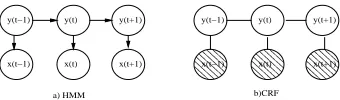
x(t+1) x(t)
x(t−1) x(t−1) x(t) x(t+1)
y(t+1) y(t)
y(t−1) y(t−1) y(t) y(t+1)
[image:2.612.102.272.70.120.2]a) HMM b)CRF
Figure 1: Graphical representation of HMMs and CRFs. Shaded areas indicate variables that the model conditions on.
even if their training time is longer. In this paper we investigate these aspects for different optimization methods, i.e. the number of features, training time and sparseness, as well as the accuracy. In some cases, an approximate optimization that is more ef-ficient in one of these aspects might be preferable to the exact method, if they have similar accuracy. We experiment with exact versus approximate as well as parallel versus sequential optimization methods. For the exact methods, we use an off-the-shelf gradi-ent based optimization routine. For the approximate methods, we use a perceptron and a boosting algo-rithm for sequence labelling which update the fea-ture weights parallel and sequentially respectively.
2 Discriminative Modeling of Label Sequences Learning
Label sequence learning is, formally, the problem of learning a function that maps a sequence of ob-servations
to a label sequence
, where each
"!
, the set of individual labels. For example, in POS tagging, the words
#
’s construct a sentence , and
is the la-belling of the sentence where
is the part of speech tag of the word
. We are interested in the super-vised learning setting, where we are given a corpus,
$
%&
%& ('
'
in order to learn the classifier.
The most popular model for label sequence learn-ing is the Hidden Markov Model (HMM). An HMM, as a generative model, is trained by finding the joint probability distribution over the observation and la-bel sequences)
that explains the corpus$
the best (Figure 1a). In this model, each random vari-able is assumed to be independent of the other ran-dom variables, given its parents. Because of the long distance dependencies of natural languages that can-not be modeled by sequences, this conditional inde-pendence assumption is violated in many NLP tasks.
Another shortcoming of this model is that, due to its generative nature, overlapping features are difficult to use in HMMs. For this reason, HMMs have been standardly used with current word-current label, and previous label(s)-current label features. However, if we incorporate information about the neighboring words and/or information about more detailed char-acteristics of the current word directly to our model, rather than propagating it through the previous la-bels, we may hope to learn a better classifier.
Many different models, such as Maximum En-tropy Markov Models (MEMMs) (McCallum et al., 2000), Projection based Markov Models (PMMs) (Punyakanok and Roth, 2000) and Conditional Ran-dom Fields (CRFs) (Lafferty et al., 2001), have been proposed to overcome these problems. The common property of these models is their discriminative ap-proach. They model the probability distribution of the label sequences given the observation sequences:
)
+*
.
The best performing models of label sequence learning are MEMMs or PMMs (also known as Maximum Entropy models) whose features are care-fully designed for the specific tasks (Ratnaparkhi, 1999; Toutanova and Manning, 2000). However, maximum entropy models suffer from the so called label bias problem, the problem of making local de-cisions (Lafferty et al., 2001). Lafferty et al. (2001) show that CRFs overcome the label-bias problem and outperform MEMMs in POS tagging.
CRFs define a probability distribution over the whole sequence
, globally conditioning over the whole observation sequence (Figure 1b).
Be-cause they condition on the observation (as opposed to generating it), they can use overlapping features. The features ,
-used in this paper are of the form:
1. Current label and information about the obser-vation sequence, such as the identity or spelling features of a word that is within a window of the word currently labelled. Each of these features corresponds to a choice of
and
/.
where0
21-43657-%-895;:
and
5
is the half window size
a choice of
and the neighbors of
, e.g. in a bigram model,,
.
The conditional probability distribution defined by this model is :
+*
,
-
where
’s are the parameters to be estimated from the training corpus C and
is a normaliza-tion term to assure a proper probability distribu-tion. In order to simplify the notation, we in-troduce
,
-, which is the number of times feature ,
is observed in
pair and,
, which is the linear combination of all the features with
parameterization.
is the sufficient statis-tic of
. Then, we can rewrite
*
as:
.
3 Loss Functions for Label Sequences
Given the theoretical advantages of discriminative models over generative models and the empirical support by (Klein and Manning, 2002), and that CRFs are the state-of-the-art among discriminative models for label sequences, we chose CRFs as our model, and trained by optimizing various objective functions
$
with respect to the corpus
$
. The application of these models to the label sequence problems vary widely. The individual labels might constitute chunks (e.g. Named-Entity Recognition, shallow parsing), or they may be single entries (e.g. POS tagging). The difficulty, therefore the accuracy of the tasks are very different from each other. The evaluation of the systems differ from one task to another, and the nature of the statistical noise level is task and corpus dependent. Given this variety, using objective functions tailored for each task might result in better classifiers. We consider two dimensions in designing objective functions: exponential versus logarithmic loss func-tions, and sequential versus pointwise optimization functions.
3.1 Exponential vs Logarithmic Loss functions
Most estimation procedures in NLP proceed by maximizing the likelihood of the training data. To
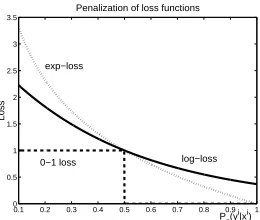
0.1 0.2 0.3 0.4 0.5 0.6 0.7 0.8 0.9 1 0
0.5 1 1.5 2 2.5 3 3.5
Loss
Pθ(yi|xi) Penalization of loss functions
0−1 loss exp−loss
[image:3.612.364.494.72.182.2]log−loss
Figure 2: Loss values of 0-1, exp and log loss func-tions in a binary classification problem
overcome the numerical problems of working with a product of a large number of small probabilities, usually the logarithm of the likelihood of the data is optimized. However, most of the time, these sys-tems, sequence labelling systems in particular, are tested with respect to their error rate on test data, i.e. the fraction of times the function
assigns a higher score to a label sequence
(such that !
"
) than the correct label sequence "
for every observation
"
in test data. Then, the rank loss of
might be a more natural objective to minimize.
$#
&% $
('
"
'
*)
+
-,/.
"
3
"
"
#is the total number of label sequences that
ranks higher than the correct label sequences for the training instances in the corpus$
. Since optimizing the rank loss is NP-complete, one can optimize an upper bound instead, e.g. an exponential loss func-tion:
##
0%
$
1'
"
'
0)
+
,
32
"
3
"
"
4
effort on the outliers and tend to be vulnerable to noisy data, especially label noise.
3.2 Sequential vs Pointwise Loss functions
In many applications it is very difficult to get the whole label sequence correct since most of the time classifiers are not perfect and as the sequences get longer, the probability of predicting every label in the sequence correctly decreases exponentially. For this reason performance is usually measured point-wise, i.e. in terms of the number of individual la-bels that are correctly predicted. Most common op-timization functions in the literature, however, treat the whole label sequence as one label, penalizing a label sequence that has one error and a label se-quence that is all wrong in the same manner. We may be able to develop better classifiers by using a loss function more similar to the evaluation func-tion. One possible way of accomplishing this may be minimizing pointwise loss functions. Sequential optimizations optimize the joint conditional proba-bility distribution
+*
, whereas pointwise op-timizations that we propose optimize the marginal conditional probability distribution,
*
"
+
,
+*
"
.
3.3 Four Loss functions
We derive four loss functions by taking the cross product of the two dimensions discussed above:
Sequential Log-loss function: This function, based on the standard maximum likelihood op-timization, is used with CRFs in (Lafferty et al., 2001).
$
3
'
"
"
*
"
3
'
"
"
"
(8
"
(1)
Sequential Exp-loss function: This loss func-tion, was first introduced in (Collins, 2000) for NLP tasks with a structured output domain. However, there, the sum is not over the whole possible label sequence set, but over the
best label sequences generated by an external mechanism. Here we include all possible la-bel sequences; so we do not require an external mechanism to identify the best sequences..
As shown in (Altun et al., 2002) it is possible to sum over all label sequences by using a dy-namic algorithm.
$
' "
*)
+
,
2
"
3
"
"
4
'
"
2
"
*
"
3 4
(2)
Note that the exponential loss function is just the inverse conditional probability plus a con-stant.
Pointwise Log-loss function: This function op-timizes the marginal probability of the labels at each position conditioning on the observation sequence:
$
3
'
"
'
"
*
"
3
'
"
'
+
,
+*
"
Obviously, this function reduces to the sequen-tial log loss if the length of the sequence is
.
Pointwise Exp-loss function: Following the parallelism in log-loss vs exp-loss functions of sequential optimization (log vs inverse condi-tional probability), we propose minimizing the pointwise exp-loss function below, which re-duces to the standard multi-class exponential loss when the length of the sequence is
.
$
'
"
"
3
'
+
,
*2
"
#
4
' "
"
*
"
4 Comparison of the Four Loss Functions
4.1 Gradient Based Optimization
The gradients of the four loss function can be com-puted as follows:
Sequential Log-loss function:
'
"
2
*
"
4 3
"
"
(3)
where expectations are taken w.r.t.
+*
. Thus at the optimum the empirical and ex-pected values of the sufficient statistics are equal. The loss function and the derivatives can be calculated with one pass of the forward-backward algorithm.
Sequential Exp-loss function:
'
"
*
"
3
"
"
"
*
"
(4)
At the optimum the empirical values of the suf-ficient statistics equals their conditional expec-tations where the contribution of each instance is weighted by the inverse conditional proba-bility of the instance. Thus this loss function focuses on the examples that have a lower con-ditional probability, which are usually the ex-amples that the model labels incorrectly. The computational complexity is the same as the log-loss case.
Pointwise Log-loss function:
' "
2
*
"
4 3
2
*
"
"
4
At the optimum the expected value of the suf-ficient statistics conditioned on the observation
"
are equal to their expected value when also conditioned on the correct label sequence
"
. The computations can be done using the dy-namic programming described in (Kakade et al., 2002), with the computational complexity of the forward-backward algorithm scaled by a constant.
Pointwise Exp-loss function:
' "
*
"
3
*
"
"
"
*
"
At the optimum the expected value of the suf-ficient statistics conditioned on
"
are equal to the value when also conditioned on
"
, where each point is weighted by
"
*
"
. Com-putational complexity is the same as the log-loss case.
4.2 Experimental Setup
Before presenting the experimental results of the comparison of the four loss functions described above, we describe our experimental setup. We ran experiments on Part-of-Speech (POS) tagging and Named-Entity-Recognition (NER) tasks.
For POS tagging, we used the Penn TreeBank cor-pus. There are 47 individual labels in this corcor-pus. Following the convention in POS tagging, we used a Tag Dictionary for frequent words. We used Sec-tions 1-21 for training and Section 22 for testing.
For NER, we used a Spanish corpus which was provided for the Special Session of CoNLL2002 on NER. There are training and test data sets and the training data consists of about 7200 sentences. The individual label set in the corpus consists of 9 la-bels: the beginning and continuation of Person, Or-ganization, Location and Miscellaneous names and nonname tags.
We used three different feature sets:
is the set of bigram features, i.e. the current tag and the current word, the current tag and previous tags.
consists of
features and spelling fea-tures of the current word (e.g. ”Is the current word capitalized and the current tag is Person-Beginning?”). Some of the spelling features, which are mostly adapted from (Bikel et al., 1999) are the last one, two and three letters of the word; whether the first letter is lower case, upper case or alphanumeric; whether the word is capitalized and contains a dot; whether all the letters are capitalized; whether the word con-tains a hyphen.
includes features not only for the current word but also for the words within a fixed win-dow of size
5
. is an instance of
where
5
. An example of
features for
5
POS
94.91 94.57 94.90 94.66
[image:6.612.93.277.70.114.2]95.68 95.25 95.71 95.31
Table 1: Accuracy of POS tagging on Penn Tree-Bank.
For NER, we used a window of size 3 (i.e. consid-ered features for the previous and next words). Since the Penn TreeBank is very large, including
fea-tures, i.e. incorporating the information in the neigh-boring words directly to the model, is intractable. Therefore, we limited our experiments to
and features for POS tagging.
4.3 Experimental Results
As a gradient based optimization method, we used an off-the-shelf optimization tool that uses the limited-memory updating method. We observed that this method is faster to converge than the conju-gate gradient descent method. It is well known that optimizing log-loss functions may result in over-fitting, especially with noisy data. For this rea-son, we used a regularization term in our cost func-tions. We experimented with different regularization terms. As expected, we observed that the regular-ization term increases the accuracy, especially when the training data is small; but we did not observe much difference when we used different regulariza-tion terms. The results we report are with the Gaus-sian prior regularization term described in (Johnson et al., 1999).
Our goal in this paper is not to build the best tag-ger or recognizer, but to compare different loss func-tions and optimization methods. Since we did not spend much effort on designing the most useful fea-tures, our results are slightly worse than, but compa-rable to the best performing models.
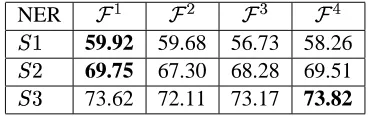
We extracted corpora of different sizes (ranging from 300 sentences to the complete corpus) and ran experiments optimizing the four loss functions us-ing different feature sets. In Table 1 and Table 2, we report the accuracy of predicting every individ-ual label. It can be seen that the test accuracy ob-tained by different loss functions lie within a rela-tively small range and the best performance depends on what kind of features are included in the model.
NER
59.92 59.68 56.73 58.26
69.75 67.30 68.28 69.51
73.62 72.11 73.17 73.82
Table 2: F1 measure of NER on Spanish newswire corpus. The window size is 3 for
.
We observed similar behavior when the training set is smaller. The accuracy is highest when more fea-tures are included to the model. From these results we conclude that when the model is the same, opti-mizing different loss functions does not have much effect on the accuracy, but increasing the variety of the features included in the model has more impact.
5 Optimization methods
In Section 4, we showed that optimizing differ-ent loss function does not have a large impact on the accuracy. In this section, we investigate differ-ent methods of optimization. The conjugate based method used in Section 4 is an exact method. If the training corpus is large, the training may take a long time, especially when the number of features are very large. In this method, the optimization is done in a parallel fashion by updating all of the pa-rameters at the same time. Therefore, the resulting classifier uses all the features that are included in the model and lacks sparseness.
We now consider two approximation methods to optimize two of the loss functions described above. We first present a perceptron algorithm for labelling sequences. This algorithm performs parallel opti-mization and is an approximation of the sequential log-loss optimization. Then, we present a boosting algorithm for label sequence learning. This algo-rithm performs sequential optimization by updating one parameter at a time. It optimizes the sequential exp-loss function. We compare these methods with the exact method using the experimental setup pre-sented in Section 4.2.
5.1 Perceptron Algorithm for Label Sequences
[image:6.612.334.518.71.129.2]might be as informative as all of the corpus to update the parameters. Then, an online algorithm which makes updates by using one training example may converge much faster than a batch algorithm. If the distribution is peaked, one label is more likely than others and the contribution of this label dominates the expectation values. If we assume this is the case, i.e. we make a Viterbi assumption, we can calculate a good approximation of the gradients by consider-ing only the most likely, i.e. the best label sequence according to the current model. The following on-line perceptron algorithm (Algorithm 1), presented in (Collins, 2002), uses these two approximations:
Algorithm 1 Label sequence Perceptron algorithm . 1: initialize
2: repeat
3: for all training patterns
"
do 4: compute
"
5: if "
then
6:
8
"
" 3
"
7: end if
8: end for
9: until stopping criteria
At each iteration, the perceptron algorithm calcu-lates an approximation of the gradient of the sequen-tial log-loss function (Eq. 3) based on the current training instance. The batch version of this algo-rithm is a closer approximation of the optimization of sequential log-loss, since the only approximation is the Viterbi assumption. The stopping criteria may be convergence, or a fixed number of iterations over the training data.
5.2 Boosting Algorithm for Label Sequences
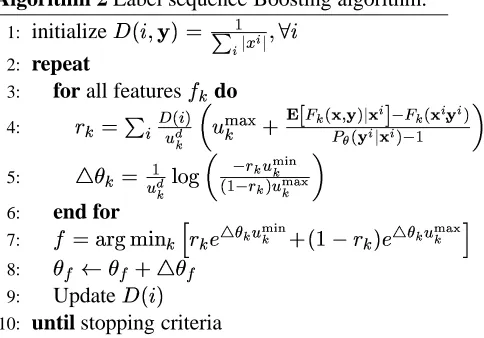
The original boosting algorithm (AdaBoost), pre-sented in (Schapire and Singer, 1999), is a sequen-tial learning algorithm to induce classifiers for sin-gle random variables. (Altun et al., 2002) presents a boosting algorithm for learning classifiers to predict label sequences. This algorithm minimizes an upper bound on the sequential exp-loss function (Eq. 2). As in AdaBoost, a distribution over observations is defined:
" * "
3
*
3 (5)
NER Perceptron Boosting
59.92 59.77 59.68 48.23 69.75 69.29 67.30 66.11
[image:7.612.316.558.352.521.2]
73.62 72.97 72.11 71.07
Table 3: F1 of different methods for NER
This distribution which expresses the importance of every training instance is updated at each round, and the algorithm focuses on the more difficult exam-ples. The sequence Boosting algorithm (Algorithm 2) optimizes an upper bound on the sequential exp-loss function by using the convexity of the exponen-tial function.
is the maximum difference of the sufficient statistic
in any label sequence and the correct label sequence of any observation
"
. ! #"
has a similar meaning.%$
3
! #"
.
Algorithm 2 Label sequence Boosting algorithm.
1: initialize
,'&(
,
&
2: repeat
3: for all features,
do
4: )
"
*,+ ".-/102
3
854 6
2
+87
-&
7
,
6
2
+97
,
,
-: ;<+ ,
&
7
,
=
5: >
/ 02
3
@?
2
/BADC2 E
+
@?
2
-/ ADFHG2
=
6: end for
7: ,
JI.K
2
)
'L'M
2
/
ADCE 2 8 3
)
LBM
2
/
ADFHG 2 4
8: N
N
8
>
N
9: Update
10: until stopping criteria
As it can be seen from Line 4 in Algorithm 2, the feature that was added to the ensemble at each round is determined by a function of the gradient of the se-quential exp-loss function (Eq. 4). At each round, one pass of the forward backward algorithm over the training data is sufficient to calculate )
’s for all .
6 Experimental Results
The results summarized in Table 3 compares the per-ceptron and the boosting algorithm with the gradi-ent based method. Performance of the standard per-ceptron algorithm fluctuates a lot, whereas the aver-age perceptron is more stable. We report the results of the average perceptron here. Not surprisingly, it does slightly worse than CRF, since it is an approx-imation of CRFs. The advantage of the Perceptron algorithm is its dual formulation. In the dual form, explicit feature mapping can be avoided by using the kernel trick and one can have a large number of fea-tures efficiently. As we have seen in the previous sections, the ability to incorporate more features has a big impact on the accuracy. Therefore, a dual per-ceptron algorithm may have a large advantage over other methods.
When only HMM features are used, Boosting as a sequential algorithm performs worse than the gra-dient based method that optimizes in a parallel fash-ion. This is because there is not much information in the HMM features other than the identity of the word to be labeled. Therefore, the boosting algo-rithm needs to include almost all the features one by one in the ensemble. When there are just a few more informative features, the boosting algorithm makes better use of them. This situation is more dramatic in POS tagging. Boosting gets 89.42% and 94.92% accuracy for
and features, whereas the gra-dient based method gets 94.57% and 95.25%. The gradient based method uses all of the available fea-tures, whereas boosting uses only about 10% of the features. Due to the loose upper bound that Boosting optimizes, the estimate of the updates are very con-servative. Therefore, the same features are selected many times. This negatively effects the convergence time, and the other methods outperform Boosting in terms of training time.
7 Conclusion and Future Work
In this paper, we investigated how different objec-tive functions and optimization methods affect the accuracy of the sequence labelling task in the dis-criminative learning framework. Our experiments show that optimizing different objective functions does not have a large affect on the accuracy. Ex-tending the feature space is more effective. We
con-clude that methods that can use large, possibly infi-nite number of features may be advantageous over others. We are running experiments where we use a dual formulation of the perceptron algorithm which has the property of being able to use infinitely many features. Our future work includes using SVMs for label sequence learning task.
References
Y. Altun, T. Hofmann, and M. Johnson. 2002. Discriminative learning for label sequences via boosting. In Proceedings of
NIPS*15.
Daniel M. Bikel, Richard L. Schwartz, and Ralph M. Weischedel. 1999. An algorithm that learns what’s in a name. Machine Learning, 34(1-3):211–231.
M. Collins. 2000. Discriminative reranking for natural lan-guage parsing. In Proceedings of ICML 2002.
M. Collins. 2002. Ranking algorithms for named-entity extrac-tion: Boosting and the voted perceptron. In Proceedings of
ACL’02.
M. Johnson, S. Geman, S. Canon, Z. Chi, and S. Riezler. 1999.
Estimators for stochastic unification-based grammars. In
Proceedings of ACL’99.
S. Kakade, Y.W. Teh, and S. Roweis. 2002. An alternative objective function for Markovian fields. In Proceedings of
ICML 2002.
Dan Klein and Christopher D. Manning. 2002. Conditional structure versus conditional estimation in nlp models. In
Proceedings of EMNLP 2002.
J. Lafferty, A. McCallum, and F. Pereira. 2001. Conditional random fields: Probabilistic models for segmenting and la-beling sequence data. In Proceedings of ICML2001.
A. McCallum, D. Freitag, and F. Pereira. 2000. Maximum En-tropy Markov Models for Information Extraction and Seg-mentation. In Proceedings of ICML 2000.
T. Minka. 2001. Algorithms for maximum-likelihood logistic regression. Technical report, CMU, Department of Statis-tics, TR 758.
V. Punyakanok and D. Roth. 2000. The use of classifiers in sequential inference. In Proceedings of NIPS*13.
Adwait Ratnaparkhi. 1999. Learning to parse natural language with maximum entropy models. Machine Learning, 34(1-3):151–175.
R. Schapire and Y. Singer. 1999. Improved boosting algo-rithms using confidence-rated predictions. Machine
Learn-ing, 37(3):297–336.