Information Extraction from Voicemail Transcripts
Martin Jansche Department of Linguistics The Ohio State University Columbus, OH 43210, USA
Steven P. Abney AT&T Labs – Research
180 Park Avenue Florham Park, NJ 07932, USA [email protected]
Abstract
Voicemail is not like email. Even such ba-sic information as the name of the caller/ sender or a phone number for returning calls is not represented explicitly and must be obtained from message transcripts or other sources. We discuss techniques for doing this and the challenges these tasks present.
1 Introduction
When you’re away from the phone and someone takes a message for you, at the very least you’d ex-pect to be told who called and whether they left a number for you to call back. If the same call is picked up by a voicemail system, even such basic in-formation like the name of the caller and their phone number may not be directly available, forcing one to listen to the entire message1 in the worst case. By contrast, information about the sender of an email message has always been explicitly represented in the message headers, starting with early standard-ization attempts (Bhushan et al., 1973) and including the two decade old current standard (Crocker, 1982). Applications that aim to present voicemail messages through an email-like interface – take as an example the idea of a “uniform inbox” presentation of email, voicemail, and other kinds of messages2– must deal with the problem of how to obtain information anal-ogous to what would be contained in email headers.
1The average message length in the corpus described below is 36 seconds.
2Similar issues arise with FAX messages, for example.
Here we will discuss one way of addressing this problem, treating it exclusively as the task of extract-ing relevant information from voicemail transcripts. In practice, e.g. in the context of a sophisticated voicemail front-end (Hirschberg et al., 2001) that is tightly integrated with an organization-wide voice-mail system and private branch exchange (PBX), ad-ditional sources of information may be available: the voicemail system or the PBX might provide infor-mation about the originating station of a call, and speaker identification can be used to match a caller’s voice against models of known callers (Rosenberg et al., 2001). Restricting our attention to voicemail transcripts means that our focus and goals are sim-ilar to those of Huang et al. (2001), but the features and techniques we use are very different.
While the present task may seem broadly similar to named entity extraction from broadcast news (Go-toh and Renals, 2000), it is quite distinct from the latter: first, we are only interested in a small subset of the named entities; and second, the structure of the voicemail transcripts in our corpus is very dif-ferent from broadcast news and certain aspects of this structure can be exploited for extracting caller names.
Huang et al. (2001) discuss three approaches: hand-crafted rules; grammatical inference of subse-quential transducers; and log-linear classifiers with bigram and trigram features used as taggers (Ratna-parkhi, 1996). While the latter are reported to yield the best overall performance, the hand-crafted rules resulted in higher recall. Our phone number extrac-tor is based on a two-phase procedure that employs a small hand-crafted component to propose candidate phrases, followed by a classifier that retains the de-sirable candidates. This allows for more or less
pendent optimization of recall and precision, some-what similar to the PNrule classifier learner (Agar-wal and Joshi, 2001; Joshi et al., 2001). We shall see that hand-crafted rules achieve very good recall, just as Huang et al. (2001) had observed, and the prun-ing phase successfully eliminates most undesirable candidates without affecting recall too much. Over-all performance of our method is better than if we employ a log-linear model with trigram features.
The success of the method proposed here is also due to the use of a rich set of features for candi-date classification. For example, the majority of phone numbers in voicemail messages has either four, seven, or ten digits, whereas nine digits would indicate a social security number. In our two-phase approach it is straightforward for the second-phase classifier to take the length of a candidate phone number into account. On the other hand, standard named entity taggers that use trigram features do not exploit this information, and doing so would entail significant changes to the underlying models and pa-rameter estimation procedures.
The rest of this paper is organized as follows. A brief overview of the data we used in§2 is followed by a discussion of methods for extracting two kinds of caller information in §3. Methods for extracting telephone numbers are discussed in§4, and§5 sum-marizes and concludes.
2 Voicemail Corpus
Development and evaluation was done using a pro-prietary corpus of almost 10,000 voicemail mes-sages that had been manually transcribed and marked up for content. Some more details about this corpus can be found in (Bacchiani, 2001). The relevant content labeling is perhaps best illustrated with an (anonymized) excerpt form a typical mes-sage transcript:
hgreetingihi Janeh/greetingi hcallerithis is Pat Callerh/calleriI just wanted to I know you’ve probably seen this or maybe you already know about it . . . so if you could give me a call athtelnoione two three four fiveh/telnoiwhen you get the message I’d like to chat about it hope things are well with youhclosingitalk to you soonh/closingi
This transcript is representative of a large class of messages that start out with a short greeting fol-lowed by a phrase that identifies the caller either by name as above or by other means (‘hi, it’s me’). A phone number may be mentioned as part of the caller’s self-identification, or is often mentioned near the end of the message. It may seem natu-ral and obvious that voicemail messages should be structured in this way, and this prototypical struc-ture can therefore be exploited for purposes of lo-cating caller information or deciding whether a digit string constitutes a phone number. The next sections discuss this in more detail.
The corpus was partitioned into two subsets, with 8120 messages used for development and 1869 for evaluation. Approximately 5% of all messages are empty. Empty messages were not discarded from the evaluation set since they constitute realistic sam-ples that the information extraction component has to cope with. The development set contains 7686 non-empty messages.
3 Caller Information
Of the non-empty messages in the development set, 7065 (92%) transcripts contain a marked-up caller phrase. Of those, 6731 messages mention a name in the caller phrase. Extracting caller information can be broken down into two slightly different tasks: we might want to reproduce the existing caller annota-tion as closely as possible, producing caller phrases like ‘this is Pat Caller’ or ‘it’s me’; or we might only be interested in caller names such as ‘Pat Caller’ in our above example. We make use of the fact that for the overwhelming majority of cases, the caller’s self-identification occurs somewhere near the begin-ning of the message.
3.1 Caller Phrases
though in one extreme case the start of the caller phrase occurred 135 words into the message.
0 10 20 30 40 50 60 70 80 90 100
0 1 2 3 4 5 6 7 8 9 10 11 12 13 14 15 16 observed max.: 135 entropy: 1.48 bits
[image:3.612.316.530.71.207.2]density cumulative
Figure 1: Empirical probability of a caller phrase starting x words into the message
These observations strongly suggest that when ex-tracting caller phrases, positional cues should be taken into account. This is good news, especially since intrinsic features of the caller phrase may not be as reliable: a caller phrase is likely to contain names that are problematic for an automatic speech recognizer. While this is less of a problem when evaluating on manual transcriptions, the experience reported in (Huang et al., 2001) suggests that the relatively high error rate of speech recognizers may negatively affect performance of caller name ex-traction on automatically generated transcripts. We therefore avoid using anything but a small number of greetings and commonly occurring words like ‘hi’, ‘this’, ‘is’ etc. and a small number of common first names for extracting caller phrases and use po-sitional information in addition to word-based fea-tures.
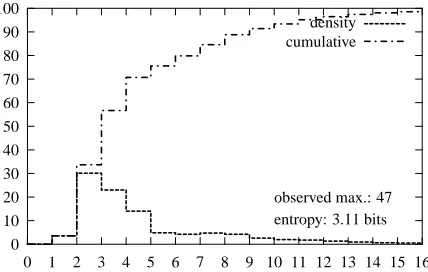
We locate caller phrases by first identifying their start position in the message and then predicting the length of the phrase. The empirical distribu-tion of caller phrase lengths in the development data is shown in Figure 2. Most caller phrases are be-tween two and four words long (‘it’s Pat’, ‘this is Pat Caller’) and there are moderately good lexical indicators that signal the end of a caller phrase (‘I’, ‘could’, ‘please’, etc.). Again, we avoid the use of names as features and rely on a small set of fea-tures based on common words, in addition to phrase length, for predicting the length of the caller phrase.
0 10 20 30 40 50 60 70 80 90 100
0 1 2 3 4 5 6 7 8 9 10 11 12 13 14 15 16 observed max.: 47 entropy: 3.11 bits
density cumulative
Figure 2: Empirical probability of a caller phrase being x words long
We have thus identified two classes of features that allow us to predict the start of the caller phrase relative to the beginning of the message, as well as the end of the caller phrase relative to its start. Since we are dealing with discrete word indices in both cases, we treat this as a classification task, rather than a regression task. A large number of classifier learners can be used to automatically infer classifiers for the two subtasks at hand. We chose a decision tree learner for convenience and note that this choice does not affect the overall results nearly as much as modifying our feature inventory.
Since a direct comparison to the log-linear named entity tagger described in (Huang et al., 2001) (we refer to this approach as HZP log-linear below) is not possible due to the use of different corpora and annotation standards, we applied a similar named entity tagger based on a log-linear model with tri-gram features to our data (we refer to this approach as Col log-linear as the tagger was provided by Michael Collins). Table 1 summarizes precision (P), recall (R), and F-measure (F) for three approaches evaluated on manual transcriptions: row HZP
log-linear repeats the results of the best model from
(Huang et al., 2001); row Col log-linear contains the results we obtained using a similar named entity tagger on our own data; and row JA classifiers shows the performance of the classifier method proposed in this section.
[image:3.612.76.292.112.248.2]numbers could be made to look better by using con-tainment as the evaluation criterion, i.e., we would count a proposed phrase as correct if it contained an actual phrase plus perhaps some additional material. While this may be more useful in practice (see be-low), it is not the objective that was maximized dur-ing traindur-ing, and so we prefer the stricter criterion for evaluation on previously annotated transcripts.
P R F
[image:4.612.351.505.231.288.2]HZP log-linear .89 .80 .84 Col log-linear .83 .78 .81 JA classifiers .73 .68 .71
Table 1: Performance of caller phrase extraction (manual transcriptions)
While the results for the approach proposed here appear clearly worse than those reported by Huang et al. (2001), we hasten to point out that this is most likely not due to any difference in the cor-pora that were used. This is corroborated by the fact that we were able to obtain performance much closer to that of the best, finely tuned log-linear model from (Huang et al., 2001) by using a generic named entity tagger that was not adapted in any way to the par-ticular task at hand. The log-linear taggers employ
n-gram features based on family names and other
particular aspects of the development data that do not necessarily generalize to other settings, where the family names of the callers may be different or may not be transcribed properly. In fact, it seems rather likely that the log-linear models and the fea-tures they employ over-fit the training data.
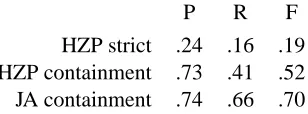
This becomes clearer when one evaluates on un-seen transcripts produced by an automatic speech recognizer (ASR),3as summarized in Table 2. Rows
HZP strict and HZP containment repeat the figures
for the best model from (Huang et al., 2001) when evaluated on automatic transcriptions. The differ-ence is that HZP strict uses the strict evaluation cri-terion described above, whereas HZP containment uses the weaker criterion of containment, i.e., an extracted phrase counts as correct if it contains ex-actly one whole actual phrase. Row JA containment summarizes the performance of our approach when
3An automatic transcription is the single best word hypoth-esis of the ASR for a given voicemail message.
evaluated on 101 unseen automatically transcribed messages. Since we did not have any labeled au-tomatic transcriptions available to compare with the predicted caller phrase labels using the strict crite-rion, we only report results based on the weaker criterion of containment. In fact, we count caller phrases as correct as long as they contain the full name of the caller, since this is the common denom-inator in the otherwise somewhat heterogeneous la-beling of our training corpus; more on this issue in the next section.
P R F
HZP strict .24 .16 .19 HZP containment .73 .41 .52 JA containment .74 .66 .70
Table 2: Performance of caller phrase extraction (au-tomatic transcriptions)
The difference between the approach in (Huang et al., 2001) and ours may be partly due to the perfor-mance of the ASR components: Huang et al. (2001) report a word error rate of ‘about 35%’, whereas we used a recognizer (Bacchiani, 2001) with a word error rate of only 23%. Still, the reduced perfor-mance of the HZP model on ASR transcripts com-pared with manual transcripts is points toward over-fitting, or reliance on features that do not generalize to ASR transcripts. Our main approach, on the other hand, uses classifiers that are extremely knowledge-poor in comparison with the many features of the log-linear models for the various named entity tag-gers, employing no more than a few dozen categori-cal features.
3.2 Caller Names
sub-sequence of capitalized words inside a marked-up caller phrase. This leaves us with 6731 messages with caller names in our development data.4
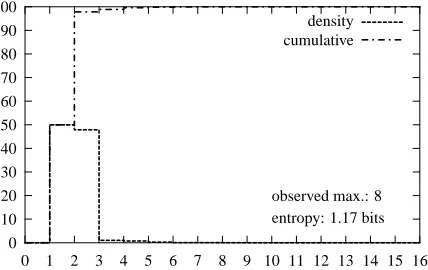
As we did for caller phrases, we briefly examine the distributions of the start position of caller names (see Figure 3) as well as their lengths (see Figure 4). Comparing the entropies of the empirical distribu-tions with the corresponding ones for caller phrases suggests that we might be dealing with a simpler extraction task here. The entropy of the empirical name length distribution is not much more than one bit, since predicting the length of a caller name is mostly a question of deciding whether a first name or full name was mentioned.
0 10 20 30 40 50 60 70 80 90 100
0 1 2 3 4 5 6 7 8 9 10 11 12 13 14 15 16 observed max.: 138 entropy: 2.20 bits
[image:5.612.366.488.190.233.2]density cumulative
Figure 3: Empirical probability of a caller name starting x words into the message
0 10 20 30 40 50 60 70 80 90 100
0 1 2 3 4 5 6 7 8 9 10 11 12 13 14 15 16 observed max.: 8 entropy: 1.17 bits
density cumulative
Figure 4: Empirical probability of a caller name be-ing x words long
4The vast majority of messages that do not mention a name as part of their caller phrase employ the caller phrase ‘it’s me’, which would be easy to detect and treat separately.
The performance comparison in Table 3 shows that we are in fact dealing with a simpler task. No-tice however that our method has not changed at all. We still use one classifier to predict the beginning of the caller name and a second classifier to predict its length, with the same small set of lexical features that do not include any names other than a handful of common first names.
P R F
phrase .730 .684 .706
[image:5.612.74.291.273.410.2]name .860 .871 .865
Table 3: Caller phrase vs. name extraction (manual transcriptions)
4 Phone Numbers
The development data contain 5303 marked-up phone numbers, for an average of almost 0.7 phone numbers per non-empty message. These phone numbers fall into the following categories based on their realization:
• 4472 (84%) consist exclusively of spoken num-bers
• 679 (13%) consist of spoken numbers and the words ‘area’, ‘code’, and ‘extension’
• 152 (3%) have additional material, due to cor-rections, hesitations, fragments, and question-able markup
Note that phone numbers in the North American Numbering Plan are either ten or seven digits long, depending on whether the Numbering Plan Area code is included or not. Two other frequent lengths for phone numbers in the development data are four (for internal lines) and, to a lesser extent, eleven (when the long distance dialing prefix is included, as in ‘one eight hundred . . . ’).
[image:5.612.76.290.490.625.2]occur many seven or ten digit numbers that are not phone numbers.
Named entity taggers based on conditional mod-els with trigram features are not particularly suited for this task. The reason is that trigrams do not pro-vide enough history to allow the tagger to judge the length of a proposed phone number: it inserts begin-ning and end tags without being able to tell how far apart they are. Data sparseness is another problem, since we are dealing with 1000 distinct trigrams over digits alone, so a different event model that replaces all spoken digits with the same representative token might be better suited, also because it avoids over-fitting issues like accidentally learning area codes and other number patterns that are frequent in the development data.
However, there is a more serious problem. Even if the distance between the start and end tags that a named entity tagger predicts could be taken into ac-count, this would not help with all spoken renditions of phone numbers. For example, ‘327-1025’ could be read aloud using only six words (‘three two seven ten twenty five’), and might be incorrectly rejected because it appears to be of a length that is not very common for phone numbers.
We therefore approach the phone number extrac-tion task differently, using a two-phase procedure. In the first phase we use a hand-crafted grammar to propose candidate phone numbers. This avoids all of the problems mentioned so far, yet the complex-ity of the task remains manageable because of the rather simple structure of most phone numbers in our development data noted above. The advantage is that it allows us to simultaneously convert spo-ken digits and numbers to a numeric representation, whose length can then be used as an important fea-ture for deciding whether to keep or throw away a candidate. Note that such a conversion process is desirable in any case, since a text-based application would presumably want to present digit strings like ‘327-1025’ to a user, rather than ‘three two seven ten twenty five’. This conversion step is not entirely trivial, though: for example, one might transcribe the spoken words ‘three hundred fourteen ninety nine’ as either ‘300-1499’ or ‘314.99’ depending on whether they are preceded by ‘call me back at’ vs. ‘I can sell it to you for’, for example. But since we are only interested in finding phone numbers, the
extrac-tion component can treat all candidates it proposes as if they were phone numbers.
Adjustments of the hand-crafted grammar were only made in order to increase recall on the devel-opment data. The grammar should locate as many actual phone numbers in the development corpus as possible, but was free to also propose spurious can-didates that did not correspond to marked-up phone numbers. While it has recently been argued that such separate optimization of recall and precision is generally desirable for certain learning tasks (Agar-wal and Joshi, 2001; Joshi et al., 2001), the main advantage in connection with hand-crafted compo-nents is simplified development. Since we noted above that 97% of all phone numbers in our devel-opment data are expressed fairly straightforwardly in terms of digits, numbers, and a few other words particular to the phone number domain, we might expect to achieve recall figures close to 97% without doing anything special to deal with the remaining 3% of difficult cases. It was very easy to achieve this recall figure on the development data, while the ratio of proposed phone numbers to actual phone numbers was about 3.2 at worst.5
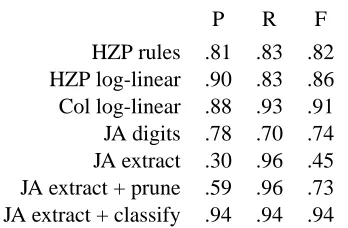
A second phase is now charged with the task of weeding through the set of candidates proposed dur-ing the first phase, retaindur-ing those that correspond to actual phone numbers. This is a simple binary clas-sification task, and again many different techniques can be applied. As a baseline we use a classifier that accepts any candidate of length four or more (now measured in terms of numeric digits, rather than spoken words), and rejects candidates of length three and less. Without this simple step (which we refer to as prune below), the precision of our hand-crafted extraction grammar is only around 30%, but by pruning away candidate phone numbers shorter than four digits precision almost doubles while re-call is unaffected.
We again used a decision tree learner to automat-ically infer a classifier for the second phase. The features we made available to the learner were the length of the phone number in numeric digits, its
distance from the end of the message, and a small number of lexical cues in the surrounding context of a candidate number (‘call’, ‘number’, etc.). This ap-proach (which we call classify below) increases the precision of the combined two steps to acceptable levels without hurting recall too much.
A comparison of performance results is presented in Table 4. Rows HZP rules and HZP log-linear re-fer to the rule-based baseline and the best log-linear model of (Huang et al., 2001) and the figures are simply taken from that paper; row Col log-linear refers to the same named entity tagger we used in the previous section and is included for comparison with the HZP models; row JA digits refers to the simple baseline where we extract strings of spoken digits of plausible lengths. Our main results appear in the re-maining rows. The performance of our hand-crafted extraction grammar (in row JA extract) was about what we had seen on the development data before, with recall being as high as one could reasonably ex-pect. As mentioned above, using a simple pruning step in the second phase (see JA extract + prune) results in a doubling of precision and leaves recall essentially unaffected (a single fragmentary phone number was wrongly excluded). Finally, if we use a decision tree classifier in the second phase, we can achieve extremely high precision with a minimal impact on recall. Our two-phase procedure outper-forms all other methods we considered.
P R F
[image:7.612.353.505.175.233.2]HZP rules .81 .83 .82 HZP log-linear .90 .83 .86 Col log-linear .88 .93 .91 JA digits .78 .70 .74 JA extract .30 .96 .45 JA extract + prune .59 .96 .73 JA extract + classify .94 .94 .94
Table 4: Performance of phone number extraction (manual transcriptions)
We evaluated the performance of our best models on the same 101 unseen ASR transcripts used above in the evaluation of the caller phrase extraction. The results are summarized in Table 5, which also re-peats the best results from (Huang et al., 2001), us-ing the same terminology as earlier: rows HZP strict
and HZP containment refer to the best model from (Huang et al., 2001) – corresponding to row HZP
log-linear in Table 4 – when evaluated using the
strict criterion and containment, respectively; and row JA containment refers to our own best model – corresponding to row JA extract + classify in Ta-ble 4.
P R F
[image:7.612.101.275.472.586.2]HZP strict .56 .52 .54 HZP containment .85 .79 .82 JA containment .95 .94 .95
Table 5: Performance of phone number extraction (automatic transcriptions)
It is not very plausible that the differences be-tween the approaches in Table 5 would be due to a difference in the performance of the ASR compo-nents that generated the message transcripts. From inspecting our own data it is clear that ASR mistakes inside phone numbers are virtually absent, and we would expect the same to hold even of an automatic recognizer with an overall much higher word error rate. Also, for most phone numbers the labeling is uncontroversial, so we expect the corpora used by Huang et al. (2001) and ourselves to be extremely similar in terms of mark-up of phone numbers. So the observed performance difference is most likely due to the difference in extraction methods.
5 Conclusion and Outlook
The novel contributions of this paper can be summa-rized as follows:
• We demonstrated empirically that positional cues can be an important source of information for locating caller names and phrases.
• We showed that good performance on the task of extracting caller information can be achieved using a very small inventory of lexical and po-sitional features.
• Our two-phase approach allows us to efficiently develop a simple extraction grammar for which the only requirement is high recall. This places less of a burden on the grammar developers than having to write an accurate set of rules like the baseline of (Huang et al., 2001).
• The combined performance of our simple ex-traction grammar and the second-phase clas-sifier exceeded the performance of all other methods, including the current state of the art (Huang et al., 2001).
Our results point towards approaches that use a small inventory of features that have been tailored to specific tasks. Generic methods like the named entity tagger used by Huang et al. (2001) may not be the best tools for particular tasks; in fact, we do not expect the bigram and trigram features used by such taggers to be sufficient for accurately extract-ing phone numbers. We also believe that usextract-ing all available lexical information for extracting caller in-formation can easily lead to over-fitting, which can partly be avoid by not relying on names being tran-scribed correctly by an ASR component.
In practice, determining the identity of a caller might have to take many diverse sources of infor-mation into account. The self-identification of a caller and the phone numbers mentioned in the same message are not uncorrelated, since there is usually only a small number of ways to reach any particular caller. In an application we might therefore try to use a combination of speaker identification (Rosenberg et al., 2001), caller name extraction, and recognized phone numbers to establish the identity of the caller. An investigation of how to combine these sources of information is left for future research.
Acknowledgements
We would like to thank Michiel Bacchiani, Michael Collins, Julia Hirschberg, and the SCANMail group at AT&T Labs. Special thanks to Michiel Bacchiani for help with ASR transcripts and to Michael Collins for letting us use his named entity tagger.
References
Ramesh C. Agarwal and Mahesh V. Joshi. 2001. PNrule: A new classification framework in data mining (A case
study in network intrusion detection). In First SIAM
International Conference on Data Mining, Chicago,
IL.
Michiel Bacchiani. 2001. Automatic transcription of voicemail at AT&T. In International Conference on
Acoustics, Speech, and Signal Processing, Salt Lake
City, UT.
Abhay Bhushan, Ken Pogran, Ray Tomlinson, and Jim White. 1973. Standardizing network mail headers. Internet RFC 561.
David H. Crocker. 1982. Standard for the format of ARPA internet text messages. Internet RFC 822, STD 11.
Yoshihiko Gotoh and Steve Renals. 2000. Informa-tion extracInforma-tion from broadcast news. Philosophical
Transactions of the Royal Society of London, Series A, 358:1295–1310.
Julia Hirschberg, Michiel Bacchiani, Don Hindle, Phil Isenhour, Aaron Rosenberg, Litza Stark, Larry Stead, Steve Whittaker, and Gary Zamchick. 2001. SCAN-Mail: Browsing and searching speech data by content. In 7th European Conference on Speech
Communica-tion and Technology, Aalborg, Denmark.
Jing Huang, Geoffrey Zweig, and Mukund Padmanab-han. 2001. Information extraction from voicemail. In
39th Annual Meeting of the Association for Computa-tional Linguistics, Toulouse, France.
Mahesh V. Joshi, Ramesh C. Agarwal, and Vipin Ku-mar. 2001. Mining needles in a haystack: Classify-ing rare classes via two-phase rule induction. In ACM
SIGMOD International Conference on Management of Data, Santa Barbara, CA.
Adwait Ratnaparkhi. 1996. A maximum entropy model for part-of-speech tagging. In Empirical Methods in
Natural Language Processing, Philadelphia, PA.
Aaron Rosenberg, Julia Hirschberg, Michiel Bacchiani, S. Parthasarathy, Philip Isenhour, and Larry Stead. 2001. Caller identification for the SCANMail voice-mail browser. In 7th European Conference on Speech