The Entropy Rate Principle as a Predictor of Processing Effort: An
Evaluation against Eye-tracking Data
Frank Keller
School of Informatics University of Edinburgh
2 Buccleuch Place Edinburgh EH8 9LW, UK
Abstract
This paper provides evidence for Genzel and Char-niak’s (2002) entropy rate principle, which predicts that the entropy of a sentence increases with its po-sition in the text. We show that this principle holds for individual sentences (not just for averages), but we also find that the entropy rate effect is partly an artifact of sentence length, which also correlates with sentence position. Secondly, we evaluate a set of predictions that the entropy rate principle makes for human language processing; using a corpus of eye-tracking data, we show that entropy and pro-cessing effort are correlated, and that propro-cessing ef-fort is constant throughout a text.
1 Introduction
Genzel and Charniak (2002, 2003) introduce the en-tropy rate principle, which states that speakers pro-duce language whose entropy rate is on average constant. The motivation for this comes from in-formation theory: the most efficient way of trans-mitting information through a noisy channel is at a constant rate. If human communication has evolved to be optimal in this sense, then we would expect humans to produce text and speech with approx-imately constant entropy. There is some evidence that this is true for speech (Aylett, 1999).
For text, the entropy rate principle predicts that the entropy of an individual sentence increases with its position in the text, if entropy is measured out of context. Genzel and Charniak (2002) show that this prediction is true for the Wall Street Journal corpus, for both function words and for content words. They estimate entropy either using a language model or using a probabilistic parser; the effect can be ob-served in both cases. Genzel and Charniak (2003) extend this results in several ways: they show that the effect holds for different genres (but the effect size varies across genres), and also applies within paragraphs, not only within whole texts. Further-more, they show that the effect can also be ob-tained for language other than English (Russian and
Spanish). The entropy rate principle also predicts that a language model that takes context into ac-count should yield lower entropy estimates com-pared to an out of context language model. Genzel and Charniak (2002) show that this prediction holds for caching language models such as the ones pro-posed by Kuhn and de Mori (1990).
The aim of the present paper is to shed further light on the entropy rate effect discovered by Gen-zel and Charniak (2002, 2003) (henceforth G&C) by providing new evidence in two areas.
In Experiment 1, we replicate G&C’s entropy rate effect and investigate the source of the effect. The results show that the correlation coefficients that G&C report are inflated by averaging over sen-tences with the same position, and by restricting the range of the sentence position considered. Once these restrictions are removed the effect is smaller, but still significant. We also show that the effect is to a large extend due to a confound with sentence length: longer sentences tend to occur later in the text. However, we are able to demonstrate that the entropy rate effect still holds once this confound has been removed.
In Experiment 2, we test the psycholinguistic pre-dictions of the entropy rate principle. This experi-ment uses a subset of the British National Corpus as training data and tests on the Embra corpus, a set of newspaper articles annotated with eye-movement data. We find that there is a correlation between the entropy of a sentence and the processing ef-fort it causes, as measured by reading times in eye-tracking data. We also show that there is no corre-lation between processing effort and sentence posi-tion, which indicates that processing effort in con-text is constant through a con-text, which is one of the assumptions underlying the entropy rate principle.
2 Predictions for Human Language Processing
in-context predictions and out-of-in-context predictions. The principle states that the entropy rate in a text is constant, i.e., that speakers produce sentences so that on average, all sentences in a text have the same entropy. In other words, communication is optimal in the sense that all sentences in the text are equally easy to understand, as they all have the same en-tropy.
This constancy principle is claimed to hold for connected text: all sentences in a text should be equally easy to process if they are presented in con-text. If we take reading time as a measure of pro-cessing effort, then the principle predicts that there should be no significant correlation between sen-tence position and reading time in context. We will test this prediction in Experiment 2 using an eye-tracking corpus consisting of connected text.
The entropy rate principle also makes the follow-ing prediction: if the entropy of a sentence is mea-sured out of context (i.e., without taking the preced-ing sentences into account), then entropy will in-crease with sentence position. This prediction was tested extensively by G&C, whose results will be replicated in Experiment 1. With respect to process-ing difficulty, the entropy rate principle also predicts that processing difficulty out of context (i.e., if iso-lated sentences are presented to experimental sub-jects) should increase with sentence position. We could not test this prediction, as we only had in-context reading time data available for the present study.
However, there is another important prediction that can be derived from the entropy rate principle: sentences with a higher entropy should have higher reading times. This is an important precondition for the entropy rate principle, whose claims about the relationship between entropy and sentence position are only meaningful if entropy and processing effort are correlated. If there was no such correlation, then there would be no reason to assume that the out-of-context entropy of a sentence increases with sen-tence position. G&C explicitly refer to this relation-ship i.e., they assume that a sentence that is more informative is harder to process (Genzel and Char-niak, 2003, p. 65). Experiment 1 will try to demon-strate the validity of this important prerequisite of the entropy rate principle.
3 Experiment 1: Entropy Rate and Sentence Length
The main aim of this experiment was to replicate G&C’s entropy rate effect. A second aim was to test the generality of their result by determining if the relationship between sentence position and
en-tropy also holds for individual sentences (rather than for averages over sentences of a given position, as tested by G&C). We also investigated the effect of two parameters that G&C did not explore: the cut-off for article position (G&C only deal with sen-tences up to position 25), and the size of the n-gram used for estimating sentence probability. Finally, we include sentence length as a baseline that entropy-based models should be evaluated against.
3.1 Method
3.1.1 Materials
This experiment used the same corpus as Genzel and Charniak (2002), viz., the Wall Street Journal part of the Penn Treebank, divided into a training set (section 0–20) and a test set (sections 21–24). Each article was treated as a separate text, and tence positions were computed by counting the sen-tences from the beginning of the text. The training set contained 42,075 sentences, the test set 7,133 sentences. The sentence positions in the test set var-ied between one and 149.
3.1.2 Procedure
The per-word entropy was computed using an n-gram language model, as proposed by G&C:1
ˆ
H(X) =− 1 |X|x
∑
i∈X
log P(xi|xi−(n−1). . .xi−1)
(1)
Here, ˆH(X) is the estimate of the per-word en-tropy of the sentence X , consisting of the words xi, and n is the size of the n-gram. The n-gram proba-bilities were computed using the CMU-Cambridge language modeling toolkit (Clarkson and Rosen-feld, 1997), with the following parameters: vocab-ulary size 50,000; smoothing by absolute discount-ing; sentence beginning and sentence end as context cues (default values were used for all other parame-ters).
G&C use n = 3, i.e., a trigram model. We experimented with this parameter and used n = 1, . . . ,5. For n=1, equation (1) reduces to ˆH(X) =
−|X1|∑xi∈Xlog P(xi), i.e., a model based on word frequency.
The experiment also includes a simple model that does not take any probabilistic information into ac-count, but simply uses the sentence length |X| to predict sentence position. This model will serve as the baseline.
1Note that the original definition given by Genzel and
0 20 40 60 80 Sentence position
7 7.5 8 8.5 9 9.5
[image:3.595.312.541.70.230.2]Entropy [bits]
Figure 1: Experiment 1: correlation of sentence en-tropy and sentence position (bins, 3-grams, cut-off 76)
We also vary another parameter: c, the cut-off for the position. Genzel and Charniak (2002) use c=25, i.e., only sentences with a position of 25 or lower are considered. In Genzel and Charniak (2003), an even smaller cut-off of c=10 is used. This severely restricts the generality of the results obtained. We will therefore report results not only for c=25, but also for c=76. This cut-off has been set so that there are at least 10 items in the test set for each position. Furthermore, we also repeated the experiment without a cut-off for sentence length.
3.2 Results
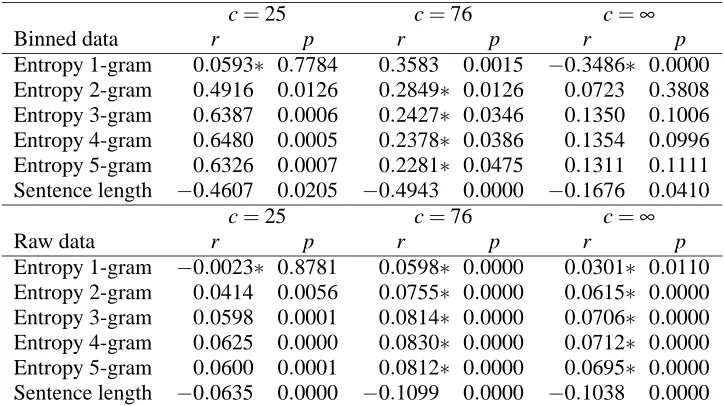
Table 1 shows the results for the replication of Gen-zel and Charniak’s (2002) entropy rate effect. The results at the top of the table were obtained using binning, i.e., we computed the mean entropy of all sentences of a given position, and then correlated these mean entropies with the sentence positions. The parameters n (n-gram size) and c (cut-off value) were varied as indicated in the previous section.
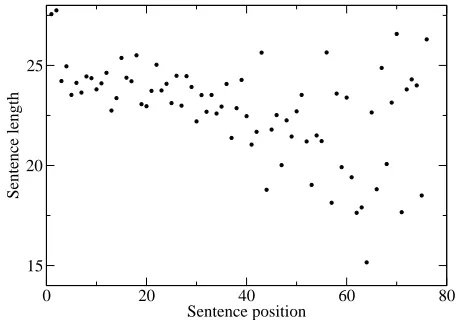
The bottom of Table 1 gives the correlation co-efficients computed on the raw data, i.e., without binning: here, we correlated the entropy of a given sentence directly with its position. The graphs in Figure 1 and Figure 2 illustrate the relationship be-tween position and entropy and bebe-tween position and length, respectively.
3.3 Discussion
3.3.1 Entropy Rate and Sentence Length
The results displayed in Table 1 confirm G&C’s main finding, i.e., that entropy increases with sen-tence length. For a cut-off of c=25 (as used by G&C), a maximum correlation of 0.6480 is
ob-tained (for the 4-gram model). The correlations for the other n-gram models are lower. All correlations
0 20 40 60 80
Sentence position 15
20 25
Sentence length
Figure 2: Experiment 1: correlation of sentence length and sentence position (bins, cut-off 76)
are significant (with the exception of the unigram model). However, we also find that a substantial cor-relation of −0.4607 is obtained even for the
base-line model: there is a negative correlation between sentence length and sentence position, i.e., longer sentences tend to occur earlier in the text. This find-ing potentially undermines the entropy rate effect, as it raises the possibility that this effect is simply an effect of sentence length, rather than of sentence entropy. Note that the correlation coefficient for the none of the n-gram models is significantly higher than the baseline (significance was computed on the absolute values of the correlation coefficients).
The second finding concerns the question whether the entropy rate effect generalizes to sen-tences with a position of greater than 25. The re-sults in Table 1 show that the effect generalizes to a cut-off of c=76 (recall that this value was cho-sen so that each position is reprecho-sented at least ten times in the test data). Again, we find a significant correlation between entropy and sentence position for all values of n. This is illustrated in Figure 1. However, none of the n-gram models is able to beat the baseline of simple sentence position; in fact, now all models (with the exception of the unigram model) perform significantly worse than the base-line. The correlation obtained by the baseline model is graphed in Figure 2.
[image:3.595.72.300.71.231.2]c=25 c=76 c=∞
Binned data r p r p r p
Entropy 1-gram 0.0593∗ 0.7784 0.3583 0.0015 −0.3486∗ 0.0000
Entropy 2-gram 0.4916 0.0126 0.2849∗ 0.0126 0.0723 0.3808
Entropy 3-gram 0.6387 0.0006 0.2427∗ 0.0346 0.1350 0.1006
Entropy 4-gram 0.6480 0.0005 0.2378∗ 0.0386 0.1354 0.0996
Entropy 5-gram 0.6326 0.0007 0.2281∗ 0.0475 0.1311 0.1111
Sentence length −0.4607 0.0205 −0.4943 0.0000 −0.1676 0.0410
c=25 c=76 c=∞
Raw data r p r p r p
Entropy 1-gram −0.0023∗ 0.8781 0.0598∗ 0.0000 0.0301∗ 0.0110
Entropy 2-gram 0.0414 0.0056 0.0755∗ 0.0000 0.0615∗ 0.0000
Entropy 3-gram 0.0598 0.0001 0.0814∗ 0.0000 0.0706∗ 0.0000
Entropy 4-gram 0.0625 0.0000 0.0830∗ 0.0000 0.0712∗ 0.0000
Entropy 5-gram 0.0600 0.0001 0.0812∗ 0.0000 0.0695∗ 0.0000
[image:4.595.125.487.71.274.2]Sentence length −0.0635 0.0000 −0.1099 0.0000 −0.1038 0.0000
Table 1: Results of Experiment 1: correlation of sentence entropy and sentence position, on binned data; c: cut-off, r: correlation coefficient, p: significance level,∗: correlation significantly different from baseline (sentence length)
available per position. Based on data this sparse, no reliable correlation coefficients can be expected.
Let us now turn to Table 1, which displays the results that were obtained by computing correlation coefficients on the raw data, i.e., without computing the mean entropy for all sentences with the same po-sition. We find that for all parameter settings a sig-nificant correlation between sentence entropy and sentence position is obtained (with the exception of n=1, c=25). The correlation coefficients are sig-nificantly lower than the ones obtained using bin-ning, the highest coefficient is 0.0830. This means
that a small but reliable entropy effect can be ob-served even on the raw data, i.e., for individual sen-tences rather than for bins of sensen-tences with the same position.
However, the results in Table 1 also confirm our findings regarding the baseline model (simple sen-tence length): in all cases the correlation coefficient achieved for the baseline is higher than the one achieved by the entropy models, in some cases even significantly so.
3.3.2 Disconfounding Entropy and Sentence Length
Taken together, the results in Table 1 seem to indi-cate that the entropy rate effect reported by G&C is not really an effect of entropy, but just an effect of sentence length. The effect seems to be due to the fact that G&C compute entropy rate by dividing the entropy of a sentence by its length: sentence length is correlated with sentence position, hence entropy rate will be correlated with position as well.
It is therefore necessary to conduct additional
analyses that remove the confound of sentence length. This can be achieved by computing partial correlations; the partial correlation coefficient be-tween a factor 1 and a factor 2 expresses the degree of association between the factors that is left once the influence of a third factor has been removed from both factors. For example, we can compute the correlation of position and entropy, with sentence length partialled out. This will tell us use the amount of association between position and entropy that is left once the influence of length has been removed from both position and entropy.
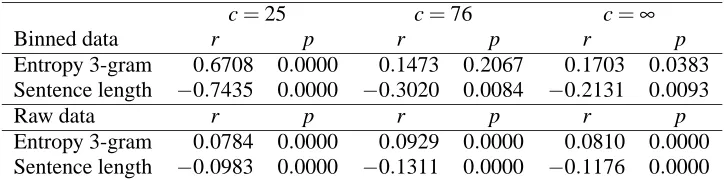
Table 2 shows the results of partial correlation analyses for length and entropy. Note that these results were obtained using total entropy, not per-word entropy, i.e., the normalizing term |X1| was dropped from (1). The partial correlations are only reported for the trigram model.
The results indicate that entropy is a signifi-cant predictor sentence position, even once sentence length has been partialled out. This result holds for both the binned data and the raw data, and for all cut-offs (with the exception of c=76 for the binned data). Note however, that entropy is always a worse predictor than sentence length; the absolute value of the correlation coefficient is always lower. This in-dicates that the entropy rate effect is a much weaker effect than the results presented by G&C suggest.
4 Entropy Rate Effect and Processing Effort
signifi-c=25 c=76 c=∞
Binned data r p r p r p
Entropy 3-gram 0.6708 0.0000 0.1473 0.2067 0.1703 0.0383
Sentence length −0.7435 0.0000 −0.3020 0.0084 −0.2131 0.0093
Raw data r p r p r p
Entropy 3-gram 0.0784 0.0000 0.0929 0.0000 0.0810 0.0000
[image:5.595.125.487.71.161.2]Sentence length −0.0983 0.0000 −0.1311 0.0000 −0.1176 0.0000
Table 2: Results of Experiment 1: correlation of entropy and sentence length with sentence position, with the other factor partialled out
cant correlation between sentence entropy and sen-tence position, even when sensen-tence length, which was shown to be a confounding factor, was con-trolled for. The effect, however, was smaller than claimed by G&C, in particular when applied to in-dividual sentences, as opposed to means obtained for sentences at the same position.
In the present experiment, we will test a crucial aspect of the entropy rate principle, viz., that en-tropy should correlate with processing effort. We will test this using a corpus of newspaper text that is annotated with eye-tracking data. Eye-tracking measures of reading time are generally thought to reflect the amount of cognitive effort that is required for the processing of a given word or sentence.
A second prediction of the entropy rate princi-ple is that sentences with higher position should be harder to process than sentences with lower posi-tion. This relationship should hold out of context, but not in context (see Section 2).
4.1 Method 4.1.1 Materials
As a test corpus, we used the Embra corpus (Mc-Donald and Shillcock, 2003). This corpus consists of 10 articles from Scottish and UK national broad-sheet newspapers. The excerpts cover a wide range of topics; they are slightly edited to make them com-patible with eye-tracking.2The length of the articles varies between 97 and 405 words, the total size of the corpus is 2,262 words (125 sentences). Twenty-three native speakers of English read all 10 arti-cles while their eye-movements were recorded us-ing a Dual-Purkinke Image eye-tracker. To make sure that subjects read the texts carefully, compre-hension questions were also administered. For de-tails on method used to create the Embra corpus, see McDonald and Shillcock (2003).
The training and development sets for this exper-iment were compiled so as to match the test corpus in terms of genre. This was achieved by selecting
2This includes, e.g., the removal of quotation marks and
brackets, which can disrupt the eye-movement record.
all files from the British National Corpus (Burnard, 1995) that originate from UK national or regional broadsheet newspapers. This subset of the BNC was divided into a 90% training set and a 10% develop-ment set. This resulted in a training set consisting of 6,729,104 words (30,284 sentences), and a develop-ment set consisting of 746,717 words (34,269 sen-tences). The development set will be used to test if the entropy rate effect holds on this new corpus.
The sentence positions in the test set varied be-tween one and 24, in the development, they varied between one and 206.
4.1.2 Procedure
To compute per-word entropy, we trained n-gram models on the training set using the CMU-Cambridge language modeling toolkit, with the same parameters as in Experiment 1. Again, n was varied from 1 to 5. We determined the correlation between per-word entropy and sentence position for both the development set (derived from the BNC) and for the test set (the Embra corpus).
Then, we investigated the predictions of G&C’s entropy rate principle by correlating the position and entropy of a sentence with its reading time in the Embra corpus.
The reading measure used was total reading time, i.e., the total time it takes a subject to read a sen-tence; this includes second fixations and re-fixations of words. We also experimented with other reading measures such as gaze duration, first fixation time, second fixation time, regression duration, and skip-ping probability. However, the results obtained with these measures were similar to the ones obtained with total reading time, and will not be reported here.
c=25 c=76 c=∞
Binned data r p r p r p
Entropy 1-gram −0.5495 0.0044 −0.2510 0.0287 0.0232 0.7419
Entropy 2-gram 0.0602 0.7751 0.4249 0.0001 0.0392 0.5773
Entropy 3-gram 0.4523 0.0232 0.5395 0.0000 0.1238 0.0776
Entropy 4-gram 0.4828 0.0145 0.5676 0.0000 0.1229 0.0800
Entropy 5-gram 0.4834 0.0144 0.5723 0.0000 0.1223 0.0813
Sentence length −0.8584 0.0000 −0.2947 0.0098 −0.2161 0.0019
Raw data r p r p r p
Entropy 1-gram −0.0636 0.0000 −0.0543 0.0000 0.0364 0.0000
Entropy 2-gram −0.0069 0.2783 0.0435 0.0000 0.0477 0.0000
Entropy 3-gram 0.0162 0.0103 0.0659 0.0000 0.0687 0.0000
Entropy 4-gram 0.0193 0.0022 0.0691 0.0000 0.0711 0.0000
Entropy 5-gram 0.0192 0.0024 0.0685 0.0000 0.0707 0.0000
[image:6.595.125.488.70.261.2]Sentence length −0.0747 0.0000 −0.1027 0.0000 −0.0913 0.0000
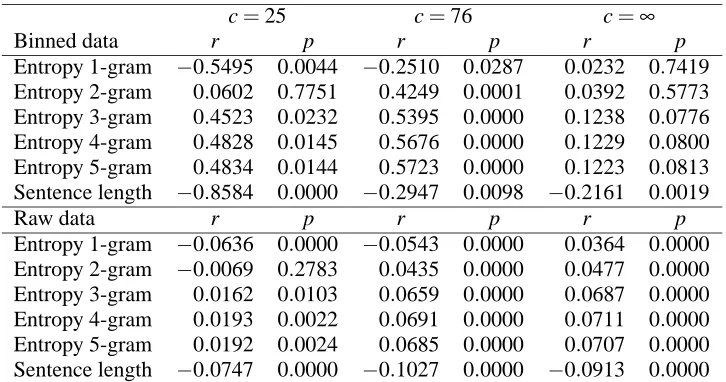
Table 3: Results of Experiment 2: correlation of sentence entropy and sentence position on the BNC
less time to read (Just and Carpenter, 1980). We removed these confounding factors by conducting multiple regression analyses involving word length, word frequency, and the predictor variable (entropy or sentence position). The aim was to establish if there is a significant effect of entropy or sentence length, even when the other factors are controlled for. Word frequency was estimated using the uni-gram model trained on the training corpus.
In the eye-tracking literature, it is generally rec-ommended to run regression analyses on the reading times collected from individual subjects. In other words, it is not good practice to compute regressions on average reading times, as this fails take between-subject variation in reading behavior into account, and leads to inflated correlation coefficients. We therefore followed the recommendations of Lorch and Myers (1990) for computing regressions with-out averaging over subjects (see also McDonald and Shillcock (2003) for details on this procedure).
4.2 Results
Table 3 shows the results of the correlation analyses on the development set. These results were obtained after excluding all sentences at positions 1 and 2. In the newspaper texts in the BNC, these positions have a special function: position 1 contains the title, and position 2 contains the name of the author. The first sentence of the text is therefore on position 3 (unlike in the Penn Treebank, in which no title or author information is included and texts start at po-sition 1).
We then conducted the same correlation analyses on the test set, i.e., on the Embra eye-tracking cor-pus. The results are tabulated in Table 4. Note we set no threshold for sentence position in the test set, as
Binned data Raw data
r p r p
1-gram −0.6505 0.0006 −0.2087 0.0195
2-gram −0.3471 0.0965 −0.1498 0.0954
3-gram −0.5512 0.0052 −0.1674 0.0620
4-gram −0.5824 0.0028 −0.1932 0.0308
5-gram −0.5750 0.0033 −0.1919 0.0320
Length 0.3902 0.0594 0.0885 0.3264
Table 4: Results of Experiment 2: correlation of sen-tence entropy and sensen-tence position on the Embra corpus
r p
Entropy 2-gram 0.1551 0.007
Entropy 3-gram 0.1646 0.000
Entropy 4-gram 0.1650 0.000
Entropy 5-gram 0.1648 0.000
[image:6.595.333.520.461.538.2]Sentence position −0.0266 0.564
Table 5: Results of Experiment 2: correlation of reading times with sentence entropy and sentence position
the maximum article length in this corpus was only 24 sentences.
0 200 400 600 800 1000 Reading time [ms]
4 6 8 10 12 14
[image:7.595.72.297.70.227.2]Entropy [bits]
Figure 3: Experiment 2: correlation of reading times and sentence entropy (3-grams)
4.3 Discussion
The results in Table 3 confirm that the results ob-tained on the Penn Treebank also hold for the news-paper part of the BNC. The top half of the table lists the correlation coefficients for the binned data. We find a significant correlation between sentence po-sition and entropy for the cut-off values 25 and 76. In both cases, there is also a significant correlation with sentence length; this correlation is particularly high (−0.8584) for c=25. The entropy rate effect
does not seem to hold if there is no cut-off; here, we fail to find a significant correlation (though the correlation with length is again significant). This is probably explained by the fact that the BNC test set contains sentences with a maximum position of 206, and data for these high sentence positions is very sparse.
The lower half of Table 3 confirms another result from Experiment 1: there is generally a low, but sig-nificant correlation between entropy and position, even if the correlation is computed for individual sentences rather than for bins of sentences with the same position. Furthermore, we find that sentence length is again a significant predictor of sentence position, even on the raw data. This is in line with the results of Experiment 1.
Table 4 lists the results obtained on the test set (i.e., the Embra corpus). Note that no cut-off was applied here, as the maximum sentence position in this set is only 24. Both on the binned data and on the raw data, we find significant correlations be-tween sentence position and both entropy and sen-tence length. However, compared to the results on the BNC, the signs of the correlations are inverted: there is a significant negative correlation between position and entropy, and a significant positive cor-relation between position and length. It seems that
the Embra corpus is peculiar in that longer sen-tences appear later in the text, rather than earlier. This is at odds with what we found on the Penn Treebank and on the BNC. Note that the positive correlation of position and length explains the neg-ative correlation of position and entropy: length en-ters into the entropy calculation as |X1|, hence a high |X|will lead to low entropy, and vice versa.
We have no immediate explanation for the inver-sion of the relationship between position and length in the Embra corpus; it might be an idiosyncrasy of this corpus (note that the texts were specifically picked for eye-tracking, and are unlikely to be a ran-dom sample; they are also shorter than usual news-paper texts). Note in particular that the Embra cor-pus is not a subset of the BNC (although it was sam-pled from UK broadsheet newspapers, and hence should be similar to our development and training corpora).
Let us now turn to Table 5, which lists the re-sults of the analyses correlating the total reading time for a sentence with its position and its entropy (derived from n-grams with n=2, . . . ,5). Note that
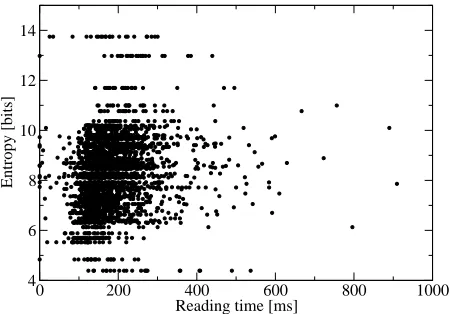
these correlation analyses were conducted by par-tialling out word length and word frequency, which are well-know to correlate with reading times. We find that even once these factors have been con-trolled, there is still a significant positive correlation between entropy and reading time: sentences with higher entropy are harder to process and hence have higher reading times. This is illustrated in Figure 3 for one of the correlations. As we argued in Sec-tion 2, this relaSec-tionship between entropy and pro-cessing effort is a crucial prerequisite of the entropy rate principle. The increase of entropy with sen-tence position observed by G&C (and in our Exper-iment 1) only makes sense if increased entropy cor-responds to increased processing difficulty (e.g., to increased reading time). Note that this result is com-patible with previous research by McDonald and Shillcock (2003), who demonstrate a correlation be-tween reading time measures and bigram probabil-ity (though their analysis is on the word level, not on the sentence level).
of a correlation between position and reading time in the eye-tracking corpus.
5 Conclusions
This paper made a contribution to the understanding of the entropy rate principle, first proposed by Gen-zel and Charniak (2002). This principle predicts that the position of a sentence in a text should correlate with its entropy, defined as the sentence probabil-ity normalized by sentence length. In Experiment 1, we replicated the entropy rate effect reported by Genzel and Charniak (2002, 2003) and showed that it generalizes to a larger range of sentence posi-tions and also holds for individual sentences, not just averaged over all sentences with the same posi-tion. However, we also found that a simple baseline model based on sentence length achieves a corre-lation with sentence position. In many cases, there was no significant difference between the entropy rate model and the baseline. This raises the possibil-ity that the entropy rate effect is simply an artifact of the way entropy rate is computed, which involves sentence length as a normalizing factor. However, using partial correlation analysis, we were able to show that entropy is a significant predictor of sen-tence position, even when sensen-tence length is con-trolled.
In Experiment 2, we tested a number of important predictions of the entropy rate principle for human sentence processing. First, we replicated the entropy rate effect on a different corpus, a subset of the BNC restricted to newspaper text. We found essentially the same pattern as in Experiment 1. Using a cor-pus of eye-tracking data, we showed that entropy is correlated with processing difficulty, as measured by reading times in the eye-movement record. This confirms an important assumption that underlies the entropy rate principle. As the eye-tracking corpus we used was a corpus of connected sentences, it abled us to also test another prediction of the en-tropy rate principle: in context, all sentences should be equally difficult to process, as speakers gener-ate sentences with constant informativeness. This means that no correlation between sentence position and reading times was expected, which is what we found.
Another important prediction of the entropy rate principle remains to be evaluated in future work: for out-of-context sentences, there should be a correla-tion between sentence posicorrela-tion and processing ef-fort. This prediction can be tested by obtaining read-ing times for sentences sampled from a corpus and read by experimental subjects in isolation.
References
Aylett, Matthew. 1999. Stochastic suprasegmen-tals: Relationships between redundancy, prosodic structure and syllabic duration. In Proceedings of the 14th International Congress of Phonetic Sci-ences. San Francisco.
Burnard, Lou. 1995. Users Guide for the British National Corpus. British National Corpus Con-sortium, Oxford University Computing Service. Clarkson, Philip R. and Ronald Rosenfeld. 1997.
Statistical language modeling using the CMU-Cambridge toolkit. In Proceedings of Eu-rospeech. ESCA, Rhodes, Greece, pages 2707– 2710.
Genzel, Dmitriy and Eugene Charniak. 2002. En-tropy rate constancy in text. In Proceedings of the 40th Annual Meeting of the Association for Com-putational Linguistics. Philadelphia, pages 199– 206.
Genzel, Dmitriy and Eugene Charniak. 2003. Vari-ation of entropy and parse trees of sentences as a function of the sentence number. In Michael Collins and Mark Steedman, editors, Proceedings of the Conference on Empirical Methods in Natu-ral Language Processing. Sapporo, pages 65–72. Just, Marcel A. and Patricia A. Carpenter. 1980. A theory of reading: From eye fixations to compre-hension. Psychological Review 87:329–354. Kuhn, Roland and Renato de Mori. 1990. A
cache-based natural language model for speech repro-duction. IEEE Transactions on Pattern Analysis and Machine Intelligence 12(6):570–583. Lorch, Robert F. and Jerome L. Myers. 1990.
Re-gression analyses of repeated measures data in cognitive research. Journal of Experimental Psychology: Learning, Memory, and Cognition 16(1):149–157.