Statistical Filtering and Subcategorization Frame Acquisition
A n n a K o r h o n e n a n d G e n e v i e v e G o r r e l lC o m p u t e r Laboratory, University of C a m b r i d g e P e m b r o k e Street, Cambridge CB2 3QG, U K
alk23@cl, cam. ac. uk, genevieve, g o r r e l l @ n e t d e c i s i o n s , co. uk
D i a n a M c C a r t h y
School of Cognitive and C o m p u t i n g Sciences University of Sussex, Brighton, BN1 9QH, U K
dianam@cogs, s u s x . a c . uk A b s t r a c t
Research "into the automatic acquisition of subcategorization frames (SCFS) from corpora is starting to produce large-scale computa- tional lexicons which include valuable fre- quency information. However, the accuracy of the resulting lexicons shows room for im- provement. One significant source of error lies in the statistical filtering used by some re- searchers to remove noise from automatically acquired subcategorization frames. In this pa- per, we compare three different approaches to filtering out spurious hypotheses. Two hy- pothesis tests perform poorly, compared to filtering frames on the basis of relative fre- quency. We discuss reasons for this and con- sider directions for future research.
1 I n t r o d u c t i o n
Subcategorization information is vital for suc- cessful parsing, however, manual develop- ment of large subcategorized lexicons has proved difficult because predicates change be- haviour between sublanguages, domains and over time. Additionally, manually devel- oped sucategorization lexicons do not provide the relative frequency of different SCFs for a given predicate, essential in a probabilistic ap- proach.
Over the past years acquiring subcatego- rization dictionaries from textual corpora has become increasingly popular. The different approaches (e.g. Brent, !991, 1993; Ushioda
et al.,
1993; Briscoe and Carroll, 1997; Man- ning, 1993; Carroll and Rooth, 1998; Gahl, 1998; Lapata, 1999; Sarkar and Zeman, 2000) vary largely according to the methods used and the number of SCFS being extracted. Re- gardless of this, there is a ceiling on the perfor- mance of these systems at around 80% token recall 1zWhere token recall is the percentage .of SCF to- kens in a sample of manually analysed text that were
The approaches to extracting SCF informa- tion from corpora have frequently employed statistical methods for filtering (e.g. Brent, 1993; Manning 1993; Briscoe and Carroll, 1997; Lapata, 1999). This has been done to remove the noise that arises when dealing with naturally occurring data, and from mistakes made by the SCF acquisition system, for ex- ample, parser errors.
Filtering is usually done with a hypothe- sis test, and frequently with a variation of the binomial filter introduced by Brent (1991, 1993). Hypothesis testing is performed by for- mulating a null hypothesis, (H0), which is as- sumed true unless there is evidence to the con- trary. If there is evidence to the contrary, H0 is rejected and the alternative hypothe- sis (H1) is accepted. In SCF acquisition, H0 is that there is no association between a particu- lar verb
(verbj)
and a SCF (SCFi), meanwhile H1 is that there is such an association. For SCF acquisition, the test is one-tailed since H1 states the direction of the association, a pos- itive correlation betweenverbj and scfi.
We compare the expected probability ofscfi
oc- curring withverbj
if H0 is true, to the ob- served probability of co-occurrence obtained from the corpus data. If the observed proba- bility is greater than the expected probability we reject Ho and accept H1, and if not, we retain H0.style binomial filter when establishing SCFs for diathesis alternation detection. L a p a t a deter- mined thresholds for each SCF using the fre- quency of the SCF in COMLEX Syntax dictio- nary (Grishman
et al.,
1994).Adopting the SCF acquisition system of Briscoe and Carroll, we have experimented with an alternative hypothesis test, the bi- nomial log-likelihood ratio (LLR) test (Dun- ning, 1993). Sarkar and Zeman (2000) have also used this test when filtering SCFs auto- matically acquired for Czech. This test has been recommended for use in NLP since it does not assume a normal distribution, which invalidates many other parametric tests for use with natural language phenomena. LLR can be used in a form
(-2logA)
which is X 2 distributed. Moreover, this a s y m p t o t e is appropriate at quite low frequencies, which makes t h e hypothesis test particularly useful when dealing with natural language phenom- ena, where low frequency events are common- place.A problem with using hypothesis testing for filtering automatically acquired SCFs is ob- taining a good estimation of the expected oc- currence of
scfi
withverbj.
This is often performed using the unconditional distribu- tion, that is the probability distribution over all SCFS, regardless of the verb. It is as- sumed t h a tverbj
must occur withscfi
sig- nificantly more t h a n is expected given this estimate. Our paper addresses the problem t h a t the conditional distribution, dependent on the verb, and unconditional distribution are rarely correlated. Therefore statistical fil- ters which assume such correlation for H0 will be susceptible to error,In this paper, we compare the results of the Brent style binomial filter of Briscoe and Carroll and the LLR filter to a simple m e t h o d which uses a threshold on the relative frequen- cies of t h e verb and SCF combinations. We do this within t h e framework of the Briscoe and Carroll SCF acquisition system, which is described in section 2.1. The details of the two statistical filters are described in section 2.2, along with the details of the threshold ap- plied to the relative frequencies o u t p u t from the SCF acquisition system. T h e details of the experimental evaluation are supplied in sec- tion 3. We discuss our findings in section 3.3 a n d conclude with directions for future work (section 4).
2 M e t h o d
2.1 F r a m e w o r k f o r S C F A c q u i s i t i o n
Briscoe and Carroll's (1997) verbal acquisition system distinguishes 163 SCFs and returns rel- ative frequencies for each SCF found for a given predicate. T h e SCFs are a superset of classes found in the Alvey NL Tools (ANLT) dictio- nary, Boguraev
et al.
(1987) and the COML~X Syntax dictionary, Grishmanet al.
(1994). They incorporate information about control of predicative arguments, as well as alterna- tions such as extraposition and particle move- ment. The system employs a shallow parser to obtain the subcategorization information. Po- tential SCF entries are filtered before the final SCF lexicon is produced. T h e filter is the only component of this system which we experi- ment with here. T h e three filtering m e t h o d s which we compare are described below.2.2 F i l t e r i n g M e t h o d s
2.2.1 B i n o m i a l H y p o t h e s i s Test
Briscoe and Carroll (1997) used a binomial hypothesis test (BHT) to filter the acquired SCFs. They applied BHT as follows. T h e sys- t e m recorded the total n u m b e r of sets of SCF cues (n) found for a given predicate, and the n u m b e r of these sets for a given SCF (ra). T h e system estimated the error probability (pe) that a cue for a SCF
(scfi)
occurred with a verb which did not takescfi.
pe was esti- m a t e d in two stages, as shown in equation 1. Firstly, the n u m b e r of verbs which are mem- bers of the target SCF in the ANLT dictionary were extracted. This n u m b e r was converted to a probability of class membership by divid- ing by the total n u m b e r of verbs in the dic- tionary. T h e complement of this probability provided an estimate for the probability of a verb not takingscfi.
Secondly, this proba- bility was multiplied by an estimate for the probability of observing the cue forscfi. This
was estimated using the n u m b e r of cues for i extracted from t h e Susanue corpus (Sampson, 1995), divided by the total n u m b e r of cues.
pe
= (1 -
Iverbsl i
cZass il I eSlc e l,
for il (1)
n~
P(m,n,p) = m ! ( n - m)! pro(1 _p)n-m
(2)The probability of the event h a p p e n i n g m or more times is:
=
(3)
k=rn
Finally,
P(m+, n,p e)
is the p r o b a b i l i t y that m or more occurrences of cues forscfi
will oc- cur with a verb which is not a m e m b e rofscfi,
given n occurrences of that verb. A threshold on this probability,P(m+,n, pe),
was set at less t h a n or equal to 0.05. This yielded a 95% or b e t t e r confidence t h a t a high enough pro- portion of cues forscfi
have b e e n observed for the verb to be legitimately assignedscfi.
Other approaches which use a binomial fil- ter differ in respect of the calculation of the error probability. Brent (1993) e s t i m a t e d the error probabilities for each SCF experimen- tally from the behaviour of his SCF extrac- tor, which detected simple morpho-syntactic cues in the corpus data. Manning (1993) in- Creased the number of available cues at the ex- pense of the reliability of these cues. To main-
tain high levels of accuracy, Manning applied higher b o u n d s on the error probabilities for certain cues. These b o u n d s were determined experimentally. A similar approach was taken by Briscoe, Carroll and Korhonen (1997) in a modification to the Briscoe and Carroll sys- tem. T h e overall performance was increased by changing the estimates of
pe
according to the performance of t h e system for the target SCF. In the work described here, we use the original BHT proposed b y Briscoe and Carroll.2 . 2 . 2 T h e B i n o m i a l L o g L i k e l i h o o d R a t i o a s a S t a t i s t i c a l F i l t e r Dunning (1993) d e m o n s t r a t e s the benefits of
the LLR statistic, compared to Pearson's chi- squared, on the task of ranking b i g r a m data.
T h e binomial log-likelihood ratio test is simple to calculate. For each verb and SCF combination four counts are required. These are the number of times that:
1. t h e target verb occurs with the target SCF
(kl)
2. t h e target verb occurs with any other SCF
(nl
-kl)
3. any other verb occurs with the target SCF (k2)
4. any other verb occurs with any other SCF
-
k2)
The statistic
-21ogA
is calculated as follows:-log-likelihood =
where
2[logL(pl, kl, nl )
+logL(p2, k2,
n2)-logL(p, kl, nl)
-logL(p, k2, n2) ]
(4)
logL(p,
n, k) = k x logp + (n - k) x log(1 - p ) andkl k2 kl + k2
P l = - - , P 2 - - - , P - -
n l n2 n l -4- n2
The LLR statistic provides a score t h a t re- flects the difference in (i) the number of bits it takes to describe the observed data, using
pl = p(SCFIverb )
and p2 =p(SCFl-~verb ),
and (ii) the n u m b e r of bits it takes to de- scribe the e x p e c t e d d a t a using the probability
p = p(scFlany verb).
The LLR statistic detects differences be- tween p l and p2. T h e difference could potentially be in either direction, b u t we are interested in LLRS where p l > p2, i.e. where there is a positive association between the SCF and the verb. For these cases, we compared the value of
-2logA
to the threshold value obtained from Pearson's Chi-Squared table, to see if it was significant at the 95% level 2.2 . 2 . 3 U s i n g a T h r e s h o l d o n t h e R e l a t i v e F r e q u e n c i e s as a B a s e l i n e
In order to examine the baseline performance of this system w i t h o u t employing any notion of the significance of the observations, we used a threshold on relative frequencies. This was done b y extracting the SCFS, and rank- ing t h e m in the order of the probability of their occurrence w i t h the verb. The probabil- ities were e s t i m a t e d using a m a x i m u m likeli- h o o d estimate
(MLE)
from the observed rela- tive frequencies. A threshold, determined em- pirically, was applied to these probability esti- mates to filter out the low probability entriesfor each verb. ....
3 E v a l u a t i o n
3.1 M e t h o d
To evaluate the different approaches, we took a sample of 10 million words of the BNC cor- pus (Leech, 1992). We extracted all sentences containing an occurrence of one of fourteen verbs 3. T h e verbs were chosen at random, subject to the constraint that they exhibited multiple complementation patterns. After the extraction process, we retained 3000 citations, on average, for each verb. T h e sentences con- taining these verbs were processed by the SCF acquisition system, and then we applied the three filtering m e t h o d s described above. We also obtained results for a baseline without any filtering.
The results were evaluated against a man- ual analysis of corpus data 4. This was ob- tained by analysing up to a m a x i m u m of 300 occurrences for each of the 14 test verbs in LOB (Garside et al., 1987), Susanne and SEC (Taylor and Knowles, 1988) corpora. Follow- ing Briscoe and Carroll (1997), we calculated
precision (percentage of SCFS acquired which were also exemplified in the manual analysis) and recall (percentage of the SCFs exemplified in the manual analysis which were acquired automatically). We also combined precision and recall into a single measure of overall per- formance using the F measure (MA.nniug and Schiitze, 1999).
F = 2 . p r e c i s i o n . recall (5)
precision + recall
3.2 R e s u l t s
Table 1 gives the raw results for the 14 verbs using each method. It shows the n u m b e r of
true positives (TP), .false positives (FP), and
.false negatives (FN), as determined accord- ing to t h e manual analysis. T h e results for high frequency SCFs (above 0.01 relative fre- quency), m e d i u m frequency (between 0.001 and 0.01) and low frequency (below 0.001) SCFs are listed respectively in the second,
3These verbs were ask, begin, believe, cause, expect,
find, give, help, like, move, produce, provide, seem, swing.
4The importance of the m a n u a l analysis is outlined in Briscoe a n d Carroll (1997). We use the same man- ual analysis as Briscoe a n d Carroll, Le. one from the Susanne, LOB, and SEC corpora. A manual analysis of the B N C data might produce better results. However, since the B N C is a heterogeneous corpus w e felt it was reasonable to test the data on a different corpus, which is also heterogeneous.
third and fourth columns, and the final col- u m n includes t h e total results for all frequency ranges.
Table 2 shows precision a n d recall for the 14 verbs and the F measure, which combines pre- cision and recall. We also provide the baseline results, if all SCFs were accepted.
From the results given in tables 1 and 2, the MLE approach outperformed b o t h hypothesis tests. For b o t h BHT and LLR there was an increase in FNs at high frequencies, and an increase in FPs at m e d i u m and low frequen- cies, when compared to MLE. T h e number of errors was typically larger for LLR t h a n BHT.
T h e hypothesis tests reduced the number of
FNS at m e d i u m a n d low frequencies, however, this was countered by the substantial increase in FPs that they gave. While BHT nearly al- ways acquired t h e three most frequent SCFs of verbs correctly, LLR tended to reject these.
While the high n u m b e r of FNS can be ex- plained by reports which have shown LLR to be over-conservative (Ribas, 1995; Pedersen, 1996), the high n u m b e r of FPs is surprising. Although theoretically, t h e strength of LLR
lies in its suitability for low frequency data, the results displayed in table 1 do not suggest t h a t the m e t h o d performs b e t t e r t h a n BHT on low frequency frames.
MLE thresholding p r o d u c e d b e t t e r results t h a n the two statistical tests used. Preci- sion improved considerably, showing that the classes occurring in the d a t a with the high- est frequency are often correct. Although MLE thresholding clearly makes no a t t e m p t to solve the sparse d a t a problem, it performs better t h a n BHT or LLR overall. MLE is not adept at finding low frequency SCFS, however, the other m e t h o d s are problematic in t h a t they wrongly accept more t h a n they correctly reject. T h e baseline, of accepting all SCFS, obtained a high recall at the expense of precision.
3.3 D i s c u s s i o n
Our results indicate t h a t MLE outperforms b o t h hypothesis tests. There are two explana- tions for this, and these are jointly responsible for t h e results.
H i g h F r e q
T P F P F N
BHT 75 29 23 LLR 66 30 32
MLE 92 31 6
M e d i u m F r e q L o w F r e q
T P F P F N T P F P I F N
11 37 31 4 23 15
9 52 33 2 23 17
0 0 42 0 0 19
Totals TP FP I FN
m
90 89 69
77 105 82
92 31 67
Table 1: Raw results for 14 test verbs
~r31ff.t: Precision % Recall % F measure
BHT 50.3 56.6 53.3
LLR 42.3 48.4 45.1
MLE 74.8 57.8 65.2
baseline 24.3 83.5 37.6
Table 2: Precision, Recall, and F measure
0 . 1
0.01
&
0.001
0.0001
. . . i . . . .
!.
o
I , r i i , , i , l , , i i i i ,
10 100
rank
0 . 1
0.01
o.oo~
0 . 0 1 ~
1 0 4
\
, , , , t , , r , i , , i , , , 1
10 100
rank
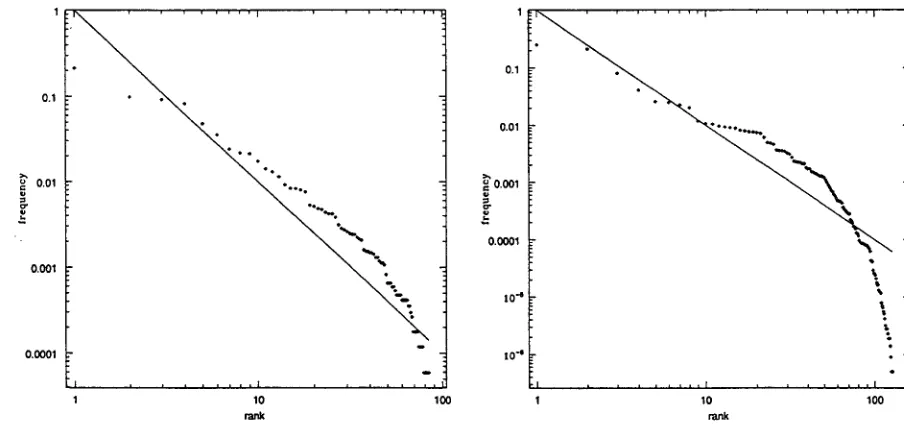
Figure 1: Hypothesised SCF distribution for
find
tern. The unconditional distribution obtained from the observed distribution of SCFs in the 20 M words of BNC is shown in figure 2. The figures show SCF rank on the X-axis versus SCF frequency on the Y-axis, using logarith- mic scales. The line indicates the closest Zipf- like power law fit to the data.
Secondly, the hypothesis tests make the false assumption (H0) that the unconditional and conditional distributions are correlated. The fact that a significant improvement in performance is made by correcting the prior probabilities according to the performance of the system (Briscoe, Carroll and Korhonen,
Figure 2: Hypothesised unconditional SCF dis- tribution
1997) suggests the discrepancy between the unconditional and the conditional distribu- tions.
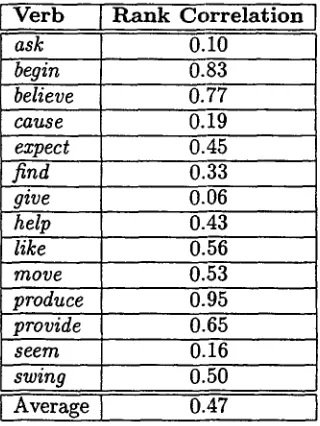
We examined the correlation between the manual analysis for the 14 verbs, and the unconditional distribution of verb types over all SCFs estimated from the ANLT using the Spearman Rank Correlation Coefficient. The results included in table 3 show that only a moderate correlation was found averaged over all verb types.
[image:5.596.84.536.290.509.2][ V e r b R a n k Correlation
ask
0.10begin
0.83believe
0.77cause
0.19expect
find
0.45 0.33
give
0.06help
0.43like
0.56move
0.53produce
0.95provide
0.65seem
0.16swing
Average
0.50 0.47Table 3: Rank correlation between the condi- tional SCF distributions of the test verbs and the unconditional distribution
value for
p(sc.filverbj)
from the system's out- put, a n d they both use an estimate for the un- conditional probability distribution(p(scfi))
for estimating the expected probability. They differ in the way that the estimate for the un- conditional probability is obtained, and the way that it is used in hypothesis testing.
F o r BHT, the null hypothesis is t h a t the ob- served value
ofp(scfiIverbj)
arose by chance, because of noise in the data. We estimate the probability that the value observed could have arisen by chance using p ( m + ,n,pe), pe
is cal- culated using:• the SCF acquisition system's raw (until- tered) estimate for t h e unconditional dis- tribution, which is obtained from the Su- sanne corpus and
• the ANLT estimate of the unconditional distribution of a verb not taking
scf~,
across all SCFs
For LLR, b o t h the conditional (pl) and un- conditional distributions (p2) are estimated from the BNC data. T h e unconditional proba- bility distribution uses the occurrence of scfi with any verb other t h a n our target.
T h e binomial tests look at one point in the SCF distribution at a time, for a given verb. The expected value is determined using the unconditional distribution, on the assumption that if the null hypothesis is true then this dis- tribution will correlate with the conditional
distribution. However, this is rarely the case. Moreover, because of the zipfian nature of the distributions, the frequency differences at any point can be substantial. I n these exper- iments, we used one-tailed tests because we were looking for cases where there was a pos- itive association between the SCF and verb, however, in a two-tailed test t h e null hypoth- esis would rarely be accepted, because of the substantial differences in the conditional and unconditional distributions.
A large n u m b e r of false negatives occurred for high frequency SCFs because the probabil- ity we compared t h e m to was too high. This probability was estimated from the combina- tion of many verbs genuinely occurring with t h e frame in question, rather t h a n from an es- timate of background noise from verbs which did not occur w i t h the frame. We did not use an estimate from verbs which do not take the SCF, since this would require a priori knowl- edge about t h e p h e n o m e n a t h a t we were en- deavouring to acquire automatically. For LLR the unconditional probability estimate (p2) was high, simply because this SCF was a com- m o n one, r a t h e r t h a n because the data was particularly noisy. For BHT, R e was likewise too high as t h e SCF was also c o m m o n in the Susanne data. T h e ANLT estimate went some- way to compensating for this, thus we ob- tained fewer false negatives w i t h BHT t h a n
LLR.
A large n u m b e r of false positives occurred for low frequency SCFs because the estimate for
p(scf)
was low. This estimate was more readily exceeded by the conditional estimate. For BHT false positives arose because of the low estimate ofp(scf)
(from Susanne) and because the estimate of p(-,SCF) from ANLT did not compensate enough for this. For LLR, there was no mean~ to c o m p e n s a t e for t h e fact t h a t p2 was lower t h a n p l .I n contrast, MLE did not compare two dis- tributions. Simply rejecting t h e low frequency d a t a produced better results overall by avoid- ing the false positives with t h e low frequency data, and the false negatives with the high frequency data.
4 C o n c l u s i o n
[image:6.596.140.300.62.275.2]ratio test, recommended for use with low fre- quency data and (iii) a simple m e t h o d using a threshold on the MLEs o f the SCFS o u t p u t from the system. Surprisingly, the simple MLE
thresholding m e t h o d worked best. The BHT
and LLR both produced an astounding mlm- ber of FPs, particularly at low frequencies.
Further work on handling low frequency data in SCF acquisition is warranted. A non- parametric statistical test, such as Fisher's ex- act test, recommended by Pedersen (1996), might improve on the results obtained using parametric tests. However, it seems from our experiments that it would be better to avoid hypothesis tests that make use of the uncon- ditional distribution.
One possibility is to p u t more effort into the estimation of
pe,
and to avoid use of the un- conditional distribution for this. In some re- cent experiments, we tried optimising the es- timates forpe
depending on the performance of the system for the target SCF, using the m e t h o d proposed by Briscoe, Carroll and Ko- rhonen (1997). T h e estimates of pe were ob- tained from a training set separate to the held- out BNC data used for testing. Results using the new estimates forpe
gave an improvement of 10% precision and 6% recall, compared to the BHT results reported here. Nevertheless, the precision result was 14% worse for preci- sion t h a n MLE, t h o u g h there was a 4% im- provement in recall, making the overall per- formance 3.9 worse t h a n MLE according to the F measure. Lapata (1999) also reported that a simple relative frequency cut off produced slightly better results than a Brent style BHT.If MLE thresholding persistently achieves better results, it would be worth investi- gating ways of handling the low frequency data, such as smoothing, for integration with this method. However, more sophisticated smoothing methods, which back-off to an un- Conditional distribution, will also suffer from the lack of correlation between conditional and unconditional SCF distributions. Any sta- tistical test would work better at low frequen- cies t h a n the MLE, since this simply disregards all low frequency SCFs. In our experiments, ff we had used MLE only for the high frequency data, and BHT for m e d i u m and low, then over- all we would have had 54% precision and 67% recall. It certainly seems worth employing hy- pothesis tests which do not rely on the un- conditional distribution for the low frequency SCFS.
5 A c k n o w l e d g e m e n t s
We thank Ted Briscoe for m a n y helpful dis- cussions and suggestions concerning this work. We also acknowledge Yuval Krymolowski for useful comments on this paper.
R e f e r e n c e s
Boguraev, B., Briscoe, E., Carroll, J., Carter, D. and Grover, C. 1987. T h e derivation of a grammatically-indexed lexicon from the Long- m a n Dictionary of C o n t e m p o r a r y English. In
Proceedings of the 25th Annual Meeting of
the Association for Computational Linguis-
tics,
Stanford, CA. 193-200.Brent, M. 1991. A u t o m a t i c acquisition of subcategorization frames from untagged text.
In Proceedings of the 29th Annual Meeting
of the Association for Computational Linguis-
tics,
Berkeley, CA. 209-214.Brent, M. 1993. From gra.mmar to lexicon: unsupervised learning of lexical syntax.
Com-
putational Linguistics
19.3: 243-262.Briscoe, E.J. and J. Carroll 1997. Automatic extraction of subcategorization from corpora. In
Proceedings of the 5th ACL Conf. on Ap-
plied Nat. Lg.
Proc., Washington, DC. 356- 363.Briscoe, E., Carroll, J. and Korhonen, A. 1997.
Automatic extraction of subcategoriza-
tion frames from corpora - a framework and
3 experiments. '97
Sparkle W P 5 Deliverable, available in http://www.ilc.pi.cnr.it/.Carroll, G. and Rooth, M. 1998. Valence induction with a head-lexicalized PCFG. In
Proceedings of the 3rd Conference on Empir-
ical Methods in Natural Language Processing,
Granada, Spain.
Dunning, T. 1993. Accurate methods for the Statistics of Surprise a n d Coincidence.
Com-
putational Linguistics
19.1: 61-74.Gahl, S. 1998. Automatic extraction of sub- corpora based on subcategorization frames from a part-of-speech tagged corpus. In Pro-
ceedings of the COLING-A CL'98,
Montreal, Canada.Garside, R., Leech, G. a n d Sampson, G. 1987.
The computational analysis of English: A
corpus-based approach.
Longman, London. Gorrell, G. 1999.Acquiring Subcategorisation
from Textual Corpora.
MPhil dissertation,Grishman, R., Macleod, C. and Meyers, A. 1994. Comlex syntax: building a computa- tional lexicon. In
Proceedings of the Interna-
tional Conference on Computational Linguis-
tics, COLING-94,
Kyoto, Japan. 268-272. Lapata, M. 1999. Acquiring lexical gener- alizations from corpora: A case study for diathesis alternations. InProceedings of the
37th Annual Meeting of the Association for
Computational Linguistics,
Maryland. 397- 404.Leech, G. 1992. 100 million words of English: the British National Corpus.
Language Re-
search
28(1): 1-13.Manning, C. 1993. Automatic acquisition of a large subcategorization dictionary from cor- pora. In
Proceedings of the 31st Annual Meet-
ing of the Association .for Computational Lin-
guistics,
Columbus, Ohio. 235-242.Manning, C. and Schiitze, H. 1999.
Founda-
tions of Statistical Natural Language Process-
ing.
MIT Press, Cambridge MA.Pedersen, T. 1996. Fishing for Exactness. In
Proceedings of the South-Central SAS Users
Group Conference SCSUG-96,
Austin, Texas. Ribas, F. 1995.On Acquiring Appropriate Se-
lectional Restrictions from Corpora Using a
Semantic Taxonomy.
Ph.D thesis, University of Catalonia.Sampson, G. 1995.
English for the computer.
Oxford University Press, Oxford UK.
Sarkar, A. and Zeman, D. 2000. Auto- matic Extraction of Subcategorization Frames for Czech. In