ISSN Print: 1913-3715
DOI: 10.4236/ijcns.2019.128009 Aug. 28, 2019 113 Int. J. Communications, Network and System Sciences
Adaptive Control of Congestion in Tough
Wireless Environments Using DCM+ Algorithm
Rushdi Hamamreh, Derar Khader
Department of Electronics and Computer Engineering, Al-Quds University, Jerusalem, Palestine
Abstract
The aim of this paper is to present DCM+, a new congestion control protocol for data networks. It stands for Dynamic Congestion control for Mobile net-works. New metrics have been newly invented and introduced like normalized advancing index (NAI) and complete transmission time (CTT). The simula-tions are done for a simple single-hop-topology (sender-router-receiver). The outcomes of this protocol are excellent and, in most cases, better than other approaches. The excellent properties of our proposed protocol were possible through tracking the available slow-start threshold. We achieved performance improvement, minimized end-to-end delay and large reduction in transmis-sion time. DCM+ was able to combine many advantages at same time of the protocols NewReno and Westwood+. The results show, that DCM+ is ex-tremely adequate for different types of networks. Feedback as main principle of control theory was used to control the congestion in the network. The pa-rameters Round-Trip-Time (RTT) and Retransmission Timeout (RTO) are used as feedback signals to adjust the next congestion window (cwnd).
Keywords
Congestion Control, Westwood+, Slow-Start, Congestion Avoidance, Bandwidth Estimation, Round-Trip Time, Retransmission Timeout, Feedback, ns-3
1. Introduction
It is vital to manage the congestion in the networks, especially those, that rely mainly on TCP traffic. It helps achieve high performance and throughput. This will prevent the big collapse in the global networks like the internet [1] [2]. Congestion control exists as indispensable software module in most operating systems within the network stack [3] [4] [5] [6]. Many protocols have been pro-posed and implemented since ’86. Their role was to control the traffic between How to cite this paper: Hamamreh, R. and
Khader, D. (2019) Adaptive Control of Congestion in Tough Wireless Environments Using DCM+ Algorithm. Int. J. Commu-nications, Network and System Sciences, 12, 113-123.
https://doi.org/10.4236/ijcns.2019.128009
Received: July 18, 2019 Accepted: August 25, 2019 Published: August 28, 2019
Copyright © 2019 by author(s) and Scientific Research Publishing Inc. This work is licensed under the Creative Commons Attribution International License (CC BY 4.0).
DOI: 10.4236/ijcns.2019.128009 114 Int. J. Communications, Network and System Sciences the different nodes. TCP NewReno is one of those variants. It is a prominent one of old days [7] [8] [9] [10], which was found to have limitations, especially in wireless environments [2] [11] [12] [13]. TCP NewReno also shows another li-mitation, when it comes to mobility [2] [8] [12]. Experiments have shown, that in Wi-Fi and MANETs networks, NewReno has little chances to perform well.
TCP DCM+ [14] has come to mitigate those limitations of old schemes. DCM+ stands for dynamic congestion control for mobile systems. It makes use of the same TCP Westwood+ algorithm to estimate the available bandwidth. DCM+ is intended to avoid the problem of congestion in mobile networks, but it is also appropriate for wired networks. The novelty of this paper is the extended analysis of this protocol. It also extensively compares the metrics of performance for DCM+ against other well-known approaches. In this paper, we have pro-posed a technique that is appropriate for different types of networks, because it minimizes drops of congestion windows, and hence, minimizes delays.
This paper is structured as follows. We state in Section 2 the problems, which cause the degradation of performance in most congestion control approaches. In Section 3, related works and new methods and techniques for congestion control are presented. Then, in Section 4, we present our research work of DCM+. The results of the simulation are shown in TCP NewReno can’t distinguish the rea-sons for packet losses [2] [11]. The main two reasons for packet losses are 1) the “full buffer” of the intermediate router [9] [15] [16] [17] [18] [19], and 2) a sig-nal error on the wireless channel, which is known as link error (LE) [2] [11] [13] [20] [21]. In both cases, TCP NewReno behaves the same. It drops its cwnd to the half, even if no real network congestion exists, and the packet was only dropped because of a bad wireless link [2] [10] [21] [22] [23]. This is the reason for bad performance of TCP NewReno in wireless or mixed networks. So, a new approach is needed, that can distinguish the reason for packet loss. DCM+ has come to solve this problem and it shows intelligent behavior.
2. Related Works
DOI: 10.4236/ijcns.2019.128009 115 Int. J. Communications, Network and System Sciences TCP variants in various network topologies.
The used topology is of simple nature, and unneeded network complexity is avoided. This topology is intended to concentrate only on comparing the per-formance of the different protocols instead of causing additional network com-plexity and overhead. This topology is preferred because it causes minimal delay and presents best available performance of the different approaches. A comparison of Westwood+ with DCM+ shows similar performance, but Westwood+ shows much more drops in cwnd value, which indicates more congestion events. This is a big advantage for DCM+, especially in wireless or MANET environments.
3. Proposed Approach (DCM+)
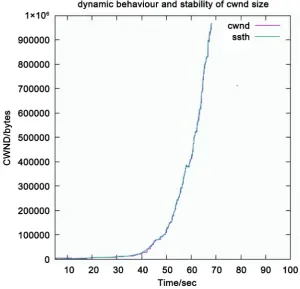
DCM+ is an End-To-End (E2E) approach. For the bandwidth-estimation (BWE), the same algorithm explained in TCP Westwood+ [11] [22] [31] [32] will be used. It describes a sender-side modifications of TCP NewReno protocol in ei-ther phases (SS and CA). DCM+ needs no additional information as it is TCP protocol compliant. Hence, the overhead is equal to the standard TCP protocol header, not more. Depending on the current value of BWE, DCM+ calculates the future values of other parameters like cwnd and ssthresh. The behavior of cwnd is observed to be dynamic, in that it continuously tracks the state of slow-start threshold (ssthresh). If a change (increase or decrease) of ssthresh has been ob-served within a time interval, then DCM+ keeps using the current value of cwnd until a newer ssthresh has been settled. After that, cwnd moves to new value. It remains on the new state of ssthresh for the new time interval until a change of link capacity occurs. This way, cwnd will not exceed the available ssthresh. Hence, congestion events are extremely minimized. Figure 1 depicts the beha-vior of DCM+ for packet-error-rate = 7.5e−3 and for maximum transmission unit (MTU size) = 1200 bytes. The design of DCM+ [14] is similar to NewReno, which is detailed in [10]. DCM+ is built from 4 phases like NewReno (SS, CA, fast retransmission (FR) and fast recovery (FV)). In DCM+, the behaviors in (SS) and (CA) have been so modified to enforce the cwnd to track ssth in the next interval. In addition to cwnd, RTT and RTO have been used as feedback to control the values of ssth and cwnd in the next interval.
DOI: 10.4236/ijcns.2019.128009 116 Int. J. Communications, Network and System Sciences Figure 1. Dynamic behavior of cwnd in DCM+.
old RTT rateCA
RTTnew
= (3.1)
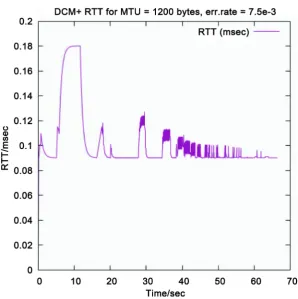
Now, we consider the following two cases: 1) rateCA higher than 1 will be considered as advance or “Link Capacity Increasing”, and 2) values of rateCA lower than 1 as danger or “Link Capacity Decreasing”. Regarding the DCM+ al-gorithm given in [14], if cwnd is less than ssth, then rateCA will be used to start the retransmission in wide steps (increased size of cwnd), otherwise, retransmis-sion goes slowly to prevent any possible congestions. Refer to Figure 2 to see the status of rateCA during the transmission. At each time sample during the transmission, the value of the next RTO is affected by the newly calculated ra-teCA. If the current RTT is decreasing, then RTO shall be also reduced, because no congestion is expected. The following equations describe this behavior:
old old
RTT RTO
rateCA
RTTnew RTOnew
= = (3.2)
Equation (3.2) can be reformulates as:
old RTO RTOnew
rateCA
= (3.3)
DOI: 10.4236/ijcns.2019.128009 117 Int. J. Communications, Network and System Sciences Figure 2. The changing of RTT as indicator of increase/decrease of cwnd.
Our simulations for many cases with different parameters like error rate, data size, MTU size, used TCP protocol, bottleneck bandwidth and access bandwidth show, that next cwnd does not exceed ssth, and hence barely cause new congestion events. We figure out, that cwnd is changing dynamically as a reaction to the changing channel capacity. This can be reflected as a higher improvement of throughput, complete-transmission-time (CTT) and normalized-advancing-index (NAI).
4. Results
Following figures show the measured values of performance metrics using ns-3 simulator for different TCP congestion control protocols (DCM+, NewReno, BIC, Ledbat and Hybla). The simulations are executed for different packet error rates. The simulation environment is ns-3.29 [33] under Ubuntu Linux VM un-der Oracle VirtualBox 5.2.22. The following parameters in Table 1 are constant throughout the tests:
4.1. Throughput
DOI: 10.4236/ijcns.2019.128009 118 Int. J. Communications, Network and System Sciences
4.2. Normalized Advancing Index (NAI)
For the reason of detailed comparison, we introduced a new metric, which we called normalized advancing index (NAI). It is defined as the ratio of throughput divided by the product of lost packets (given in bytes) and error rates. Its unit is (1/second), and should indicate the speed of delivering the complete size of data from one end to the other despite the existence of lost packets at a specific error rate. From Figure 4 we figure out, that DCM+ performs better than all other protocols.
Throughput
ErrorRate Packetslost MTUsize
NAI =
[image:6.595.211.536.259.507.2]∗ ∗ (4.1)
Table 1. Simulation environment’s parameters.
Data size BW Access BW MTU Size Simulation Duration (sec)
[image:6.595.218.531.534.706.2]100 MB 1 Gb/sec 100 Mb/sec 1500 Bytes 5000
Figure 3. Throughput comparison with different TCP Protocols.
DOI: 10.4236/ijcns.2019.128009 119 Int. J. Communications, Network and System Sciences We clearly see that DCM+ has the best results for all used error rates. This re-flects best transmission speed and quality for the used applications.
4.3. Complete Transmission Time (CTT)
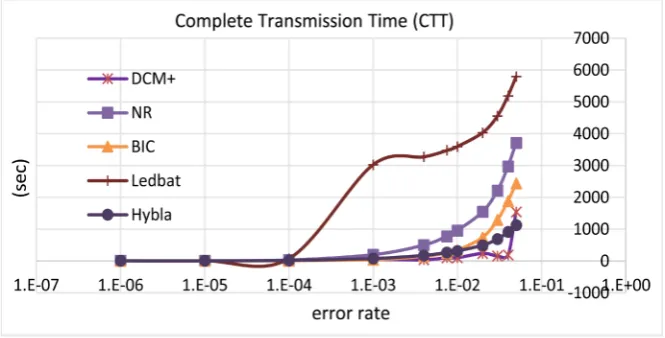
It is a good advantage to finish transmission in short time without causing con-gestions, if possible. This is the case for DCM+ protocol as depicted in Figure 5. It has the lowest (CTT) among all tested protocols, which is defined as the time needed for the last ACK segment to arrive at the sender. Based on that result, TCP applications and devices can extremely speedup data transmission and stop using the link earlier. This results in less power consumption. For the error rate (0.05), only TCP Hybla performs a little better.
5. Assessment of the Results
We have demonstrated, that our proposed approach (DCM+) owns a better be-havior than the other TCP approaches used in this paper. It may change from one case to another, but DCM+ remains faster, provides higher throughput and shows less false drops. The simulations are done for different situations like packet error rates and sizes of the sent packets (MTU).
Following two cases are considered:
Case 1: same error rate, different MTU sizes
In the following we see, that unwanted drops are occurring as a side effect of lowering the MTU size. For example, if MTU = 600 bytes, we have a lower time to finish transmission compared with the case MTU = 1500, but it suffers 3 un-wanted drops. On the other hand, if MTU = 1500 bytes, we have longest time to finish transmission (CTT), but only one unwanted drop. It is also clear, that the performance for MTU = 1200 is the best. It finishes transmission faster and suf-fers no unwanted drops, as shown in Figure 6.
Figure 6 gives a hint, that an additional increase of the performance of DCM+ may be possible if the used MTU size is optimized before the transmission.
[image:7.595.208.541.536.705.2]Case 2: different error rates, same MTU size
DOI: 10.4236/ijcns.2019.128009 120 Int. J. Communications, Network and System Sciences Figure 6. cwnd for different MTU sizes, but same error rate.
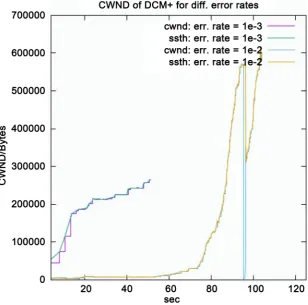
[image:8.595.221.530.403.708.2]DOI: 10.4236/ijcns.2019.128009 121 Int. J. Communications, Network and System Sciences In Figure 7, the size of data to be transmitted is (100 MB), and the used error rates are: (1e−3, 1e−2). We see, that for the error rate = 1e−3, the transmission is much quicker (CTT is reduced by the half), and the throughput is around 200%. Besides, it does not make any false drops.
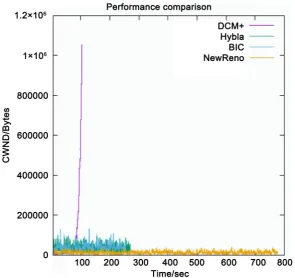
In Figure 8, we present a comparison of different TCP congestion control protocols with MTU = 1500 bytes, and error rate = 0.0075. The advantage of DCM+ over the other protocols is clear. DCM+ shows best performance among all tested approaches. It finishes transmission much faster; it has the highest throughput and it causes no congestions on the transmission link. The figure shows clearly, that the cwnd values are exactly tracking the available bandwidth. This is of great benefit for new devices, that may be currently using the same channel.
6. Conclusion
[image:9.595.226.522.427.705.2]We have presented a protocol, that can be used in wireless, mixed and MANET networks. It is robust and adaptive for all changes in its environment. It has the ability to minimize the average delay and packet loss, but also to improve the throughput and the speed of the transmission even under high error rates. DCM+ is a new approach for managing congestions in mobile and wired net-works. It is designed in similar fashion like TCP NewReno. It is an end-to-end technique, which will be used from the TCP sender to control the sent amount of data on the transmission link. It has a modified behavior in CA phase. It uses the BWE algorithm described in TCP Westwood+ protocol to estimate the available
DOI: 10.4236/ijcns.2019.128009 122 Int. J. Communications, Network and System Sciences channel capacity. Thereafter, it calculates the appropriate value for cwnd de-pending on the feedback signals RTT and RTO, the parameter rateCA, and whether the calculated cwnd is less than ssth or not.
Conflicts of Interest
The authors declare no conflicts of interest regarding the publication of this paper.
References
[1] Jacobson, V. (1988) Congestion Avoidance and Control. ACM SIGCOMM Com-puter Communication Review, 18, 314-329.https://doi.org/10.1145/52325.52356
[2] Tian, Y., Xu, K. and Ansari, N. (2005) TCP in Wireless Environments: Problems and Solutions. IEEE Communications Magazine, 43, S27-S32.
[3] Miller, K. and Hsiao, L. (2016) TCPTuner: Congestion Control Your Way. [4] Arianfar, S. (2012) TCP’s Congestion Control Implementation in Linux Kernel. [5] Sarolahti, P. and Kuznetsov, A. (2002) Congestion Control in Linux TCP.
[6] Microsoft Networking Blog. Category-Ledbat. 2018.
https://blogs.technet.microsoft.com/networking/category/windows-transports/ledbat/
[7] Floyd, S., Henderson, T. and Gurtov, A. (2004) The NewReno Modification to TCP’s Fast Recovery Algorithm. RFC 3782.https://doi.org/10.17487/rfc3782
[8] Henderson, T., Floyd, S., Gurtov, A. and Nishida, Y. (2012) The NewReno Modifi-cation to TCP’s Fast Recovery Algorithm, RFC 6582.
https://doi.org/10.17487/rfc6582
[9] Eckberg, A.E. and Luan, D.T. (1989) Meeting the Challenge: Congestion and Flow Control Strategies for Broadband Information Transport. 1989 IEEE Global Tele-communications Conference and Exhibition “Communications Technology for the
1990s and Beyond”,Dallas, TX, 27-30 November 1989,1769-1773.
[10] Yaghmaee, M.H., Fatemipour, F., Bahekmat, M. and Barasani, A. (2015) A New Fuzzy Logic Approach for TCP Congestion Control.
[11] Grieco, L. and Mascolo, S. (2004) Performance Evaluation and Comparison of Westwood+, New Reno, and Vegas. ACM SIGCOMM Computer Communication Review, 34, 25-38.https://doi.org/10.1145/997150.997155
[12] Patel, K. and Rathod, J. (2013) A Survey on Effectiveness of TCP Westwood in Mixed Wired and Wireless Networks.International Journal of Scientific and Engi-neering Research, 4, 197-205.
[13] Tan, K., Jiang, F and Zhang, Q. (2007) Congestion Control in Multihop Wireless Networks. IEEE Transactions on Vehicular Technology, 56, 863-873.
https://doi.org/10.1109/TVT.2007.891405
[14] Hamamreh, R. and Khader, D. (2019) DCM+: A Multi-Purpose Protocol for Con-gestion Control. 2019 IEEE 7th Palestinian International Conference on Electrical and Computer Engineering (PICECE),Gaza, Palestine, 26-27 March 2019, 1-7.
https://doi.org/10.1109/PICECE.2019.8747237
[15] Yang, C.-Q. and Reddy, A.V.S. (1995) A Taxonomy for Congestion Control Algo-rithms in Packet Switching Networks. IEEE Network, 9, 34-45.
https://doi.org/10.1109/65.397042
DOI: 10.4236/ijcns.2019.128009 123 Int. J. Communications, Network and System Sciences [17] May, M., Bolot, J., Diot, C. and Lyles, B. (1999) Reasons Not to Deploy RED. 1999
Seventh International Workshop on Quality of Service,London, UK, 31 May-4 June 1999, 260-262.
[18] Torres, R., Border, J., Choquette, G., Xu, J. and Jong, J.-H. (2012) Congestion Con-trol Using RED and TCP Window Adjustment. MILCOM 2012-2012 IEEE Military Communications Conference,Orlando, FL, 29 October-1 November 2012, 1-6.
https://doi.org/10.1109/MILCOM.2012.6415799
[19] Floyd, S. and Jacobson, V. (1993) Random Early Detection Gateways for Congestion Avoidance. IEEE/ACM Transactions on Networking, 1, 397-413.
https://doi.org/10.1109/90.251892
[20] Olsen, J. (2004) On Packet Loss Rates for TCP Network Modeling.
[21] Parsa, C. and Garcia-Luna-Aceves, J.J. (2000) Differentiating Congestion vs. Ran-dom Loss: A Method for Improving TCP Performance over Wireless Links. 2000
IEEE Wireless Communications and Networking Conference, Chicago, IL, 23-28 September 2000, 90-93.
[22] Mascolo, S. (2005) Testing TCP Westwood+ over Transatlantic Links at 10 Giga-bit/Second Rate.
[23] Allman, M., Paxson, V. and Blanton, E. (2009) TCP Congestion Control. RFC 5681.
https://doi.org/10.17487/rfc5681
[24] Elaarag, H. and Wozniak, M. (2010) Using Fuzzy Inference to Improve TCP Con-gestion Control over Wireless Networks. BSc. Thesis, Stetson University DeLand, Florida.
[25] Hadi Hosseini, S.M. and Araabi, B.N. (2009) A Neuro-Fuzzy Control for TCP Net-work Congestion. In: Mehnen, J., Köppen, M., Saad, A. and Tiwari, A., Eds., Appli-cations of Soft Computing. Advances in Intelligent and Soft Computing, Vol. 58, Springer, Berlin, Heidelberg, 93-101. https://doi.org/10.1007/978-3-540-89619-7_10
[26] El Khayat, I., Geurts, P. and Leduc, G. (2004) Enhancement of TCP over Wired/Wireless Networks with Packet Loss Classifiers Inferred by Supervised Learning. Tech. Re-port, Montefiore Inst., Belgium.
[27] Geurts, P., El Khayat, I. and Leduc, G. (2005) A Machine Learning Approach to Improve Congestion Control over Wireless Computer Networks. University of Liège, Belgium.
[28] Shajahan and Alavandar, S. (2015) ANN Based Intelligent Congestion Controller for High Speed Computer Networks. Journal of Electrical Engineering.
[29] Niu, L. (2015) Applying the Linear Neural Network to TCP Congestion Control. 5th International Conference on Advanced Design and Manufacturing Engineering. [30] Yang, P., Shao, J., Luo, W., Xu, L., Deogun, J.S. and Lu, Y. (2014) TCP Congestion
Avoidance Algorithm Identification. IEEE/ACM Transactions on Networking, 22, 1311-1324. https://doi.org/10.1109/TNET.2013.2278271
[31] Dell’Aera, A., Grieco, L.A. and Mascolo, S. (2004) Linux 2.4 Implementation of Westwood+ TCP with Rate-Halving: A Performance Evaluation over the Internet. 2004 IEEE International Conference on Communications, Paris,20-24 June 2004, 2092-2096.https://doi.org/10.1109/ICC.2004.1312887
[32] Mascolo, S., Grieco, L.A., Ferorelli, R., Camarda, P. and Piscitelli, G. (2004) Perfor-mance Evaluation of Westwood+ TCP Congestion Control. Performance Evalua-tion, 55, 93-111.